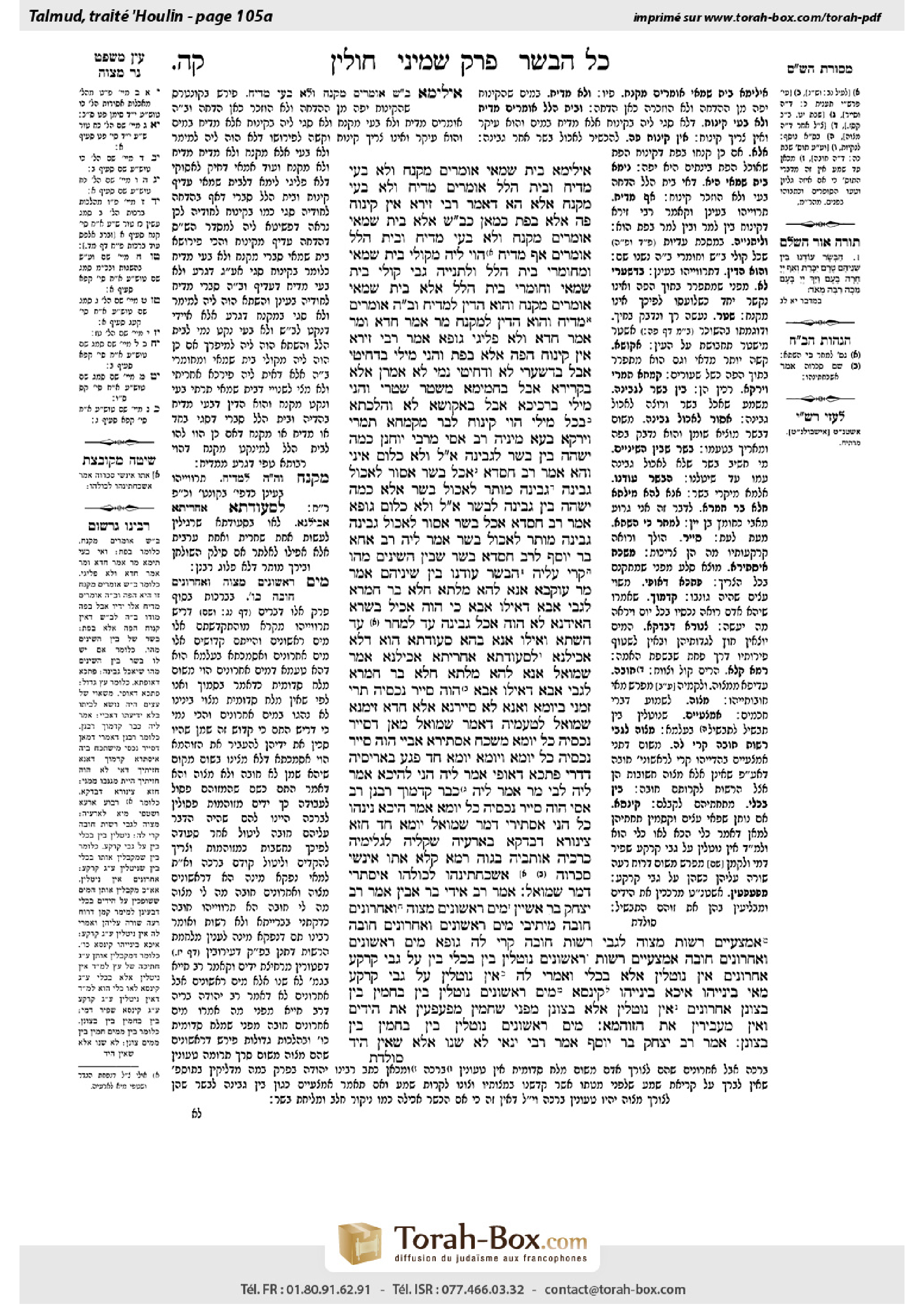
Chullin 105a: Talmud study for Daf Yomi
Study the Talmud for Daf Yomi with scanned pages, Hebrew text, English translations from Sefaria and AI-generated French translations.
Passage selection and English or AI-generated French translation are available where the scan has annotations. Daf Study is independent of Torah-Box and Sefaria.
Browse Chullin · חולין · All tractatesChullin 105a text and translations
This page of Chullin includes the Aramaic text, an English translation and an AI-generated French translation, alongside the scan above.
חולין ק״ה א · Aramaic and Hebrew text
אִילֵּימָא בֵּית שַׁמַּאי אוֹמְרִים: מְקַנֵּחַ וְלָא בָּעֵי מֵדִיחַ, וּבֵית הִלֵּל אוֹמְרִים: מֵדִיחַ וְלָא בָּעֵי מְקַנֵּחַ. אֶלָּא הָא דְּאָמַר רַבִּי זֵירָא: אֵין קִינּוּחַ פֶּה אֶלָּא בְּפַת, כְּמַאן? כְּבֵית שַׁמַּאי!
אֶלָּא, בֵּית שַׁמַּאי אוֹמְרִים: מְקַנֵּחַ וְלָא בָּעֵי מֵדִיחַ, וּבֵית הִלֵּל אוֹמְרִים: אַף מֵדִיחַ. הָוֵי לֵיהּ מִקּוּלֵּי בֵּית שַׁמַּאי וּמֵחוּמְרֵי בֵּית הִלֵּל, וְלִתְנְיַיהּ גַּבֵּי קוּלֵּי בֵּית שַׁמַּאי וְחוּמְרֵי בֵּית הִלֵּל!
אֶלָּא, בֵּית שַׁמַּאי אוֹמְרִים: מְקַנֵּחַ, וְהוּא הַדִּין לְמֵדִיחַ, וּבֵית הִלֵּל אוֹמְרִים: מֵדִיחַ, וְהוּא הַדִּין לִמְקַנֵּחַ. מָר אָמַר חֲדָא, וּמָר אָמַר חֲדָא, וְלָא פְּלִיגִי.
גּוּפָא, אָמַר רַבִּי זֵירָא: אֵין קִינּוּחַ הַפֶּה אֶלָּא בְּפַת. וְהָנֵי מִילֵּי בִּדְחִיטֵּי, אֲבָל בְּדִשְׂעָרֵי – לָא.
וּדְחִיטֵּי נָמֵי לָא אֲמַרַן, אֶלָּא בִּקְרִירָא, אֲבָל בְּחַמִּימָא – מִשְׁטָר שָׁטְרִי. וְהָנֵי מִילֵּי בְּרַכִּיכָא, אֲבָל בְּאַקּוֹשָׁא – לָא. וְהִלְכְתָא בְּכֹל מִילֵּי הָוֵי קִינּוּחַ, לְבַר מִקִּמְחָא, תַּמְרֵי וְיַרְקָא.
בְּעָא מִינֵּיהּ רַב אַסִּי מֵרַבִּי יוֹחָנָן: כַּמָּה יִשְׁהֶה בֵּין בָּשָׂר לִגְבִינָה? אָמַר לוֹ: וְלֹא כְּלוּם. אִינִי? וְהָא אָמַר רַב חִסְדָּא: אָכַל בָּשָׂר – אָסוּר לֶאֱכוֹל גְּבִינָה, גְּבִינָה – מוּתָּר לֶאֱכוֹל בָּשָׂר! אֶלָּא כַּמָּה יִשְׁהֶה בֵּין גְּבִינָה לְבָשָׂר? אֲמַר לֵיהּ: וְלֹא כְּלוּם.
גּוּפָא, אָמַר רַב חִסְדָּא: אָכַל בָּשָׂר – אָסוּר לֶאֱכוֹל גְּבִינָה, גְּבִינָה – מוּתָּר לֶאֱכוֹל בָּשָׂר. אֲמַר לֵיהּ רַב אַחָא בַּר יוֹסֵף לְרַב חִסְדָּא: בָּשָׂר שֶׁבֵּין הַשִּׁינַּיִם מַהוּ?
קָרֵי עֲלֵיהּ ״הַבָּשָׂר עוֹדֶנּוּ בֵּין שִׁנֵּיהֶם״.
אָמַר מָר עוּקְבָא: אֲנָא, לְהָא מִלְּתָא, חַלָּא בַּר חַמְרָא לְגַבֵּי אַבָּא, דְּאִילּוּ אַבָּא כִּי הֲוָה אָכֵיל בִּשְׂרָא הָאִידָּנָא, לָא הֲוָה אָכֵל גְּבִינָה עַד לִמְחַר עַד הַשְׁתָּא, וְאִילּוּ אֲנָא – בְּהָא סְעוֹדְתָּא הוּא דְּלָא אָכֵילְנָא, לִסְעוֹדְתָּא אַחְרִיתָא – אָכֵילְנָא.
אָמַר שְׁמוּאֵל: אֲנָא, לְהָא מִלְּתָא, חַלָּא בַּר חַמְרָא לְגַבֵּי אַבָּא, דְּאִילּוּ אַבָּא הֲוָה סָיַיר נִכְסֵיהּ תְּרֵי זִמְנֵי בְּיוֹמָא, וַאֲנָא לָא סָיַירְנָא אֶלָּא חֲדָא זִימְנָא. שְׁמוּאֵל לְטַעְמֵיהּ, דְּאָמַר שְׁמוּאֵל: מַאן דְּסָיַיר נִכְסֵיהּ כֹּל יוֹמָא מַשְׁכַּח אִסְתֵּירָא.
אַבָּיֵי הֲוָה סָיַיר נִכְסֵיהּ כֹּל יוֹמָא וְיוֹמָא. יוֹמָא חַד פְּגַע בַּאֲרִיסֵיהּ דְּדָרֵי פִּתְכָּא דְּאוּפֵי. אֲמַר לֵיהּ: הָנֵי לְהֵיכָא? אֲמַר לֵיהּ: לְבֵי מָר. אֲמַר לֵיהּ: כְּבָר קַדְמוּךְ רַבָּנַן.
רַב אַסִּי הֲוָה סָיַיר נִכְסֵיהּ כֹּל יוֹמָא, אָמַר: הֵיכָא נִינְהוּ כֹּל הָנֵי אִסְתִּירֵי דְּמָר שְׁמוּאֵל? יוֹמָא חַד חֲזָא צִינּוֹרָא דְּבִדְקָא בְּאַרְעֵיהּ, שַׁקְלֵיהּ לִגְלִימֵיהּ, כַּרְכֵיהּ אוֹתְבֵיהּ בְּגַוַּהּ, רְמָא קָלָא, אֲתוֹ אִינָשֵׁי סַכְרוּהּ, [אֲמַר]: אַשְׁכַּחְתִּינְהוּ לְכוּלְּהוּ אִיסְתֵּרֵי דְּמָר שְׁמוּאֵל.
אָמַר רַב אִידִי בַּר אָבִין, אָמַר רַב יִצְחָק בַּר אַשְׁיָין: מַיִם רִאשׁוֹנִים מִצְוָה, וְאַחֲרוֹנִים חוֹבָה.
מֵיתִיבִי: מַיִם רִאשׁוֹנִים וְאַחֲרוֹנִים חוֹבָה, אֶמְצָעִיִּים רְשׁוּת. מִצְוָה לְגַבֵּי רְשׁוּת – חוֹבָה קָרֵי לַהּ.
גּוּפָא: מַיִם רִאשׁוֹנִים וְאַחֲרוֹנִים – חוֹבָה, אֶמְצָעִיִּים – רְשׁוּת. רִאשׁוֹנִים – נוֹטְלִין בֵּין בִּכְלִי בֵּין עַל גַּבֵּי קַרְקַע, אַחֲרוֹנִים – אֵין נוֹטְלִין אֶלָּא בִּכְלִי, וְאָמְרִי לָהּ: אֵין נוֹטְלִין עַל גַּבֵּי קַרְקַע.
מַאי בֵּינַיְיהוּ? אִיכָּא בֵּינַיְיהוּ קִינְסָא.
מַיִם רִאשׁוֹנִים נוֹטְלִין בֵּין בְּחַמִּין בֵּין בְּצוֹנֵן, אַחֲרוֹנִים אֵין נוֹטְלִין אֶלָּא בְּצוֹנֵן, מִפְּנֵי שֶׁחַמִּין מְפַעְפְּעִין אֶת הַיָּדַיִם וְאֵין מַעֲבִירִין אֶת הַזּוּהֲמָא. מַיִם רִאשׁוֹנִים נוֹטְלִין בֵּין בְּחַמִּין בֵּין בְּצוֹנֵן, אָמַר רַב יִצְחָק בַּר יוֹסֵף אָמַר רַבִּי יַנַּאי: לֹא שָׁנוּ אֶלָּא שֶׁאֵין הַיָּד
Chullin 105a · English translation
If we say that Beit Shammai say that one wipes out his mouth with solid food and does not need to rinse his mouth with water, since they maintain that wiping is more effective than rinsing, and Beit Hillel say that he rinses his mouth in water and does not need to wipe his mouth, as rinsing is more effective, one can respond: But as for that which Rabbi Zeira said: Wiping of the mouth can be performed only with bread, in accordance with whose opinion is it? It is apparently in accordance with the opinion of Beit Shammai, since Beit Hillel do not require wiping. Yet, it is unlikely that Rabbi Zeira would rule in accordance with the opinion of Beit Shammai rather than Beit Hillel.
Rather, one must explain the dispute as follows: Beit Shammai say that one wipes his mouth after eating meat and does not need to rinse his mouth as well, and Beit Hillel say that in addition to wiping one must also rinse. This interpretation is difficult as well, since if so, this constitutes one of the disputes between them that involve leniencies of Beit Shammai and stringencies of Beit Hillel, and consequently, let the tanna of tractate Eduyyot teach it alongside the other disputes listed there that involve leniencies of Beit Shammai and stringencies of Beit Hillel.
Rather, one must interpret their statements as follows: Beit Shammai say that one wipes his mouth after eating meat, and the same is true of rinsing, i.e., one must rinse his mouth as well. And Beit Hillel say that one rinses his mouth, and the same is true of wiping. And one Sage said one statement and one Sage said another statement, and they do not disagree.
§ After citing Rabbi Zeira’s statement tangentially, the Gemara discusses the matter itself. Rabbi Zeira says: Wiping of the mouth can be performed only with bread. The Gemara explains: And this statement applies only to bread prepared from wheat flour. But with regard to bread prepared from barley flour, one may not use it for wiping, as barley bread crumbles in the mouth and does not wipe thoroughly.
The Gemara adds: And even in the case of bread prepared from wheat flour, we said the halakha only with regard to cold bread, but as for warm bread, it is ineffective for wiping even if made of wheat, as it softens and sticks to the palate, and it does not wipe the mouth properly. And furthermore, even if the bread is cold, this statement applies only with regard to soft bread, but one may not wipe with hard bread, as it also does not clean effectively. The Gemara concludes: And the halakha is that the use of all items constitutes effective wiping, except for flour, dates, and vegetables.
§ Rav Asi posed a dilemma to Rabbi Yoḥanan: How much time should one wait between eating meat and eating cheese? Rabbi Yoḥanan said to him: No time at all. The Gemara asks: Is that so? But doesn’t Rav Ḥisda say: If one ate meat, it is prohibited for him to eat cheese immediately, but if he ate cheese it is permitted for him to eat meat without delay? Rather, Rav Asi actually asked Rabbi Yoḥanan the following question: How much time should one wait between eating cheese and eating meat? In response to this question, Rabbi Yoḥanan said to him: No time at all.
After tangentially citing a statement of Rav Ḥisda, the Gemara discusses the matter itself. Rav Ḥisda says: If one ate meat, it is prohibited for him to eat cheese immediately, as the meat contains fatty substances that stick to one’s mouth and preserve the flavor of meat. But if he ate cheese it is permitted for him to eat meat without delay. Rav Aḥa bar Yosef said to Rav Ḥisda: In the case of meat that is between the teeth, what is the halakha? Are these remnants considered meat to the extent that one may not eat cheese as long as they are in his mouth?
In response, Rav Ḥisda read about him the following verse: “While the meat was yet between their teeth” (Numbers 11:33). This verse indicates that even when the meat is between one’s teeth it is still considered meat, and therefore one may not partake of cheese until that meat has been removed.
Mar Ukva said: I am, with regard to this matter, like vinegar, son of wine, with respect to Father, i.e., my practice is inferior to that of my father. As Father, if he were to eat meat at this time, would not eat cheese until tomorrow at this time. But as for me, only at this meal, during which I ate meat, do I not eat cheese; at a different meal on the same day I will eat cheese.
Similarly, Shmuel said: I am, with regard to this other matter, like vinegar, son of wine, with respect to Father. As Father would patrol his property to examine it twice daily, but I patrol it only once a day. The Gemara notes: In this regard Shmuel conforms to his line of reasoning, as Shmuel said: One who patrols his property every day will find an asteira coin.
The Gemara relates that Abaye would patrol his property each and every day. One day he encountered his sharecropper carrying a load of wood that the sharecropper intended to take for himself. Abaye said to him: To where are you taking these logs of wood? The sharecropper said to him: To the Master’s house. Abaye, who knew that the sharecropper had intended to take the wood for himself, said to him: The Sages already preempted you when they said that one should patrol his property regularly, and they thereby prevented you from stealing the wood.
The Gemara likewise relates that Rav Asi would patrol his property every day. He said: Where are all these asteira coins mentioned by Mar Shmuel? This patrol is not reaping me any benefit. One day he saw a water channel that overflowed, causing water to flood onto his land. He took off his cloak, wrapped it, and placed it inside the pipe to block the flow of water. He then raised his voice, and people came and sealed the hole. He said: I have just found all the asteira coins mentioned by Mar Shmuel, as I would have suffered a great loss had I not patrolled my fields.
§ Having mentioned the manner of washing hands during a meal, the Gemara discusses another matter concerning washing hands. Rav Idi bar Avin says that Rav Yitzḥak bar Ashyan says: The first waters, i.e., washing of the hands before eating bread, are a mitzva by rabbinic law, but the final waters, washing of the hands upon conclusion of the meal and before reciting Grace after Meals, are an obligation, a more stringent requirement.
The Gemara raises an objection to this ruling from a baraita: The first waters and the final waters are an obligation, whereas the middle waters, between courses during the meal, are optional. Apparently, the first waters are also an obligation, not a mitzva. The Gemara responds: Although the first waters are in fact a mitzva, the tanna calls a mitzva an obligation when compared to an optional requirement.
The Gemara analyzes the matter itself. The full text of the baraita is as follows: First waters and final waters are an obligation, whereas middle waters are optional. For first waters, one may wash either by spilling the water into a vessel or onto the ground. But for final waters, one washes only by pouring the water into a vessel. And some say a slightly different version of the baraita: For final waters, one may not wash by pouring the water onto the ground.
The Gemara interjects: What is the difference between these two versions? The Gemara answers: There is a practical difference between them with regard to pouring the water on thin wood slivers on the ground. According to the first version, which requires that the water be poured into a vessel, one may not use such slivers for this purpose, whereas according to the second version, which merely prohibits pouring the water onto the ground, one may use wood slivers.
The baraita continues: With regard to first waters, one may wash either with hot water or with cold water. But for final waters, one may wash only with cold water, because hot water softens the hands and does not remove the dirt from them. The Gemara analyzes the statement that for first waters one may wash either with hot water or with cold water: Rav Yitzḥak bar Yosef says that Rabbi Yannai says: They taught this halakha only in a case where the hand does not
Chullin 105a · Traduction française (IA)
Si l'on dit que Beit Shammai affirme qu'on peut essuyer sa bouche avec de la nourriture solide et qu'il n'est pas nécessaire de rincer sa bouche avec de l'eau, car ils considèrent que l'essuyage est plus efficace que le rincage, et Beit Hillel affirme qu'on doit rincer sa bouche avec de l'eau et qu'il n'est pas nécessaire d'essuyer sa bouche, car le rincage est plus efficace, on peut répondre : Mais concernant ce que Rabbi Zeira a dit : L'essuyage de la bouche peut être effectué uniquement avec du pain, selon quel avis s'agit-il ? Il semble s'agir de l'avis de Beit Shammai, car Beit Hillel n'exige pas l'essuyage. Cependant, il est peu probable que Rabbi Zeira ait décidé en faveur de l'avis de Beit Shammai plutôt que celui de Beit Hillel.
Plutôt, il faut interpréter le débat comme suit : Beit Shammai affirme qu'on doit essuyer sa bouche après avoir mangé de la viande et qu'il n'est pas nécessaire de rincer sa bouche, et Beit Hillel affirme qu'en plus d'essuyer, on doit aussi rincer. Cette interprétation est difficile également, car si c'est ainsi, cela constitue l'un des débats entre eux qui implique des leniencies de Beit Shammai et des stringences de Beit Hillel, et par conséquent, il faut que le tanna du traité Eduyyot l'enseigne en même temps que les autres débats mentionnés là qui impliquent des leniencies de Beit Shammai et des stringences de Beit Hillel.
Plutôt, il faut interpréter leurs déclarations comme suit : Beit Shammai affirme qu'on doit essuyer sa bouche après avoir mangé de la viande, et c'est pareil pour le rincage, c'est-à-dire qu'on doit rincer sa bouche également. Et Beit Hillel affirme qu'on doit rincer sa bouche, et c'est pareil pour l'essuyage. Et un Sage a dit une déclaration et un autre Sage une autre déclaration, et ils ne s'opposent pas.
§ Après avoir évoqué tangiquement la déclaration de Rabbi Zeira, le Guemara discute la question elle-même. Rabbi Zeira dit : L'essuyage de la bouche peut être effectué uniquement avec du pain. Le Guemara explique : Et cette déclaration s'applique uniquement au pain préparé à partir de farine de blé. Mais concernant le pain préparé à partir de farine de seigle, on ne peut pas l'utiliser pour l'essuyage, car le pain de seigle se désintègre dans la bouche et ne nettoie pas efficacement.
Le Guemara ajoute : Et même dans le cas du pain préparé à partir de farine de blé, nous avons dit la halakha uniquement concernant le pain froid, mais concernant le pain chaud, il est inefficace pour l'essuyage même s'il est fait de blé, car il se ramollit et collerait à la langue, et ne nettoierait pas efficacement la bouche. Et de plus, même si le pain est froid, cette déclaration s'applique uniquement concernant le pain mou, mais on ne peut pas utiliser le pain dur pour l'essuyage, car il ne nettoie pas efficacement non plus. Le Guemara conclut : Et la halakha est que l'utilisation de tous les objets constitue un essuyage efficace, sauf pour la farine, les dattes et les légumes.
§ Rav Asi a posé un dilemme à Rabbi Yoḥanan : Combien de temps doit-on attendre entre la consommation de viande et de fromage ? Rabbi Yoḥanan a répondu à lui : Aucun temps. Le Guemara demande : Est-ce ainsi ? Mais ne dit-il pas Rav Ḥisda : Si l'on a mangé de la viande, il est interdit de manger de fromage immédiatement, mais si l'on a mangé de fromage, il est permis de manger de la viande sans délai ? Plutôt, Rav Asi a réellement posé à Rabbi Yoḥanan la question suivante : Combien de temps doit-on attendre entre la consommation de fromage et de viande ? En réponse à cette question, Rabbi Yoḥanan a répondu à lui : Aucun temps.
Après avoir évoqué tangamment une déclaration de Rav Ḥisda, le Guemara discute la question elle-même. Rav Ḥisda dit : Si l'on a mangé de la viande, il est interdit de manger de fromage immédiatement, car la viande contient des substances grasses qui collent à la bouche et préservent le goût de la viande. Mais si l'on a mangé de fromage, il est permis de manger de la viande sans délai. Rav Aḥa bar Yosef a dit à Rav Ḥisda : Dans le cas de viande entre les dents, quelle est la halakha ? Ces restes sont-ils considérés comme de la viande à tel point qu'on ne peut pas manger de fromage tant qu'ils sont dans la bouche ?
En réponse, Rav Ḥisda a cité le verset suivant : « Tandis que la viande était encore entre leurs dents » (Nombres 11:33). Ce verset indique que même lorsque la viande est entre les dents d'une personne, elle est encore considérée comme de la viande, et par conséquent, on ne peut pas manger de fromage jusqu'à ce que cette viande ait été retirée.
Mar Ukva a dit : Je suis, concernant cette question, comme le vinaigre, fils du vin, par rapport à mon père, c'est-à-dire ma pratique est inférieure à celle de mon père. Comme mon père, s'il mangeait de la viande à ce moment, ne mangerait pas de fromage jusqu'à ce moment demain. Mais concernant moi, seulement pendant ce repas, pendant lequel j'ai mangé de la viande, ne mangerai-je pas de fromage ; à un autre repas le même jour, je mangerai du fromage.
De même, Shmuel a dit : Je suis, concernant cette autre question, comme le vinaigre, fils du vin, par rapport à mon père. Comme mon père inspecterait ses terres pour les examiner deux fois par jour, mais je les inspecte seulement une fois par jour. Le Guemara note : À ce sujet, Shmuel correspond à sa ligne de raisonnement, car Shmuel a dit : Celui qui inspecte ses terres chaque jour trouvera une pièce d'asteira.
Le Guemara rapporte que Abaye inspectait ses terres chaque jour. Un jour, il a rencontré son fermier qui portait un chargement de bois que le fermier avait l'intention de prendre pour lui-même. Abaye a dit au fermier : Où vas-tu avec ces troncs de bois ? Le fermier a répondu à Abaye : Chez le Maître. Abaye, qui savait que le fermier avait l'intention de prendre le bois pour lui-même, a dit au fermier : Les Sages ont déjà anticipé cela lorsqu'ils ont dit qu'on devrait inspecter ses terres régulièrement, et ils ont ainsi empêché que tu volles le bois.
Le Guemara rapporte également que Rav Asi inspectait ses terres chaque jour. Il a dit : Où sont toutes ces pièces d'asteira mentionnées par Mar Shmuel ? Cette inspection ne me rapporte aucun bénéfice. Un jour, il a vu un canal d'eau qui débordait, causant une inondation sur ses terres. Il a enlevé son manteau, l'a enveloppé et l'a placé à l'intérieur du tuyau pour bloquer le débit de l'eau. Il a ensuite levé la voix, et les gens sont venus sceller le trou. Il a dit : J'ai justement trouvé toutes les pièces d'asteira mentionnées par Mar Shmuel, car j'aurais subi une grande perte si je n'avais pas inspecté mes champs.
§ Ayant mentionné la manière de se laver les mains lors d'un repas, la Guemara discute d'une autre question concernant le lavage des mains. Rav Idi bar Avin dit que Rav Yitzḥak bar Ashyan dit : Les premières eaux, c'est-à-dire le lavage des mains avant de manger du pain, sont une mitsva selon la loi rabbinique, mais les eaux finales, le lavage des mains à la fin du repas et avant de réciter la berakha après le repas, sont une obligation, une exigence plus stricte.
La Guemara soulève une objection contre cette décision, tirée d'une baraïta : Les premières eaux et les eaux finales sont une obligation, tandis que les eaux intermédiaires, entre les plats durant le repas, sont optionnelles. Apparemment, les premières eaux sont également une obligation, pas une mitsva. La Guemara répond : Bien que les premières eaux soient effectivement une mitsva, le tanna appelle une mitsva une obligation lorsqu'on la compare à une exigence optionnelle.
La Guemara analyse la question elle-même. Le texte complet de la baraïta est le suivant : Les premières eaux et les eaux finales sont une obligation, tandis que les eaux intermédiaires sont optionnelles. Pour les premières eaux, on peut se laver les mains en versant l'eau dans un récipient ou sur le sol. Mais pour les eaux finales, on se lave uniquement en versant l'eau dans un récipient. Et certains disent une version légèrement différente de la baraïta : Pour les eaux finales, on ne peut pas se laver les mains en versant l'eau sur le sol.
La Guemara intercale : Quelle est la différence entre ces deux versions ? La Guemara répond : Il y a une différence pratique entre elles concernant le versement de l'eau sur des copeaux de bois fins sur le sol. Selon la première version, qui exige que l'eau soit versée dans un récipient, on ne peut pas utiliser ces copeaux à cette fin, tandis que selon la deuxième version, qui interdit simplement de verser l'eau sur le sol, on peut utiliser les copeaux de bois.
La baraïta continue : En ce qui concerne les premières eaux, on peut se laver les mains avec de l'eau chaude ou de l'eau froide. Mais pour les eaux finales, on peut se laver uniquement avec de l'eau froide, car l'eau chaude ramollit les mains et ne retire pas la saleté. La Guemara analyse l'affirmation selon laquelle pour les premières eaux on peut se laver les mains avec de l'eau chaude ou de l'eau froide : Rav Yitzḥak bar Yosef dit que Rabbi Yannai dit : Ils ont enseigné cette halakha uniquement dans un cas où la main ne
Traduction française générée par IA à partir de l’édition anglaise de Sefaria. Vérifie toujours un passage avec le texte source.
Text from Sefaria: William Davidson Edition - Vocalized Aramaic (unknown); William Davidson Edition - English (CC BY NC).