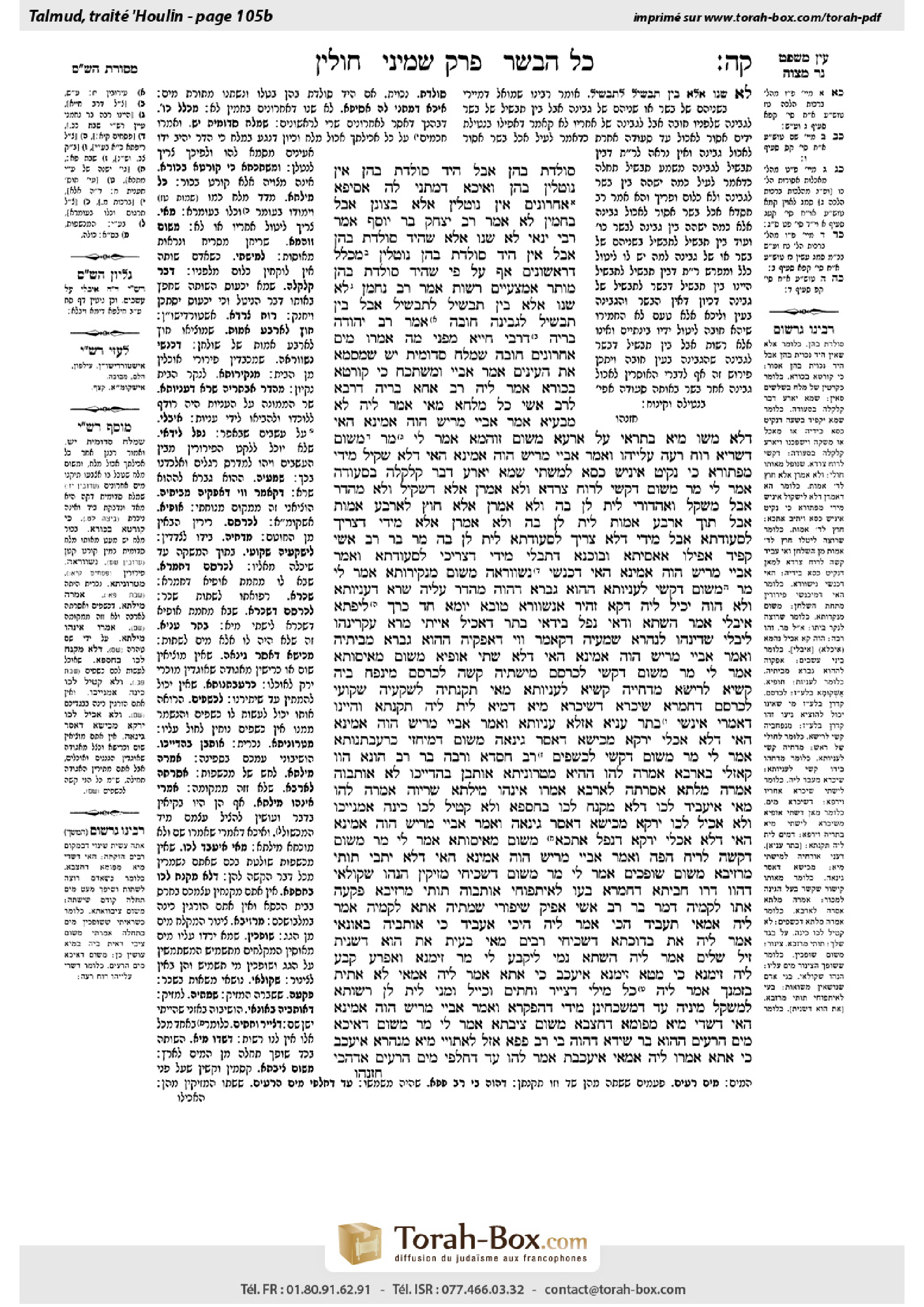
Chullin 105b: Talmud study for Daf Yomi
Study the Talmud for Daf Yomi with scanned pages, Hebrew text, English translations from Sefaria and AI-generated French translations.
Passage selection and English or AI-generated French translation are available where the scan has annotations. Daf Study is independent of Torah-Box and Sefaria.
Browse Chullin · חולין · All tractatesChullin 105b text and translations
This page of Chullin includes the Aramaic text, an English translation and an AI-generated French translation, alongside the scan above.
חולין ק״ה ב · Aramaic and Hebrew text
סוֹלֶדֶת בָּהֶן, אֲבָל הַיָּד סוֹלֶדֶת בָּהֶן אֵין נוֹטְלִין בָּהֶן.
וְאִיכָּא דְּמַתְנֵי לַהּ אַסֵּיפָא, אַחֲרוֹנִים אֵין נוֹטְלִין אֶלָּא בְּצוֹנֵן, אֲבָל בְּחַמִּין – לֹא. אָמַר רַב יִצְחָק בַּר יוֹסֵף אָמַר רַבִּי יַנַּאי: לֹא שָׁנוּ אֶלָּא שֶׁהַיָּד סוֹלֶדֶת בָּהֶן, אֲבָל אֵין הַיָּד סוֹלֶדֶת בָּהֶן – נוֹטְלִין. מִכְּלָל דְּרִאשׁוֹנִים, אַף עַל פִּי שֶׁהַיָּד סוֹלֶדֶת בָּהֶן – מוּתָּר.
אֶמְצָעִיִּים רְשׁוּת. אָמַר רַב נַחְמָן: לֹא שָׁנוּ אֶלָּא בֵּין תַּבְשִׁיל לְתַבְשִׁיל, אֲבָל בֵּין תַּבְשִׁיל לִגְבִינָה – חוֹבָה.
אָמַר רַב יְהוּדָה בְּרֵיהּ דְּרַבִּי חִיָּיא: מִפְּנֵי מָה אָמְרוּ מַיִם אַחֲרוֹנִים חוֹבָה? שֶׁמֶּלַח סְדוֹמִית יֵשׁ, שֶׁמְּסַמֵּא אֶת הָעֵינַיִם. אָמַר אַבָּיֵי: וּמִשְׁתְּכַח כִּי קוּרְטָא בְּכוֹרָא. אֲמַר לֵיהּ רַב אַחָא בְּרֵיהּ דְּרָבָא לְרַב אָשֵׁי: כָּל מִלְחָא מַאי? אֲמַר לֵיהּ: לָא מִבַּעְיָא.
אָמַר אַבָּיֵי: מֵרֵישׁ הֲוָה אָמֵינָא, הַאי דְּלָא מָשׁוּ מַיָּא בָּתְרָאֵי עַל אַרְעָא – מִשּׁוּם זוּהֲמָא. אֲמַר לִי מָר: מִשּׁוּם דְּשָׁרְיָא רוּחַ רָעָה עֲלַיְיהוּ.
וְאָמַר אַבָּיֵי: מֵרֵישׁ הֲוָה אָמֵינָא, הַאי דְּלָא שָׁקֵיל מִידֵּי מִפָּתוּרָא כִּי נָקֵיט אִינִישׁ כָּסָא לְמִשְׁתֵּי, שֶׁמָּא יֶאֱרַע דְּבַר קַלְקָלָה בַּסְּעוּדָה. אֲמַר לִי מָר: מִשּׁוּם דְּקָשֵׁי לְרוּחַ צְרָדָא.
וְלָא אֲמַרַן, אֶלָּא דְּשָׁקֵיל וְלָא מַהְדַּר, אֲבָל מִשְׁקַל וְאַהְדּוֹרֵי – לֵית לַן בַּהּ. וְלָא אֲמַרַן אֶלָּא חוּץ לְאַרְבַּע אַמּוֹת, אֲבָל תּוֹךְ אַרְבַּע אַמּוֹת – לֵית לַן בַּהּ. וְלָא אֲמַרַן אֶלָּא מִידֵּי דִּצְרִיךְ לִסְעוֹדְתָּא, אֲבָל מִידֵּי דְּלָא צְרִיךְ לִסְעוֹדְתָּא – לֵית לַן בַּהּ.
מָר בַּר רַב אָשֵׁי קָפֵיד אֲפִילּוּ אַאֲסִיתָא וּבוּכְנָא דְּתַבְלֵי, מִידֵּי דִּצְרִיכִי לִסְעוּדְתָּא.
וְאָמַר אַבָּיֵי: מֵרֵישׁ הֲוָה אָמֵינָא, הַאי דְּכָנְשִׁי נִשְׁוָורָאָה – מִשּׁוּם מְנַקֵּירוּתָא. אֲמַר לִי מָר: מִשּׁוּם דְּקָשֵׁי לְעַנְיוּתָא.
הָהוּא גַּבְרָא דַּהֲוָה מְהַדַּר עֲלֵיהּ שָׂרָא דְּעַנְיוּתָא, וְלָא הֲוָה יָכֵיל לֵיהּ, דְּקָא זְהִיר אַנִּשְׁוָורָא טוּבָא. יוֹמָא חַד כְּרַךְ לִיפְתָּא אַיַּבְלֵי, אֲמַר: הַשְׁתָּא וַדַּאי נָפֵל בִּידַאי. בָּתַר דְּאָכֵיל, אַיְיתִי מָרָא עַקְרִינְהוּ לְיַבְלֵי, שְׁדִינְהוּ לְנַהֲרָא. שַׁמְעֵיהּ דְּקָאָמַר: וַוי דְּאַפְּקֵיהּ הָהוּא גַּבְרָא מִבֵּיתֵיהּ.
וְאָמַר אַבָּיֵי: מֵרֵישׁ הֲוָה אָמֵינָא, הַאי דְּלָא שָׁתֵי אוּפְיָא – מִשּׁוּם מְאִיסוּתָא. אֲמַר לִי מָר: מִשּׁוּם דְּקָשֵׁי לְכַרְסָם. מִישְׁתְּיֵהּ – קָשֵׁה לְכַרְסָם, מִינְפַּח בֵּיהּ – קַשְׁיָא לְרֵישָׁא, מִדְחֲיֵיהּ – קַשְׁיָא לְעַנְיוּתָא. מַאי תַּקַּנְתֵּיהּ? לְשַׁקְּעֵיהּ שַׁקּוֹעֵי.
לְכַרְסָם דְּחַמְרָא – שִׁיכְרָא, דְּשִׁיכְרָא – מַיָּא, דְּמַיָּא – לֵית לֵיהּ תַּקַּנְתָּא, וְהַיְינוּ דְּאָמְרִי אִינָשֵׁי: בָּתַר עַנְיָא אָזְלָא עַנְיוּתָא.
וְאָמַר אַבָּיֵי: מֵרֵישׁ הֲוָה אָמֵינָא, הַאי דְּלָא אָכְלִי יַרְקָא מִכִּישָׁא דְּאָסַר גִּינָּאָה, מִשּׁוּם דְּמִיחֲזֵי כְּרַעַבְתָנוּתָא. אֲמַר לִי מָר: מִשּׁוּם דְּקָשֵׁי לִכְשָׁפִים.
רַב חִסְדָּא וְרַבָּה בַּר רַב הוּנָא הֲווֹ קָאָזְלִי בְּאַרְבָּא, אֲמַרָה לְהוּ הָהִיא מַטְרוֹנִיתָא: אוֹתְבַן בַּהֲדַיְיכוּ. לָא אוֹתְבוּהָ. אֲמַרָה מִלְּתָא, אֲסַרְתַּהּ לְאַרְבָּא. אֲמַרוּ אִינְהוּ מִילְּתָא, שַׁרְיוּהָ. אֲמַרָה לְהוּ: מַאי אֶיעְבֵּיד לְכוּ, דְּלָא מְקַנַּח לְכוּ בְּחַסְפָּא, וְלָא קְטִיל לְכוּ כִּינָּה אַמָּנַיְיכוּ, וְלָא אֲכִיל לְכוּ יַרְקָא מִכִּישָׁא דְּאָסַר גִּינָּאָה.
וְאָמַר אַבָּיֵי: מֵרֵישׁ הֲוָה אָמֵינָא, הַאי דְּלָא אָכְלִי יַרְקָא דִּנְפַל (אַתַּכָּא) [מִתַּכָּא], מִשּׁוּם מְאִיסוּתָא. אֲמַר לִי מָר: מִשּׁוּם דְּקָשֶׁה לְרֵיחַ הַפֶּה. וְאָמַר אַבָּיֵי: מֵרֵישׁ הֲוָה אָמֵינָא, הַאי דְּלָא יָתְבִי תּוּתֵי מַרְזֵיבָא, מִשּׁוּם שׁוֹפְכִים. אֲמַר לִי מָר: מִשּׁוּם דִּשְׁכִיחִי מַזִּיקִין.
הָנְהוּ שָׁקוֹלָאֵי דַּהֲווֹ דָּרוּ חָבִיתָא דְּחַמְרָא, בְּעוֹ לְאִיתְּפוֹחֵי, אוֹתְבוּהָ תּוּתֵי מַרְזֵיבָא, פְּקַעָה. אֲתוֹ לְקַמֵּיהּ דְּמָר בַּר רַב אָשֵׁי, אַפֵּיק שִׁיפּוּרֵי שַׁמְּתֵיהּ. אֲתָא לְקַמֵּיהּ, אֲמַר לֵיהּ: אַמַּאי תַּעֲבֵיד הָכִי? אֲמַר לֵיהּ: הֵיכִי אֶעֱבֵיד, כִּי אוֹתְבֵיהּ בְּאוּנַּאי?
אֲמַר לֵיהּ: אַתְּ בְּדוּכְתָּא דִּשְׁכִיחִי רַבִּים מַאי בָּעֵית? אַתְּ הוּא דְּשַׁנֵּית, זִיל שַׁלֵּים! אֲמַר לֵיהּ: הַשְׁתָּא נָמֵי לִיקְבַּע לִי מָר זִימְנָא וְאֶפְרַע. קְבַע לֵיהּ זִימְנָא. כִּי מְטָא זִימְנָא, אִיעַכַּב. כִּי אֲתָא, אֲמַר לֵיהּ: אַמַּאי לָא אֲתֵית בְּזִמְנָךְ? אֲמַר לֵיהּ: כֹּל מִילֵּי דִּצְיִיר וַחֲתִים וּכְיִיל וּמְנֵי, לֵית לַן רְשׁוּתָא לְמִשְׁקַל מִינֵּיהּ, עַד דְּמַשְׁכְּחִינַן מִידֵּי דְּהֶפְקֵרָא.
וְאָמַר אַבָּיֵי: מֵרֵישׁ הֲוָה אָמֵינָא, הַאי דְּשָׁדֵי מַיָּא מִפּוּמָּא דְּחַצְבָּא – מִשּׁוּם צִיבְתָּא. אֲמַר לִי מָר: מִשּׁוּם דְּאִיכָּא מַיִם הָרָעִים.
הָהוּא בַּר שֵׁידָא דַּהֲוָה בֵּי רַב פָּפָּא, אֲזַל לְאֵתוֹיֵי מַיָּא מִנַּהֲרָא, אִיעַכַּב. כִּי אֲתָא, אֲמַרוּ לֵיהּ: אַמַּאי אִיעַכַּבְתְּ? אֲמַר לְהוּ: עַד דְּחָלְפִי מַיִם הָרָעִים. אַדְּהָכִי
Chullin 105b · English translation
recoil [soledet] from the water’s heat. But if the hand recoils from it, one may not wash with it.
And there are those who teach a version of this statement with regard to the latter clause of the baraita: For final waters, one may wash only with cold water, but one may not wash with hot water. Rav Yitzḥak bar Yosef says that Rabbi Yannai says: They taught that one may not use hot water only in a case where the water is so hot that the hand recoils from it, but if the hand does not recoil from it, one may wash with it. The Gemara comments: One can learn by inference from this version of the statement that in the case of first waters, even if the water is so hot that the hand recoils from it, it is permitted to use it for washing.
§ The baraita states that middle waters are optional. Rav Naḥman says: They taught this only with regard to washing the hands between one cooked dish and another cooked dish served at a meal. But between a cooked dish and cheese there is an obligation to wash one’s hands.
§ The baraita further teaches that final waters are an obligation. Rav Yehuda, son of Rabbi Ḥiyya, says: For what reason did the Sages say that final waters are an obligation? It is because Sodomite salt is sometimes present, a small amount of which blinds the eyes. Since Sodomite salt could remain on one’s hands, one must wash them after eating. Abaye said: And this type of dangerous salt is present in the proportion of a pinch [korta] in an entire kor of regular salt. Rav Aḥa, son of Rava, said to Rav Ashi: If one measured salt between meals, what is the halakha? Must he wash his hands afterward? He said to him: It is not necessary to say this; he is certainly obligated to do so.
§ Abaye said: At first I would say that this halakha that one may not wash his hands with final waters over the ground is due to messiness. But the Master, Rabba, said to me that it is because an evil spirit rests upon the water and passersby are liable to be afflicted.
And Abaye also said: At first I would say that the reason for this statement of the Sages that one should not take anything from the table when a person is holding a cup to drink, is lest a mishap occur at the meal, i.e., the one holding the cup might have wanted the item that was taken, and since he is unable to speak he will choke in his anger. But the Master subsequently said to me that it is because it is bad for one’s health, causing a spirit of pain in half his head, i.e., a migraine.
And we said that this practice is prohibited only if one takes an item from the table and does not put it back. But as for taking and putting back, we have no problem with it. And likewise, we said it is prohibited only if one takes the item beyond four cubits of the table. But if one leaves it within four cubits, we have no problem with it. And furthermore, we said this halakha only with regard to an item that is necessary for the meal. But in the case of an item that is not necessary for the meal, we have no problem with it.
The Gemara relates that Mar bar Rav Ashi was particular not to remove any object from the table when someone was holding his cup in hand, even with regard to a mortar [asita] and pestle [bukhna] for spices, like all items that are necessary for the meal.
And Abaye further said: At first I would say that this practice that people collect the crumbs of bread after a meal is due to cleanliness. But the Master subsequently said to me that it is because leaving them is bad for, i.e., it can increase, a person’s vulnerability to poverty.
The Gemara relates: There was a certain man who was pursued by the ministering angel of poverty, but the angel was unable to impoverish him, as he was exceptionally careful with regard to crumbs. One day that man broke his bread over grass, and some crumbs fell among the blades of grass. The angel said: Now he will certainly fall into my hands, as he cannot collect all the crumbs. After the man ate, he brought a hoe, uprooted the grass, and threw it into the river. He subsequently heard the ministering angel of poverty say: Woe is me, as that man has removed me from my house, i.e., my position of comfort.
And Abaye said: At first I would say that this practice that people do not drink the foam from the top of a beverage is followed because it is repulsive. But the Master said to me that it is followed because it is bad for one’s vulnerability to catarrh. The Gemara comments: Drinking it is bad for catarrh, while blowing off the foam from the drink is bad for head pains, and removing it with one’s hand is bad for poverty. If so, what is its remedy? How may one drink? He should sink the foam inside the beverage and then drink it.
The Gemara notes: The treatment for catarrh caused by the foam of wine is beer; the treatment for catarrh caused by the foam of beer is water; and for catarrh caused by the foam of water there is no remedy. And this is in accordance with the adage that people say: Poverty follows the poor. Not only does a pauper have nothing to drink other than water, but there also is no treatment for the disease caused by his beverage.
And Abaye said: At first I would say that the reason for this practice that people do not eat vegetables from a bundle tied by the gardener is because it has the appearance of gluttony, as he does not wait to untie the bundle to eat. But the Master said to me that it is because it is bad for one’s vulnerability to witchcraft.
The Gemara relates: Rav Ḥisda and Rabba bar Rav Huna were traveling on a boat. A certain matron said to them: Seat me together with you on the boat, but they did not seat her alongside them. She said something, an incantation, and thereby tied the boat to its spot so that it could not move. They too said something and thereby released it. That matron said to them: What can I do to you? Witchcraft has no power over you, as after attending to your bodily functions, you do not wipe yourselves with an earthenware shard, and you do not kill a louse that you find on your garments, and you do not eat vegetables from a bundle tied by the gardener.
And Abaye said: At first I would say as follows: The reason for this practice that people do not eat vegetables that fell on the table is because it is repulsive. But the Master said to me that it is because it is bad for halitosis. And Abaye said: At first I would say that the reason for this practice that people do not sit under a gutter is because of the waste water that pours out of it. But the Master said to me that it is because demons are commonly found there.
The Gemara relates: There were certain porters who were carrying a barrel of wine. When they wanted to rest, they placed it under a gutter and the barrel burst. They came before Mar bar Rav Ashi, who brought out horns and had them blown as he excommunicated the demon of that place. The demon came before Mar bar Rav Ashi, and the Sage said to it: Why did you do this? The demon said to him: How else should I act, when these men place a barrel on my ear?
Mar bar Rav Ashi said to it: What are you doing in a place where many people are found? You are the one who deviated from the norm; go and pay them the value of the barrel of wine. The demon said to him: Let the Master now set a time for me, so that I can find the money, and I will pay. Mar bar Rav Ashi set a time for his payment. When that time arrived, the demon delayed in coming to pay. When the demon eventually came, Mar bar Rav Ashi said to it: Why did you not come at the time set for you? The demon said to him: With regard to any item that is tied up, or sealed, or measured, or counted, we have no authority to take it. We are unable to obtain money until we find an ownerless item. For this reason, it took him a long time to find enough money to pay for the barrel.
And Abaye said: At first I would say that this practice that people pour out a little water from the mouth of a pitcher before drinking from it is followed because of twigs it might contain. But the Master said to me that it is followed because there are foul waters in the pitcher.
The Gemara relates: There was a certain son of a demon that was in Rav Pappa’s house as a servant. It went to bring water from the river, and it delayed in returning. When it came, the members of Rav Pappa’s household said to it: Why did you delay? It said to them: I waited until the foul waters passed. In the meantime,
Chullin 105b · Traduction française (IA)
On recule du chaud de l'eau. Mais si la main recule d'elle, on ne peut pas la faire passer pour se laver.
Et il y a ceux qui enseignent une version de cette déclaration concernant la dernière partie de la baraïta : Pour les eaux finales, on peut se laver uniquement avec de l'eau froide, mais on ne peut pas se laver avec de l'eau chaude. Rav Yitzḥak bar Yosef dit que Rabbi Yannai dit : Ils enseignent que l'on ne peut utiliser de l'eau chaude qu'en cas où l'eau est si chaude que la main recule d'elle, mais si la main ne recule pas d'elle, on peut la faire passer pour se laver. La Guemara commente : On peut apprendre par déduction de cette version de la déclaration que dans le cas des eaux premières, même si l'eau est si chaude que la main recule d'elle, il est permis d'utiliser cette eau pour se laver.
§ La baraïta stipule que les eaux intermédiaires sont optionnelles. Rav Naḥman dit : Ils ont enseigné cela uniquement concernant le lavage des mains entre un plat cuisiné et un autre plat cuisiné servis lors d'un repas. Mais entre un plat cuisiné et du fromage, il y a une obligation de laver ses mains.
§ La baraïta enseigne de plus que les eaux finales sont une obligation. Rav Yehuda, fils de Rabbi Ḥiyya, dit : Pour quelle raison les Sages ont-ils dit que les eaux finales sont une obligation ? C'est parce que parfois du sel de Sodome est présent, une petite quantité de ce sel aveugle les yeux. Puisque le sel de Sodome pourrait rester sur ses mains, il faut laver ses mains après avoir mangé. Abaye dit : Et ce type de sel dangereux est présent dans la proportion d'une pincée [korta] dans un kor entier de sel ordinaire. Rav Aḥa, fils de Rava, a dit à Rav Ashi : Si l'on mesure le sel entre les repas, quelle est la halakha ? Doit-il laver ses mains après ? Il lui a dit : Il n'est pas nécessaire de dire cela ; il est certainement obligé de le faire.
§ Abaye dit : D'abord, je disais que cette halakha selon laquelle on ne peut pas laver ses mains avec les eaux finales sur le sol est due à la saleté. Mais le Maître, Rabba, a dit à moi que c'est parce qu'un esprit malin repose sur l'eau et les passants sont tenus de souffrir.
§ Abaye a aussi dit : D'abord, je disais que la raison de cette déclaration des Sages selon laquelle on ne doit pas prendre quelque chose de la table quand une personne tient un verre à boire, est pour éviter qu'un malheur survienne lors du repas, c'est-à-dire que celui qui tient le verre pourrait avoir voulu l'objet qui a été pris, et puisqu'il ne peut pas parler, il étoufferait de colère. Mais le Maître a ensuite dit à moi que c'est mauvais pour la santé, causant un esprit de douleur dans la moitié de sa tête, c'est-à-dire une migraine.
Et nous avons dit que cette pratique est interdite uniquement si l'on prend un objet de la table et qu'on ne le remet pas. Mais concernant prendre et remettre, nous n'avons pas de problème. Et de même, nous avons dit qu'il est interdite uniquement si l'on prend l'objet au-delà de quatre cubits de la table. Mais si l'on le laisse à l'intérieur de quatre cubits, nous n'avons pas de problème. Et en outre, nous avons dit que cette halakha est uniquement concernant un objet nécessaire pour le repas. Mais dans le cas d'un objet non nécessaire pour le repas, nous n'avons pas de problème.
La Guemara rapporte que Mar bar Rav Ashi était particulièrement attentif à ne pas retirer aucun objet de la table quand quelqu'un tenait son verre, même concernant un mortier [asita] et un pilon [bukhna] pour les épices, comme tous les objets nécessaires pour le repas.
Et Abaye a aussi dit : D'abord, je disais que cette pratique selon laquelle les gens collectent les miettes de pain après un repas est due à la propreté. Mais le Maître a ensuite dit à moi que c'est parce que laisser ces miettes est mauvais, c'est-à-dire qu'elles peuvent augmenter la vulnérabilité d'une personne à la pauvreté.
La Guemara rapporte : Il y avait un certain homme poursuivi par l'ange ministériel de la pauvreté, mais l'ange n'était pas capable de le rendre pauvre, car il était exceptionnellement prudent concernant les miettes. Un jour, cet homme a cassé son pain sur l'herbe, et certaines miettes sont tombées parmi les herbes. L'ange a dit : Maintenant, il entrera certainement dans mes mains, car il ne peut pas ramasser toutes les miettes. Après avoir mangé, il a pris une houe, a arraché l'herbe et l'a jetée dans le fleuve. Il a ensuite entendu l'ange ministériel de la pauvreté dire : Que m'importe, car cet homme a enlevé de ma maison, c'est-à-dire ma position de confort.
Et Abaye a dit : D'abord, je disais que cette pratique selon laquelle les gens ne boivent pas la mousse sur la surface d'une boisson est suivie parce qu'elle est répugnante. Mais le Maître a dit à moi que c'est suivie parce qu'elle est mauvaise pour la vulnérabilité à la catarrhe. La Guemara commente : Boire cela est mauvais pour la catarrhe, tandis que souffler la mousse de la boisson est mauvais pour les maux de tête, et l'enlever avec la main est mauvais pour la pauvreté. Si c'est ainsi, quelle est la solution ? Comment peut-on boire ? Il devrait faire descendre la mousse dans la boisson et ensuite la boire.
La Guemara note : Le traitement de la catarrhe causée par la mousse du vin est la bière ; le traitement de la catarrhe causée par la mousse de la bière est l'eau ; et pour la catarrhe causée par la mousse de l'eau, il n'y a pas de traitement. Et cela correspond à l'adage que les gens disent : La pauvreté suit le pauvre. Non seulement un pauvre n'a rien d'autre à boire que de l'eau, mais il n'y a aussi aucun traitement pour la maladie causée par son boisson.
Et Abaye a dit : D'abord, je croyais que la raison de cette pratique selon laquelle les gens ne mangent pas les légumes d'un paquet lié par le jardinier est qu'il a l'air de la gourmandise, car on ne fait pas attendre pour délier le paquet pour manger. Mais le Maître m'a dit que c'est parce que cela est mauvais pour la vulnérabilité à la sorcellerie.
La Guemara rapporte : Rav Ḥisda et Rabba bar Rav Huna voyageaient sur un bateau. Une certaine matrone leur dit : Assieds-moi avec vous sur le bateau, mais ils ne l'assirent pas à côté d'eux. Elle dit quelque chose, une incantation, et ainsi attacha le bateau à son lieu de manière qu'il ne puisse plus bouger. Ils dirent aussi quelque chose et ainsi le libérèrent. La matrone leur dit : Que puis-je faire à vous ? La sorcellerie n'a pas de pouvoir sur vous, car après avoir pris soin de vos besoins corporels, vous ne vous nettoyez pas avec un fragment de terre cuite, et vous ne tuez pas une poule que vous trouvez sur vos vêtements, et vous ne mangez pas de légumes provenant d'un paquet lié par le jardinier.
Et Abaye dit : D'abord je disais ainsi : La raison de cette pratique que les gens ne mangent pas les légumes tombés sur la table est qu'ils sont répugnants. Mais le Maître me dit que c'est parce qu'ils sont mauvais pour la halitose. Et Abaye dit : D'abord je disais que la raison de cette pratique que les gens ne s'assoient pas sous une gouttière est à cause de l'eau usée qui en sort. Mais le Maître me dit que c'est à cause des démons qui y sont fréquemment présents.
La Guemara rapporte : Il y avait certains porteurs qui transportaient une barrique de vin. Lorsqu'ils voulaient se reposer, ils la placèrent sous une gouttière et la barrique explosa. Ils se présentèrent devant Mar bar Rav Ashi, qui sortit des trompettes et les fit sonner tout en excommuniant le démon de ce lieu. Le démon vint devant Mar bar Rav Ashi, et le Sage lui dit : Pourquoi as-tu fait cela ? Le démon lui dit : Comment aurais-je dû agir, quand ces hommes placent une barrique sur mon oreille ?
Mar bar Rav Ashi dit à lui : Qu'est-ce que tu fais dans un lieu où beaucoup de gens sont présents ? Tu es celui qui a dévié de la norme ; va et paie à ces gens la valeur de la barrique de vin. Le démon lui dit : Que le Maître fixe maintenant un délai pour que je puisse trouver l'argent, et je paierai. Mar bar Rav Ashi fixa un délai pour son paiement. Lorsque ce délai arriva, le démon retarda à venir payer. Lorsque le démon vint enfin, Mar bar Rav Ashi lui dit : Pourquoi n'es-tu pas venu à l'heure fixée ? Le démon lui dit : Concernant toute chose qui est liée, ou scellée, ou mesurée, ou comptée, nous n'avons pas de pouvoir de la prendre. Nous ne pouvons pas obtenir de l'argent jusqu'à ce que nous trouvions un objet sans propriétaire. Pour cette raison, il lui a fallu un long temps pour trouver assez d'argent pour payer la barrique.
Et Abaye dit : D'abord je disais que cette pratique que les gens versent un peu d'eau du bec d'une cruche avant de boire de celle-ci est suivie à cause des branches qu'elle pourrait contenir. Mais le Maître me dit que c'est à cause des eaux sales dans la cruche.
La Guemara rapporte : Il y avait un certain fils de démon qui était dans la maison de Rav Pappa comme serviteur. Il alla chercher de l'eau du fleuve, et il retarda à revenir. Lorsqu'il revint, les membres de la maison de Rav Pappa lui dirent : Pourquoi as-tu retardé ? Il leur dit : J'ai attendu jusqu'à ce que les eaux sales passent. Pendant ce temps,
Traduction française générée par IA à partir de l’édition anglaise de Sefaria. Vérifie toujours un passage avec le texte source.
Text from Sefaria: William Davidson Edition - Vocalized Aramaic (unknown); William Davidson Edition - English (CC BY NC).