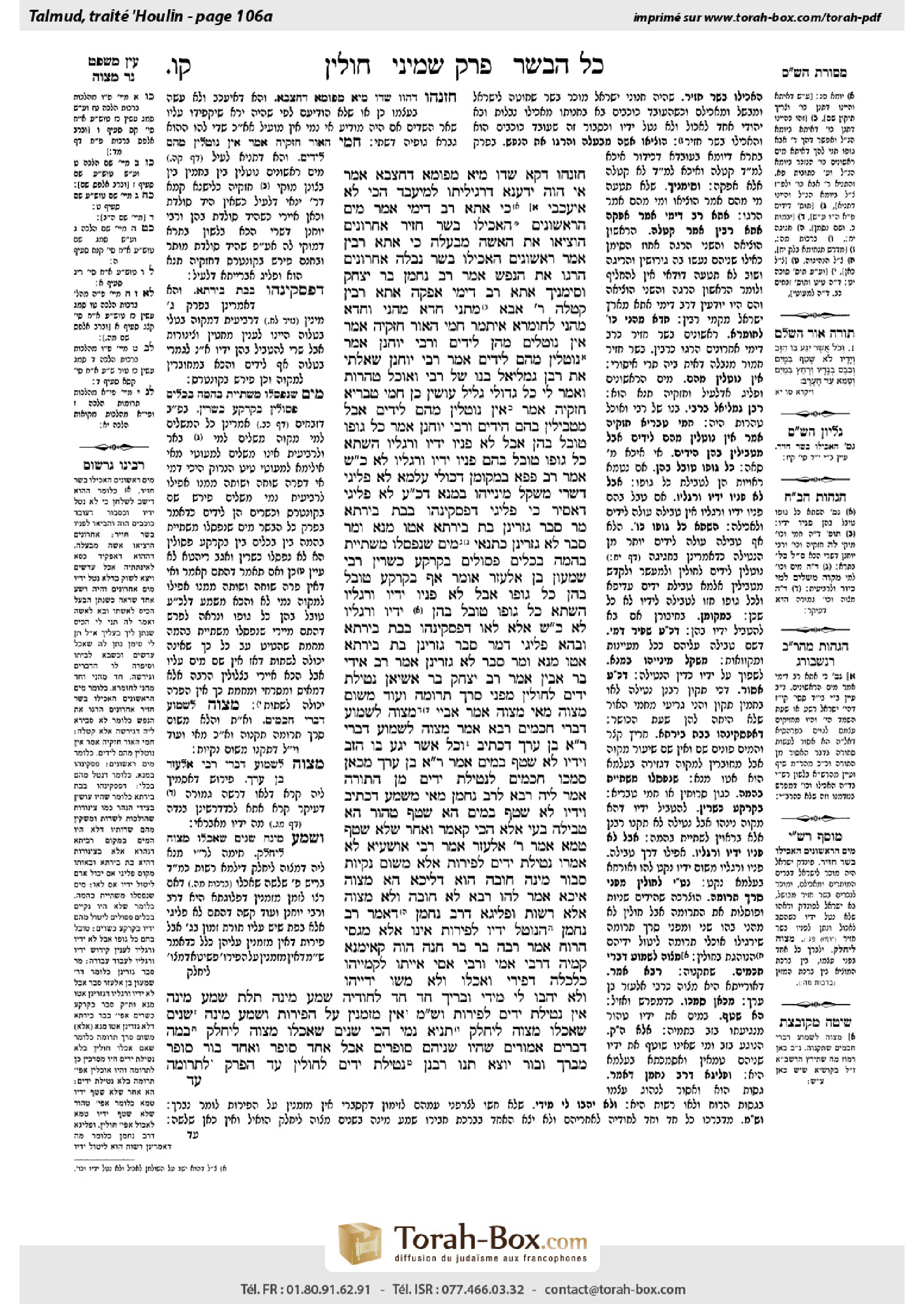
Chullin 106a: Talmud study for Daf Yomi
Study the Talmud for Daf Yomi with scanned pages, Hebrew text, English translations from Sefaria and AI-generated French translations.
Passage selection and English or AI-generated French translation are available where the scan has annotations. Daf Study is independent of Torah-Box and Sefaria.
Browse Chullin · חולין · All tractatesChullin 106a text and translations
This page of Chullin includes the Aramaic text, an English translation and an AI-generated French translation, alongside the scan above.
חולין ק״ו א · Aramaic and Hebrew text
חֲזָנְהוּ דְּקָא שָׁדוּ מַיָּא מִפּוּמָּא דְּחַצְבָּא, אָמַר: אִי הֲוָה יָדַעְנָא דִּרְגִילִיתוּ לְמִיעְבַּד הָכִי, לָא אִיעַכַּבִי.
כִּי אֲתָא רַב דִּימִי אָמַר: מַיִם הָרִאשׁוֹנִים הֶאֱכִילוּ בְּשַׂר חֲזִיר,
אַחֲרוֹנִים הוֹצִיאוּ אֶת הָאִשָּׁה מִבַּעְלָהּ.
כִּי אֲתָא רָבִין אָמַר: רִאשׁוֹנִים הֶאֱכִילוּ בְּשַׂר נְבֵלָה, אַחֲרוֹנִים הָרְגוּ אֶת הַנֶּפֶשׁ. אָמַר רַב נַחְמָן בַּר יִצְחָק: וְסִימָנָיךְ – אֲתָא רַב דִּימִי אַפְּקַהּ, אֲתָא רָבִין קַטְלַהּ.
רַבִּי אַבָּא מַתְנֵי חֲדָא מֵהָנֵי, וַחֲדָא מֵהָנֵי, לְחוּמְרָא.
אִיתְּמַר, חַמֵּי הָאוּר: חִזְקִיָּה אָמַר אֵין נוֹטְלִים מֵהֶן לַיָּדַיִם, וְרַבִּי יוֹחָנָן אָמַר נוֹטְלִין מֵהֶם לַיָּדַיִם. אָמַר רַבִּי יוֹחָנָן: שָׁאַלְתִּי אֶת רַבָּן גַּמְלִיאֵל בְּנוֹ שֶׁל רַבִּי, וְאוֹכֵל טְהָרוֹת, וְאָמַר לִי כׇּל גְּדוֹלֵי גָּלִיל עוֹשִׂין כֵּן.
חַמֵּי טְבֶרְיָא, חִזְקִיָּה אָמַר: אֵין נוֹטְלִין מֵהֶם לַיָּדַיִם, אֲבָל מַטְבִּילִין בָּהֶם הַיָּדַיִם. וְרַבִּי יוֹחָנָן אָמַר: כׇּל גּוּפוֹ טוֹבֵל בָּהֶן, אֲבָל לֹא פָּנָיו יָדָיו וְרַגְלָיו.
הַשְׁתָּא כׇּל גּוּפוֹ טוֹבֵל בָּהֶם, פָּנָיו יָדָיו וְרַגְלָיו לֹא כׇּל שֶׁכֵּן? אָמַר רַב פָּפָּא: בִּמְקוֹמָן – דְּכוּלֵּי עָלְמָא לָא פְּלִיגִי דִּשְׁרֵי, מִשְׁקַל מִינַּיְיהוּ בְּמָנָא – דְּכוּלֵּי עָלְמָא לָא פְּלִיגִי דַּאֲסִיר. כִּי פְּלִיגִי – דְּפַסְקִינְהוּ בְּבַת בִּירְתָּא: מָר סָבַר גָּזְרִינַן בַּת בִּירְתָּא אַטּוּ מָנָא, וּמָר סָבַר לָא גָּזְרִינַן.
כְּתַנָּאֵי: מַיִם שֶׁנִּפְסְלוּ מִשְּׁתִיַּית בְּהֵמָה, בְּכֵלִים – פְּסוּלִים, בַּקַּרְקַע – כְּשֵׁרִין. רַבִּי שִׁמְעוֹן בֶּן אֶלְעָזָר אוֹמֵר: אַף בַּקַּרְקַע, טוֹבֵל בָּהֶן כׇּל גּוּפוֹ, אֲבָל לֹא פָּנָיו יָדָיו וְרַגְלָיו.
הַשְׁתָּא, כׇּל גּוּפוֹ טוֹבֵל בָּהֶן, יָדָיו וְרַגְלָיו לֹא כׇּל שֶׁכֵּן? אֶלָּא לָאו דְּפַסְקִינְהוּ בְּבַת בִּירְתָּא, וּבְהָא פְּלִיגִי: דְּמָר סָבַר גָּזְרִינַן בַּת בִּירְתָּא אַטּוּ מָנָא, וּמָר סָבַר לָא גָּזְרִינַן.
אָמַר רַב אִידִי בַּר אָבִין, אָמַר רַב יִצְחָק בַּר אַשְׁיָאן: נְטִילַת יָדַיִם לְחוּלִּין, מִפְּנֵי סֶרֶךְ תְּרוּמָה.
וְעוֹד מִשּׁוּם מִצְוָה. מַאי מִצְוָה? אֲמַר אַבָּיֵי: מִצְוָה לִשְׁמוֹעַ דִּבְרֵי חֲכָמִים. רָבָא אָמַר: מִצְוָה לִשְׁמוֹעַ דִּבְרֵי רַבִּי אֶלְעָזָר בֶּן עֲרָךְ, דִּכְתִיב: ״וְכֹל אֲשֶׁר יִגַּע בּוֹ הַזָּב וְיָדָיו לֹא שָׁטַף בַּמָּיִם״. אָמַר רַבִּי אֶלְעָזָר בֶּן עֲרָךְ: מִכָּאן סָמְכוּ חֲכָמִים לִנְטִילַת יָדַיִם מִן הַתּוֹרָה.
אֲמַר לֵיהּ רָבָא לְרַב נַחְמָן: מַאי מַשְׁמַע? דִּכְתִיב ״וְיָדָיו לֹא שָׁטַף בְּמַיִם״, הָא שָׁטַף – טָהוֹר? הָא טְבִילָה בָּעֵי! אֶלָּא הָכִי קָאָמַר: וְאַחֵר שֶׁלֹּא שָׁטַף – טָמֵא.
אָמַר רַבִּי אֶלְעָזָר אָמַר רַבִּי אוֹשַׁעְיָא: לֹא אָמְרוּ נְטִילַת יָדַיִם לְפֵירוֹת אֶלָּא מִשּׁוּם נְקִיּוּת. סְבוּר מִינָּה: חוֹבָה הוּא דְּלֵיכָּא, הָא מִצְוָה אִיכָּא. אֲמַר לְהוּ רָבָא: לֹא חוֹבָה וְלֹא מִצְוָה, אֶלָּא רְשׁוּת. וּפְלִיגָא דְּרַב נַחְמָן, דְּאָמַר רַב נַחְמָן: הַנּוֹטֵל יָדָיו לְפֵירוֹת אֵינוֹ אֶלָּא מִגַּסֵּי הָרוּחַ.
אָמַר רַבָּה בַּר בַּר חָנָה: הֲוָה קָאֵימְנָא קַמֵּיהּ דְּרַבִּי אַמֵּי וְרַבִּי אַסִּי, אַיְיתוֹ לְקַמַּיְיהוּ כַּלְכַּלָּה דְּפֵירֵי, וַאֲכַלוּ וְלָא מָשׁוּ יְדַיְיהוּ, וְלָא יְהַבוּ לִי מִידֵּי, וּבָרֵיךְ חַד חַד לְחוֹדֵיהּ. שְׁמַע מִינַּהּ תְּלָת: שְׁמַע מִינַּהּ אֵין נְטִילַת יָדַיִם לְפֵירוֹת, וּשְׁמַע מִינַּהּ אֵין מְזַמְּנִין עַל הַפֵּירוֹת, וּשְׁמַע מִינַּהּ שְׁנַיִם שֶׁאָכְלוּ – מִצְוָה לֵיחָלֵק.
תַּנְיָא נָמֵי הָכִי: שְׁנַיִם שֶׁאָכְלוּ – מִצְוָה לֵיחָלֵק. בַּמֶּה דְּבָרִים אֲמוּרִים? שֶׁהָיוּ שְׁנֵיהֶם סוֹפְרִים, אֲבָל אֶחָד סוֹפֵר וְאֶחָד בּוּר – סוֹפֵר מְבָרֵךְ וּבוּר יוֹצֵא.
תָּנוּ רַבָּנַן: נְטִילַת יָדַיִם לְחוּלִּין – עַד הַפֶּרֶק, לִתְרוּמָה –
Chullin 106a · English translation
the demon saw the members of Rav Pappa’s household pouring water from the mouth of the pitcher before drinking from it. The demon said to them: If I had known that you regularly do this, I would not have delayed. I would have brought the water straight from the river, knowing you would pour out the foul waters.
§ When Rav Dimi came from Eretz Yisrael he said: Due to the failure to wash with the first waters, they ultimately fed a Jew pig meat. This case involved a storekeeper who would sell different meat to his Jewish and gentile customers. When a Jew who came to eat with him neglected to wash before eating, the storekeeper assumed he was a gentile and fed him pig meat.
And due to the failure to wash with final waters a woman was ultimately divorced from her husband. In this incident, a host who had stolen his guests’ money had lentils on his mustache from a previous meal because he had not washed his hands and mouth after eating. Realizing he had eaten lentils that day, his victims approached the man’s wife and said that her husband had instructed them to tell her to return their money. They then claimed that the man told them to tell her that he had eaten lentils that day as proof that they were telling the truth. They thereby fooled his wife into thinking he wanted her to give their money back. Out of anger, the host divorced his wife.
When Ravin came from Eretz Yisrael he said the statement slightly differently: Due to the failure to wash with first waters, they fed a Jew meat from an animal carcass, and the failure to wash with final waters killed a person, as in the second incident the host was so angry with his wife that he killed her. Rav Naḥman bar Yitzḥak said: And your mnemonic to remember which Sage said which version is: Rav Dimi came and divorced her from her husband, i.e., according to his version she was divorced, and Ravin came and killed her, since in his version the husband killed his wife.
Rabbi Abba would teach one of these versions involving first waters and one of them with regard to final waters, and in both cases he taught the more severe version, i.e., he specified the meat of a pig and that the husband killed his wife.
A disagreement was stated with regard to water heated by fire: Ḥizkiyya says that one may not wash his hands with such water, and Rabbi Yoḥanan says that one may wash his hands with it. Rabbi Yoḥanan said: I asked Rabban Gamliel, son of Rabbi Yehuda HaNasi, about this halakha, and he was one who would eat only in a state of ritual purity and was therefore careful about washing his hands; and he said to me that all the great men of the Galilee would do so, i.e., wash their hands in heated water.
Likewise, with regard to the hot springs of Tiberias, Ḥizkiyya says that one may not wash his hands with water from them before eating, but if there are forty se’a, the requisite size of a ritual bath, then one may immerse the hands directly in them, and this is effective for the ritual of washing the hands before a meal. And Rabbi Yoḥanan says that an impure person may immerse his entire body in such water to become pure, but one may still not use it for the immersion of part of his body, such as his face, hands, and feet, as this immersion is not considered equivalent to washing the hands.
The Gemara asks: Now that it has been said that one may immerse his entire body in the hot springs of Tiberias, is it not all the more so permitted for his face, hands, and feet? Rav Pappa said: When the water in the hot springs stands in place, everyone, both Ḥizkiyya and Rabbi Yoḥanan, agrees that it is permitted to immerse one’s hands in it. Likewise, everyone agrees that to take from these waters in a vessel and wash one’s hands from it is prohibited. They disagree when one draws the waters through a ditch. One Sage, Rabbi Yoḥanan, holds that we decree against the use of ditch water due to the concern that one might come to use water in a vessel, and one Sage, Ḥizkiyya, holds that we do not decree against it.
The Gemara comments: This dispute is like a dispute between tanna’im, as it was taught: When water that has ceased to be fit for drinking even by an animal is in vessels, it is unfit for washing the hands, but when it is in the ground it is fit for immersion, like a ritual bath. Rabbi Shimon ben Elazar says: Even when the water is in the ground, one may immerse his entire body in it, but he may not immerse his face, hands, and feet.
As above, one might ask: Now that one may immerse his entire body in the water, is it not all the more so the case that one may immerse his hands and feet in it? Rather, must it not be referring to a case when one draws the waters through a ditch? And if so, they disagree about this: One Sage, Rabbi Shimon ben Elazar, holds that we decree against the use of ditch water due to concern that one may come to use a vessel, and one Sage, the first tanna of that baraita, holds that we do not decree against it.
§ Rav Idi bar Avin says that Rav Yitzḥak bar Ashiyan says: The obligation of washing hands before eating non-sacred food is due to an ancillary decree on account of teruma, the portion of produce designated for the priest, which must be consumed in a state of ritual purity. By rabbinic decree, one’s hands are considered impure with second-degree ritual impurity, as they may have touched impure items. Therefore, they render teruma impure. Consequently, priests who partake of teruma are obligated to wash their hands first. The Sages therefore decreed that all must wash their hands even before eating non-sacred food, so that people not become accustomed to eating without washing their hands, which would in turn lead the priests to partake of teruma without washing their hands.
And the obligation is further due to its being a mitzva. The Gemara asks: What mitzva does it involve? Abaye says: It is a mitzva to listen to and obey the statements of the Sages, who instituted this washing of the hands. Rava says: It is a mitzva to listen to the statement of Rabbi Elazar ben Arakh, as it is written with regard to a man who experiences a gonorrhea-like discharge [zav]: “And whomever he that has the issue touches, without having rinsed his hands in water,” he contracts ritual impurity (Leviticus 15:11), and Rabbi Elazar ben Arakh says: From here the Sages based washing of the hands upon a verse from the Torah.
Rava said to Rav Naḥman: From where is this inferred? How can this verse, which concerns a zav, be interpreted as referring to washing the hands before a meal? Rava explains: As it is written: “Without having rinsed his hands in water.” Consequently, one could infer that if he rinsed his hands the zav becomes ritually pure. But this cannot be correct, as verses elsewhere prove that a zav requires the immersion of his entire body. Rather, this is what the verse is saying: And there is another type of person who, if he has not rinsed his hands in water, is considered like one who is impure. The verse thereby serves as the basis for washing the hands.
Rabbi Elazar says that Rabbi Oshaya says: The Sages said that washing of the hands before eating fruit is mandatory only due to cleanliness. The Gemara comments: They understood from this statement that there is no true obligation to wash the hands before eating fruit, but there is a mitzva to do so. Rava said to them: This practice is not an obligation nor a mitzva, but merely optional. And the Gemara notes that Rava disagrees with Rav Naḥman in this regard, as Rav Naḥman said: One who washes his hands before eating fruit is nothing other than one of the arrogant, i.e., it is actually prohibited to do so.
Rabba bar bar Ḥana said: I was standing before Rabbi Ami and Rabbi Asi when attendants brought a basket of fruit before them, and they ate and did not wash their hands. And they did not give me anything to eat, to enable me to join the zimmun, the quorum required for communal Grace after Meals, and they each recited a blessing after eating, separately. One may learn three halakhot from this incident. Learn from it that there is no washing of the hands before fruit. And learn from it that one does not issue a zimmun on fruit, i.e., the halakha that when three people eat together, one leads the Grace after Meals does not apply when they ate fruit. And finally, learn from it that if only two people ate, it is a mitzva for them to separate, i.e., each should recite the blessing after eating for himself.
The Gemara notes: This halakha is also taught in a baraita: If only two individuals ate, it is a mitzva for them to separate. In what case is this statement said? It is said when they were both scribes, i.e., Torah scholars, who know how to recite Grace after Meals properly. But if one of them was a scribe and one was an ignoramus, the scribe recites Grace after Meals and the ignoramus fulfills his obligation by listening to the scribe.
The Sages taught in a baraita: In washing of the hands for consumption of non-sacred food, one must pour the water on the area that extends until the joint of the fingers. In washing hands for consumption of teruma,
Chullin 106a · Traduction française (IA)
Le démon vit les membres de la maison de Rav Pappa verser de l'eau du robinet avant de boire. Le démon leur dit : Si j'avais su que vous faisiez cela régulièrement, je n'aurais pas tardé. J'aurais apporté l'eau directement du fleuve, sachant que vous verriez l'eau sale.
§ Quand Rav Dimi est venu d'Eretz Yisrael, il a dit : En raison de l'oubli de laver avec les premières eaux, ils ont fini par servir de la viande de porc à un Juif. Ce cas concernait un marchand qui vendait différentes viandes à ses clients juifs et païens. Quand un Juif venu dîner avec lui avait oublié de laver avant de manger, le marchand supposait qu'il était païen et lui servait de la viande de porc.
Et en raison de l'oubli de laver avec les eaux finales, une femme a fini par être divorcée de son mari. Dans cet incident, un hôte qui avait volé l'argent de ses invités avait des lentilles sur sa moustache à cause d'un repas précédent, car il n'avait pas lavé ses mains et sa bouche après avoir mangé. En réalisant qu'il avait mangé des lentilles ce jour-là, ses victimes se sont approchés de la femme de l'homme et leur ont dit qu'il avait ordonné qu'elles lui disent de rendre leur argent. Ils ont ensuite affirmé que l'homme avait dit qu'ils devaient lui dire qu'il avait mangé des lentilles ce jour-là comme preuve qu'ils disaient la vérité. Ils ont ainsi trompé sa femme en pensant qu'il voulait qu'elle leur rende leur argent. En colère, l'hôte a divorcé de sa femme.
Quand Ravin est venu d'Eretz Yisrael, il a dit cette déclaration légèrement différemment : En raison de l'oubli de laver avec les premières eaux, ils ont servi de la viande d'un animal mort à un Juif, et en raison de l'oubli de laver avec les eaux finales, une personne est morte, comme dans le second incident, l'hôte était tellement en colère contre sa femme qu'il l'a tuée. Rav Naḥman bar Yitzḥak a dit : Et votre mnémotechnique pour se souvenir de quel Sage a dit quelle version est : Rav Dimi est venu et a divorcé sa femme de son mari, c'est-à-dire selon sa version elle a été divorcée, et Ravin est venu et l'a tuée, car selon sa version le mari a tué sa femme.
Rabbi Abba enseignait l'une de ces versions concernant les premières eaux et l'autre concernant les eaux finales, et dans les deux cas il enseignait la version la plus grave, c'est-à-dire il spécifiait la viande de porc et que le mari a tué sa femme.
Un désaccord a été évoqué concernant l'eau chauffée par le feu : Ḥizkiyya dit qu'on ne peut pas laver ses mains avec cette eau, et Rabbi Yoḥanan dit qu'on peut laver ses mains avec. Rabbi Yoḥanan a dit : J'ai demandé à Rabban Gamliel, fils de Rabbi Yehuda HaNasi, à propos de cette halakha, et il était celui qui ne mangeait que dans un état de pureté rituelle et prenait soin de laver ses mains ; et il m'a dit que tous les grands hommes de la Galilée le faisaient, c'est-à-dire lavaient leurs mains dans l'eau chauffée.
De même, concernant les sources chaudes de Tiberias, Ḥizkiyya dit qu'on ne peut pas laver ses mains avec l'eau provenant de ces sources avant de manger, mais si l'on a quarante se'a, la quantité nécessaire pour un mikvé, alors on peut immerger directement ses mains dans ces eaux, et cela est efficace pour la purification rituelle avant un repas. Et Rabbi Yoḥanan dit qu'un homme impur peut immerger son corps entier dans ces eaux pour devenir pur, mais on ne peut pas utiliser ces eaux pour l'immersion d'une partie de son corps, comme son visage, ses mains ou ses pieds, car cette immersion n'est pas considérée comme équivalente à la purification des mains.
Le Guemara pose la question : Maintenant que cela a été dit qu'on peut immerger son corps entier dans les sources chaudes de Tiberias, n'est-ce pas encore plus permis pour son visage, ses mains et ses pieds ? Rav Pappa a dit : Quand l'eau des sources chaudes est stationnaire, tout le monde, à la fois Ḥizkiyya et Rabbi Yoḥanan, est d'accord pour dire qu'on peut immerger ses mains dans ces eaux. De même, tout le monde est d'accord pour dire qu'on ne peut pas utiliser ces eaux dans un récipient pour laver ses mains. Ils s'entendent seulement quand on fait couler l'eau à travers un canal. Un Sage, Rabbi Yoḥanan, considère que nous décrétons contre l'eau provenant d'un canal en raison de la crainte qu'on puisse utiliser de l'eau dans un récipient, et un autre Sage, Ḥizkiyya, considère qu'on ne décréte pas contre cela.
Le Guemara commente : Ce débat est comme un débat entre des tannaïm, car il a été enseigné : Quand l'eau qui n'est plus propre à boire même pour un animal est dans des récipients, elle n'est pas propre pour laver les mains, mais quand elle est dans le sol, elle est propre pour l'immersion, comme un mikvé. Rabbi Shimon ben Elazar dit : Même quand l'eau est dans le sol, on peut immerger son corps entier dans elle, mais on ne peut pas immerger son visage, ses mains et ses pieds.
Comme ci-dessus, on pourrait demander : Maintenant que l'on peut immerger son corps entier dans l'eau, n'est-ce pas encore plus permis d'immerger ses mains et ses pieds dans elle ? Plutôt, ne doit-il pas s'agir d'un cas où l'on fait couler l'eau à travers un canal ? Et si c'est le cas, ils sont en désaccord sur cela : Un Sage, Rabbi Shimon ben Elazar, considère que nous décrétons contre l'eau provenant d'un canal en raison de la crainte qu'on puisse utiliser un récipient, et un Sage, le premier tanna de ce baraïta, considère qu'on ne décréte pas contre cela.
§ Rav Idi bar Avin dit que Rav Yitzḥak bar Ashiyan dit : L'obligation de laver les mains avant de manger de la nourriture non sacrée est due à un décret secondaire concernant la terouma, la part de la récolte réservée au prêtre, qui doit être consommée dans un état de pureté rituelle. Par décret rabbinique, les mains sont considérées comme impures à un degré secondaire, car elles pourraient avoir touché des objets impurs. Elles rendent ainsi la terouma impure. Les prêtres qui mangent de la terouma sont donc obligés de laver leurs mains d'abord. Les Sages ont donc décrété que tout le monde doit laver ses mains même avant de manger de la nourriture non sacrée, afin que les gens ne s'habituent pas à manger sans laver leurs mains, ce qui pourrait entraîner les prêtres à manger de la terouma sans laver leurs mains.
Et l'obligation est encore due à ce qu'il s'agit d'une mitsva. La Guemara pose la question : quelle mitsva implique-t-elle ? Abaye dit : il s'agit d'une mitsva d'écouter et d'obéir aux paroles des Sages, qui ont institué ce lavage des mains. Rava dit : il s'agit d'une mitsva d'écouter la parole de Rabbi Elazar ben Arakh, car il est écrit concernant un homme qui a un dégagement similaire à celui de zav : « Et celui qui touche celui qui a le dégagement sans avoir rincé ses mains dans l'eau », il contracte une impureté rituelle (Lévitique 15:11), et Rabbi Elazar ben Arakh dit : c'est à partir de là que les Sages ont fondé le lavage des mains sur une parole de la Torah.
Rava dit à Rav Naḥman : d'où cela est-il inféré ? Comment peut cette parole concernant un zav être interprétée comme concernant le lavage des mains avant un repas ? Rava explique : il est écrit : « Sans avoir rincé ses mains dans l'eau ». Par conséquent, on pourrait en déduire que si l'on rince ses mains, le zav devient rituellement pur. Mais cela ne peut pas être correct, car d'autres versets prouvent que le zav nécessite l'immersion de tout son corps. En réalité, c'est ce que dit le verset : et il existe un autre type de personne, celui qui, s'il n'a pas rincé ses mains dans l'eau, est considéré comme impur. Le verset sert ainsi de fondement au lavage des mains.
Rabbi Elazar dit que Rabbi Oshaya dit : les Sages ont dit que le lavage des mains avant de manger des fruits est obligatoire uniquement pour la propreté. La Guemara commente : ils ont compris de cette déclaration que l'obligation réelle de laver les mains avant de manger des fruits n'existe pas, mais il s'agit d'une mitsva. Rava dit à ceux-ci : cette pratique n'est ni une obligation ni une mitsva, mais simplement optionnelle. Et la Guemara note que Rava est en désaccord avec Rav Naḥman à ce sujet, car Rav Naḥman dit : celui qui lave ses mains avant de manger des fruits est simplement un orgueilleux, c'est-à-dire qu'il est même interdit de le faire.
Rabba bar bar Ḥana dit : J'étais devant Rabbi Ami et Rabbi Asi lorsque des serviteurs apportèrent un panier de fruits devant eux, et ils mangèrent sans laver leurs mains. Et ils ne m'offrirent rien à manger pour m'autoriser à participer au zimmun, le quorum requis pour la bénédiction de la grâce après le repas, et chacun d'eux prononça une bénédiction après avoir mangé, séparément. On peut apprendre trois halakhot de cet incident. Apprendre que l'on ne lave pas les mains avant de manger des fruits. Et apprendre que l'on ne fait pas de zimmun sur les fruits, c'est-à-dire la halakha selon laquelle quand trois personnes mangent ensemble, l'un mène la grâce après le repas ne s'applique pas quand ils ont mangé des fruits. Enfin, apprendre que si seulement deux personnes ont mangé, il est une mitsva qu'ils séparent, c'est-à-dire que chacun devrait prononcer la bénédiction après avoir mangé pour soi.
La Guemara note : cette halakha est également enseignée dans une baraïta : si seulement deux personnes ont mangé, il est une mitsva qu'ils séparent. Dans quel cas cette déclaration est-elle faite ? C'est lorsque les deux étaient des scribes, c'est-à-dire des savants de la Torah, qui savent bien prononcer la grâce après le repas. Mais si l'un d'eux était un scribe et l'autre un ignorant, le scribe prononce la grâce après le repas et l'ignorant remplit son obligation en écoutant le scribe.
Les Sages ont enseigné dans une baraïta : lors du lavage des mains pour la consommation de nourriture non sacrée, il faut verser l'eau sur la zone qui s'étend jusqu'au joint des doigts. Lors du lavage des mains pour la consommation de terouma,
Traduction française générée par IA à partir de l’édition anglaise de Sefaria. Vérifie toujours un passage avec le texte source.
Text from Sefaria: William Davidson Edition - Vocalized Aramaic (unknown); William Davidson Edition - English (CC BY NC).