Chullin 106b: Talmud study for Daf Yomi
Study the Talmud for Daf Yomi with scanned pages, Hebrew text, English translations from Sefaria and AI-generated French translations.
Passage selection and English or AI-generated French translation are available where the scan has annotations. Daf Study is independent of Torah-Box and Sefaria.
Browse Chullin · חולין · All tractatesChullin 106b text and translations
This page of Chullin includes the Aramaic text, an English translation and an AI-generated French translation, alongside the scan above.
חולין ק״ו ב · Aramaic and Hebrew text
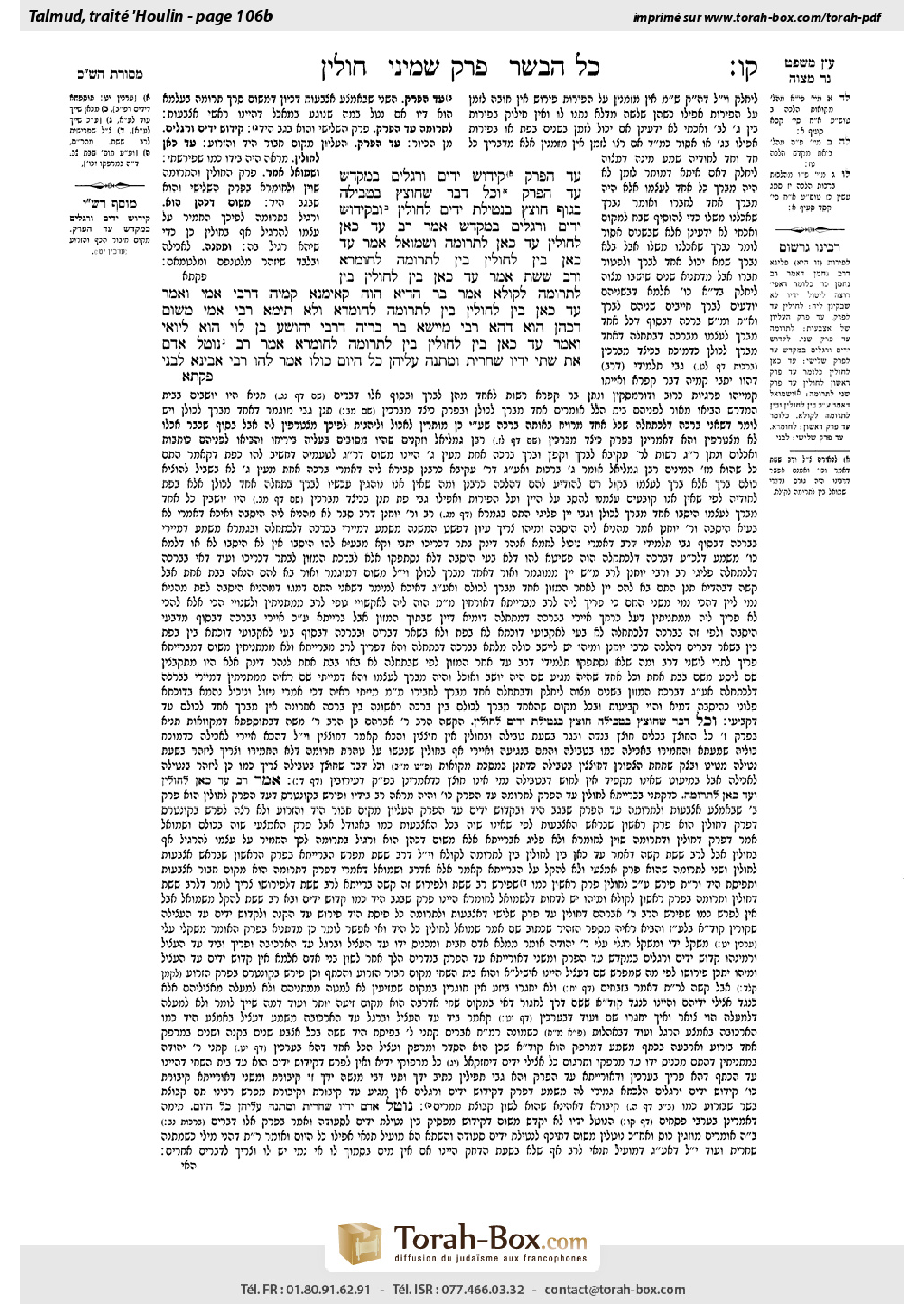
עַד הַפֶּרֶק. קִידּוּשׁ יָדַיִם וְרַגְלַיִם בַּמִּקְדָּשׁ – עַד הַפֶּרֶק, וְכׇל דָּבָר שֶׁחוֹצֵץ בִּטְבִילָה בַּגּוּף – חוֹצֵץ בִּנְטִילַת יָדַיִם לְחוּלִּין, וּבְקִידּוּשׁ יָדַיִם וְרַגְלַיִם בַּמִּקְדָּשׁ.
אָמַר רַב: עַד כָּאן לְחוּלִּין, עַד כָּאן לִתְרוּמָה. וּשְׁמוּאֵל אָמַר: עַד כָּאן בֵּין לְחוּלִּין בֵּין לִתְרוּמָה, לְחוּמְרָא. וְרַב שֵׁשֶׁת אָמַר: עַד כָּאן בֵּין לְחוּלִּין בֵּין לִתְרוּמָה, לְקוּלָּא.
אָמַר בַּר הֶדְיָא: הֲוָה קָאֵימְנָא קַמֵּיהּ דְּרַבִּי אַמֵּי, וְאָמַר: עַד כָּאן בֵּין לְחוּלִּין בֵּין לִתְרוּמָה לְחוּמְרָא, וְלָא תֵּימָא רַבִּי אַמֵּי מִשּׁוּם דְּכֹהֵן הוּא, דְּהָא רַבִּי מְיָישָׁא בַּר בְּרֵיהּ דְּרַבִּי יְהוֹשֻׁעַ בֶּן לֵוִי הוּא לֵיוַאי, וְאָמַר: עַד כָּאן בֵּין לְחוּלִּין בֵּין לִתְרוּמָה לְחוּמְרָא.
אָמַר רַב: נוֹטֵל אָדָם אֶת שְׁתֵּי יָדָיו שַׁחֲרִית, וּמַתְנֶה עֲלֵיהֶן כׇּל הַיּוֹם כּוּלּוֹ. אֲמַר לְהוּ רַבִּי אֲבִינָא לִבְנֵי
Chullin 106b · English translation
he must pour on the area extending until the joint. In sanctifying the hands and feet in the Temple before the service, he must pour the water until another joint, where the palm meets the wrist. And any item that is considered to interpose between one’s skin and the water with regard to immersion of the body in a ritual bath, disqualifying the immersion, likewise interposes with regard to washing the hands for eating non-sacred food and with regard to sanctification of the hands and feet in the Temple.
Rav said this halakha to his students while indicating with his hand the joints to which the baraita is referring: One washes until here, the second joint of the fingers, for non-sacred food, and until there, the third joint, where the fingers join the palm, for teruma. And Shmuel disagreed and said: One washes until here both for eating non-sacred food and for teruma, indicating the more stringent location, the third joint where the fingers join the palm. And Rav Sheshet said: Until here both for the consumption of non-sacred food and for teruma, indicating the more lenient location, the second joint.
Bar Hedya said: I was standing before Rabbi Ami, and he said: One washes until here both for non-sacred food and for teruma, indicating the more stringent location, the third joint. And do not say that Rabbi Ami acted this way only because he is a priest and acted stringently to avoid confusing teruma and non-sacred food. This cannot be, as Rabbi Meyasha, son of the son of Rabbi Yehoshua ben Levi, is a Levite, and yet he too said: Until here both for non-sacred food and for teruma, indicating the more stringent location.
§ Rav says: A person may wash both of his hands in the morning and stipulate with regard to them that he may eat on the basis of that washing throughout the entire day, provided he guards his hands from dirt and ritual impurity. It is likewise related that Rabbi Avina said to the inhabitants of
Chullin 106b · Traduction française (IA)
il doit verser l'eau sur la zone s'étendant jusqu'au joint. Lors de la sanctification des mains et des pieds dans le Temple avant le service, il doit verser l'eau jusqu'à un autre joint, où la paume rencontre le poignet. Tout objet qui est considéré comme interposant entre la peau et l'eau concernant l'immersion du corps dans un mikvé, invalidant l'immersion, interpose également lors du lavage des mains pour manger de la nourriture non sacrée et lors de la sanctification des mains et des pieds dans le Temple.
Rav a dit cette halakha à ses élèves en indiquant du doigt les joints auxquels la baraïta fait référence : On lave jusqu'ici, le deuxième joint des doigts, pour la nourriture non sacrée, et jusqu'ici, le troisième joint, où les doigts se joignent à la paume, pour la terouma. Et Shmuel a désaccordé et dit : On lave jusqu'ici à la fois pour manger de la nourriture non sacrée et pour la terouma, indiquant la zone plus exigeante, le troisième joint où les doigts se joignent à la paume. Et Rav Sheshet a dit : Jusqu'ici à la fois pour la consommation de nourriture non sacrée et pour la terouma, indiquant la zone plus clémente, le deuxième joint.
Bar Hedya a dit : J'étais devant Rabbi Ami, et il a dit : On lave jusqu'ici à la fois pour la nourriture non sacrée et pour la terouma, indiquant la zone plus exigeante, le troisième joint. Et ne dis pas que Rabbi Ami agissait ainsi uniquement parce qu'il est un prêtre et agissait avec rigueur pour éviter de confondre la terouma et la nourriture non sacrée. Cela ne peut pas être, car Rabbi Meyasha, fils du fils de Rabbi Yehoshua ben Levi, est un Lévite, et pourtant il a dit aussi : Jusqu'ici à la fois pour la nourriture non sacrée et pour la terouma, indiquant la zone plus exigeante.
§ Rav dit : Une personne peut laver ses deux mains du matin et stipuler à leur sujet qu'elle peut manger sur la base de ce lavage tout au long de la journée, à condition qu'elle garde ses mains propres de souillure et de souillure rituelle. Il est également rapporté que Rabbi Avina a dit aux habitants de
Traduction française générée par IA à partir de l’édition anglaise de Sefaria. Vérifie toujours un passage avec le texte source.
Text from Sefaria: William Davidson Edition - Vocalized Aramaic (unknown); William Davidson Edition - English (CC BY NC).