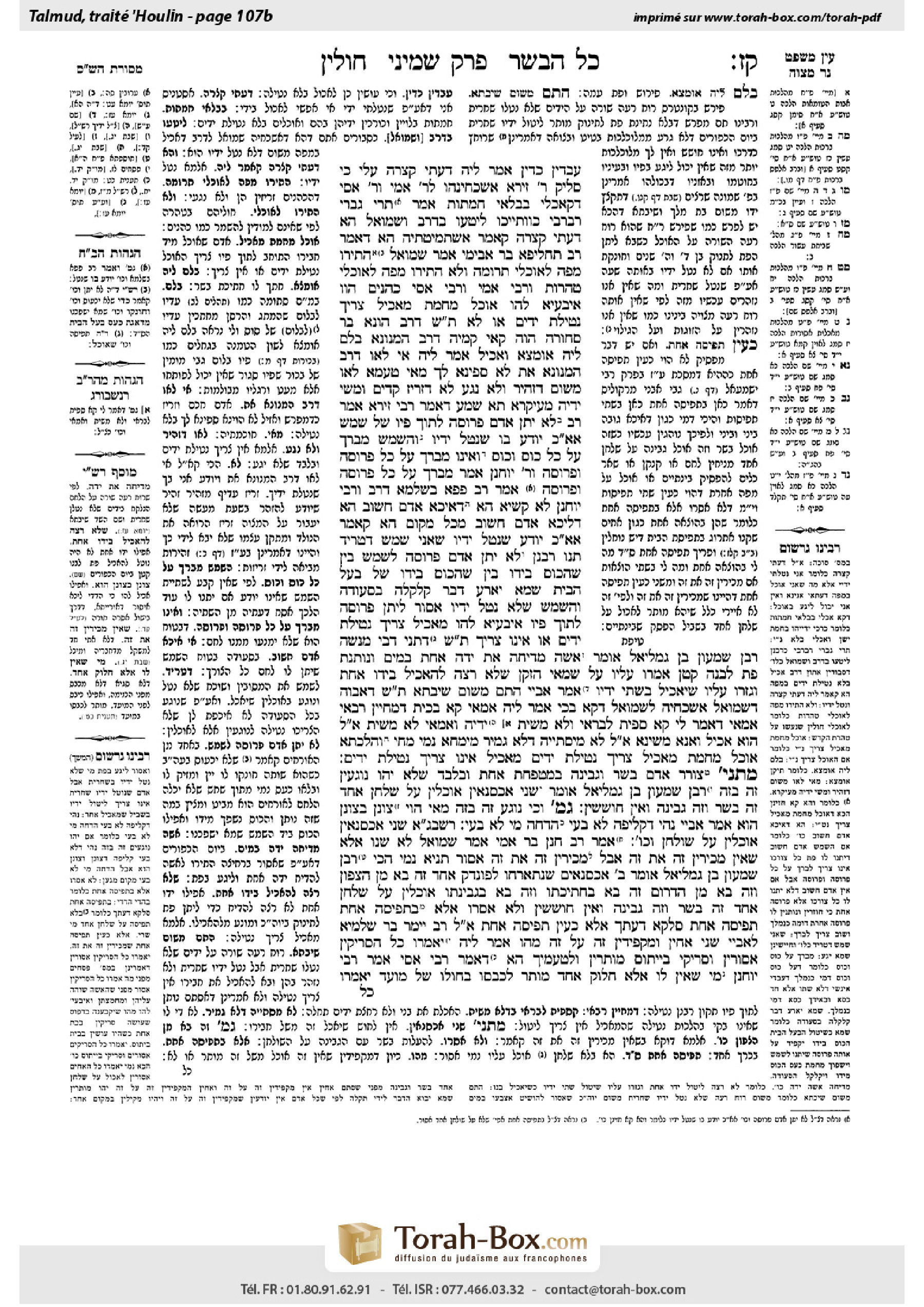
Chullin 107b: Talmud study for Daf Yomi
Study the Talmud for Daf Yomi with scanned pages, Hebrew text, English translations from Sefaria and AI-generated French translations.
Passage selection and English or AI-generated French translation are available where the scan has annotations. Daf Study is independent of Torah-Box and Sefaria.
Browse Chullin · חולין · All tractatesChullin 107b text and translations
This page of Chullin includes the Aramaic text, an English translation and an AI-generated French translation, alongside the scan above.
חולין ק״ז ב · Aramaic and Hebrew text
עָבְדִין כְּדֵין? אֲמַר לֵיהּ: דַּעְתִּי קְצָרָה עָלַי.
כִּי סְלֵיק רַבִּי זֵירָא, אַשְׁכְּחִינְהוּ לְרַבִּי אַמֵּי וְרַבִּי אַסִּי דְּקָאָכְלִי בִּבְלָאֵי חֲמָתוֹת. אֲמַר: תְּרֵי גַּבְרֵי רַבְרְבֵי כְּוָותַיְיכוּ, לִיטְעוֹ בִּדְרַב וּשְׁמוּאֵל? הָא ״דַּעְתִּי קְצָרָה״ קָאָמַר!
אִשְׁתְּמִיטְתֵּיהּ הָא דְּאָמַר רַב תַּחְלִיפָא בַּר אֲבִימִי אָמַר שְׁמוּאֵל: הִתִּירוּ מַפָּה לְאוֹכְלֵי תְרוּמָה, וְלֹא הִתִּירוּ מַפָּה לְאוֹכְלֵי טְהָרוֹת, וְרַבִּי אַמֵּי וְרַבִּי אַסִּי כֹּהֲנִים הֲווֹ.
אִיבַּעְיָא לְהוּ: אוֹכֵל מֵחֲמַת מַאֲכִיל, צָרִיךְ נְטִילַת יָדַיִם אוֹ לָא? תָּא שְׁמַע, דְּרַב הוּנָא בַּר סְחוֹרָה הֲוָה קָאֵי קַמֵּיהּ דְּרַב הַמְנוּנָא, בְּלַם לֵיהּ אוּמְצָא וְאָכֵיל. אֲמַר לֵיהּ: אִי לָאו דְּרַב הַמְנוּנָא אַתְּ, לָא סָפֵינָא לָךְ.
מַאי טַעְמָא, לָאו מִשּׁוּם דִּזְהִיר וְלָא נָגַע? לָא, דִּזְרִיז קָדֵים וּמָשֵׁי יְדֵיהּ מֵעִיקָּרָא.
תָּא שְׁמַע, דְּאָמַר רַבִּי זֵירָא אָמַר רַב: לֹא יִתֵּן אָדָם פְּרוּסָה לְתוֹךְ פִּיו שֶׁל שַׁמָּשׁ, אֶלָּא אִם כֵּן יוֹדֵעַ בּוֹ שֶׁנָּטַל יָדָיו. וְהַשַּׁמָּשׁ מְבָרֵךְ עַל כׇּל כּוֹס וָכוֹס, וְאֵינוֹ מְבָרֵךְ עַל כׇּל פְּרוּסָה וּפְרוּסָה. וְרַבִּי יוֹחָנָן אָמַר: מְבָרֵךְ עַל כׇּל פְּרוּסָה וּפְרוּסָה.
אָמַר רַב פָּפָּא: בִּשְׁלָמָא דְּרַב וְרַבִּי יוֹחָנָן לָא קַשְׁיָא, הָא דְּאִיכָּא אָדָם חָשׁוּב, הָא דְּלֵיכָּא אָדָם חָשׁוּב.
מִכׇּל מָקוֹם, הָא קָאָמַר: אֶלָּא אִם כֵּן יוֹדֵעַ שֶׁנָּטַל יָדָיו! שָׁאנֵי שַׁמָּשׁ, דִּטְרִיד.
תָּנוּ רַבָּנַן: לֹא יִתֵּן אָדָם פְּרוּסָה לַשַּׁמָּשׁ, בֵּין שֶׁהַכּוֹס בְּיָדוֹ בֵּין שֶׁהַכּוֹס בְּיָדוֹ שֶׁל בַּעַל הַבַּיִת, שֶׁמָּא יֶאֱרַע דְּבַר קַלְקָלָה בַּסְּעוּדָה. וְהַשַּׁמָּשׁ שֶׁלֹּא נָטַל יָדָיו – אָסוּר לִיתֵּן פְּרוּסָה לְתוֹךְ פִּיו.
אִיבַּעְיָא לְהוּ: מַאֲכִיל, צָרִיךְ נְטִילַת יָדַיִם, אוֹ אֵינוֹ צָרִיךְ?
תָּא שְׁמַע, דְּתָנֵי דְּבֵי מְנַשֶּׁה: רַבָּן שִׁמְעוֹן בֶּן גַּמְלִיאֵל אוֹמֵר: אִשָּׁה מְדִיחָה אֶת יָדָהּ אַחַת בַּמַּיִם, וְנוֹתֶנֶת פַּת לִבְנָהּ קָטָן. אָמְרוּ עָלָיו עַל שַׁמַּאי הַזָּקֵן שֶׁלֹּא רָצָה לְהַאֲכִיל בְּיָדוֹ אַחַת, וְגָזְרוּ עָלָיו שֶׁיַּאֲכִיל בִּשְׁתֵּי יָדָיו.
אָמַר אַבָּיֵי: הָתָם מִשּׁוּם שִׁיבְתָּא.
תָּא שְׁמַע, דַּאֲבוּהּ דִּשְׁמוּאֵל אַשְׁכְּחֵיהּ לִשְׁמוּאֵל דְּקָא בָכֵי. אֲמַר לֵיהּ: אַמַּאי קָא בָכֵית? דְּמַחְיַין רַבַּאי. אַמַּאי? דְּאָמַר לִי: קָא סָפֵית לִבְרַאי וְלָא מְשֵׁית יְדָיךְ. וְאַמַּאי לָא מְשֵׁית? אֲמַר לֵיהּ: הוּא אָכֵיל וַאֲנָא מָשֵׁינָא?!
אֲמַר לֵיהּ: לָא מִיסָּתְיֵיהּ דְּלָא גְּמִיר, מִימְחָא נָמֵי מָחֵי! וְהִלְכְתָא: אוֹכֵל מֵחֲמַת מַאֲכִיל – צָרִיךְ נְטִילַת יָדַיִם, מַאֲכִיל – אֵינוֹ צָרִיךְ נְטִילַת יָדַיִם.
מַתְנִי׳ צוֹרֵר אָדָם בָּשָׂר וּגְבִינָה בְּמִטְפַּחַת אַחַת, וּבִלְבַד שֶׁלֹּא יְהוּ נוֹגְעִין זֶה בָּזֶה. רַבָּן שִׁמְעוֹן בֶּן גַּמְלִיאֵל אוֹמֵר: שְׁנֵי אַכְסְנָאִין אוֹכְלִין עַל שֻׁלְחָן אֶחָד, זֶה בָּשָׂר וְזֶה גְּבִינָה, וְאֵין חוֹשְׁשִׁין.
גְּמָ׳ וְכִי נוֹגֵעַ זֶה בָּזֶה, מַאי הָוֵי? צוֹנֵן בְּצוֹנֵן הוּא! אָמַר אַבָּיֵי: נְהִי דִּקְלִיפָה לָא בָּעֵי, הַדָּחָה מִי לָא בָּעֵי?
רַבָּן שִׁמְעוֹן בֶּן גַּמְלִיאֵל אוֹמֵר: שְׁנֵי אַכְסְנָאִין אוֹכְלִין עַל שׁוּלְחָן וְכוּ׳. אָמַר רַב חָנָן בַּר אַמֵּי אָמַר שְׁמוּאֵל: לֹא שָׁנוּ אֶלָּא שֶׁאֵין מַכִּירִין זֶה אֶת זֶה, אֲבָל מַכִּירִין זֶה אֶת זֶה – אָסוּר.
תַּנְיָא נָמֵי הָכִי: רַבָּן שִׁמְעוֹן בֶּן גַּמְלִיאֵל אוֹמֵר: שְׁנֵי אַכְסְנָאִים שֶׁנִּתְאָרְחוּ לְפוּנְדָּק אֶחָד, זֶה בָּא מִן הַצָּפוֹן וְזֶה בָּא מִן הַדָּרוֹם, זֶה בָּא בַּחֲתִיכָתוֹ וְזֶה בָּא בִּגְבִינָתוֹ, אוֹכְלִין עַל שֻׁלְחָן אֶחָד, זֶה בָּשָׂר וְזֶה גְּבִינָה, וְאֵין חוֹשְׁשִׁין.
וְלֹא אָסְרוּ אֶלָּא בִּתְפִיסָה אַחַת. תְּפִיסָה אַחַת סָלְקָא דַּעְתָּךְ? אֶלָּא כְּעֵין תְּפִיסָה אַחַת.
אֲמַר לֵיהּ רַב יֵימַר בַּר שֶׁלֶמְיָא לְאַבָּיֵי: שְׁנֵי אַחִין, וּמַקְפִּידִין זֶה עַל זֶה, מַהוּ?
אֲמַר לֵיהּ: יֹאמְרוּ כׇּל הַסְּרִיקִין אֲסוּרִין, וּסְרִיקֵי בַיְיתּוֹס מוּתָּרִין?!
וּלְטַעְמָיךְ, הָא דְּאָמַר רַבִּי אַסִּי אָמַר רַבִּי יוֹחָנָן: מִי שֶׁאֵין לוֹ אֶלָּא חָלוּק אֶחָד מוּתָּר לְכַבְּסוֹ בְּחוּלּוֹ שֶׁל מוֹעֵד. יֹאמְרוּ:
Chullin 107b · English translation
Do we act in this manner? Rav said to Shmuel: I did wash my hands, but as I am delicate I do not wish to hold food in my bare hands; therefore I covered them with a cloth.
The Gemara further relates: When Rabbi Zeira left Babylonia for Eretz Yisrael, he found Rabbi Ami and Rabbi Asi eating bread while covering their hands with worn pieces of wineskins, rather than washing them. Rabbi Zeira said to them: Could two great men such as yourselves err with regard to the incident of Rav and Shmuel related above? After all, Rav said to Shmuel: I am using a cloth because I am delicate; he did wash his hands beforehand.
The Gemara notes: It escaped Rabbi Zeira’s mind that Rav Taḥlifa bar Avimi said that Shmuel said: The Sages permitted the consumption of bread while the hands are wrapped with a cloth rather than washed, specifically to priests who partake of teruma, as they are careful not to touch the bread with their hands. But they did not permit the use of a cloth in this manner to non-priests, even those who are particular to eat non-sacred food in a state of ritual purity, as they do not maintain the same level of diligence as priests. And since Rabbi Ami and Rabbi Asi were priests, it was permitted for them to eat with a cloth.
A dilemma was raised before the Sages: If one eats by means of another feeding him, without himself touching the food, does he need to wash hands before eating or not? The Gemara suggests: Come and hear proof from the following incident where Rav Huna bar Seḥora was standing before Rav Hamnuna and serving him. Rav Huna bar Seḥora cut a slice of meat for Rav Hamnuna and placed it in his mouth, and he ate it. Rav Huna bar Seḥora said to Rav Hamnuna: Were you not Rav Hamnuna, I would not feed you in this fashion.
The Gemara infers from this episode: What is the reason that it was permitted for Rav Hamnuna to eat in such a manner? Is it not because he was careful not to touch the food with his hands? This indicates that someone may be fed even without washing his hands. The Gemara rejects this: No, one can say that he was vigilant and went ahead and washed his hands at the outset.
The Gemara suggests: Come and hear proof from that which Rabbi Zeira said that Rav said: A person may not place a slice of bread into the mouth of the attendant serving at a meal unless he knows that he has washed his hands. And it was also stated that the attendant recites a blessing over each and every cup of wine presented to him at a meal. This is because he never knows if he will receive another cup, and he cannot intend that his initial blessing apply to a cup he does not know he will receive. But he does not recite a blessing over each and every slice of bread given to him. And Rabbi Yoḥanan says that he must recite a blessing over each and every slice he receives.
Rav Pappa said: Granted, the apparent contradiction between the opinions of Rav and Rabbi Yoḥanan is not difficult; one can resolve it by saying that this statement of Rav, that the attendant need not recite a blessing for every slice of bread, is referring to a case where there is an important person at the meal. Since the attendant is confident that the important person will ensure the attendant receives enough to eat, his initial blessing applies to each slice he receives. And that statement of Rabbi Yoḥanan is referring to a meal where there is no important person. Since the attendant is not confident that he will receive another slice, he must recite a new blessing whenever he does receive one.
In any case, Rav first says that one should not place a slice into the attendant’s mouth unless he knows that he has washed his hands. This indicates that one who is fed by another must wash his hands. The Gemara responds: The case of an attendant is different, as he is occupied with his duties and may touch the food inadvertently. Therefore, he specifically may not eat without washing his hands.
§ The Sages taught in a baraita: A person who is a guest may not give a slice of bread from the meal in front of him to the attendant serving, whether a cup is in the attendant’s hand or a cup is in the host’s hand, lest a mishap occur at the meal. The host might become angry or distracted by the concern that there will not remain enough food for his guests, and the cup will fall from his hand. If the cup is in the attendant’s hand, he might drop it while accepting food from the guest. And with regard to an attendant who has not washed his hands, it is prohibited to place a slice of bread into his mouth.
§ A dilemma was raised before the Sages: Does one who feeds another need to wash his hands, since his hands are touching the food? Or perhaps he does not need to wash his hands, as he himself is not eating.
The Gemara suggests: Come and hear a resolution to the dilemma from that which the school of Menashe taught that Rabban Shimon ben Gamliel says: A woman may rinse one hand in water on Yom Kippur, so that she does not touch food before she has washed her hands in the morning, and give bread to her minor son, without concern about violating the prohibition against bathing on Yom Kippur. They said about Shammai the Elder that he did not want to feed his children with even one hand on Yom Kippur, to avoid having to wash it. But due to concerns about the health and well-being of his children, they decreed that he must feed them with two hands, forcing him to wash both. Apparently one who feeds another must wash his hands, even though he himself is not eating.
Abaye said: The reason for the washing there is not on account of the food specifically. Rather, it is due to an evil spirit named Shivta, who contaminates hands that have not been washed in the morning. As long as one washes his hands in the morning, perhaps he need not wash them again to feed another.
The Gemara further suggests: Come and hear a resolution to the dilemma from the following incident, as Shmuel’s father found the young Shmuel crying, and said to him: Why are you crying? Shmuel replied: Because my teacher struck me. His father asked: Why did he strike you? Shmuel responded: My teacher said to me: You are feeding my son, but you did not wash your hands. His father asked: And why did you not wash your hands? Shmuel said to him: Only he, the teacher’s son, is eating, and I must wash my hands?
Shmuel’s father said to him: Is it not enough that your teacher did not learn the halakha properly, that he even strikes you on account of his error? One who feeds another need not wash his hands if he himself is not eating. The Gemara concludes: And the halakha is that one who eats by means of another feeding him needs to wash his hands, even though he does not touch the food. But one who feeds another does not need to wash his hands.
MISHNA: A person may bind meat and cheese in one cloth, provided that they do not come into contact with each other. Rabban Shimon ben Gamliel says: Two unacquainted guests [akhsena’in] may eat together on one table, this one eating meat and that one eating cheese, and they need not be concerned lest they come to violate the prohibition of eating meat and milk by partaking of the food of the other.
GEMARA: The mishna teaches that one may bind meat and cheese together in one cloth, provided that they do not come into contact with each other. The Gemara asks: And if they come into contact with each other, what of it? It is a case of one cold food in contact with another cold food, and they would not absorb substances from one another. Abaye said: Granted that cold foods do not require the peeling of the place where they came into contact, as they do not absorb substances from one another. Nevertheless, don’t they require rinsing in water? The Sages therefore decreed against the contact of even cold meat and cheese, lest one come to eat them without rinsing them first.
§ The mishna teaches that Rabban Shimon ben Gamliel says: Two guests may eat together on one table, this one eating meat and that one eating cheese. Rav Ḥanan bar Ami says that Shmuel says: They taught this halakha only in a case where the guests do not know each other, as they will not eat of each other’s food. But in a situation where they know each other, it is prohibited for them to eat together at the same table.
That opinion is also taught in a baraita: Rabban Shimon ben Gamliel says: If two guests roomed in one inn, this one coming from the north and that one coming from the south, this one coming with his piece of meat and that one coming with his cheese, they may eat together on one table, this one eating meat and that one cheese, and they need not be concerned.
The baraita adds: And the Sages prohibited this practice only if they both eat from one parcel. The Gemara adds: Can it enter your mind that the baraita is actually referring to a case where they eat from one parcel? This is obviously prohibited. Rather, it prohibits eating even in a manner as though they were eating from one parcel, i.e., when the diners are somewhat acquainted with each other, since neither would mind if the other ate from his food.
§ It was stated above that if two diners are acquainted with each other they may not eat meat and cheese on the same table. Rav Yeimar bar Shelemya said to Abaye: If these diners are two brothers, but they are each particular not to let one another eat of his food, what is the halakha? May they eat separate dishes of meat and cheese at a single table?
Abaye said to him: Your question evokes that of Baitos ben Zunin. The Sages prohibited the baking of elaborately decorated Syrian cakes for Passover, lest people tarry in their preparation and the cakes become leavened. Baitos wished to prepare the cakes in a way that would not lead to a violation of any prohibition, and yet the Sages prohibited it, because people will say: All the decorated Syrian cakes are forbidden, but the Syrian cakes of Baitos are permitted? Here too, to avoid confusion, we will not allow exceptions to the rule.
Rav Yeimar responded: But according to your reasoning, one may refute that which Rabbi Asi said that Rabbi Yoḥanan said: Although the Sages prohibited laundering on the intermediate days of a Festival, one who has only one shirt is permitted to launder it on the intermediate days of a Festival. Here too, one can claim: People will say metaphorically:
Chullin 107b · Traduction française (IA)
Agissons-nous ainsi ? Rav dit à Shmuel : J'ai lavé mes mains, mais comme je suis délicat, je ne veux pas tenir les aliments avec mes mains nues ; par conséquent, j'ai recouvert mes mains d'un linge.
La Guemara rapporte ensuite : Lorsque Rabbi Zeïra quitta Babylone pour la Terre d'Israël, il trouva Rabbi Ami et Rabbi Asi mangeant du pain tout en recouvrant leurs mains avec des morceaux usés de peau de raisin, plutôt que de les laver. Rabbi Zeïra dit à eux : Pourquoi deux grands hommes tels que vous pourraient-ils se tromper concernant l'incident de Rav et de Shmuel mentionné ci-dessus ? En effet, Rav dit à Shmuel : Je utilise un linge car je suis délicat ; il a lavé ses mains auparavant.
La Guemara note : Il n'a pas échappé à Rabbi Zeïra que Rav Taḥlifa bar Avimi ait dit que Shmuel ait dit : Les Sages ont permis la consommation du pain avec les mains recouvertes d'un linge plutôt que lavées, spécifiquement pour les prêtres qui consomment la terouma, car ils prennent soin de ne pas toucher le pain avec leurs mains. Mais ils n'ont pas permis l'utilisation d'un linge de cette manière aux non-prêtres, même ceux qui sont particuliers à manger des aliments non sacrés dans un état de pureté rituelle, car ils ne maintiennent pas le même niveau de diligence que les prêtres. Et puisque Rabbi Ami et Rabbi Asi étaient des prêtres, il était permis qu'ils mangent avec un linge.
Un dilemme a été soulevé devant les Sages : Si l'on mange par l'intermédiaire d'une autre personne qui lui nourrit, sans toucher lui-même les aliments, a-t-on besoin de laver ses mains avant de manger ou non ? La Guemara suggère : Venez et entendez la preuve à partir de l'incident suivant où Rav Huna bar Seḥora était devant Rav Hamnuna et lui servait. Rav Huna bar Seḥora coupa une tranche de viande pour Rav Hamnuna et la mit dans sa bouche, et il la mangea. Rav Huna bar Seḥora dit à Rav Hamnuna : Si tu n'étais pas Rav Hamnuna, je ne t'aurais pas nourri ainsi.
La Guemara déduit de cet épisode : Quel est le motif qui a permis à Rav Hamnuna de manger ainsi ? N'est-ce pas parce qu'il prenait soin de ne pas toucher les aliments avec ses mains ? Cela indique que l'on peut nourrir quelqu'un sans laver ses mains. La Guemara rejette cette interprétation : Non, on peut dire qu'il était vigilant et a lavé ses mains dès le début.
La Guemara suggère : Venez et entendez la preuve à partir de ce que Rabbi Zeïra a dit que Rav a dit : On ne doit pas placer une tranche de pain dans la bouche du serviteur qui sert à un repas, sauf si l'on sait qu'il a lavé ses mains. Il a également été dit que le serviteur récite une berakha sur chaque verre de vin présenté à lui lors d'un repas. C'est parce qu'il ne sait pas s'il recevra un autre verre, et il ne peut pas avoir l'intention que sa première berakha s'applique à un verre qu'il ne sait pas qu'il recevra. Mais il ne récite pas de berakha sur chaque tranche de pain qu'on lui donne. Et Rabbi Yoḥanan dit qu'il doit réciter une berakha sur chaque tranche qu'il reçoit.
Rav Pappa dit : C'est évident, la contradiction entre les opinions de Rav et de Rabbi Yoḥanan n'est pas difficile à résoudre ; on peut la résoudre en disant que cette déclaration de Rav, selon laquelle le serviteur n'a pas besoin de réciter une berakha pour chaque tranche de pain, se réfère à un cas où il y a une personne importante au repas. Comme le serviteur est sûr que la personne importante assurera qu'il reçoive assez à manger, sa première berakha s'applique à chaque tranche qu'il reçoit. Et cette déclaration de Rabbi Yoḥanan se réfère à un repas où il n'y a pas de personne importante. Comme le serviteur n'est pas sûr qu'il recevra une autre tranche, il doit réciter une nouvelle berakha chaque fois qu'il en reçoit une.
En tout cas, Rav dit d'abord que l'on ne doit pas placer une tranche dans la bouche du serviteur, sauf si l'on sait qu'il a lavé ses mains. Cela indique que celui qui est nourri par un autre doit laver ses mains. La Guemara répond : Le cas du serviteur est différent, car il est occupé par ses tâches et peut toucher accidentellement les aliments. Par conséquent, il ne doit pas manger sans laver ses mains.
§ Les Sages ont enseigné dans une baraïta : Une personne qui est un invité ne doit pas donner une tranche de pain du repas devant lui au serviteur, que ce soit lorsqu'un verre est dans la main du serviteur ou dans celle du maître, de peur qu'un incident survienne au repas. Le maître pourrait s'émouvoir ou être distrait par l'inquiétude qu'il ne reste pas assez de nourriture pour ses invités, et le verre pourrait tomber de sa main. Si le verre est dans la main du serviteur, il pourrait le lâcher en acceptant la nourriture de l'invité. Et concernant un serviteur qui n'a pas lavé ses mains, il est interdit de placer une tranche de pain dans sa bouche.
§ Un dilemme a été soulevé devant les Sages : Celui qui nourrit un autre doit-il laver ses mains, puisque ses mains touchent les aliments ? Ou peut-être n'a-t-il pas besoin de laver ses mains, car il ne mange pas lui-même.
La Guemara suggère : Venez et entendez la résolution de ce dilemme à partir de ce que l'école de Menashe a enseigné que Rabban Shimon ben Gamliel dit : Une femme peut rincer une main dans l'eau le Yom Kippur, afin de ne pas toucher les aliments avant d'avoir lavé ses mains le matin, et donner du pain à son fils mineur, sans craindre de violer l'interdiction de bain le Yom Kippur. Ils ont dit à propos de Shammai l'Aîné qu'il ne voulait pas nourrir ses enfants avec une seule main le Yom Kippur, pour éviter de devoir la laver. Mais en raison des préoccupations concernant la santé et le bien-être de ses enfants, ils ont ordonné qu'il les nourrisse avec deux mains, forçant ainsi à laver les deux. Apparemment, celui qui nourrit un autre doit laver ses mains, même s'il ne mange pas lui-même.
Abaye dit : La raison du lavage là n'est pas spécifiquement liée aux aliments. C'est plutôt à cause d'un esprit malin nommé Shivta, qui contamine les mains non lavées le matin. Aussi longtemps qu'on lave ses mains le matin, peut-être n'a-t-on pas besoin de les laver à nouveau pour nourrir un autre.
La Guemara suggère également : Approchez-vous d'une résolution à ce dilemme à partir de l'incident suivant : le père de Shmuel a trouvé le jeune Shmuel en larmes et lui a demandé : Pourquoi pleures-tu ? Shmuel a répondu : Parce que mon maître m'a frappé. Son père a demandé : Pourquoi l'as-tu frappé ? Shmuel a répondu : Mon maître m'a dit : Tu nourris mon fils, mais tu n'as pas lavé tes mains. Son père a demandé : Et pourquoi n'as-tu pas lavé tes mains ? Shmuel a répondu : Seul le fils du maître mange, et moi, je dois laver mes mains.
Le père de Shmuel a dit à son fils : N'est-ce pas suffisant que ton maître n'ait pas appris correctement la halakha, qu'il frappe même toi à cause de son erreur ? Celui qui nourrit un autre n'a pas besoin de laver ses mains s'il ne mange pas lui-même. La Guemara conclut : Et la halakha est que celui qui mange grâce à un autre qui le nourrit doit laver ses mains, même s'il ne touche pas le nourriture. Celui qui nourrit un autre n'a pas besoin de laver ses mains.
MICHNA : Une personne peut attacher de la viande et du fromage dans un seul tissu, à condition qu'ils ne s'effleurent pas. Rabban Shimon ben Gamliel dit : Deux invités inconnus peuvent manger ensemble sur une même table, l'un mangeant de la viande et l'autre du fromage, et ils n'ont pas à craindre qu'ils viennent à transgresser la prohibition de manger de la viande et du fromage en mangeant la nourriture de l'autre.
GUEMARA : La mishna enseigne que l'on peut attacher de la viande et du fromage ensemble dans un seul tissu, à condition qu'ils ne s'effleurent pas. La Guemara demande : Et si ils s'effleurent, qu'est-ce que cela change ? C'est un cas de nourriture froide en contact avec une autre nourriture froide, et ils ne s'absorberaient pas les substances les unes des autres. Abaye a dit : C'est vrai que les aliments froids n'ont pas besoin de laver la place où ils se sont effleurés, car ils ne s'absorbent pas les uns les autres. Cependant, ne devraient-ils pas être rincés à l'eau ? Les Sages ont donc décrété l'interdiction du contact même entre de la viande froide et du fromage, de peur qu'on les mange sans les rincer d'abord.
§ La mishna enseigne que Rabban Shimon ben Gamliel dit : Deux invités peuvent manger ensemble sur une même table, l'un mangeant de la viande et l'autre du fromage. Rav Ḥanan bar Ami dit que Shmuel dit : Ils ont enseigné cette halakha uniquement dans un cas où les invités ne se connaissent pas, car ils ne mangeront pas de la nourriture de l'autre. Mais dans un cas où ils se connaissent, il est interdit qu'ils mangent ensemble à la même table.
Cette opinion est également enseignée dans une baraïta : Rabban Shimon ben Gamliel dit : Si deux invités logent dans la même auberge, l'un venant du nord et l'autre du sud, l'un venant avec sa viande et l'autre avec son fromage, ils peuvent manger ensemble sur une même table, l'un mangeant de la viande et l'autre du fromage, et ils n'ont pas à craindre.
La baraïta ajoute : Et les Sages ont interdit cette pratique uniquement si ils mangent tous deux d'un même paquet. La Guemara ajoute : Pourriez-vous penser que la baraïta fait référence à un cas où ils mangent d'un même paquet ? Cela est évidemment interdit. Plutôt, elle interdit de manger même de manière semblant qu'ils mangent d'un même paquet, c'est-à-dire lorsque les convives sont un peu connus entre eux, car aucun ne s'offenserait si l'autre mangeait de sa nourriture.
§ Il a été dit ci-dessus que si deux convives se connaissent, ils ne peuvent pas manger de la viande et du fromage sur la même table. Rav Yeimar bar Shelemya a dit à Abaye : Si ces convives sont deux frères, mais ils sont tous deux particuliers à ne pas laisser l'autre manger de leur nourriture, quelle est la halakha ? Peuvent-ils manger des plats séparés de viande et de fromage à la même table ?
Abaye a dit à lui : Votre question évoque celle de Baitos ben Zunin. Les Sages ont interdit la cuisson de gâteaux syriens décorés pour la Pâque, de peur que les gens s'attardent dans leur préparation et que les gâteaux ferment. Baitos voulait préparer les gâteaux de manière à ne pas violer aucune prohibition, et pourtant les Sages l'ont interdit, car les gens diraient : Tous les gâteaux syriens décorés sont interdits, mais ceux de Baitos sont permis ? Ici aussi, pour éviter la confusion, nous ne permettrons pas d'exceptions à la règle.
Rav Yeimar a répondu : Mais selon votre raisonnement, on peut réfuter ce que Rabbi Asi a dit que Rabbi Yoḥanan a dit : Bien que les Sages aient interdit le lavage pendant les jours intermédiaires d'un festival, celui qui possède uniquement une chemise est autorisé à la laver pendant les jours intermédiaires d'un festival. Ici aussi, on peut dire : Les gens diraient métaphoriquement :
Traduction française générée par IA à partir de l’édition anglaise de Sefaria. Vérifie toujours un passage avec le texte source.
Text from Sefaria: William Davidson Edition - Vocalized Aramaic (unknown); William Davidson Edition - English (CC BY NC).