Chullin 108a: Talmud study for Daf Yomi
Study the Talmud for Daf Yomi with scanned pages, Hebrew text, English translations from Sefaria and AI-generated French translations.
Passage selection and English or AI-generated French translation are available where the scan has annotations. Daf Study is independent of Torah-Box and Sefaria.
Browse Chullin · חולין · All tractatesChullin 108a text and translations
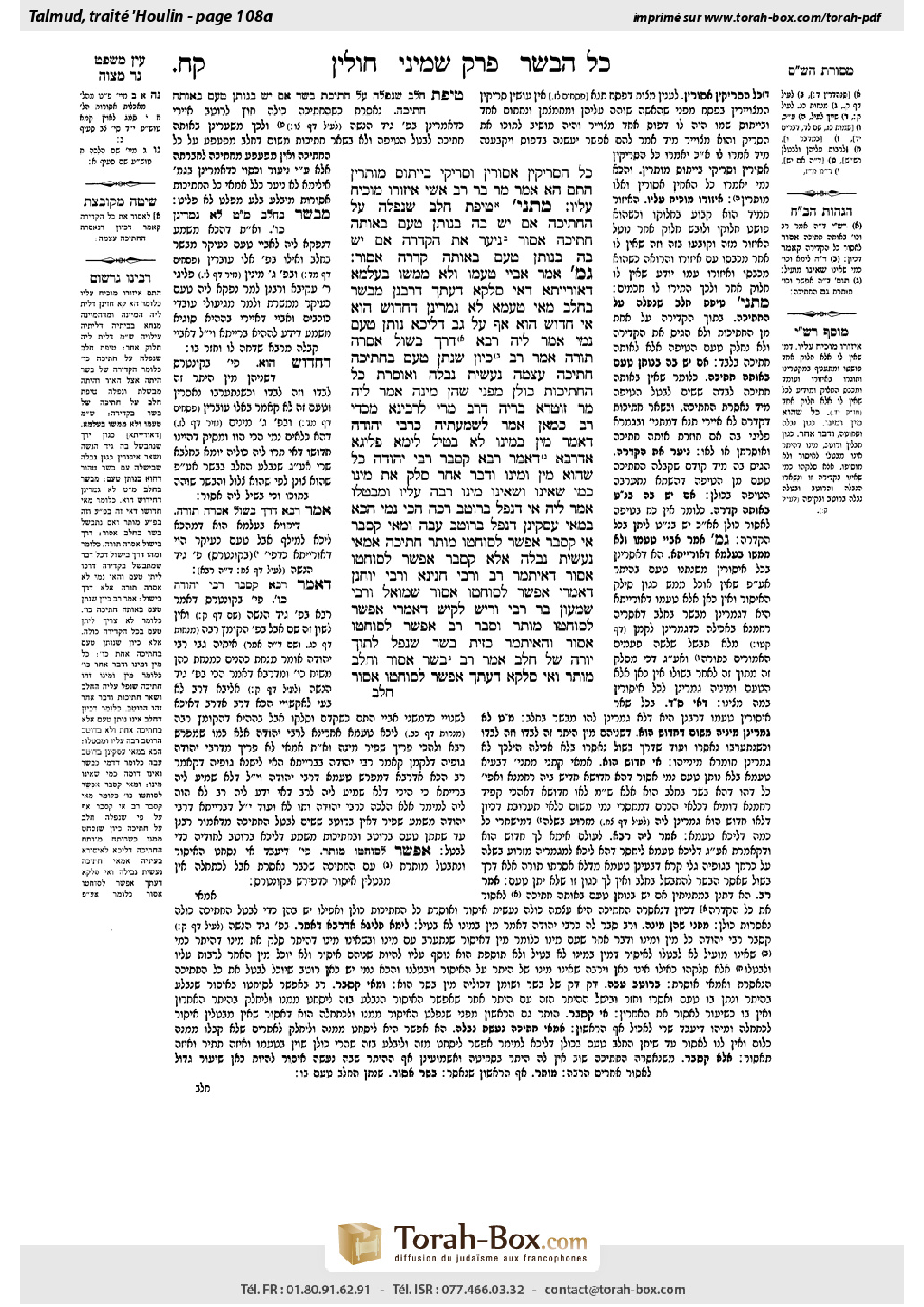
This page of Chullin includes the Aramaic text, an English translation and an AI-generated French translation, alongside the scan above.
חולין ק״ח א · Aramaic and Hebrew text
כׇּל הַסְּרִיקִין אֲסוּרִין וּסְרִיקֵי בַיְיתּוֹס מוּתָּרִין? הָתָם, הָא אָמַר מָר בַּר רַב אָשֵׁי: אֵיזוֹרוֹ מוֹכִיחַ עָלָיו.
מַתְנִי׳ טִיפַּת חָלָב שֶׁנָּפְלָה עַל הַחֲתִיכָה, אִם יֵשׁ בָּהּ בְּנוֹתֵן טַעַם בְּאוֹתָהּ חֲתִיכָה – אָסוּר. נִיעֵר אֶת הַקְּדֵרָה, אִם יֵשׁ בָּהּ בְּנוֹתֵן טַעַם בְּאוֹתָהּ קְדֵרָה – אָסוּר.
גְּמָ׳ אָמַר אַבָּיֵי: טַעְמוֹ וְלֹא מַמָּשׁוֹ בְּעָלְמָא – דְּאוֹרָיְיתָא.
דְּאִי סָלְקָא דַעְתָּךְ דְּרַבָּנַן, מִבָּשָׂר בְּחָלָב מַאי טַעְמָא לָא גָּמְרִינַן? דְּחִדּוּשׁ הוּא. אִי חִדּוּשׁ הוּא, אַף עַל גַּב דְּלֵיכָּא נוֹתֵן טַעַם נָמֵי!
אֲמַר לֵיהּ רָבָא: דֶּרֶךְ בִּשּׁוּל אָסְרָה תּוֹרָה.
אָמַר רַב: כֵּיוָן שֶׁנָּתַן טַעַם בַּחֲתִיכָה, חֲתִיכָה עַצְמָהּ נַעֲשֵׂית נְבֵלָה, וְאוֹסֶרֶת כׇּל הַחֲתִיכוֹת כּוּלָּן, מִפְּנֵי שֶׁהֵן מִינָהּ.
אֲמַר לֵיהּ מָר זוּטְרָא בְּרֵיהּ דְּרַב מָרִי לְרָבִינָא: מִכְּדֵי רַב כְּמַאן אָמַר לִשְׁמַעְתֵּיהּ? כְּרַבִּי יְהוּדָה, דְּאָמַר מִין בְּמִינוֹ לֹא בָּטֵיל, לֵימָא פְּלִיגָא אַדְּרָבָא?
דְּאָמַר רָבָא: קָסָבַר רַבִּי יְהוּדָה, כׇּל שֶׁהוּא מִין וּמִינוֹ וְדָבָר אַחֵר – סַלֵּק אֶת מִינוֹ כְּמִי שֶׁאֵינוֹ, וְשֶׁאֵינוֹ מִינוֹ רָבֶה עָלָיו וּמְבַטְּלוֹ.
אֲמַר לֵיהּ: אִי דִּנְפַל בְּרוֹטֶב רַכָּה – הָכִי נָמֵי, הָכָא בְּמַאי עָסְקִינַן – דִּנְפַל בְּרוֹטֶב עָבָה.
וּמַאי קָסָבַר? אִי קָסָבַר אֶפְשָׁר לְסוֹחֳטוֹ מוּתָּר, חֲתִיכָה אַמַּאי נַעֲשֵׂית נְבֵלָה? אֶלָּא קָסָבַר אֶפְשָׁר לְסוֹחֳטוֹ אָסוּר.
דְּאִיתְּמַר: רַב וְרַבִּי חֲנִינָא וְרַבִּי יוֹחָנָן דְּאָמְרִי: אֶפְשָׁר לְסוֹחֳטוֹ – אָסוּר, שְׁמוּאֵל וְרַבִּי שִׁמְעוֹן בַּר רַבִּי וְרֵישׁ לָקִישׁ דְּאָמְרִי: אֶפְשָׁר לְסוֹחֳטוֹ – מוּתָּר.
וְסָבַר רַב אֶפְשָׁר לְסוֹחֳטוֹ אָסוּר? וְהָאִיתְּמַר: כְּזַיִת בָּשָׂר שֶׁנָּפַל לְתוֹךְ יוֹרָה שֶׁל חָלָב, אָמַר רַב: בָּשָׂר אָסוּר וְחָלָב מוּתָּר, וְאִי סָלְקָא דַּעְתָּךְ אֶפְשָׁר לְסוֹחֳטוֹ אָסוּר,
Chullin 108a · English translation
All the Syrian cakes are prohibited, but the Syrian cakes of Baitos are permitted? The Gemara responds: With regard to the case there, Mar, son of Rav Ashi, said: His belt is proof for him, as in those days people commonly had one belt, which was worn over the shirt. If a person had more than one shirt, then whenever he laundered one he would remove the belt and wear it over the second. If one saw a shirt being washed with its belt, he would know that the owner had only one shirt.
MISHNA: In the case of a drop of milk that fell on a piece of meat, if the drop contains enough milk to impart flavor to that piece of meat, i.e., the meat is less than sixty times the size of the drop, the meat is forbidden. If one stirred the contents of the pot and the piece was submerged in the gravy before it absorbed the milk, if the drop contains enough milk to impart flavor to the contents of that entire pot, the contents of the entire pot are forbidden.
GEMARA: Abaye said: The principle that the flavor of a forbidden food renders prohibited the substance in which it is absorbed, and it is not necessary for there to be actual forbidden substance, applies by Torah law in general, and not just to the prohibition of meat cooked in milk.
As, if it enters your mind that the principle applies to other prohibited foods by rabbinic law, one can claim: What is the reason that we do not learn that it applies by Torah law from the analogous case of meat cooked in milk? It must be because the prohibition of meat cooked in milk is a novelty that is not derived through logical reasoning, as each substance is separately permitted, and they are prohibited only when cooked together. No analogies can be drawn to a novelty. But if the prohibition is a novelty, then even if there is not enough milk to impart flavor, the meat and milk should also be prohibited. Since the measure of the prohibition follows the standard principles of mixtures, the prohibition itself is apparently not a novelty. One may therefore draw an analogy to other mixtures, inferring that this measure applies to them by Torah law as well.
Rava said to Abaye: This is not a valid proof. The prohibition of meat cooked in milk is in fact a novelty and differs from other prohibited mixtures. Nevertheless, its measure is the imparting of flavor only because the action the Torah prohibited is in the manner of cooking, and cooking involves the imparting of flavor.
§ The mishna teaches that if the piece of meat acquires the flavor of milk, it is forbidden. Rav says: Once the milk imparts flavor to the piece of meat, the piece itself becomes non-kosher meat in its own right. And therefore, if one did not immediately remove the piece from the pot, it renders all the pieces of meat in the pot forbidden, even if they are together more than sixty times the size of that forbidden piece. This is because they are the same type as the forbidden piece, and as a rule, a substance in contact with the same type of substance cannot be nullified.
Mar Zutra, son of Rav Mari, said to Ravina: Now consider, in accordance with whose opinion did Rav say his halakha? It is in accordance with the opinion of Rabbi Yehuda, who said that a type of food mixed with food of its own type is not nullified. If so, shall we say that Rav disagrees with Rava’s interpretation of Rabbi Yehuda’s opinion?
As Rava said: Rabbi Yehuda holds with regard to any tripartite mixture consisting of a forbidden type of food, a permitted food of the same type, and another food item that is permitted, one disregards the permitted food that is its own type as though it were not there, and if the permitted food that is not of its own type is more than the forbidden food, the permitted food nullifies the forbidden food. In the case Rav describes, although the other pieces of meat are of the same type as the piece that has become forbidden, the gravy in the pot is not of the same type, and it should nullify the forbidden piece. Since Rav does not mention this principle, he apparently disagrees with it.
Ravina said to him: If the forbidden substance fell into thin gravy, Rav would concede that the gravy would indeed nullify the piece of meat, since the two substances are of different types. But here we are dealing with a case where it fell into thick gravy, which is composed of meat residue. Since the gravy is of the same substance as the meat, the forbidden piece is not nullified.
The Gemara returns to Rav’s statement that the piece of meat upon which the milk fell is considered a non-kosher item in its own right. And what does Rav maintain in this regard? If he maintains that an item that can be wrung to remove the forbidden substance it contains becomes permitted again after wringing, then it follows that only the absorbed substance is truly forbidden. If so, why should this piece of meat itself become non-kosher? Once it has been mixed into the stew, the milk it has absorbed should be evenly distributed throughout the pot and be nullified. Rather, Rav must maintain that even an item that can be wrung to remove the forbidden substance is forbidden.
The Gemara elaborates: As it was stated: Rav and Rabbi Ḥanina and Rabbi Yoḥanan say that even an item that can be wrung to remove the forbidden substance is forbidden, whereas Shmuel, and Rabbi Shimon, son of Rabbi Yehuda HaNasi, and Reish Lakish say: An item that can be wrung to remove the forbidden substance is permitted.
The Gemara asks: And does Rav really maintain that an item that can be wrung to remove the forbidden substance is forbidden? But wasn’t it stated: If an olive-bulk of meat fell into a pot of milk so large that the meat did not impart flavor to it, Rav says: The meat is forbidden, as it absorbed the taste of the milk, but the milk is permitted, since it did not absorb the taste of the meat. But if it enters your mind that according to Rav an item that can be wrung is forbidden,
Chullin 108a · Traduction française (IA)
Tous les gâteaux syriens sont interdits, mais les gâteaux syriens de Baitos sont permis ? La Guemara répond : En ce cas, Mar, fils de Rav Ashi, disait : Sa ceinture est une preuve pour lui, car, à cette époque, les gens portaient généralement une seule ceinture, qu'ils portaient sur la chemise. Si une personne avait plus d'une chemise, chaque fois qu'il lavait une chemise, il retirait la ceinture et la portait sur la seconde. Si l'on voyait une chemise lavée avec sa ceinture, on savait que l'owner n'avait qu'une seule chemise.
MICHNA : Dans le cas d'une goutte de lait tombant sur un morceau de viande, si la goutte contient assez de lait pour imprimer un goût à ce morceau de viande, c'est-à-dire que la viande est inférieure à soixante fois la taille de la goutte, la viande est interdite. Si l'on remue le contenu de la casserole et que le morceau est immergé dans la sauce avant d'avoir absorbé le lait, si la goutte contient assez de lait pour imprimer un goût au contenu de toute la casserole, le contenu de toute la casserole est interdit.
GUEMARA : Abaye dit : Le principe selon lequel le goût d'un aliment interdit rend interdit la substance dans laquelle il est absorbé, et il n'est pas nécessaire qu'il y ait une substance réellement interdite, s'applique à la loi juive en général, et non seulement à l'interdiction de la viande cuite dans le lait.
Car, si l'idée vous vient que ce principe s'applique à d'autres aliments interdits par la loi rabbinique, on peut dire : Pourquoi ne pas apprendre que ce principe s'applique par la loi juive à partir du cas analogue de la viande cuite dans le lait ? Il doit être parce que l'interdiction de la viande cuite dans le lait est une nouveauté qui ne provient pas d'un raisonnement logique, car chaque substance est séparément permise, et elles sont interdites seulement lorsqu'elles sont cuites ensemble. Aucune analogie ne peut être tirée d'une nouveauté. Mais si l'interdiction est une nouveauté, alors même s'il n'y a pas assez de lait pour imprimer un goût, la viande et le lait devraient être également interdits. Puisque la mesure de l'interdiction suit les principes standards des mélanges, l'interdiction elle-même n'est pas une nouveauté. On peut donc tirer une analogie d'autres mélanges, en inférant que cette mesure s'applique également par la loi juive à d'autres mélanges.
Rava dit à Abaye : Ce n'est pas une preuve valide. L'interdiction de la viande cuite dans le lait est en effet une nouveauté et diffère des autres mélanges interdits. Cependant, sa mesure est l'impression de goût uniquement car l'action interdite par la Torah est dans le sens de la cuisson, et la cuisson implique l'impression de goût.
§ La Michna enseigne que si le morceau de viande acquiert le goût du lait, il est interdit. Rav dit : Une fois que le lait imprime un goût au morceau de viande, ce morceau lui-même devient de la viande non-kosher à part entière. Et donc, si l'on n'a pas retiré immédiatement le morceau de la casserole, il rend tous les morceaux de viande de la casserole interdits, même s'ils sont ensemble plus de soixante fois la taille de ce morceau interdit. C'est parce qu'ils sont du même type que le morceau interdit, et selon la règle, une substance en contact avec une substance du même type ne peut pas être annulée.
Mar Zutra, fils de Rav Mari, dit à Ravina : Maintenant, considérons selon quel avis Rav a dit son halakha ? C'est selon l'avis de Rabbi Yehuda, qui disait qu'un aliment mélangé avec un aliment de même type n'est pas annulé. Si c'est ainsi, devons-nous dire que Rav est en désaccord avec l'interprétation de Rava sur l'avis de Rabbi Yehuda ?
Car Rava dit : Rabbi Yehuda tient compte de tout mélange tripartite composé d'un aliment interdit, d'un aliment permis du même type et d'un autre aliment permis, et l'on néglige l'aliment permis du même type comme s'il n'était pas là, et si l'aliment permis non du même type est plus que l'aliment interdit, l'aliment permis annule l'aliment interdit. Dans le cas que Rav décrit, bien que les autres morceaux de viande soient du même type que le morceau interdit, la sauce de la casserole n'est pas du même type, et elle devrait annuler le morceau interdit. Puisque Rav ne mentionne pas ce principe, il semble qu'il en soit en désaccord.
Ravina dit à lui : Si l'aliment interdit est tombé dans une sauce claire, Rav admettrait que la sauce annulerait effectivement le morceau de viande, car les deux substances sont de types différents. Mais ici, nous sommes dans un cas où il est tombé dans une sauce épaisse, composée de résidus de viande. Puisque la sauce est de la même substance que la viande, le morceau interdit n'est pas annulé.
La Guemara revient sur l'affirmation de Rav que le morceau de viande sur lequel le lait est tombé est considéré comme un aliment non-kosher à part entière. Et qu'entend-t-on par là selon Rav ? Si Rav maintient qu'un aliment dont on peut éponger la substance interdite devient permis après éponger, alors il suit que seule la substance absorbée est véritablement interdite. Si c'est ainsi, pourquoi ce morceau de viande devient-il non-kosher ? Une fois qu'il a été mélangé dans la bouillie, le lait qu'il a absorbé devrait être uniformément distribué dans la casserole et être annulé. Plutôt, Rav doit maintenir que même un aliment dont on peut éponger la substance interdite est interdit.
La Guemara développe : Comme il a été dit : Rav et Rabbi Ḥanina et Rabbi Yoḥanan disent que même un objet dont on peut éponger la substance interdite est interdit, tandis que Shmuel, et Rabbi Shimon, fils de Rabbi Yehuda HaNasi, et Reish Lakish disent : Un objet dont on peut éponger la substance interdite est permis.
La Guemara pose la question : Et Rav maintient-t-il vraiment que l'objet dont on peut éponger la substance interdite est interdit ? Mais n'était-il pas dit : Si une quantité d'olive de viande est tombée dans une casserole de lait si grande que la viande n'a pas impréssé de goût, Rav dit : La viande est interdite, car elle a absorbé le goût du lait, mais le lait est permis, car il n'a pas absorbé le goût de la viande. Mais si l'idée vous vient que selon Rav un objet dont on peut éponger est interdit,
Traduction française générée par IA à partir de l’édition anglaise de Sefaria. Vérifie toujours un passage avec le texte source.
Text from Sefaria: William Davidson Edition - Vocalized Aramaic (unknown); William Davidson Edition - English (CC BY NC).