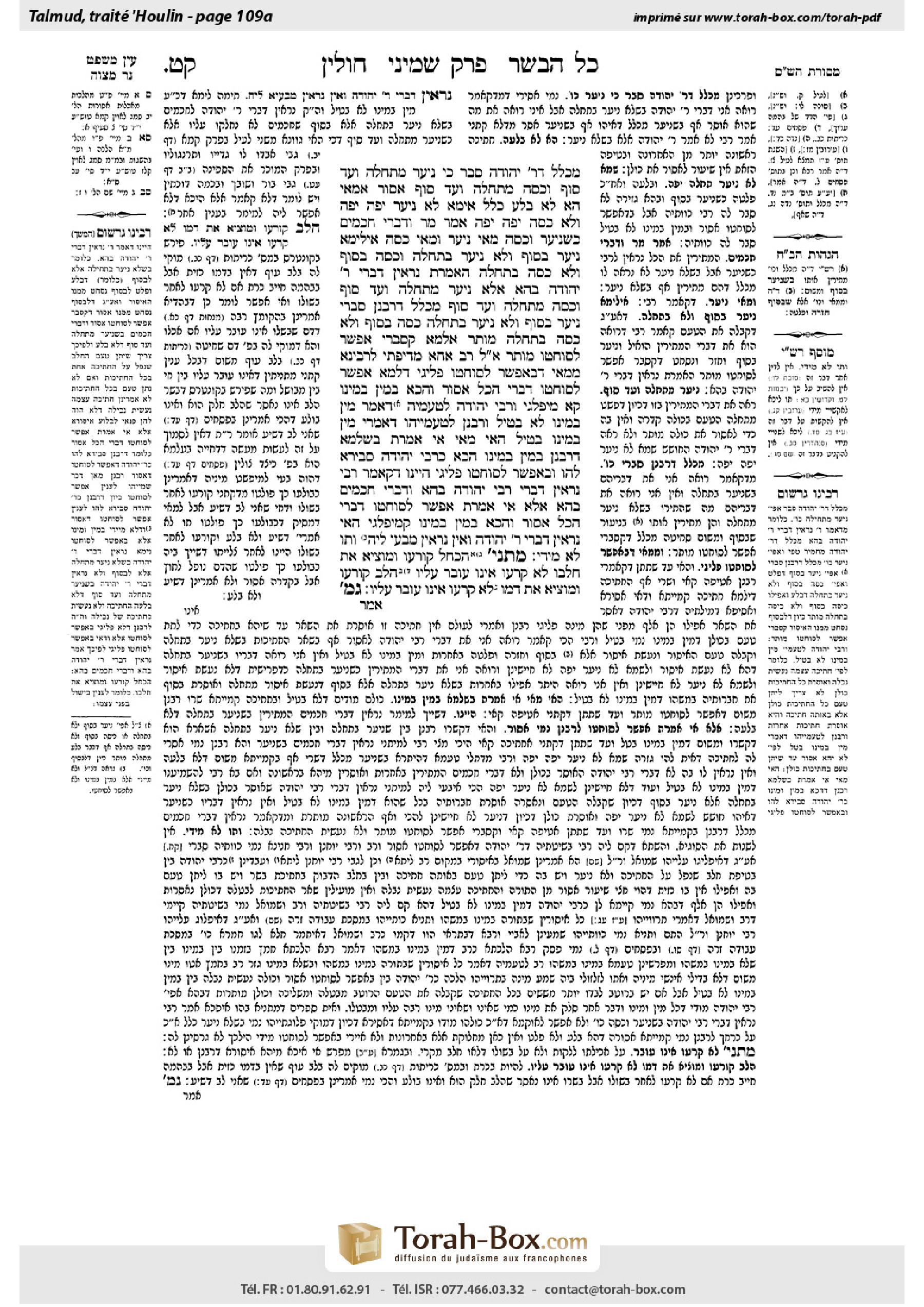
Chullin 109a: Talmud study for Daf Yomi
Study the Talmud for Daf Yomi with scanned pages, Hebrew text, English translations from Sefaria and AI-generated French translations.
Passage selection and English or AI-generated French translation are available where the scan has annotations. Daf Study is independent of Torah-Box and Sefaria.
Browse Chullin · חולין · All tractatesChullin 109a text and translations
This page of Chullin includes the Aramaic text, an English translation and an AI-generated French translation, alongside the scan above.
חולין ק״ט א · Aramaic and Hebrew text
מִכְּלָל דְּרַבִּי יְהוּדָה סָבַר: כִּי נִיעֵר מִתְּחִלָּה וְעַד סוֹף וְכִסָּה מִתְּחִלָּה וְעַד סוֹף – אָסוּר, אַמַּאי? הָא לָא בָּלַע כְּלָל!
אֵימָא: לֹא נִיעֵר יָפֶה יָפֶה, וְלֹא כִּסָּה יָפֶה יָפֶה.
אָמַר מָר, וְדִבְרֵי חֲכָמִים כְּשֶׁנִּיעֵר וְכִסָּה. מַאי ״נִיעֵר״ וּמַאי ״כִּסָּה״? אִילֵּימָא נִיעֵר בַּסּוֹף וְלֹא נִיעֵר בַּתְּחִלָּה, וְכִסָּה בַּסּוֹף וְלֹא כִּסָּה בַּתְּחִלָּה – הָאָמְרַתְּ נִרְאִין דִּבְרֵי רַבִּי יְהוּדָה בְּהָא! אֶלָּא נִיעֵר מִתְּחִלָּה וְעַד סוֹף, וְכִסָּה מִתְּחִלָּה וְעַד סוֹף.
מִכְּלָל דְּרַבָּנַן סָבְרִי: נִיעֵר בַּסּוֹף וְלֹא נִיעֵר בַּתְּחִלָּה, כִּסָּה בַּסּוֹף וְלֹא כִּסָּה בַּתְּחִלָּה – מוּתָּר.
אַלְמָא קָסָבְרִי אֶפְשָׁר לְסוֹחֳטוֹ מוּתָּר.
אֲמַר לֵיהּ רַב אַחָא מִדִּיפְתִּי לְרָבִינָא: מִמַּאי דִּבְאֶפְשָׁר לְסוֹחֳטוֹ פְּלִיגִי? דִּלְמָא אֶפְשָׁר לְסוֹחֳטוֹ דִּבְרֵי הַכֹּל אָסוּר, וְהָכָא בְּמִין בְּמִינוֹ קָא מִיפַּלְגִי, וְרַבִּי יְהוּדָה לְטַעְמֵיהּ דְּאָמַר: מִין בְּמִינוֹ לֹא בָּטֵיל, וְרַבָּנַן לְטַעְמַיְיהוּ דְּאָמְרִי: מִין בְּמִינוֹ בָּטֵיל!
הַאי מַאי? אִי אָמְרַתְּ בִּשְׁלָמָא דְּרַבָּנַן בְּמִין בְּמִינוֹ הָכָא כְּרַבִּי יְהוּדָה סְבִירָא לְהוּ, וּבְאֶפְשָׁר לְסוֹחֳטוֹ פְּלִיגִי – הַיְינוּ דְּקָאָמַר רַבִּי: נִרְאִין דִּבְרֵי רַבִּי יְהוּדָה בְּהָא, וְדִבְרֵי חֲכָמִים בְּהָא.
אֶלָּא אִי אָמְרַתְּ: אֶפְשָׁר לְסוֹחֳטוֹ דִּבְרֵי הַכֹּל אָסוּר, וְהָכָא בְּמִין בְּמִינוֹ קָמִיפַּלְגִי – הַאי נִרְאִין דִּבְרֵי רַבִּי יְהוּדָה וְאֵין נִרְאִין מִבְּעֵי לֵיהּ, וְתוּ לָא מִידִּי.
מַתְנִי׳ הַכְּחָל – קוֹרְעוֹ וּמוֹצִיא אֶת חֶלְבּוֹ. לֹא קְרָעוֹ – אֵינוֹ עוֹבֵר עָלָיו. הַלֵּב – קוֹרְעוֹ וּמוֹצִיא אֶת דָּמוֹ, לֹא קְרָעוֹ – אֵינוֹ עוֹבֵר עָלָיו.
Chullin 109a · English translation
The Gemara objects: From Rabbi Yehuda HaNasi’s acceptance of Rabbi Yehuda’s opinion only when one did not stir or cover the pot, one can conclude by inference that Rabbi Yehuda himself maintains that even when one stirred the contents of the pot continuously from beginning to end, i.e., before and after the drop of milk was absorbed, or covered the pot continuously from beginning to end, all the contents of the pot are prohibited. But why should this be so? The first piece of meat did not absorb any more milk than the others. Since the milk definitely diffused evenly through the pot immediately, it should be nullified, assuming that the pot’s contents amount to more than sixty times the milk.
The Gemara responds: Say that Rabbi Yehuda is stringent because one might not have stirred thoroughly, or he might not have covered the pot thoroughly, and therefore initially the milk might have been absorbed only by the first piece, rendering it prohibited. Afterward, when he does stir thoroughly, that piece of meat renders the other pieces prohibited. Rabbi Yehuda HaNasi does not share this concern.
§ The Gemara returns to Rabbi Yehuda HaNasi’s statement: The Master said above: And the statement of the Rabbis appears correct in a case where one stirred the pot and covered it. The Gemara asks: What is the meaning of the term: Stirred, and what is the meaning of the term: Covered? If we say that he stirred at the end, after the first piece absorbed the milk, and did not stir at the beginning, beforehand, and likewise he covered at the end and did not cover at the beginning, one may respond: Didn’t you already say on the previous amud that the statement of Rabbi Yehuda appears to be correct in this case? Rather, it must be a case where he stirred continuously from beginning to end or covered the pot continuously from beginning to end.
If so, one can conclude by inference from Rabbi Yehuda HaNasi’s qualified acceptance of the Rabbis’ opinion that the Rabbis themselves maintain that even when one stirred only at the end and did not stir at the beginning, and similarly if he covered the pot only at the end and did not cover at the beginning, all the contents of the pot are permitted. Even the first piece is permitted, as they hold that the milk it absorbed diffused out of it and throughout the pot.
Evidently, the Rabbis maintain that an item that can be wrung to remove the forbidden substance is permitted. This illustrates that tanna’im dispute this issue, as according to Rabbi Yehuda and Rabbi Yehuda HaNasi, an item that can be wrung to remove the forbidden substance is prohibited.
Rav Aḥa of Difti said to Ravina: From where is it derived that Rabbi Yehuda and the Rabbis disagree with regard to an item that can be wrung? Perhaps even if an item can be wrung, everyone agrees that it remains prohibited, and here they disagree with regard to whether a type of food mixed with food of its own type can be nullified. And Rabbi Yehuda conforms to his standard line of reasoning, as he said that a type of food mixed with food of its own type cannot be nullified. And likewise, the Rabbis conform to their standard line of reasoning, as they said that a type of food mixed with food of its own type can be nullified. This is why they maintain that all the meat in the pot is permitted.
Ravina responded: What is this reasoning? Granted, if you say that the Rabbis here hold in accordance with the opinion of Rabbi Yehuda with regard to the issue of a type of food mixed with food of its own type, and they disagree with regard to an item that can be wrung, that is why Rabbi Yehuda HaNasi says: The statement of Rabbi Yehuda appears to be correct in this case, when one did not initially stir or cover the pot, and the statement of the Rabbis appears to be correct in that case, when one did initially stir or cover it, since the issue of when one stirred or covered the pot is relevant to the dispute, as explained above.
But if you say: Everyone agrees that an item that can be wrung is prohibited, and here they disagree only with regard to a type of food mixed with food of its own type, Rabbi Yehuda HaNasi should not phrase his statement as a qualified acceptance of both opinions, which seems arbitrary. Rather, he should have said this: I accept that a type of food is not nullified by a food of its own type. Therefore, the statement of Rabbi Yehuda appears correct where one did not stir initially, as the flavor of the prohibited first piece cannot be nullified; but it does not appear correct where one stirred immediately, since in that case, even the first piece is not prohibited, and I do not share Rabbi Yehuda’s concern that perhaps one did not stir thoroughly. And nothing more need be said.
MISHNA: One who wants to eat the udder of a slaughtered animal tears it and removes its milk, and only then is it permitted to cook it. If he did not tear the udder before cooking it, he does not violate the prohibition against cooking and eating meat and milk and does not receive lashes for it, as the halakhic status of the milk in the udder is not that of milk. One who wants to eat the heart of a slaughtered animal tears it and removes its blood, and only then may he cook and eat it. If he did not tear the heart before cooking and eating it, he does not violate the prohibition against consuming blood and is not liable to receive karet for it.
Chullin 109a · Traduction française (IA)
La Guemara s'oppose : D'après l'acceptation par Rabbi Yéhuda HaNasi de l'opinion de Rabbi Yéhuda uniquement lorsqu'on n'avait pas remué ou couvert le récipient, on peut conclure par analogie que Rabbi Yéhuda lui-même considère que même lorsqu'on a remué continuellement le contenu du récipient du début à la fin, c'est-à-dire avant et après l'absorption du lait, ou que l'on a couvert le récipient continuellement du début à la fin, tous les contenants du récipient sont interdits. Mais pourquoi en serait-il ainsi ? La première pièce de viande n'a pas absorbé plus de lait que les autres. Puisque le lait s'est certainement diffusé uniformément dans le récipient dès le début, il devrait être annulé, en supposant que la quantité de contenu du récipient est supérieure à soixante fois le lait.
La Guemara répond : Disons que Rabbi Yéhuda est strict, car on pourrait ne pas avoir remué suffisamment ou ne pas avoir couvert le récipient suffisamment, et donc initialement le lait aurait pu être absorbé uniquement par la première pièce, la rendant interdite. Par la suite, lorsqu'il remue suffisamment, cette pièce de viande rend les autres interdites. Rabbi Yéhuda HaNasi ne partage pas cette préoccupation.
§ La Guemara revient sur l'affirmation de Rabbi Yéhuda HaNasi : Le Maître a dit plus haut : Et l'affirmation des Rabbins est correcte dans le cas où l'on a remué le récipient et l'on l'a couvert. La Guemara demande : Quelle est la signification du terme « remuer » et quelle est la signification du terme « couvrir » ? Si nous disons qu'il a remué à la fin, après que la première pièce ait absorbé le lait, et qu'il n'a pas remué au début, avant, et de même il a couvert à la fin et n'a pas couvert au début, on peut répondre : N'avez-vous pas déjà dit sur l'amud précédent que l'affirmation de Rabbi Yéhuda semble correcte dans ce cas ? Plutôt, il doit s'agir d'un cas où il a remué continuellement du début à la fin ou où il a couvert le récipient continuellement du début à la fin.
Si c'est ainsi, on peut conclure par analogie à partir de l'acceptation conditionnelle par Rabbi Yéhuda HaNasi de l'opinion des Rabbins que les Rabbins eux-mêmes considèrent que même lorsqu'on a remué uniquement à la fin et qu'on n'a pas remué au début, et de même si l'on a couvert le récipient uniquement à la fin et qu'on n'a pas couvert au début, tous les contenants du récipient sont permis. Même la première pièce est permise, car ils considèrent que le lait qu'elle a absorbé s'est diffusé hors d'elle et à travers tout le récipient.
Il est évident que les Rabbins considèrent qu'un objet dont on peut éponger la substance interdite est permis. Cela illustre que les tannaïm disputent cette question, car selon Rabbi Yéhuda et Rabbi Yéhuda HaNasi, un objet dont on peut éponger la substance interdite est interdit.
Rav Acha de Difti a dit à Ravina : D'où tire-t-on que Rabbi Yéhuda et les Rabbins s'opposent concernant un objet dont on peut éponger ? Peut-être même si un objet peut être épongé, tout le monde convient qu'il reste interdit, et ici ils s'opposent uniquement concernant si un aliment mélangé à un aliment de même type peut être annulé. Et Rabbi Yéhuda suit sa ligne de raisonnement habituelle, car il a dit qu'un aliment mélangé à un aliment de même type ne peut pas être annulé. De même, les Rabbins suivent leur ligne de raisonnement habituelle, car ils ont dit qu'un aliment mélangé à un aliment de même type peut être annulé. C'est pourquoi ils considèrent que toute la viande du récipient est permise.
Ravina répondit : Quelle est cette raisonnement ? En effet, si vous dites que les Rabbins ici suivent l'opinion de Rabbi Yéhuda concernant la question d'un aliment mélangé à un aliment de même type, et qu'ils s'opposent concernant un objet dont on peut éponger, c'est pourquoi Rabbi Yéhuda HaNasi dit : L'affirmation de Rabbi Yéhuda semble correcte dans ce cas, lorsqu'on n'a pas initiallement remué ou couvert le récipient, et l'affirmation des Rabbins semble correcte dans ce cas, lorsqu'on a initiallement remué ou couvert le récipient, car la question de l'acte de remuer ou de couvrir est pertinente dans le débat, comme expliqué plus haut.
Mais si vous dites : Tout le monde convient qu'un objet dont on peut éponger est interdit, et ici ils s'opposent uniquement concernant un aliment mélangé à un aliment de même type, Rabbi Yéhuda HaNasi ne devrait pas formuler son affirmation comme une acceptation conditionnelle des deux opinions, ce qui semble arbitraire. Plutôt, il devrait avoir dit cela : J'accepte que l'aliment n'est pas annulé par un aliment de même type. Ainsi, l'affirmation de Rabbi Yéhuda semble correcte là où l'on n'a pas initiallement remué, car le goût de la première pièce interdite ne peut pas être annulé ; mais elle ne semble pas correcte là où l'on a initiallement remué, car dans ce cas, même la première pièce n'est pas interdite, et je ne partage pas la préoccupation de Rabbi Yéhuda que l'on n'ait pas suffisamment remué. Et plus rien n'aurait besoin d'être dit.
MICHNA : Celui qui veut manger la mamelle d'un animal sacrifié déchire la mamelle et enlève son lait, et seulement alors est-il permis de la cuisiner. Si l'on n'a pas déchiré la mamelle avant de la cuisiner, il ne viole pas l'interdiction de cuisiner et de manger viande et lait et ne reçoit pas de fessures pour cela, car le statut halakhique du lait dans la mamelle n'est pas celui du lait. Celui qui veut manger le cœur d'un animal sacrifié déchire le cœur et enlève son sang, et seulement alors peut-il le cuisiner et le manger. Si l'on n'a pas déchiré le cœur avant de le cuisiner et de le manger, il ne viole pas l'interdiction de consommer du sang et n'est pas puni par la karet.
Traduction française générée par IA à partir de l’édition anglaise de Sefaria. Vérifie toujours un passage avec le texte source.
Text from Sefaria: William Davidson Edition - Vocalized Aramaic (unknown); William Davidson Edition - English (CC BY NC).