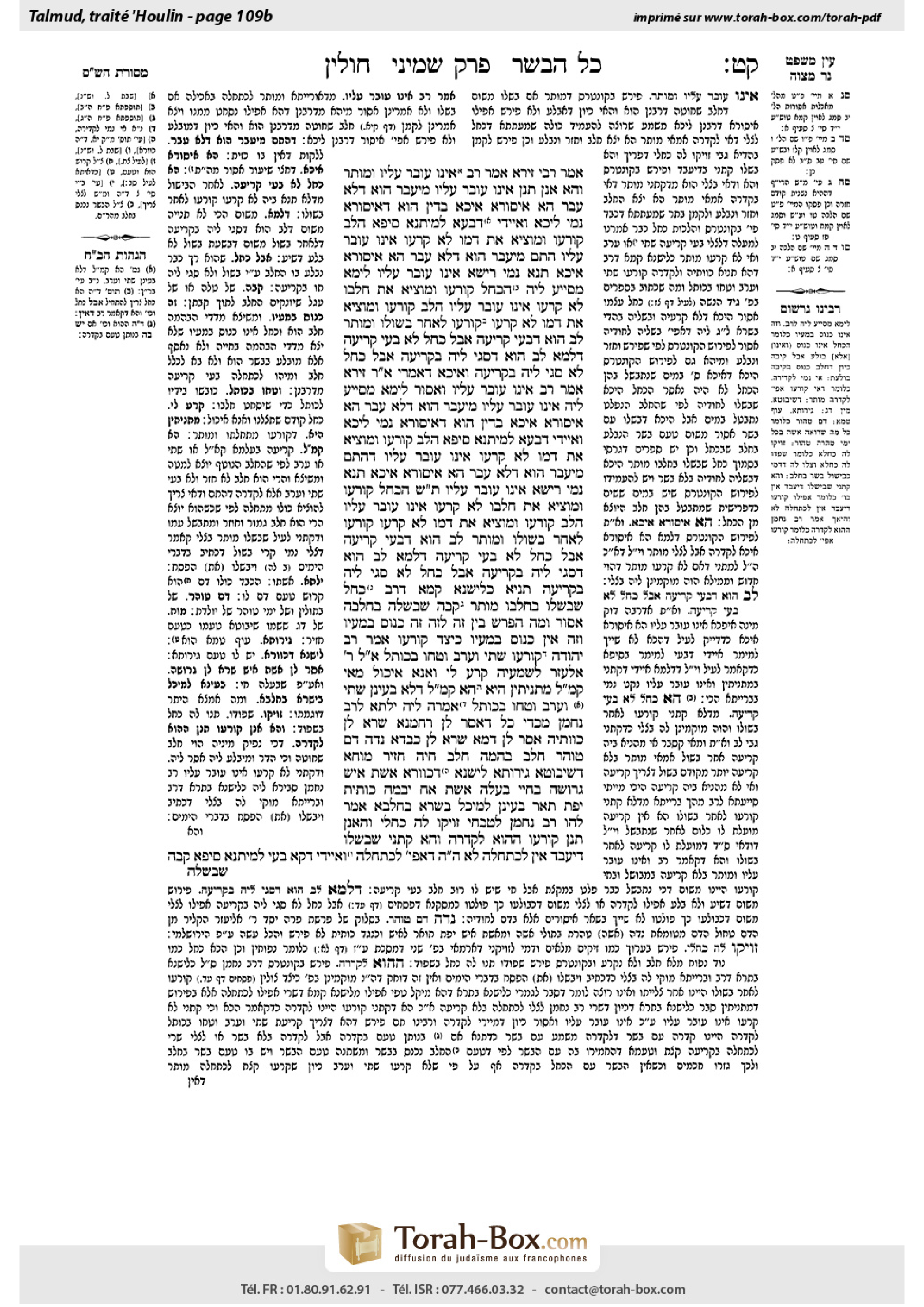
Chullin 109b: Talmud study for Daf Yomi
Study the Talmud for Daf Yomi with scanned pages, Hebrew text, English translations from Sefaria and AI-generated French translations.
Passage selection and English or AI-generated French translation are available where the scan has annotations. Daf Study is independent of Torah-Box and Sefaria.
Browse Chullin · חולין · All tractatesChullin 109b text and translations
This page of Chullin includes the Aramaic text, an English translation and an AI-generated French translation, alongside the scan above.
חולין ק״ט ב · Aramaic and Hebrew text
גְּמָ׳ אָמַר רַבִּי זֵירָא אָמַר רַב: אֵינוֹ עוֹבֵר עָלָיו וּמוּתָּר. וְהָא אֲנַן תְּנַן אֵינוֹ עוֹבֵר עָלָיו – מִיעְבָּר הוּא דְּלָא עָבַר, הָא אִיסּוּרָא אִיכָּא!
בְּדִין הוּא דְּאִיסּוּרָא נָמֵי לֵיכָּא, וְאַיְּידֵי דִּבְעָא לְמִיתְנֵא סֵיפָא: הַלֵּב קוֹרְעוֹ וּמוֹצִיא אֶת דָּמוֹ, לֹא קְרָעוֹ – אֵינוֹ עוֹבֵר עָלָיו. הָתָם מִיעְבָּר הוּא דְּלָא עָבַר, הָא אִיסּוּרָא אִיכָּא, תְּנָא נָמֵי רֵישָׁא אֵינוֹ עוֹבֵר עָלָיו.
לֵימָא מְסַיַּיע לֵיהּ: הַכְּחָל – קוֹרְעוֹ וּמוֹצִיא אֶת חֶלְבּוֹ, לֹא קְרָעוֹ – אֵינוֹ עוֹבֵר עָלָיו. הַלֵּב – קוֹרְעוֹ וּמוֹצִיא אֶת דָּמוֹ, לֹא קְרָעוֹ – קוֹרְעוֹ לְאַחַר בִּשּׁוּלוֹ וּמוּתָּר. לֵב הוּא דְּבָעֵי קְרִיעָה, אֲבָל כְּחָל לָא בָּעֵי קְרִיעָה.
דִּלְמָא לֵב הוּא דְּסַגִּי לֵיהּ בִּקְרִיעָה, אֲבָל כְּחָל – לָא סַגִּי לֵיהּ בִּקְרִיעָה.
וְאִיכָּא דְּאָמְרִי, אָמַר רַבִּי זֵירָא אָמַר רַב: אֵינוֹ עוֹבֵר עָלָיו, וְאָסוּר. לֵימָא מְסַיַּיע לֵיהּ: ״אֵינוֹ עוֹבֵר עָלָיו״ – מִיעְבָּר הוּא דְּלָא עָבַר, הָא אִיסּוּרָא אִיכָּא.
בְּדִין הוּא דְּאִיסּוּרָא נָמֵי לֵיכָּא, וְאַיְּידֵי דִּבְעָא לְמִיתְנֵא סֵיפָא: הַלֵּב קוֹרְעוֹ וּמוֹצִיא אֶת דָּמוֹ, לֹא קְרָעוֹ – אֵינוֹ עוֹבֵר עָלָיו, דְּהָתָם מִיעְבָּר הוּא דְּלָא עָבַר, הָא אִיסּוּרָא אִיכָּא, תְּנָא נָמֵי רֵישָׁא ״אֵינוֹ עוֹבֵר עָלָיו״.
תָּא שְׁמַע: הַכְּחָל – קוֹרְעוֹ וּמוֹצִיא אֶת חֶלְבּוֹ, לֹא קְרָעוֹ – אֵינוֹ עוֹבֵר עָלָיו. הַלֵּב – קוֹרְעוֹ וּמוֹצִיא אֶת דָּמוֹ, לֹא קְרָעוֹ – קוֹרְעוֹ לְאַחַר בִּשּׁוּלוֹ, וּמוּתָּר. לֵב הוּא דְּבָעֵי קְרִיעָה, אֲבָל כְּחָל – לָא בָּעֵי קְרִיעָה!
דִּלְמָא לֵב הוּא דְּסַגִּי לֵיהּ בִּקְרִיעָה, אֲבָל כְּחָל לָא סַגִּי לֵיהּ בִּקְרִיעָה.
תַּנְיָא כְּלִישְׁנָא קַמָּא דְּרַב: כְּחָל שֶׁבִּשְּׁלוֹ בַּחֲלָבוֹ – מוּתָּר, קֵבָה שֶׁבִּשְּׁלָהּ בַּחֲלָבָהּ – אָסוּר.
וּמָה הֶפְרֵשׁ בֵּין זֶה לָזֶה? זֶה כָּנוּס בְּמֵעָיו, וְזֶה אֵין כָּנוּס בְּמֵעָיו.
כֵּיצַד קוֹרְעוֹ? אָמַר רַב יְהוּדָה: קוֹרְעוֹ שְׁתִי וָעֵרֶב, וְטָחוֹ בַּכּוֹתֶל. אֲמַר לֵיהּ רַבִּי אֶלְעָזָר לְשַׁמָּעֵיהּ: קְרַע לִי, וַאֲנָא אֵיכוֹל. מַאי קָא מַשְׁמַע לַן? מַתְנִיתִין הִיא! הָא קָא מַשְׁמַע לַן: דְּלָא בָּעֵינַן שְׁתִי וָעֵרֶב וְטָחוֹ בַּכּוֹתֶל.
אֲמַרָה לֵיהּ יַלְתָּא לְרַב נַחְמָן: מִכְּדֵי, כֹּל דַּאֲסַר לַן רַחֲמָנָא שְׁרָא לַן כְּוָותֵיהּ, אֲסַר לַן דְּמָא – שְׁרָא לַן כַּבְדָּא, נִדָּה – דַּם טוֹהַר.
חֵלֶב בְּהֵמָה – חֵלֶב חַיָּה, חֲזִיר – מוֹחָא דְּשִׁיבּוּטָא, גֵּירוּתָא – לִישָּׁנָא דִּכְוָורָא.
אֵשֶׁת אִישׁ – גְּרוּשָׁה בְּחַיֵּי בַעְלָהּ, אֵשֶׁת אָח – יְבָמָה, גּוֹיָה – יְפַת תֹּאַר, בָּעֵינַן לְמֵיכַל בִּשְׂרָא בַּחֲלָבָא.
אֲמַר לְהוּ רַב נַחְמָן לְטַבָּחֵי: זַוִּיקוּ לַהּ כַּחְלֵי. וְהָאֲנַן תְּנַן: קוֹרְעוֹ! הָהוּא לִקְדֵרָה.
וְהָא קָתָנֵי: שֶׁבִּשְּׁלוֹ – דִּיעֲבַד אִין, לְכַתְּחִלָּה לָא? הוּא הַדִּין דַּאֲפִילּוּ לְכַתְּחִלָּה, וְאַיְּידֵי דְּקָא בָעֵי לְמִיתְנֵא סֵיפָא קֵבָה
Chullin 109b · English translation
GEMARA: The mishna teaches that if one did not tear the udder of a slaughtered animal before cooking it he does not violate the biblical prohibition against eating meat and milk. Rabbi Zeira says that Rav says: He does not violate the prohibition, and it is altogether permitted to eat the cooked product ab initio. The Gemara objects: But didn’t we learn in the mishna: He does not violate the prohibition, i.e., he is not held liable after the fact. One can infer from here as follows: He does not violate a prohibition by Torah law, but there is nevertheless a prohibition ab initio by rabbinic law.
The Gemara explains: By right the mishna should have taught that there is no prohibition here by rabbinic law either. But the tanna of the mishna uses this language since he wants to teach in the latter clause: One who wants to eat the heart of a slaughtered animal tears it and removes its blood, but if he did not tear the heart before cooking and eating it, he does not violate the prohibition. There it is true that although he does not violate a prohibition by Torah law there is a prohibition by rabbinic law. To preserve linguistic symmetry, he teaches the first clause in this manner as well, stating: He does not violate the prohibition.
The Gemara suggests: Let us say that the following baraita supports this opinion: One who wants to eat the udder of a slaughtered animal tears it and removes its milk. If he did not tear the udder before cooking it, he does not violate the prohibition against cooking and eating meat and milk and does not receive lashes for it. One who wants to eat the heart of a slaughtered animal tears it and removes its blood. If he did not tear the heart before cooking and eating it, he tears it after its cooking, and it is permitted. One can infer from the baraita that it is only the heart that requires tearing after cooking if it was not torn beforehand. But the udder does not require tearing after being cooked unlawfully. Evidently, it is permitted as is.
The Gemara rejects this: Perhaps one should infer the opposite, that tearing after cooking is sufficient only to render the heart permitted, as the heart does not absorb blood through cooking. But tearing after cooking is not sufficient to render the udder permitted, as the meat of the udder absorbs the milk through cooking, and tearing will not remove the absorbed milk.
And some say a different version of the above exchange, based on a different version of Rav’s statement: Rabbi Zeira says that Rav says: If one does not tear the udder of a slaughtered animal before cooking it, he does not violate the Torah prohibition, but it is prohibited to eat the cooked product by rabbinic law. The Gemara suggests: Let us say that the mishna supports this opinion, as it states: He does not violate the prohibition, indicating that although he does not violate a Torah prohibition and is not flogged, there is nevertheless a prohibition by rabbinic law.
The Gemara responds: By right the mishna should have taught that there is not even a prohibition by rabbinic law. But the tanna of the mishna uses this language since he wants to teach the latter clause: One who wants to eat the heart of a slaughtered animal tears it and removes its blood, but if he did not tear the heart before cooking and eating it, he does not violate the prohibition for it. There, it is true that although he does not violate a Torah prohibition there is a prohibition by rabbinic law. He therefore teaches in the first clause in this manner as well, stating: He does not violate the prohibition for it.
The Gemara suggests: Come and hear a proof from a baraita: One who wants to eat the udder of a slaughtered animal tears it and removes its milk. If he did not tear the udder before cooking it, he does not violate the prohibition for it. One who wants to eat the heart of a slaughtered animal tears it and removes its blood. If he did not tear the heart before cooking and eating it, he tears it after its cooking, and it is permitted. One can infer from the baraita that it is only the heart that requires tearing after cooking if it was not torn beforehand, but the udder does not require tearing after being cooked unlawfully. Evidently, it is permitted as is.
The Gemara rejects this: Perhaps one should infer the opposite, that tearing after cooking is sufficient only to render the heart permitted, as the heart does not absorb blood through cooking. But tearing it after cooking is not sufficient to render the udder permitted, as the meat of the udder absorbs the milk through cooking, and tearing will not remove the absorbed milk. This concludes the second version of the Gemara’s discussion.
The Gemara comments: It is taught in a baraita in accordance with the first version of Rav’s statement: An udder that one cooked, i.e., roasted, in its milk is permitted. By contrast, the stomach of a suckling lamb or calf that one cooked, i.e., roasted, together with the milk it contains is prohibited for consumption.
The baraita explains: And what is the distinction between this stomach and that udder? The milk this calf suckled was considered milk the moment it left the mother’s teat, and it was merely collected in the calf’s innards. But that milk in the udder is not defined as milk, since it was never collected in the animal’s innards from outside but is found in the flesh. Consequently, this meat of the udder is not prohibited if it is roasted with the milk it contains, although one should still tear it by rabbinic law ab initio.
§ The Gemara inquires: How must one tear an udder before cooking it? Rav Yehuda says: One tears it lengthwise and widthwise [sheti va’erev] and smears it against a wall to remove all the milk. The Gemara relates: Rabbi Elazar said to his attendant: Tear an udder for me before you roast it, and I will eat it. The Gemara asks: What is this episode teaching us? It is explicitly stated in the mishna that one must do this. The Gemara answers: This story teaches us that according to Rabbi Elazar we do not require one to tear it lengthwise and widthwise and smear it against a wall. Rather, it is enough simply to tear it once, either lengthwise or widthwise.
§ Yalta said to her husband Rav Naḥman: Now as a rule, for any item that the Merciful One prohibited to us, He permitted to us a similar item. He prohibited to us the consumption of blood, yet He permitted to us the consumption of liver, which is filled with blood and retains the taste of blood. Likewise, God prohibited sexual intercourse with a menstruating woman, but permitted sexual intercourse with one’s wife while she discharges the blood of purity. During a particular period after giving birth, even if she experiences a flow of blood she is not rendered ritually impure and remains permitted to her husband by Torah law.
Furthermore, the Torah prohibits the consumption of the forbidden fat of a domesticated animal, but permitted the fat of an undomesticated animal, which has the same flavor. It is prohibited to eat pork, but one may eat the brain of a shibuta fish, which has a similar taste. One may not eat giruta, a non-kosher fish, but one may eat the tongue of a fish, which tastes similar.
Likewise, the Torah prohibits sexual intercourse with the wife of another man but permitted one to marry a divorced woman in her previous husband’s lifetime. The Torah prohibits sexual intercourse with one’s brother’s wife, and yet it permits one to marry his yevama, i.e., his brother’s widow when the brother dies childless. Finally, the Torah prohibits sexual intercourse with a gentile woman but permitted one to marry a beautiful woman who is a prisoner of war (see Deuteronomy 21:10–14). Yalta concluded: The Torah prohibits the consumption of meat cooked in milk; I wish to eat a dish that tastes like meat cooked in milk.
Upon hearing this, Rav Naḥman said to his cooks: Roast udders on a spit for her. The Gemara asks: But didn’t we learn in the mishna that one must tear the udder first? Rav Naḥman did not tell his cooks to tear the udders. The Gemara answers: That requirement was stated only with regard to cooking in a pot, not roasting.
The Gemara asks: But isn’t it taught in the baraita cited above: An udder that one cooked in its milk is permitted? This indicates that after the fact, yes, it is permitted, but one may not roast it ab initio without tearing it. The Gemara answers: The same is true even of roasting ab initio, i.e., it is permitted, and the tanna of the baraita uses this language since he wants to teach in the latter clause: A stomach
Chullin 109b · Traduction française (IA)
GUEMARA : La Michna enseigne que si l'on n'a pas déchiré la mamelle d'un animal sacrifié avant de le cuire, on ne commet pas la prohibition biblique de manger viande et lait. Rabbi Zeïra dit que Rav dit : Il ne commet pas la prohibition, et il est tout à fait permis de manger le produit cuit dès le début. La Guemara s'oppose à cela : Mais n'avons-nous pas appris dans la Michna : Il ne commet pas la prohibition, c'est-à-dire qu'il n'est pas tenu responsable après coup. On peut en déduire ceci : Il ne commet pas une prohibition selon la Torah, mais il y a tout de même une prohibition dès le début selon la loi rabbinique.
La Guemara explique : D'un point de vue strict, la Michna aurait dû enseigner qu'il n'y a pas non plus de prohibition selon la loi rabbinique. Mais le tanna de la Michna utilise ce langage car il veut enseigner dans la clause suivante : Celui qui veut manger le cœur d'un animal sacrifié déchire le cœur et enlève son sang. Si l'on n'a pas déchiré le cœur avant de le cuire et de le manger, il ne commet pas la prohibition. Là, c'est vrai que bien qu'il ne commette pas une prohibition selon la Torah, il y a tout de même une prohibition selon la loi rabbinique. Pour préserver la symétrie linguistique, il enseigne la première clause de la même manière, en disant : Il ne commet pas la prohibition.
La Guemara suggère : Disons que la baraïta suivante soutient cette opinion : Celui qui veut manger la mamelle d'un animal sacrifié déchire la mamelle et enlève son lait. Si l'on n'a pas déchiré la mamelle avant de la cuire, il ne commet pas la prohibition contre la cuisson et la consommation de viande et de lait et ne reçoit pas de fessures pour cela. Celui qui veut manger le cœur d'un animal sacrifié déchire le cœur et enlève son sang. Si l'on n'a pas déchiré le cœur avant de le cuire et de le manger, l'on déchire le cœur après sa cuisson et il est permis. On peut en déduire de la baraïta que c'est uniquement le cœur qui nécessite de déchirer après la cuisson si l'on n'a pas déchiré avant. Mais la mamelle ne nécessite pas de déchirer après une cuisson illégale. Apparemment, il est permis tel quel.
La Guemara rejette cela : Peut-être devrait-on en déduire le contraire, que déchirer après la cuisson suffit uniquement à rendre le cœur permis, car le cœur ne capte pas le sang par la cuisson. Mais déchirer après la cuisson ne suffit pas à rendre la mamelle permise, car la viande de la mamelle capte le lait par la cuisson, et déchirer ne retirera pas le lait absorbé.
Et certains disent une version différente de l'échange ci-dessus, basée sur une version différente de la déclaration de Rav : Rabbi Zeïra dit que Rav dit : Si l'on n'a pas déchiré la mamelle d'un animal sacrifié avant de la cuire, il ne commet pas la prohibition de la Torah, mais il est interdit de manger le produit cuit selon la loi rabbinique. La Guemara suggère : Disons que la Michna soutient cette opinion, car elle dit : Il ne commet pas la prohibition, indiquant que bien qu'il ne commette pas une prohibition de la Torah et ne soit pas fui, il y a tout de même une prohibition selon la loi rabbinique.
La Guemara répond : D'un point de vue strict, la Michna aurait dû enseigner qu'il n'y a même pas de prohibition selon la loi rabbinique. Mais le tanna de la Michna utilise ce langage car il veut enseigner la clause suivante : Celui qui veut manger le cœur d'un animal sacrifié déchire le cœur et enlève son sang, mais si l'on n'a pas déchiré le cœur avant de le cuire et de le manger, il ne commet pas la prohibition. Là, c'est vrai que bien qu'il ne commette pas une prohibition de la Torah, il y a tout de même une prohibition selon la loi rabbinique. Il enseigne donc dans la première clause de la même manière, en disant : Il ne commet pas la prohibition.
La Guemara suggère : Viens écouter une preuve d'une baraïta : Celui qui veut manger la mamelle d'un animal sacrifié déchire la mamelle et enlève son lait. Si l'on n'a pas déchiré la mamelle avant de la cuire, il ne commet pas la prohibition. Celui qui veut manger le cœur d'un animal sacrifié déchire le cœur et enlève son sang. Si l'on n'a pas déchiré le cœur avant de le cuire et de le manger, l'on déchire le cœur après sa cuisson et il est permis. On peut en déduire de la baraïta que c'est uniquement le cœur qui nécessite de déchirer après la cuisson si l'on n'a pas déchiré avant, mais la mamelle ne nécessite pas de déchirer après une cuisson illégale. Apparemment, il est permis tel quel.
La Guemara rejette cela : Peut-être devrait-on en déduire le contraire, que déchirer après la cuisson suffit uniquement à rendre le cœur permis, car le cœur ne capte pas le sang par la cuisson. Mais déchirer après la cuisson ne suffit pas à rendre la mamelle permise, car la viande de la mamelle capte le lait par la cuisson, et déchirer ne retirera pas le lait absorbé. Cela conclut la deuxième version de la discussion de la Guemara.
La Guemara commente : Il est enseigné dans une baraïta selon la première version de la déclaration de Rav : Une mamelle que l'on a cuite, c'est-à-dire grillée, dans son lait est permise. À l'inverse, le ventre d'un agneau ou d'un veau allaitant que l'on a cuite, c'est-à-dire grillée, avec le lait qu'il contient est interdite à la consommation.
La baraïta explique : Et quelle est la différence entre ce ventre et cette mamelle ? Le lait que ce veau a sucré était considéré comme du lait dès qu'il a quitté la tétine de sa mère, et il était simplement collecté dans les entrailles du veau. Mais ce lait dans la mamelle n'est pas défini comme du lait, car il n'a jamais été collecté dans les entrailles de l'animal depuis l'extérieur, mais il est trouvé dans la viande. Par conséquent, cette viande de mamelle n'est pas interdite si elle est grillée avec le lait qu'elle contient, bien qu'on doive toujours déchirer la mamelle selon la loi rabbinique dès le début.
§ La Guemara pose la question : Comment doit-on déchirer l’abdomen avant de le cuire ? Rav Yehuda dit : On le déchire longitudinalement et transversalement [sheti va’erev] et on le frotte contre un mur pour enlever tout le lait. La Guemara rapporte : Rabbi Elazar dit à son serviteur : Déchire l’abdomen pour moi avant de le faire rôtir, et je le mangerai. La Guemara demande : Quel enseignement nous donne cet épisode ? Il est explicitement mentionné dans la mitsna que l’on doit faire cela. La Guemara répond : Cette histoire nous apprend que selon Rabbi Elazar, on n’exige pas de déchirer l’abdomen longitudinalement et transversalement et de le frotter contre un mur. Il suffit simplement de le déchirer une seule fois, soit longitudinalement soit transversalement.
§ Yalta dit à son mari Rav Naḥman : Maintenant, selon la règle générale, pour toute chose que l’Éternel nous a interdit, Il nous a permis une chose semblable. Il nous a interdit la consommation du sang, mais Il nous a permis la consommation du foie, qui est plein de sang et conserve le goût du sang. De même, Dieu a interdit les relations sexuelles avec une femme en état de ménstruation, mais Il a permis les relations sexuelles avec sa femme pendant qu’elle écoule le sang de pureté. Pendant une période particulière après l’accouchement, même si elle éprouve un écoulement de sang, elle n’est pas rendue impure rituellement et reste permise à son mari selon la Loi.
De plus, la Torah interdit la consommation de la graisse interdite d’un animal domestique, mais permet la graisse d’un animal sauvage, qui a le même goût. Il est interdit de manger le porc, mais on peut manger le cerveau d’un poisson shibuta, qui a un goût similaire. On ne peut pas manger le giruta, un poisson non-kosher, mais on peut manger la langue d’un poisson, qui a un goût similaire.
De même, la Torah interdit les relations sexuelles avec la femme d’un autre homme, mais permet de se marier avec une femme divorcée pendant la vie de son ex-mari. La Torah interdit les relations sexuelles avec la femme de son frère, et pourtant elle permet de se marier avec sa yevama, c’est-à-dire la veuve de son frère lorsqu’il meurt sans enfants. Enfin, la Torah interdit les relations sexuelles avec une femme païenne, mais permet de se marier avec une femme belle qui est une prisonnière de guerre (voir Deutéronome 21:10–14). Yalta conclut : La Torah interdit la consommation de viande cuite avec du lait ; je veux manger un plat qui a le goût de viande cuite avec du lait.
En entendant cela, Rav Naḥman dit à ses cuisiniers : Rôtissez les abdômes sur une broche pour elle. La Guemara demande : Mais n’avons-nous pas appris dans la mitsna que l’on doit déchirer l’abdomen d’abord ? Rav Naḥman n’a pas dit à ses cuisiniers de déchirer les abdômes. La Guemara répond : Cette exigence a été énoncée uniquement concernant la cuisson dans une marmite, pas la cuisson par rôtissage.
La Guemara demande : Mais n’est-il pas enseigné dans la baraïta citée ci-dessus : Un abdomen que l’on a cuisiné dans son lait est permis ? Cela indique que, après coup, oui, il est permis, mais on ne peut pas le rôtir d’abord sans le déchirer. La Guemara répond : La même chose est vraie même pour le rôtissage d’abord, c’est-à-dire qu’il est permis, et le tanna de la baraïta utilise ce langage car il veut enseigner dans la clause suivante : Un estomac
Traduction française générée par IA à partir de l’édition anglaise de Sefaria. Vérifie toujours un passage avec le texte source.
Text from Sefaria: William Davidson Edition - Vocalized Aramaic (unknown); William Davidson Edition - English (CC BY NC).