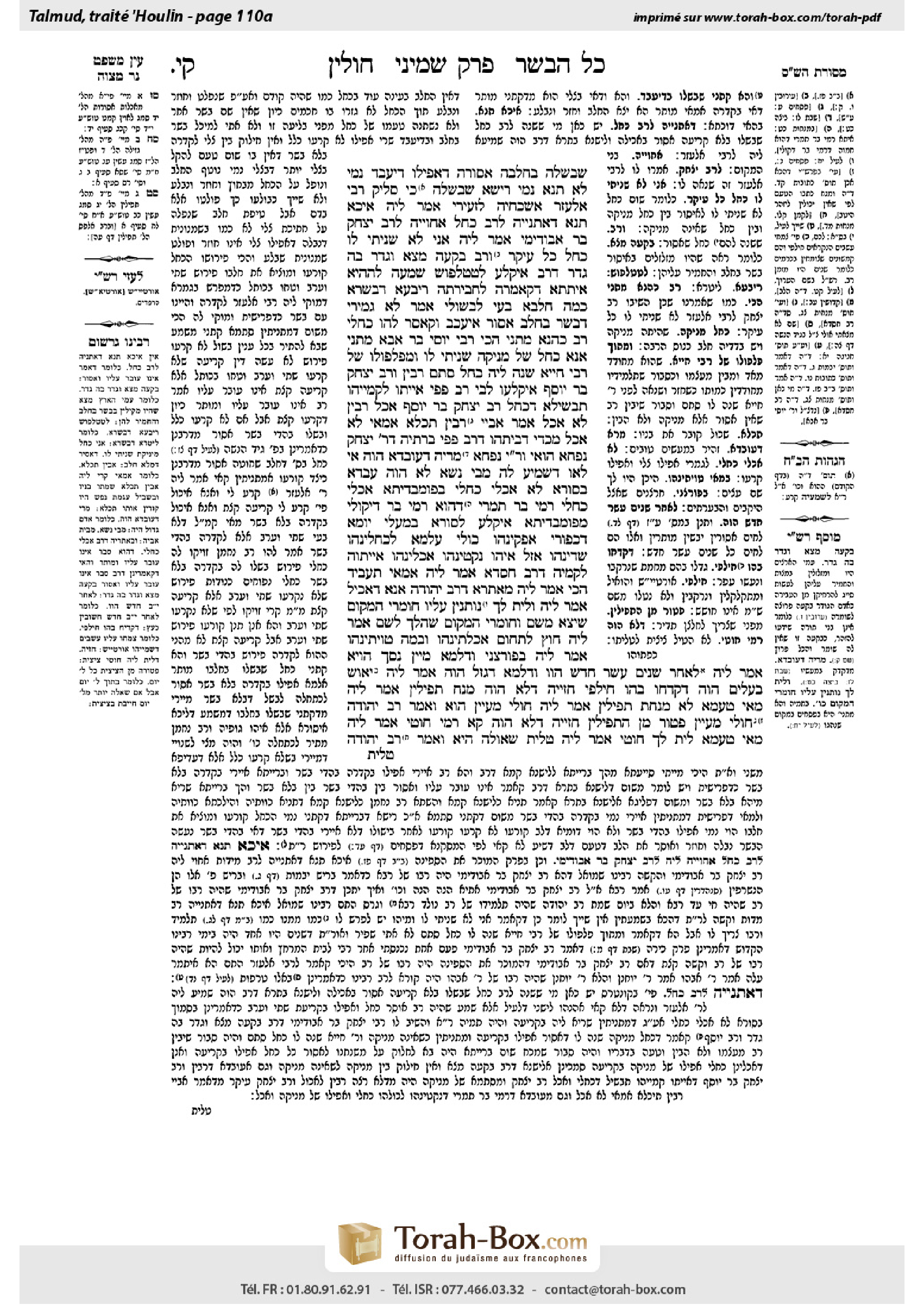
Chullin 110a: Talmud study for Daf Yomi
Study the Talmud for Daf Yomi with scanned pages, Hebrew text, English translations from Sefaria and AI-generated French translations.
Passage selection and English or AI-generated French translation are available where the scan has annotations. Daf Study is independent of Torah-Box and Sefaria.
Browse Chullin · חולין · All tractatesChullin 110a text and translations
This page of Chullin includes the Aramaic text, an English translation and an AI-generated French translation, alongside the scan above.
חולין ק״י א · Aramaic and Hebrew text
שֶׁבִּשְּׁלָהּ בַּחֲלָבָהּ – אֲסוּרָה, דַּאֲפִילּוּ דִּיעֲבַד נָמֵי לָא, תְּנָא נָמֵי רֵישָׁא שֶׁבִּשְּׁלָהּ.
כִּי סְלֵיק רַבִּי אֶלְעָזָר, אַשְׁכְּחֵיהּ לִזְעֵירִי, אֲמַר לֵיהּ: אִיכָּא תַּנָּא דְּאַתְנְיֵיהּ לְרַב כְּחָל? אַחְוְיֵיהּ לְרַב יִצְחָק בַּר אֲבוּדִימִי. אֲמַר לֵיהּ: אֲנִי לֹא שָׁנִיתִי לוֹ כְּחָל כׇּל עִיקָּר, וְרַב – בִּקְעָה מָצָא וְגָדַר בָּהּ גָּדֵר.
דְּרַב אִיקְּלַע לְטַטְלְפוּשׁ, שַׁמְעַהּ לְהַהִיא אִיתְּתָא דְּקָאָמְרָה לַחֲבִירְתַּהּ: רִיבְעָא דְּבִשְׂרָא כַּמָּה חֲלָבָא בָּעֵי לְבַשּׁוֹלֵי? אָמַר: לָא גְּמִירִי דְּבָשָׂר בְּחָלָב אָסוּר, אִיעַכַּב (וְקָאָסַר) [וַאֲסַר] לְהוּ כַּחְלֵי.
רַב כָּהֲנָא מַתְנֵי הָכִי. רַבִּי יוֹסֵי בַּר אַבָּא מַתְנֵי: אֲנָא, כְּחָל שֶׁל מְנִיקָה שָׁנִיתִי לוֹ, וּמִפִּלְפּוּלוֹ שֶׁל רַב חִיָּיא שְׁנָה לֵיהּ כְּחָל סְתָם.
רָבִין וְרַב יִצְחָק בַּר יוֹסֵף אִיקְּלַעוּ לְבֵי רַב פַּפֵּי, אַיְיתוֹ לְקַמַּיְיהוּ תַּבְשִׁילָא דִּכְחָל. רַב יִצְחָק בַּר יוֹסֵף אֲכַל, רָבִין לָא אֲכַל. אָמַר אַבָּיֵי: רָבִין תַּכָּלָא, אַמַּאי לָא אֲכַל? מִכְּדֵי, דְּבֵיתְהוּ דְּרַב פַּפֵּי בְּרַתֵּיה דְּרַבִּי יִצְחָק נַפָּחָא הֲוַאי, וְרַבִּי יִצְחָק נַפָּחָא מָרֵיהּ דְּעוֹבָדָא הֲוָה, אִי לָאו דִּשְׁמִיעַ לַהּ מִבֵּי נָשָׁא לָא הֲוָה עָבְדָא.
בְּסוּרָא לָא אָכְלִי כַּחְלֵי, בְּפוּמְבְּדִיתָא אָכְלִי כַּחְלֵי. רָמֵי בַּר תַּמְרֵי, דְּהוּא רָמֵי בַּר דִּיקּוּלֵי, מִפּוּמְבְּדִיתָא אִיקְּלַע לְסוּרָא בְּמַעֲלֵי יוֹמָא דְכִפּוּרֵי. אַפְּקִינְהוּ כּוּלֵּי עָלְמָא לְכַחְלִינְהוּ שְׁדִינְהוּ, אֲזַל אִיהוּ נַקְטִינְהוּ אַכְלִינְהוּ.
אַיְיתוּהּ לְקַמֵּיהּ דְּרַב חִסְדָּא, אֲמַר לֵיהּ: אַמַּאי תַּעֲבֵיד הָכִי? אֲמַר לֵיהּ: מֵאַתְרָא דְּרַב יְהוּדָה אֲנָא, דְּאָכֵיל. אֲמַר לֵיהּ: וְלֵית לָךְ נוֹתְנִין עָלָיו חוּמְרֵי הַמָּקוֹם שֶׁיָּצָא מִשָּׁם וְחוּמְרֵי הַמָּקוֹם שֶׁהָלַךְ לְשָׁם? אֲמַר לֵיהּ: חוּץ לַתְּחוּם אֲכַלְתִּינְהוּ.
וּבְמָה טְוִיתִינְהוּ? אֲמַר לֵיהּ: בְּפוּרְצָנֵי. וְדִלְמָא מִיֵּין נֶסֶךְ (הָוְיָא) [הֲווֹ]? אֲמַר לֵיהּ: לְאַחַר שְׁנֵים עָשָׂר חֹדֶשׁ הֲווֹ.
וְדִלְמָא דְּגָזֵל הֲוָה? אֲמַר לֵיהּ: יֵאוּשׁ בְּעָלִים הֲוָה, דִּקְדַחוּ בְּהוּ חִילְפֵי.
חַזְיֵיהּ דְּלָא הֲוָה מַנַּח תְּפִילִּין, אֲמַר לֵיהּ: מַאי טַעְמָא לָא מַנְּחַתְּ תְּפִילִּין? אֲמַר לֵיהּ: חוֹלֵי מֵעַיִין הוּא, וְאָמַר רַב יְהוּדָה: חוֹלֵי מֵעַיִין פָּטוּר מִן הַתְּפִילִּין.
חַזְיֵיהּ דְּלָא הֲוָה קָא רָמֵי חוּטֵי, אֲמַר לֵיהּ: מַאי טַעְמָא לֵית לָךְ חוּטֵי? אֲמַר לֵיהּ: טַלִּית שְׁאוּלָה הִיא, וְאָמַר רַב יְהוּדָה:
Chullin 110a · English translation
of a suckling lamb or calf that one cooked together with the milk it contains is prohibited. There, even if one roasted it he may not eat it after the fact. To preserve symmetry, the tanna of the baraita taught in the first clause in this manner as well, stating: An udder that one cooked in its milk is permitted.
§ The Gemara above cited a second version of Rav’s opinion, according to which an udder that was roasted without being torn is prohibited for consumption. The Gemara relates: When Rabbi Elazar ascended from Babylonia to Eretz Yisrael he found Ze’eiri and said to him: Is there a tanna who taught Rav that an udder roasted without first being torn is prohibited? Ze’eiri showed him Rav Yitzḥak bar Avudimi. Rav Yitzḥak bar Avudimi said to Rabbi Elazar: I did not teach Rav that an udder is prohibited at all; rather, Rav found an unguarded valley and fenced it in. Rav taught this stringent ruling as an additional safeguard in Babylonia, where Jews were not careful about the prohibition of meat cooked in milk.
The Gemara elaborates: As when Rav arrived in Tatlefush, he heard a certain woman saying to another: How much milk does it require to cook a quarter weight of meat? Rav said: Evidently, these people are not learned enough in halakha to know that meat cooked in milk is prohibited. Rav tarried in that place, and prohibited even udders to them, so that they would not come to violate the prohibition of meat cooked in milk.
Rav Kahana teaches that Rav Yitzḥak bar Avudimi replied to Rabbi Elazar in that manner described above. By contrast, Rabbi Yosei bar Abba teaches that Rav Yitzḥak bar Avudimi said: I taught Rav only that the udder of an animal nursing offspring is prohibited, as its udder contains much milk. And due to the sharp mind of Rav Ḥiyya, Rav’s teacher, he assumed that Rav too would understand this without his saying so explicitly. Therefore, he taught this halakha to Rav with regard to an unspecified udder. Rav mistakenly thought that the ruling applies to all animals.
The Gemara relates that Ravin and Rav Yitzḥak bar Yosef arrived at the house of Rav Pappi. The servants brought before them a dish made of udder. Rav Yitzḥak bar Yosef ate of it, but Ravin did not eat. Abaye said: Bereaved Ravin, why do you not eat? After all, Rav Pappi’s wife is the daughter of Rabbi Yitzḥak Nappaḥa, and Rabbi Yitzḥak Nappaḥa was a master of good deeds, who was meticulous in his performance of mitzvot. Had Rav Pappi’s wife not heard in her father’s house that such a dish is permitted, she would not have made it.
The Gemara relates: In Sura they would not eat udders at all, even torn and roasted. But in Pumbedita they would eat udders. Rami bar Tamrei, who is also called Rami bar Dikulei, from Pumbedita, arrived in Sura on the eve of Yom Kippur. Since it is a mitzva to eat and drink then, large quantities of meat were cooked, and everyone brought out their udders from the animals they had slaughtered and threw them away. Rami bar Tamrei went and gathered the udders, roasted them, and ate them, in accordance with his custom.
The residents of Sura brought Rami bar Tamrei before Rav Ḥisda, who said to him: Why did you do this? Rami bar Tamrei said to Rav Ḥisda: I am from the place of Rav Yehuda, who eats udders, and this is the accepted custom in Pumbedita. Rav Ḥisda said to him: And do you not hold by the principle that the Sages impose upon a traveler the stringencies of the place that he left and also the stringencies of the place to which he went? You should have accepted the stringency of Sura and not eaten the udders. Rami bar Tamrei said to Rav Ḥisda: That principle applies only to one who remains in the place he is visiting, but I ate the udders outside the boundaries of Sura.
Rav Ḥisda further asked Rami bar Tamrei: And with what did you roast the udders? Rami bar Tamrei said to him: I roasted them with grape seeds [purtzenei] I found in the vines there. Rav Ḥisda objected: But how could you roast the udders with grape seeds, as perhaps they were from wine used for a libation to idolatry, from which it is prohibited to derive benefit. Rami bar Tamrei said to him: These were old seeds that still lay there after twelve months had passed since the grapes were used, and any prohibition had expired, as by that point they are assumed to have lost any prohibited liquid that previously remained inside (see Avoda Zara 34a).
Rav Ḥisda further objected: But perhaps these seeds were from stolen property, i.e., they belonged to someone and it was prohibited for you to take them. Rami bar Tamrei said to him: Even so, in this case there was certainly despair of the owners of recovering them, as grass was growing among them. Since the owners had allowed them to lie there for so long, they had clearly given up all hope of retrieving them.
Rav Ḥisda saw that Rami bar Tamrei had not donned phylacteries, and said to him: What is the reason that you have not donned phylacteries? Rami bar Tamrei said to him: He, i.e., I, am suffering from intestinal illness, and Rav Yehuda said that one who has intestinal illness is exempt from the mitzva of phylacteries, which require a clean body, because he would have to remove them constantly to defecate.
Rav Ḥisda further saw that Rami bar Tamrei had not placed the threads of ritual fringes on his garment and said to him: What is the reason that you do not have the threads of ritual fringes? Rami bar Tamrei said to him: It is a borrowed robe, and Rav Yehuda said:
Chullin 110a · Traduction française (IA)
d'un agneau ou d'un veau tetaire que l'on a cuits avec le lait qu'il contient est interdit. Là, même si l'on a grillé ce bœuf, on ne peut pas le manger après. Pour préserver la symétrie, le tanna de la baraïta a enseigné dans la première phrase de cette manière également, en disant : Une mamelle cuite dans son lait est permise.
§ Le Guemara a cité ci-dessus une autre version de l'opinion de Rav, selon laquelle une mamelle grillée sans être déchirée est interdite à la consommation. Le Guemara rapporte : Quand Rabbi Eléazar est monté de Babylone vers la Terre d'Israël, il a trouvé Zé'iri et lui a dit : Y a-t-il un tanna qui a enseigné Rav que une mamelle grillée sans être d'abord déchirée est interdite ? Zé'iri lui a montré Rav Yitzḥak bar Avudimi. Rav Yitzḥak bar Avudimi a dit à Rabbi Eléazar : Je n'ai pas enseigné Rav que la mamelle est interdite du tout ; plutôt, Rav a trouvé un vallon non gardé et l'a clôturé. Rav a enseigné cette règle stricte comme une mesure de précaution supplémentaire en Babylone, où les Juifs ne prenaient pas soin de l'interdiction de la viande cuite avec le lait.
Le Guemara développe : Comme lorsque Rav est arrivé à Tatlefush, il a entendu une certaine femme dire à une autre : Combien de lait faut-il pour cuire un quart de poids de viande ? Rav a dit : Évidemment, ces gens ne sont pas suffisamment instruits en halakha pour savoir que la viande cuite avec le lait est interdite. Rav a resté dans ce lieu et a interdit même les mamelles à ces gens, afin qu'ils ne viennent pas à enfreindre l'interdiction de la viande cuite avec le lait.
Rav Kahana enseigne que Rav Yitzḥak bar Avudimi a répondu à Rabbi Eléazar de cette manière décrite ci-dessus. En revanche, Rabbi Yosei bar Abba enseigne que Rav Yitzḥak bar Avudimi a dit : J'ai enseigné à Rav seulement que la mamelle d'un animal allaitant des petits est interdite, car sa mamelle contient beaucoup de lait. Et grâce à l'esprit aigu de Rav Ḥiyya, le maître de Rav, il a supposé que Rav lui-même comprendrait cela sans qu'il ne le dise explicitement. Ainsi, il a enseigné cette halakha à Rav concernant une mamelle indéterminée. Rav a mal compris que cette règle s'applique à tous les animaux.
Le Guemara rapporte que Rabin et Rav Yitzḥak bar Yosef sont arrivés chez Rav Pappi. Les serviteurs leur ont présenté un plat de mamelle. Rav Yitzḥak bar Yosef a mangé de ce plat, mais Rabin n'a pas mangé. Abaye a dit : Rabin triste, pourquoi ne manges-tu pas ? Après tout, la femme de Rav Pappi est la fille de Rabbi Yitzḥak Nappaḥa, et Rabbi Yitzḥak Nappaḥa était un maître de bonnes œuvres, qui était minutieux dans l'accomplissement des mitsvot. Si la femme de Rav Pappi n'avait pas entendu chez son père que ce plat était permis, elle ne l'aurait pas fait.
Le Guemara rapporte : À Sura, on ne mangeait pas de mamelles du tout, même déchirées et grillées. Mais à Pumbedita, on mangeait des mamelles. Rami bar Tamrei, qui est aussi appelé Rami bar Dikulei, provenant de Pumbedita, est arrivé à Sura à la veille de Yom Kippur. Puisqu'il est un mitsva de manger et de boire alors, de grandes quantités de viande ont été cuites, et tout le monde a sorti les mamelles des animaux qu'ils avaient sacrifiés et les a jetées. Rami bar Tamrei est allé récolter les mamelles, les a grillées et les a mangées, conformément à sa coutume.
Les habitants de Sura ont amené Rami bar Tamrei devant Rav Ḥisda, qui lui a dit : Pourquoi as-tu fait cela ? Rami bar Tamrei a répondu à Rav Ḥisda : Je viens de la place de Rav Yéhuda, qui mange des mamelles, et c'est la coutume acceptée à Pumbedita. Rav Ḥisda lui a dit : Et ne tiens-tu pas par le principe que les Sages imposent à un voyageur les stringences du lieu qu'il a quitté ainsi que celles du lieu où il est allé ? Tu aurais dû accepter la stringence de Sura et ne pas manger les mamelles. Rami bar Tamrei a répondu à Rav Ḥisda : Ce principe s'applique seulement à celui qui reste dans le lieu qu'il visite, mais j'ai mangé les mamelles en dehors des limites de Sura.
Rav Ḥisda a encore interrogé Rami bar Tamrei : Et avec quoi as-tu grillé les mamelles ? Rami bar Tamrei a répondu à lui : J'ai grillé les mamelles avec des graines de raisin [purtzenei] que j'ai trouvées dans les vignes là-bas. Rav Ḥisda a objecté : Mais comment pouvais-tu griller les mamelles avec des graines de raisin, car peut-être elles provenaient du vin utilisé pour une libation idolâtre, d'où il est interdit d'en tirer un bénéfice. Rami bar Tamrei a répondu à lui : Ces graines étaient des graines anciennes qui restaient encore là après douze mois depuis que les raisins avaient été utilisés, et toute prohibition avait expiré, car à ce moment-là on suppose qu'elles avaient perdu toute liquide interdit qui était resté à l'intérieur (voir Avoda Zara 34a).
Rav Ḥisda a encore objecté : Mais peut-être ces graines appartenaient à un vol, c'est-à-dire qu'elles appartenaient à quelqu'un et il était interdit pour toi de les prendre. Rami bar Tamrei a répondu à lui : Même ainsi, dans ce cas, les propriétaires avaient certainement perdu espoir de les récupérer, car de l'herbe poussait parmi elles. Puisque les propriétaires avaient permis qu'elles restent là si longtemps, ils avaient clairement abandonné tout espoir de les récupérer.
Rav Ḥisda vit que Rami bar Tamrei n'avait pas mis les phylacteries, et lui dit : Quelle est la raison que tu n'as pas mis les phylacteries ? Rami bar Tamrei lui répondit : C'est moi qui souffre d'une maladie intestinale, et Rav Yehuda dit que celui qui souffre d'une maladie intestinale est exempt de la mitsva des phylacteries, car celle-ci exige un corps propre, car il devrait retirer constamment les phylacteries pour déféquer.
Rav Ḥisda vit ensuite que Rami bar Tamrei n'avait pas mis les fils des franges rituelles sur sa robe et lui dit : Quelle est la raison que tu n'as pas les fils des franges rituelles ? Rami bar Tamrei lui répondit : C'est une robe empruntée, et Rav Yehuda dit :
Traduction française générée par IA à partir de l’édition anglaise de Sefaria. Vérifie toujours un passage avec le texte source.
Text from Sefaria: William Davidson Edition - Vocalized Aramaic (unknown); William Davidson Edition - English (CC BY NC).