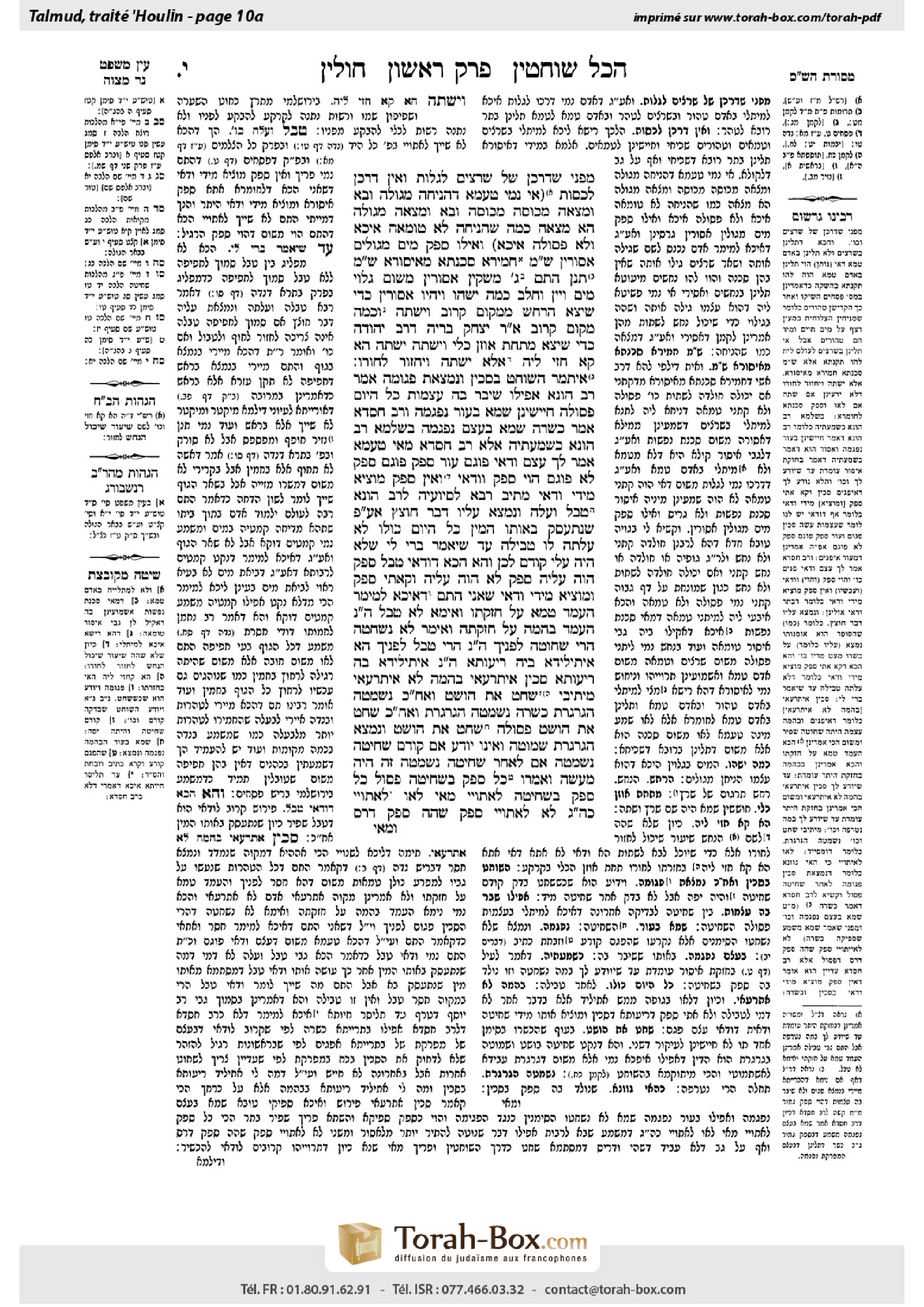
Chullin 10a: Talmud study for Daf Yomi
Study the Talmud for Daf Yomi with scanned pages, Hebrew text, English translations from Sefaria and AI-generated French translations.
Passage selection and English or AI-generated French translation are available where the scan has annotations. Daf Study is independent of Torah-Box and Sefaria.
Browse Chullin · חולין · All tractatesChullin 10a text and translations
This page of Chullin includes the Aramaic text, an English translation and an AI-generated French translation, alongside the scan above.
חולין י׳ א · Aramaic and Hebrew text
מִפְּנֵי שֶׁדַּרְכָּן שֶׁל שְׁרָצִים לְגַלּוֹת, וְאֵין דַּרְכָּן לְכַסּוֹת.
אִי נָמֵי, טַעְמָא דְּהִנִּיחָהּ מְגוּלָּה וּבָא וּמְצָאָהּ מְכוּסָּה, מְכוּסָּה וּבָא וּמְצָאָהּ מְגוּלָּה, הָא מְצָאָהּ כְּמָה שֶׁהִנִּיחָהּ – לָא טוּמְאָה אִיכָּא וְלָא פְּסוּלָא אִיכָּא.
וְאִילּוּ סְפֵק מַיִם מְגוּלִּים אֲסוּרִין, שְׁמַע מִינַּהּ: חֲמִירָא סַכַּנְתָּא מֵאִיסּוּרָא, שְׁמַע מִינַּהּ.
תְּנַן הָתָם: שְׁלֹשָׁה מַשְׁקִין אֲסוּרִין מִשּׁוּם גִּלּוּי – מַיִם, וְיַיִן, וְחָלָב. כַּמָּה יִשְׁהוּ וְיִהְיוּ אֲסוּרִין? כְּדֵי שֶׁיֵּצֵא הָרַחַשׁ מִמָּקוֹם קָרוֹב וְיִשְׁתֶּה. וְכַמָּה מָקוֹם קָרוֹב? אָמַר רַב יִצְחָק בְּרֵיהּ דְּרַב יְהוּדָה: כְּדֵי שֶׁיֵּצֵא מִתַּחַת אוֹזֶן כְּלִי וְיִשְׁתֶּה.
יִשְׁתֶּה? הָא קָא חָזֵי לֵיהּ! אֶלָּא, יִשְׁתֶּה וְיַחֲזוֹר לְחוֹרוֹ.
אִיתְּמַר: הַשּׁוֹחֵט בְּסַכִּין וְנִמְצֵאת פְּגוּמָה, אָמַר רַב הוּנָא: אֲפִילּוּ שִׁיבֵּר בָּהּ עֲצָמוֹת כׇּל הַיּוֹם – פְּסוּלָה, חָיְישִׁינַן שֶׁמָּא בָּעוֹר נִפְגְּמָה. וְרַב חִסְדָּא אָמַר: כְּשֵׁרָה, שֶׁמָּא בְּעֶצֶם נִפְגְּמָה.
בִּשְׁלָמָא רַב הוּנָא כִּשְׁמַעְתֵּיהּ, אֶלָּא רַב חִסְדָּא מַאי טַעְמָא? אָמַר לָךְ: עֶצֶם – וַדַּאי פּוֹגֵם, עוֹר – סָפֵק פּוֹגֵם סָפֵק לָא פּוֹגֵם, הָוֵי סָפֵק וּוַדַּאי, וְאֵין סָפֵק מוֹצִיא מִידֵי וַדַּאי.
מֵתִיב רָבָא לְסַיּוֹעֵיהּ לְרַב הוּנָא: טָבַל וְעָלָה, וְנִמְצָא עָלָיו דָּבָר חוֹצֵץ, אַף עַל פִּי שֶׁנִּתְעַסֵּק בְּאוֹתוֹ הַמִּין כׇּל הַיּוֹם כּוּלּוֹ – לֹא עָלְתָה לוֹ טְבִילָה, עַד שֶׁיֹּאמַר: ״בָּרִי לִי שֶׁלֹּא הָיָה עָלַי קוֹדֶם לָכֵן״. וְהָא הָכָא, דְּוַדַּאי טָבַל, סָפֵק הֲוָה עֲלֵיהּ סָפֵק לָא הֲוָה עֲלֵיהּ, וְקָאָתֵי סָפֵק וּמוֹצִיא מִידֵי וַדַּאי!
שָׁאנֵי הָתָם, דְּאִיכָּא לְמֵימַר: הַעֲמֵד טָמֵא עַל חֶזְקָתוֹ, וְאֵימַר לֹא טָבַל.
הָכָא נָמֵי, הַעֲמֵד בְּהֵמָה עַל חֶזְקָתָהּ, וְאֵימַר לֹא נִשְׁחֲטָה! הֲרֵי שְׁחוּטָה לְפָנֶיךָ.
הָכָא נָמֵי, הֲרֵי טָבַל לְפָנֶיךָ! הָא אִיתְיְלִידָא בֵּיהּ רֵיעוּתָא.
הָכָא נָמֵי אִיתְיְלִידָא בַּהּ רֵיעוּתָא! סַכִּין אִיתְרְעַאי, בְּהֵמָה לָא אִיתְרְעַאי.
מֵיתִיבִי: שָׁחַט אֶת הַוֶּשֶׁט וְאַחַר כָּךְ נִשְׁמְטָה הַגַּרְגֶּרֶת – כְּשֵׁרָה, נִשְׁמְטָה הַגַּרְגֶּרֶת וְאַחַר כָּךְ שָׁחַט אֶת הַוֶּשֶׁט – פְּסוּלָה.
שָׁחַט אֶת הַוֶּשֶׁט (ונמצא) [וְנִמְצֵאת] הַגַּרְגֶּרֶת שְׁמוּטָה, וְאֵינוֹ יוֹדֵעַ אִם קוֹדֶם שְׁחִיטָה נִשְׁמְטָה אִם לְאַחַר שְׁחִיטָה נִשְׁמְטָה, זֶה הָיָה מַעֲשֶׂה, וְאָמְרוּ: כׇּל סְפֵק בִּשְׁחִיטָה פָּסוּל.
כׇּל סָפֵק בִּשְׁחִיטָה לְאֵתוֹיֵי מַאי? לָאו לְאֵתוֹיֵי כְּהַאי גַוְונָא? לָא, לְאֵתוֹיֵי סָפֵק שָׁהָה, סָפֵק דָּרַס.
Chullin 10a · English translation
It is due to the fact that it is the typical manner of creeping animals to expose the contents of a vessel so that they may drink. Therefore, the exposure of the water is attributed to a creeping animal or to a ritually pure person. By contrast, in a case where he left the vessel exposed and found it covered, the concern is that it was an impure man who covered it, since it is not the typical manner of creeping animals to cover exposed vessels. Evidently, with regard to prohibition or ritual impurity, there are circumstances of uncertainty when the ruling is lenient.
Alternatively, it can be inferred from the baraita that the reason the contents of the vessel are impure or disqualified, respectively, is that he left it exposed and came back and found it covered or that he left it covered and came back and found it exposed. But if he found the vessel just as he left it, there is neither impurity nor disqualification.
But in a situation of uncertainty where he left exposed water and then came and found the vessel exposed, the water is forbidden under all circumstances. Learn from it that danger is more severe than prohibition. The Gemara affirms: Indeed, learn from it.
We learned in a mishna there (Terumot 8:4): Three liquids are forbidden due to exposure: Water, wine, and milk. How long shall they remain exposed and their contents will be forbidden? It is a period equivalent to the time necessary so that a snake could emerge from a proximate place and drink. And how far away is considered a proximate place? Rav Yitzḥak, son of Rav Yehuda, said: Even a period equivalent to the time necessary so that a snake could emerge from beneath the handle of the vessel and drink.
The Gemara asks: If it is only the time necessary for the snake to emerge and drink, doesn’t one see the snake drink, in which case there is no uncertainty? Rather, it is a period equivalent to the time necessary for a snake to emerge from a proximate place, drink, and return to its hole. If one left exposed liquid unattended for that interval, it is possible that the snake drank the liquid unseen by the owner of the liquid.
§ It was stated: With regard to one who slaughters an animal with a knife that was afterward found to be notched, Rav Huna says: Even if, after the slaughter and before the knife was examined, he broke bones with the knife all day, the slaughter is not valid, as we are concerned that perhaps the knife became notched on the hide of the neck. And Rav Ḥisda says: The slaughter is valid, as perhaps it was on the bone that he broke with the knife after the slaughter that it became notched.
The Gemara asks: Granted, Rav Huna stated his opinion in accordance with his halakha cited earlier (9a): An animal during its lifetime exists with the presumptive status of prohibition until it becomes known in what manner it was slaughtered. But as for Rav Ḥisda, what is the reason for his ruling that the slaughter is valid? The Gemara answers that Rav Ḥisda could have said to you: A bone certainly notches the knife, but with regard to hide, it is uncertain whether it notches the knife and uncertain whether it does not notch it. This is a case of certainty and uncertainty, and the principle is that an uncertainty does not override a certainty.
Rava raises an objection to the opinion of Rav Ḥisda to support the opinion of Rav Huna, from a baraita: If one immersed and emerged from the ritual bath and an interposing item was later found on him, then even if he had been engaged in handling that same type of item for the entire day after his immersion, the immersion does not fulfill his obligation. This is so until he will say: It is clear to me that this interposition was not on me beforehand. And here it is a case where he certainly immersed, and it is uncertain whether the interposition was on him at that time and uncertain whether it was not on him, and nevertheless, contrary to the opinion of Rav Ḥisda, the uncertainty overrides the certainty.
The Gemara rejects that proof: It is different there, as it can be said: Establish the status of the impure person on the basis of his presumptive status of impurity, and say that he did not immerse properly.
The Gemara challenges: Here too, establish the status of the animal on the basis of its presumptive status of prohibition and say that it was not slaughtered properly. Why does Rav Ḥisda rule that it is permitted? The Gemara explains: That status has been undermined, as the slaughtered animal is before you. There is no indication that the slaughter was not valid, and most slaughtered animals are slaughtered properly.
The Gemara challenges: Here too, in the case of immersion, the status of impurity is undermined, as the person who has immersed is before you. The Gemara explains: The case of immersion is different, as a flaw developed in the presumptive validity of the immersion, since there is an interposition.
The Gemara challenges: Here too, a flaw developed in the presumptive validity of slaughter, as the knife is notched. The Gemara explains: In the case of slaughter, the knife became flawed, but the animal did not become flawed. Therefore, the animal assumes the presumptive status of permissibility. By contrast, in the case of immersion, the interposition was found on the person, thereby nullifying his presumptive status of purity.
The Gemara raises an objection to the opinion of Rav Ḥisda from a baraita: The slaughter of a bird is valid with the cutting of one siman, the windpipe or the gullet. Therefore, if one cut the gullet, and the windpipe was displaced thereafter, the slaughter is valid. If the windpipe was displaced and one cut the gullet thereafter, the slaughter is not valid.
If one cut the gullet, and the windpipe was found displaced, and he does not know whether the windpipe was displaced before the slaughter or whether it was displaced after the slaughter; that was the incident that came before the Sages, and they said: In any case of uncertainty with regard to slaughter, the slaughter is not valid.
The Gemara asks: With regard to the expansive formulation: With regard to any case of uncertainty with regard to slaughter, what does it serve to add? Does it not serve to add a case like this one where there is uncertainty whether the knife was notched before or after the slaughter? The Gemara answers: No, it serves to add a case of uncertainty whether he interrupted the slaughter in the middle, or uncertainty whether he pressed the knife on the simanim. If he did either, it invalidates the slaughter.
Chullin 10a · Traduction française (IA)
C'est à cause du fait que c'est la manière typique des animaux rampants d'exposer le contenu d'un récipient afin qu'ils puissent boire. Ainsi, l'exposition de l'eau est attribuée à un animal rampant ou à une personne rituellement pure. En revanche, dans le cas où il a laissé le récipient exposé et l'a trouvé recouvert, la préoccupation est que c'était un homme impur qui l'avait recouvert, car ce n'est pas la manière typique des animaux rampants de recouvrir des récipients exposés. Évidemment, concernant l'interdiction ou la souillure rituelle, il existe des circonstances d'incertitude où la décision est clémente.
Une autre interprétation peut être tirée de la baraïta : la raison pour laquelle le contenu du récipient est souillé ou disqualifié, respectivement, est qu'il l'a laissé exposé et est revenu le trouver recouvert ou qu'il l'a laissé recouvert et est revenu le trouver exposé. Mais s'il a trouvé le récipient exactement tel qu'il l'avait laissé, il n'y a ni souillure ni disqualification.
Mais dans un cas d'incertitude où il a laissé l'eau exposée et est revenu et l'a trouvée exposée, l'eau est interdite dans tous les cas. Apprenez-en que le danger est plus grave que l'interdiction. La Guemara affirme : En effet, apprenez-en.
Nous avons appris dans une mitsva là (Terouma 8:4) : Trois liquides sont interdits en raison de l'exposition : l'eau, le vin et le lait. Pendant combien de temps doivent-ils rester exposés pour que leur contenu devienne interdit ? C'est une période équivalente au temps nécessaire pour qu'un serpent puisse sortir d'un lieu proche et boire. Et à quelle distance est considéré comme un lieu proche ? Rav Yitzḥak, fils de Rav Yehuda, a dit : Même une période équivalente au temps nécessaire pour qu'un serpent sorte du dessous de la poignée du récipient et boive.
La Guemara pose une question : Si c'est seulement le temps nécessaire pour que le serpent sorte et boive, ne voit-on pas le serpent boire, ce qui éliminerait l'incertitude ? Plutôt, c'est une période équivalente au temps nécessaire pour qu'un serpent sorte d'un lieu proche, boive et retourne dans son trou. Si l'on a laissé un liquide exposé sans surveillance pendant cette durée, il est possible que le serpent ait bu le liquide sans que l'propriétaire ne l'ait vu.
§ On a dit : Concernant celui qui sacrifie un animal avec un couteau qui a été trouvé ultérieurement rayé, Rav Huna dit : Même si, après la sacrifice et avant que le couteau ne soit examiné, il a cassé des os avec le couteau toute la journée, la sacrifice n'est pas valide, car nous craignons que le couteau ait été rayé sur la peau du cou. Et Rav Ḥisda dit : La sacrifice est valide, car peut-être c'était sur l'os qu'il a cassé avec le couteau après la sacrifice que le couteau s'est rayé.
La Guemara pose une question : C'est admis, Rav Huna a exprimé son opinion conformément à sa halakha citée plus tôt (9a) : L'animal pendant sa vie existe avec le statut présomptif d'interdiction jusqu'à ce qu'il soit connu de quelle manière il a été sacrifié. Mais concernant Rav Ḥisda, quelle est la raison de son jugement selon lequel la bête est valide ? La Guemara répond que Rav Ḥisda aurait pu dire à vous : L'os certifie certainement le rayage du couteau, mais concernant la peau, il est incertain si elle raye le couteau et incertain si elle ne le fait pas. C'est un cas de certitude et d'incertitude, et le principe est que l'incertitude ne remplace pas la certitude.
Rava soulève un objection contre l'opinion de Rav Ḥisda pour soutenir celle de Rav Huna, à partir d'une baraïta : Si l'on s'est immergé et est sorti du bain rituel et un objet interposant a été trouvé plus tard sur lui, alors même s'il avait été occupé à manipuler ce même type d'objet toute la journée après son immersion, l'immersion ne remplit pas son obligation. C'est ainsi jusqu'à ce qu'il dise : Il est clair pour moi que cet interposition n'était pas sur moi auparavant. Et ici, c'est un cas où il a certainement immergé, et il est incertain si l'interposition était sur lui à ce moment-là et incertain si elle ne l'était pas, et pourtant, contrairement à l'opinion de Rav Ḥisda, l'incertitude remplace la certitude.
La Guemara rejette cette preuve : C'est différent là-bas, car on peut dire : Établissez le statut de la personne souillée sur la base de son statut présomptif de souillure et dites qu'il n'a pas immergé correctement.
La Guemara conteste : Ici aussi, établissez le statut de l'animal sur la base de son statut présomptif d'interdiction et dites qu'il n'a pas été sacrifié correctement. Pourquoi Rav Ḥisda juge-t-il qu'il est permis ? La Guemara explique : Ce statut a été ébranlé, car l'animal sacrifié est devant vous. Il n'y a pas d'indication que la sacrifice n'était pas valide, et la plupart des animaux sacrifiés sont sacrifiés correctement.
La Guemara conteste : Ici aussi, dans le cas d'immersion, le statut de souillure est ébranlé, car la personne qui s'est immergée est devant vous. La Guemara explique : Le cas d'immersion est différent, car un défaut s'est développé dans la validité présomptive de l'immersion, en raison de l'interposition.
La Guemara conteste : Ici aussi, un défaut s'est développé dans la validité présomptive de la sacrifice, car le couteau est rayé. La Guemara explique : Dans le cas de la sacrifice, le couteau s'est détérioré, mais l'animal n'a pas été détérioré. Ainsi, l'animal assume le statut présomptif de permisibilité. En revanche, dans le cas d'immersion, l'interposition a été trouvée sur la personne, annulant ainsi son statut présomptif de pureté.
La Guemara soulève une objection contre l'opinion de Rav Ḥisda à partir d'une baraïta : La mise à mort d'un oiseau est valide avec la coupure d'un siman, le trachée ou le gosier. Ainsi, si l'on a coupé le gosier et que le trachée a été déplacé ensuite, la mise à mort est valide. Si le trachée a été déplacé et qu'on a coupé le gosier ensuite, la mise à mort n'est pas valide.
Si l'on coupe la gorge, et que l'on trouve la trachée déplacée, et qu'on ne sait pas si la trachée était déplacée avant la boucherie ou après la boucherie ; c'était l'incident qui est venu devant les Sages, et ils dirent : Dans tout cas d'incertitude concernant la boucherie, la boucherie n'est pas valide.
La Guemara demande : Concernant la formulation expansive : Concernant tout cas d'incertitude concernant la boucherie, à quoi sert-il d'ajouter ? N'est-ce pas pour ajouter un cas comme celui-ci où il y a incertitude quant à ce que le couteau n'était pas recourbé avant ou après la boucherie ? La Guemara répond : Non, cela sert à ajouter un cas d'incertitude quant à ce qu'il a interrompu la boucherie au milieu, ou d'incertitude quant à ce qu'il a appuyé le couteau sur les simanim. Si c'est le cas, cela invalidate la boucherie.
Traduction française générée par IA à partir de l’édition anglaise de Sefaria. Vérifie toujours un passage avec le texte source.
Text from Sefaria: William Davidson Edition - Vocalized Aramaic (unknown); William Davidson Edition - English (CC BY NC).