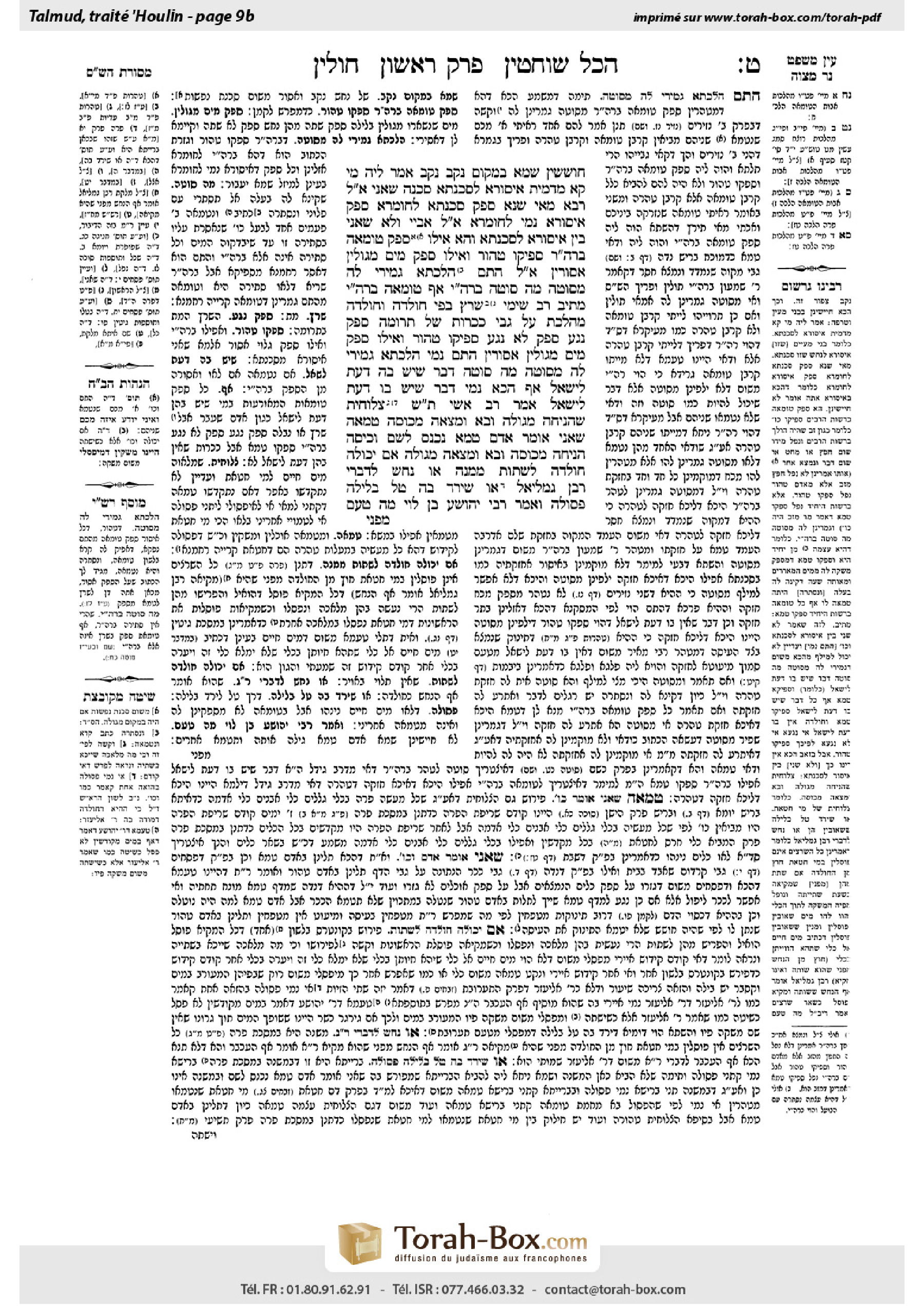
Chullin 9b: Talmud study for Daf Yomi
Study the Talmud for Daf Yomi with scanned pages, Hebrew text, English translations from Sefaria and AI-generated French translations.
Passage selection and English or AI-generated French translation are available where the scan has annotations. Daf Study is independent of Torah-Box and Sefaria.
Browse Chullin · חולין · All tractatesChullin 9b text and translations
This page of Chullin includes the Aramaic text, an English translation and an AI-generated French translation, alongside the scan above.
חולין ט׳ ב · Aramaic and Hebrew text
חוֹשְׁשִׁין שֶׁמָּא בִּמְקוֹם נֶקֶב נָקַב.
אֲמַר לֵיהּ: מִי קָא מְדַמֵּית אִיסּוּרָא לְסַכַּנְתָּא? סַכָּנָה שָׁאנֵי! אֲמַר לֵיהּ רָבָא: מַאי שְׁנָא? סְפֵק סַכַּנְתָּא לְחוּמְרָא? סְפֵק אִיסּוּרָא נָמֵי לְחוּמְרָא!
אֲמַר לֵיהּ אַבָּיֵי: וְלָא שָׁאנֵי בֵּין אִיסּוּרָא לְסַכַּנְתָּא? וְהָא אִילּוּ סְפֵק טוּמְאָה בִּרְשׁוּת הָרַבִּים – סְפֵיקוֹ טָהוֹר, וְאִילּוּ סְפֵק מַיִם מְגוּלִּין – אֲסוּרִין!
אֲמַר לֵיהּ: הָתָם הִלְכְתָא גְּמִירִי לַהּ מִסּוֹטָה, מָה סוֹטָה בִּרְשׁוּת הַיָּחִיד – אַף טוּמְאָה בִּרְשׁוּת הַיָּחִיד.
מֵתִיב רַב שִׁימִי: שֶׁרֶץ בְּפִי חוּלְדָּה, וְחוּלְדָּה מְהַלֶּכֶת עַל גַּבֵּי כִּכָּרוֹת שֶׁל תְּרוּמָה – סָפֵק נָגַע, סָפֵק לֹא נָגַע – סְפֵיקוֹ טָהוֹר, וְאִילּוּ סְפֵק מַיִם מְגוּלִּין אֲסוּרִין!
הָתָם נָמֵי הִלְכְתָא גְּמִירִי לַהּ מִסּוֹטָה: מָה סוֹטָה דָּבָר שֶׁיֵּשׁ בָּהּ דַּעַת לִישָּׁאֵל, אַף הָכָא נָמֵי דָּבָר שֶׁיֵּשׁ בּוֹ דַּעַת לִישָּׁאֵל.
אָמַר רַב אָשֵׁי, תָּא שְׁמַע: צְלוֹחִית שֶׁהִנִּיחָהּ מְגוּלָּה וּבָא וּמְצָאָהּ מְכוּסָּה – טְמֵאָה, שֶׁאֲנִי אוֹמֵר: אָדָם טָמֵא נִכְנַס לְשָׁם וְכִיסָּהּ.
הִנִּיחָהּ מְכוּסָּה וּבָא וּמְצָאָהּ מְגוּלָּה, אִם יְכוֹלָה חוּלְדָּה לִשְׁתּוֹת מִמֶּנָּה, אוֹ נָחָשׁ לְדִבְרֵי רַבָּן גַּמְלִיאֵל, אוֹ שֶׁיָּרַד בָּהּ טַל בַּלַּיְלָה – פְּסוּלָה.
וְאָמַר רַבִּי יְהוֹשֻׁעַ בֶּן לֵוִי: מָה טַעַם?
Chullin 9b · English translation
one is concerned that perhaps the bird or the mouse perforated it in the place of the preexisting perforation caused by a snake, and it is prohibited to eat the fig or the melon, due to the danger that the snake might have left its venom.
Rav Huna said to Rabbi Abba: Are you comparing danger to prohibition? Danger is different, and one rules stringently in cases involving danger. Rava said to him: What is different about the fact that the ruling in cases of uncertainty involving danger is stringent, given that in cases of uncertainty involving prohibition the ruling is also stringent?
Abaye said to Rava: And is there no difference between prohibition and danger? But isn’t it the halakha that in a case of uncertainty involving ritual impurity in the public domain, its uncertain impurity leaves it pure, while in a case of uncertainty involving water that is exposed and therefore susceptible to a snake leaving venom in it, the water is forbidden.
Rava said to Abaye: There, in the case of ritual impurity in the public domain, the Sages learned this halakha through tradition from the case of a sota, a woman who enters into seclusion with a particular man after her husband warns her not to. She is forbidden to her husband even though there is uncertainty whether or not she committed adultery. Just as a sota is forbidden only in a case of uncertainty in the private domain, as there is no seclusion in the public domain; so too with regard to ritual impurity, one becomes ritually impure in a case of uncertainty only in the private domain.
Rav Shimi raises an objection to the opinion of Rava from a mishna (Teharot 4:2): If the carcass of a creeping animal was in the mouth of a weasel, and that weasel was walking on loaves of teruma, and there is uncertainty whether the creeping animal touched the loaves and uncertainty whether it did not touch the loaves, its uncertain impurity leaves it pure, while in a case of uncertainty involving water that is exposed and therefore susceptible to a snake leaving venom in it, the water is forbidden.
The Gemara answers: There too, the halakha is derived from the case of a sota. Just as the uncertainty in the case of sota involves an entity that has consciousness in order for her to be asked whether she was unfaithful and is forbidden to her husband, so too here, only uncertainty involving an entity that has consciousness in order for it to be asked whether the loaves were rendered impure would become impure. The weasel does not have that consciousness.
Rav Ashi said: Come and hear additional proof that danger is more severe than prohibition (see mishna Para 11:1): In the case of a flask of purification water that one left exposed and he came back and found it covered, it is ritually impure, as I say: An impure man entered into there and covered it, and in the course of doing so he rendered the vessel and its contents impure.
In a case where one left the vessel covered and came back and found it exposed, if it is in a place where a weasel could drink from it, or a snake according to the statement of Rabban Gamliel, or if there is concern that dew fell into it at night, the purification waters are disqualified for sprinkling in the process of purification of a person impure with impurity imparted by a corpse, due to the concern that the saliva of the weasel or the dew, which are unfit for sprinkling, intermingled with it. Nevertheless, the water is not impure.
And Rabbi Yehoshua ben Levi says: What is the reason that there is no concern that a ritually impure person exposed the waters and rendered them impure?
Chullin 9b · Traduction française (IA)
on est préoccupé par le fait que peut-être l'oiseau ou la souris l'ont perforé à la place de la perforation préexistante causée par un serpent, et il est interdit de manger la figue ou le melon, en raison du danger que le serpent aurait pu laisser son venin.
Rav Huna dit à Rabbi Abba : Est-ce que tu compares le danger à l'interdiction ? Le danger est différent, et l'on applique la règle stricte dans les cas de danger. Rava dit à lui : Qu'est-ce qui rend différent le fait que la règle dans les cas d'incertitude concernant le danger est stricte, étant donné que dans les cas d'incertitude concernant l'interdiction, la règle est également stricte ?
Abaye dit à Rava : Et n'y a-t-il pas de différence entre l'interdiction et le danger ? Mais n'est-ce pas la halakha que dans un cas d'incertitude concernant la souillure rituelle dans le domaine public, l'incertitude de souillure le rend pure, tandis que dans un cas d'incertitude concernant l'eau exposée et donc susceptible d'avoir reçu le venin d'un serpent, l'eau est interdite.
Rava dit à Abaye : Là, dans le cas de souillure rituelle dans le domaine public, les Sages ont appris cette halakha par tradition à partir du cas d'une sota, une femme qui entre en retraite avec un homme particulier après que son mari l'ait avertie de ne pas le faire. Elle est interdite à son mari même s'il y a incertitude sur le fait qu'elle ait commis l'adultère. Tout comme la sota est interdite uniquement dans le cas d'incertitude dans le domaine privé, car il n'y a pas de retraite dans le domaine public ; de même, concernant la souillure rituelle, l'incertitude de souillure rend rituellement impur uniquement dans le domaine privé.
Rav Shimi émet un objet contre l'opinion de Rava à partir d'une mitsva (Teharot 4:2) : Si la carcasse d'un animal rampant était dans la bouche d'un blaireau, et que ce blaireau marchait sur des pains de terouma, et s'il y a incertitude sur le fait que l'animal rampant ait touché les pains et incertitude sur le fait qu'il n'ait pas touché les pains, l'incertitude de souillure le rend pure, tandis que dans le cas d'incertitude concernant l'eau exposée et donc susceptible d'avoir reçu le venin d'un serpent, l'eau est interdite.
La Guemara répond : Là aussi, la halakha est tirée du cas de la sota. Tout comme l'incertitude dans le cas de la sota implique un être conscient afin qu'elle soit interrogée sur son infidélité et soit interdite à son mari, de même ici, seule l'incertitude concernant un être conscient afin qu'il soit interrogé sur le fait que les pains aient été souillés rendrait impur. Le blaireau n'a pas cette conscience.
Rav Ashi dit : Viens entendre une preuve supplémentaire que le danger est plus grave que l'interdiction (voir mitsva Para 11:1) : Dans le cas d'une bouteille d'eau de purification laissée exposée, et qu'on revient et la trouve couverte, elle est rituellement impure, car je dis : un homme impur est entré là et l'a couverte, et en le faisant, il a rendu le vase et son contenu impurs.
Dans le cas où l'on a laissé le vase couvert et est revenu et l'a trouvé exposé, si c'est dans un lieu où un blaireau pourrait boire dedans, ou un serpent selon la déclaration de Rabban Gamliel, ou s'il y a une crainte que la rosée soit tombée dedans la nuit, les eaux de purification sont disqualifiées pour l'aspersion dans le processus de purification d'une personne souillée par la souillure d'un cadavre, en raison de la crainte que la salive du blaireau ou la rosée, qui ne sont pas adaptées à l'aspersion, aient été mélangées avec elle. Cependant, l'eau n'est pas impure.
Et Rabbi Yehoshua ben Levi dit : Quel est le motif qui fait que l'on n'a pas de crainte que la personne souillée ait exposé les eaux et les ait rendues impures ?
Traduction française générée par IA à partir de l’édition anglaise de Sefaria. Vérifie toujours un passage avec le texte source.
Text from Sefaria: William Davidson Edition - Vocalized Aramaic (unknown); William Davidson Edition - English (CC BY NC).