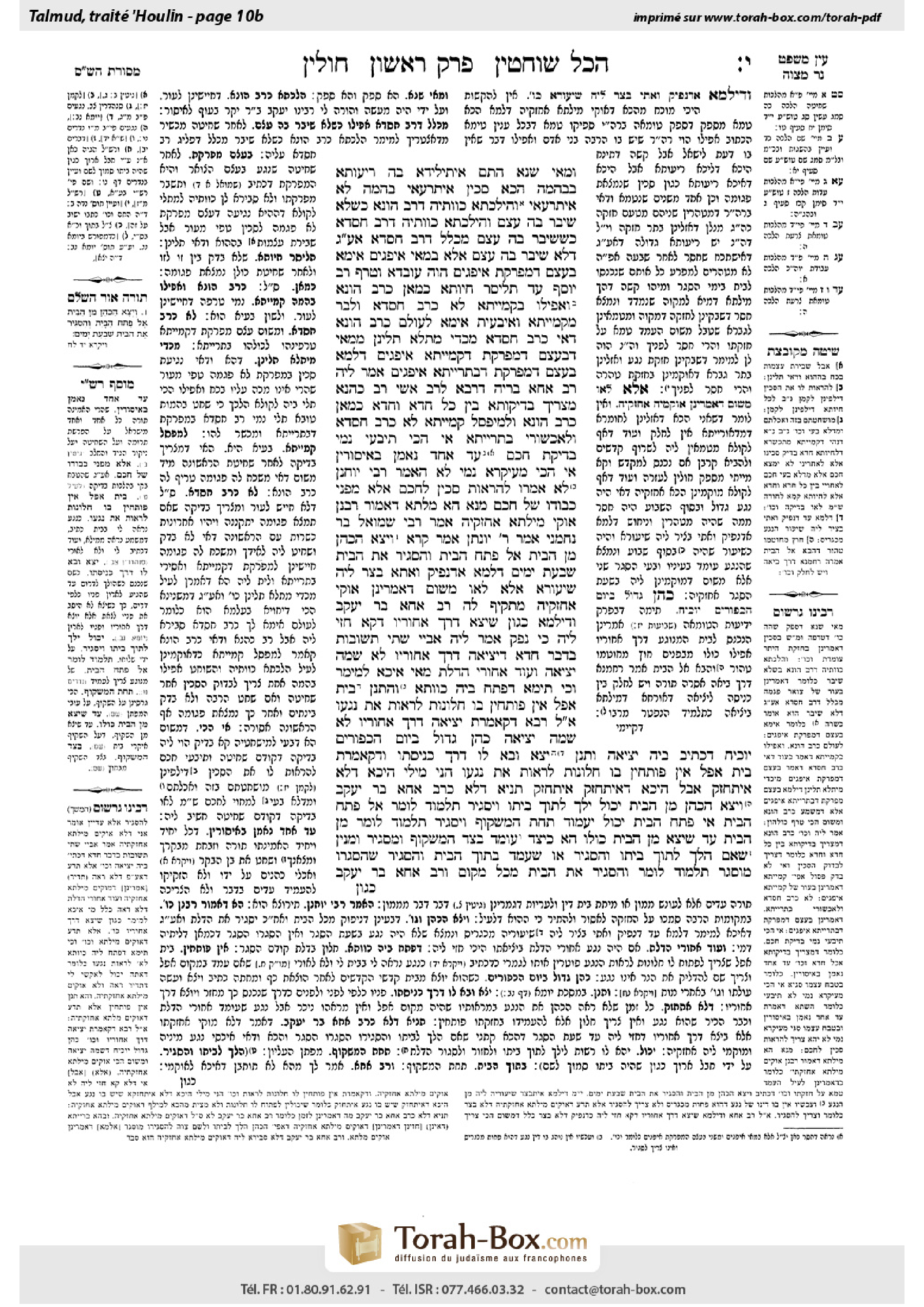
Chullin 10b: Talmud study for Daf Yomi
Study the Talmud for Daf Yomi with scanned pages, Hebrew text, English translations from Sefaria and AI-generated French translations.
Passage selection and English or AI-generated French translation are available where the scan has annotations. Daf Study is independent of Torah-Box and Sefaria.
Browse Chullin · חולין · All tractatesChullin 10b text and translations
This page of Chullin includes the Aramaic text, an English translation and an AI-generated French translation, alongside the scan above.
חולין י׳ ב · Aramaic and Hebrew text
וּמַאי שְׁנָא? הָתָם אִיתְיְלִידָא בַּהּ רֵיעוּתָא בִּבְהֵמָה, הָכָא סַכִּין אִיתְרְעַאי, בְּהֵמָה לָא אִיתְרְעַאי.
וְהִילְכְתָא כְּוָותֵיהּ דְּרַב הוּנָא, כְּשֶׁלֹּא שִׁיבֵּר בָּהּ עֶצֶם. וְהִילְכְתָא כְּוָותֵיהּ דְּרַב חִסְדָּא, כְּשֶׁשִּׁיבֵּר בָּהּ עֶצֶם. מִכְּלָל דְּרַב חִסְדָּא אַף עַל גַּב דְּלָא שִׁיבֵּר בָּהּ עֶצֶם? אֶלָּא בְּמַאי אִיפְּגִים? אֵימָא: בְּעֶצֶם דְּמַפְרֶקֶת אִיפְּגִים.
הֲוָה עוֹבָדָא וְטָרַף רַב יוֹסֵף עַד תְּלֵיסַר חֵיוָתָא, כְּמַאן? כְּרַב הוּנָא, וַאֲפִילּוּ בְּקַמַּיְיתָא? לָא, כְּרַב חִסְדָּא, וּלְבַר מִקַּמַּיְיתָא.
וְאִיבָּעֵית אֵימָא: לְעוֹלָם כְּרַב הוּנָא, דְּאִי כְּרַב חִסְדָּא, מִכְּדֵי מִתְלָא תָּלֵינַן, מִמַּאי דִּבְעֶצֶם דְּמַפְרֶקֶת דְּקַמַּיְיתָא אִיפְּגִים? דִּלְמָא בְּעֶצֶם דְּמַפְרֶקֶת דְּבָתְרָיְיתָא אִיפְּגִים!
אֲמַר לֵיהּ רַב אַחָא בְּרֵיהּ דְּרָבָא לְרַב אָשֵׁי: רַב כָּהֲנָא מַצְרֵיךְ בְּדִיקוּתָא בֵּין כֹּל חֲדָא וַחֲדָא. כְּמַאן? כְּרַב הוּנָא, וּלְמִיפְסַל קַמַּיְיתָא? לָא, כְּרַב חִסְדָּא, וּלְאַכְשׁוֹרֵי בָּתְרָיְיתָא.
אִי הָכִי, תִּיבְעֵי נָמֵי בְּדִיקַת חָכָם! עֵד אֶחָד נֶאֱמָן בְּאִיסּוּרִין. אִי הָכִי, מֵעִיקָּרָא נָמֵי לָא! הָאָמַר רַבִּי יוֹחָנָן: לֹא אָמְרוּ לְהַרְאוֹת סַכִּין לְחָכָם אֶלָּא מִפְּנֵי כְּבוֹדוֹ שֶׁל חָכָם.
מְנַָא הָא מִלְּתָא דַאֲמוּר רַבָּנַן: אוֹקֵי מִילְּתָא אַחֶזְקֵיהּ?
אָמַר רַבִּי שְׁמוּאֵל בַּר נַחְמָנִי אָמַר רַבִּי יוֹנָתָן, אָמַר קְרָא ״וְיָצָא הַכֹּהֵן מִן הַבַּיִת אֶל פֶּתַח הַבָּיִת וְהִסְגִּיר אֶת הַבַּיִת שִׁבְעַת יָמִים״, דִּלְמָא אַדְּנָפֵיק וְאָתֵא בְּצַר לֵיהּ שִׁיעוּרָא! אֶלָּא לָאו מִשּׁוּם דְּאָמְרִינַן אוֹקֵי אַחֶזְקֵיהּ.
מַתְקֵיף לַהּ רַב אַחָא בַּר יַעֲקֹב: וְדִילְמָא כְּגוֹן שֶׁיָּצָא דֶּרֶךְ אֲחוֹרָיו, דְּקָא חָזֵי לֵיהּ כִּי נָפֵק!
אֲמַר לֵיהּ אַבָּיֵי: שְׁתֵּי תְּשׁוּבוֹת בַּדָּבָר, חֲדָא, דִּיצִיאָה דֶּרֶךְ אֲחוֹרָיו לֹא שְׁמָהּ יְצִיאָה, וְעוֹד, אֲחוֹרֵי הַדֶּלֶת מַאי אִיכָּא לְמֵימַר? וְכִי תֵּימָא דְּפָתַח בֵּיהּ כַּוְּותָא – וְהָתְנַן: בַּיִת אָפֵל אֵין פּוֹתְחִין בּוֹ חַלּוֹנוֹת לִרְאוֹת אֶת נִגְעוֹ!
אֲמַר לֵיהּ רָבָא: דְּקָאָמְרַתְּ יְצִיאָה דֶּרֶךְ אֲחוֹרָיו לֹא שְׁמָהּ יְצִיאָה – כֹּהֵן גָּדוֹל בְּיוֹם הַכִּפּוּרִים יוֹכִיחַ, דִּכְתִיב בֵּיהּ יְצִיאָה, וּתְנַן: יָצָא וּבָא לוֹ דֶּרֶךְ כְּנִיסָתוֹ. וּדְקָאָמְרַתְּ בַּיִת אָפֵל אֵין פּוֹתְחִין בּוֹ חַלּוֹנוֹת לִרְאוֹת אֶת נִגְעוֹ – הָנֵי מִילֵּי הֵיכָא דְּלָא אִיתַּחְזַק, אֲבָל הֵיכָא דְּאִיתַּחְזַק – אִיתַּחְזַק.
תַּנְיָא דְּלָא כְּרַב אַחָא בַּר יַעֲקֹב, ״וְיָצָא הַכֹּהֵן מִן הַבַּיִת״ – יָכוֹל יֵלֵךְ לְתוֹךְ בֵּיתוֹ וְיַסְגִּיר? תַּלְמוּד לוֹמַר: ״אֶל פֶּתַח הַבָּיִת״.
אִי ״פֶּתַח הַבָּיִת״, יָכוֹל יַעֲמוֹד תַּחַת הַמַּשְׁקוֹף וְיַסְגִּיר? תַּלְמוּד לוֹמַר: ״מִן הַבַּיִת״ – עַד שֶׁיֵּצֵא מִן הַבַּיִת כּוּלּוֹ. הָא כֵּיצַד? עוֹמֵד בְּצַד הַמַּשְׁקוֹף וּמַסְגִּיר.
וּמִנַּיִן שֶׁאִם הָלַךְ לְתוֹךְ בֵּיתוֹ וְהִסְגִּיר, אוֹ שֶׁעָמַד בְּתוֹךְ הַבַּיִת וְהִסְגִּיר, שֶׁהֶסְגֵּרוֹ מוּסְגָּר? תַּלְמוּד לוֹמַר: ״וְהִסְגִּיר אֶת הַבַּיִת״, מִכׇּל מָקוֹם.
וְרַב אַחָא בַּר יַעֲקֹב,
Chullin 10b · English translation
The Gemara asks: And in what way is uncertainty whether he interrupted the slaughter or pressed the knife different from uncertainty whether the knife became notched before or after the slaughter? The Gemara answers: There, in the case of uncertainty with regard to interruption or pressing, the flaw developed in the animal, and the slaughter is not valid. Here, in the case of uncertainty whether the knife became notched before or after the slaughter, a flaw developed in the knife but a flaw did not develop in the animal, and the slaughter is valid.
And the halakha is in accordance with the opinion of Rav Huna that the slaughter is not valid in a case where he did not break a bone with the knife. And the halakha is in accordance with the opinion of Rav Ḥisda that the slaughter is valid in a case where he broke a bone with the knife. Learn by inference that Rav Ḥisda rules that the slaughter is valid even if he did not break a bone with the knife. The Gemara asks: But if he did not break bones, on what was the knife notched? It must have been on the hide. Why, then, is the slaughter valid? The Gemara answers: Say that it was notched on the neck bone after he completed slaughtering the animal.
The Gemara relates: There was an incident, and Rav Yosef deemed as many as thirteen animals tereifot when he discovered the knife was notched after slaughtering the final animal. The Gemara asks: In accordance with whose opinion did Rav Yosef issue his ruling? Is it in accordance with the opinion of Rav Huna, who holds that the concern is that the knife was notched by the animal’s hide, and he ruled that even the first animal is forbidden? The Gemara answers: No, perhaps it is in accordance with the opinion of Rav Ḥisda, who holds that the notch is attributed to the neck bone, and they are all forbidden except for the first animal.
And if you wish, say instead: Actually, it is in accordance with the opinion of Rav Huna, as, if it were in accordance with the opinion of Rav Ḥisda, since we attribute the notch to the neck bone as a leniency, from where is it ascertained that it is on the neck bone of the first animal that it was notched? Perhaps it is on the neck bone of the last animal that it was notched, and all of the animals are permitted.
Rav Aḥa, son of Rava, said to Rav Ashi: Rav Kahana requires an examination of the knife between each and every act of slaughter. The Gemara asks: In accordance with whose opinion did Rav Kahana issue his ruling? Is it in accordance with the opinion of Rav Huna, and he stated the halakha to invalidate the slaughter of the first animal that he slaughtered if he discovers a notch in the knife? The Gemara answers: No, perhaps it is in accordance with the opinion of Rav Ḥisda, according to the first of the two explanations of the ruling of Rav Yosef, who holds that if a notch is found it is attributed to the neck bone, and examination of the knife is required to validate the slaughter of the next animal.
The Gemara raises an objection: If so, and the reference is to the examination before slaughter, the knife should require the examination of a Torah scholar that was required by the Sages. The Gemara explains: There is no need for a Sage to examine the knife, based on the principle: The testimony of one witness, in this case the slaughterer, is deemed credible with regard to ritual matters. The Gemara challenges: If so, even from the outset, examination of the knife by a Torah scholar should also not be required. The Gemara explains: Didn’t Rabbi Yoḥanan say that the Sages said to show the knife to a Torah scholar only due to the requirement to show deference to the Sage? Once deference was shown before the initial slaughter, it is no longer necessary to do so.
§ Apropos the statement of Rav Huna that an animal during its lifetime exists with the presumptive status of prohibition, and therefore in cases of uncertainty whether the animal was properly slaughtered, one rules stringently and it is prohibited to eat its flesh, the Gemara asks: From where is this matter that the Sages said: Establish the status of the matter on the basis of its presumptive status, derived?
Rabbi Shmuel bar Naḥmani said that Rabbi Yonatan said that the verse states with regard to leprosy of houses that after a priest views a leprous mark: “And the priest shall emerge from the house to the entrance of the house, and quarantine the house seven days” (Leviticus 14:38). The Gemara asks: How can the priest quarantine the house based on his viewing the leprous mark? Perhaps as he was emerging and coming out of the house, the size of the leprous mark diminished and it lacks the requisite measure for leprosy. Rather, is it not due to the fact that we say: Establish the status of the matter on the basis of its presumptive status?
Rav Aḥa bar Ya’akov objects to that proof: And perhaps the verse is referring to a case where the priest emerged backward, as in that case, the priest sees the leprous mark as he emerges.
Abaye said to him that there are two refutations of that statement. One is that emerging backward is not called emerging, and the priest would not fulfill the verse “And the priest shall emerge from the house” by doing so. And furthermore, in a case where the leprous mark is behind the door, what is there to say? Even walking backward would not enable the priest to see it. And if you would say that the priest can open a window in the wall to enable him to see the leprous mark, but didn’t we learn in a mishna (Nega’im 2:3): In a dark house one may not open windows to enable him to see his leprous mark?
Rava said to Abaye: With regard to that which you say: Emerging backward is not called emerging, the case of the High Priest on Yom Kippur will prove that this is not so, as emerging is written in his regard (see Leviticus 16:18), and we learned in a mishna (Yoma 52b): The High Priest emerged and came out backward in the manner of his entry, facing the Ark in the Holy of Holies. And with regard to that which you say: In a dark house, one may not open windows to enable him to see his leprous mark, this statement applies only in a case where the existence of a leprous mark in the house was not yet established; but in a case where the existence of a leprous mark in the house was already established, it was established, and the priest may open a window to view it.
It is taught in a baraita not in accordance with the opinion of Rav Aḥa bar Ya’akov, who suggested that the verse is referring to a case where the priest emerged from the house backward and therefore there is no proof that one lets the matter remain in its presumptive status. It is written: “And the priest shall emerge from the house to the entrance of the house and quarantine the house.” One might have thought that he may go into his own house and quarantine the house from there; therefore, the verse states: “To the entrance of the house,” referring to the house that is being quarantined.
If he must emerge to the entrance of the house, one might have thought that he may stand beneath the lintel and quarantine the house; therefore, the verse states: “From the house,” indicating that he does not quarantine the house until he emerges from the house in its entirety. How so? He stands alongside the lintel and quarantines the house.
The baraita concludes: And from where is it derived that if he went inside his own house and quarantined the leprous house, or that if he stood inside the leprous house and quarantined it, that his quarantine is a valid quarantine? It is derived from that which the verse states: “And quarantine the house,” meaning in any case. Apparently, the quarantine is valid even if he is unable to see the leprous mark, as the mark remains in its previous presumptive status.
And Rav Aḥa bar Ya’akov interprets the baraita in accordance with his opinion
Chullin 10b · Traduction française (IA)
La Guemara pose la question : Et en quoi la situation d'incertitude quant à l'interruption de la bête ou à la pression du couteau diffère-t-elle de l'incertitude quant à l'usure du couteau avant ou après la bête ? La Guemara répond : Dans le cas d'incertitude concernant l'interruption ou la pression, le défaut s'est développé dans la bête, et la bête n'est pas valide. Ici, dans le cas d'incertitude quant à l'usure du couteau avant ou après la bête, un défaut s'est développé dans le couteau mais pas dans la bête, et la bête est valide.
Et la halakha suit l'opinion de Rav Huna selon laquelle la bête n'est pas valide dans le cas où il n'a pas cassé un os avec le couteau. Et la halakha suit l'opinion de Rav Ḥisda selon laquelle la bête est valide dans le cas où il a cassé un os avec le couteau. Apprends par déduction que Rav Ḥisda considère que la bête est valide même s'il n'a pas cassé un os avec le couteau. La Guemara pose la question : Mais si il n'a pas cassé d'os, sur quoi l'usure du couteau était-elle ? Il devait être sur la peau. Pourquoi alors la bête est-elle valide ? La Guemara répond : Dis qu'elle était usée sur l'os du cou après qu'il ait terminé la bête.
La Guemara rapporte : Il y avait un incident, et Rav Yosef considérait que treize bêtes étaient tereifot lorsqu'il a découvert que le couteau était usé après avoir sacrifié la dernière bête. La Guemara pose la question : Selon l'opinion de qui a-t-il rendu son jugement ? Est-ce selon l'opinion de Rav Huna, qui considère que la préoccupation est que le couteau était usé par la peau de la bête, et il a rendu son jugement en disant que même la première bête est interdite ? La Guemara répond : Non, peut-être selon l'opinion de Rav Ḥisda, qui considère que l'usure est attribuée à l'os du cou, et toutes sont interdites sauf la première bête.
Et si tu veux, dis plutôt : En réalité, c'est selon l'opinion de Rav Huna, car, si c'était selon l'opinion de Rav Ḥisda, puisque nous attribuons la marque à l'os du cou comme une leniency, d'où est-il établi qu'il est sur l'os du cou de la première bête qu'il était marqué ? Peut-être qu'il est sur l'os du cou de la dernière bête qu'il était marqué, et toutes les bêtes sont permises.
Rav Aḥa, fils de Rava, a dit à Rav Ashi : Rav Kahana exige une inspection du couteau entre chaque acte de sacrifice. La Guemara pose la question : Selon l'opinion de qui a-t-il rendu son jugement ? Est-ce selon l'opinion de Rav Huna, et il a déclaré la halakha pour invalider le sacrifice de la première bête qu'il a sacrifié s'il découvre une usure dans le couteau ? La Guemara répond : Non, peut-être selon l'opinion de Rav Ḥisda, selon la première des deux explications du jugement de Rav Yosef, qui considère que si une usure est trouvée, elle est attribuée à l'os du cou, et l'inspection du couteau est nécessaire pour valider le sacrifice de la bête suivante.
La Guemara soulève une objection : Si c'est ainsi, et la référence est à l'inspection avant le sacrifice, le couteau devrait nécessiter l'inspection d'un savant que les Sages ont exigé. La Guemara explique : Il n'y a pas besoin d'un sage pour inspecter le couteau, selon le principe : Le témoignage d'un seul témoin, dans ce cas le bêteur, est considéré comme crédible concernant les affaires rituelles. La Guemara conteste : Si c'est ainsi, même dès le début, l'inspection du couteau par un sage ne devrait pas être nécessaire. La Guemara explique : N'a-t-on pas dit que Rabbi Yoḥanan a dit que les Sages ont dit de montrer le couteau à un sage uniquement en raison de la nécessité de montrer le respect au sage ? Une fois que le respect a été montré avant le premier sacrifice, il n'est plus nécessaire de le faire.
§ Concerning the statement of Rav Huna that an animal during its lifetime exists with the presumptive status of prohibition, and therefore in cases of uncertainty whether the animal was properly slaughtered, one rules stringently and it is prohibited to eat its flesh, the Guemara asks: From where is this matter that the Sages said: Establish the status of the matter on the basis of its presumptive status, derived?
Rabbi Shmuel bar Naḥmani said that Rabbi Yonatan said that the verse states with regard to leprosy of houses that after a priest views a leprous mark: "And the priest shall emerge from the house to the entrance of the house, and quarantine the house seven days" (Leviticus 14:38). The Guemara asks: How can the priest quarantine the house based on his viewing the leprous mark? Perhaps as he was emerging and coming out of the house, the size of the leprous mark diminished and it lacks the requisite measure for leprosy. Rather, is it not due to the fact that we say: Establish the status of the matter on the basis of its presumptive status?
Rav Aḥa bar Ya’akov objects to that proof: And perhaps the verse is referring to a case where the priest emerged backward, as in that case, the priest sees the leprous mark as he emerges.
Abaye dit à lui qu'il y a deux réfutations à cette déclaration. Une est que sortir en arrière n'est pas appelé sortir, et le prêtre ne pourrait pas accomplir la parole « Et le prêtre sortira de la maison » en le faisant. Et de plus, dans le cas où la marque de lèpre est derrière la porte, que dire ? Même en marchant en arrière, le prêtre ne pourrait pas la voir. Et si tu dis que le prêtre peut ouvrir une fenêtre dans le mur pour pouvoir voir la marque de lèpre, n'avons-nous pas appris dans une mitsva (Nega’im 2:3) : Dans une maison sombre, on ne peut pas ouvrir de fenêtres pour permettre au prêtre de voir sa marque de lèpre ?
Rava dit à Abaye : En ce qui concerne ce que vous dites : sortir en arrière n'est pas appelé sortir, le cas du grand prêtre le jour de l'Expiation prouvera que cela n'est pas vrai, car il est dit à son sujet (Lévitique 16 : 18) : « sortir », et nous avons appris dans une mitsva (Yoma 52b) : Le grand prêtre sortit et sortit en arrière dans la manière de son entrée, face à l'Arche dans le Saint des Saints. Et en ce qui concerne ce que vous dites : dans une maison obscure, on ne peut pas ouvrir des fenêtres pour permettre à l'homme de voir sa marque de tumeur, cette déclaration s'applique uniquement dans le cas où la présence d'une marque de tumeur dans la maison n'était pas encore établie ; mais dans le cas où la présence d'une marque de tumeur dans la maison était déjà établie, elle était établie, et le prêtre peut ouvrir une fenêtre pour l'observer.
Il est enseigné dans une baraïta, contraire à l'opinion de Rav Acha bar Ya'akov, qui suggérait que la versette faisait référence à un cas où le prêtre sortit de la maison en arrière et donc il n'y a pas de preuve que l'on laisse la chose dans son statut présomptif. Il est écrit : « Et le prêtre sortira de la maison à l'entrée de la maison et quarantainera la maison. » On aurait pu penser qu'il pouvait entrer dans sa propre maison et quarantainera la maison depuis là ; donc la versette dit : « à l'entrée de la maison », faisant référence à la maison qui est en quarantaine.
Si l'on doit sortir à l'entrée de la maison, on aurait pu penser qu'il pouvait se tenir sous le linteau et quarantainera la maison ; donc la versette dit : « De la maison », indiquant qu'il ne quarantainera pas la maison jusqu'à ce qu'il sorte entièrement de la maison. Comment cela ? Il se tient à côté du linteau et quarantainera la maison.
La baraïta conclut : Et d'où est-il déduit que s'il entre dans sa propre maison et quarantaine la maison tuméreuse, ou s'il se tient à l'intérieur de la maison tuméreuse et quarantaine celle-ci, sa quarantaine est une quarantaine valide ? C'est déduit de ce que le verset dit : « Et quarantaine la maison », c'est-à-dire dans tous les cas. Apparemment, la quarantaine est valide même s'il ne peut pas voir la marque de tumeur, car la marque reste dans son statut présomptif précédent.
Et Rav Acha bar Ya'akov interprète la baraïta selon son opinion
Traduction française générée par IA à partir de l’édition anglaise de Sefaria. Vérifie toujours un passage avec le texte source.
Text from Sefaria: William Davidson Edition - Vocalized Aramaic (unknown); William Davidson Edition - English (CC BY NC).