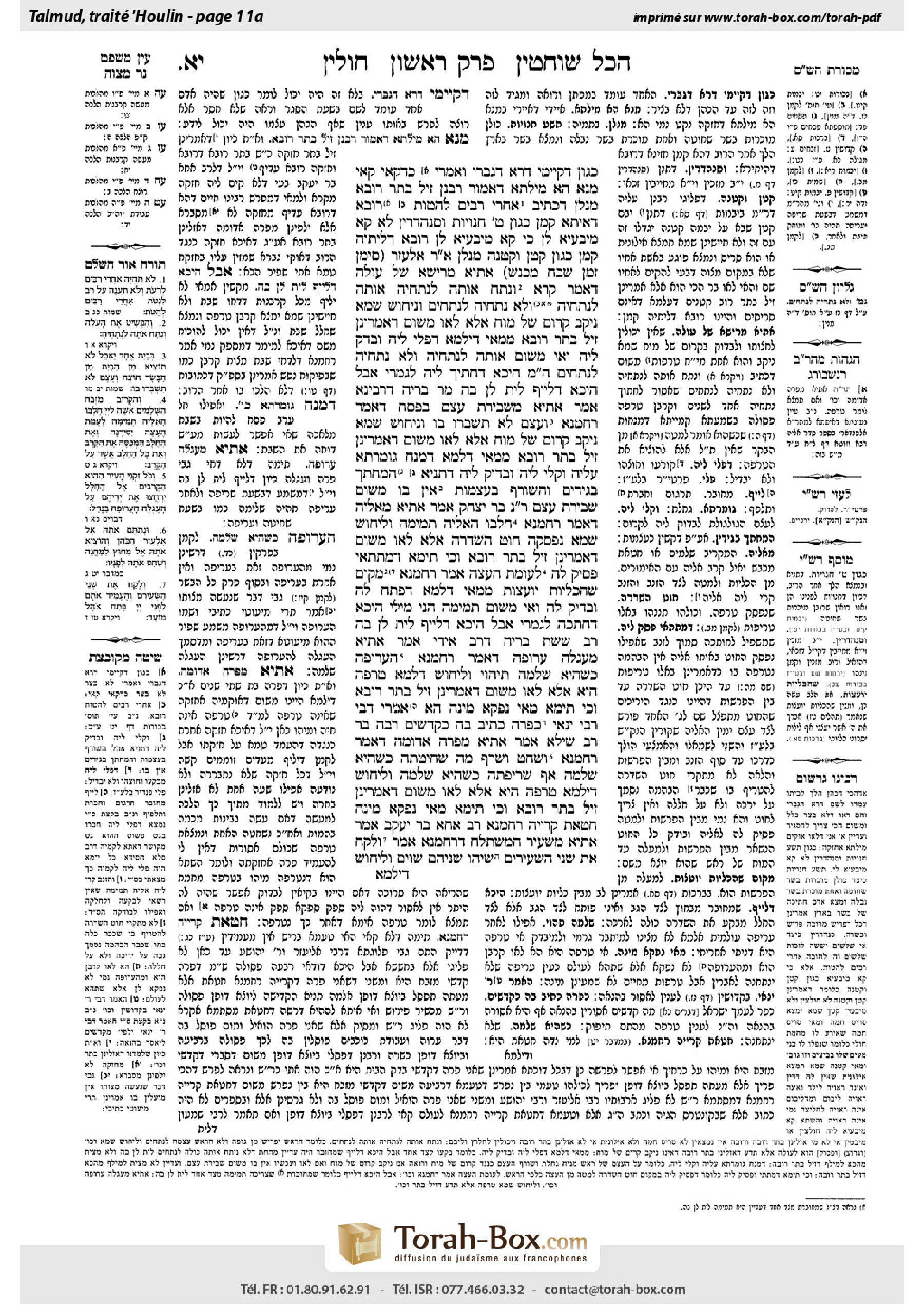
Chullin 11a: Talmud study for Daf Yomi
Study the Talmud for Daf Yomi with scanned pages, Hebrew text, English translations from Sefaria and AI-generated French translations.
Passage selection and English or AI-generated French translation are available where the scan has annotations. Daf Study is independent of Torah-Box and Sefaria.
Browse Chullin · חולין · All tractatesChullin 11a text and translations
This page of Chullin includes the Aramaic text, an English translation and an AI-generated French translation, alongside the scan above.
חולין י״א א · Aramaic and Hebrew text
כְּגוֹן דְּקָיְימִי דָּרָא דְּגַבְרֵי וְאָמְרִי: כִּדְקָאֵי קָאֵי.
מְנַָא הָא מִילְּתָא דַאֲמוּר רַבָּנַן: זִיל בָּתַר רוּבָּא? מְנָלַן?! דִּכְתִיב: ״אַחֲרֵי רַבִּים לְהַטֹּת״.
רוּבָּא דְּאִיתָא קַמַּן, כְּגוֹן תֵּשַׁע חֲנוּיוֹת, וְסַנְהֶדְרִין – לָא קָא מִיבַּעְיָא לַן.
כִּי קָא מִיבַּעְיָא לַן, רוּבָּא דְּלֵיתֵיהּ קַמַּן, כְּגוֹן קָטָן וּקְטַנָּה, מְנָלַן?
אָמַר רַבִּי אֶלְעָזָר (סִימָן זְמַן שֶׁבַח מְכַנֵּשׁ):
אָתְיָא מֵרֵישָׁא שֶׁל עוֹלָה, דְּאָמַר קְרָא: ״וְנִתַּח אוֹתָהּ לִנְתָחֶיהָ״, אוֹתָהּ לִנְתָחֶיהָ, וְלֹא נְתָחֶיהָ לִנְתָחִים, וְנֵיחוּשׁ שֶׁמָּא נִיקַּב קְרוּם שֶׁל מוֹחַ? אֶלָּא לָאו מִשּׁוּם דְּאָמְרִינַן זִיל בָּתַר רוּבָּא.
מִמַּאי? דִּילְמָא דְּפָלֵי לֵיהּ וּבָדֵק לֵיהּ, וְאִי מִשּׁוּם ״אוֹתָהּ לִנְתָחֶיהָ״ וְלֹא נְתָחֶיהָ לִנְתָחִים – הָנֵי מִילֵּי הֵיכָא דְּחָתֵיךְ לֵיהּ לִגְמָרֵי, אֲבָל הֵיכָא דְּלַיִיף לֵית לַן בַּהּ.
מָר בְּרֵיהּ דְּרָבִינָא אָמַר: אָתְיָא מִשְּׁבִירַת עֶצֶם בְּפֶסַח, דְּאָמַר רַחֲמָנָא: ״וְעֶצֶם לֹא תִשְׁבְּרוּ בוֹ״, וְנֵיחוּשׁ שֶׁמָּא נִיקַּב קְרוּם שֶׁל מוֹחַ? אֶלָּא לָאו מִשּׁוּם דְּאָמְרִינַן: זִיל בָּתַר רוּבָּא.
מִמַּאי? דִּלְמָא דְּמַנַּח גּוּמַרְתָּא עֲלֵיהּ, וְקָלֵי לֵיהּ, וּבָדֵיק לֵיהּ, דְּתַנְיָא: הַמְחַתֵּךְ בְּגִידִים וְהַשּׂוֹרֵף בַּעֲצָמוֹת – אֵין בּוֹ מִשּׁוּם שְׁבִירַת עֶצֶם.
רַב נַחְמָן בַּר יִצְחָק אָמַר: אָתְיָא מֵאַלְיָה, דְּאָמַר רַחֲמָנָא: ״חֶלְבּוֹ הָאַלְיָה תְּמִימָה״, וְלֵיחוּשׁ שֶׁמָּא נִפְסְקָה חוּט הַשִּׁדְרָה? אֶלָּא לָאו מִשּׁוּם דְּאָמְרִינַן: זִיל בָּתַר רוּבָּא.
וְכִי תֵּימָא דְּמִתַּתַּאי פָּסֵיק לַהּ, ״לְעֻמַּת הֶעָצֶה״ אָמַר רַחֲמָנָא, מְקוֹם שֶׁהַכְּלָיוֹת יוֹעֲצוֹת.
מִמַּאי? דִּלְמָא דְּפָתַח לַהּ וּבָדֵיק לַהּ, וְאִי מִשּׁוּם ״תְּמִימָה״ – הָנֵי מִילֵּי הֵיכָא דְּחַתְכַהּ לִגְמָרֵי, אֲבָל הֵיכָא דְּלַיִיף – לֵית לַן בַּהּ.
רַב שֵׁשֶׁת בְּרֵיהּ דְּרַב אִידִי אָמַר: אָתְיָא מֵעֶגְלָה עֲרוּפָה, דְּאָמַר רַחֲמָנָא: ״הָעֲרוּפָה״ – כְּשֶׁהִיא שְׁלֵמָה תֶּיהְוֵי, וְלֵיחוּשׁ דִּלְמָא טְרֵפָה הִיא! אֶלָּא לָאו מִשּׁוּם דְּאָמְרִינַן: זִיל בָּתַר רוּבָּא.
וְכִי תֵּימָא, מַאי נָפְקָא מִינַּהּ, הָא אָמְרִי דְּבֵי רַבִּי יַנַּאי: כַּפָּרָה כְּתִיב בָּהּ כְּקָדָשִׁים.
רַבָּה בַּר רַב שֵׁילָא אָמַר: אָתְיָא מִפָּרָה אֲדוּמָּה, דְּאָמַר רַחֲמָנָא ״וְשָׁחַט… וְשָׂרַף״, מָה שְׁחִיטָתָהּ כְּשֶׁהִיא שְׁלֵמָה, אַף שְׂרֵיפָתָהּ כְּשֶׁהִיא שְׁלֵמָה, וְלֵיחוּשׁ דִּילְמָא טְרֵפָה הִיא! אֶלָּא לָאו מִשּׁוּם דְּאָמְרִינַן: זִיל בָּתַר רוּבָּא.
וְכִי תֵּימָא, מַאי נָפְקָא מִינַּהּ? ״חַטָּאת״ קַרְיַיהּ רַחֲמָנָא.
רַב אַחָא בַּר יַעֲקֹב אָמַר: אָתְיָא מִשָּׂעִיר הַמִּשְׁתַּלֵּחַ, דְּרַחֲמָנָא אָמַר: ״וְלָקַח אֶת שְׁנֵי הַשְּׂעִירִם״, שֶׁיְּהוּ שְׁנֵיהֶם שָׁוִים, וְלֵיחוּשׁ
Chullin 11a · English translation
in a case where there is a row of standing men, from the house to be quarantined to the priest’s house, and they each say to the one standing next to him that the leprous mark remains standing unaltered.
§ After discussing the role of presumptive status in determining halakha, the Gemara discusses the role of the majority. From where is this matter that the Sages stated: Follow the majority, derived? The Gemara is surprised at the question: From where do we derive it? Obviously, it is derived from a verse, as it is written explicitly: “After the majority to incline” (Exodus 23:2).
The Gemara explains: With regard to a majority that is quantifiable before us, for example, in the case of a piece of meat that was found on the street before ten shops, nine shops selling kosher meat and one shop selling non-kosher meat, one follows the majority and deems that piece kosher. Or when the Sanhedrin adjudicates a case, one follows a majority of the judges in determining the ruling. In these cases, we do not raise the dilemma.
When the dilemma is raised to us it is in the case of a majority that is not quantifiable before us, for example, the case of a minor boy and a minor girl. If the boy entered into levirate marriage with the girl, it is permitted for them to remain married, and there is no concern that when they grow older it will be discovered that the boy or the girl never develop sexually. Rather, one follows the majority, that minors develop sexually at puberty. It is with regard to that non-quantifiable majority that the Gemara asks: From where do we derive it?
Rabbi Elazar said an answer to this question. Before presenting his answer, the Gemara cites a mnemonic for the names of the Sages who address this question: Zayin, Rabbi Elazar; mem, Mar, son of Ravina; nun, Rav Naḥman bar Yitzḥak; shin, Rav Sheshet; beit, Rabba bar Rav Sheila; ḥet, Rav Aḥa bar Ya’akov; mem, Rav Mari; kaf, Rav Kahana; nun, Ravina; shin, Rav Ashi.
Rabbi Elazar’s answer was as follows: It is derived from the halakha concerning the head of a burnt offering, that one severs it from the animal’s body but does not cut it into smaller pieces, as the verse states: “And he shall flay the burnt offering and cut it into its pieces” (Leviticus 1:6), and it is inferred: The animal is cut into its pieces, but its pieces, including its head, are not cut into pieces. Rabbi Elazar suggested: And since the head is not cut and cannot be examined, let us be concerned that perhaps the brain membrane was perforated, which would render the animal a tereifa and unfit for sacrifice. Rather, is the reason we are not concerned for this not due to the fact that we say: Follow the majority of animals, which are not tereifot?
The Gemara asks: From where is that conclusion drawn? Perhaps the reference is to a case where one splits the head open and examines the brain membrane. And if that could not be due to the inference: The animal is cut into its pieces, but its pieces are not cut into pieces, that statement applies in a case where one cuts the head completely in half. But in a case where the sides of the head remain joined, we have no problem with it. Therefore, no proof can be cited from here.
Mar, son of Ravina, said: The fact that we follow a non-quantifiable majority is derived from the halakha of the breaking of a bone in the Paschal offering, as the Merciful One states: “Nor shall you break a bone thereof” (Exodus 12:46). Mar, son of Ravina, suggested: And let us be concerned that perhaps the brain membrane was perforated and the animal is a tereifa, as it is impossible to examine its brain membrane since one may not break its bones. Rather, is the reason we are not concerned for this not due to the fact that we say: Follow the majority of animals, which are not tereifot?
The Gemara asks: From where is that conclusion drawn? Perhaps the reference is to a case where one places a coal on the head and burns through the head, exposing the brain membrane, and then examines it, as it is taught in a baraita: One who cuts the sinews or burns the bones of the Paschal offering is not subject to lashes due to the prohibition of breaking bones. Therefore, no proof can be cited from here either.
Rav Naḥman bar Yitzḥak said: It is derived from the halakha of the tail of a lamb brought as a peace offering, with regard to which the Merciful One states: “And he shall sacrifice of the peace offering…the fat tail whole, which he shall remove opposite the rump bone” (Leviticus 3:9), meaning that the tail must remain intact and may not be cut. Rav Naḥman bar Yitzḥak suggested: And let us be concerned that perhaps the segment of the spinal column in the tail was severed prior to slaughter, rendering the animal a tereifa and unfit for sacrifice. Rather, is the reason we are not concerned for this not due to the fact that we say: Follow the majority of animals, which are not tereifot?
And if you would say in rejection of that proof that one severs the tail from below the spine, in a place that would not render the animal a tereifa, the Merciful One states: “Opposite the rump bone [he’atze],” the place where the kidneys advise [yo’atzot], This is a location where severing the spinal column renders the animal a tereifa. Consequently, the proof that the majority is followed remains intact.
The Gemara asks: From where is that conclusion drawn? Perhaps the reference is to a case where one splits the tail and examines the spinal column. And if that could not be, due to the requirement that the fat tail remain “whole,” that statement applies in a case where one cuts the tail completely in half. But in a case where the sides of the tail remain joined, we have no problem with it. Therefore, no proof can be cited from here.
Rav Sheshet, son of Rav Idi, said: The principle of following a non-quantifiable majority is derived from the halakha of the heifer whose neck is broken when a person is found killed in an area that is between two cities and the murderer is unknown (Deuteronomy 21:1–9). As the Merciful One states: “And all the elders of that city…shall wash their hands over the heifer whose neck was broken, in the valley” (Deuteronomy 21:6), from which it is inferred: Other than its neck being broken, the heifer should remain in a state where it is whole. And if one does not follow the majority, let us be concerned that perhaps the animal is a tereifa. Rather, is the reason we are not concerned for this not due to the fact that we say: Follow the majority of animals, which are not tereifot?
And if you would say in rejection of that proof that there is no need for an examination, as what difference is there whether it is a tereifa, since it is neither eaten nor sacrificed, didn’t they say in the school of Rabbi Yannai: A term of atonement is written in its regard (see Deuteronomy 21:8), indicating that the halakhic status of the heifer whose neck is broken is like that of sacrificial animals, and a tereifa is unfit for use in that ritual?
Rabba bar Rav Sheila said: The principle of following an unquantifiable majority is derived from the halakha of the red heifer, with regard to which the Merciful One states: “And he shall slaughter…and he shall burn” (Numbers 19:3, 5), from which it is derived: Just as its slaughter is performed when it is whole, so too its burning is performed when it is whole. And if the majority is not followed, let us be concerned that perhaps the animal is a tereifa. Rather, is the reason we are not concerned for this not due to the fact that we say: Follow the majority of animals, which are not tereifot?
And if you would say in rejection of that proof that there is no need for an examination, as what difference is there whether it is a tereifa, since it is neither eaten nor sacrificed, the Merciful One called it ḥatat, meaning purification, just as a sin offering is called ḥatat, indicating that in both cases a tereifa is unfit.
Rav Aḥa bar Ya’akov said: The fact that one follows a non-quantifiable majority is derived from the halakha of the scapegoat, with regard to which the Merciful One says: “And he shall take the two goats…one lot for the Lord and one lot for Azazel” (Leviticus 16:7–8). From the fact that the verse mentions the two goats together, the Sages inferred that the two goats should be equal. But how can it be ascertained that they are equal; let us be concerned
Chullin 11a · Traduction française (IA)
dans un cas où il y a une rangée d'hommes debout, du domicile à être isolé jusqu'à la maison du prêtre, et chacun dit à celui qui est debout à côté de lui que la marque de la lèpre reste intacte sans modification.
§ Après avoir discuté du rôle du statut présomptif dans la détermination de la halakha, le Guemara discute du rôle de la majorité. D'où vient cette matière que les Sages ont dit : Suivez la majorité, d'où est-elle dérivée ? Le Guemara est surpris par la question : D'où vient-elle ? Évidemment, elle est dérivée d'un verset, car il est écrit explicitement : « Après la majorité, inclinez-vous » (Exode 23:2).
Le Guemara explique : En ce qui concerne une majorité quantifiable devant nous, par exemple, dans le cas d'une pièce de viande trouvée dans la rue devant dix boutiques, neuf boutiques vendant de la viande kasher et une boutique vendant de la viande non kasher, on suit la majorité et considère que cette pièce est kasher. Ou lorsqu'on fait l'appréciation devant le Sanhédrin, on suit la majorité des juges pour déterminer la décision. Dans ces cas, nous ne soulevons pas le dilemme.
Lorsque le dilemme est soulevé devant nous, c'est dans le cas d'une majorité non quantifiable devant nous, par exemple, le cas d'un petit garçon et d'une petite fille. Si le garçon entre en mariage levirat avec la fille, il est permis qu'ils restent mariés, et il n'y a pas de crainte que lorsqu'ils grandiront, on découvrira que le garçon ou la fille n'ont jamais développé sexuellement. Plutôt, on suit la majorité, celle des mineurs qui développent sexuellement à l'adolescence. C'est à propos de cette majorité non quantifiable que le Guemara pose la question : D'où vient-elle ?
Rabbi Elazar a donné une réponse à cette question. Avant de présenter sa réponse, le Guemara cite un mnémonique pour les noms des Sages qui abordent cette question : Zayin, Rabbi Elazar ; mem, Mar, fils de Ravina ; nun, Rav Naḥman bar Yitzḥak ; shin, Rav Sheshet ; beit, Rabba bar Rav Sheila ; ḥet, Rav Aḥa bar Ya’akov ; mem, Rav Mari ; kaf, Rav Kahana ; nun, Ravina ; shin, Rav Ashi.
La réponse de Rabbi Elazar était la suivante : Elle est dérivée de la halakha concernant la tête d'un holocauste, à savoir qu'on la sépare du corps de l'animal mais qu'on ne la découpe pas en morceaux, comme le dit le verset : « Et il flaira le holocauste et le découpe en ses morceaux » (Lévitique 1:6), et on en déduit : L'animal est découpé en ses morceaux, mais ses morceaux, y compris sa tête, ne sont pas découpés en morceaux. Rabbi Elazar suggère : Et puisque la tête n'est pas découpée et ne peut pas être examinée, soyons inquiets que peut-être la membrane cérébrale ait été perfore, ce qui rendrait l'animal tereifa et non propre à l'offrande. Plutôt, est-ce que la raison pour laquelle nous ne sommes pas inquiets n'est pas due au fait que nous disons : Suivez la majorité des animaux, qui ne sont pas tereifot ?
Le Guemara pose la question : D'où vient cette conclusion ? Peut-être la référence est-elle à un cas où l'on ouvre la tête et examine la membrane cérébrale. Et si cela ne peut pas être, en raison de l'inférence : L'animal est découpé en ses morceaux, mais ses morceaux ne sont pas découpés en morceaux, cette déclaration s'applique à un cas où l'on coupe la tête en deux. Mais dans un cas où les côtés de la tête restent joints, nous n'avons pas de problème. Par conséquent, aucun témoignage ne peut être cité à partir de là.
Mar, fils de Ravina, a dit : Le fait que nous suivons une majorité non quantifiable est dérivé de la halakha concernant la fracture d'une osse dans l'offrande pascal, comme dit le Tout-Puissant : « Ni ne briserez-vous aucun os de cela » (Exode 12:46). Mar, fils de Ravina, suggère : Et soyons inquiets que peut-être la membrane cérébrale ait été perfore et l'animal soit tereifa, car il est impossible d'examiner sa membrane cérébrale puisqu'on ne peut pas briser ses os. Plutôt, est-ce que la raison pour laquelle nous ne sommes pas inquiets n'est pas due au fait que nous disons : Suivez la majorité des animaux, qui ne sont pas tereifot ?
Le Guemara pose la question : D'où vient cette conclusion ? Peut-être la référence est-elle à un cas où l'on place un charbon sur la tête et brûle la tête, exposant la membrane cérébrale, et ensuite l'examine, comme il est enseigné dans une baraïta : Celui qui coupe les nerfs ou brûle les os de l'offrande pascal n'est pas sujet aux fessouls en raison de l'interdiction de briser les os. Par conséquent, aucun témoignage ne peut être cité à partir de là non plus.
Rav Naḥman bar Yitzḥak a dit : Elle est dérivée de la halakha concernant la queue d'un agneau offert en paix, à propos de laquelle le Très Miséricordieux dit : « Et il offrira de l'offrande de paix… la queue graisseuse entière, qu'il enlevera opposé à l'os du cul » (Lévitique 3:9), signifiant que la queue doit rester intacte et ne doit pas être coupée. Rav Naḥman bar Yitzḥak suggère : Et soyons inquiets que peut-être la portion de la colonne vertébrale dans la queue ait été séparée avant l'abattage, rendant l'animal tereifa et non propre à l'offrande. Plutôt, est-ce que la raison pour laquelle nous ne sommes pas inquiets n'est pas due au fait que nous disons : Suivez la majorité des animaux, qui ne sont pas tereifot ?
Et si vous dites pour rejeter cette preuve que l'on coupe la queue en dessous de la colonne vertébrale, dans un endroit qui ne rendrait pas l'animal tereifa, le Très Miséricordieux dit : « Opposé à l'os du cul [he’atze], » l'endroit où les reins conseillent [yo’atzot], c'est une localisation où la séparation de la colonne vertébrale rend l'animal tereifa. Par conséquent, la preuve que la majorité est suivie reste intacte.
Le Guemara pose la question : D'où vient cette conclusion ? Peut-être la référence est-elle à un cas où l'on coupe la queue et examine la colonne vertébrale. Et si cela ne peut pas être, en raison de la nécessité que la queue graisseuse reste « entière », cette déclaration s'applique à un cas où l'on coupe la queue en deux. Mais dans un cas où les côtés de la queue restent joints, nous n'avons pas de problème. Par conséquent, aucun témoignage ne peut être cité à partir de là.
Rav Sheshet, fils de Rav Idi, a dit : Le principe de suivre une majorité non quantifiable est tiré de la halakha de la bête dont le cou est brisé, lorsqu'une personne est trouvée morte dans une zone entre deux villes et que l'assassin est inconnu (Deutéronome 21:1–9). Comme le Tout-Puissant dit : « Et tous les anciens de cette ville… laveront leurs mains sur la bête dont le cou fut brisé, dans le vallon » (Deutéronome 21:6), d'où on déduit : À l'exception de son cou étant brisé, la bête doit rester dans un état intact. Et si l'on ne suit pas la majorité, craignons que la bête ne soit tereifa. Plutôt, n'est-ce pas que la raison pour laquelle nous ne craignons pas cela pas due au fait que nous disons : Suivez la majorité des bêtes, qui ne sont pas tereifot ?
Et si l'on dit en rejet de cette preuve qu'il n'y a pas besoin d'examen, comme quelle différence y a-t-il si elle est tereifa, puisqu'elle n'est ni mangée ni sacrifiée, n'ont-ils pas dit dans la maison de Rabbi Yannai : Un terme d'atoneur est écrit à son sujet (voir Deutéronome 21:8), indiquant que le statut halakhique de la bête dont le cou est brisé est comme celui des animaux sacrés, et une tereifa est inadaptée à l'usage dans ce rituel ?
Rabba bar Rav Sheila a dit : Le principe de suivre une majorité non quantifiable est tiré de la halakha de la bête rouge, à propos de laquelle le Tout-Puissant dit : « Et il tuera… et il brûlera » (Nombres 19:3, 5), d'où on déduit : Comme sa mise à mort est faite lorsqu'elle est intacte, ainsi sa combustion est faite lorsqu'elle est intacte. Et si la majorité n'est pas suivie, craignons que la bête ne soit tereifa. Plutôt, n'est-ce pas que la raison pour laquelle nous ne craignons pas cela pas due au fait que nous disons : Suivez la majorité des bêtes, qui ne sont pas tereifot ?
Et si l'on disait en rejet de cette preuve qu'il n'y a pas besoin d'examen, car quelle différence y a-t-il si elle est tereifa, puisqu'elle n'est ni mangée ni sacrifiée, le Tout-Puissant l'a appelée ḥatat, c'est-à-dire purification, comme un sacrifice expiatoire est appelé ḥatat, indiquant que dans les deux cas une tereifa est inadaptée.
Rav Aḥa bar Ya’akov a dit : Le fait de suivre une majorité non quantifiable est tiré de la halakha du bouc émissaire, à propos duquel le Tout-Puissant dit : « Et il prendra les deux boucs… l'un pour l'Éternel et l'autre pour Azazel » (Lévitique 16:7–8). À partir du fait que la parole mentionne les deux boucs ensemble, les Sages ont déduit que les deux boucs doivent être égaux. Mais comment peut-on être certain qu'ils sont égaux ; craignons
Traduction française générée par IA à partir de l’édition anglaise de Sefaria. Vérifie toujours un passage avec le texte source.
Text from Sefaria: William Davidson Edition - Vocalized Aramaic (unknown); William Davidson Edition - English (CC BY NC).