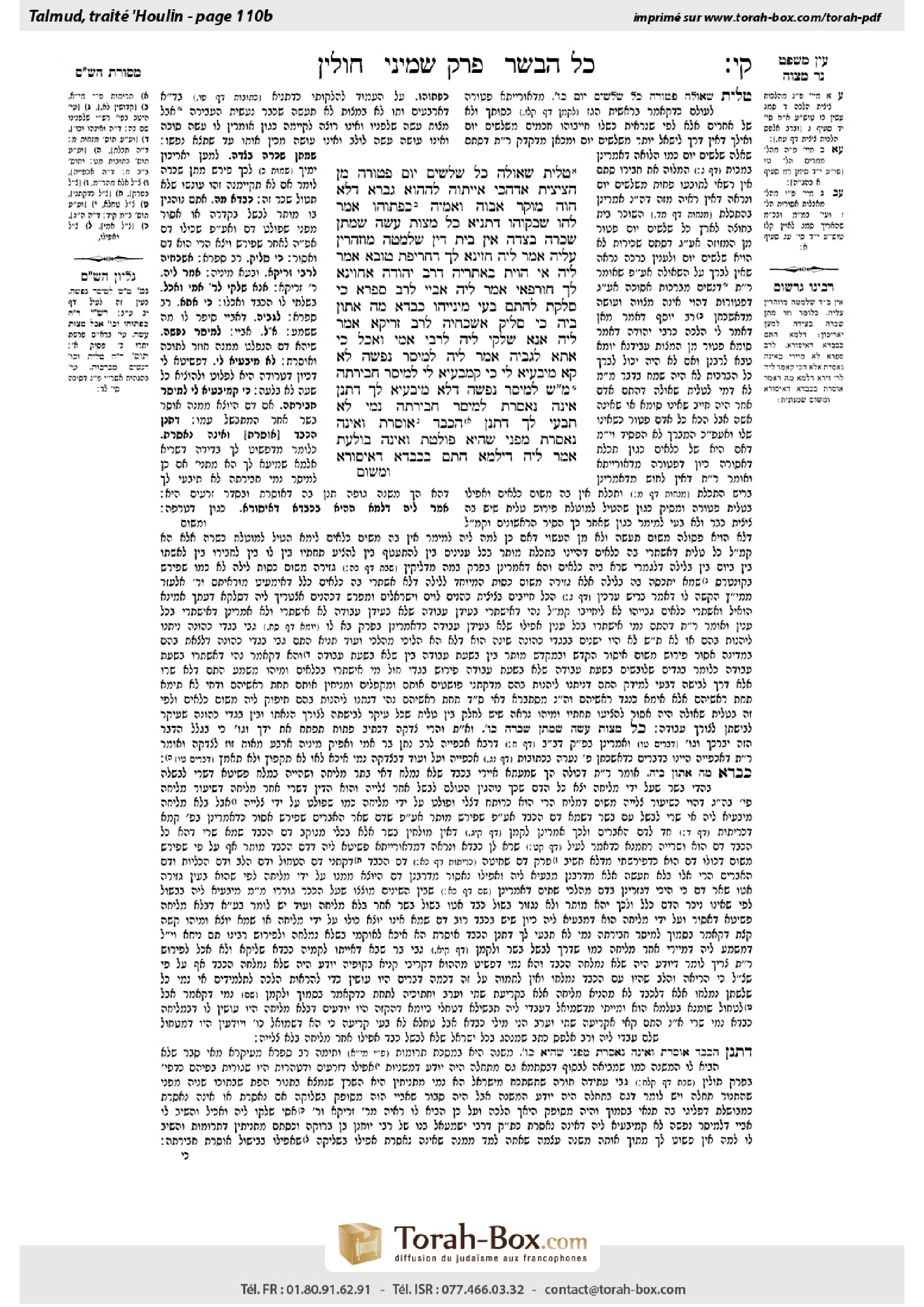
Chullin 110b: Talmud study for Daf Yomi
Study the Talmud for Daf Yomi with scanned pages, Hebrew text, English translations from Sefaria and AI-generated French translations.
Passage selection and English or AI-generated French translation are available where the scan has annotations. Daf Study is independent of Torah-Box and Sefaria.
Browse Chullin · חולין · All tractatesChullin 110b text and translations
This page of Chullin includes the Aramaic text, an English translation and an AI-generated French translation, alongside the scan above.
חולין ק״י ב · Aramaic and Hebrew text
טַלִּית שְׁאוּלָה כׇּל שְׁלֹשִׁים יוֹם פְּטוּרָה מִן הַצִּיצִית.
אַדְּהָכִי, אַיְיתוּהּ לְהָהוּא גַּבְרָא דְּלָא הֲוָה מוֹקַר אֲבוּהּ וְאִמֵּיהּ, כַּפְתוּהּ.
אֲמַר לְהוּ: שִׁבְקוּהּ, דְּתַנְיָא: כׇּל מִצְוַת עֲשֵׂה שֶׁמַּתַּן שְׂכָרָהּ בְּצִדָּהּ – אֵין בֵּית דִּין שֶׁלְּמַטָּה מוּזְהָרִין עָלֶיהָ. אֲמַר לֵיהּ חֲזֵינָא לָךְ דְּחָרִיפַתְּ טוּבָא. אֲמַר לֵיהּ: אִי הֲוֵית בְּאַתְרֵיהּ דְּרַב יְהוּדָה, אַחְוִינָא לָךְ חוּרְפַּאי.
אֲמַר לֵיהּ אַבָּיֵי לְרַב סָפְרָא: כִּי סָלְקַתְּ לְהָתָם, בְּעִי מִינַּיְיהוּ: כַּבְדָּא, מָה אַתּוּן בֵּיהּ? כִּי סְלֵיק, אַשְׁכְּחֵיהּ לְרַב זְרִיקָא. אֲמַר לֵיהּ: אֲנָא שְׁלַקִי לֵיהּ לְרַבִּי אַמֵּי, וַאֲכַל.
כִּי אֲתָא לְגַבֵּיהּ, אֲמַר לֵיהּ: לְמֵיסַר נַפְשַׁהּ – לָא קָא מִיבַּעְיָא לִי, כִּי קָמִבַּעְיָא לִי – לְמֵיסַר חֲבִירְתַּהּ.
מַאי שְׁנָא לְמֵיסַר נַפְשַׁהּ דְּלָא מִיבַּעְיָא לָךְ – דִּתְנַן: אֵינָהּ נֶאֱסֶרֶת, לְמֵיסַר חֲבִירְתַּהּ נָמֵי לָא תִּבְּעֵי לָךְ! דִּתְנַן: הַכָּבֵד אוֹסֶרֶת וְאֵינָהּ נֶאֱסֶרֶת, מִפְּנֵי שֶׁהִיא פּוֹלֶטֶת וְאֵינָהּ בּוֹלַעַת. אֲמַר לֵיהּ: דִּילְמָא הָתָם בְּכַבְדָּא דְּאִיסּוּרָא,
Chullin 110b · English translation
With regard to a borrowed robe, during all of the first thirty days that one borrows it, one is exempt from performing the mitzva of ritual fringes with it.
Meanwhile, as Rav Ḥisda and Rami bar Tamrei were talking, the attendants brought in a certain man to Rav Ḥisda’s court who would not honor his father and mother, and they tied him to a pillar in order to flog him.
Rami bar Tamrei said to them: Leave him alone, as it is taught in a baraita: With regard to any positive mitzva whose reward is stated alongside it in the Torah, the earthly court below is not warned to enforce it through punishments such as flogging. And it is stated after the mitzva of honoring one’s father and mother: “That your days may be long, and that it go well with you” (Deuteronomy 5:16). Rav Ḥisda said to Rami bar Tamrei: I see that you are very sharp. Rami bar Tamrei said to Rav Ḥisda: If you were in the place where Rav Yehuda resides, I would be able to show you my sharpness of mind far better than here.
§ Pursuant to the discussion of different local customs, Abaye said to Rav Safra: When you ascend there, to Eretz Yisrael, ask the Sages there: With regard to liver, how do you treat it? When Rav Safra ascended to Eretz Yisrael he found Rav Zerika and asked him this question. Rav Zerika said to him: I cooked liver for Rabbi Ami and he ate it.
When Rav Safra returned to Babylonia and came before Abaye and reported what Rav Zerika had said, Abaye said to him: I do not raise the dilemma as to whether liver renders itself prohibited if cooked alone. It is clear to me that the blood that diffuses out of the liver is not absorbed again while it cooks. When I raise the dilemma, it is with regard to whether liver renders prohibited another piece of meat cooked with it. Rav Zerika’s statement therefore has no bearing on my question.
Rav Safra asked Abaye: What is different about the issue of the liver rendering itself prohibited, that you did not raise the dilemma with regard to this case? It is presumably because the answer is obvious to you, as we learned in a mishna (Terumot 10:11) that liver is not rendered prohibited by its own cooking. But if so, you should not raise the dilemma with regard to whether it renders the other piece of meat prohibited either, as we learned in that same mishna: Liver renders food cooked with it in the same pot prohibited but is not prohibited itself, because while it does expel blood as it cooks, it does not absorb this blood again, since the blood diffuses only outward. Abaye said to Rav Safra: That mishna does not answer my question, as perhaps there it is referring specifically to forbidden liver, e.g., the liver of a non-kosher animal.
Chullin 110b · Traduction française (IA)
Concernant un manteau emprunté, pendant les trente premiers jours que l'on emprunte ce manteau, on est exempt de remplir la mitsva des franges rituelles avec celui-ci.
En même temps, alors que Rav Ḥisda et Rami bar Tamrei discutaient, les serviteurs amenèrent un certain homme devant la cour de Rav Ḥisda, qui n'honorait pas son père et sa mère, et ils le ligèrent à un poteau afin de le flageller.
Rami bar Tamrei dit à ceux-ci : Laissez-le tranquille, car il est enseigné dans une baraïta : Concernant toute mitsva positive dont la récompense est mentionnée à côté dans la Torah, le tribunal terrestre en dessous n'est pas averti de l'appliquer par des sanctions telles que la flagellation. Et il est dit après la mitsva d'honorer ses parents : « Que tes jours soient longs, et que cela aille bien avec toi » (Deutéronome 5:16). Rav Ḥisda dit à Rami bar Tamrei : Je vois que tu es très perspicace. Rami bar Tamrei dit à Rav Ḥisda : Si tu étais à l'endroit où réside Rav Yehuda, je pourrais te montrer ma perspicacité bien mieux qu'ici.
§ Selon la discussion sur les coutumes locales différentes, Abaye dit à Rav Safra : Quand tu monteras là-bas, en Eretz Yisrael, demande aux Sages là-bas : Concernant le foie, comment le traitez-vous ? Quand Rav Safra monta en Eretz Yisrael, il trouva Rav Zerika et lui posa cette question. Rav Zerika dit à lui : J'ai cuisiné du foie pour Rabbi Ami et il l'a mangé.
Quand Rav Safra revint en Babylone et vint devant Abaye et rapporta ce que Rav Zerika avait dit, Abaye dit à lui : Je ne soulève pas la question de savoir si le foie devient interdit s'il est cuit seul. Il est clair pour moi que le sang qui s'échappe du foie n'est pas absorbé à nouveau pendant la cuisson. Quand je soulève cette question, c'est concernant savoir si le foie rend un autre morceau de viande cuit avec lui interdit. L'énoncé de Rav Zerika n'a donc aucun lien avec ma question.
Rav Safra demanda à Abaye : Qu'est-ce qui diffère dans l'affaire du foie qui rend lui-même interdit, que tu n'as pas soulevé cette question dans ce cas-là ? C'est probablement parce que la réponse te semble évidente, comme nous avons appris dans une mitsva (Terouma 10:11) que le foie ne devient pas interdit par sa propre cuisson. Mais si c'est ainsi, tu ne devrais pas non plus soulever la question de savoir s'il rend interdit un autre morceau de viande cuit avec lui, comme nous l'avons appris dans la même mitsva : Le foie rend la nourriture cuite avec lui dans la même marmite interdite, mais ne devient pas lui-même interdit, car bien qu'il émette du sang pendant la cuisson, il ne l'absorbe pas à nouveau, car le sang s'échappe uniquement vers l'extérieur. Abaye dit à Rav Safra : Cette mitsva ne répond pas à ma question, car peut-être qu'il s'agit là spécifiquement du foie interdit, c'est-à-dire du foie d'un animal non-kosher.
Traduction française générée par IA à partir de l’édition anglaise de Sefaria. Vérifie toujours un passage avec le texte source.
Text from Sefaria: William Davidson Edition - Vocalized Aramaic (unknown); William Davidson Edition - English (CC BY NC).