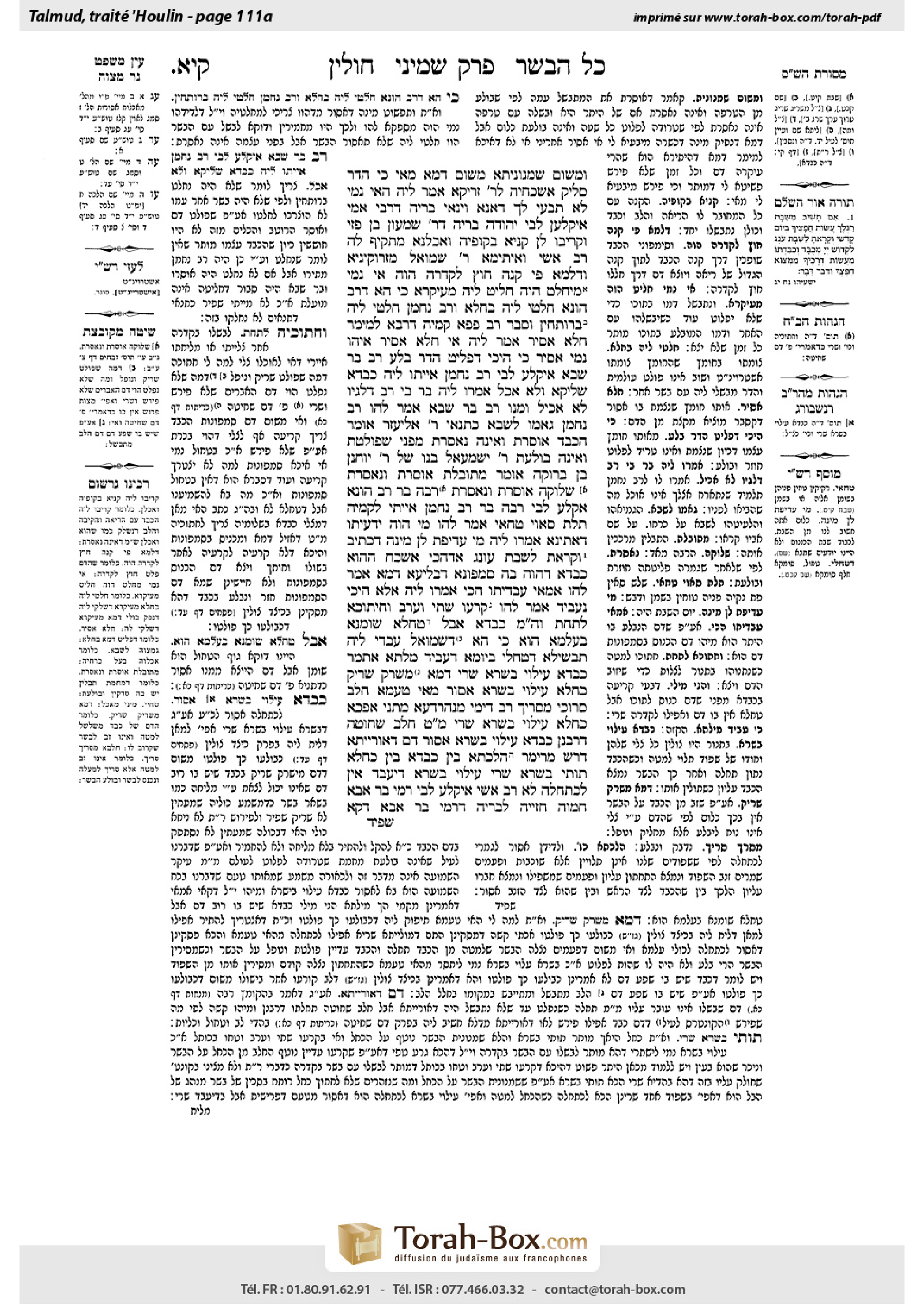
Chullin 111a: Talmud study for Daf Yomi
Study the Talmud for Daf Yomi with scanned pages, Hebrew text, English translations from Sefaria and AI-generated French translations.
Passage selection and English or AI-generated French translation are available where the scan has annotations. Daf Study is independent of Torah-Box and Sefaria.
Browse Chullin · חולין · All tractatesChullin 111a text and translations
This page of Chullin includes the Aramaic text, an English translation and an AI-generated French translation, alongside the scan above.
חולין קי״א א · Aramaic and Hebrew text
וּמִשּׁוּם שַׁמְנוּנִיתָא. מִשּׁוּם דְּמָא, מַאי?
כִּי הֲדַר סְלֵיק, אַשְׁכְּחֵיהּ לְרַבִּי זְרִיקָא, אֲמַר לֵיהּ: הַאי נָמֵי לָא תִּבְּעֵי לָךְ, דַּאֲנָא וְיַנַּאי בְּרֵיהּ דְּרַבִּי אַמֵּי אִיקַּלְעַן לְבֵי יְהוּדָה בְּרֵיהּ דְּרַבִּי שִׁמְעוֹן בֶּן פַּזִּי, וְקָרִיבוּ לַן קַנְיָא בְּקוֹפֵיהּ, וַאֲכַלְנָא.
מַתְקֵיף לַהּ רַב אָשֵׁי, וְאִיתֵּימָא רַבִּי שְׁמוּאֵל מִזְּרוּקִינְיָא: וְדִלְמָא פִּי קָנֶה חוּץ לִקְדֵרָה הֲוָה, אִי נָמֵי מִיחְלָט הֲוָה חָלֵיט לֵיהּ מֵעִיקָּרָא, כִּי הָא דְּרַב הוּנָא חָלְטִי לֵיהּ בְּחַלָּא, וְרַב נַחְמָן חָלְטִי לֵיהּ בְּרוֹתְחִין.
וּסְבַר רַב פָּפָּא קַמֵּיהּ דְּרָבָא לְמֵימַר: חַלָּא אֲסִיר. אֲמַר לֵיהּ: אִי חַלָּא אֲסִיר – אִיהוּ נָמֵי אֲסִיר, כִּי הֵיכִי דְּפָלֵיט – הֲדַר בָּלַע.
רַב בַּר שְׁבָא אִיקְּלַע לְבֵי רַב נַחְמָן, אַיְיתוֹ לֵיהּ כַּבְדָּא שְׁלִיקָא, וְלָא אֲכַל. אֲמַרוּ לֵיהּ: בַּר בֵּי רַב דִּלְגָיו לָא אָכֵיל, וּמַנּוּ? רַב בַּר שַׁבָּא. אֲמַר לְהוּ רַב נַחְמָן: גַּאמוּ לְשַׁבָּא.
כְּתַנָּאֵי: רַבִּי אֱלִיעֶזֶר אוֹמֵר: הַכָּבֵד אוֹסֶרֶת וְאֵינָהּ נֶאֱסֶרֶת, מִפְּנֵי שֶׁפּוֹלֶטֶת וְאֵינָהּ בּוֹלַעַת. רַבִּי יִשְׁמָעֵאל בְּנוֹ שֶׁל רַבִּי יוֹחָנָן בֶּן בְּרוֹקָה אוֹמֵר: מְתוּבֶּלֶת – אוֹסֶרֶת וְנֶאֱסֶרֶת, שְׁלוּקָה – אוֹסֶרֶת וְנֶאֱסֶרֶת.
רַבָּה בַּר רַב הוּנָא אִקְּלַע לְבֵי רַבָּה בַּר רַב נַחְמָן, אַיְיתִי לְקַמֵּיהּ תְּלָת סָאוֵי טַחְאֵי, אֲמַר לְהוּ: מִי הֲוָה יָדְעִיתוּ דְּאָתֵינָא? אֲמַרוּ לֵיהּ: מִי עֲדִיפַתְּ לַן מִינַּהּ, דִּכְתִיב: ״וְקָרָאתָ לַשַּׁבָּת עֹנֶג״!
אַדְּהָכִי, אַשְׁכַּח הָהוּא כַּבְדָּא דַּהֲוָה בַּהּ סִמְפּוֹנָא דִּבְלִיעָא דְּמָא, אֲמַר לְהוּ: אַמַּאי עָבְדִיתוּ הָכִי? אֲמַרוּ לֵיהּ: אֶלָּא הֵיכִי נַעֲבֵיד? אֲמַר לְהוּ: קְרַעוּ שְׁתִי וָעֵרֶב, וְחִיתּוּכָא לְתַחַת.
וְהָנֵי מִילֵּי כַּבְדָּא, אֲבָל טְחָלָא – שׁוּמְנָא בְּעָלְמָא הוּא, כִּי הָא דִּשְׁמוּאֵל עָבְדִי לֵיהּ תַּבְשִׁילָא דִטְחָלֵי בְּיוֹמָא דְּעָבֵיד מִלְּתָא.
אִתְּמַר: כַּבְדָּא עִילָּוֵי בִּשְׂרָא – שְׁרֵי, דְּמָא מִשְׁרָק שָׁרֵיק. כַּחְלָא עִילָּוֵי בִּשְׂרָא – אָסוּר. מַאי טַעְמָא? חָלָב סָרוֹכֵי מְסָרֵיךְ.
רַב דִּימִי מִנְּהַרְדְּעָא מַתְנֵי אִפְכָּא: כַּחְלָא עִילָּוֵי בִּשְׂרָא – שְׁרֵי, מַאי טַעְמָא? חֲלֵב שְׁחוּטָה דְּרַבָּנַן, כַּבְדָּא עִילָּוֵי בִּשְׂרָא – אֲסִיר, דָּם דְּאוֹרָיְיתָא.
דָּרֵשׁ מָרִימָר: הִלְכְתָא, בֵּין כַּבְדָּא בֵּין כַּחְלָא, תּוּתֵי בִּשְׂרָא – שְׁרֵי, עִילָּוֵי בִּשְׂרָא – דִּיעֲבַד אִין, לְכַתְּחִלָּה לָא.
רַב אָשֵׁי אִיקְּלַע לְבֵי רָמֵי בַּר אַבָּא חֲמוּהּ, חַזְיֵיהּ לִבְרֵיהּ דְּרָמֵי בַּר אַבָּא דְּקָא
Chullin 111a · English translation
And the other food is not forbidden due to the liver’s blood, but rather due to the fat of the liver it absorbed. But if permitted liver is cooked with another piece of meat, and the concern is only that the meat might be prohibited due to the meat absorbing excess blood from the liver, what is the halakha? Perhaps blood is absorbed less easily than fat.
When Rav Safra again ascended to Eretz Yisrael, he found Rabbi Zerika once more and asked him about liver cooked with another piece of meat. Rabbi Zerika said to him: You need not ask this question either, as I and Yannai, son of Rabbi Ami, arrived at the house of Yehuda, son of Rabbi Shimon ben Pazi, and they brought before us the windpipe of an animal with all the parts attached to it, i.e., the lungs, heart, and liver, all of which had been cooked together, and we ate it. This proves that the blood emitted from the liver does not render prohibited other pieces of meat cooked with it.
Rav Ashi, and some say Rabbi Shmuel from Zerokinya, objects to this conclusion: But perhaps in that incident the mouth of the windpipe was positioned outside of the pot, allowing the liver’s excess blood to run out of the pot rather than being absorbed by the other pieces of meat. Alternatively, perhaps they poured boiling liquid on the liver at the outset, before it was cooked with the lung and heart, like that custom of Rav Huna, for whom they would pour boiling vinegar on liver, and that of Rav Naḥman, for whom they would pour boiling water on liver. This would cook the excess blood into the liver and prevent it from diffusing into the other pieces. Abaye’s question remains unresolved.
And with regard to the pouring of boiling vinegar on the liver, Rav Pappa, when he was a student before Rava, thought to say that the vinegar becomes prohibited for consumption in the process, since it absorbs blood from the liver. Rava said to Rav Pappa: If you claim that the vinegar is prohibited, then the liver itself should also be prohibited, since just as the liver expels blood and prohibits the vinegar, so too it then absorbs the blood back from the forbidden vinegar. Rather, one must say that no blood is expelled from the liver during this process at all, which is why the liver is permitted afterward.
The Gemara relates that Rav bar Shabba visited the house of Rav Naḥman. They brought him cooked liver, but Rava bar Shabba did not partake of it. The members of the household said to Rav Naḥman: There is a student of Torah inside who is not eating. And who is he? Rav bar Shabba. Rav Naḥman said to them: Feed Shabba against his will.
The Gemara notes: Abaye’s question above with regard to liver cooked with other meat is subject to a dispute between tanna’im, as it is taught in a baraita: Rabbi Eliezer says: The liver that was cooked with other pieces of meat prohibits them, but it itself is not prohibited, because it expels blood as it cooks but does not absorb it again. Rabbi Yishmael, son of Rabbi Yoḥanan ben Beroka, says: If the liver was spiced when cooking, it prohibits the other meat and it becomes prohibited as well, as the spices cause the liver to reabsorb the blood that was expelled. Likewise, if the liver was stewed, i.e., heavily cooked, it renders the other pieces prohibited and is itself prohibited.
The Gemara relates: Rabba bar Rav Huna visited the house of Rabba bar Rav Naḥman and dined with him on Shabbat. They brought before him three se’a of fine bread that had been kneaded in oil and honey. Rabba bar Rav Huna said to the members of Rabba bar Rav Naḥman’s household: Did you know that I was coming, that you prepared such superior food? They said to him: Are you more distinguished than Shabbat, as it is written with regard to Shabbat: “If you proclaim Shabbat a delight, the sacred day of God honored” (Isaiah 58:13).
Meanwhile, Rabba bar Rav Huna found among the dishes before him a certain liver that contained an artery suffused with blood. He said to the members of the household: Why do you do this? Although the blood absorbed in the liver is permitted, that which is collected in the blood vessels is prohibited. The members of the household said to him: Rather, what should we do in order to prepare the liver? Rabba bar Rav Huna said to them: First tear the liver lengthwise and widthwise, and position the side with the tear downward, so that the blood will flow out when you place it on the fire.
The Gemara comments: And this statement applies only to liver, due to the blood that collects in its blood vessels; but there is no need to tear the spleen in this manner, as it merely contains fat. And this ruling accords with that which is reported about Shmuel, that his attendants would prepare a dish of spleens for him on the day that he performed the practice of bloodletting.
§ It was stated: If liver and other meat are roasted on spits in an oven such that the liver is positioned on top of the meat, the meat is permitted even though blood from the liver flows onto it. This is because the blood that flows from an item roasting in the oven slides over meat located underneath it and is not absorbed. But if an udder is positioned on top of the meat when roasted in the oven, the meat is prohibited. What is the reason? It is that the milk expelled by the roasting udder adheres to and is absorbed by the meat.
Rav Dimi from Neharde’a would teach the opposite: Whenever an udder is positioned on top of the meat, the meat is permitted. What is the reason? The prohibition of meat cooked in milk of a slaughtered animal applies by rabbinic law, and is treated less stringently. But if liver is positioned on top of the meat, the meat is prohibited, as the prohibition of blood applies by Torah law, and one must be concerned that perhaps the meat will absorb blood from the liver.
Mareimar taught in public: The halakha is: Whether in the case of liver or in the case of an udder, if it is underneath the meat, the meat is permitted, but if it is on top of the meat, then after the fact, yes, the meat is permitted, but ab initio, no, one may not situate them in this manner.
The Gemara relates: Rav Ashi arrived at the house of his father-in-law Rami bar Abba, and he saw that the son of Rami bar Abba was
Chullin 111a · Traduction française (IA)
Et la nourriture autre est permise non pas à cause du sang du foie, mais à cause de la graisse du foie qu'il a absorbée. Mais si un foie permis est cuit avec une autre pièce de viande, et la préoccupation est seulement que la viande pourrait être interdite à cause de la viande absorbant le sang en excès du foie, quelle est la halakha ? Peut-être que le sang est moins facilement absorbé que la graisse.
Quand Rav Safra est revenu à Eretz Yisrael, il a trouvé Rabbi Zerika une fois de plus et lui a posé une question sur un foie cuit avec une autre pièce de viande. Rabbi Zerika lui a dit : Tu n'as pas besoin de poser cette question, car moi et Yannai, fils de Rabbi Ami, sommes arrivés chez Yehuda, fils de Rabbi Shimon ben Pazi, et ils nous ont présenté la trachée d'un animal avec toutes les parties attachées, c'est-à-dire les poumons, le cœur et le foie, tous cuits ensemble, et nous avons mangé cela. Cela prouve que le sang émis par le foie ne rend pas interdite d'autres pièces de viande cuites avec lui.
Rav Ashi, et certains disent Rabbi Shmuel de Zerokinya, s'oppose à cette conclusion : Mais peut-être que dans cet incident la trachée était positionnée en dehors de la marmite, permettant au sang en excès du foie de s'écouler hors de la marmite plutôt que d'être absorbé par les autres pièces de viande. Alternativement, peut-être qu'ils ont versé une eau bouillante sur le foie dès le début, avant de le cuire avec les poumons et le cœur, comme la coutume de Rav Huna, pour qui on versait de l'eau bouillante sur le foie, et celle de Rav Naḥman, pour qui on versait de l'eau bouillante sur le foie. Cela aurait cuisiné le sang en excès dans le foie et empêché qu'il se diffuse dans les autres pièces. La question d'Abaye reste sans réponse.
Et concernant le versement d'eau de vinaigre bouillant sur le foie, Rav Pappa, lorsqu'il était encore élève de Rava, avait l'intention de dire que le vinaigre devient interdit à la consommation, car il absorbe le sang du foie. Rava a dit à Rav Pappa : Si tu affirmes que le vinaigre est interdit, alors le foie lui-même devrait aussi être interdit, car tout comme le foie expulse le sang et interdit le vinaigre, ainsi le foie absorbe à nouveau le sang du vinaigre interdit. Plutôt, il faut dire qu'aucun sang n'est expulsé du foie durant ce processus, ce qui est pourquoi le foie est permis après.
La Guemara rapporte que Rav bar Shabba a visité la maison de Rav Naḥman. Ils lui ont présenté du foie cuit, mais Rava bar Shabba n'a pas mangé. Les membres de la maison ont dit à Rav Naḥman : Il y a un étudiant de la Torah à l'intérieur qui ne mange pas. Et qui est-ce ? Rav bar Shabba. Rav Naḥman a dit à eux : Alimentez Shabba contre sa volonté.
La Guemara note : La question d'Abaye concernant le foie cuit avec d'autres viandes est sujette à un débat entre les tannaïm, comme il est enseigné dans une baraïta : Rabbi Eliezer dit : Le foie cuit avec d'autres pièces de viande interdit ces dernières, mais lui-même n'est pas interdit, car il expulse le sang lors de la cuisson mais ne l'absorbe pas à nouveau. Rabbi Yishmael, fils de Rabbi Yoḥanan ben Beroka, dit : Si le foie a été assaisonné lors de la cuisson, il interdit les autres viandes et devient lui-même interdit, car les épices font absorber le sang expulsé par le foie. De même, si le foie a été bouilli, c'est-à-dire cuisiné intensément, il rend les autres pièces interdites et devient lui-même interdit.
La Guemara rapporte : Rabba bar Rav Huna a visité la maison de Rabba bar Rav Naḥman et a dîné avec lui le sabbat. Ils lui ont présenté trois se'ot de pain fin, pétri dans de l'huile et du miel. Rabba bar Rav Huna a dit aux membres de la maison de Rabba bar Rav Naḥman : Saviez-vous que je venais, que vous avez préparé de la nourriture si excellente ? Ils lui ont répondu : Es-tu plus distingué que le sabbat, car il est écrit concernant le sabbat : « Si tu proclames le sabbat un délice, le jour sacré de Dieu honoré » (Yachin 58:13).
En même temps, Rabba bar Rav Huna a trouvé parmi les plats devant lui un certain foie qui contenait un vaisseau plein de sang. Il a dit aux membres de la maison : Pourquoi faites-vous cela ? Bien que le sang absorbé dans le foie soit permis, celui qui est collecté dans les vaisseaux est interdit. Les membres de la maison lui ont dit : Plutôt, que devons-nous faire pour préparer le foie ? Rabba bar Rav Huna a dit à eux : D'abord, déchirez le foie en long et en large, et placez le côté déchiré en bas, de sorte que le sang s'écoule lorsque vous le placez sur le feu.
La Guemara commente : Et cette déclaration s'applique uniquement au foie, en raison du sang qui se collecte dans ses vaisseaux ; mais il n'est pas nécessaire de déchirer le rate de cette manière, car elle contient seulement de la graisse. Et cette décision correspond à ce qui est rapporté sur Shmuel, que ses serviteurs préparaient un plat de rate pour lui le jour où il faisait la pratique de la saignée.
§ Il a été dit : Si le foie et d'autres viandes sont rôtis sur des broches dans un four de sorte que le foie est placé au-dessus de la viande, la viande est permise même si le sang du foie s'écoule sur elle. Cela est dû au fait que le sang qui s'écoule d'un aliment rôti dans le four glisse sur la viande située en dessous et n'est pas absorbé. Mais si un pis est placé au-dessus de la viande lors de la cuisson dans le four, la viande est interdite. Quelle est la raison ? C'est que le lait expulsé par le pis rôti s'attache et est absorbé par la viande.
Rav Dimi de Neharde’a enseignait l'opposé : Quand un pis est placé au-dessus de la viande, la viande est permise. Quelle est la raison ? La prohibition de la viande cuite dans le lait d'un animal sacrifié s'applique par ordonnance rabbinique et est traitée moins sévèrement. Mais si le foie est placé au-dessus de la viande, la viande est interdite, car la prohibition du sang s'applique par la Loi divine, et on doit s'inquiéter que la viande absorbe le sang du foie.
Mareimar a enseigné en public : La halakha est la suivante : Quand il s'agit du foie ou de la mamelle, si elle est sous la viande, la viande est permise, mais si elle est sur la viande, après coup, oui, la viande est permise, mais ab initio, non, on ne peut pas les placer ainsi.
Le Guemara rapporte : Rav Ashi est arrivé chez son beau-père Rami bar Abba, et il a vu que le fils de Rami bar Abba était
Traduction française générée par IA à partir de l’édition anglaise de Sefaria. Vérifie toujours un passage avec le texte source.
Text from Sefaria: William Davidson Edition - Vocalized Aramaic (unknown); William Davidson Edition - English (CC BY NC).