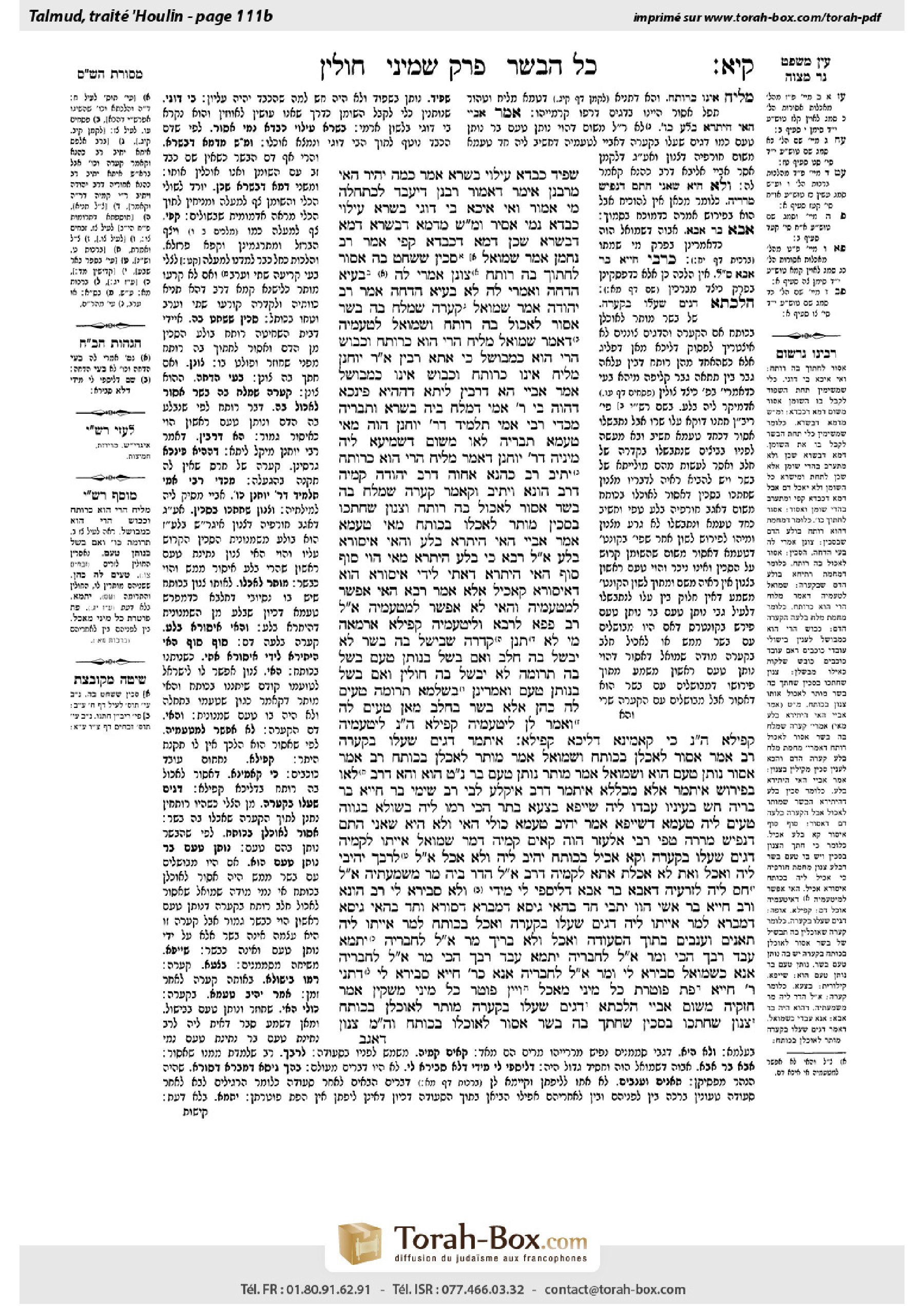
Chullin 111b: Talmud study for Daf Yomi
Study the Talmud for Daf Yomi with scanned pages, Hebrew text, English translations from Sefaria and AI-generated French translations.
Passage selection and English or AI-generated French translation are available where the scan has annotations. Daf Study is independent of Torah-Box and Sefaria.
Browse Chullin · חולין · All tractatesChullin 111b text and translations
This page of Chullin includes the Aramaic text, an English translation and an AI-generated French translation, alongside the scan above.
חולין קי״א ב · Aramaic and Hebrew text
שָׁפֵיד כַּבְדָּא עִילָּוֵי בִּשְׂרָא, אָמַר: כַּמָּה יְהִיר הַאי מֵרַבָּנַן! אֵימַר דַּאֲמוּר רַבָּנַן דִּיעֲבַד, לְכַתְּחִלָּה מִי אֲמוּר?
וְאִי אִיכָּא בֵּי דוּגֵי, בִּשְׂרָא עִילָּוֵי כַּבְדָּא נָמֵי אֲסִיר.
וּמַאי שְׁנָא מִדְּמָא דְּבִשְׂרָא? דְּמָא דְּבִשְׂרָא – שָׁכֵן, דְּמָא דְּכַבְדָּא – קָפֵי.
אָמַר רַב נַחְמָן, אָמַר שְׁמוּאֵל: סַכִּין שֶׁשָּׁחַט בָּהּ, אָסוּר לַחְתּוֹךְ בָּהּ רוֹתֵחַ. צוֹנֵן – אָמְרִי לַהּ בָּעֲיָא הַדָּחָה, וְאָמְרִי לַהּ לָא בָּעֲיָא הַדָּחָה.
אָמַר רַב יְהוּדָה אָמַר שְׁמוּאֵל: קְעָרָה שֶׁמָּלַח בָּהּ בָּשָׂר, אָסוּר לֶאֱכוֹל בָּהּ רוֹתֵחַ, וּשְׁמוּאֵל לְטַעְמֵיהּ, דְּאָמַר שְׁמוּאֵל: מָלִיחַ הֲרֵי הוּא כְּרוֹתֵחַ, וְכָבוּשׁ הֲרֵי הוּא כִּמְבוּשָּׁל.
כִּי אֲתָא רָבִין, אָמַר רַבִּי יוֹחָנָן: מָלִיחַ אֵינוֹ כְּרוֹתֵחַ, וְכָבוּשׁ אֵינוֹ כִּמְבוּשָּׁל. אָמַר אַבָּיֵי: הָא דְּרָבִין לֵיתַהּ, דְּהַהִיא פִּינְכָּא דַּהֲוָה בֵּי רַבִּי אַמֵּי, דְּמָלַח בֵּיהּ בִּשְׂרָא, וְתַבְרֵיהּ. מִכְּדֵי, רַבִּי אַמֵּי תַּלְמִיד דְּרַבִּי יוֹחָנָן הֲוָה, מַאי טַעְמָא תַּבְרֵיהּ? לָאו מִשּׁוּם דִּשְׁמִיעָא לֵיהּ מִינֵּיהּ דְּרַבִּי יוֹחָנָן דְּאָמַר: מָלִיחַ הֲרֵי הוּא כְּרוֹתֵחַ!
יָתֵיב רַב כָּהֲנָא אֲחוּהּ דְּרַב יְהוּדָה קַמֵּיהּ דְּרַב הוּנָא, וְיָתֵיב וְקָאָמַר: קְעָרָה שֶׁמָּלַח בָּהּ בָּשָׂר – אָסוּר לֶאֱכוֹל בָּהּ רוֹתֵחַ, וּצְנוֹן שֶׁחֲתָכוֹ בְּסַכִּין – מוּתָּר לְאׇכְלוֹ בְּכוּתָּח.
מַאי טַעְמָא? אָמַר אַבָּיֵי: הַאי – הֶיתֵּרָא בָּלַע, וְהַאי – אִיסּוּרָא בָּלַע.
אֲמַר לֵיהּ רָבָא: כִּי בָּלַע הֶיתֵּרָא, מַאי הָוֵי? סוֹף סוֹף, הַאי הֶיתֵּרָא דְּאָתֵי לִידֵי אִיסּוּרָא הוּא, דְּאִיסּוּרָא קָאָכֵיל! אֶלָּא אָמַר רָבָא: הַאי אֶפְשָׁר לְמִטְעֲמֵיהּ, וְהַאי לָא אֶפְשָׁר לְמִטְעֲמֵיהּ.
אֲמַר לֵיהּ רַב פָּפָּא לְרָבָא: וְלִיטְעֲמֵיהּ קַפִּילָא אֲרַמָּאָה, מִי לָא תְּנַן: קְדֵרָה שֶׁבִּישֵּׁל בָּהּ בָּשָׂר לֹא יְבַשֵּׁל בָּהּ חָלָב, וְאִם בִּשֵּׁל – בְּנוֹתֵן טַעַם, בִּשֵּׁל בָּהּ תְּרוּמָה לֹא יְבַשֵּׁל בָּהּ חוּלִּין, וְאִם בִּשֵּׁל – בְּנוֹתֵן טַעַם.
וְאָמְרִינַן: בִּשְׁלָמָא תְּרוּמָה – טָעֵים לַהּ כֹּהֵן, אֶלָּא בָּשָׂר בְּחָלָב – מַאן טָעֵים לַהּ? וַאֲמַר לַן: לִיטְעֲמֵיהּ קַפִּילָא! הָכִי נָמֵי לִיטְעֲמֵיהּ קַפִּילָא! הָכִי נָמֵי, כִּי קָאָמֵינָא – דְּלֵיכָּא קַפִּילָא.
אִיתְּמַר: דָּגִים שֶׁעָלוּ בַּקְּעָרָה, רַב אָמַר: אָסוּר לְאָכְלָן בְּכוּתָּח, וּשְׁמוּאֵל אָמַר: מוּתָּר לְאָכְלָן בְּכוּתָּח.
רַב אָמַר: אָסוּר, נוֹתֵן טַעַם הוּא; וּשְׁמוּאֵל אָמַר: מוּתָּר, נוֹתֵן טַעַם בַּר נוֹתֵן טַעַם הוּא.
וְהָא דְּרַב, לָאו בְּפֵירוּשׁ אִיתְּמַר, אֶלָּא מִכְּלָלָא אִיתְּמַר. דְּרַב אִיקְּלַע לְבֵי רַב שִׁימִי בַּר חִיָּיא בַּר בְּרֵיהּ, חַשׁ (בְּעֵינָיו) [בְּעֵינֵיהּ], עֲבַדוּ לֵיהּ שְׁיָיפָא בְּצָעָא, בָּתַר הָכִי רְמוֹ לֵיהּ בִּשּׁוּלָא בְּגַוַּוהּ, טָעֵים לֵיהּ טַעְמָא דִּשְׁיָיפָא, אֲמַר: יָהֵיב טַעְמָא כּוּלֵּי הַאי. וְלָא הִיא, שָׁאנֵי הָתָם דִּנְפִישׁ מְרָרֵהּ טְפֵי.
רַבִּי אֶלְעָזָר הֲוָה קָאֵים קַמֵּיהּ דְּמָר שְׁמוּאֵל, אַיְיתוֹ לְקַמֵּיהּ דָּגִים שֶׁעָלוּ בַּקְּעָרָה, וְקָא אָכֵיל בְּכוּתָּח. יָהֵיב לֵיהּ וְלָא אֲכַל, אֲמַר לֵיהּ: לְרַבָּךְ יְהַבִי לֵיהּ וַאֲכַל, וְאַתְּ לָא אָכְלַתְּ? אֲתָא לְקַמֵּיהּ דְּרַב, אֲמַר לֵיהּ: הֲדַר בֵּיהּ מָר מִשְּׁמַעְתֵּיהּ? אֲמַר לֵיהּ: חַס לֵיהּ לְזַרְעֵיהּ דְּאַבָּא בַּר אַבָּא דְּלִיסְפֵּי לִי מִידֵּי וְלָא סְבִירָא לִי.
רַב הוּנָא וְרַב חִיָּיא בַּר אָשֵׁי הֲווֹ יָתְבִי, חַד בְּהַאי גִּיסָא דְּמַבָּרָא דְּסוּרָא, וְחַד בְּהַאי גִּיסָא דְּמַבָּרָא. לְמָר אַיְיתוֹ לֵיהּ דָּגִים שֶׁעָלוּ בַּקְּעָרָה וַאֲכַל בְּכוּתָּח, לְמָר אַיְיתוֹ לֵיהּ תְּאֵנִים וַעֲנָבִים בְּתוֹךְ הַסְּעוּדָה, וַאֲכַל וְלָא בָּרֵיךְ.
מָר אֲמַר לֵיהּ לְחַבְרֵיהּ: יַתְמָא! עֲבַד רַבָּךְ הָכִי? וּמָר אֲמַר לֵיהּ לְחַבְרֵיהּ: יַתְמָא! עֲבַד רַבָּךְ הָכִי? מָר אֲמַר לֵיהּ לְחַבְרֵיהּ: אֲנָא כִּשְׁמוּאֵל סְבִירָא לִי, וּמָר אֲמַר לֵיהּ לְחַבְרֵיהּ: אֲנָא כְּרַבִּי חִיָּיא סְבִירָא לִי, דְּתָנֵי רַבִּי חִיָּיא: פַּת פּוֹטֶרֶת כׇּל מִינֵי מַאֲכָל, וְיַיִן פּוֹטֵר כׇּל מִינֵי מַשְׁקִין.
אָמַר חִזְקִיָּה מִשּׁוּם אַבָּיֵי: הִלְכְתָא דָּגִים שֶׁעָלוּ בַּקְּעָרָה – מוּתָּר לְאוֹכְלָן בְּכוּתָּח, צְנוֹן שֶׁחֲתָכוֹ בְּסַכִּין שֶׁחָתַךְ בָּהּ בָּשָׂר – אָסוּר לְאוֹכְלוֹ בְּכוּתָּח.
וְהָנֵי מִילֵּי צְנוֹן,
Chullin 111b · English translation
skewering liver on top of meat for roasting. Rav Ashi said: How haughty is this Sage! Even if you say that the Sages stated that one may eat meat roasted under liver after the fact, did they say that one may roast them in this manner ab initio?
The Gemara adds: And if there is a receptacle under the spit for the drippings of fat, then even if the meat is on top of the liver it is also prohibited to roast the meat, as the blood from the liver will fall into the fat in the vessel, and one might come to eat the mixture.
The Gemara asks: And in what way is this case different from roasting a piece of meat by itself over such a vessel, which is permitted? Here too the blood of the meat drips into the fat in the vessel. The Gemara answers: Blood of most meat sinks to the bottom of the vessel, while the fat floats on top. Since the fat can be separated from the blood, it is permitted. By contrast, the blood of the liver floats above the fat and cannot be removed from it, and therefore the entire mixture is prohibited.
§ Rav Naḥman says that Shmuel says: The knife with which one slaughtered an animal absorbs blood due to its heat, and it is therefore prohibited to cut any boiling food with it, since that food will in turn absorb the blood from the knife. If one cut cold food with this knife, some say that the piece he cut requires rinsing before one may eat it, and some say that it does not require rinsing.
§ The Gemara cites other statements of Shmuel. Rav Yehuda says that Shmuel says: With regard to a bowl in which meat was salted to remove its blood before cooking, it is prohibited to eat any boiling food placed in it, as that food absorbs blood of the meat from the bowl. And in this Shmuel conforms to his standard line of reasoning, as Shmuel said: A salted food imparts its flavor like a boiling food, and a food item marinated in vinegar, brine, or the like absorbs flavor from the liquid or vessel as would a cooked food.
When Ravin came from Eretz Yisrael to Babylonia he said that Rabbi Yoḥanan said: A salted food is not considered like a boiling food, and a marinated food is not considered like a cooked food. Abaye said: I can prove that this ruling that Ravin cited is not correct, as there was a certain bowl [pinka] in Rabbi Ami’s house in which meat was salted, and Rabbi Ami broke it so that it would no longer be used. Now Rabbi Ami was a student of Rabbi Yoḥanan. What is the reason he broke that bowl? Is it not because he heard that Rabbi Yoḥanan said: A salted food is considered like a boiling food? Ravin’s citation was evidently in error.
Rav Kahana, the brother of Rav Yehuda, sat before Rav Huna, and he sat and said: With regard to a bowl in which meat was salted, it is prohibited to eat any boiling food placed in it. And he added: With regard to a radish that one cut with a knife used for cutting meat, it is permitted to eat it with kutaḥ, a food that contains milk, even though the sharpness of the radish causes it to absorb the fat of the meat from the knife.
The Gemara asks: What is the reason to distinguish between blood absorbed in a bowl and fat absorbed by the radish? Abaye said: This radish absorbed a permitted substance, as the fat on the knife is permitted for consumption by itself, but that bowl in which meat was salted absorbed a prohibited substance, i.e., blood.
Rava said to Abaye: And if the radish absorbed a permitted substance, what of it? Ultimately, if one desires to eat the radish with kutaḥ, it is a permitted substance that leads to a prohibition, as he will eat a prohibited substance. Rather, Rava said: The distinction is that with regard to this radish, it is possible for a Jew to taste it before eating it with milk to see if it has acquired the flavor of meat. But with regard to that bowl, it is not possible for a Jew to taste its contents to see whether they have absorbed blood.
Rav Pappa said to Rava: But let a gentile cook taste the contents of the bowl to see whether they have the taste of blood. Didn’t we learn in the Tosefta (Terumot 8:12): With regard to a pot in which one cooked meat, one may not cook milk in it, and if he cooked milk in it, the meat absorbed in the pot renders the milk forbidden if it imparts flavor to the milk. Likewise, if one cooked teruma in the pot, he may not cook non-sacred food in it, and if he cooked non-sacred food in it, the non-sacred food is prohibited if there is sufficient teruma absorbed in the pot to impart flavor to the non-sacred food.
And we said with regard to this baraita: Granted, one can know whether the non-sacred food has acquired the flavor of teruma, as a priest can taste it. But with regard to the prohibition of meat cooked in milk, who can taste it? And you, Rava, said to us: Let a gentile cook taste it. So too here, with regard to the food in the bowl, let a gentile cook taste it. Rava responded: Indeed, a gentile cook can discover whether the food in the bowl has absorbed the taste of blood. When I said my statement I was referring to a case where there is no gentile cook available.
§ It was stated: If a fish was removed from the fire and placed, still hot, in a bowl in which meat had been eaten, Rav says: It is prohibited to eat the fish with the milk dish kutaḥ, since the fish has absorbed meat from the bowl. And Shmuel says: It is permitted to eat the fish with kutaḥ.
The Gemara explains: Rav says that it is prohibited to eat the fish with kutaḥ because this is a case of imparted flavor, i.e., from the meat to the fish. And Shmuel says that it is permitted because the flavor is first imparted to the bowl, and only then from the bowl to the fish. This is therefore a case of imparted flavor derived from imparted flavor.
The Gemara notes: And this opinion of Rav was not stated explicitly; rather, it was stated by inference. As Rav arrived at the house of Rav Shimi bar Ḥiyya, the son of his son. He felt pain in his eyes, and they prepared for him an ointment in an earthenware bowl as a remedy. Later they placed a dish for him in that same bowl. Rav tasted in that dish the flavor of the ointment and said: It imparts so much flavor! Those present inferred that according to Rav, imparted flavor derived from imparted flavor is strong enough itself to impart flavor. The Gemara rejects this: But that is not so, and one cannot reach any general conclusions from this story. It is different there, as the ointment was very bitter.
The Gemara relates: Rabbi Elazar was standing before Mar Shmuel, and they brought before Shmuel a fish that had been removed directly from the fire and placed into a bowl used previously for meat, and he ate it together with kutaḥ. Shmuel gave Rabbi Elazar some of this dish, but Rabbi Elazar did not eat it, as he was a student of Rav, who prohibited such mixtures. Shmuel said to him: To your teacher, Rav, I gave this dish and he ate from it, yet you will not eat? Later Rabbi Elazar came before Rav, and said to him: Did the Master retract this halakha? Do you permit this? Rav said to him: God forbid that the progeny of Abba bar Abba, i.e., Shmuel, would feed me something that I do not hold to be permitted. Shmuel never fed me such a dish.
The Gemara relates that Rav Huna and Rav Ḥiyya bar Ashi were sitting down to eat. One of them was sitting on this side of the ford of the Sura River, and the other one was sitting on that side of the ford. They brought one Sage a fish that had been removed from the fire and placed into a bowl previously used for meat, and he ate it together with kutaḥ. They also brought the other Sage figs and grapes during the meal, and he ate them but did not recite a separate blessing over them, even though these foods were usually consumed following the main portion of the meal before reciting Grace after Meals, and a separate blessing was made on them.
One Sage said to his colleague: Orphan! Student without a teacher! Would your teacher do this, i.e., eat such fish with kutaḥ? And the other Sage said to his colleague: Orphan! Would your teacher do this, i.e., eat these fruits during a meal without reciting a blessing over them? One Sage said to his colleague: I hold in accordance with the opinion of Shmuel, who permits eating such fish with kutaḥ. And the other Sage said to his colleague: I hold in accordance with the opinion of Rabbi Ḥiyya, as Rabbi Ḥiyya teaches: The blessing over the bread exempts all the other types of food eaten during a meal, including those usually eaten separately following bread, and likewise the blessing over wine exempts all types of drinks.
Ḥizkiyya says in the name of Abaye: The halakha is: If a fish was removed from the fire and placed into a bowl used for meat, it is permitted to eat it together with kutaḥ. But with regard to a radish that one cut with a knife with which he had cut meat, it is prohibited to eat that radish with kutaḥ, contrary to Rav Kahana’s statement above.
The Gemara notes: And this statement applies only to a radish,
Chullin 111b · Traduction française (IA)
Faire cuire le foie sur la viande. Rav Ashi dit : Quel orgueilleux ce sage est-il ! Même si l'on dit que les Sages ont dit qu'on peut manger de la viande cuite sous le foie après coup, n'ont-ils pas dit qu'on peut cuire ainsi d'ab initio ?
La Guemara ajoute : Et si il y a un récipient sous la broche pour les graisses, alors même que la viande est sur le foie, il est interdit de cuire la viande, car le sang du foie tombera dans les graisses du récipient, et l'on pourrait manger le mélange.
La Guemara pose la question : Et dans quelle mesure cette situation diffère-t-elle de la cuisson d'une pièce de viande seule sur un tel récipient, qui est permis ? Ici aussi, le sang de la viande tombe dans les graisses du récipient. La Guemara répond : Le sang de la plupart des viandes descend au fond du récipient, tandis que les graisses flottent en surface. Puisque les graisses peuvent être séparées du sang, cela est permis. En revanche, le sang du foie flotte au-dessus des graisses et ne peut être retiré, et par conséquent, le mélange entier est interdit.
§ Rav Naḥman dit que Shmuel dit : Le couteau avec lequel on a sacrifié un animal absorbe du sang à cause de sa chaleur, et il est donc interdit de couper un aliment bouillant avec lui, car cet aliment absorbera à son tour le sang du couteau. Si l'on coupe un aliment froid avec ce couteau, certains disent que la pièce que l'on a coupée nécessite un rincage avant de pouvoir la manger, et d'autres disent qu'il n'en est pas ainsi.
§ La Guemara cite d'autres propos de Shmuel. Rav Yehuda dit que Shmuel dit : Concernant un bol dans lequel la viande a été salée pour enlever son sang avant la cuisson, il est interdit de manger tout aliment bouillant placé dedans, car cet aliment absorbe le sang de la viande du bol. Et dans ce cas, Shmuel suit sa ligne de raisonnement habituelle, car Shmuel a dit : Un aliment salé transmet son goût comme un aliment bouillant, et un aliment mariné dans du vinaigre, du sel ou un tel liquide absorbe le goût du liquide ou du récipient comme un aliment cuit.
Quand Rabin est venu de la Terre d'Israël vers Babylone, il a dit que Rabbi Yoḥanan a dit : Un aliment salé n'est pas considéré comme un aliment bouillant, et un aliment mariné n'est pas considéré comme un aliment cuit. Abaye a dit : Je peux prouver que cette décision que Rabin a citée n'est pas correcte, car il y avait un bol [pinka] chez Rabbi Ami, dans lequel la viande avait été salée, et Rabbi Ami l'avait brisé pour ne plus le utiliser. Maintenant, Rabbi Ami était un disciple de Rabbi Yoḥanan. Pourquoi a-t-il brisé ce bol ? N'est-ce pas parce qu'il avait entendu que Rabbi Yoḥanan disait : Un aliment salé est considéré comme un aliment bouillant ? La citation de Rabin était manifestement erronée.
Rav Kahana, le frère de Rav Yehuda, s'est assis devant Rav Huna, et il a dit : Concernant un bol dans lequel de la viande avait été salée, il est interdit de manger tout aliment bouillant placé dedans. Et il a ajouté : Concernant un radis que l'on a coupé avec un couteau utilisé pour couper de la viande, il est permis de le manger avec kutaḥ, un aliment contenant du lait, même si la dureté du radis cause son absorption des graisses de la viande du couteau.
La Guemara pose la question : Quelle est la raison de distinguer entre le sang absorbé dans un bol et les graisses absorbées par le radis ? Abaye a dit : Ce radis a absorbé une substance permise, car les graisses sur le couteau sont permises à consommer par elles-mêmes, mais ce bol dans lequel de la viande avait été salée a absorbé une substance interdite, c'est-à-dire le sang.
Rava a dit à Abaye : Et si le radis a absorbé une substance permise, qu'est-ce que cela change ? Finalement, si l'on veut manger le radis avec kutaḥ, c'est une substance permise qui mène à une interdiction, car l'on mangera une substance interdite. Plutôt, Rava a dit : La distinction est que concernant ce radis, un Juif peut goûter avant de le manger avec le lait pour voir s'il a acquis le goût de la viande. Mais concernant ce bol, il n'est pas possible pour un Juif de goûter son contenu pour voir s'il a absorbé du sang.
Rav Pappa a dit à Rava : Mais laisse un non-Juif goûter le contenu du bol pour voir s'il a le goût du sang. N'avons-nous pas appris dans la Tosefta (Terumot 8:12) : Concernant un récipient dans lequel on a cuisiné de la viande, on ne peut pas cuire du lait dedans, et si l'on a cuisiné du lait dedans, la viande absorbée dans le récipient rend le lait interdit si elle transmet son goût au lait. De même, si l'on a cuisiné de la terouma dans le récipient, on ne peut pas cuisiner un aliment non sacré dedans, et si l'on a cuisiné un aliment non sacré dedans, l'aliment non sacré est interdit si suffisamment de terouma s'est absorbé dans le récipient pour transmettre son goût à l'aliment non sacré.
Et nous avons dit concernant cette baraïta : C'est évident, on peut savoir si l'aliment non sacré a acquis le goût de la terouma, car un prêtre peut le goûter. Mais concernant l'interdiction de la viande cuite avec du lait, qui peut goûter ? Et toi, Rava, tu as dit à nous : Laisse un non-Juif goûter. De même ici, concernant l'aliment dans le bol, laisse un non-Juif goûter. Rava a répondu : En effet, un non-Juif peut découvrir si l'aliment dans le bol a absorbé le goût du sang. Quand j'ai dit ma déclaration, je faisais référence à un cas où il n'y a pas de non-Juif disponible.
§ Il a été dit : Si un poisson a été retiré du feu et placé, encore chaud, dans un bol dans lequel de la viande avait été mangée, Rav dit : Il est interdit de manger le poisson avec le plat de lait kutaḥ, car le poisson a absorbé de la viande du bol. Et Shmuel dit : Il est permis de manger le poisson avec kutaḥ.
La Guemara explique : Rav dit qu'il est interdit de manger le poisson avec kutaḥ parce que c'est un cas de transmission de goût, c'est-à-dire du bœuf au poisson. Et Shmuel dit qu'il est permis parce que le goût est d'abord transmis au bol, puis du bol au poisson. C'est donc un cas de transmission de goût dérivé d'une transmission de goût.
La Guemara note : L'opinion de Rava n'a pas été exprimée explicitement ; plutôt, elle a été déduite par l'inférence. Quand Rava arriva chez Rabbî Shimi bar Ḥiyya, le fils de son fils, il ressentit une douleur dans les yeux, et on prépara pour lui un onguent dans un bol en terre comme remède. Plus tard, on plaça un plat dans ce même bol. Rava goûta dans ce plat le goût de l'onguent et dit : Ce goût est si fort ! Ceux qui étaient présents inférèrent que selon Rava, un goût transmis par un goût est suffisamment fort pour transmettre un goût. La Guemara rejette cette interprétation : Mais cela n'est pas vrai, et on ne peut tirer aucune conclusion générale de cette histoire. C'est différent là, car l'onguent était très amer.
La Guemara rapporte : Rabbi Eléazar était devant Mar Shmuel, et on présenta à Shmuel un poisson qui avait été retiré du feu et placé dans un bol utilisé précédemment pour la viande, et il le mangea avec du kutaḥ. Shmuel donna à Rabbi Eléazar une part de ce plat, mais Rabbi Eléazar ne le mangea pas, car il était un disciple de Rav, qui interdisait de telles mélanges. Shmuel lui dit : À ton maître, Rav, j’ai donné ce plat et il l’a mangé, et pourtant tu ne le mangeras pas ? Plus tard, Rabbi Eléazar vint devant Rav et lui dit : Le Maître a-t-il rétracté cette halakha ? Permets-tu cela ? Rav lui répondit : Dieu forbid que la descendance d’Abba bar Abba, c’est-à-dire Shmuel, me fournisse quelque chose que je ne considère pas comme permis. Shmuel ne m’a jamais offert un tel plat.
La Guemara rapporte que Rav Huna et Rav Ḥiyya bar Ashi étaient assis pour manger. L’un d’eux était assis de ce côté du fleuve Sura, et l’autre de l’autre côté. On présenta à l’un de ces sages un poisson qui avait été retiré du feu et placé dans un bol utilisé précédemment pour la viande, et il le mangea avec du kutaḥ. On présenta également à l’autre sage des figues et des raisins pendant le repas, et il les mangea sans réciter une prière séparée sur eux, même si ces aliments étaient normalement consommés après la principale partie du repas avant de réciter la bénédiction de la gratitude.
Un Sage dit à son collègue : Orphelin ! Étudiant sans maître ! Votre maître ferait-il cela, c'est-à-dire manger ce poisson avec kutaḥ ? Et l'autre Sage dit à son collègue : Orphelin ! Votre maître ferait-il cela, c'est-à-dire manger ces fruits lors d'un repas sans bénir leur consommation ? Un Sage dit à son collègue : Je suis d'avec l'opinion de Shmuel, qui permet de manger ce poisson avec kutaḥ. Et l'autre Sage dit à son collègue : Je suis d'avec l'opinion de Rabbi Ḥiyya, car Rabbi Ḥiyya enseigne : La bénédiction sur le pain exempt tous les autres types de nourriture mangés lors d'un repas, y compris ceux généralement mangés séparément après le pain, et de même la bénédiction sur le vin exempt tous les types de boissons.
Ḥizkiyya dit en nom d'Abaye : La halakha est la suivante : Si un poisson a été retiré du feu et placé dans un bol utilisé pour la viande, il est permis de le manger avec kutaḥ. Mais concernant un radis que l'on a coupé avec un couteau avec lequel on avait coupé de la viande, il est interdit de le manger avec kutaḥ, contrairement à la déclaration de Rav Kahana ci-dessus.
La Guemara note que : Et cette déclaration s'applique uniquement au radis,
Traduction française générée par IA à partir de l’édition anglaise de Sefaria. Vérifie toujours un passage avec le texte source.
Text from Sefaria: William Davidson Edition - Vocalized Aramaic (unknown); William Davidson Edition - English (CC BY NC).