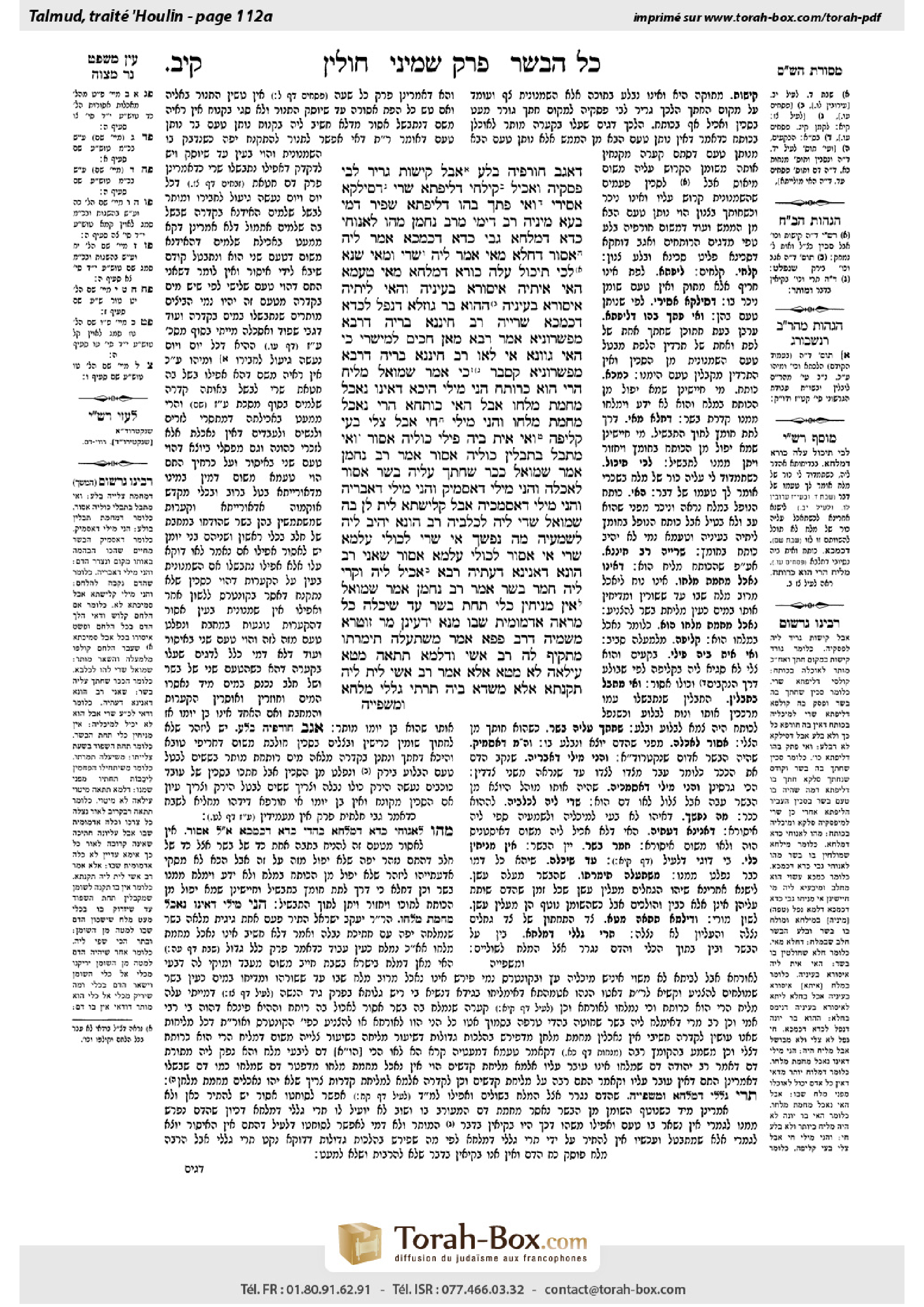
Chullin 112a: Talmud study for Daf Yomi
Study the Talmud for Daf Yomi with scanned pages, Hebrew text, English translations from Sefaria and AI-generated French translations.
Passage selection and English or AI-generated French translation are available where the scan has annotations. Daf Study is independent of Torah-Box and Sefaria.
Browse Chullin · חולין · All tractatesChullin 112a text and translations
This page of Chullin includes the Aramaic text, an English translation and an AI-generated French translation, alongside the scan above.
חולין קי״ב א · Aramaic and Hebrew text
דְּאַגַּב חוּרְפֵּיהּ בָּלַע, אֲבָל קִישּׁוּת – גָּרֵיר לְבֵי פְסָקֵיהּ וְאָכֵיל.
קִילְחֵי דְּלִיפְתָּא – שְׁרֵי, דְּסִילְקָא – אֲסִירי, וְאִי פְּתַךְ בְּהוּ דְּלִיפְתָּא – שַׁפִּיר דָּמֵי.
בְּעָא מִינֵּיהּ רַב דִּימִי מֵרַב נַחְמָן: מַהוּ לְאַנּוֹחֵי כַּדָּא דְמִלְחָא גַּבֵּי כַּדָּא דְכַמְכָּא? אֲמַר לֵיהּ: אָסוּר. דְּחַלָּא מַאי? אֲמַר לֵיהּ: שְׁרֵי.
וּמַאי שְׁנָא לְכִי תֵּיכוּל עֲלַהּ כּוֹרָא דְמִלְחָא? מַאי טַעְמָא? הַאי – אִיתֵיהּ (איסורא) [לְאִיסּוּרָא] בְּעֵינֵיהּ, וְהַאי – לֵיתֵיהּ (איסורא) [לְאִיסּוּרָא] בְּעֵינֵיהּ.
הָהוּא בַּר גּוֹזָלָא דִּנְפַל לְכַדָּא דְּכַמְכָּא, שַׁרְיֵיהּ רַב חִינָּנָא בְּרֵיהּ דְּרָבָא מִפַּשְׁרוּנְיָא. אָמַר רָבָא: מַאן חַכִּים לְמִישְׁרֵי כִּי הַאי גַוְונָא, אִי לָאו רַב חִינָּנָא בְּרֵיהּ דְּרָבָא מִפַּשְׁרוּנְיָא? קָסָבַר: כִּי אָמַר שְׁמוּאֵל ״מָלִיחַ הֲרֵי הוּא כְּרוֹתֵחַ״, הָנֵי מִילֵּי הֵיכָא דְּאֵינוֹ נֶאֱכָל מֵחֲמַת מִלְחוֹ, אֲבָל הַאי כּוּתָּחָא הֲרֵי נֶאֱכָל מֵחֲמַת מִלְחוֹ.
וְהָנֵי מִילֵּי חַי, אֲבָל צָלִי – בָּעֵי קְלִיפָה, וְאִי אִית בֵּיהּ פִּילֵי – כּוּלֵּיהּ אָסוּר, וְאִי מְתַבַּל בְּתַבְלִין – כּוּלֵּיהּ אָסוּר.
אָמַר רַב נַחְמָן, אָמַר שְׁמוּאֵל: כִּכָּר שֶׁחָתַךְ עָלֶיהָ בָּשָׂר – אָסוּר לְאׇכְלָהּ, וְהָנֵי מִילֵּי דְּאַסְמֵיק, וְהָנֵי מִילֵּי דְּאַבְרְיֵהּ, וְהָנֵי מִילֵּי דְּאַסְמְכֵיהּ, אֲבָל קְלִישְׁתָּא – לֵית לַן בַּהּ.
שְׁמוּאֵל שָׁדֵי לֵיהּ לְכַלְבֵּיהּ, רַב הוּנָא יָהֵיב לֵיהּ לְשַׁמָּעֵיהּ. מָה נַפְשָׁךְ? אִי שְׁרֵי – לְכוּלֵּי עָלְמָא שְׁרֵי, אִי אֲסִיר – לְכוּלֵּי עָלְמָא אֲסִיר! שָׁאנֵי רַב הוּנָא דַּאֲנִינָא דַּעְתֵּיהּ. רָבָא אָכֵיל לֵיהּ, וְקָרֵי לֵיהּ ״חֲמַר בָּשָׂר״.
אָמַר רַב נַחְמָן, אָמַר שְׁמוּאֵל: אֵין מַנִּיחִין כְּלִי תַּחַת בָּשָׂר עַד שֶׁיִּכְלֶה כׇּל מַרְאֵה אַדְמוּמִית שֶׁבּוֹ. מְנָא יָדְעִינַן? מָר זוּטְרָא מִשְּׁמֵיהּ דְּרַב פָּפָּא אָמַר: מִשֶּׁתַּעֲלֶה תִּימְרָתוֹ.
מַתְקֵיף לַהּ רַב אָשֵׁי: וְדִלְמָא תַּתָּאָה מְטָא, עִילָּאָה לָא מְטָא? אֶלָּא אָמַר רַב אָשֵׁי: לֵית לֵיהּ תַּקַּנְתָּא, אֶלָּא מִשְׁדֵּא בֵּיהּ תַּרְתֵּי גַּלְלֵי מִלְחָא,
Chullin 112a · English translation
as due to its sharpness it absorbs the fat on the knife. But if one cut a cucumber with the same knife, it does not absorb the fat to the same extent. One may therefore simply scrape the place of the cut to remove any fat residue, and then one may eat the cucumber with kutaḥ.
Likewise, turnip stalks cut with such a knife are permitted for consumption with kutaḥ. But chard cut with such a knife is prohibited for consumption with kutaḥ, as it absorbs flavor from the knife. And if one alternated between cutting chard and turnip stalks it is permitted, as the turnip stalks nullify the taste of the meat in the knife.
§ Rav Dimi inquired of Rav Naḥman: What is the halakha with regard to placing a jug of salt, used to salt meat, alongside a jug of kamka, i.e., kutaḥ, a milk dish? Need one be concerned lest some of the kutaḥ fall on the salt without his knowledge and ultimately contaminate his meat? Rav Naḥman said to him: It is prohibited to place the two jugs next to each other. Rav Dimi further inquired: What is the halakha with regard to a similar case involving a jug of vinegar used to season meat? Need one be concerned lest the kutaḥ fall into the vinegar? Rav Naḥman said to him: It is permitted to place these two jugs next to each other.
Rav Dimi asked: And what is different about the vinegar? Rav Naḥman responded: When you have thought about it long enough to eat a kor of salt, you will know the reason. The Gemara clarifies: What is the reason then? In this case of the salt, the prohibited substance is substantive, as the traces of kutaḥ are discernible and not nullified by the salt. But in that case of the vinegar, the prohibited substance is not substantive, since the kutaḥ melts away in the vinegar and will no longer impart flavor.
The Gemara relates: There was a certain young bird that fell into a jug of kamka, i.e., kutaḥ. Rav Ḥinnana, son of Rava of the city of Pashronya, permitted the bird. Rava said about this: Who is wise enough to discern reasons to permit the food in difficult cases like this, if not Rav Ḥinnana, son of Rava of Pashronya? He maintains that when Shmuel said that a salted food imparts flavor like a boiling food, that statement applies only to a food so salty that it is not eaten due to its salt, but this kutaḥ can still be eaten due to, i.e., despite, its salt. Therefore, it is as if both foods are cold and unsalted, and they do not impart flavor to one another, provided one rinses the area of contact.
The Gemara adds: And this statement applies only if the bird is raw, but if it is roasted, it requires peeling to remove the outer layer, since roasting softens the meat and causes it to absorb more flavor. And if it has cracks [pilei], it is entirely forbidden, because the milk is absorbed into the cracks. And if it has been flavored with spices it is likewise entirely forbidden, because the spices soften the meat and render it absorbent.
Rav Naḥman said that Shmuel says: It is prohibited to eat a loaf of bread upon which one cut unsalted roasted meat, since the blood expelled from the roasted meat is absorbed in the loaf. The Gemara adds: And this statement applies only if the meat is ruddy from the blood it contains. And furthermore, this statement applies only if so much blood was absorbed in the loaf that it passed through from one side of the loaf to the other and was visible from both sides. And furthermore, this statement applies only if the liquid emitted by the roasted meat is viscous. But if it is runny, we have no problem with it, i.e., the loaf is permitted.
The Gemara relates: Shmuel would throw to his dog such a loaf of bread that he held was prohibited. Rav Huna would not eat the loaf himself but would rather give it to his attendant. The Gemara objects: Whichever way you look at it, Rav Huna’s behavior is problematic: If the loaf is permitted, it is permitted for everyone, including Rav Huna himself. And if it is prohibited, then it is prohibited for everyone, and he should not give it to his attendant. The Gemara explains: In fact, the loaf is permitted for consumption, and Rav Huna is different, as he is of delicate constitution and did not want to eat the loaf himself. The Gemara further relates: Rava would eat a loaf of this type, and he would call the red liquid meat wine.
Rav Naḥman says that Shmuel says: One may not place a vessel under roasting meat to catch the drippings of fat until all the ruddiness of the meat’s appearance has dissipated. Beforehand, though, one must be concerned that blood will fall with the drippings into the vessel, rendering the mixture and the vessel prohibited. The Gemara asks: How do we know when all the meat’s redness has disappeared? Mar Zutra said in the name of Rav Pappa: As soon as its smoke rises, one can be sure that all the blood has been expelled from the meat.
Rav Ashi objects to this: But perhaps the underside of the meat, which is closest to the coals, has been fully roasted, but its upper part is still not roasted and still expels blood at this stage. Rather, Rav Ashi said: One who wishes to collect the drippings has no remedy except to place two lumps of salt in it, i.e., one in the receptacle under the meat and one on top, in the meat itself.
Chullin 112a · Traduction française (IA)
car, en raison de sa dureté, il absorbe la graisse sur le couteau. Mais si l'on coupe un concombre avec le même couteau, il n'absorbe pas la graisse dans la même mesure. On peut donc simplement gratifier la zone de la coupure pour éliminer toute résidu de graisse, puis on peut manger le concombre avec kutaḥ.
De même, les tiges de navet coupées avec un tel couteau sont permises à la consommation avec kutaḥ. Mais les chardons coupés avec ce couteau sont interdits à la consommation avec kutaḥ, car ils absorbent le goût du couteau. Et si l'on alterne entre la coupe de chardons et de tiges de navet, cela est permis, car les tiges de navet annulent le goût de la viande dans le couteau.
§ Rav Dimi a interrogé Rav Naḥman : Quel est le halakha concernant la mise d'une jarre de sel, utilisée pour saler la viande, à côté d'une jarre de kamka, c'est-à-dire de kutaḥ, un plat laitier ? Faut-il craindre que quelque partie du kutaḥ tombe sur le sel sans que l'on s'en aperçoive et finisse par contaminer sa viande ? Rav Naḥman a répondu à lui : Il est interdit de placer les deux jarres côte à côte. Rav Dimi a encore interrogé : Quel est le halakha concernant un cas similaire impliquant une jarre de vinaigre utilisée pour assaisonner la viande ? Faut-il craindre que le kutaḥ tombe dans le vinaigre ? Rav Naḥman a répondu à lui : Il est permis de placer ces deux jarres côte à côte.
Rav Dimi demanda : Et qu'y a-t-il de différent dans le vinaigre ? Rav Naḥman répondit : Quand vous avez réfléchi suffisamment pour manger un kor de sel, vous saurez la raison. La Guemara explique : Quelle est la raison alors ? Dans ce cas du sel, la substance interdite est substantielle, car les traces de kutaḥ sont discernables et ne sont pas annulées par le sel. Mais dans ce cas du vinaigre, la substance interdite n'est pas substantielle, car le kutaḥ se dissout dans le vinaigre et ne transmet plus de goût.
La Guemara rapporte : Il y avait un certain petit oiseau qui est tombé dans une jarre de kamka, c'est-à-dire de kutaḥ. Rav Ḥinnana, fils de Rava de la ville de Pashronya, permit l'oiseau. Rava dit à ce sujet : Qui est sage assez pour distinguer les raisons permettant de consommer les aliments dans des cas difficiles comme celui-ci, si ce n'est Rav Ḥinnana, fils de Rava de Pashronya ? Il maintient que lorsque Shmuel a dit qu'un aliment salé transmet un goût comme un aliment bouilli, cette déclaration s'applique uniquement à un aliment si salé qu'il n'est pas mangé à cause de son sel, mais ce kutaḥ peut encore être mangé malgré son sel. Par conséquent, c'est comme si les deux aliments étaient froids et non salés, et ils ne transmettent pas de goût l'un à l'autre, à condition de rincer la zone de contact.
La Guemara ajoute : Et cette déclaration s'applique uniquement si l'oiseau est cru, mais si l'oiseau est rôti, il faut le dépouiller pour enlever la couche externe, car la cuisson rôti ramollit la viande et la fait absorber plus de goût. Et si l'oiseau a des fissures [pilei], il est entièrement interdit, car le lait est absorbé dans les fissures. Et si l'oiseau a été aromatisé par des épices, il est également entièrement interdit, car les épices ramollissent la viande et la rendent absorbante.
Rav Naḥman dit que Shmuel dit : Il est interdit de manger un pain sur lequel l'on a placé de la viande rôti non salée, car le sang expulsé de la viande rôti est absorbé dans le pain. La Guemara ajoute : Et cette déclaration s'applique uniquement si la viande est rousse à cause du sang qu'elle contient. Et de plus, cette déclaration s'applique uniquement si autant de sang a été absorbé dans le pain qu'il est passé d'un côté à l'autre et est visible des deux côtés. Et de plus, cette déclaration s'applique uniquement si le liquide émis par la viande rôti est visqueux. Mais si c'est liquide, nous n'avons pas de problème, c'est-à-dire que le pain est permis.
La Guemara rapporte : Shmuel jetait à son chien un tel pain qu'il considérait comme interdit. Rav Huna ne mangeait pas lui-même ce pain mais le donnait à son serviteur. La Guemara s'oppose : Quel que soit le point de vue, le comportement de Rav Huna est problématique : Si le pain est permis, il est permis pour tout le monde, y compris Rav Huna lui-même. Et si le pain est interdit, alors il est interdit pour tout le monde, et il ne devrait pas le donner à son serviteur. La Guemara explique : En fait, le pain est permis à la consommation, et Rav Huna est différent, car il a une constitution délicate et ne voulait pas manger le pain lui-même. La Guemara rapporte également : Rava mangeait un tel pain, et il appelait le liquide rouge viande vin.
Rav Naḥman dit que Shmuel dit : On ne doit pas placer un récipient sous de la viande rôti pour récupérer les gouttes de graisse jusqu'à ce que toute la rougeur de l'apparence de la viande ait disparu. Avant cela, cependant, on doit craindre que le sang tombe avec les gouttes dans le récipient, rendant le mélange et le récipient interdits. La Guemara demande : Comment savons-nous quand toute la rougeur de la viande a disparu ? Mar Zutra a dit en nom de Rav Pappa : Dès que la fumée monte, on peut être sûr que tout le sang a été expulsé de la viande.
Rav Ashi s'oppose à cela : Mais peut-être que la partie inférieure de la viande, la plus proche des braises, a été entièrement rôtie, mais sa partie supérieure n'est pas encore rôtie et expulse encore du sang à cette étape. En revanche, Rav Ashi a dit : Celui qui veut récupérer les gouttes n'a aucun remède sauf de placer deux morceaux de sel dedans, c'est-à-dire un dans le récipient sous la viande et un sur la viande elle-même.
Traduction française générée par IA à partir de l’édition anglaise de Sefaria. Vérifie toujours un passage avec le texte source.
Text from Sefaria: William Davidson Edition - Vocalized Aramaic (unknown); William Davidson Edition - English (CC BY NC).