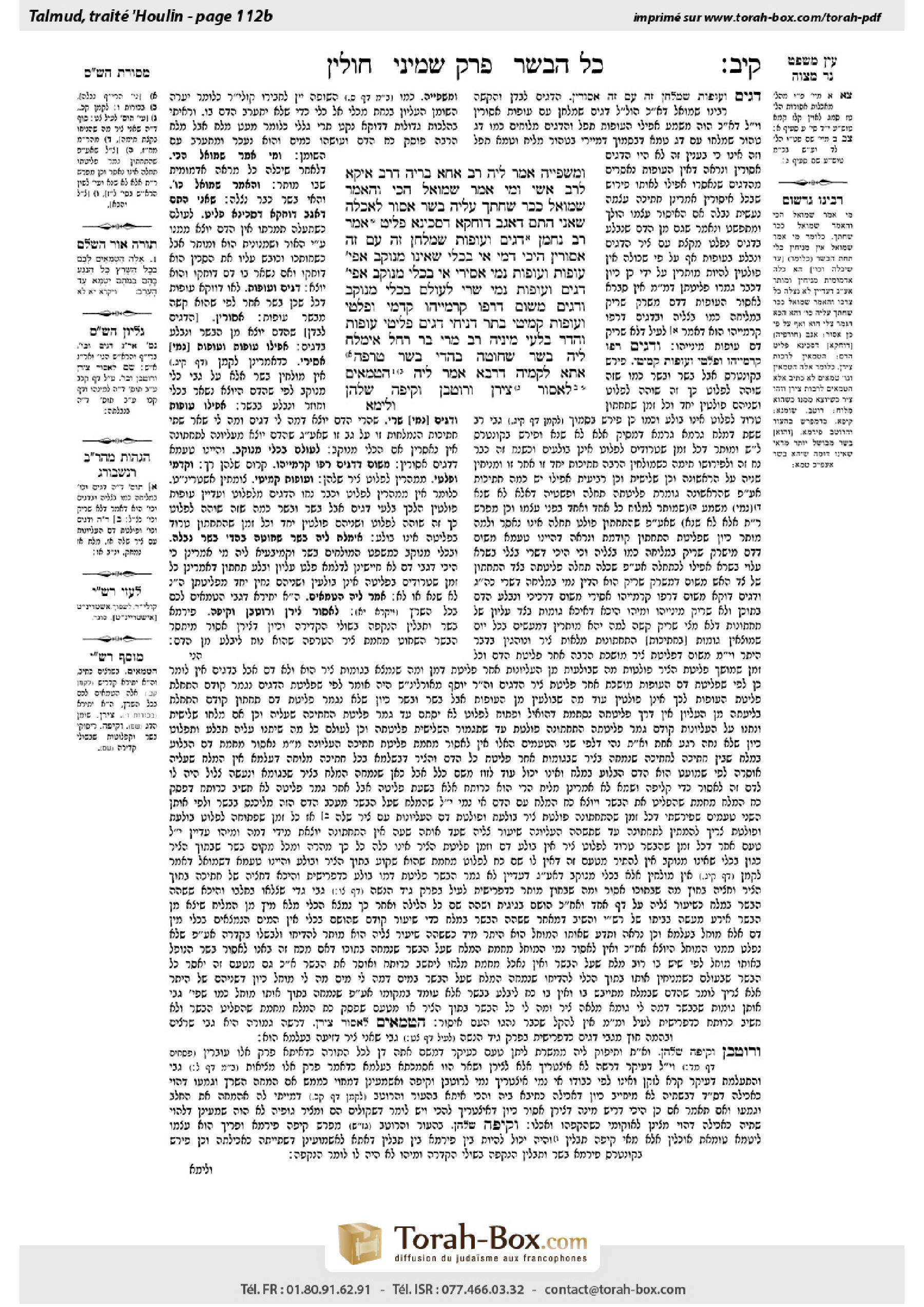
Chullin 112b: Talmud study for Daf Yomi
Study the Talmud for Daf Yomi with scanned pages, Hebrew text, English translations from Sefaria and AI-generated French translations.
Passage selection and English or AI-generated French translation are available where the scan has annotations. Daf Study is independent of Torah-Box and Sefaria.
Browse Chullin · חולין · All tractatesChullin 112b text and translations
This page of Chullin includes the Aramaic text, an English translation and an AI-generated French translation, alongside the scan above.
חולין קי״ב ב · Aramaic and Hebrew text
וּמִשְׁפְּיֵיהּ.
אֲמַר לֵיהּ רַב אַחָא בְּרֵיהּ דְּרַב אִיקָא לְרַב אָשֵׁי: וּמִי אָמַר שְׁמוּאֵל הָכִי? וְהָאָמַר שְׁמוּאֵל: כִּכָּר שֶׁחָתַךְ עָלֶיהָ בָּשָׂר אָסוּר לְאׇכְלָהּ! שָׁאנֵי הָתָם, דְּאַגַּב דּוּחְקָא דְסַכִּינָא פָּלֵיט.
אָמַר רַב נַחְמָן: דָּגִים וְעוֹפוֹת שֶׁמְּלָחָן זֶה עִם זֶה – אֲסוּרִין. הֵיכִי דָמֵי? אִי בִּכְלִי שֶׁאֵינוֹ מְנוּקָּב – אֲפִילּוּ עוֹפוֹת וְעוֹפוֹת נָמֵי אֲסִירִי, אִי בִּכְלִי מְנוּקָּב – אֲפִילּוּ דָּגִים וְעוֹפוֹת נָמֵי שְׁרֵי.
לְעוֹלָם בִּכְלִי מְנוּקָּב, וְדָגִים מִשּׁוּם דִּרְפוּ קְרָמַיְיהוּ קָדְמִי וּפָלְטִי, וְעוֹפוֹת קְמִיטִי, בָּתַר דְּנָיְחִי דָּגִים פָּלְיטִי עוֹפוֹת, וַהֲדַר בָּלְעִי מִינֵּיהּ.
רַב מָרִי בַּר רָחֵל אִימְּלַח לֵיהּ בְּשַׂר שְׁחוּטָה בַּהֲדֵי בְּשַׂר טְרֵפָה, אֲתָא לְקַמֵּיהּ דְּרָבָא.
אֲמַר לֵיהּ: ״הַטְּמֵאִים״ – לֶאֱסוֹר צִירָן, וְרוֹטְבָן, וְקֵיפֶה שֶׁלָּהֶן.
Chullin 112b · English translation
Doing this will allow the blood dripping from the meat to stick to the salt on the sides of the vessel, while the fat will float to the top. And when emptying the receptacle, he should tilt it gently to pour the fat into another vessel without it mixing with the blood.
Rav Aḥa, son of Rav Ika, said to Rav Ashi: And did Shmuel really say this, that once the meat’s ruddiness has dissipated it is permitted to place a receptacle underneath it? But didn’t Shmuel say: It is prohibited to eat a loaf of bread upon which one cut roasted meat? Apparently he holds that meat contains blood even after it has finished roasting. Rav Ashi replied: Shmuel holds that the meat no longer emits blood after its ruddiness has dissipated. And as for his ruling with regard to a loaf of bread, it is different there, as due to the pressure of the knife the meat expels more blood.
§ Rav Naḥman says: If one salted fish and birds together, the fish are prohibited for consumption due to the blood they absorb from the birds. The Gemara asks: What are the circumstances of this ruling? If they were placed in an unperforated vessel, in which the blood emitted by the birds will pool, then even if one salted a bird and another bird together they should be prohibited, as the blood expelled from one bird will be absorbed by the other. And if the case involves a perforated vessel, out of which the blood can flow, then even if fish are salted with birds the fish should be permitted.
The Gemara answers: Actually, the ruling is referring to a perforated vessel. And the fish are prohibited because their skin is soft, and therefore when they are salted they expel their blood first, whereas the skin of birds is hard. After the fish finish expelling their blood, the birds continue to expel their blood, and then the fish absorb blood from them. If one salts two birds together, they expel their blood simultaneously, and neither will absorb blood from outside while expelling its own.
The Gemara relates: Meat of a slaughtered animal was salted for Rav Mari bar Raḥel together with prohibited meat of an animal that had a wound that would have caused it to die within twelve months [tereifa], in a perforated vessel, as meat is generally salted. He came before Rava to ask whether the kosher meat was prohibited, as perhaps it would not have absorbed flavor from the non-kosher meat while itself expelling blood.
Rava said to him: When the verse states, with regard to forbidden foods: “These are the unclean to you” (Leviticus 11:31), the added definite article serves to prohibit not only their flesh but also their juice emitted by salting, and their gravy, and their spices with which they are cooked. Even while the kosher meat is emitting its blood, it still absorbs the juices of the non-kosher meat, which are absorbed more easily than blood.
Chullin 112b · Traduction française (IA)
Faire cela permettra au sang qui coule du viande de rester collé au sel sur les côtés du récipient, tandis que la graisse flottera en surface. Et lorsqu'on vide le récipient, il devra le pencher doucement pour verser la graisse dans un autre récipient sans qu'elle ne mélange avec le sang.
Rav Aḥa, fils de Rav Ika, dit à Rav Ashi : Et Shmuel a vraiment dit cela, que lorsqu'il a perdu sa couleur rougeâtre, il est permis de placer un récipient sous la viande ? Mais n'a-t-il pas dit : Il est interdit de manger un pain sur lequel on a coupé de la viande rôtie ? Apparemment, il considère que la viande contient du sang même après qu'elle ait fini de rôtir. Rav Ashi répondit : Shmuel considère que la viande ne plus émettre de sang après que sa couleur rougeâtre ait disparu. Et concernant sa décision concernant le pain, c'est différent, car en raison de la pression du couteau, la viande expulse plus de sang.
§ Rav Naḥman dit : Si l'on a saumé des poissons et des oiseaux ensemble, les poissons sont interdits à la consommation en raison du sang qu'ils absorbent des oiseaux. La Guemara demande : Quelles sont les circonstances de cette décision ? Si on les a placés dans un récipient non percé, dans lequel le sang émis par les oiseaux se regroupera, alors même si l'on a saumé un oiseau avec un autre oiseau ensemble, ils devraient être interdits, car le sang expulsé par un oiseau sera absorbé par l'autre. Et si le cas concerne un récipient percé, par lequel le sang peut s'écouler, alors même si les poissons sont saumés avec des oiseaux, les poissons devraient être permis.
La Guemara répond : En réalité, la décision fait référence à un récipient percé. Les poissons sont interdits car leur peau est douce, et donc lorsqu'ils sont saumés, ils expulsent leur sang en premier, tandis que la peau des oiseaux est dure. Après que les poissons aient terminé d'expulser leur sang, les oiseaux continuent à en expulser, et ensuite les poissons absorbent le sang des oiseaux. Si l'on saumé deux oiseaux ensemble, ils expulsent leur sang simultanément, et aucun ne sera absorbé par l'extérieur pendant qu'il expulse le sien.
La Guemara rapporte : La viande d'un animal immolé a été saumée avec la viande non permise d'un animal qui avait une blessure qui l'aurait tué en douze mois [tereifa], dans un récipient percé, comme la viande est généralement saumée. Il est venu devant Rava pour demander si la viande kasher était interdite, car peut-être elle n'avait pas absorbé le goût de la viande non kasher pendant qu'elle expulsait son sang.
Rava dit à lui : Lorsque la Sainte Écriture dit, concernant les aliments interdits : « Ces sont les impurs pour vous » (Lévitique 11:31), l'article défini supplémentaire sert à interdire non seulement leur chair mais aussi leur jus émis par le sel, leur sauce et leurs épices avec lesquels ils sont cuits. Même pendant que la viande kasher émet son sang, elle absorbe les jus de la viande non kasher, qui sont plus facilement absorbés que le sang.
Traduction française générée par IA à partir de l’édition anglaise de Sefaria. Vérifie toujours un passage avec le texte source.
Text from Sefaria: William Davidson Edition - Vocalized Aramaic (unknown); William Davidson Edition - English (CC BY NC).