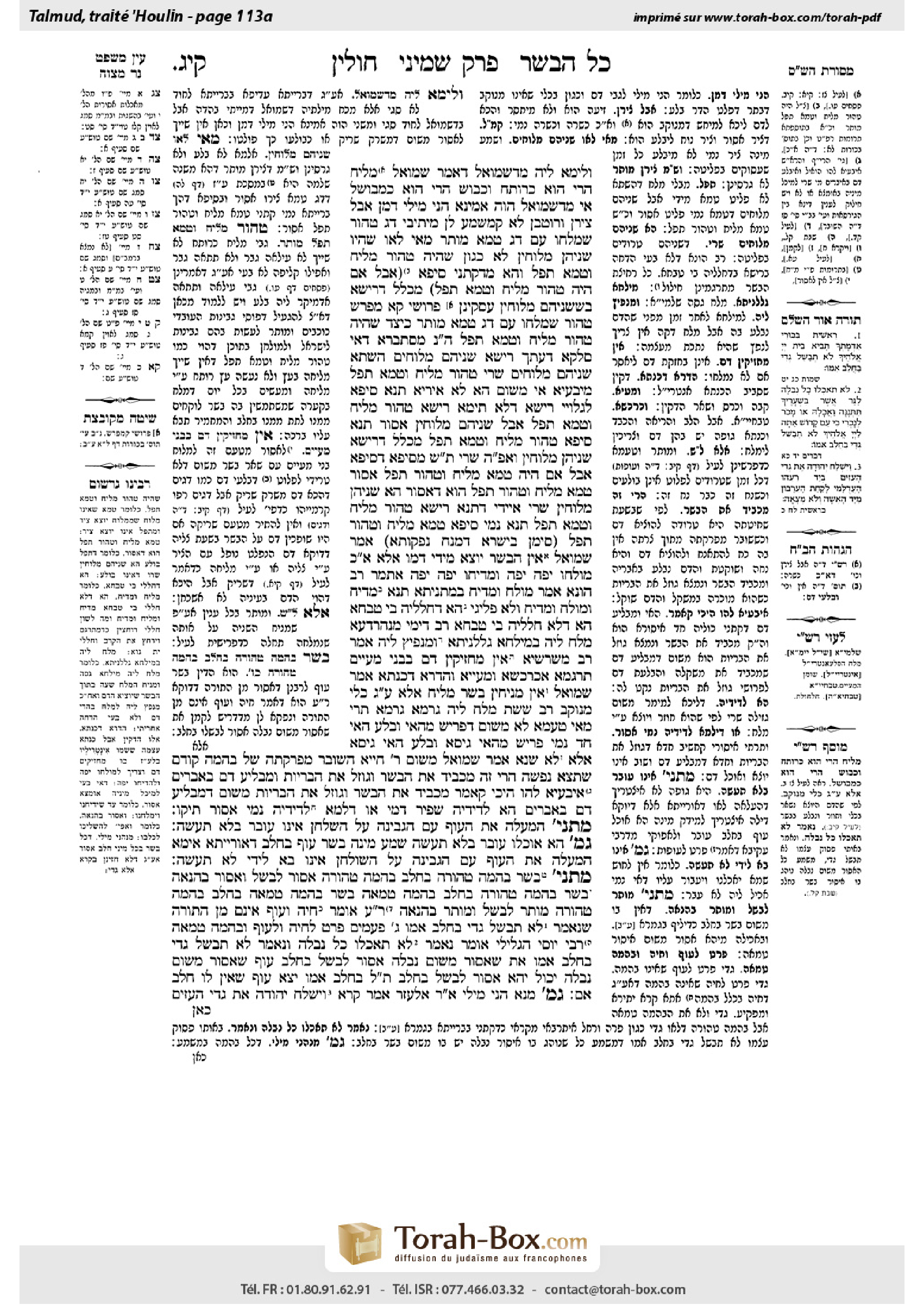
Chullin 113a: Talmud study for Daf Yomi
Study the Talmud for Daf Yomi with scanned pages, Hebrew text, English translations from Sefaria and AI-generated French translations.
Passage selection and English or AI-generated French translation are available where the scan has annotations. Daf Study is independent of Torah-Box and Sefaria.
Browse Chullin · חולין · All tractatesChullin 113a text and translations
This page of Chullin includes the Aramaic text, an English translation and an AI-generated French translation, alongside the scan above.
חולין קי״ג א · Aramaic and Hebrew text
וְלֵימָא לֵיהּ מִדִּשְׁמוּאֵל, דְּאָמַר שְׁמוּאֵל: מָלִיחַ הֲרֵי הוּא כְּרוֹתֵחַ, וְכָבוּשׁ הֲרֵי הוּא כִּמְבוּשָּׁל!
אִי מִדִּשְׁמוּאֵל, הֲוָה אָמֵינָא: הָנֵי מִילֵּי – דָּמָן, אֲבָל צִירָן וְרוֹטְבָן – לָא, קָמַשְׁמַע לַן.
מֵיתִיבִי: דָּג טָהוֹר שֶׁמְּלָחוֹ עִם דָּג טָמֵא – מוּתָּר. מַאי לָאו שֶׁהָיוּ שְׁנֵיהֶן מְלוּחִין? לָא, כְּגוֹן שֶׁהָיָה טָהוֹר מָלִיחַ וְטָמֵא תָּפֵל.
וְהָא מִדְּקָתָנֵי סֵיפָא: אֲבָל אִם הָיָה טָהוֹר מָלִיחַ וְטָמֵא תָּפֵל, מִכְּלָל דְּרֵישָׁא בְּשֶׁשְּׁנֵיהֶם מְלוּחִין עָסְקִינַן! פָּרוֹשֵׁי קָא מְפָרֵשׁ: טָהוֹר שֶׁמְּלָחוֹ עִם דָּג טָמֵא – מוּתָּר, כֵּיצַד? שֶׁהָיָה טָהוֹר מָלִיחַ וְטָמֵא תָּפֵל.
הָכִי נָמֵי מִסְתַּבְּרָא, דְּאִי סָלְקָא דַעְתָּךְ רֵישָׁא שְׁנֵיהֶם מְלוּחִים – הַשְׁתָּא שְׁנֵיהֶם מְלוּחִים שְׁרֵי, טָהוֹר מָלִיחַ וְטָמֵא תָּפֵל מִיבַּעְיָא?
אִי מִשּׁוּם הָא לָא אִירְיָא, תְּנָא סֵיפָא לְגַלּוֹיֵי רֵישָׁא, דְּלָא תֵּימָא רֵישָׁא טָהוֹר מָלִיחַ וְטָמֵא תָּפֵל, אֲבָל שְׁנֵיהֶם מְלוּחִין אָסוּר, תְּנָא סֵיפָא טָהוֹר מָלִיחַ וְטָמֵא תָּפֵל, מִכְּלָל דְּרֵישָׁא שְׁנֵיהֶן מְלוּחִין, וַאֲפִילּוּ הָכִי שְׁרֵי.
תָּא שְׁמַע מִסֵּיפָא דְּסֵיפָא: אֲבָל אִם הָיָה טָמֵא מָלִיחַ וְטָהוֹר תָּפֵל – אָסוּר. טָמֵא מָלִיחַ וְטָהוֹר תָּפֵל הוּא דְּאָסוּר, הָא שְׁנֵיהֶן מְלוּחִין – שְׁרֵי.
אַיְּידֵי דִּתְנָא רֵישָׁא: טָהוֹר מָלִיחַ וְטָמֵא תָּפֵל, תְּנָא נָמֵי סֵיפָא: טָמֵא מָלִיחַ וְטָהוֹר תָּפֵל.
(סִימָן: בִּישְׂרָא דְּמַנַּח נַפְקוּתָא).
אָמַר שְׁמוּאֵל: אֵין הַבָּשָׂר יוֹצֵא מִידֵי דָּמוֹ, אֶלָּא אִם כֵּן מוֹלְחוֹ יָפֶה יָפֶה, וּמְדִיחוֹ יָפֶה יָפֶה. אִתְּמַר: רַב הוּנָא אָמַר: מוֹלֵחַ וּמֵדִיחַ. בְּמַתְנִיתָא תְּנָא: מֵדִיחַ וּמוֹלֵחַ וּמֵדִיחַ. וְלָא פְּלִיגִי, הָא דְּחַלְלֵיהּ בֵּי טַבָּחָא, הָא דְּלָא חַלְלֵיהּ בֵּי טַבָּחָא. רַב דִּימִי מִנְּהַרְדְּעָא מָלַח לֵיהּ בְּמִילְחָא גְּלָלְנִיתָא, וּמְנַפֵּיץ לֵיהּ.
אָמַר רַב מְשַׁרְשְׁיָא: אֵין מַחֲזִיקִין דָּם בִּבְנֵי מֵעַיִים. תַּרְגְּמַאּ אַכַּרְכְּשָׁא וּמְעַיָּיא וְהַדְרָא דְּכַנְתָּא.
אָמַר שְׁמוּאֵל: אֵין מַנִּיחִין בָּשָׂר מָלִיחַ אֶלָּא עַל גַּבֵּי כְּלִי מְנוּקָּב.
רַב שֵׁשֶׁת מָלַח לֵיהּ גַּרְמָא גַּרְמָא. תְּרֵי מַאי טַעְמָא לָא? מִשּׁוּם דְּפָרֵישׁ מֵהַאי וּבָלַע הַאי? חַד נָמֵי פָּרֵישׁ מֵהַאי גִּיסָא וּבָלַע הַאי גִּיסָא! אֶלָּא לָא שְׁנָא.
אָמַר שְׁמוּאֵל, מִשּׁוּם רַבִּי חִיָּיא: הַשּׁוֹבֵר מַפְרַקְתָּהּ שֶׁל בְּהֵמָה קוֹדֶם שֶׁתֵּצֵא נַפְשָׁהּ – הֲרֵי זֶה מַכְבִּיד אֶת הַבָּשָׂר, וְגוֹזֵל אֶת הַבְּרִיּוֹת, וּמַבְלִיעַ דָּם בָּאֵבָרִים.
אִיבַּעְיָא לְהוּ: הֵיכִי קָאָמַר? מַכְבִּיד אֶת הַבָּשָׂר, וְגוֹזֵל אֶת הַבְּרִיּוֹת מִשּׁוּם דְּמַבְלִיעַ דָּם בָּאֵבָרִים – הָא לְדִידֵיהּ שַׁפִּיר דָּמֵי, אוֹ דִלְמָא לְדִידֵיהּ נָמֵי אֲסִיר? תֵּיקוּ.
מַתְנִי׳ הַמַּעֲלֶה אֶת הָעוֹף עִם הַגְּבִינָה עַל הַשֻּׁלְחָן – אֵינוֹ עוֹבֵר בְּלֹא תַעֲשֶׂה.
גְּמָ׳ הָא אוֹכְלוֹ – עוֹבֵר בְּלֹא תַעֲשֶׂה, שְׁמַע מִינַּהּ: בְּשַׂר עוֹף בְּחָלָב דְּאוֹרָיְיתָא! אֵימָא: הַמַּעֲלֶה אֶת הָעוֹף עִם הַגְּבִינָה עַל הַשּׁוּלְחָן – אֵינוֹ בָּא לִידֵי לֹא תַעֲשֶׂה.
מַתְנִי׳ בְּשַׂר בְּהֵמָה טְהוֹרָה בַּחֲלֵב בְּהֵמָה טְהוֹרָה – אָסוּר לְבַשֵּׁל וְאָסוּר בַּהֲנָאָה. בְּשַׂר בְּהֵמָה טְהוֹרָה בַּחֲלֵב בְּהֵמָה טְמֵאָה, בְּשַׂר בְּהֵמָה טְמֵאָה בַּחֲלֵב בְּהֵמָה טְהוֹרָה – מוּתָּר לְבַשֵּׁל וּמוּתָּר בַּהֲנָאָה. רַבִּי עֲקִיבָא אוֹמֵר: חַיָּה וָעוֹף אֵינָם מִן הַתּוֹרָה, שֶׁנֶּאֱמַר ״לֹא תְבַשֵּׁל גְּדִי בַּחֲלֵב אִמּוֹ״ שָׁלֹשׁ פְּעָמִים – פְּרָט לְחַיָּה, וּלְעוֹף, וּבְהֵמָה טְמֵאָה.
רַבִּי יוֹסֵי הַגְּלִילִי אוֹמֵר: נֶאֱמַר ״לֹא תֹאכְלוּ כׇל נְבֵלָה״, וְנֶאֱמַר ״לֹא תְבַשֵּׁל גְּדִי בַּחֲלֵב אִמּוֹ״, אֶת שֶׁאָסוּר מִשּׁוּם נְבֵלָה אָסוּר לְבַשֵּׁל בְּחָלָב. עוֹף שֶׁאָסוּר מִשּׁוּם נְבֵלָה, יָכוֹל יְהֵא אָסוּר לְבַשֵּׁל בְּחָלָב? תַּלְמוּד לוֹמַר ״בַּחֲלֵב אִמּוֹ״ – יָצָא עוֹף שֶׁאֵין לוֹ חֲלֵב אֵם.
גְּמָ׳ מְנָא הָנֵי מִילֵּי? אָמַר רַבִּי אֶלְעָזָר: אָמַר קְרָא ״וַיִּשְׁלַח יְהוּדָה אֶת גְּדִי הָעִזִּים״,
Chullin 113a · English translation
The Gemara objects: But let Rava say to him the same ruling by instead citing the seemingly more relevant statement of Shmuel, as Shmuel said: A salted food imparts its flavor like a boiling food, and a marinated food is as absorbent as a cooked food. Clearly, the kosher meat absorbed flavor from the meat of the tereifa as it would have had they been cooked together.
The Gemara explains: Had Rava based his ruling only on Shmuel’s statement, I would say in response: This statement applies only to the absorption of the blood of the meat, but kosher meat is not prohibited if it absorbs only the juices and gravy of the meat of the tereifa. Since in this case the meat is salted in a perforated vessel, the blood from each piece runs out and is not absorbed by the other, and one might think that the kosher meat remains permitted. Rava’s interpretation of the verse in Leviticus teaches us that the juices and gravy of the meat of the tereifa must also be taken into account.
The Gemara raises an objection from a baraita: A kosher fish that one salted together with a non-kosher fish is permitted. What, is it not referring to a case where they were both salted and expel juices? This indicates that the kosher fish is not prohibited by the juices of the non-kosher fish, contrary to Rava’s statement. The Gemara responds: No, this is referring to a case where the kosher fish was salted and the non-kosher fish was unsalted. Since an unsalted fish does not emit juices, the kosher fish does not absorb the flavor of the non-kosher fish.
The Gemara challenges: But from the fact that the latter clause teaches: But if the kosher fish was salted and the non-kosher fish was unsalted the kosher fish remains permitted, it may be inferred that in the first clause we are dealing with a case where they are both salted. The Gemara responds: The latter clause is explaining the halakha of the first clause. The baraita should be read as follows: A kosher fish that one salted together with a non-kosher fish is permitted. How so? This is the halakha if the kosher fish was salted and the non-kosher fish was unsalted.
The Gemara notes: So, too, it is reasonable that this is the meaning of the baraita, as if it enters your mind that the first clause is referring to a case where both of them are salted, one can claim: Now that the baraita has stated that even if both of them are salted the kosher fish is permitted, is it necessary to state that the same applies in the less problematic case where the kosher fish was salted and the non-kosher fish was unsalted?
The Gemara rejects this: If it is due to that reason, there is no conclusive argument. It is possible that the first clause of the baraita is indeed referring to a case where both fish are salted, and the tanna of the baraita nevertheless taught the latter clause to shed light on the first clause, so that you should not say: The first clause is referring only to a case where the kosher fish was salted and the non-kosher fish was unsalted, but if they were both salted, then the kosher fish is prohibited. To rule this out, he taught the latter clause, which explicitly makes reference to a case where the kosher fish was salted and the non-kosher fish unsalted, which by inference indicates that the first clause is referring to a case where they are both salted, and teaches that even so the kosher fish is permitted.
The Gemara further suggests: Come and hear proof against Rava’s ruling from the latter clause of the latter clause, i.e., the third clause of that baraita: But if the non-kosher fish was salted and the kosher fish was unsalted, the kosher fish is prohibited. One can infer from here that it is only if the non-kosher fish is salted and the kosher fish is unsalted that the kosher fish is prohibited. But if they were both salted, then the kosher fish is permitted, contrary to Rava’s ruling.
The Gemara rejects this: Perhaps the last section of the baraita uses this language only since it teaches in the former clause, i.e., the second clause: If the kosher fish was salted and the non-kosher fish unsalted, etc. The baraita therefore taught the last clause as well using parallel language: If the non-kosher fish was salted and the kosher fish unsalted, etc. But nothing can be derived from here with regard to a case where both fish were salted.
§ The Gemara provides a mnemonic for remembering the three halakhot stated by Shmuel below: The manner in which blood is expelled from meat; salted meat that is placed on a vessel; an animal whose neck is broken before its soul departs.
Shmuel says: Meat cannot be rid of its blood unless one salts it thoroughly and rinses it thoroughly in water. It was stated: Rav Huna says: One must salt and rinse the meat in water. And it was taught in a baraita: One must rinse the meat, and salt it, and then rinse it again. The Gemara adds: And these two rulings do not disagree. This ruling of Rav Huna is referring to a case where one already washed the meat in the slaughterhouse before salting, whereas that baraita is referring to a case where one did not wash the meat in the slaughterhouse. The Gemara relates: Rav Dimi of Neharde’a would salt meat with coarse salt and then shake the salt off the meat.
Rav Mesharshiyya says: One does not presume that there is blood in the intestines, and therefore they are not prohibited if they have not been salted. The Gemara comments: The Sages interpreted this statement as referring to the rectum, the intestines, and the spiral colon.
Shmuel says: One may place salted meat only on a perforated vessel, so that the expelled blood can run out. But if the vessel is not perforated then the blood will pool and be reabsorbed by the meat.
The Gemara relates: Rav Sheshet would salt meat one bone, i.e., one piece, at a time. The Gemara asks: What is the reason that he would not salt two together? Could it be because the blood leaves this piece and that piece absorbs it? If so, with regard to one piece as well, one could claim that the blood leaves this side of the piece and that side absorbs it. Rather, there is no difference between one piece and two pieces, and one may salt even several pieces together.
Shmuel says in the name of Rabbi Ḥiyya: One who breaks the neck of an animal after it is slaughtered but before its soul departs thereby makes the meat heavy. The meat expels blood at the time of slaughter, but if one breaks the animal’s neck, excess blood is trapped inside and weighs down the meat. And by this action he robs people, as he causes blood to be absorbed in the animal’s limbs, and since he sells the meat by weight, people will pay extra to acquire the same amount of edible meat.
A dilemma was raised before the Sages: With regard to what case is he speaking? Does Shmuel mean that there is only one problem with this practice, namely, that it renders the meat heavy and robs people since he causes blood to be absorbed in the animal’s limbs? If so, it may be inferred that if one wishes to keep the meat for himself, one may well do so, since he is robbing no one. Or perhaps Shmuel is referring to two prohibitions, first, that the blood trapped in the meat renders it prohibited for consumption, and second, that of robbery. If so, then even if one wants to keep the meat for himself, it is also prohibited. The Gemara concludes: The dilemma shall stand unresolved.
MISHNA: One who places the meat of birds with cheese on the table upon which he eats does not thereby violate a Torah prohibition.
GEMARA: The Gemara suggests: Since the mishna mentions only that placing meat of birds and milk on one table does not violate a Torah prohibition, one may consequently infer that if one eats them together he does violate a Torah prohibition. If so, learn from the mishna that meat of birds in milk is prohibited by Torah law, contrary to the opinion of Rabbi Akiva, who maintains that it applies by rabbinic law. The Gemara responds: Say that the mishna should be understood as follows: One who places bird meat with cheese on the table will not thereby come to violate a Torah prohibition, since eating the two together is a rabbinic prohibition, as Rabbi Akiva maintains.
MISHNA: It is prohibited to cook the meat of a kosher animal in the milk of any kosher animal, not merely the milk of its mother, and deriving benefit from that mixture is prohibited. It is permitted to cook the meat of a kosher animal in the milk of a non-kosher animal, or the meat of a non-kosher animal in the milk of a kosher animal, and deriving benefit from that mixture is permitted. Rabbi Akiva says: Cooking the meat of an undomesticated animal or bird in milk is not prohibited by Torah law, as it is stated: “You shall not cook a kid in its mother’s milk” (Exodus 23:19, 34:26; Deuteronomy 14:21) three times. The repetition of the word “kid” three times excludes an undomesticated animal, a bird, and a non-kosher animal.
Rabbi Yosei HaGelili says that it is stated: “You shall not eat of any animal carcass” (Deuteronomy 14:21), and in the same verse it is stated: “You shall not cook a kid in its mother’s milk.” This indicates that meat of an animal that is subject to be prohibited due to the prohibition of eating an unslaughtered carcass is prohibited for one to cook in milk. Consequently, with regard to meat of birds, which is subject to be prohibited due to the prohibition of eating an unslaughtered carcass, one might have thought that it would be prohibited to cook it in milk. Therefore, the verse states: “In its mother’s milk,” excluding a bird, which has no mother’s milk.
GEMARA: The Gemara asks: From where are these matters derived? Rabbi Elazar said: The verse states: “And Judah sent the kid of the goats” (Genesis 38:20).
Chullin 113a · Traduction française (IA)
La Guemara s'oppose : Mais que Rava dise à l'autre la même décision en citant plutôt la déclaration de Shmuel qui semble plus pertinente, car Shmuel a dit : Un aliment salé transmet son goût comme un aliment bouilli, et un aliment mariné est aussi absorbant qu'un aliment cuit. Évidemment, la viande kasher a absorbé le goût de la viande de l'animal mort comme si elles avaient été cuites ensemble.
La Guemara explique : Si Rava avait fondé sa décision uniquement sur la déclaration de Shmuel, je dirais en réponse : Cette déclaration s'applique uniquement à l'absorption du sang de la viande, mais la viande kasher n'est pas interdite si elle absorbe uniquement les jus et la sauce de la viande de l'animal mort. Puisque dans ce cas la viande est salée dans un récipient percé, le sang de chaque morceau s'écoule et n'est pas absorbé par l'autre, et l'on pourrait penser que la viande kasher reste permise. L'interprétation de Rava de la parole du Lévitique nous apprend que les jus et la sauce de la viande de l'animal mort doivent également être pris en compte.
La Guemara soulève un objet à partir d'une baraïta : Un poisson kasher que l'on a salé avec un poisson non-kasher est permis. Qu'est-ce que cela signifie ? N'est-ce pas en référence à un cas où ils ont tous les deux été salés et ont expulsé des jus ? Cela indique que le poisson kasher n'est pas interdit par les jus du poisson non-kasher, contrairement à la déclaration de Rava. La Guemara répond : Non, cela fait référence à un cas où le poisson kasher a été salé et le poisson non-kasher n'a pas été salé. Puisque le poisson non-salé ne libère pas de jus, le poisson kasher n'absorbe pas le goût du poisson non-kasher.
La Guemara conteste : Mais à partir du fait que la dernière clause enseigne : Mais si le poisson kasher a été salé et le poisson non-kasher n'a pas été salé, le poisson kasher reste permis, on pourrait en déduire que dans la première clause nous sommes en présence d'un cas où ils ont tous les deux été salés. La Guemara répond : La dernière clause explique la halakha de la première clause. La baraïta devrait être lue ainsi : Un poisson kasher que l'on a salé avec un poisson non-kasher est permis. Comment cela est-il possible ? C'est la halakha si le poisson kasher a été salé et le poisson non-kasher n'a pas été salé.
La Guemara note : De même, il est raisonnable que cela soit la signification de la baraïta, car si cela entre dans votre esprit que la première clause fait référence à un cas où les deux sont salés, on peut dire : Maintenant que la baraïta a déclaré que même si les deux sont salés le poisson kasher est permis, est-ce nécessaire de dire que cela s'applique également dans le cas moins problématique où le poisson kasher a été salé et le poisson non-kasher n'a pas été salé ?
La Guemara rejette cela : Si c'est pour cette raison, il n'y a pas d'argument concluant. Il est possible que la première clause de la baraïta fasse effectivement référence à un cas où les deux poissons sont salés, et que le tanna de la baraïta ait tout de même enseigné la deuxième clause pour éclairer la première clause, afin que l'on ne dise pas : La première clause fait référence uniquement à un cas où le poisson kasher a été salé et le poisson non-kasher n'a pas été salé, mais si les deux étaient salés, alors le poisson kasher est interdit. Pour éliminer cela, il a enseigné la deuxième clause, qui fait explicitement référence à un cas où le poisson kasher a été salé et le poisson non-kasher n'a pas été salé, ce qui, par déduction, indique que la première clause fait référence à un cas où les deux sont salés, et enseigne que même ainsi le poisson kasher est permis.
La Guemara suggère davantage : Approchez-vous de la preuve contre la décision de Rava à partir de la troisième clause de cette baraïta, c'est-à-dire la dernière clause de la dernière clause : Mais si le poisson non-kasher a été salé et le poisson kasher n'a pas été salé, le poisson kasher est interdit. On peut en déduire ici que c'est uniquement si le poisson non-kasher est salé et le poisson kasher n'est pas salé que le poisson kasher est interdit. Mais si les deux étaient salés, alors le poisson kasher est permis, contrairement à la décision de Rava.
La Guemara rejette cela : Peut-être que la dernière clause de la baraïta utilise ce langage uniquement parce qu'elle enseigne dans la première clause, c'est-à-dire la deuxième clause : Si le poisson kasher a été salé et le poisson non-kasher n'a pas été salé, etc. La baraïta a donc enseigné la dernière clause en utilisant un langage parallèle : Si le poisson non-kasher a été salé et le poisson kasher n'a pas été salé, etc. Mais rien ne peut être déduit à partir de cela concernant un cas où les deux poissons ont été salés.
§ La Guemara fournit un mnémonique pour se souvenir des trois halakhot énoncées par Shmuel ci-dessous : La manière dont le sang est expulsé de la viande ; la viande salée placée sur un récipient ; un animal dont le cou est rompu avant que son âme ne s'élance.
Shmuel dit : La viande ne peut être débarrassée de son sang qu'à condition qu'on la salisse soigneusement et qu'on la rince soigneusement à l'eau. Il a été dit : Rav Huna dit : On doit saler et rincer la viande à l'eau. Et cela a été enseigné dans une baraïta : On doit rincer la viande, la saler, puis la rincer à nouveau. La Guemara ajoute : Et ces deux décisions ne s'opposent pas. Cette décision de Rav Huna fait référence à un cas où l'on a déjà lavé la viande dans l'abattoir avant de la saler, tandis que cette baraïta fait référence à un cas où l'on n'a pas lavé la viande dans l'abattoir. La Guemara rapporte : Rav Dimi de Neharde’a salait la viande avec du sel grossier et puis secouait le sel de la viande.
Rav Mesharshiyya dit : On ne suppose pas qu'il y a du sang dans les intestins, et par conséquent ils ne sont pas interdits s'ils n'ont pas été salés. La Guemara commente : Les Sages ont interprété cette déclaration comme faisant référence au rectum, aux intestins et au colon spiral.
Shmuel dit : On peut placer une viande salée uniquement sur un récipient percé, afin que le sang expulsé puisse s'écouler. Mais si le récipient n'est pas percé, alors le sang s'accumulera et sera reabsorbé par la viande.
La Guemara rapporte : Rav Sheshet salait la viande une pièce, c'est-à-dire une portion, à la fois. La Guemara pose la question : Pourquoi ne salait-il pas deux pièces ensemble ? Pourrait-il être parce que le sang de cette pièce s'écoule et que celle-ci absorbe le sang ? Si c'est le cas, on pourrait aussi affirmer que pour une seule pièce, on pourrait dire que le sang s'écoule d'un côté de la pièce et que l'autre côté l'absorbe. Cependant, il n'y a pas de différence entre une seule pièce et deux pièces, et l'on peut saler même plusieurs pièces ensemble.
Shmuel dit au nom de Rabbi Ḥiyya : Celui qui casse le cou d'un animal après qu'il a été sacrifié mais avant que son âme ne s'envole rend la viande lourde. La viande expulse le sang au moment de la sacrifice, mais si l'on casse le cou de l'animal, le sang en excès est coincé à l'intérieur et rend la viande lourde. Et par cette action, il vole aux gens, car il cause l'absorption du sang dans les membres de l'animal, et puisqu'il vend la viande par poids, les gens paieront davantage pour obtenir la même quantité de viande comestible.
Un dilemme a été soulevé devant les Sages : De quel cas parle-t-il ? Est-ce que Shmuel veut dire qu'il n'y a qu'un seul problème avec cette pratique, à savoir que cela rend la viande lourde et vole aux gens en causant l'absorption du sang dans les membres de l'animal ? Si c'est le cas, on pourrait en déduire que si l'on veut garder la viande pour soi, on peut le faire, car l'on ne vole personne. Ou peut-être Shmuel fait référence à deux prohibitions, la première étant que le sang coincé dans la viande la rend interdite à la consommation, et la seconde étant celle du vol. Si c'est le cas, alors même que l'on veut garder la viande pour soi, elle est également interdite. La Guemara conclut : Ce dilemme restera sans réponse.
MICHNA : Celui qui place la viande de volaille avec du fromage sur la table sur laquelle il mange ne viole pas ainsi une interdiction divine.
GUEMARA : La Guemara suggère : Puisque la Michna mentionne seulement que placer la viande de volaille et le lait sur une même table ne viole pas une interdiction divine, on peut en déduire que si l'on mange les deux ensemble, l'on viole une interdiction divine. Si c'est le cas, apprenez de la Michna que la viande de volaille avec du lait est interdite par la Loi divine, contrairement à l'opinion de Rabbi Akiva, qui maintient qu'il s'agit d'une interdiction rabbinique. La Guemara répond : Dites que la Michna doit être comprise ainsi : Celui qui place la viande de volaille avec du fromage sur la table ne viole pas ainsi une interdiction divine, car manger les deux ensemble est une interdiction rabbinique, selon l'opinion de Rabbi Akiva.
MICHNA : Il est interdit de cuire la viande d'un animal kasher dans le lait d'un autre animal kasher, pas seulement dans le lait de sa mère, et il est interdit d'en tirer un bénéfice. Il est permis de cuire la viande d'un animal kasher dans le lait d'un animal non kasher, ou la viande d'un animal non kasher dans le lait d'un animal kasher, et il est permis d'en tirer un bénéfice. Rabbi Akiva dit : Cuire la viande d'un animal sauvage ou d'un oiseau dans le lait n'est pas interdit par la Loi divine, car il est dit : « Tu ne cuiras pas un petit agneau dans le lait de sa mère » (Exode 23:19, 34:26 ; Deutéronome 14:21) trois fois. La répétition du mot « agneau » trois fois exclut un animal sauvage, un oiseau et un animal non kasher.
Rabbi Yosei HaGelili dit que cela est dit : « Tu ne mangeras pas de carcase d'animal » (Deutéronome 14:21), et dans la même versette, il est dit : « Tu ne cuiras pas un petit agneau dans le lait de sa mère. » Cela indique que la viande d'un animal soumis à l'interdiction de manger une carcase non sacrifiée est interdite à la consommation. Par conséquent, concernant la viande d'oiseaux, qui est soumise à l'interdiction de manger une carcase non sacrifiée, on pourrait penser qu'il est interdit de la cuire dans le lait. Ainsi, le verset dit : « Dans le lait de sa mère », excluant un oiseau, qui n'a pas de lait de mère.
GUEMARA : La Guemara pose la question : D'où sont dérivés ces enseignements ? Rabbi Elazar dit : Le verset dit : « Et Juda envoya le petit bouc des chèvres » (Genèse 38:20).
Traduction française générée par IA à partir de l’édition anglaise de Sefaria. Vérifie toujours un passage avec le texte source.
Text from Sefaria: William Davidson Edition - Vocalized Aramaic (unknown); William Davidson Edition - English (CC BY NC).