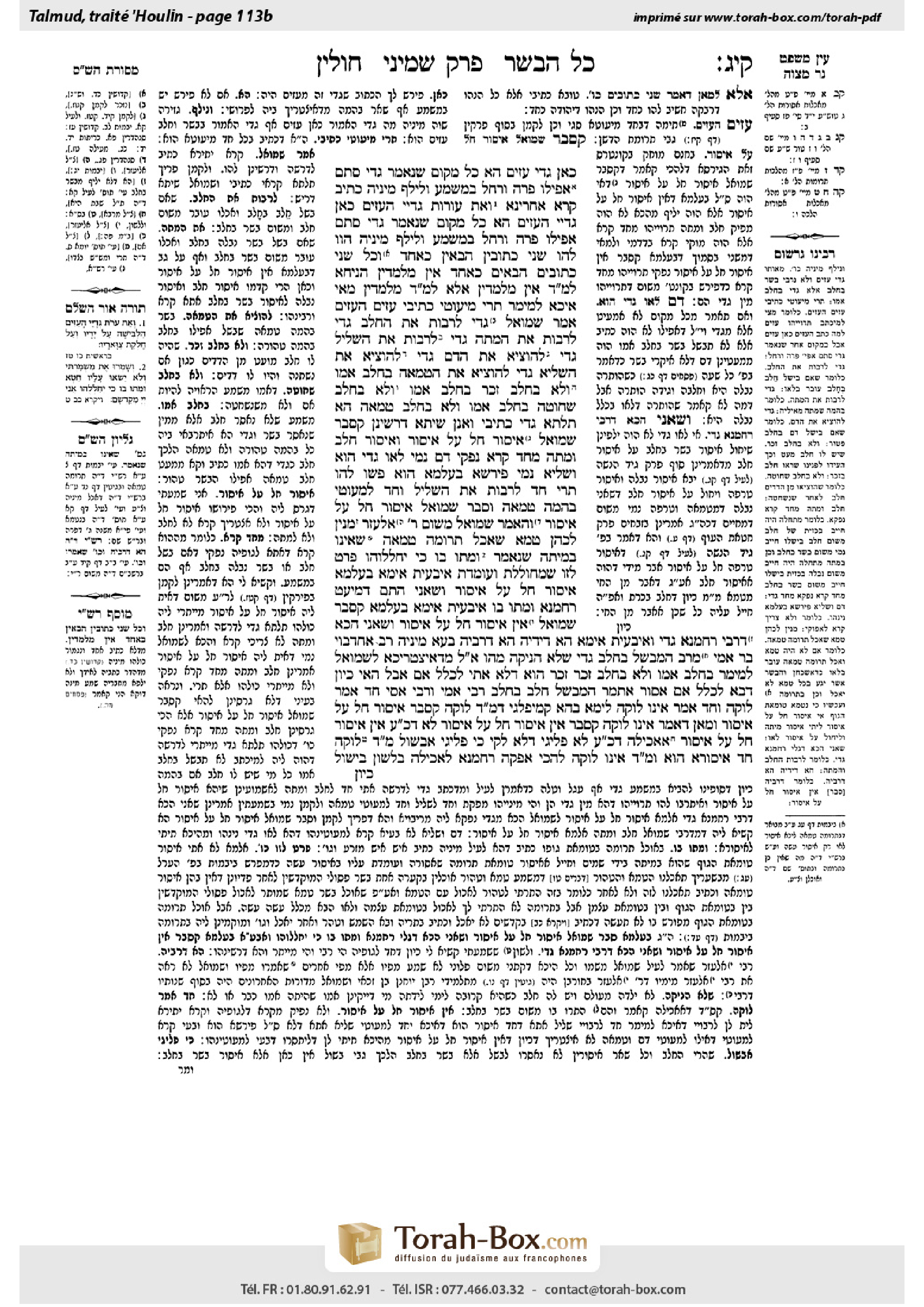
Chullin 113b: Talmud study for Daf Yomi
Study the Talmud for Daf Yomi with scanned pages, Hebrew text, English translations from Sefaria and AI-generated French translations.
Passage selection and English or AI-generated French translation are available where the scan has annotations. Daf Study is independent of Torah-Box and Sefaria.
Browse Chullin · חולין · All tractatesChullin 113b text and translations
This page of Chullin includes the Aramaic text, an English translation and an AI-generated French translation, alongside the scan above.
חולין קי״ג ב · Aramaic and Hebrew text
כָּאן גְּדִי עִזִּים, הָא כׇּל מָקוֹם שֶׁנֶּאֱמַר גְּדִי סְתָם – אֲפִילּוּ פָּרָה וְרָחֵל בַּמַּשְׁמָע.
וְלֵילַף מִינֵּיהּ? כְּתִיב קְרָא אַחֲרִינָא: ״וְאֵת עֹרֹת גְּדָיֵי הָעִזִּים״ – כָּאן ״גְּדָיֵי הָעִזִּים״, הָא כׇּל מָקוֹם שֶׁנֶּאֱמַר ״גְּדִי״ סְתָם – אֲפִילּוּ פָּרָה וְרָחֵל בַּמַּשְׁמָע.
וְלֵילַף מִינֵּיהּ? הָווּ לְהוּ שְׁנֵי כְּתוּבִין הַבָּאִין כְּאֶחָד, וְכׇל שְׁנֵי כְתוּבִים הַבָּאִים כְּאֶחָד – אֵין מְלַמְּדִין.
הָנִיחָא לְמַאן דְּאָמַר אֵין מְלַמְּדִין, אֶלָּא לְמַאן דְּאָמַר מְלַמְּדִין, מַאי אִיכָּא לְמֵימַר? תְּרֵי מִיעוּטֵי כְּתִיבִי: ״עִזִּים״, ״הָעִזִּים״.
אָמַר שְׁמוּאֵל: ״גְּדִי״ – לְרַבּוֹת אֶת הַחֵלֶב, ״גְּדִי״ – לְרַבּוֹת אֶת הַמֵּתָה, ״גְּדִי״ – לְרַבּוֹת אֶת הַשְּׁלִיל.
״גְּדִי״ – לְהוֹצִיא אֶת הַדָּם, ״גְּדִי״ – לְהוֹצִיא אֶת הַשִּׁלְיָא, ״גְּדִי״ – לְהוֹצִיא אֶת הַטְּמֵאָה.
״בַּחֲלֵב אִמּוֹ״ – וְלֹא בַּחֲלֵב זָכָר, ״בַּחֲלֵב אִמּוֹ״ – וְלֹא בַּחֲלֵב שְׁחוּטָה, ״בַּחֲלֵב אִמּוֹ״ – וְלֹא בַּחֲלֵב טְמֵאָה.
הָא תְּלָתָא ״גְּדִי״ כְּתִיבִי, וַאֲנַן שִׁיתָּא דָּרְשִׁינַן! קָסָבַר שְׁמוּאֵל אִיסּוּר חָל עַל אִיסּוּר, וְאִיסּוּר חֵלֶב וּמֵתָה מֵחַד קְרָא נָפְקִי. דָּם נָמֵי לָאו ״גְּדִי״ הוּא, וְשִׁלְיָא נָמֵי פִּירְשָׁא בְּעָלְמָא הוּא. פָּשׁוּ לְהוּ תְּרֵי: חַד לְרַבּוֹת אֶת הַשְּׁלִיל, וְחַד לְמַעוֹטֵי בְּהֵמָה טְמֵאָה.
וְסָבַר שְׁמוּאֵל אִיסּוּר חָל עַל אִיסּוּר? וְהָאָמַר שְׁמוּאֵל מִשּׁוּם רַבִּי אֶלְעָזָר: מִנַּיִן לְכֹהֵן טָמֵא שֶׁאָכַל תְּרוּמָה טְמֵאָה שֶׁאֵינוֹ בְּמִיתָה? שֶׁנֶּאֱמַר ״וּמֵתוּ בוֹ כִּי יְחַלְּלֻהוּ״ – פְּרַט לָזוֹ שֶׁמְּחוּלֶּלֶת וְעוֹמֶדֶת.
אִיבָּעֵית אֵימָא: בְּעָלְמָא אִיסּוּר חָל עַל אִיסּוּר, וְשָׁאנֵי הָתָם דְּמִיעֵט רַחֲמָנָא ״וּמֵתוּ בוֹ״. אִיבָּעֵית אֵימָא: בְּעָלְמָא קָסָבַר שְׁמוּאֵל אֵין אִיסּוּר חָל עַל אִיסּוּר, וְשָׁאנֵי הָכָא דְּרַבִּי רַחֲמָנָא ״גְּדִי״.
וְאִיבָּעֵית אֵימָא: הָא דִידֵיהּ, הָא דְרַבֵּיהּ.
בְּעָא מִינֵּיהּ רַב אַחָדְבוּי בַּר אַמֵּי מֵרַב: הַמְבַשֵּׁל בַּחֲלֵב גְּדִי שֶׁלֹּא הֵנִיקָה, מַהוּ? אֲמַר לֵיהּ: מִדְּאִיצְטְרִיכָא לִשְׁמוּאֵל לְמֵימַר ״בַּחֲלֵב אִמּוֹ״ – וְלֹא בַּחֲלֵב זָכָר, זָכָר הוּא דְּלָא אָתֵי לִכְלַל אֵם, אֲבָל הַאי, כֵּיוָן דְּבָא לִכְלַל אֵם – אָסוּר.
אִתְּמַר: הַמְבַשֵּׁל חֵלֶב בְּחָלָב, רַבִּי אַמֵּי וְרַבִּי אַסִּי – חַד אָמַר: לוֹקֶה, וְחַד אָמַר: אֵינוֹ לוֹקֶה. לֵימָא בְּהָא קָמִיפַּלְגִי, דְּמַאן דְּאָמַר לוֹקֶה קָסָבַר: אִיסּוּר חָל עַל אִיסּוּר, וּמַאן דְּאָמַר אֵינוֹ לוֹקֶה קָסָבַר: אֵין אִיסּוּר חָל עַל אִיסּוּר.
לָא, דְּכוּלֵּי עָלְמָא אֵין אִיסּוּר חָל עַל אִיסּוּר, אַאֲכִילָה דְּכוּלֵּי עָלְמָא לָא פְּלִיגִי דְּלָא לָקֵי, כִּי פְּלִיגִי אַבִּשּׁוּל. מַאן דְּאָמַר לוֹקֶה – חַד אִיסּוּרָא הוּא, וּמַאן דְּאָמַר אֵינוֹ לוֹקֶה – לְהָכִי אַפְּקַהּ רַחֲמָנָא לַאֲכִילָה בִּלְשׁוֹן בִּישּׁוּל,
Chullin 113b · English translation
One may infer that here, since this verse specifies that it is referring to a kid of the goats, consequently, anywhere the word “kid” is stated without specification, it means even a cow or a ewe. Accordingly, the prohibition of meat cooked in milk applies to all kosher domesticated animals.
The Gemara asks: But why not derive from that verse that in general, every instance of the word “kid” is referring to a goat, including the prohibition of meat cooked in milk? The Gemara answers: This cannot be, as another verse is written: “And the skins of the kids of the goats” (Genesis 27:16). This indicates that only here they are kids of the goats, but anywhere the word “kid” is stated without specification, it means even a cow or a ewe.
The Gemara objects: But let us derive from this verse as well that on the contrary, the word “kid” is always referring to a goat. The Gemara explains: These two examples are two verses that come as one, i.e., to teach the same matter, and as a rule, any two verses that come as one do not teach their common element to other cases.
The Gemara asks: This works out well according to the one who says this principle that two verses that come as one do not teach their common element to other cases, but according to the one who says that two verses that come as one do teach their common element to other cases, what is there to say? The Gemara answers: Two exclusions are written, as both of the verses cited use the term “the goats.” The verses could have stated simply: Goats, but state “the goats,” with the definite article, teaching that it is only in these cases that the reference is specifically to a goat.
§ Shmuel says: Each of the Torah’s three mentions of the prohibition of not cooking a kid in its mother’s milk serves to include a different case. The first mention of the word “kid” serves to include liability for cooking in milk and eating forbidden fats, beyond the liability for eating forbidden fat per se. The second mention of the word “kid” likewise serves to include additional liability for cooking in milk and eating the meat of a dead animal carcass. Finally, the third mention of the word “kid” serves to include liability for cooking in milk and eating an animal fetus.
Each mention excludes a case as well: The first mention of the word “kid” serves to exclude liability for cooking in milk and consuming blood. The second mention of the word “kid” serves to exclude liability for cooking in milk and eating the placenta of an animal. The third mention of the word “kid” serves to exclude liability for cooking in milk and eating the meat of a non-kosher animal.
Furthermore, the first instance of the phrase “in its mother’s milk” indicates that one is not liable for cooking meat in the milk of a male animal, in the rare case that a male might produce milk. The second instance of the phrase “in its mother’s milk” indicates that one is not liable for cooking meat in the milk of an already slaughtered animal, since it is considered milk only if given while the animal is alive. The third instance of the phrase “in its mother’s milk” indicates that one is not liable for cooking meat in the milk of a non-kosher animal.
The Gemara challenges: The word “kid” is written only three times, and yet we expound it to teach six different halakhot. The Gemara responds: Shmuel maintains that a prohibition takes effect even where another prohibition already exists, and therefore the prohibition of forbidden fat in milk and the prohibition of a dead animal carcass in milk are both derived from one verse, as both are applications of the prohibition to an already prohibited item. The exclusion of blood from the prohibition also does not require its own verse, as blood is not considered a kid at all, and likewise there is no need for a verse to exclude a placenta from the prohibition, as it is merely a secretion of the animal, rather than a kind of meat. Therefore, two mentions of “kid” are left; one serves to include a fetus, and one serves to exclude a non-kosher animal.
The Gemara asks: And does Shmuel really maintain that a prohibition takes effect where another prohibition already exists? But didn’t Shmuel say in the name of Rabbi Elazar: From where is it derived that an impure priest who partakes of impure teruma, i.e., the portion of produce designated for the priest, is not punished with death at the hand of Heaven as he would had the teruma been ritually pure? It is derived from a verse, as it is stated, with regard to the prohibition of an impure priest partaking of teruma: “And die therein if they desecrate it” (Leviticus 22:9), to the exclusion of this case of teruma that is impure, which was already desecrated before the priest ate it. Here, it seems, since impure teruma is already prohibited for consumption, the added prohibition of an impure priest partaking of teruma does not take effect.
The Gemara answers: If you wish, say that in general Shmuel maintains that a prohibition takes effect where another prohibition already exists, and it is different there, with regard to teruma, as the Merciful One expressly excludes impure teruma by the phrase “and die therein if they desecrate it,” and in this case the teruma is already desecrated. And if you wish, say that in general Shmuel maintains that a prohibition does not take effect where another prohibition already exists, and here, the case of meat cooked in milk, is different, as the Merciful One expressly includes the meat of an animal carcass and forbidden fat by the repetition of the word “kid.”
And if you wish, say that this statement of Shmuel with regard to meat cooked in milk is his own opinion, as he maintains that a prohibition takes effect where another prohibition already exists, and that statement with regard to teruma is his teacher’s, i.e., Rabbi Elazar’s, opinion, as he holds that a prohibition does not take effect where another prohibition already exists.
§ Rav Aḥadvoi bar Ami raised a dilemma to Rav: If one cooks meat in milk of a goat that has not yet nursed, but that is about to give birth and already has milk, what is the halakha? Rav said to him: From the fact that it was necessary for Shmuel to say that the phrase “in its mother’s milk” teaches: And not in the milk of a male animal, one can infer that it is only the milk of a male that is excluded, as the male cannot attain the status of a mother. But in this case, since the goat will attain the status of a mother, it is prohibited to cook meat in its milk.
It was stated: With regard to one who cooks forbidden fat in milk, Rabbi Ami and Rabbi Asi disagree as to the halakha. One says that he is flogged for violating the prohibition of meat cooked in milk, and one says that he is not flogged. The Gemara suggests: Let us say that they disagree about this: That the one who says he is flogged maintains that a prohibition takes effect where another prohibition already exists, and the one who says he is not flogged maintains that a prohibition does not take effect where another prohibition already exists.
The Gemara responds: No; everyone agrees that a prohibition does not take effect where another prohibition already exists, and therefore everyone agrees that one is not flogged for eating the mixture. When they disagree, it is with regard to cooking. The one who says he is flogged holds that one who cooks violates only one prohibition, that of cooking meat in milk, since it is permitted to cook forbidden fat without eating it. Consequently, this is not a case of a prohibition taking effect where another prohibition already exists. And the one who says he is not flogged holds that it was for this reason that the Merciful One expressed the prohibition of eating meat cooked in milk in the Torah using the language of cooking: “You shall not cook a kid in its mother’s milk.”
Chullin 113b · Traduction française (IA)
On peut en déduire que, puisque cette versette précise qu'il s'agit d'un petit bouc des chèvres, il en va de même partout où le mot « petit bouc » est utilisé sans précision, ce qui signifie même un taureau ou une brebis. Ainsi, l'interdiction de cuisiner la viande avec le lait s'applique à tous les animaux domestiques kasher.
La Guemara demande : Pourquoi ne pas en déduire de cette versette que, dans le général, chaque occurrence du mot « petit bouc » désigne un bouc, y compris l'interdiction de cuisiner la viande avec le lait ? La Guemara répond : Cela n'est pas possible, car une autre versette est écrite : « Et les peaux des petits boucs » (Genèse 27:16). Cela indique que seul ici ils sont des petits boucs des chèvres, mais partout où le mot « petit bouc » est utilisé sans précision, cela signifie même un taureau ou une brebis.
La Guemara s'oppose : Mais pourquoi ne pas en déduire de cette versette que, contrairement à cela, le mot « petit bouc » désigne toujours un bouc. La Guemara explique : Ces deux exemples sont deux versettes qui traitent de la même chose, c'est-à-dire pour enseigner la même matière, et, en règle générale, toute paire de versettes qui traitent de la même chose ne transmet pas leur élément commun à d'autres cas.
La Guemara demande : Cela s'explique bien selon celui qui dit que deux versets qui viennent ensemble ne transmettent pas leur élément commun à d'autres cas, mais selon celui qui dit que deux versets qui viennent ensemble transmettent leur élément commun à d'autres cas, que dire ? La Guemara répond : Deux exclusions sont écrites, car les deux versets cités utilisent le terme « les boucs ». Les versets auraient pu simplement dire « boucs », mais elles utilisent « les boucs », avec l'article défini, enseignant que c'est uniquement dans ces cas-là que la référence est spécifiquement à un bouc.
§ Shmuel dit : Chaque mention des trois prohibitions de la Torah concernant l'interdiction de cuire un petit dans le lait de sa mère sert à inclure un cas différent. La première mention du mot « petit » sert à inclure la responsabilité de cuire dans le lait et de manger des graisses interdites, au-delà de la responsabilité de manger des graisses interdites en soi. La deuxième mention du mot « petit » sert également à inclure une responsabilité supplémentaire de cuire dans le lait et de manger la viande d'un cadavre d'animaux. Enfin, la troisième mention du mot « petit » sert à inclure la responsabilité de cuire dans le lait et de manger un fœtus d'animaux.
Chaque mention exclut également un cas : La première mention du mot « petit » sert à exclure la responsabilité de cuire dans le lait et de consommer le sang. La deuxième mention du mot « petit » sert à exclure la responsabilité de cuire dans le lait et de manger la placenta d'un animal. La troisième mention du mot « petit » sert à exclure la responsabilité de cuire dans le lait et de manger la viande d'un animal non-kosher.
En outre, la première occurrence de la phrase « dans le lait de sa mère » indique que l'on n'est pas responsable de cuire la viande dans le lait d'un animal mâle, dans le cas rare où un mâle pourrait produire du lait. La deuxième occurrence de la phrase « dans le lait de sa mère » indique que l'on n'est pas responsable de cuire la viande dans le lait d'un animal déjà sacrifié, car on considère que le lait est seulement celui donné pendant que l'animal est vivant. La troisième occurrence de la phrase « dans le lait de sa mère » indique que l'on n'est pas responsable de cuire la viande dans le lait d'un animal non-kosher.
La Guemara conteste : Le mot « petit » est écrit seulement trois fois, et pourtant on l'interprète pour enseigner six halakhot différentes. La Guemara répond : Shmuel maintient que l'interdiction s'applique même là où une autre interdiction existe déjà, et donc l'interdiction des graisses interdites dans le lait et l'interdiction de la viande d'un cadavre d'animaux dans le lait sont toutes deux dérivées d'une même versette, car elles sont des applications de l'interdiction à un objet déjà interdit. L'exclusion du sang de l'interdiction n'a pas besoin d'une versette particulière, car le sang n'est pas considéré comme un petit du tout, et de même, il n'y a pas besoin d'une versette pour exclure la placenta de l'interdiction, car c'est simplement une sécrétion de l'animal, et non une sorte de viande. Ainsi, deux mentions du mot « petit » restent ; l'une sert à inclure un fœtus, et l'autre sert à exclure un animal non-kosher.
La Guemara demande : Et Shmuel maintient-il vraiment que l'interdiction s'applique là où une autre interdiction existe déjà ? Mais n'a-t-il pas dit en nom de Rabbi Elazar : D'où est tiré le fait qu'un prêtre impur qui mange de la terouma impure, c'est-à-dire la part de produits désignée pour le prêtre, ne soit pas puni par la mort à la main du Ciel comme s'il avait mangé de la terouma pure ? C'est tiré d'une versette, car il est dit, concernant l'interdiction du prêtre impur mangeant de la terouma : « Et mourir là-dedans s'ils l'ont profané » (Lévitique 22:9), en excluant ce cas de terouma impure, qui avait déjà été profanée avant que le prêtre ne l'ait mangée. Ici, il semble que, puisque la terouma impure est déjà interdite à la consommation, l'interdiction supplémentaire du prêtre impur mangeant de la terouma ne s'applique pas.
La Guemara répond : Si vous le souhaitez, dites que, en général, Shmuel maintient que l'interdiction s'applique là où une autre interdiction existe déjà, et c'est différent là, concernant la terouma, car le Très Miséricordieux exclut explicitement la terouma impure par la phrase « et mourir là-dedans s'ils l'ont profané », et ici la terouma est déjà profanée. Et si vous le souhaitez, dites que, en général, Shmuel maintient que l'interdiction ne s'applique pas là où une autre interdiction existe déjà, et ici, le cas de la viande cuite dans le lait est différent, car le Très Miséricordieux inclut explicitement la viande d'un cadavre d'animaux et les graisses interdites par la répétition du mot « petit ».
Et si vous le souhaitez, dites que cette déclaration de Shmuel concernant la viande cuite dans le lait est son propre avis, car il maintient que l'interdiction s'applique là où une autre interdiction existe déjà, et que cette déclaration concernant la terouma est l'avis de son maître, c'est-à-dire celui de Rabbi Elazar, car il maintient que l'interdiction ne s'applique pas là où une autre interdiction existe déjà.
§ Rav Aḥadvoi bar Ami a posé un dilemme à Rav : Si l'on cuisine de la viande dans le lait d'une chèvre qui n'a pas encore donné naissance, mais qui est sur le point de le faire et qui possède déjà du lait, quelle est la halakha ? Rav répondit à lui : D'après le fait que Shmuel a eu besoin de dire que la phrase « dans son lait maternel » enseigne : et non dans le lait d'un animal mâle, on peut en déduire que seul le lait d'un animal mâle est exclu, car un animal mâle ne peut pas atteindre le statut de mère. Mais dans ce cas, puisque la chèvre atteindra le statut de mère, il est interdit de cuisiner de la viande dans son lait.
On a dit : En ce qui concerne celui qui fait bouillir de la graisse interdite dans le lait, Rabbi Ami et Rabbi Asi s'opposent quant à la halakha. L'un affirme qu'il est battu pour avoir violé la prohibition de la viande cuite dans le lait, et l'autre affirme qu'il n'est pas battu. La Guemara suggère : Faisons-nous dire qu'ils s'opposent à cela : que celui qui affirme qu'il est battu maintient que une prohibition prend effet là où une autre prohibition existe déjà, et celui qui affirme qu'il n'est pas battu maintient que une prohibition ne prend pas effet là où une autre prohibition existe déjà.
La Guemara répond : Non ; tout le monde convient qu'une prohibition ne prend pas effet là où une autre prohibition existe déjà, et par conséquent tout le monde convient qu'on n'est pas battu pour manger le mélange. Lorsqu'ils s'opposent, c'est concernant la cuisson. Celui qui affirme qu'il est battu maintient que celui qui cuisine viole seulement une prohibition, celle de cuisson de viande dans le lait, car il est permis de cuisiner de la graisse interdite sans la manger. Ainsi, ce n'est pas un cas de prohibition prenant effet là où une autre prohibition existe déjà. Et celui qui affirme qu'il n'est pas battu maintient que c'est pour cette raison que l'Éternel a exprimé la prohibition de manger de la viande cuite dans le lait dans la Torah en utilisant le langage de la cuisson : « Tu ne cuiras pas un petit agneau dans le lait de sa mère. »
Traduction française générée par IA à partir de l’édition anglaise de Sefaria. Vérifie toujours un passage avec le texte source.
Text from Sefaria: William Davidson Edition - Vocalized Aramaic (unknown); William Davidson Edition - English (CC BY NC).