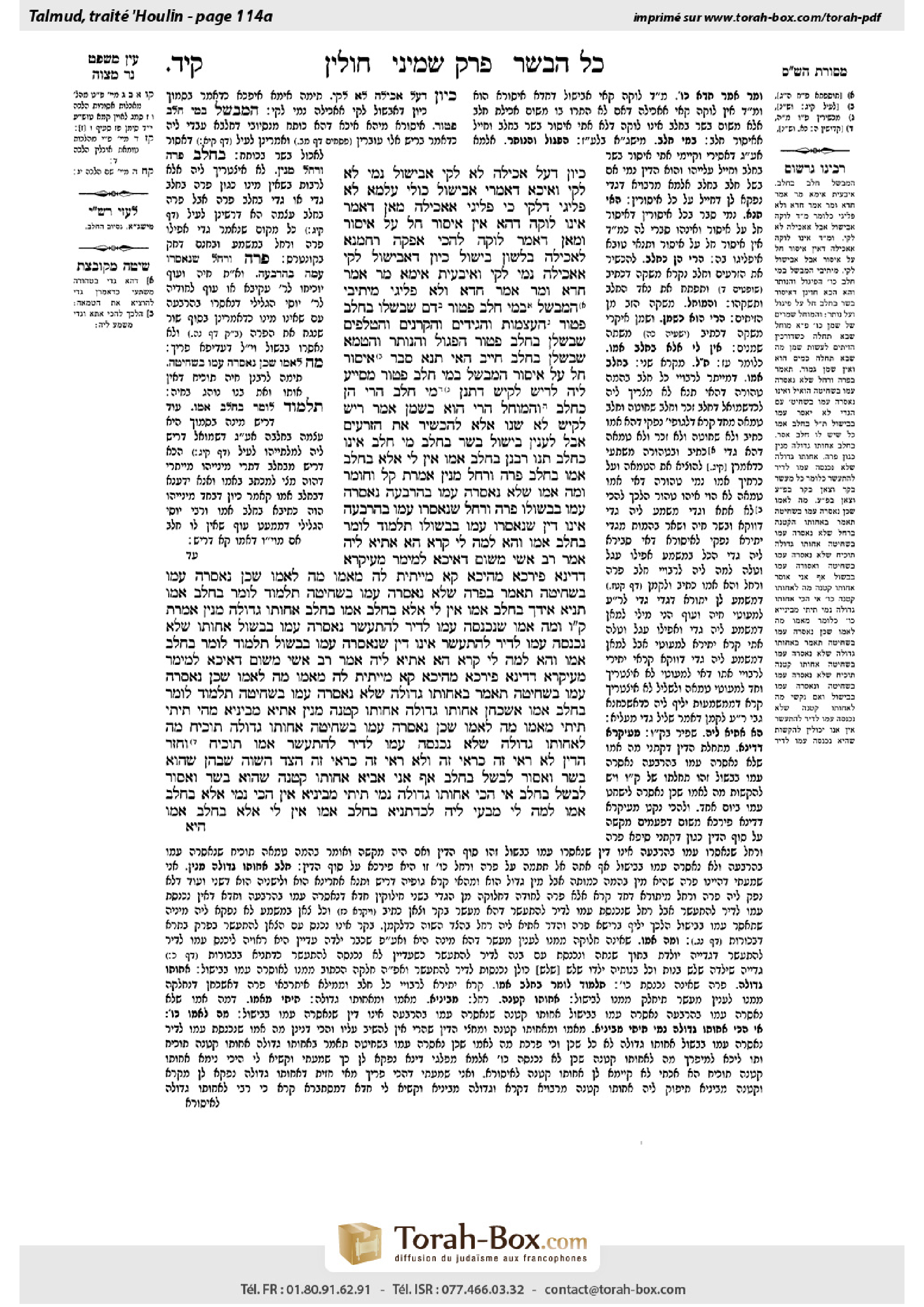
Chullin 114a: Talmud study for Daf Yomi
Study the Talmud for Daf Yomi with scanned pages, Hebrew text, English translations from Sefaria and AI-generated French translations.
Passage selection and English or AI-generated French translation are available where the scan has annotations. Daf Study is independent of Torah-Box and Sefaria.
Browse Chullin · חולין · All tractatesChullin 114a text and translations
This page of Chullin includes the Aramaic text, an English translation and an AI-generated French translation, alongside the scan above.
חולין קי״ד א · Aramaic and Hebrew text
כֵּיוָן דְּעַל אֲכִילָה לָא לָקֵי, אַבִּישּׁוּל נָמֵי לָא לָקֵי.
וְאִיכָּא דְּאָמְרִי: אַבִּישּׁוּל – כּוּלֵּי עָלְמָא לָא פְּלִיגִי דְּלָקֵי, כִּי פְּלִיגִי אַאֲכִילָה. מַאן דְּאָמַר אֵינוֹ לוֹקֶה – דְּהָא אֵין אִיסּוּר חָל עַל אִיסּוּר, וּמַאן דְּאָמַר לוֹקֶה – לְהָכִי אַפְּקַהּ רַחֲמָנָא לַאֲכִילָה בִּלְשׁוֹן בִּישּׁוּל, כֵּיוָן דְּאַבִּישּׁוּל לָקֵי – אַאֲכִילָה נָמֵי לָקֵי.
וְאִיבָּעֵית אֵימָא: מָר אֲמַר חֲדָא, וּמָר אֲמַר חֲדָא, וְלָא פְּלִיגִי.
מֵיתִיבִי: הַמְבַשֵּׁל בְּמֵי חָלָב – פָּטוּר, דָּם שֶׁבִּשְּׁלוֹ בְּחָלָב – פָּטוּר, הַעֲצָמוֹת וְהַגִּידִים וְהַקַּרְנַיִם וְהַטְּלָפַיִם שֶׁבִּשְּׁלָן בְּחָלָב – פָּטוּר.
הַפִּגּוּל, וְהַנּוֹתָר, וְהַטָּמֵא, שֶׁבִּשְּׁלָן בְּחָלָב – חַיָּיב!
הַאי תַּנָּא סָבַר אִיסּוּר חָל עַל אִיסּוּר.
הַמְבַשֵּׁל בְּמֵי חָלָב פָּטוּר, מְסַיַּיע לֵיהּ לְרֵישׁ לָקִישׁ, דִּתְנַן: מֵי חָלָב הֲרֵי הֵן כְּחָלָב, וְהַמּוֹחַל הֲרֵי הוּא כְּשֶׁמֶן. אָמַר רֵישׁ לָקִישׁ: לֹא שָׁנוּ אֶלָּא לְהַכְשִׁיר אֶת הַזְּרָעִים, אֲבָל לְעִנְיַן בִּישּׁוּל בָּשָׂר בְּחָלָב – מֵי חָלָב אֵינוֹ כְּחָלָב.
תָּנוּ רַבָּנַן: ״בַּחֲלֵב אִמּוֹ״ – אֵין לִי אֶלָּא בַּחֲלֵב אִמּוֹ, בַּחֲלֵב פָּרָה וְרָחֵל מִנַּיִן?
אָמַרְתָּ, קַל וָחוֹמֶר: וּמָה אִמּוֹ, שֶׁלֹּא נֶאֶסְרָה עִמּוֹ בְּהַרְבָּעָה – נֶאֶסְרָה עִמּוֹ בְּבִשּׁוּלוֹ, פָּרָה וְרָחֵל, שֶׁנֶּאֶסְרוּ עִמּוֹ בְּהַרְבָּעָה – אֵינוֹ דִּין שֶׁנֶּאֶסְרוּ עִמּוֹ בְּבִשּׁוּלוֹ! תַּלְמוּד לוֹמַר ״בַּחֲלֵב אִמּוֹ״.
וְהָא לְמָה לִי קְרָא? הָא אָתְיָא לֵיהּ!
אָמַר רַב אָשֵׁי: מִשּׁוּם דְּאִיכָּא לְמֵימַר מֵעִיקָּרָא דְּדִינָא פִּירְכָא, מֵהֵיכָא קָא מַיְיתֵית לַהּ? מֵאִמּוֹ, מָה לְאִמּוֹ שֶׁכֵּן נֶאֶסְרָה עִמּוֹ בִּשְׁחִיטָה, תֹּאמַר בְּפָרָה שֶׁלֹּא נֶאֶסְרָה עִמּוֹ בִּשְׁחִיטָה? תַּלְמוּד לוֹמַר ״בַּחֲלֵב אִמּוֹ״.
תַּנְיָא אִידַּךְ: ״בַּחֲלֵב אִמּוֹ״ – אֵין לִי אֶלָּא בַּחֲלֵב אִמּוֹ, בַּחֲלֵב אֲחוֹתוֹ גְּדוֹלָה מִנַּיִן?
אָמַרְתָּ קַל וָחוֹמֶר, וּמָה אִמּוֹ שֶׁנִּכְנְסָה עִמּוֹ לְדִיר לְהִתְעַשֵּׂר – נֶאֶסְרָה עִמּוֹ בְּבִשּׁוּל, אֲחוֹתוֹ שֶׁלֹּא נִכְנְסָה עִמּוֹ לְדִיר לְהִתְעַשֵּׂר – אֵינוֹ דִּין שֶׁנֶּאֶסְרָה עִמּוֹ בְּבִשּׁוּל! תַּלְמוּד לוֹמַר ״בַּחֲלֵב אִמּוֹ״.
וְהָא לְמָה לִי קְרָא, הָא אָתְיָא לַיהּ? אָמַר רַב אָשֵׁי: מִשּׁוּם דְּאִיכָּא לְמֵימַר מֵעִיקָּרָא דְּדִינָא פִּירְכָא, מֵהֵיכָא קָא מַיְיתֵית לַהּ? מֵאִמּוֹ, מָה לְאִמּוֹ, שֶׁכֵּן נֶאֶסְרָה עִמּוֹ בִּשְׁחִיטָה, תֹּאמַר בַּאֲחוֹתוֹ גְּדוֹלָה, שֶׁלֹּא נֶאֶסְרָה עִמּוֹ בִּשְׁחִיטָה? תַּלְמוּד לוֹמַר ״בַּחֲלֵב אִמּוֹ״.
אַשְׁכְּחַן אֲחוֹתוֹ גְּדוֹלָה, אֲחוֹתוֹ קְטַנָּה מִנַּיִן? אָתְיָא מִבֵּינַיָּא.
מֵהֵי תֵּיתֵי? תֵּיתֵי מֵאִמּוֹ – מָה לְאִמּוֹ שֶׁכֵּן נֶאֶסְרָה עִמּוֹ בִּשְׁחִיטָה? אֲחוֹתוֹ גְּדוֹלָה תּוֹכִיחַ. מָה לַאֲחוֹתוֹ גְּדוֹלָה שֶׁלֹּא נִכְנְסָה עִמּוֹ לְדִיר לְהִתְעַשֵּׂר? אִמּוֹ תּוֹכִיחַ.
וְחָזַר הַדִּין, לֹא רְאִי זֶה כִּרְאִי זֶה, וְלֹא רְאִי זֶה כִּרְאִי זֶה, הַצַּד הַשָּׁוֶה שֶׁבָּהֶן: שֶׁהוּא בָּשָׂר, וְאָסוּר לְבַשֵּׁל בְּחָלָב, אַף אֲנִי אָבִיא אֲחוֹתוֹ קְטַנָּה, שֶׁהוּא בָּשָׂר, וְאָסוּר לְבַשֵּׁל בְּחָלָב.
אִי הָכִי, אֲחוֹתוֹ גְּדוֹלָה נָמֵי תֵּיתֵי מִבֵּינַיָּא.
אִין הָכִי נָמֵי, אֶלָּא ״בַּחֲלֵב אִמּוֹ״ לְמָה לִי? מִבְּעֵי לֵיהּ לְכִדְתַנְיָא: ״בַּחֲלֵב אִמּוֹ״ – אֵין לִי אֶלָּא בַּחֲלֵב אִמּוֹ,
Chullin 114a · English translation
This link between cooking and eating indicates that since one is not flogged for eating forbidden fat cooked in milk, as agreed upon above, one also is not flogged for cooking the two together.
And some say the opposite: With regard to cooking, everyone agrees that one is flogged for this act, since the principle of a prohibition not taking effect where another prohibition already exists is not relevant. When they disagree, it is with regard to eating. The one who says he is not flogged applies the principle that a prohibition does not take effect where another prohibition already exists, and the fat was already prohibited for consumption in its own right before being cooked with milk. And the one who says he is flogged holds that it was for this reason that the Merciful One expressed the prohibition of eating meat cooked in milk using the language of cooking, to teach that since one is flogged for cooking forbidden fat in milk, one also is flogged for eating the product.
The Gemara suggests a third explanation of the dispute between Rabbi Ami and Rabbi Asi: And if you wish, say that one Sage said one statement and one Sage said another statement, and they do not disagree, as they are referring to different cases. The Sage who said that one is flogged is referring to the transgression of cooking forbidden fat with milk, whereas the one who said one is not flogged is referring to the consumption of forbidden fat with milk. Everyone agrees that a prohibition does not take effect where another prohibition already exists, and therefore one is flogged only for cooking forbidden fat in milk, but not for eating the two together.
The Gemara raises an objection from a Tosefta (8:3): One who cooks meat in whey, the liquid leftover after milk has been curdled, is exempt from lashes, as whey is not defined as milk for purposes of the prohibition. Likewise, for blood that one cooked in milk, he is exempt, as blood is not considered meat. Similarly, with regard to the bones, the tendons, the horns, and the hooves that one cooked in milk, he is exempt.
The Tosefta continues: By contrast, with regard to prohibited piggul meat, i.e., meat from an offering that was sacrificed with the intent to sprinkle its blood or partake of its meat beyond its designated time, and similarly prohibited notar, meat from an offering whose period for consumption has expired, and the prohibited impure meat of an offering, that one cooked in milk, he is liable to be flogged for violating the prohibition of meat cooked in milk. This indicates that the prohibition applies to items already prohibited for consumption, contrary to the above opinion attributed to Rabbi Ami and Rabbi Asi.
The Gemara answers: This tanna of the baraita maintains in general that a prohibition takes effect where another prohibition already exists, whereas Rabbi Ami and Rabbi Asi are of the opposite opinion. It is conceivable that these Sages, who are amora’im, disagree with that tanna, as the issue of whether a prohibition takes effect where another prohibition already exists is a well-known dispute among the tanna’im themselves.
§ It was stated in the above baraita: One who cooks meat in whey is exempt from lashes. The Gemara comments: This ruling supports the opinion of Reish Lakish, as we learned in a mishna, with regard to liquids that render food susceptible to ritual impurity (Makhshirin 6:5): The halakhic status of whey is like that of milk, which is one of the liquids that render food susceptible to impurity, and the halakhic status of olive secretion is like that of oil, which also renders food susceptible to impurity. With regard to this mishna, Reish Lakish says: They taught this halakha only with regard to rendering seeds, i.e., produce, susceptible to impurity. But with regard to cooking meat in milk, the halakhic status of whey is not like that of milk.
§ The Sages taught in a baraita: From the phrase “in its mother’s milk” I have derived only that the prohibition applies to the mother goat’s milk. From where do I derive that it also applies to the milk of a cow and a ewe?
You can say an a fortiori inference: Just as a kid’s mother, which is not prohibited for mating with the kid, as they are of the same species, is nevertheless prohibited for cooking with it, as stated in the verse, is it not right that a cow or a ewe, which are prohibited for mating with it, as they are of different species, should be prohibited for cooking with it? Therefore, the verse states elsewhere: “In its mother’s milk,” a second time, to include a cow and a ewe.
The Gemara challenges the conclusion of the baraita. But why do I need a verse? It was just derived through the a fortiori inference.
Rav Ashi said: It is needed because one can say that the refutation of the a fortiori inference is present from the outset, i.e., there is a difficulty with the comparison: From where do you derive the inference? It is derived from its mother goat, which the baraita presents as being treated more leniently than a cow or ewe since it may be mated with a kid. But there is a stringent aspect of the mother goat not shared by a cow or ewe: What is unique about its mother? It is unique in that it is prohibited for slaughter with it, since one may not slaughter an animal and its mother on the same day (see Leviticus 22:28). Will you say the same about a cow, which is not prohibited for slaughter with it? Therefore, the verse states: “In its mother’s milk,” to include a cow and a ewe.
§ The above baraita accounts for two of the Torah’s three mentions of the phrase “in its mother’s milk.” The Gemara now addresses the third. It is taught in another baraita: From one instance of the phrase “in its mother’s milk” I have derived only that the prohibition applies to the milk of its mother, if the mother is less than a year old and has not yet entered the pen for the purpose of its owner’s separating the annual animal tithe. From where do I derive that it also applies to the milk of its older sister, i.e., one that is more than a year old that has already entered the pen for the animal tithe in the previous year?
You can say an a fortiori inference: Just as a kid’s mother, which enters the pen to be tithed with it, is nevertheless prohibited for cooking with it, is it not right that its sister, which does not enter the pen to be tithed with it, should be prohibited for cooking with it? Therefore, the verse states elsewhere: “In its mother’s milk,” a third time, to include the older sister in the prohibition.
The Gemara asks: But why do I need a verse? It was just derived from the a fortiori inference. Rav Ashi said: It is needed because one can say that the refutation of that a fortiori inference is present from the outset. From where do you derive the inference? It is derived from its mother. But one may respond: What is unique about its mother? It is unique in that it is prohibited for slaughter with it on the same day. Will you say the same halakhot apply to its older sister, which is not prohibited for slaughter with it? Therefore, the verse states: “In its mother’s milk,” including the older sister.
The Gemara continues: We have found a source for the halakha that its older sister is included in the prohibition of meat cooked in milk. From where is it derived that the same applies to its younger sister, one that has not yet entered the pen for the tithe? The Gemara responds: It is derived from between them, i.e., from the combination of the mother and the older sister.
The Gemara elaborates on the need for both cases in order to derive the third: From which of the two cases should it be derived? If it should be derived from its mother, one can claim: What is unique about its mother? It is unique in that it is prohibited for slaughter with it on the same day, unlike the younger sister. One may respond: Its older sister can prove the point, since it is not prohibited for slaughter with the kid, but it is still included in the prohibition of meat cooked in milk. But this can be refuted as well: What is unique about its older sister? It is unique in that it does not enter the pen to be tithed with it, unlike the younger sister. One may respond that its mother can then prove the point, as it can enter the pen to be tithed with the kid and is still included in the prohibition.
And consequently, the inference has reverted to its starting point: The aspect of this case is not like the aspect of that case and the aspect of that case is not like the aspect of this case; their common element is that both the mother and older sister are meat and it is prohibited to cook them in milk. If so, I will also include its younger sister in the prohibition, since it is also meat, and therefore it is prohibited to cook it in milk.
The Gemara challenges: If so, the inclusion of its older sister in the prohibition can also be derived from between them, i.e., from the combination of the kid’s mother and a cow. Although both a cow and the mother possess unique stringencies not shared by the older sister, i.e., the prohibition of mating and of slaughtering with the kid, respectively, neither possesses both stringencies, and the halakha with regard to the older sister can be derived from their common element, i.e., that they are both meat and prohibited to cook in milk, as stated above. If so, what need is there to derive this halakha from the verse?
The Gemara responds: Yes, it is indeed so; the halakha with regard to the older sister is derived from the common denominator of the mother and a cow. Rather, why do I need the verse’s additional mention of the phrase “in its mother’s milk?” It is necessary for that which is taught in a baraita: When the verse states: “In its mother’s milk,” I have derived only the prohibition to cook the kid in its mother’s milk;
Chullin 114a · Traduction française (IA)
Ce lien entre la cuisson et la consommation indique que puisque l'on n'est pas fouetté pour manger de la graisse interdite cuite avec du lait, comme convenu ci-dessus, l'on n'est pas non plus fouetté pour cuisiner les deux ensemble.
Et certains disent le contraire : concernant la cuisson, tout le monde convient que l'on est fouetté pour cet acte, car le principe selon lequel une interdiction ne s'applique pas là où une autre interdiction existe déjà n'est pas pertinent. Lorsqu'ils divergent, c'est concernant la consommation. Celui qui dit qu'on n'est pas fouetté applique le principe selon lequel une interdiction ne s'applique pas là où une autre interdiction existe déjà, et la graisse était déjà interdite à la consommation en soi avant d'être cuite avec du lait. Celui qui dit qu'on est fouetté considère que c'est pour cette raison que l'Éternel a exprimé l'interdiction de manger de la viande cuite avec du lait à l'aide du langage de la cuisson, afin d'enseigner que puisque l'on est fouetté pour cuisiner de la graisse interdite avec du lait, l'on est également fouetté pour manger le produit.
La Guemara suggère une troisième explication du débat entre Rabbi Ami et Rabbi Asi : Et si vous le souhaitez, dites que l'un des Sages a dit une chose et l'autre un autre, et qu'ils ne divergent pas, car ils parlent de cas différents. Le Sage qui dit qu'on est fouetté fait référence à la transgression de cuisiner de la graisse interdite avec du lait, tandis que celui qui dit qu'on n'est pas fouetté fait référence à la consommation de la graisse interdite avec du lait. Tout le monde convient que l'interdiction ne s'applique pas là où une autre interdiction existe déjà, et donc on est fouetté uniquement pour cuisiner de la graisse interdite avec du lait, mais pas pour manger les deux ensemble.
La Guemara soulève un objet tiré d'une Tosefta (8:3) : Celui qui cuisine de la viande dans le lait, le liquide restant après que le lait ait été coagulé, est exempt de fouettage, car le lait n'est pas considéré comme du lait pour l'effet de l'interdiction. De même, pour le sang que l'on a cuisiné avec du lait, il est exempt, car le sang n'est pas considéré comme de la viande. De même, concernant les os, les tendons, les cornes et les sabots que l'on a cuisinés avec du lait, il est exempt.
La Tosefta continue : En revanche, concernant la viande piggul interdite, c'est-à-dire la viande d'un sacrifice qui a été sacrifié avec l'intention de verser son sang ou de consommer sa viande au-delà de son temps déterminé, et de même la viande notar interdite, celle dont la période de consommation a expiré, et la viande impure d'un sacrifice, que l'on a cuisiné avec du lait, il est tenu pour responsable de la violation de l'interdiction de viande cuite avec du lait. Cela indique que l'interdiction s'applique aux choses déjà interdites à la consommation, contrairement à l'opinion attribuée à Rabbi Ami et Rabbi Asi.
La Guemara répond : Ce tanna de la baraïta maintient en général que l'interdiction s'applique là où une autre interdiction existe déjà, tandis que Rabbi Ami et Rabbi Asi sont d'avis contraire. Il est concevable que ces Sages, qui sont des amoraïm, divergent de ce tanna, car la question de savoir si une interdiction s'applique là où une autre interdiction existe déjà est un débat bien connu parmi les tannaïm eux-mêmes.
§ Il a été dit dans la baraïta ci-dessus : Celui qui cuisine de la viande dans le lait est exempt de fouettage. La Guemara commente : Cette décision soutient l'opinion de Reish Lakish, comme nous l'avons appris dans une mitsva, concernant les liquides qui rendent les aliments suspects de souillure (Makhshirin 6:5) : Le statut halakhique du lait est comme celui du lait de vache, qui est l'un des liquides qui rendent les aliments suspects de souillure, et le statut halakhique de la sécrétion d'olive est comme celui de l'huile, qui rend également les aliments suspects de souillure. Concernant cette mitsva, Reish Lakish dit : Ils ont enseigné cette halakha uniquement concernant la rendre susceptible de souillure aux semences, c'est-à-dire aux produits, mais concernant la cuisson de la viande avec du lait, le statut halakhique du lait n'est pas comme celui du lait de vache.
§ Les Sages ont enseigné dans une baraïta : À partir de la phrase « dans le lait de sa mère » j'ai déduit seulement que l'interdiction s'applique au lait de la chèvre mère. D'où déduis-je qu'elle s'applique également au lait d'une vache et d'une brebis ?
Vous pouvez dire une déduction a fortiori : Tout comme la mère d'un agneau, qui n'est pas interdite pour être mise en couple avec l'agneau, car ils sont de la même espèce, est toutefois interdite pour être cuisinée avec lui, comme indiqué dans la parabole, n'est-ce pas justifié que la vache ou la brebis, qui sont interdites pour être mises en couple avec lui, car elles sont d'espèces différentes, soient interdites pour être cuisinées avec lui ? Par conséquent, la parabole stipule ailleurs : « Dans le lait de sa mère », une seconde fois, pour inclure la vache et la brebis.
La Guemara remet en question la conclusion de la baraïta. Mais pourquoi ai-je besoin d'un verset ? Cela a été simplement déduit par une déduction a fortiori.
Rav Ashi a dit : Il est nécessaire, car l'on peut dire que la réfutation de l'inférence a fortiori est présente dès le départ, c'est-à-dire qu'il y a un problème avec la comparaison : D'où déduisez-vous cette déduction ? Elle est déduite de la chèvre mère, que la baraïta présente comme étant traitée plus clémentement qu'une vache ou une brebis, car elle peut être mise en couple avec un agneau. Mais il y a un aspect strict de la chèvre mère non partagé par une vache ou une brebis : Qu'est-ce qui rend la mère unique ? C'est unique dans le fait qu'elle est interdite pour être sacrifiée avec elle, car on ne peut pas sacrifier un animal et sa mère le même jour (voir Lévitique 22:28). Direz-vous la même chose concernant une vache, qui n'est pas interdite pour être sacrifiée avec elle ? Par conséquent, la parabole stipule : « Dans le lait de sa mère », pour inclure la vache et la brebis.
§ La baraïta mentionnée ci-dessus explique deux des trois mentions de la formule « dans le lait de sa mère » dans la Torah. La Guemara aborde maintenant la troisième. Elle est enseignée dans une autre baraïta : D'une seule occurrence de la formule « dans le lait de sa mère », j'ai déduit uniquement que l'interdiction s'applique au lait de sa mère, si la mère a moins d'un an et n'a pas encore été mise dans l'enclos afin que son propriétaire sépare l'offrande annuelle. D'où déduit-on que cela s'applique également au lait de sa sœur aînée, c'est-à-dire une qui a plus d'un an et qui a déjà été mise dans l'enclos l'année précédente pour l'offrande annuelle ?
On peut dire une déduction par analogie : Tout comme la mère du petit, qui entre dans l'enclos pour être tournée avec lui, est toutefois interdite de cuisson avec lui, n'est-ce pas aussi vrai pour sa sœur, qui n'entre pas dans l'enclos pour être tournée avec lui, qu'elle soit interdite de cuisson avec lui ? Ainsi, le verset mentionne ailleurs : « Dans le lait de sa mère », une troisième fois, afin d'inclure la sœur aînée dans l'interdiction.
La Guemara pose la question : Mais pourquoi ai-je besoin d'un verset ? Cela aurait pu être déduit par l'analogie. Rav Ashi a dit : Il est nécessaire, car on peut dire que la réfutation de cette analogie existe dès le départ. D'où déduit-on l'analogie ? C'est de sa mère. Mais on peut répondre : Qu'est-ce qui rend sa mère unique ? C'est qu'elle est interdite de sacrifice avec lui le même jour. Diras-tu que les mêmes halakhot s'appliquent à sa sœur aînée, qui n'est pas interdite de sacrifice avec lui ? Ainsi, le verset dit : « Dans le lait de sa mère », incluant la sœur aînée.
La Guemara continue : Nous avons trouvé une source pour la halakha selon laquelle la sœur aînée est incluse dans l'interdiction de la cuisson du viande avec le lait. D'où déduit-on que cela s'applique également à sa sœur plus jeune, celle qui n'a pas encore été mise dans l'enclos pour l'offrande ? La Guemara répond : C'est déduit de leur intermédiaire, c'est-à-dire de la combinaison de la mère et de la sœur aînée.
La Guemara développe la nécessité des deux cas afin de déduire le troisième : D'entre les deux cas, d'avec lequel devons-nous déduire ? Si c'est de sa mère, on peut dire : Qu'est-ce qui rend sa mère unique ? C'est qu'elle est interdite de sacrifice avec lui le même jour, contrairement à la sœur plus jeune. On peut répondre : La sœur aînée peut démontrer le point, car elle n'est pas interdite de sacrifice avec le petit, mais elle est incluse dans l'interdiction de la cuisson du viande avec le lait. Mais cela peut être réfuté également : Qu'est-ce qui rend sa sœur aînée unique ? C'est qu'elle n'entre pas dans l'enclos pour être tournée avec lui, contrairement à la sœur plus jeune. On peut répondre que sa mère peut alors démontrer le point, car elle peut entrer dans l'enclos pour être tournée avec le petit et est toujours incluse dans l'interdiction.
Et ainsi, l'analogie est retournée à son point de départ : L'aspect de ce cas n'est pas comme l'aspect de celui-là et l'aspect de celui-là n'est pas comme l'aspect de ce cas ; leur élément commun est que la mère et la sœur aînée sont de la viande et qu'il est interdit de les cuisiner avec le lait. Si c'est ainsi, je vais aussi inclure sa sœur plus jeune dans l'interdiction, car elle est aussi de la viande, et donc il est interdit de la cuisiner avec le lait.
La Guemara conteste : Si c'est ainsi, l'inclusion de sa sœur aînée dans l'interdiction peut aussi être déduite de leur intermédiaire, c'est-à-dire de la combinaison de la mère du petit et d'une vache. Bien que la vache et la mère possèdent des stringences uniques non partagées par la sœur aînée, c'est-à-dire l'interdiction de cohabiter et d'être sacrifiée avec le petit, respectivement, ni l'une ni l'autre ne possèdent les deux stringences, et la halakha concernant la sœur aînée peut être déduite de leur élément commun, c'est-à-dire qu'ils sont tous deux de la viande et interdits de cuisson avec le lait, comme mentionné ci-dessus. Si c'est ainsi, quelle est la nécessité de déduire cette halakha du verset ?
La Guemara répond : Oui, c'est effectivement ainsi ; la halakha concernant la sœur aînée est déduite de l'élément commun de la mère et d'une vache. Cependant, pourquoi ai-je besoin de la mention supplémentaire du verset de la formule « dans le lait de sa mère » ? C'est nécessaire pour ce qui est enseigné dans une baraïta : Lorsque le verset dit : « Dans le lait de sa mère », j'ai déduit uniquement l'interdiction de cuisiner le petit dans le lait de sa mère ;
Traduction française générée par IA à partir de l’édition anglaise de Sefaria. Vérifie toujours un passage avec le texte source.
Text from Sefaria: William Davidson Edition - Vocalized Aramaic (unknown); William Davidson Edition - English (CC BY NC).