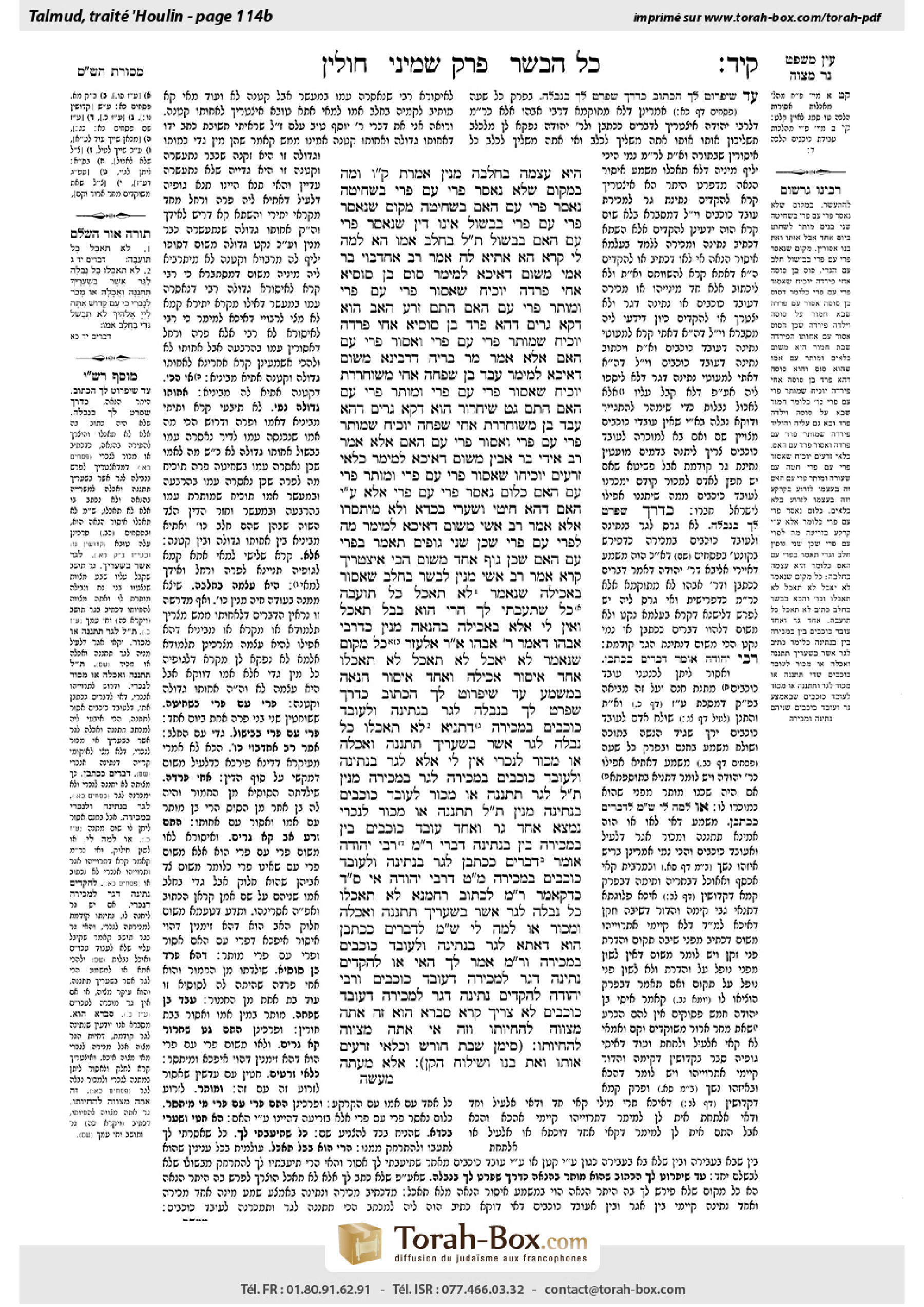
Chullin 114b: Talmud study for Daf Yomi
Study the Talmud for Daf Yomi with scanned pages, Hebrew text, English translations from Sefaria and AI-generated French translations.
Passage selection and English or AI-generated French translation are available where the scan has annotations. Daf Study is independent of Torah-Box and Sefaria.
Browse Chullin · חולין · All tractatesChullin 114b text and translations
This page of Chullin includes the Aramaic text, an English translation and an AI-generated French translation, alongside the scan above.
חולין קי״ד ב · Aramaic and Hebrew text
הִיא עַצְמָהּ בַּחֲלָבָהּ מִנַּיִן? אָמַרְתָּ קַל וְחוֹמֶר: וּמָה בִּמְקוֹם שֶׁלֹּא נֶאֱסַר פְּרִי עִם פְּרִי בִּשְׁחִיטָה, נֶאֱסָר פְּרִי עִם הָאֵם בִּשְׁחִיטָה, מְקוֹם שֶׁנֶּאֱסַר פְּרִי עִם פְּרִי בְּבִשּׁוּל – אֵינוֹ דִּין שֶׁנֶּאֱסַר פְּרִי עִם הָאֵם בְּבִשּׁוּל? תַּלְמוּד לוֹמַר ״בַּחֲלֵב אִמּוֹ״.
הָא לְמָה לִי קְרָא, הָא אָתְיָא לַהּ? אָמַר רַב אַחָדְבוּי בַּר אַמֵּי: מִשּׁוּם דְּאִיכָּא לְמֵימַר, סוּס בֶּן סוּסְיָא אֲחִי פִּרְדָּה יוֹכִיחַ, שֶׁאָסוּר פְּרִי עִם פְּרִי, וּמוּתָּר פְּרִי עִם הָאֵם.
הָתָם, זֶרַע הָאָב הוּא דְּקָא גָרֵים.
דְּהָא פֶּרֶד בֶּן סוּסְיָא אֲחִי פִּרְדָּה יוֹכִיחַ, שֶׁמּוּתָּר פְּרִי עִם פְּרִי, וְאָסוּר פְּרִי עִם הָאֵם.
אֶלָּא אָמַר מָר בְּרֵיהּ דְּרָבִינָא: מִשּׁוּם דְּאִיכָּא לְמֵימַר, עֶבֶד בֶּן שִׁפְחָה אֲחִי מְשׁוּחְרֶרֶת יוֹכִיחַ, שֶׁאָסוּר פְּרִי עִם פְּרִי, וּמוּתָּר פְּרִי עִם הָאֵם!
הָתָם גֵּט שִׁיחְרוּר הוּא דְּקָא גָרֵים, דְּהָא עֶבֶד בֶּן מְשׁוּחְרֶרֶת אֲחִי שִׁפְחָה יוֹכִיחַ, שֶׁמּוּתָּר פְּרִי עִם פְּרִי, וְאָסוּר פְּרִי עִם הָאֵם.
אֶלָּא אָמַר רַב אִידִי בַּר אָבִין: מִשּׁוּם דְּאִיכָּא לְמֵימַר, כִּלְאֵי זְרָעִים יוֹכִיחוּ, שֶׁאָסוּר פְּרִי עִם פְּרִי, וּמוּתָּר פְּרִי עִם הָאֵם. כְּלוּם נֶאֱסָר פְּרִי עִם פְּרִי אֶלָּא עַל יְדֵי הָאֵם? דְּהָא חִיטֵּי וּשְׂעָרֵי בְּכַדָּא וְלָא מִיתַּסְרוּ.
אֶלָּא אָמַר רַב אָשֵׁי: מִשּׁוּם דְּאִיכָּא לְמֵימַר, מָה לִפְרִי עִם פְּרִי, שֶׁכֵּן שְׁנֵי גּוּפִים, תֹּאמַר בִּפְרִי עִם הָאֵם, שֶׁכֵּן גּוּף אֶחָד, מִשּׁוּם הָכִי אִיצְטְרִיךְ קְרָא.
אָמַר רַב אָשֵׁי: מִנַּיִן לְבָשָׂר בְּחָלָב שֶׁאָסוּר בַּאֲכִילָה? שֶׁנֶּאֱמַר ״לֹא תֹאכַל כׇּל תּוֹעֵבָה״ – כֹּל שֶׁתִּעַבְתִּי לָךְ הֲרֵי הוּא בְּבַל תֹּאכַל.
וְאֵין לִי אֶלָּא בַּאֲכִילָה, בַּהֲנָאָה מִנַּיִן? כִּדְרַבִּי אֲבָהוּ, דְּאָמַר רַבִּי אֲבָהוּ אָמַר רַבִּי אֶלְעָזָר: כׇּל מָקוֹם שֶׁנֶּאֱמַר ״לֹא יֹאכַל״, ״לֹא תֹאכַל״, ״לֹא תֹּאכְלוּ״ – אֶחָד אִיסּוּר אֲכִילָה וְאֶחָד אִיסּוּר הֲנָאָה בַּמַּשְׁמָע, עַד שֶׁיִּפְרוֹט לְךָ הַכָּתוּב, כְּדֶרֶךְ שֶׁפָּרַט לְךָ בִּנְבֵלָה לַגֵּר בִּנְתִינָה וְלַגּוֹי בִּמְכִירָה.
דְּתַנְיָא: ״לֹא תֹאכְלוּ כׇּל נְבֵלָה לַגֵּר אֲשֶׁר בִּשְׁעָרֶיךָ תִּתְּנֶנָּה וַאֲכָלָהּ אוֹ מָכוֹר לְנׇכְרִי״ – אֵין לִי אֶלָּא לְגֵר בִּנְתִינָה, וּלְגוֹי בִּמְכִירָה; לְגֵר בִּמְכִירָה מִנַּיִן? תַּלְמוּד לוֹמַר: ״לַגֵּר תִּתְּנֶנָּה אוֹ מָכוֹר״.
לְגוֹי בִּנְתִינָה מִנַּיִן? תַּלְמוּד לוֹמַר: ״תִּתְּנֶנָּה… אוֹ מָכוֹר לְנׇכְרִי״. נִמְצָא אֶחָד גֵּר וְאֶחָד גּוֹי, בֵּין בִּמְכִירָה בֵּין בִּנְתִינָה, דִּבְרֵי רַבִּי מֵאִיר. רַבִּי יְהוּדָה אוֹמֵר: דְּבָרִים כִּכְתָבָן, לְגֵר בִּנְתִינָה וְלַגּוֹי בִּמְכִירָה.
מַאי טַעְמָא דְּרַבִּי יְהוּדָה? אִי סָלְקָא דַעְתָּךְ כִּדְקָאָמַר רַבִּי מֵאִיר, לִכְתּוֹב רַחֲמָנָא ״לֹא תֹאכְלוּ כׇל נְבֵלָה לַגֵּר אֲשֶׁר בִּשְׁעָרֶיךָ תִּתְּנֶנָּה וַאֲכָלָהּ וּמָכוֹר״ – ״אוֹ״ לְמָה לִי? שְׁמַע מִינַּהּ לִדְבָרִים כִּכְתָבָן הוּא דַּאֲתָא: לְגֵר בִּנְתִינָה, וְלַגּוֹי בִּמְכִירָה.
וְרַבִּי מֵאִיר אָמַר לָךְ: הַאי ״אוֹ״ לְהַקְדִּים נְתִינָה דְּגֵר לִמְכִירָה דְּגוֹי. וְרַבִּי יְהוּדָה, לְהַקְדִּים נְתִינָה דְגֵר לִמְכִירָה דְּגוֹי לָא צְרִיךְ קְרָא, סְבָרָא הוּא: זֶה אַתָּה מְצוֶּּוה לְהַחְיוֹתוֹ, וְזֶה אִי אַתָּה מְצוֶּּוה לְהַחֲיוֹתוֹ.
(סִימָן: שַׁבָּת, חוֹרֵשׁ, וְכִלְאֵי זְרָעִים, אוֹתוֹ וְאֶת בְּנוֹ, וְשִׁילּוּחַ הַקֵּן).
אֶלָּא מֵעַתָּה,
Chullin 114b · English translation
from where is it derived that the meat of a mother animal may not itself be cooked in its own milk? Say an a fortiori inference: Just as with regard to an issue where the fruit is not prohibited with the fruit, i.e., slaughter, as it is permitted to slaughter two offspring of one mother on one day, the fruit is nevertheless prohibited for slaughter with the mother, is it not right that with regard to an issue where the fruit is prohibited with the fruit, i.e., cooking, as it is prohibited to cook a mother’s offspring with its milk, the fruit, i.e., the milk, should be prohibited for cooking with the mother? Therefore, the verse states: “In its mother’s milk,” to prohibit the cooking of the meat of the mother in its own milk.
The Gemara asks: Why do I need a verse? It was just derived a fortiori. Rav Aḥadvoi bar Ami said: The verse is necessary because one can say that the case of a horse born of both a stallion and mare but which is the brother of a mule, i.e., its mother also bore a mule after being impregnated by a donkey, proves this a fortiori inference invalid. As here the fruit is prohibited with the fruit, but the fruit is permitted with the mother. One may not mate a horse with a mule, but one may mate a horse with its mother.
The Gemara rejects this: There it is the seed of the father that effects the prohibition of mating the mule with the daughter horse. The two may not be paired for reasons unrelated to their status as offspring of one mother. This ruling therefore proves nothing about the hypothesis that if two fruit cannot be paired, one can learn by a fortiori inference that the fruit cannot be paired with the mother.
And this explanation must be true, as the case of a mule born of a donkey and a mare and which is the brother of a female mule proves. As here one fruit is permitted with the other fruit, i.e., one may mate the male and female mules since they are of the same species, and yet the fruit is prohibited to be mated with the mother, i.e., the mare. This case illustrates that the prohibition of crossbreeding is contingent on paternity, and does not rest solely on the relation between the mother and the fruit.
Rather, Mar, son of Ravina, said: The a fortiori inference is invalid because one can say that the case of a male Canaanite slave born of a female slave and who is the brother of a female freed slave proves it invalid. As here the fruit is prohibited with the fruit, i.e., the slave may not engage in sexual intercourse with his freed sister, and yet the fruit is permitted with his slave mother.
The Gemara rejects this as well: There it is the bill of manumission that effects the prohibition. The slave is prohibited to his sister only because she has been freed, not because they are both fruit of one mother, as the case of a male slave, son of a female freed slave, and the brother of a female slave proves. As here the fruit is permitted with the fruit, i.e., he is permitted to his sister, since they are both slaves, and yet the fruit is prohibited with his released mother, as she is now considered a full-fledged Jew. Clearly the prohibition is entirely contingent on the emancipation of one of the slaves, irrespective of their relationship.
Rather, Rav Idi bar Avin said: The a fortiori inference is invalid because one can say that the case of diverse kinds of seeds proves it invalid. As it is prohibited to sow fruit of one species with fruit of another species, and yet it is permitted to sow all types of fruit with the mother, i.e., the ground, from which all fruit grows. The Gemara rejects this as well: Isn’t fruit of one species with fruit of another species prohibited only by means of the mother, i.e., the ground? The prohibition of sowing diverse seeds applies only when they are both sown in the ground, as wheat and barley can be placed in a single jug and they are not prohibited.
Rather, Rav Ashi said: The a fortiori inference is invalid because one can say: What is unique about fruit with fruit, e.g., the kid and its mother’s milk, which are prohibited for cooking together? They are unique in that they are two separate bodies that were never unified. Must you say the same prohibition of pairing applies to the fruit with the mother, i.e., the mother’s meat and its milk, which were once one body? Due to this reason, the extra verse stating: “In its mother’s milk,” was necessary to include the meat and milk of the same animal in the prohibition.
§ Rav Ashi says: From where is it derived that meat cooked in milk is prohibited for consumption, even though the verse explicitly prohibits only cooking? It is derived from a verse, as it is stated elsewhere: “You shall not eat any abominable thing” (Deuteronomy 14:3). This verse teaches that with regard to any practice that I have made abominable, i.e., forbidden, to you, the product is prohibited for consumption.
And I have derived only that meat cooked in milk is prohibited with regard to consumption; from where do I derive that it is also prohibited with regard to benefit? It is derived in accordance with the statement of Rabbi Abbahu, as Rabbi Abbahu says that Rabbi Elazar says: Wherever it is stated, “He shall not eat,” or “you,” in the singular, “shall not eat,” or “you,” in the plural, “shall not eat,” both a prohibition against eating and a prohibition against deriving benefit are indicated. This is so unless the verse specifies for you that one may derive benefit, in the manner that it specified for you with regard to an animal carcass, from which the verse explicitly permits one to derive benefit, as it states: “You may sell it to a foreigner” (Deuteronomy 14:21). Accordingly, one may provide such meat to a gentile resident alien in Eretz Yisrael by giving it to him as a gift, and to any other gentile by sale.
As it is taught in a baraita: The verse states: “You shall not eat of any unslaughtered animal carcass; you may give it to the resident alien who is within your gates, that he may eat it; or you may sell it to a foreigner; for you are a sacred people to the Lord your God.” From this verse I have derived only that it is permitted to provide such meat to a resident alien through giving and to a gentile through selling. From where is it derived that it is permitted to transfer an unslaughtered animal to a resident alien through selling as well? The verse states: “You may give it to the stranger…or you may sell it,” indicating that one has the option to do either of these.
The baraita continues: From where is it derived that it is permitted to a gentile through giving as well? The verse states: “You may give it…or you may sell it to a foreigner.” Consequently, one finds that he may transfer an animal carcass to both a resident alien and a gentile, both through selling or through giving. This is the statement of Rabbi Meir. Rabbi Yehuda says: These matters are to be understood as they are written; one may transfer an unslaughtered animal carcass to a resident alien only through giving, and to a gentile only through selling.
The Gemara asks: What is the reason for the opinion of Rabbi Yehuda? The Gemara responds: Rabbi Yehuda holds that if it enters your mind to understand the verse in accordance with that which Rabbi Meir says, then let the Merciful One write: You shall not eat of any animal carcass, you may give it to the resident alien who is within your gates that he may eat it and also you may sell it to a foreigner. Why do I need the word “or” between these two options? Learn from it that it comes to teach that the matters are to be understood as they are written: To a resident alien through giving alone, and to any other gentile through selling.
The Gemara asks: And how does Rabbi Meir explain the wording of the verse? The Gemara answers: Rabbi Meir could say to you that this word “or” teaches one to prioritize to giving to a resident alien over selling to a gentile. And Rabbi Yehuda holds that the priority of giving to a resident alien over selling to a gentile does not require a verse, as it is based on logical reasoning: You are commanded by the Torah to sustain this resident alien, but you are not commanded to sustain that gentile.
§ The Gemara provides a mnemonic device for the topics that will be discussed: Shabbat; plows; and diverse kinds of seeds; a mother and its offspring; and sending away of the mother bird from the nest.
Rav Ashi stated above that the product of any practice described in the Torah as abominable is prohibited for consumption. The Gemara asks: If that is so,
Chullin 114b · Traduction française (IA)
D'où tire-t-on que la viande d'une bête mère ne doit pas être cuite dans son propre lait ? On tire une déduction a fortiori : Tout comme, concernant une question où le fruit n'est pas interdit avec le fruit, c'est-à-dire la bête, puisque l'on permet de sacrifier deux petits d'une même mère en un seul jour, le fruit est cependant interdit avec la mère, n'est-il pas raisonnable que, concernant une question où le fruit est interdit avec le fruit, c'est-à-dire la cuisson, puisque l'on interdit de cuire le petit avec le lait de sa mère, le fruit, c'est-à-dire le lait, soit interdit à la cuisson avec la mère ? Ainsi, la Sainte Écriture dit : « Dans le lait de sa mère », afin d'interdire la cuisson de la viande de la mère dans son propre lait.
La Guemara demande : Pourquoi a-t-on besoin d'une Sainte Écriture ? Cela était déjà déduit a fortiori. Rav Aḥadvoi bar Ami dit : La Sainte Écriture est nécessaire, car l'on pourrait dire que le cas d'un cheval né d'un étalon et d'une jument, mais qui est le frère d'un mulet, c'est-à-dire que sa mère a également porté un mulet après avoir été enceinte d'un âne, invalide cette déduction a fortiori. Car ici le fruit est interdit avec le fruit, mais le fruit est permis avec la mère. On ne peut pas faire l'amour à un cheval et à un mulet, mais on peut faire l'amour à un cheval et à sa mère.
La Guemara rejette cela : Là, c'est la semence du père qui produit l'interdiction de faire l'amour au mulet et à la fille cheval. Les deux ne peuvent pas être associés pour des raisons non liées à leur relation d'être des enfants d'une même mère. Cette décision prouve donc rien concernant l'hypothèse que si deux fruits ne peuvent pas être associés, on peut déduire a fortiori que le fruit ne peut pas être associé à la mère.
Et cette explication doit être vraie, car le cas d'un mulet né d'un âne et d'une jument, et qui est le frère d'une femelle mulet, le prouve. Car ici un fruit est permis avec l'autre fruit, c'est-à-dire qu'on peut faire l'amour au mulet mâle et à la femelle mulet puisqu'ils sont de la même espèce, et pourtant le fruit est interdit d'être mis en relation avec la mère, c'est-à-dire la jument. Ce cas illustre que l'interdiction de la croisade dépend de la paternité, et ne repose pas uniquement sur la relation entre la mère et le fruit.
Plutôt, Mar, fils de Ravina, dit : La déduction a fortiori est invalide, car l'on pourrait dire que le cas d'un esclave cananéen mâle né d'une esclave femelle et qui est le frère d'une esclave femme libérée prouve qu'elle est invalide. Car ici le fruit est interdit avec le fruit, c'est-à-dire que l'esclave ne peut pas avoir des relations sexuelles avec sa sœur libérée, et pourtant le fruit est permis avec sa mère esclave.
La Guemara rejette cela également : Là, c'est le certificat de manumission qui produit l'interdiction. L'esclave est interdit à sa sœur uniquement parce qu'elle a été libérée, pas parce qu'ils sont tous deux des fruits d'une même mère, comme le cas d'un esclave mâle, fils d'une esclave femme libérée, et le frère d'une esclave femme prouve. Car ici le fruit est permis avec le fruit, c'est-à-dire qu'il est permis à sa sœur, puisqu'ils sont tous deux esclaves, et pourtant le fruit est interdit avec sa mère libérée, car elle est désormais considérée comme un Juif complet. Évidemment, l'interdiction dépend entièrement de la libération d'un des esclaves, indépendamment de leur relation.
Plutôt, Rav Idi bar Avin dit : La déduction a fortiori est invalide, car l'on pourrait dire que le cas de différentes sortes de graines prouve qu'elle est invalide. Car il est interdit de semer des fruits d'une même espèce avec des fruits d'une autre espèce, et pourtant il est permis de semer tous les types de fruits avec la mère, c'est-à-dire le sol, d'où tous les fruits proviennent. La Guemara rejette cela également : N'est-ce pas que le semer des fruits d'une espèce avec des fruits d'une autre espèce est interdit uniquement par le moyen de la mère, c'est-à-dire le sol ? L'interdiction de semer des graines différentes s'applique uniquement lorsqu'elles sont semées dans le sol, comme le blé et la seigle peuvent être placés dans un seul récipient et ne sont pas interdits.
Plutôt, Rav Ashi dit : La déduction a fortiori est invalide, car l'on pourrait dire : Qu'est-ce qui rend unique le fruit avec le fruit, par exemple le petit et le lait de sa mère, qui sont interdits à la cuisson ensemble ? Ils sont uniques dans le sens où ils sont deux corps distincts qui n'ont jamais été unis. Doit-on dire que la même interdiction d'association s'applique au fruit avec la mère, c'est-à-dire la viande et le lait de la mère, qui étaient un seul corps ? Pour cette raison, la Sainte Écriture supplémentaire disant : « Dans le lait de sa mère », était nécessaire pour inclure la viande et le lait de l'animal même dans l'interdiction.
§ Rav Ashi dit : D'où tire-t-on que la viande cuite dans le lait est interdite à la consommation, même si la Sainte Écriture interdit explicitement seulement la cuisson ? Cela est tiré d'une Sainte Écriture, car il est dit ailleurs : « Vous ne mangerez point de chose abominable » (Deutéronome 14:3). Cette Sainte Écriture enseigne que concernant toute pratique que je vous ai rendue abominable, c'est-à-dire interdite, la production est interdite à la consommation.
Et j'ai tiré seulement que la viande cuite dans le lait est interdite en ce qui concerne la consommation ; d'où tire-t-on qu'elle est également interdite en ce qui concerne le bénéfice ? Cela est tiré selon la déclaration de Rabbi Abbahu, car Rabbi Abbahu dit que Rabbi Elazar dit : Lorsque l'on lit : « Il ne mangera point », ou « vous », au singulier, « ne mangerez point », ou « vous », au pluriel, « ne mangerez point », cela indique à la fois une interdiction de manger et une interdiction de tirer un bénéfice. Cela est ainsi sauf si la Sainte Écriture spécifie que l'on peut tirer un bénéfice, comme c'est spécifié concernant un cadavre d'animaux, duquel la Sainte Écriture permet explicitement de tirer un bénéfice, comme il est dit : « Vous pouvez le vendre à un étranger » (Deutéronome 14:21). Ainsi, on peut donner de telle viande à un étranger non juif en Israël en le lui donnant en cadeau, et à tout autre étranger par la vente.
Comme il est enseigné dans une baraïta : La Parole dit : « Vous ne mangerez point de carcas d'animaux non immolés ; vous pouvez le donner à l'étranger qui habite dans vos villes, afin qu'il le mange ; ou vous pouvez le vendre à un étranger ; car vous êtes un peuple saint devant l'Éternel votre Dieu. » De cette Parole, j'ai déduit seulement que c'est permis de fournir cette viande à un étranger résident par don et à un non-Juif par vente. D'où tire-t-on que c'est permis de transférer une carcas d'animaux non immolés à un étranger résident par vente également ? La Parole dit : « Vous pouvez le donner à l'étranger… ou vous pouvez le vendre », indiquant que l'on a le choix entre ces deux options.
La baraïta continue : D'où tire-t-on que c'est permis à un non-Juif par don également ? La Parole dit : « Vous pouvez le donner… ou vous pouvez le vendre à un étranger. » Ainsi, on découvre qu'on peut transférer une carcas d'animaux à la fois à un étranger résident et à un non-Juif, soit par vente soit par don. C'est la déclaration du Rabbi Meïr. Le Rabbi Yéhuda dit : Ces choses doivent être comprises telles qu'elles sont écrites ; on peut transférer une carcas d'animaux non immolés à un étranger résident uniquement par don, et à un non-Juif uniquement par vente.
La Guemara demande : Quel est le motif de l'opinion du Rabbi Yéhuda ? La Guemara répond : Le Rabbi Yéhuda considère que si l'on a l'idée de comprendre la Parole selon ce que dit le Rabbi Meïr, alors que l'Éternel Tout-Puissant écrive : « Vous ne mangerez point de carcas d'animaux, vous pouvez le donner à l'étranger qui habite dans vos villes afin qu'il le mange et aussi vous pouvez le vendre à un étranger. » Pourquoi ai-je besoin du mot « ou » entre ces deux options ? Apprends-y que cela vient enseigner que les choses doivent être comprises telles qu'elles sont écrites : à l'étranger résident par don seul, et à tout autre non-Juif par vente.
La Guemara demande : Et comment le Rabbi Meïr explique-t-il la formulation de la Parole ? La Guemara répond : Le Rabbi Meïr pourrait te dire que ce mot « ou » enseigne à prioriser le don à l'étranger résident sur la vente à un non-Juif. Et le Rabbi Yéhuda considère que la priorité du don à l'étranger résident sur la vente à un non-Juif ne nécessite pas une Parole, car elle repose sur un raisonnement logique : Tu es commandé par la Torah à sustenter cet étranger résident, mais tu n'es pas commandé à sustenter ce non-Juif.
§ La Guemara fournit un dispositif mnémotechnique pour les sujets qui seront discutés : le Sabbat ; les charrues ; et diverses sortes de semences ; une mère et son petit ; et l'expulsion de la mère de son nid.
Rav Ashi a dit ci-dessus que le produit de toute pratique décrite dans la Torah comme abominable est interdit à la consommation. La Guemara demande : Si c'est ainsi,
Traduction française générée par IA à partir de l’édition anglaise de Sefaria. Vérifie toujours un passage avec le texte source.
Text from Sefaria: William Davidson Edition - Vocalized Aramaic (unknown); William Davidson Edition - English (CC BY NC).