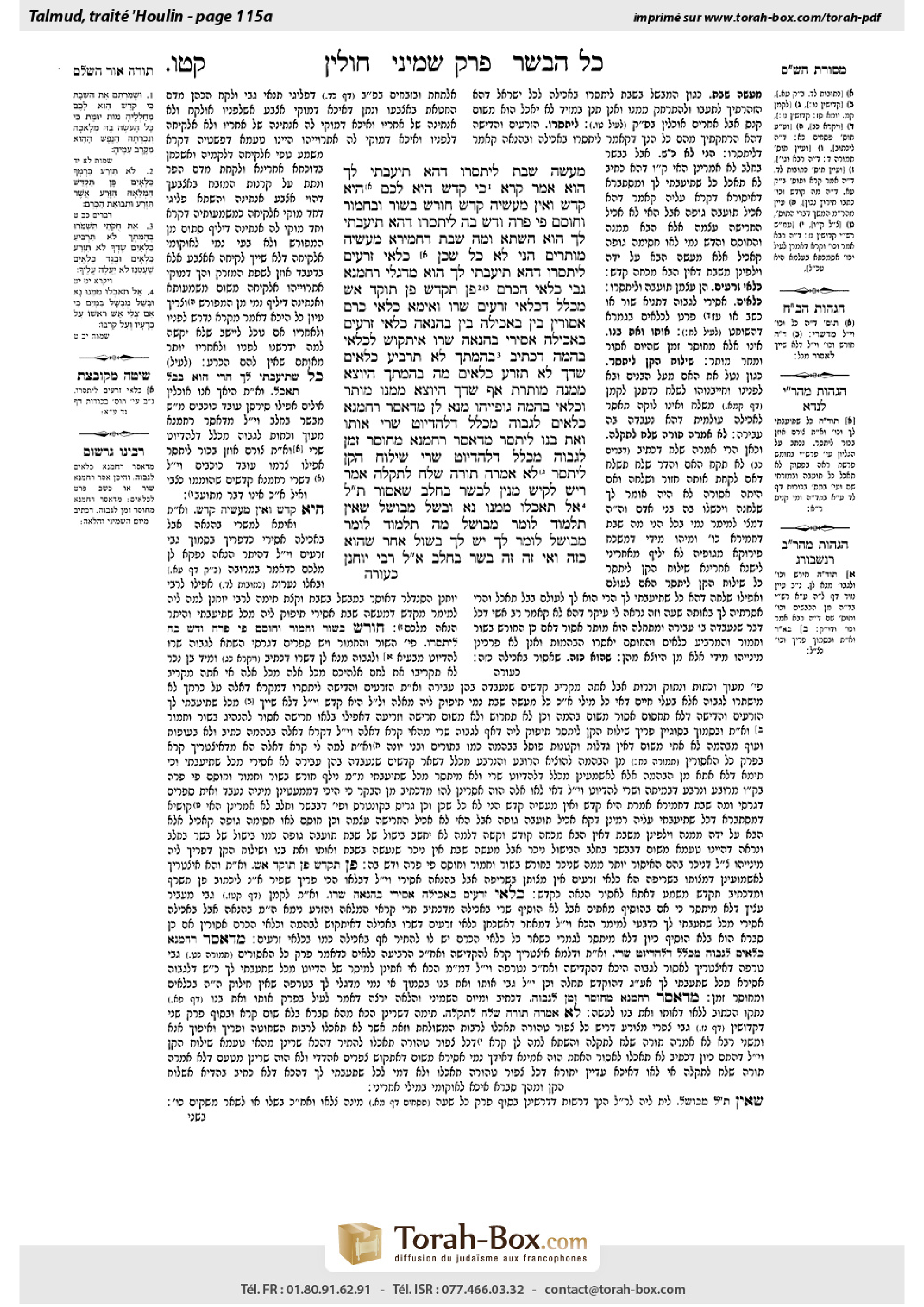
Chullin 115a: Talmud study for Daf Yomi
Study the Talmud for Daf Yomi with scanned pages, Hebrew text, English translations from Sefaria and AI-generated French translations.
Passage selection and English or AI-generated French translation are available where the scan has annotations. Daf Study is independent of Torah-Box and Sefaria.
Browse Chullin · חולין · All tractatesChullin 115a text and translations
This page of Chullin includes the Aramaic text, an English translation and an AI-generated French translation, alongside the scan above.
חולין קי״ה א · Aramaic and Hebrew text
מַעֲשֵׂה שַׁבָּת לִיתַּסְרוּ, דְּהָא ״תִּיעַבְתִּי לְךָ״ הוּא.
אָמַר קְרָא: ״כִּי קֹדֶשׁ הִיא לָכֶם״ – הִיא קֹדֶשׁ, וְאֵין מַעֲשֶׂיהָ קֹדֶשׁ.
חוֹרֵשׁ בְּשׁוֹר וּבַחֲמוֹר, וְחוֹסֵם פִּי פָרָה וְדָשׁ בָּהּ, לִיתַּסְרוּ, דְּהָא ״תִּיעַבְתִּי לְךָ״ הוּא!
הַשְׁתָּא, וּמָה שַׁבָּת דַּחֲמִירָא, מַעֲשֶׂיהָ מוּתָּרִים; הָנֵי, לֹא כׇּל שֶׁכֵּן?
כִּלְאֵי זְרָעִים לִיתַּסְרוּ, דְּהָא ״תִּיעַבְתִּי לְךָ״ הוּא! מִדְּגַלִּי רַחֲמָנָא גַּבֵּי כִּלְאֵי הַכֶּרֶם ״פֶּן תִּקְדַּשׁ״ – ״פֶּן תּוּקַד אֵשׁ״, מִכְּלָל דְּכִלְאֵי זְרָעִים שְׁרוּ.
וְאֵימָא: כִּלְאֵי כֶרֶם אֲסוּרִין בֵּין בַּאֲכִילָה בֵּין בַּהֲנָאָה, כִּלְאֵי זְרָעִים בַּאֲכִילָה אֲסִירִי, בַּהֲנָאָה שְׁרוּ. אִיתַּקּוּשׁ לְכִלְאֵי בְהֵמָה, דִּכְתִיב: ״בְּהֶמְתְּךָ לֹא תַרְבִּיעַ כִּלְאַיִם שָׂדְךָ לֹא תִזְרַע כִּלְאָיִם״, מָה בְּהֶמְתְּךָ – הַיּוֹצֵא מִמֶּנָּה מוּתֶּרֶת, אַף שָׂדְךָ – הַיּוֹצֵא מִמֶּנּוּ מוּתָּר.
וְכִלְאֵי בְהֵמָה גּוּפַיְיהוּ מְנָא לַן? מִדַּאֲסַר רַחֲמָנָא כִּלְאַיִם לַגָּבוֹהַּ, מִכְּלָל דִּלְהֶדְיוֹט שְׁרֵי.
אוֹתוֹ וְאֶת בְּנוֹ לִיתְּסַר! מִדַּאֲסַר רַחֲמָנָא מְחוּסַּר זְמַן לַגָּבוֹהַּ, מִכְּלָל דִּלְהֶדְיוֹט שְׁרֵי.
שִׁילּוּחַ הַקֵּן לִיתְּסַר! לֹא אָמְרָה תּוֹרָה ״שַׁלַּח״ לְתַקָּלָה.
אָמַר רֵישׁ לָקִישׁ: מִנַּיִן לְבָשָׂר בְּחָלָב שֶׁאָסוּר? תַּלְמוּד לוֹמַר ״אַל תֹּאכְלוּ מִמֶּנּוּ נָא וּבָשֵׁל מְבֻשָּׁל״, שֶׁאֵין תַּלְמוּד לוֹמַר ״מְבֻשָּׁל״. מָה תַּלְמוּד לוֹמַר ״מְבֻשָּׁל״? לוֹמַר לְךָ יֵשׁ לְךָ בִּשּׁוּל אַחֵר שֶׁהוּא כָּזֶה, וְאֵי זֶה – זֶה בָּשָׂר בְּחָלָב.
אָמַר לוֹ רַבִּי יוֹחָנָן:
Chullin 115a · English translation
then let the product of an action that desecrates Shabbat, e.g., food cooked on Shabbat, be prohibited for consumption, as desecration of Shabbat is a practice of which God states: I have made it abominable to you, in that it is prohibited to cook on Shabbat. How can this food be prohibited only to the one who cooked it as a penalty by rabbinic law, but be permitted to others (see 15a)?
The Gemara answers: A product of the desecration of Shabbat is an exception to the rule, as the verse states with regard to Shabbat: “For it is sacred to you” (Exodus 31:14). One may infer: It, Shabbat itself, is sacred, but the products of actions that desecrate it are not sacred, i.e., not prohibited.
The Gemara raises another difficulty: If one plows with an ox and with a donkey together, thereby violating the prohibition in Deuteronomy 22:10, or if one muzzles the mouth of a cow and threshes with it, thereby violating the prohibition in Deuteronomy 25:4, the seeds or threshed grain should be prohibited for consumption according to the above principle, as these are both practices I have made abominable to you.
The Gemara responds: Now that it has been established that products of desecration of Shabbat are permitted, one can derive the following using an a fortiori inference: Just as with regard to Shabbat, which is treated more stringently, the products of prohibited actions are permitted; is it not all the more so with regard to these prohibitions of plowing with an ox and a donkey and threshing with a muzzled animal, which are treated less stringently, that the products of prohibited actions should be permitted?
The Gemara challenges: Diverse kinds of seeds sown together should be prohibited for consumption, as this is a matter whose practice I have made abominable to you. The Gemara explains: One learns otherwise from the fact that the Merciful One revealed with regard to diverse kinds in a vineyard: “You shall not sow your vineyard with two kinds of seed; lest the growth of the seed that you will sow be forfeited [pen tikdash]” (Deuteronomy 22:9). The Sages read the phrase “be forfeited [pen tikdash]” as though it states: Lest it be burned [pen tukad esh], indicating that diverse kinds in a vineyard must be destroyed so that no benefit is derived from them. Since this is stated specifically with regard to a vineyard, one can conclude by inference that other diverse kinds of seeds are permitted.
The Gemara objects: But say instead that the uniqueness of diverse kinds in a vineyard is that they are prohibited both for consumption and for benefit, whereas diverse kinds of seeds are prohibited for consumption but are permitted for benefit. The Gemara responds: One cannot say that diverse kinds of seeds are prohibited for consumption, as they are juxtaposed in the Torah to diverse kinds of animals, whose offspring are permitted. As it is written: “You shall not let your cattle mate with a diverse kind; you shall not sow your field with two kinds of seed” (Leviticus 19:19). The juxtaposition teaches that just as with regard to your cattle, the animal that comes from diverse species is permitted, so too, with regard to your field, that produce that comes from diverse seeds is permitted.
The Gemara asks: And with regard to diverse kinds of animals themselves, from where do we derive that their offspring is permitted? The Gemara answers: From the fact that the Merciful One prohibits the offspring of diverse kinds of animals for sacrifice to the Most High upon the altar (see 38b), learn by inference that they are permitted to ordinary people for consumption.
The Gemara raises another difficulty: A mother and its offspring slaughtered on the same day should be prohibited for consumption, as this too is a practice made abominable. The Gemara answers: From the fact that the Merciful One prohibits an animal whose time has not yet arrived, i.e., that is less than eight days old, as an offering to the Most High (Leviticus 22:27), learn by inference that such animals are permitted to ordinary people for consumption. The offspring of a mother slaughtered that day is also considered an animal whose time has not yet arrived, since the prohibition against slaughtering it is limited to that day.
The Gemara raises a final difficulty: If one violated the mitzva that mandates sending away the mother bird from the nest, as it is stated: “You shall not take the mother with the young. You shall in any way let the mother go” (Deuteronomy 22:6–7), and the court instructed him to set the mother bird free, that mother bird should be prohibited to all, as this practice is also abominable. The Gemara responds: The Torah did not say: Send it away, if doing so could lead to a mishap. If the bird were prohibited, the Torah would not have commanded one to send it away, as others might eat it unwittingly.
§ Reish Lakish says: From where is it derived that meat cooked in milk is prohibited for consumption? The verse states with regard to the Paschal offering: “You shall not eat it partially roasted, nor boiled in any way” (Exodus 12:9). As there is no need for the verse to state: “Boiled in any way,” since it could simply have stated: “Boiled.” What is the meaning when the verse states: “Boiled in any way?” It is included to tell you that there is another manner of cooking, the product of which is prohibited like this one. And which cooking is this? This is meat cooked in milk.
Rabbi Yoḥanan said to Reish Lakish:
Chullin 115a · Traduction française (IA)
alors que le produit d'une action qui profane le Shabbat, par exemple, un aliment cuit le Shabbat, soit interdit à la consommation, car la profanation du Shabbat est une pratique dont Dieu dit : J'ai rendu cela abominable à vous, car il est interdit de cuire le Shabbat. Comment ce aliment peut-il être interdit uniquement à celui qui l'a cuisiné comme sanction par la loi rabbinique, mais être permis aux autres (voir 15a) ?
La Guemara répond : le produit de la profanation du Shabbat est une exception à la règle, car la Parashia dit concernant le Shabbat : « Car il est saint pour vous » (Exode 31:14). On peut en déduire : le Shabbat lui-même est saint, mais les produits d'actions qui le profanent ne sont pas saints, c'est-à-dire non interdits.
La Guemara soulève une autre difficulté : si l'on attelle un bœuf et un âne ensemble, en violant l'interdiction du Deutéronome 22:10, ou si l'on étrangle la bouche d'une vache et l'on fait paître avec elle, en violant l'interdiction du Deutéronome 25:4, les semences ou le grain écrasé devraient être interdits à la consommation selon le principe ci-dessus, car ces pratiques sont celles que Dieu a rendues abominables à vous.
La Guemara répond : désormais que cela a été établi que les produits de la profanation du Shabbat sont permis, on peut en déduire ceci par une inférence a fortiori : tout comme concernant le Shabbat, qui est traité plus strictement, les produits d'actions interdites sont permis ; n'est-ce pas encore davantage concernant ces interdits de labourer avec un bœuf et un âne et de battre avec un animal étranglé, qui sont traités moins strictement, que les produits d'actions interdites devraient être permis ?
La Guemara soulève une difficulté : diverses sortes de semences plantées ensemble devraient être interdites à la consommation, car c'est une pratique dont Dieu a rendu cela abominable à vous. La Guemara explique : on apprend autrement du fait que le Bienveillant a révélé concernant les diverses sortes dans un vignoble : « Vous ne semerez pas votre vignoble avec deux sortes de semence ; de peur que la croissance de la semence que vous serez en train de semer soit perdue [pen tikdash] » (Lévitique 22:9). Les Sages lisent la phrase « soit perdue [pen tikdash] » comme si elle disait : de peur qu'elle soit brûlée [pen tukad esh], indiquant que les diverses sortes dans un vignoble doivent être détruites afin que aucun bénéfice ne soit tiré d'elles. Puisque cela est spécifiquement dit concernant un vignoble, on peut conclure par une inférence que d'autres diverses sortes de semences sont permises.
La Guemara s'oppose : mais disons plutôt que la particularité des diverses sortes dans un vignoble est qu'elles sont interdites à la fois à la consommation et au bénéfice, tandis que les diverses sortes de semences sont interdites à la consommation mais permises au bénéfice. La Guemara répond : on ne peut pas dire que les diverses sortes de semences sont interdites à la consommation, car elles sont juxtaposées dans la Torah avec les diverses sortes d'animaux, dont les descendants sont permis. Comme il est écrit : « Vous ne laisserez pas votre bœuf se reproduire avec une autre espèce ; vous ne semerez pas votre champ avec deux sortes de semence » (Lévitique 19:19). La juxtaposition enseigne que tout comme concernant votre bœuf, l'animal qui vient d'une espèce différente est permis, ainsi aussi concernant votre champ, que la production qui vient de diverses semences est permise.
La Guemara pose une question : et concernant les diverses sortes d'animaux elles-mêmes, d'où déduit-on que leurs descendants sont permis à la consommation ? La Guemara répond : du fait que le Bienveillant interdit les descendants de diverses sortes d'animaux comme offrande au Très Haut sur l'autel (voir 38b), on en déduit par une inférence qu'ils sont permis aux gens ordinaires pour la consommation.
La Guemara soulève une autre difficulté : une mère et son petit tués le même jour devraient être interdits à la consommation, car cela est aussi une pratique rendue abominable. La Guemara répond : du fait que le Bienveillant interdit un animal dont le temps n'est pas encore arrivé, c'est-à-dire moins de huit jours, comme offrande au Très Haut (Lévitique 22:27), on en déduit par une inférence qu'un tel animal est permis aux gens ordinaires pour la consommation. Le petit d'une mère tué ce jour-là est aussi considéré comme un animal dont le temps n'est pas encore arrivé, car l'interdiction de le tuer est limitée à ce jour-là.
La Guemara soulève une dernière difficulté : si l'on a violé la mitsva qui commande d'expulser la mère du nid, comme il est dit : « Vous ne prendrez pas la mère avec les petits. Vous la laisserez aller de toute façon » (Deutéronome 22:6–7), et que le tribunal a ordonné de libérer la mère, cette mère devrait être interdite à tous, car cette pratique est aussi abominable. La Guemara répond : la Torah n'a pas dit : expulsez-la, si cela pourrait entraîner un accident. Si le volatile était interdit, la Torah n'aurait pas commandé d'expulser, car d'autres pourraient le manger sans le savoir.
§ Reish Lakish dit : d'où déduit-on que la viande cuite avec du lait est interdite à la consommation ? La Parashia dit concernant l'offrande pascal : « Vous ne mangerez pas en partie rôti, ni bouilli de toute manière » (Exode 12:9). Il n'y a pas besoin que la Parashia dise : « bouilli de toute manière », car elle aurait pu simplement dire : « bouilli ». Quel est le sens lorsque la Parashia dit : « bouilli de toute manière » ? C'est pour dire qu'il y a une autre manière de cuisson, dont le produit est interdit comme celui-ci. Et quelle cuisson est-ce ? C'est la viande cuite avec du lait.
Rabbi Yoḥanan dit à Reish Lakish :
Traduction française générée par IA à partir de l’édition anglaise de Sefaria. Vérifie toujours un passage avec le texte source.
Text from Sefaria: William Davidson Edition - Vocalized Aramaic (unknown); William Davidson Edition - English (CC BY NC).