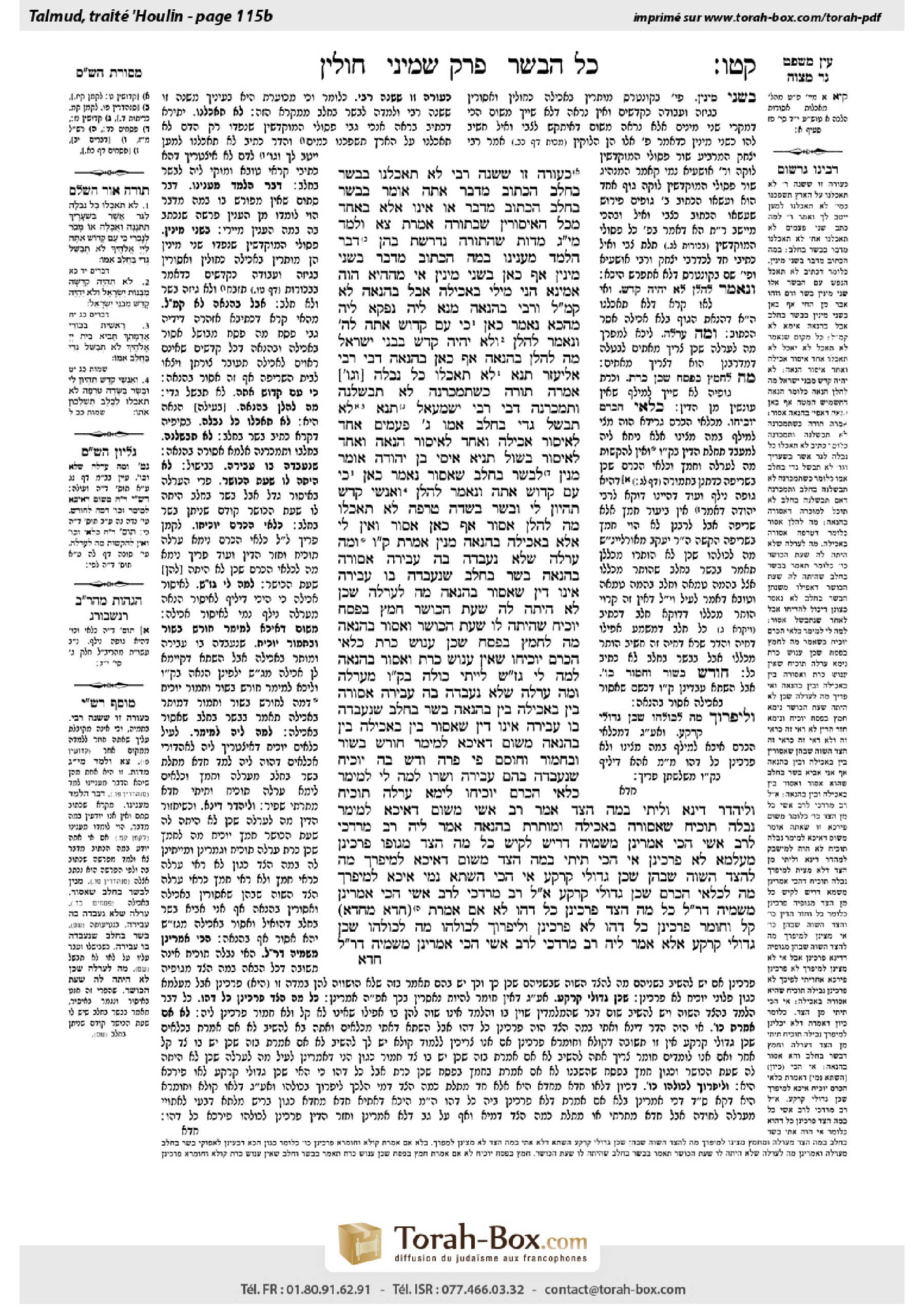
Chullin 115b: Talmud study for Daf Yomi
Study the Talmud for Daf Yomi with scanned pages, Hebrew text, English translations from Sefaria and AI-generated French translations.
Passage selection and English or AI-generated French translation are available where the scan has annotations. Daf Study is independent of Torah-Box and Sefaria.
Browse Chullin · חולין · All tractatesChullin 115b text and translations
This page of Chullin includes the Aramaic text, an English translation and an AI-generated French translation, alongside the scan above.
חולין קי״ה ב · Aramaic and Hebrew text
כְּעוּרָה זוֹ שֶׁשָּׁנָה רַבִּי? ״לֹא תֹּאכְלֶנּוּ״ – בְּבָשָׂר בְּחָלָב הַכָּתוּב מְדַבֵּר.
אַתָּה אוֹמֵר בְּבָשָׂר בְּחָלָב הַכָּתוּב מְדַבֵּר, אוֹ אֵינוֹ אֶלָּא בְּאֶחָד מִכׇּל הָאִיסּוּרִין שֶׁבַּתּוֹרָה? אָמַרְתָּ: צֵא וּלְמַד מִשְּׁלֹשׁ עֶשְׂרֵה מִדּוֹת שֶׁהַתּוֹרָה נִדְרֶשֶׁת בָּהֶן, דָּבָר הַלָּמֵד מֵעִנְיָנוֹ. בַּמֶּה הַכָּתוּב מְדַבֵּר? בִּשְׁנֵי מִינִין, אַף כָּאן בִּשְׁנֵי מִינִין.
אִי מֵהַהִיא – הֲוָה אָמֵינָא: הָנֵי מִילֵּי בַּאֲכִילָה, אֲבָל בַּהֲנָאָה – לָא; קָמַשְׁמַע לַן.
וְרַבִּי, בַּהֲנָאָה מְנָא לֵיהּ? נָפְקָא לֵיהּ מֵהָכָא: נֶאֱמַר כָּאן ״כִּי עַם קָדוֹשׁ אַתָּה לַה׳״, וְנֶאֱמַר לְהַלָּן ״וְלֹא יִהְיֶה קָדֵשׁ בִּבְנֵי יִשְׂרָאֵל״, מָה לְהַלָּן בַּהֲנָאָה, אַף כָּאן בַּהֲנָאָה.
דְּבֵי רַבִּי אֱלִיעֶזֶר תָּנָא: ״לֹא תֹאכְלוּ כׇל נְבֵלָה [וְגוֹ׳]״, אָמְרָה תּוֹרָה: כְּשֶׁתִּמְכְּרֶנָּה – לֹא תְּבַשְּׁלֶנָּה וְתִמְכְּרֶנָּה.
דְּבֵי רַבִּי יִשְׁמָעֵאל תָּנָא: ״לֹא תְבַשֵּׁל גְּדִי בַּחֲלֵב אִמּוֹ״ שָׁלֹשׁ פְּעָמִים, אֶחָד לְאִיסּוּר אֲכִילָה, וְאֶחָד לְאִיסּוּר הֲנָאָה, וְאֶחָד לְאִיסּוּר בִּשּׁוּל.
תַּנְיָא, אִיסִי בֶּן יְהוּדָה אוֹמֵר: מִנַּיִן לְבָשָׂר בְּחָלָב שֶׁאָסוּר? נֶאֱמַר כָּאן ״כִּי עַם קָדוֹשׁ אַתָּה״, וְנֶאֱמַר לְהַלָּן ״וְאַנְשֵׁי קֹדֶשׁ תִּהְיוּן לִי וּבָשָׂר בַּשָּׂדֶה טְרֵפָה לֹא תֹאכֵלוּ״, מָה לְהַלָּן אָסוּר, אַף כָּאן אָסוּר.
וְאֵין לִי אֶלָּא בַּאֲכִילָה, בַּהֲנָאָה מִנַּיִן? אָמַרְתָּ קַל וְחוֹמֶר: וּמָה עׇרְלָה שֶׁלֹּא נֶעֶבְדָה בָּהּ עֲבֵירָה – אֲסוּרָה בַּהֲנָאָה, בָּשָׂר בְּחָלָב שֶׁנֶּעֶבְדָה בּוֹ עֲבֵירָה – אֵינוֹ דִּין שֶׁאָסוּר בַּהֲנָאָה!
מָה לְעׇרְלָה, שֶׁכֵּן לֹא הָיְתָה לָהּ שְׁעַת הַכּוֹשֶׁר.
חָמֵץ בַּפֶּסַח יוֹכִיחַ, שֶׁהָיְתָה לוֹ שְׁעַת הַכּוֹשֶׁר, וְאָסוּר בַּהֲנָאָה. מָה לְחָמֵץ בַּפֶּסַח, שֶׁכֵּן עָנוּשׁ כָּרֵת.
כִּלְאֵי הַכֶּרֶם יוֹכִיחוּ, שֶׁאֵין עָנוּשׁ כָּרֵת, וְאָסוּר בַּהֲנָאָה.
לְמָה לִי גְּזֵירָה שָׁוָה? לַיְיתֵי כּוּלַּהּ בְּקַל וָחוֹמֶר מֵעׇרְלָה: וּמָה עׇרְלָה, שֶׁלֹּא נֶעֶבְדָה בָּהּ עֲבֵירָה, אֲסוּרָה בֵּין בַּאֲכִילָה בֵּין בַּהֲנָאָה; בָּשָׂר בְּחָלָב, שֶׁנֶּעֶבְדָה בּוֹ עֲבֵירָה, אֵינוֹ דִּין שֶׁאָסוּר בֵּין בַּאֲכִילָה בֵּין בַּהֲנָאָה!
מִשּׁוּם דְּאִיכָּא לְמֵימַר: חוֹרֵשׁ בְּשׁוֹר וּבַחֲמוֹר, וְחוֹסֵם פִּי פָרָה וְדָשׁ בָּהּ יוֹכִיחַ, שֶׁנֶּעֶבְדָה בָּהֶם עֲבֵירָה וּשְׁרוּ.
לְמָה לִי לְמֵימַר ״כִּלְאֵי הַכֶּרֶם יוֹכִיחוּ״, לֵימָא ״עׇרְלָה תּוֹכִיחַ״, וְלִיהְדַּר דִּינָא וְלֵיתֵי בְּמָה הַצַּד.
אָמַר רַב אָשֵׁי: מִשּׁוּם דְּאִיכָּא לְמֵימַר, נְבֵלָה תּוֹכִיחַ, שֶׁאֲסוּרָה בַּאֲכִילָה וּמוּתֶּרֶת בַּהֲנָאָה.
אֲמַר לֵיהּ רַב מָרְדֳּכַי לְרַב אָשֵׁי: הָכִי אָמְרִינַן מִשְּׁמֵיהּ דְּרֵישׁ לָקִישׁ: כֹּל ״מָה הַצַּד״ – מִגּוּפוֹ פָּרְכִינַן, מֵעָלְמָא לָא פָּרְכִינַן.
אִי הָכִי, תֵּיתֵי בְּמָה הַצַּד? מִשּׁוּם דְּאִיכָּא לְמִיפְרַךְ: מָה לְהַצַּד הַשָּׁוֶה שֶׁבָּהֶן – שֶׁכֵּן גִּדּוּלֵי קַרְקַע.
אִי הָכִי, הַשְׁתָּא נָמֵי אִיכָּא לְמִיפְרַךְ: מָה לְכִלְאֵי הַכֶּרֶם, שֶׁכֵּן גִּדּוּלֵי קַרְקַע?
אֲמַר לֵיהּ רַב מָרְדֳּכַי לְרַב אָשֵׁי: הָכִי אָמְרִינַן מִשְּׁמֵיהּ דְּרֵישׁ לָקִישׁ: כֹּל מָה הַצַּד פָּרְכִינַן כֹּל דְּהוּ, לֹא אִם אָמַרְתָּ חֲדָא מֵחֲדָא – קַל וָחוֹמֶר פָּרְכִינַן, כֹּל דְּהוּ – לָא פָּרְכִינַן.
וְלִיפְרוֹךְ לְכוּלְּהוּ, מָה לְכוּלְּהוּ שֶׁכֵּן גִּדּוּלֵי קַרְקַע!
אֶלָּא, אֲמַר לֵיהּ רַב מָרְדֳּכַי לְרַב אָשֵׁי, הָכִי אָמְרִינַן מִשְּׁמֵיהּ דְּרֵישׁ לָקִישׁ:
Chullin 115b · English translation
Is that derivation that Rabbi Yehuda HaNasi taught ugly, that you derive a new one? The verse states with regard to an animal’s blood: “You shall not eat it; you shall pour it upon the earth as water” (Deuteronomy 12:24), and the next verse adds: “You shall not eat it; that it may go well with you, and with your children after you.” Rabbi Yehuda HaNasi teaches that the redundant second verse is not referring to the prohibition of blood. Rather, the verse is speaking of the prohibition of meat cooked in milk, teaching that it is prohibited for consumption.
Do you say that the verse is speaking of the prohibition of meat cooked in milk? Or perhaps it is only referring to one of the other prohibitions in the Torah? You say: Go out and learn from the thirteen hermeneutical principles, one of which is: A matter that is derived from its context. To what are the adjacent verses referring? They are referring to consecrated animals that were redeemed, which are a combination of two types: They are non-sacred in that they may be eaten, but they are prohibited for shearing and work, like consecrated animals. Here too, one may conclude that the verse is referring to a prohibition that involves two types of food, i.e., the prohibition of meat cooked in milk.
Reish Lakish replied to Rabbi Yoḥanan: My exposition is still necessary, since if the source for the prohibition of eating meat cooked in milk were from that verse cited by Rabbi Yehuda HaNasi alone, I would say that this statement applies only to the prohibition of eating meat cooked in milk, but not to that of deriving benefit from it. The verse cited with regard to the Paschal offering teaches us that even deriving benefit is prohibited, just as it is prohibited to derive benefit from a disqualified Paschal offering.
The Gemara asks: And Rabbi Yehuda HaNasi, from where does he derive that meat cooked in milk is prohibited for benefit? The Gemara responds: He derives it from here, as it is stated here: “For you are a sacred [kadosh] people unto the Lord your God. You shall not cook a kid in its mother’s milk” (Deuteronomy 14:21). And it is stated below: “Neither shall there be a sodomite [kadesh] of the sons of Israel” (Deuteronomy 23:18). The similar expressions teach that just as below, the prohibition of sodomy is a prohibition that involves enjoyment, i.e., deriving benefit, not eating, so too here, meat cooked in milk is prohibited with regard to deriving benefit.
The school of Rabbi Eliezer taught: The verse states: “You shall not eat of any animal carcass; you may give it to the stranger who is within your gates, that he may eat it; or you may sell it to a foreigner; for you are a sacred people to the Lord your God; you shall not cook a kid in its mother’s milk” (Deuteronomy 14:21). The Torah stated the prohibition of meat cooked in milk after the halakha of an animal carcass to teach that when you sell a carcass to a gentile, you shall not cook it in milk and then sell it, i.e., meat cooked in milk is prohibited for benefit and may not be sold.
The school of Rabbi Yishmael taught: The Torah states three times: “You shall not cook a kid in its mother’s milk” (Exodus 23:19, 34:26; Deuteronomy 14:21). One verse serves to teach the prohibition against eating meat cooked in milk, and one serves to teach the prohibition against deriving benefit from it, and one serves to teach the prohibition against cooking meat in milk.
It is taught in a baraita: Isi ben Yehuda says: From where is it derived that it is prohibited to eat meat cooked in milk? It is stated here: “For you are a sacred people unto the Lord your God. You shall not cook a kid in its mother’s milk” (Deuteronomy 14:21). And it is stated below: “And you shall be sacred men unto Me; therefore you shall not eat any flesh that is torn of animals in the field [tereifa]; you shall cast it to the dogs” (Exodus 22:30). Just as below it is prohibited to eat a tereifa, so too here it is prohibited to eat meat cooked in milk.
And from this I have derived only that it is prohibited for consumption. From where do I derive that it is prohibited for benefit as well? You can say it can be derived by an a fortiori inference: Just as with regard to the prohibition against eating the fruit of a tree during the first three years after its planting [orla], which is treated less stringently as no sin has been committed in the planting of the tree and its production of fruit, it is prohibited for benefit, is it not right that meat cooked in milk, with regard to which a sin has been committed, should be prohibited for benefit?
The Gemara rejects this, as orla exhibits a unique stringency: What is unique about orla? It is unique in that it never had a time when it was fit. The same cannot be said about meat and milk, which were each permitted on their own before being cooked together.
The Gemara suggests: Let leavened bread on Passover prove the point, as it had a time when it was fit, before Passover, and yet it is prohibited for benefit. The Gemara rejects this inference as well: What is unique about consumption of leavened bread on Passover? It is unique in that it is punishable by karet, unlike the prohibition of meat cooked in milk.
The Gemara comments: Let the prohibition of diverse kinds in a vineyard prove the point, as it is not punishable by karet, and yet it is prohibited to derive benefit from the product.
The Gemara asks: Why do I need both Isi ben Yehuda’s verbal analogy to teach the prohibition of consumption and the a fortiori inference to teach the prohibition of benefit? Let all of it, both the prohibition of consumption and the prohibition against deriving benefit, be derived by an a fortiori inference from orla: Just as orla, which is treated less stringently, as no sin has been committed in the tree’s planting, is nevertheless prohibited both for consumption and for benefit; is it not right that meat cooked in milk, with regard to which a sin has been committed, should be prohibited both for consumption and for benefit?
The Gemara responds: That inference would be invalid because one could say: The cases of one who plows with an ox and with a donkey, and one who muzzles the mouth of a cow and threshes with it prove it invalid. As in those cases, a sin has been committed through them, and yet benefit from the products of these actions is permitted. One cannot refute a verbal analogy with logical reasoning.
The Gemara asks further: Why do I need to say, as was stated above, that the case of diverse kinds in a vineyard proves that benefit from meat and milk is prohibited? At that point, two other cases, orla and leavened bread on Passover, had already been offered as proof. Although they were rejected because they both possess a unique stringency, each lacks the stringency possessed by the other. Therefore, let us say that the case of orla proves that the stringency for consumption of leavened bread on Passover, i.e., the penalty of karet, is irrelevant, and vice versa. And let the inference revert to its starting point, and let the halakha with regard to meat cooked in milk be derived by analogy from the common element of the two sources, i.e., the prohibition against both consumption and benefit.
Rav Ashi said: Such a derivation cannot be suggested, because one can say that the case of an unslaughtered animal carcass proves it invalid, as an animal carcass is prohibited for consumption and yet it is permitted for benefit.
Rav Mordekhai said to Rav Ashi: We say in the name of Reish Lakish as follows: For any analogy derived from the common element of two sources, one can refute the analogy only by invoking conflicting details of the two sources themselves, e.g., here, some stringency shared by orla and leavened bread, but not by meat cooked in milk. One cannot refute the analogy from an external case, as you do.
The Gemara asks: If so, then the question remains: Why not let the halakha be derived by analogy from the common element of orla and leavened bread on Passover? The Gemara responds: Because the analogy can be refuted as follows: What is unique about the common element of orla and leavened bread? It is unique in that they both involve produce that grows from the ground, whereas meat and milk do not grow from the ground.
The Gemara counters: If so, then even now that the Gemara has invoked diverse kinds in a vineyard to prove the point, the derivation can be refuted in the same manner: What is unique about the prohibition of diverse kinds in a vineyard? It is unique in that it involves produce that grows from the ground.
Rav Mordekhai said to Rav Ashi: We say in the name of Reish Lakish as follows: For any analogy derived from the common element of two sources, one can refute the analogy by invoking any factor shared by the two source cases but not by the target case. But this is insufficient to refute an analogy to a single source from a single source using the standard formulation: No, if you say the halakha applies to the source case, which possesses a unique factor X, must you say the same of the target case, which does not? One can refute such analogies using this formulation only by way of an a fortiori inference, i.e., if the unique factor X is a stringency. But one cannot refute it by simply mentioning any unique factor, e.g., that diverse kinds in a vineyard grow from the ground.
The Gemara counters: But one need not invoke the case of diverse kinds in a vineyard by itself, since it is invoked in addition to the cases of orla and leavened bread. Consequently, this is effectively a derivation from the common element of all three sources, not from one single case to another. If so, let us refute the derivation from all of them: What is unique about all of the cases? They are unique in that they involve produce that grows from the ground.
Rather, Rav Mordekhai said to Rav Ashi: We say in the name of Reish Lakish as follows:
Chullin 115b · Traduction française (IA)
Est-ce que cette dérivation que Rabbi Yehuda HaNasi a enseignée est laid, que tu en donnes une nouvelle ? La Parashah dit concernant le sang d'un animal : « Tu ne mangeras point ce sang ; tu le verseras sur la terre comme de l'eau » (Deutéronome 12:24), et la Parashah suivante ajoute : « Tu ne mangeras point ce sang ; afin que cela aille bien avec toi, et avec tes enfants après toi. » Rabbi Yehuda HaNasi enseigne que la Parashah redondante ne concerne pas l'interdiction du sang. En réalité, la Parashah parle de l'interdiction de la viande cuite avec du lait, enseignant qu'il est interdit de la consommer.
Dis-tu que la Parashah parle de l'interdiction de la viande cuite avec du lait ? Ou peut-être parle-t-elle seulement d'une des autres interdictions de la Torah ? Tu dis : Allez, apprenez par les treize principes de dérivation, l'un d'entre eux étant : une chose dérivée de son contexte. À quoi les versets adjacents font-ils référence ? Ils font référence aux animaux consacrés qui ont été rachetés, qui sont une combinaison de deux types : ils sont non sacrés dans le sens où ils peuvent être mangés, mais ils sont interdits pour la tonte et le travail, comme les animaux consacrés. Ici aussi, on peut conclure que la Parashah parle d'une interdiction qui concerne deux types d'aliments, c'est-à-dire l'interdiction de la viande cuite avec du lait.
Reish Lakish répondit à Rabbi Yoḥanan : Mon exposition est encore nécessaire, car si la source de l'interdiction de manger de la viande cuite avec du lait provenait uniquement de cette Parashah citée par Rabbi Yehuda HaNasi, je dirais que cette déclaration s'applique uniquement à l'interdiction de manger de la viande cuite avec du lait, mais pas à celle de tirer un bénéfice d'elle. La Parashah citée concernant l'offrande pascal nous apprend que même tirer un bénéfice est interdit, tout comme il est interdit de tirer un bénéfice d'une offrande pascal non conforme.
La Guemara demande : Et Rabbi Yehuda HaNasi, d'où tire-t-il qu'il est interdit de tirer un bénéfice de la viande cuite avec du lait ? La Guemara répond : Il le tire de là, comme il est dit ici : « Car vous êtes un peuple saint au Seigneur votre Dieu. Vous ne cuirez point un petit agneau dans le lait de sa mère » (Deutéronome 14:21). Et il est dit plus bas : « Ni ne sera-t-il un sodomite des fils d'Israël » (Deutéronome 23:18). Les expressions semblables enseignent que tout comme en bas, l'interdiction de la sodomie est une interdiction qui concerne le plaisir, c'est-à-dire le bénéfice, pas la consommation, ainsi ici, la viande cuite avec du lait est interdite concernant le bénéfice.
L'école de Rabbi Eliezer enseigna : La Parashah dit : « Tu ne mangeras point de carcaсs d'animaux ; tu peux les donner à l'étranger qui est dans tes portes, qu'il les mange ; ou tu peux les vendre à un étranger ; car vous êtes un peuple saint au Seigneur votre Dieu ; vous ne cuirez point un petit agneau dans le lait de sa mère » (Deutéronome 14:21). La Torah a placé l'interdiction de la viande cuite avec du lait après la halakha du carcaсs d'animaux pour enseigner que quand tu vends un carcaсs à un non-Juif, tu ne dois pas le cuire avec du lait et le vendre, c'est-à-dire que la viande cuite avec du lait est interdite pour le bénéfice et ne peut pas être vendue.
L'école de Rabbi Yishmael enseigna : La Torah dit trois fois : « Tu ne cuiras point un petit agneau dans le lait de sa mère » (Exode 23:19, 34:26 ; Deutéronome 14:21). Une Parashah enseigne l'interdiction de manger de la viande cuite avec du lait, une autre enseigne l'interdiction de tirer un bénéfice d'elle, et une troisième enseigne l'interdiction de cuire la viande avec du lait.
Il est enseigné dans une baraïta : Isi ben Yehuda dit : D'où tire-t-on que manger de la viande cuite avec du lait est interdit ? Il est dit ici : « Car vous êtes un peuple saint au Seigneur votre Dieu. Vous ne cuirez point un petit agneau dans le lait de sa mère » (Deutéronome 14:21). Et il est dit plus bas : « Et vous serez saints pour moi ; donc vous ne mangerez point de chair de bêtes qui sont déchirées dans le champ [tereifa] ; vous la jetterez aux chiens » (Exode 22:30). Tout comme en bas il est interdit de manger un tereifa, ainsi ici il est interdit de manger de la viande cuite avec du lait.
Et d'où tire-t-on seulement que c'est interdit pour la consommation ? D'où tire-t-on que c'est interdit pour le bénéfice aussi ? Tu peux dire qu'on peut le déduire par une inférence a fortiori : Tout comme concernant l'interdiction de manger les fruits d'un arbre pendant les trois premières années après sa plantation [orla], qui est traité moins sévèrement car aucun péché n'a été commis dans la plantation de l'arbre et la production de ses fruits, il est interdit pour le bénéfice, n'est-ce pas juste que la viande cuite avec du lait, concernant laquelle un péché a été commis, soit interdite pour le bénéfice ?
La Guemara rejette cela, car l'orla présente une spécificité unique : Qu'est-ce qui est unique à l'orla ? C'est unique dans le sens où elle n'a jamais eu de moment où elle était permise. Cela ne peut pas être dit de la viande et du lait, qui étaient chacun permis en eux-mêmes avant d'être cuits ensemble.
La Guemara suggère : Que le levain de Pessah prouve le point, car il avait un moment où il était acceptable, avant Pessah, et pourtant il est interdit pour le bénéfice. La Guemara rejette cette inférence également : Qu'est-ce qui est unique concernant la consommation du levain de Pessah ? C'est unique dans le sens où il est puni par karet, contrairement à l'interdiction de la viande cuite avec du lait.
La Guemara commente : Que l'interdiction des diverses sortes dans un vignoble prouve le point, car elle n'est pas punie par karet, et pourtant elle est interdite de tirer un bénéfice du produit.
La Guemara demande : Pourquoi ai-je besoin à la fois de l'analogie verbale d'Isi ben Yehuda pour enseigner l'interdiction de la consommation et de l'inférence a fortiori pour enseigner l'interdiction du bénéfice ? Que tout cela, à la fois l'interdiction de la consommation et l'interdiction de tirer un bénéfice, soit dérivé par une inférence a fortiori de l'orla : Tout comme l'orla, qui est traité moins sévèrement, car aucun péché n'a été commis dans la plantation de l'arbre, est néanmoins interdit à la fois pour la consommation et pour le bénéfice ; n'est-ce pas juste que la viande cuite avec du lait, concernant laquelle un péché a été commis, soit interdite à la fois pour la consommation et pour le bénéfice ?
La Guemara répond : Cette déduction serait invalide, car on pourrait dire : Les cas d'une personne qui laboure avec un bœuf et avec un âne, et d'une personne qui bâfre un vache et la fait paître prouvent qu'il est invalide. Comme dans ces cas, un péché a été commis à travers eux, et pourtant le bénéfice des produits de ces actions est permis. On ne peut pas réfuter une analogie verbale par un raisonnement logique.
La Guemara demande ensuite : Pourquoi ai-je besoin de dire, comme cela a été dit ci-dessus, que le cas de diverses espèces dans un vignoble prouve que le bénéfice de viande et de lait est interdit ? À ce moment-là, deux autres cas, l'orla et le pain aisé de Pessah, avaient déjà été offerts comme preuve. Bien qu'ils aient été rejetés car ils possèdent tous deux une stricte rigidité, chacun manque de la rigidité possédée par l'autre. Par conséquent, disons que le cas de l'orla prouve que la rigidité concernant la consommation du pain aisé de Pessah, c'est-à-dire la peine de karet, est irrélevante, et vice versa. Et la déduction doit revenir à son point de départ, et la halakha concernant la viande cuite avec du lait doit être dérivée par analogie à partir de l'élément commun des deux sources, c'est-à-dire l'interdiction de la consommation et du bénéfice.
Rav Ashi dit : Une telle déduction ne peut pas être suggérée, car on pourrait dire que le cas d'un cadavre d'animaux non sacrifiés prouve qu'il est invalide, car un cadavre d'animaux est interdit à la consommation et pourtant il est permis au bénéfice.
Rav Mordekhai dit à Rav Ashi : Nous disons en nom de Reish Lakish comme suit : Pour toute analogie dérivée de l'élément commun de deux sources, on peut réfuter l'analogie uniquement en invoquant des détails contradictoires des deux sources elles-mêmes, par exemple ici, une stricte interdiction partagée par l'orla et le pain aisé, mais pas par la viande cuite avec du lait. On ne peut pas réfuter l'analogie à partir d'un cas externe, comme vous le faites.
La Guemara demande : Si c'est ainsi, alors la question reste : pourquoi ne pas dériver la halakha par analogie à partir de l'élément commun de l'orla et du pain aisé de Pessah ? La Guemara répond : Parce que l'analogie peut être réfutée comme suit : Qu'est-ce qui est unique dans l'élément commun de l'orla et du pain aisé de Pessah ? C'est unique dans le fait qu'ils impliquent des produits qui poussent du sol, tandis que la viande et le lait ne poussent pas du sol.
La Guemara contredit : Si c'est ainsi, alors même maintenant que la Guemara a invoqué les diverses espèces dans un vignoble pour prouver le point, la déduction peut être réfutée de la même manière : Qu'est-ce qui est unique dans l'interdiction des diverses espèces dans un vignoble ? C'est unique dans le fait qu'il s'agit de produits qui poussent du sol.
Rav Mordekhai dit à Rav Ashi : Nous disons en nom de Reish Lakish comme suit : Pour toute analogie dérivée de l'élément commun de deux sources, on peut réfuter l'analogie en invoquant tout facteur partagé par les deux cas source mais pas par le cas cible. Mais cela n'est pas suffisant pour réfuter une analogie tirée d'une source unique vers une autre source unique en utilisant la formulation standard : Non, si vous dites que la halakha s'applique au cas source, qui possède un facteur unique X, devez-vous dire la même chose du cas cible, qui n'en possède pas ? On peut réfuter de telles analogies avec cette formulation uniquement par une déduction a fortiori, c'est-à-dire si le facteur unique X est une stricte rigidité. Mais on ne peut pas réfuter cela simplement en mentionnant tout facteur unique, par exemple que les diverses espèces dans un vignoble poussent du sol.
La Guemara contredit : Mais on n'a pas besoin d'invoquer le cas des diverses espèces dans un vignoble seul, car il est invoqué en plus des cas de l'orla et du pain aisé de Pessah. Par conséquent, cela est effectivement une déduction à partir de l'élément commun de toutes les trois sources, et non d'un seul cas à un autre. Si c'est ainsi, disons que nous réfutons la déduction à partir de tous d'entre eux : Qu'est-ce qui est unique dans tous les cas ? Ils sont uniques dans le fait qu'ils impliquent des produits qui poussent du sol.
Rav Mordekhai dit à Rav Ashi : Nous disons en nom de Reish Lakish comme suit :
Traduction française générée par IA à partir de l’édition anglaise de Sefaria. Vérifie toujours un passage avec le texte source.
Text from Sefaria: William Davidson Edition - Vocalized Aramaic (unknown); William Davidson Edition - English (CC BY NC).