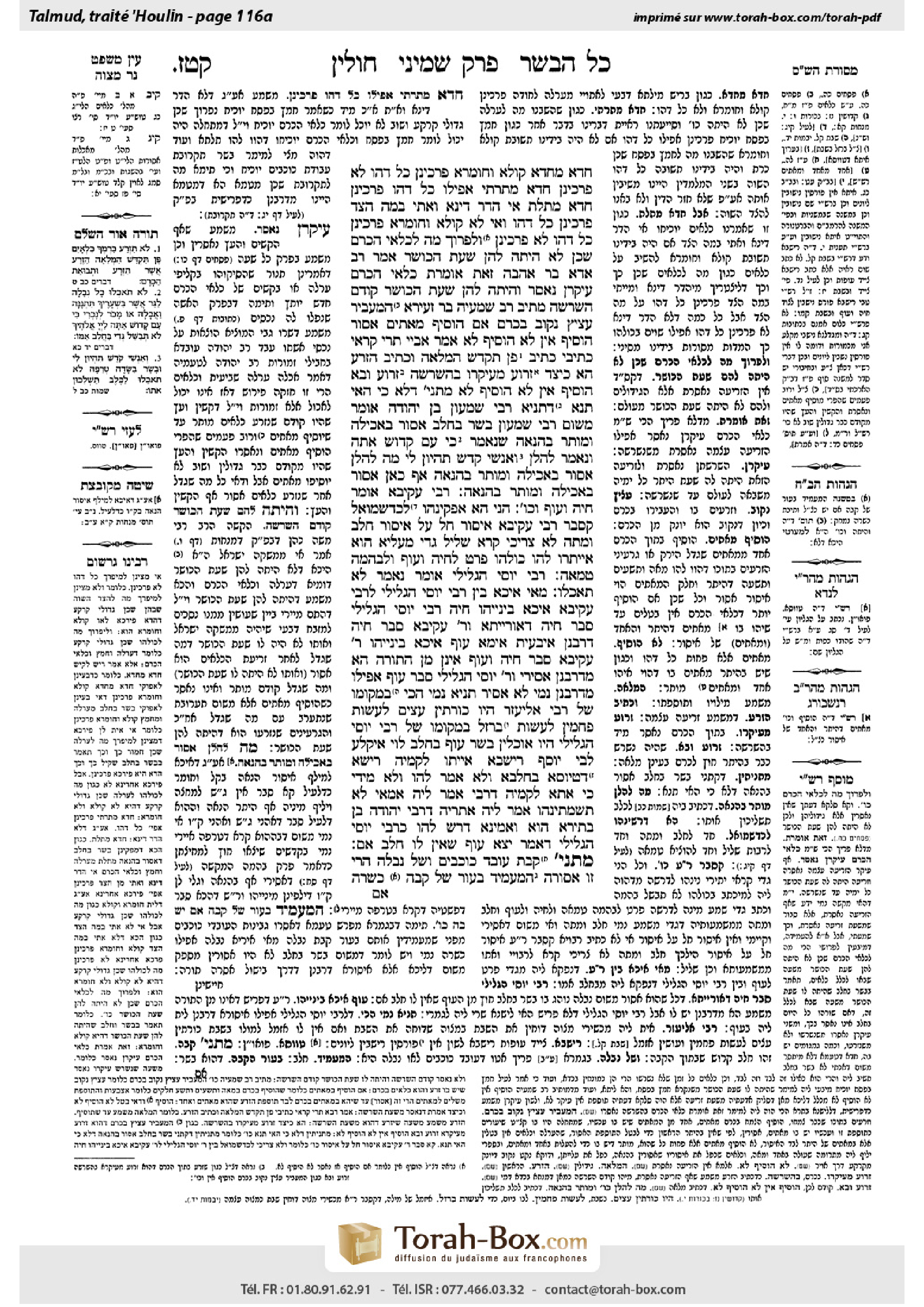
Chullin 116a: Talmud study for Daf Yomi
Study the Talmud for Daf Yomi with scanned pages, Hebrew text, English translations from Sefaria and AI-generated French translations.
Passage selection and English or AI-generated French translation are available where the scan has annotations. Daf Study is independent of Torah-Box and Sefaria.
Browse Chullin · חולין · All tractatesChullin 116a text and translations
This page of Chullin includes the Aramaic text, an English translation and an AI-generated French translation, alongside the scan above.
חולין קי״ו א · Aramaic and Hebrew text
חֲדָא מֵחֲדָא קוּלָּא וְחוּמְרָא פָּרְכִינַן, כֹּל דְּהוּ לָא פָּרְכִינַן, חֲדָא מִתַּרְתֵּי אֲפִילּוּ כֹּל דְּהוּ פָּרְכִינַן.
חֲדָא מִתְּלָת, אִי הָדַר דִּינָא וְאָתֵי בְּמָה הַצַּד – פָּרְכִינַן כֹּל דְּהוּ, וְאִי לָא – קוּלָּא וְחוּמְרָא פָּרְכִינַן, כֹּל דְּהוּ לָא פָּרְכִינַן.
וְלִפְרוֹךְ: מָה לְכִלְאֵי הַכֶּרֶם, שֶׁכֵּן לֹא הָיְתָה לָהֶן שְׁעַת הַכּוֹשֶׁר? אָמַר רַב אַדָּא בַּר אַהֲבָה: זֹאת אוֹמֶרֶת – כִּלְאֵי הַכֶּרֶם עִיקָּרָן נֶאֱסָר, וְהָיְתָה לָהֶן שְׁעַת הַכּוֹשֶׁר קוֹדֶם הַשְׁרָשָׁה.
מֵתִיב רַב שְׁמַעְיָה בַּר זְעֵירָא: הַמַּעֲבִיר עָצִיץ נָקוּב בַּכֶּרֶם, אִם הוֹסִיף מָאתַיִם – אָסוּר. הוֹסִיף – אִין, לֹא הוֹסִיף – לָא.
אָמַר אַבָּיֵי: תְּרֵי קְרָאֵי כְּתִיבִי, כְּתִיב ״פֶּן תִּקְדַּשׁ הַמְּלֵאָה״, וּכְתִיב ״הַזֶּרַע״.
הָא כֵּיצַד? זָרוּעַ מֵעִיקָּרוֹ – בְּהַשְׁרָשָׁה, זָרוּעַ וּבָא, הוֹסִיף – אִין, לֹא הוֹסִיף – לָא.
מַתְנִיתִין דְּלָא כִּי הַאי תַּנָּא, דְּתַנְיָא: רַבִּי שִׁמְעוֹן בֶּן יְהוּדָה אוֹמֵר מִשּׁוּם רַבִּי שִׁמְעוֹן: בָּשָׂר בְּחָלָב אָסוּר בַּאֲכִילָה וּמוּתָּר בַּהֲנָאָה, שֶׁנֶּאֱמַר: ״כִּי עַם קָדוֹשׁ אַתָּה״, וְנֶאֱמַר לְהַלָּן: ״וְאַנְשֵׁי קֹדֶשׁ תִּהְיוּן לִי״.
מָה לְהַלָּן אָסוּר בַּאֲכִילָה וּמוּתָּר בַּהֲנָאָה, אַף כָּאן אָסוּר בַּאֲכִילָה וּמוּתָּר בַּהֲנָאָה.
רַבִּי עֲקִיבָא אוֹמֵר: חַיָּה וָעוֹף וְכוּ׳. הָנֵי – הָא אַפְּקִינְהוּ לִכְדִשְׁמוּאֵל.
קָסָבַר רַבִּי עֲקִיבָא: אִיסּוּר חָל עַל אִיסּוּר, חֵלֶב וּמֵתָה לָא צְרִיכִי קְרָא, שְׁלִיל – גְּדִי מְעַלְּיָא הוּא, אִיַּיתַּרוּ לְהוּ כּוּלְּהוּ – פְּרָט לְחַיָּה, וְעוֹף, וְלִבְהֵמָה טְמֵאָה.
רַבִּי יוֹסֵי הַגְּלִילִי אוֹמֵר: נֶאֱמַר ״לֹא תֹאכְלוּ״. מַאי אִיכָּא בֵּין רַבִּי יוֹסֵי הַגְּלִילִי לְרַבִּי עֲקִיבָא?
אִיכָּא בֵּינַיְיהוּ חַיָּה: רַבִּי יוֹסֵי הַגְּלִילִי סָבַר חַיָּה דְּאוֹרָיְיתָא, וְרַבִּי עֲקִיבָא סָבַר חַיָּה דְּרַבָּנַן.
אִיבָּעֵית אֵימָא, עוֹף אִיכָּא בֵּינַיְיהוּ: רַבִּי עֲקִיבָא סָבַר חַיָּה וָעוֹף אֵינָן מִן הַתּוֹרָה, הָא מִדְּרַבָּנַן אֲסִירִי, וְרַבִּי יוֹסֵי הַגְּלִילִי סָבַר עוֹף אֲפִילּוּ מִדְּרַבָּנַן נָמֵי לָא אֲסִיר.
תַּנְיָא נָמֵי הָכִי: בִּמְקוֹמוֹ שֶׁל רַבִּי אֱלִיעֶזֶר הָיוּ כּוֹרְתִין עֵצִים לַעֲשׂוֹת פֶּחָמִין לַעֲשׂוֹת בַּרְזֶל, בִּמְקוֹמוֹ שֶׁל רַבִּי יוֹסֵי הַגְּלִילִי הָיוּ אוֹכְלִין בְּשַׂר עוֹף בְּחָלָב.
לֵוִי אִיקְּלַע לְבֵי יוֹסֵף רִישְׁבָּא, אַיְיתוֹ לְקַמֵּיהּ רֵישָׁא דְּטַוָּוסָא בַּחֲלָבָא, וְלָא אֲמַר לְהוּ וְלָא מִידֵּי. כִּי אֲתָא לְקַמֵּיהּ דְּרַבִּי, אֲמַר לֵיהּ: אַמַּאי לָא תְּשַׁמְּתִינְהוּ?
אֲמַר לֵיהּ: אַתְרֵיהּ דְּרַבִּי יְהוּדָה בֶּן בְּתֵירָא הוּא, וְאָמֵינָא: דְּרַשׁ לְהוּ כְּרַבִּי יוֹסֵי הַגְּלִילִי, דְּאָמַר: יָצָא עוֹף שֶׁאֵין לוֹ חֲלֵב אֵם.
מַתְנִי׳ קֵבַת גּוֹי וְשֶׁל נְבֵלָה – הֲרֵי זוֹ אֲסוּרָה. הַמַּעֲמִיד בְּעוֹר שֶׁל קֵבָה כְּשֵׁרָה,
Chullin 116a · English translation
As stated above, for any a fortiori inference of a single source from a single source, one can refute the derivation by invoking a unique leniency in the supposedly stringent case and a stringency in the lenient one, but one cannot refute it by simply mentioning any aspect unique to the first source. And for inferences of one source from two other sources one can even refute the derivation by mentioning any aspect unique to the first source.
For inferences of one source from three other sources, as suggested here, only if the inference reverts to its starting point, as each source possesses its own unique stringency, and the halakha is then derived by analogy from the common element of all of them, can one refute the inference by mentioning any factor unique to the source cases. But if the inference does not revert, one can refute the derivation only by invoking a leniency and a stringency, but one cannot refute it by mentioning any unique factor. The suggested inference does not revert, since the prohibition of diverse kinds in a vineyard possesses no stringent element that the other sources lack. Therefore, the fact that all the source cases involve produce is immaterial, and the inference from diverse kinds in a vineyard stands.
The Gemara suggests: But let one refute the inference as follows: What is unique about diverse kinds in a vineyard? They are unique in that they had no time that they were fit. The produce is forbidden as soon as it begins to grow, whereas meat and milk are prohibited only when they are cooked together. Rav Adda bar Ahava said: If this suggestion was not employed, that is to say that even the roots of diverse kinds in a vineyard are prohibited, including the seeds and saplings from which the hybrid plants grow. And they too had a time when they were fit, before taking root. Consequently, the premise of the question must be false.
Rav Shemaya bar Zeira raises an objection to this conclusion from a mishna (Kilayim 7:8): If one transfers a perforated pot with seeds in it into a vineyard, if the size of the plant growing in the pot increases by one two-hundredth of its previous size, such that the permitted original plant is less than two hundred times the amount of the prohibited growth and insufficient to nullify it, the produce is prohibited, due to the prohibition against planting diverse kinds in a vineyard. One may infer: If it increases, yes, it is prohibited; but if it does not increase, no, it is permitted. Apparently, only the additional growth is prohibited, not the planted seeds or saplings.
Abaye said: Two verses are written, i.e., two separate terms in one verse indicate two separate prohibitions: The verse states: “You shall not sow your vineyard with two kinds of seed, lest the growth of the seed that you will sow be forfeited together with the increase of the vineyard” (Deuteronomy 22:9). It is written: “Lest the growth be forfeited,” indicating that it is prohibited only if it has grown, and it is written: “Of the seed,” from which it can be inferred that it is prohibited immediately when it is planted and takes root.
How can these texts be reconciled? Abaye explains: If it was planted initially in the vineyard, it becomes prohibited immediately upon taking root. But in a case where it was planted elsewhere and brought into the vineyard later, e.g., in a perforated pot, then one must distinguish: If its size increases in the vineyard, yes, the growth is prohibited; if its size does not increase, no, it is not prohibited.
The Gemara notes: The mishna, which states that meat cooked in milk is prohibited for benefit, is not in accordance with the opinion of this tanna, as it is taught in a baraita: Rabbi Shimon ben Yehuda says in the name of Rabbi Shimon: It is prohibited to eat meat cooked in milk but it is permitted to derive benefit from it, as it is stated: “For you are a holy people to the Lord your God; you shall not cook a kid in its mother’s milk” (Deuteronomy 14:21). And the verse states elsewhere: “And you shall be holy people to Me; therefore you shall not eat any flesh that is torn by animals [tereifa] in the field; you shall throw it to the dogs” (Exodus 22:30).
The use of the word “holy” in both verses indicates that just as there, with regard to a tereifa, it is prohibited to eat it but one is permitted to derive benefit from it, as one may give it to the dogs, so too here, with regard to meat cooked in milk, it is prohibited to eat it but one is permitted to derive benefit from it.
§ The mishna states: Rabbi Akiva says: Cooking the meat of an undomesticated animal or a bird in milk is not prohibited by Torah law, as it is stated: “You shall not cook a kid in its mother’s milk” (Exodus 23:19, 34:26; Deuteronomy 14:21), three times, excluding an undomesticated animal, a bird, and a non-kosher animal. The Gemara raises a difficulty: Other halakhot have already been derived from these mentions of the word “kid,” in accordance with the statement of Shmuel (see 113b).
The Gemara answers: Rabbi Akiva maintains in general that a prohibition takes effect even where another prohibition already exists, and therefore forbidden fat and the meat of a dead animal, which are already prohibited, do not require a verse to teach that the prohibition of meat and milk applies to them. Furthermore, there is no need to derive from a verse that a fetus is included, as it is a full-fledged kid. Consequently, all three mentions of the word remain for him to expound that they serve to exclude an undomesticated animal and a bird and a non-kosher animal.
§ The mishna further teaches that Rabbi Yosei HaGelili says: It is stated: “You shall not eat of any animal carcass” (Deuteronomy 14:21), and in the same verse it is stated: “You shall not cook a kid in its mother’s milk.” This indicates that the meat of an animal that is subject to be prohibited due to the prohibition of eating an unslaughtered carcass is prohibited to cook in milk. Consequently, one might have thought it is prohibited to cook in milk the meat of a bird, which is subject to this prohibition. Therefore, the verse states: “In its mother’s milk,” to exclude a bird, which has no mother’s milk. The Gemara asks: What difference is there between the opinion of Rabbi Yosei HaGelili, who excludes a bird from the prohibition of meat and milk due to the phrase “in its mother’s milk,” and the opinion of Rabbi Akiva, who comes to the same conclusion as Rabbi Yosei HaGelili based upon the phrase “You shall not cook a kid”?
The Gemara explains: There is a difference between them with regard to an undomesticated animal. Rabbi Yosei HaGelili maintains that the prohibition of cooking the meat of an undomesticated animal in milk applies by Torah law, as an undomesticated animal has mother’s milk, but Rabbi Akiva maintains that the prohibition of cooking the meat of an undomesticated animal in milk applies only by rabbinic law, as it is excluded by the phrase: “You shall not cook a kid.”
If you wish, say instead that there is a difference between them with regard to the meat of a bird itself: Rabbi Akiva maintains that the prohibitions of an undomesticated animal and a bird do not apply by Torah law; but it may be inferred from his statement that they are prohibited by rabbinic law. And Rabbi Yosei HaGelili maintains that a bird is not prohibited even by rabbinic law.
The Gemara notes: That distinction is also taught in a baraita: In the locale of Rabbi Eliezer, where his ruling was followed, they would cut down trees on Shabbat to prepare charcoal from them with which to light a fire to fashion iron tools with which to circumcise a child on Shabbat. In Rabbi Eliezer’s opinion, not only does the mitzva of circumcision override Shabbat, but also any action required for the preparation of the tools necessary for the circumcision likewise overrides Shabbat. The baraita adds: In the locale of Rabbi Yosei HaGelili they would eat bird meat cooked in milk. Evidently, Rabbi Yosei HaGelili maintains that the prohibition of meat cooked in milk does not include birds.
The Gemara relates: Levi happened to come to the house of Yosef the bird hunter [rishba]. They served him the head of a peacock [tayvasa] in milk and he did not say anything to them. When Levi came before Rabbi Yehuda HaNasi, Rabbi Yehuda HaNasi said to him: Why did you not excommunicate these people who eat bird meat cooked in milk, contrary to the decree of the Sages?
Levi said to him: It was in the locale of Rabbi Yehuda ben Beteira, and I said: Perhaps he taught them that the halakha is in accordance with the opinion of Rabbi Yosei HaGelili, who said that the phrase “in its mother’s milk” serves to exclude a bird, which does not have mother’s milk. If so, I could not prohibit it to them, and I certainly could not excommunicate them for following their ruling.
MISHNA: The congealed milk in the stomach of the animal of a gentile and of an unslaughtered animal carcass is prohibited. With regard to one who curdled milk by using the skin of the stomach of a kosher animal as a coagulant to make cheese, which may then have the taste of meat cooked in milk,
Chullin 116a · Traduction française (IA)
Comme mentionné ci-dessus, pour toute déduction a fortiori d'une source unique à partir d'une autre source unique, on peut réfuter cette déduction en invoquant une tolérance unique dans le cas supposé strict et une stricte exigence dans le cas tolérant, mais on ne peut pas réfuter cette déduction simplement en mentionnant un aspect unique de la première source. Et pour les déductions d'une source à partir de deux autres sources, on peut même réfuter la déduction en mentionnant n'importe quel aspect unique de la première source.
Pour les déductions d'une source à partir de trois autres sources, comme suggéré ici, seule si la déduction revient à son point de départ, c'est-à-dire que chaque source possède sa propre stricte exigence, et que la halakha est déduite par analogie à partir de l'élément commun de toutes ces sources, peut-on réfuter la déduction en mentionnant n'importe quel facteur unique de la source. Mais si la déduction ne revient pas, on peut réfuter la déduction uniquement en invoquant une tolérance et une stricte exigence, mais on ne peut pas réfuter cette déduction en mentionnant n'importe quel facteur unique. La déduction suggérée ne revient pas, car la prohibition des diverses espèces dans un vignoble ne possède aucun élément strict que les autres sources n'ont pas. Par conséquent, le fait que toutes les cas de source impliquent des produits est sans importance, et la déduction à partir des diverses espèces dans un vignoble tient.
La Guemara suggère : Mais laissons réfuter cette déduction ainsi : Qu'est-ce qui rend unique les diverses espèces dans un vignoble ? Ils sont uniques dans le fait qu'ils n'avaient pas de temps où ils étaient aptes. Les produits sont interdits dès qu'ils commencent à pousser, tandis que la viande et le lait sont interdits uniquement lorsqu'ils sont cuits ensemble. Rav Adda bar Ahava dit : Si cette suggestion n'avait pas été employée, c'est-à-dire que même les racines des diverses espèces dans un vignoble sont interdites, y compris les graines et les jeunes plants des plantes hybrides. Et eux aussi avaient un temps où ils étaient aptes, avant de prendre racine. Par conséquent, la prémisse de la question doit être fausse.
Rav Shemaya bar Zeira émet un objection à cette conclusion à partir d'une mitsva (Kilayim 7:8) : Si l'on transfère un récipient percé contenant des graines dans un vignoble, et si la taille de la plante poussant dans le récipient augmente d'un deux-centième de sa taille précédente, de sorte que la plante permise originale est inférieure à deux cents fois la quantité de la croissance interdite et insuffisante pour l'annuler, le produit est interdit, en raison de la prohibition contre la plantation de diverses espèces dans un vignoble. On peut inférer : Si elle augmente, oui, elle est interdite ; mais si elle ne s'élargit pas, non, elle est permise. Apparemment, seule la croissance supplémentaire est interdite, pas les graines ou les jeunes plants plantés.
Abaye dit : Deux versets sont écrits, c'est-à-dire deux termes distincts dans un seul verset indiquent deux prohibitions distinctes : Le verset dit : « Tu ne semeras pas ton vignoble avec deux espèces de grain, afin que la croissance du grain que tu semes ne soit pas perdue avec l'augmentation du vignoble » (Deutéronome 22:9). Il est écrit : « afin que la croissance soit perdue », indiquant qu'il est interdit uniquement si elle a poussé, et il est écrit : « de la semence », d'où on peut déduire qu'il est interdit dès qu'il est planté et prend racine.
Comment ces textes peuvent-ils être conciliés ? Abaye explique : Si elle a été plantée initialement dans le vignoble, elle devient interdite dès qu'elle prend racine. Mais dans un cas où elle a été plantée ailleurs et apportée dans le vignoble plus tard, par exemple dans un récipient percé, alors on doit distinguer : Si sa taille augmente dans le vignoble, oui, la croissance est interdite ; si sa taille ne s'élargit pas, non, elle n'est pas interdite.
La Guemara note : La mitsva, qui stipule que la viande cuite avec du lait est interdite pour un bénéfice, n'est pas en accord avec l'opinion de ce tanna, car elle est enseignée dans une baraïta : Rabbi Shimon ben Yehuda dit en nom de Rabbi Shimon : Il est interdit de manger de la viande cuite avec du lait, mais il est permis d'en tirer un bénéfice, comme il est dit : « Vous êtes un peuple saint pour l'Éternel votre Dieu ; vous ne cuirez pas un petit veau dans le lait de sa mère » (Deutéronome 14:21). Et le verset dit ailleurs : « Et vous serez un peuple saint pour Moi ; donc vous ne mangerez pas aucune chair qui est déchirée par les animaux [tereifa] dans le champ ; vous la jetterez aux chiens » (Exode 22:30).
L'usage du mot « saint » dans les deux versets indique que tout comme là, concernant un tereifa, il est interdit de le manger mais on est autorisé à en tirer un bénéfice, car on peut le donner aux chiens, ainsi ici, concernant la viande cuite avec du lait, il est interdit de la manger mais on est autorisé à en tirer un bénéfice.
§ La mitsva stipule : Rabbi Akiva dit : Cuire la viande d'un animal sauvage ou d'un oiseau dans le lait n'est pas interdit par la Torah, comme il est dit : « Tu ne cuiras pas un petit veau dans le lait de sa mère » (Exode 23:19, 34:26 ; Deutéronome 14:21), trois fois, excluant un animal sauvage, un oiseau et un animal non-kosher. La Guemara soulève une difficulté : D'autres halakhot ont déjà été déduites à partir de ces mentions du mot « petit veau », conformément à l'affirmation de Shmuel (voir 113b).
La Guemara répond : Rabbi Akiva affirme en général que une prohibition prend effet même là où une autre prohibition existe déjà, et par conséquent, les graisses interdites et la viande d'un animal mort, qui sont déjà interdites, n'ont pas besoin d'un verset pour enseigner que la prohibition de viande et lait s'applique à elles. De plus, il n'y a pas besoin de déduire à partir d'un verset que le fœtus est inclus, car il est un petit veau complet. Par conséquent, les trois mentions du mot restent pour lui afin d'expliquer qu'elles servent à exclure un animal sauvage et un oiseau et un animal non-kosher.
§ La Michna enseigne davantage que Rabbi Yosei HaGelili dit : Il est écrit : « Vous ne mangerez point de carcas d'animal » (Deutéronome 14:21), et dans la même versette il est écrit : « Vous ne cuirez point un petit agneau dans le lait de sa mère. » Cela indique que la viande d'un animal soumis à l'interdiction de manger une carcas non sacrifiée est interdite à cuire dans le lait. Par conséquent, on pourrait penser qu'il est interdit de cuire dans le lait la viande d'un oiseau, qui est soumis à cette interdiction. Ainsi, la versette dit : « Dans le lait de sa mère », pour exclure l'oiseau, qui n'a pas de lait de mère. La Guemara demande : Quelle différence y a-t-il entre l'opinion de Rabbi Yosei HaGelili, qui exclut l'oiseau de l'interdiction de viande et de lait grâce à la phrase « dans le lait de sa mère », et l'opinion de Rabbi Akiva, qui arrive à la même conclusion que Rabbi Yosei HaGelili grâce à la phrase « Vous ne cuirez point un petit agneau » ?
La Guemara explique : Il y a une différence entre eux concernant un animal sauvage. Rabbi Yosei HaGelili maintient que l'interdiction de cuire la viande d'un animal sauvage dans le lait s'applique par la Loi juive, car un animal sauvage a du lait de mère, mais Rabbi Akiva maintient que l'interdiction de cuire la viande d'un animal sauvage dans le lait s'applique uniquement par la loi rabbinique, car il est exclu par la phrase : « Vous ne cuirez point un petit agneau. »
Si vous le souhaitez, dites plutôt qu'il y a une différence entre eux concernant la viande d'oiseau elle-même : Rabbi Akiva maintient que les interdictions concernant un animal sauvage et un oiseau ne s'appliquent pas par la Loi juive ; mais on peut en déduire de son propos qu'ils sont interdits par la loi rabbinique. Et Rabbi Yosei HaGelili maintient qu'un oiseau n'est même pas interdit par la loi rabbinique.
La Guemara note : Cette distinction est également enseignée dans une baraïta : Dans la région de Rabbi Eliezer, où sa décision était suivie, ils coupaient des arbres le sabbat pour préparer du charbon avec lesquels allumer un feu pour fabriquer des outils en fer avec lesquels circoncire un enfant le sabbat. Selon l'opinion de Rabbi Eliezer, non seulement la Mitsva de circoncision supprime le sabbat, mais aussi toute action nécessaire pour la préparation des outils nécessaires à la circoncision supprime également le sabbat. La baraïta ajoute : Dans la région de Rabbi Yosei HaGelili, ils mangeaient la viande d'oiseau cuite dans le lait. Évidemment, Rabbi Yosei HaGelili maintient que l'interdiction de viande cuite dans le lait ne comprend pas les oiseaux.
La Guemara rapporte : Levi est tombé par hasard chez Yosef le chasseur d'oiseaux [rishba]. Ils lui servirent la tête d'un paon [tayvasa] dans le lait et il ne dit rien à ceux-ci. Lorsque Levi vint devant Rabbi Yehuda HaNasi, Rabbi Yehuda HaNasi lui dit : Pourquoi n'avez-vous pas excommunié ces gens qui mangent la viande d'oiseau cuite dans le lait, contraire à la décision des Sages ?
Levi dit à lui : C'était dans la région de Rabbi Yehuda ben Beteira, et je dis : Peut-être qu'il a enseigné qu'il faut suivre l'opinion de Rabbi Yosei HaGelili, qui dit que la phrase « dans le lait de sa mère » sert à exclure l'oiseau, qui n'a pas de lait de mère. Si c'est ainsi, je ne pouvais pas interdire cela à ces gens, et je n'aurais certainement pas pu excommunier ces gens pour suivre leur décision.
MICHNA : Le lait congelé dans l'estomac d'un non-Juif et d'un cadavre non sacrifié est interdit. Concernant celui qui a fait coaguler le lait en utilisant la peau de l'estomac d'un animal kasher comme coagulant pour faire du fromage, ce dernier pouvant alors avoir le goût de viande cuite dans le lait,
Traduction française générée par IA à partir de l’édition anglaise de Sefaria. Vérifie toujours un passage avec le texte source.
Text from Sefaria: William Davidson Edition - Vocalized Aramaic (unknown); William Davidson Edition - English (CC BY NC).