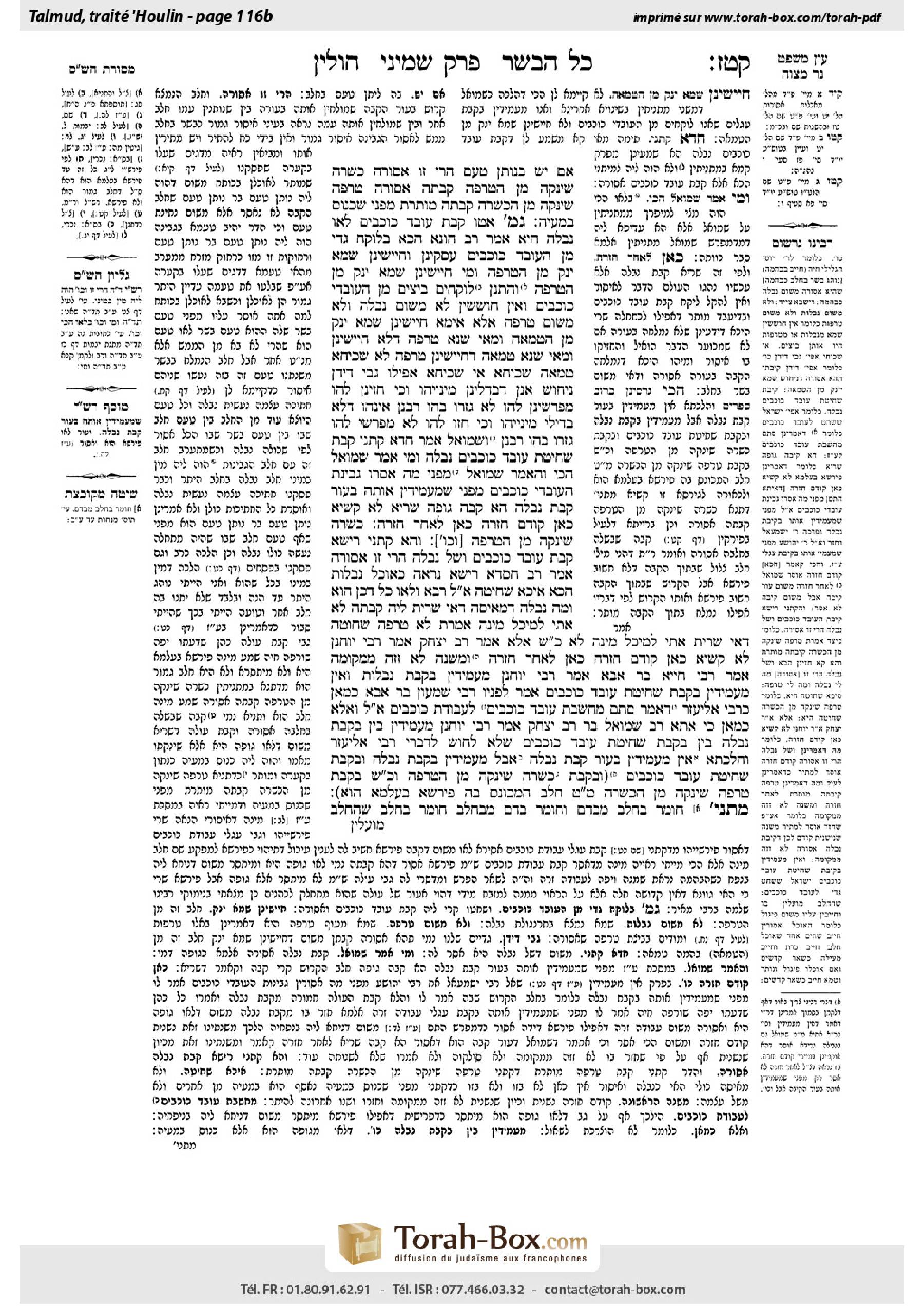
Chullin 116b: Talmud study for Daf Yomi
Study the Talmud for Daf Yomi with scanned pages, Hebrew text, English translations from Sefaria and AI-generated French translations.
Passage selection and English or AI-generated French translation are available where the scan has annotations. Daf Study is independent of Torah-Box and Sefaria.
Browse Chullin · חולין · All tractatesChullin 116b text and translations
This page of Chullin includes the Aramaic text, an English translation and an AI-generated French translation, alongside the scan above.
חולין קי״ו ב · Aramaic and Hebrew text
אִם יֵשׁ בְּנוֹתֵן טַעַם – הֲרֵי זוֹ אֲסוּרָה. כְּשֵׁרָה שֶׁיָּנְקָה מִן הַטְּרֵפָה – קֵבָתָהּ אֲסוּרָה. טְרֵפָה שֶׁיָּנְקָה מִן הַכְּשֵׁרָה – קֵבָתָהּ מוּתֶּרֶת, מִפְּנֵי שֶׁכָּנוּס בְּמֵעֶיהָ.
גְּמָ׳ אַטּוּ קֵבַת גּוֹי לָאו נְבֵלָה הִיא? אָמַר רַב הוּנָא: הָכָא בְּלוֹקֵחַ גְּדִי מִן הַגּוֹי עָסְקִינַן, וְחָיְישִׁינַן שֶׁמָּא יָנַק מִן הַטְּרֵפָה.
וּמִי חָיְישִׁינַן שֶׁמָּא יָנַק מִן הַטְּרֵפָה? וְהָתְנַן: לוֹקְחִים בֵּיצִים מִן הַגּוֹיִם, וְאֵין חוֹשְׁשִׁין לֹא מִשּׁוּם נְבֵלָה וְלֹא מִשּׁוּם טְרֵפָה! אֶלָּא אֵימָא: חָיְישִׁינַן שֶׁמָּא יָנַק מִן הַטְּמֵאָה.
וּמַאי שְׁנָא טְרֵפָה דְּלָא חָיְישִׁינַן, וּמַאי שְׁנָא טְמֵאָה דְּחָיְישִׁינַן? טְרֵפָה לָא שְׁכִיחָא, טְמֵאָה שְׁכִיחָא.
אִי שְׁכִיחָא, אֲפִילּוּ גַּבֵּי דִּידַן נֵיחוּשׁ! אֲנַן דְּבָדְלִינַן מִינַּיְיהוּ, וְכִי חָזֵינַן לְהוּ מַפְרְשִׁינַן לְהוּ – לָא גְּזַרוּ בְּהוּ רַבָּנַן. אִינְהוּ דְּלָא בְּדִילִי מִינַּיְיהוּ, וְכִי חָזוּ לְהוּ לָא מַפְרְשִׁי לְהוּ – גְּזַרוּ בְּהוּ רַבָּנַן.
וּשְׁמוּאֵל אָמַר: חֲדָא קָתָנֵי, קֵבַת שְׁחִיטַת גּוֹי – נְבֵלָה.
וּמִי אָמַר שְׁמוּאֵל הָכִי? וְהָאָמַר שְׁמוּאֵל: מִפְּנֵי מָה אָסְרוּ גְּבִינַת הַגּוֹיִם – מִפְּנֵי שֶׁמַּעֲמִידִין אוֹתָהּ בְּעוֹר קֵבַת נְבֵלָה. הָא קֵבָה גּוּפַהּ שַׁרְיָא!
לָא קַשְׁיָא: כָּאן – קוֹדֶם חֲזָרָה, כָּאן – לְאַחַר חֲזָרָה.
כְּשֵׁרָה שֶׁיָּנְקָה מִן הַטְּרֵפָה [וְכוּ׳]. וְהָא קָתָנֵי רֵישָׁא: קֵבַת גּוֹי וְשֶׁל נְבֵלָה הֲרֵי זוֹ אֲסוּרָה?
אָמַר רַב חִסְדָּא: רֵישָׁא נִרְאֶה כְּאוֹכֵל נְבֵלוֹת, הָכָא אִיכָּא שְׁחִיטָה.
אֲמַר לֵיהּ רָבָא: וְלָאו כֹּל דְּכֵן הוּא? וּמָה נְבֵלָה דִּמְאִיסָה, דְּאִי שָׁרֵית לֵיהּ קֵבָתָהּ לָא אָתֵי לְמֵיכַל מִינַּהּ, אָמְרַתְּ לָא. טְרֵפָה שְׁחוּטָה, דְּאִי שָׁרֵית אָתֵי לְמֵיכַל מִינַּהּ, לֹא כׇּל שֶׁכֵּן?
אֶלָּא אָמַר רַב יִצְחָק, אָמַר רַבִּי יוֹחָנָן: לָא קַשְׁיָא, כָּאן קוֹדֶם חֲזָרָה, כָּאן לְאַחַר חֲזָרָה, וּמִשְׁנָה לֹא זָזָה מִמְּקוֹמָהּ.
אָמַר רַבִּי חִיָּיא בַּר אַבָּא, אָמַר רַבִּי יוֹחָנָן: מַעֲמִידִין בְּקֵבַת נְבֵלוֹת, וְאֵין מַעֲמִידִין בְּקֵבַת שְׁחִיטַת גּוֹי. אָמַר לְפָנָיו רַבִּי שִׁמְעוֹן בַּר אַבָּא: כְּמַאן? כְּרַבִּי אֱלִיעֶזֶר, דְּאָמַר סְתָם מַחְשֶׁבֶת גּוֹי לַעֲבוֹדָה זָרָה.
אֲמַר לֵיהּ: וְאֶלָּא כְּמַאן?
כִּי אֲתָא רַב שְׁמוּאֵל בַּר רַב יִצְחָק, אָמַר רַבִּי יוֹחָנָן: מַעֲמִידִין בֵּין בְּקֵבַת נְבֵלָה, בֵּין בְּקֵבַת שְׁחִיטַת גּוֹי, שֶׁלֹּא לָחוֹשׁ לְדִבְרֵי רַבִּי אֱלִיעֶזֶר.
וְהִלְכְתָא: אֵין מַעֲמִידִין בָּעוֹר קֵבַת נְבֵלָה, אֲבָל מַעֲמִידִין בְּקֵבַת נְבֵלָה, וּבְקֵבַת שְׁחִיטַת גּוֹי, וּבְקֵבַת כְּשֵׁרָה שֶׁיָּנְקָה מִן הַטְּרֵפָה, וְכׇל שֶׁכֵּן בְּקֵבַת טְרֵפָה שֶׁיָּנְקָה מִן הַכְּשֵׁרָה. מַאי טַעְמָא? חָלָב הַמְכוּנָּס בָּהּ פִּירְשָׁא בְּעָלְמָא הוּא.
מַתְנִי׳ חוֹמֶר בַּחֵלֶב מִבַּדָּם, וְחוֹמֶר בַּדָּם מִבַּחֵלֶב. חוֹמֶר בַּחֵלֶב – שֶׁהַחֵלֶב
Chullin 116b · English translation
if the measure of the skin is enough to impart flavor to the milk, that cheese is prohibited. In the case of a kosher animal that suckled milk from a tereifa, the milk in its stomach is prohibited, as the milk is from the tereifa. If it was a tereifa that suckled milk from a kosher animal, the milk in its stomach is permitted, as the milk is from the kosher animal. In both cases, the milk that an animal suckles has the status of the animal from which it was suckled, and not that of the animal which suckled, because the milk is collected in its innards and is not an integral part of its body.
GEMARA: The mishna makes reference to the stomach of the animal of a gentile and that of an unslaughtered carcass. The Gemara asks: Is that to say that the stomach of an animal slaughtered by a gentile is not itself a carcass? Why does the tanna of the mishna differentiate between them? Rav Huna said: The mishna here is not referring to an animal slaughtered by a gentile. Rather, we are dealing with a Jew who purchases a kid from a gentile and slaughters it himself. Therefore, the kid is not prohibited as a carcass, but we are concerned that perhaps it suckled from a tereifa animal, and it is therefore prohibited.
The Gemara asks: And are we concerned that perhaps it suckled from an animal that is a tereifa? But didn’t we learn in a baraita (Tosefta 3:8): One may purchase eggs from gentiles, and we are not concerned that perhaps the eggs came from a carcass nor that they came from a tereifa. The Gemara answers: Indeed, there is no concern that the kid might have suckled from a tereifa. Rather, say that we are concerned that perhaps it suckled from a non-kosher animal, and therefore the milk in its stomach is prohibited.
The Gemara asks: And what is different about a tereifa that we are not concerned that perhaps the animal suckled from it, and what is different about a non-kosher animal that we are concerned? The Gemara answers: A tereifa animal is not common, whereas a non-kosher animal is common, and it is therefore more likely that the young animal suckled from one.
The Gemara raises a difficulty: If suckling from a non-kosher animal is common, then let us be concerned even with regard to our own animals. The Gemara responds: We Jews, who separate ourselves from non-kosher animals, when we see them we immediately distance our suckling animals from them. Therefore, the Sages did not issue a decree with regard to animals purchased from Jews. But as for the gentiles, who do not separate themselves from non-kosher animals, when they see them they do not distance their kosher animals from them. Consequently, the Sages issued a decree with regard to animals purchased from a gentile.
And Shmuel said a different explanation of the mishna’s language: The tanna of the mishna is teaching only one halakha: The congealed milk in the stomach of an animal slaughtered by a gentile is like a carcass, and it is therefore prohibited.
The Gemara asks: And did Shmuel actually say this? Does he hold that the milk in the stomach of an unslaughtered animal is prohibited as if it were part of its body? But didn’t Shmuel say: For what reason did the Sages prohibit the cheese of gentiles? It is because they curdle it with the skin of the stomach of a carcass. One may infer consequently that congealed milk, or rennet, from the stomach of a gentile’s animal is itself permitted and would not render the cheese prohibited if used as a coagulant.
The Gemara answers: That is not difficult. Elsewhere (Avoda Zara 29b), Rabbi Yehoshua teaches two reasons for the prohibition on gentile cheese. Initially, he held it to be prohibited because it is curdled using rennet from the stomach of an animal carcass. He later adopted the opinion that such rennet is permitted, and that the cheese is prohibited because it is curdled using rennet from the stomach of calves used for idol worship, which is prohibited. Therefore, the mishna here, which states that the rennet in a carcass’s stomach is itself prohibited, was taught before Rabbi Yehoshua’s retraction, while Shmuel’s statement there, that the Sages prohibited gentile cheese only because it is curdled with the skin of the stomach of a carcass, was after Rabbi Yehoshua’s retraction.
§ The mishna teaches: In the case of a kosher animal that suckled milk from a tereifa, the milk in its stomach is prohibited, whereas if a tereifa suckled milk from a kosher animal, the milk in its stomach is permitted. The Gemara raises a difficulty: But doesn’t the first clause of the mishna teach: The congealed milk in the stomach of the animal of a gentile and of a carcass is prohibited? What is the difference between the milk found in the stomach of a tereifa in the second clause and the milk found in the stomach of an unslaughtered carcass in the first clause?
Rav Ḥisda said: In fact, milk found in the stomach of a carcass is not itself prohibited. The first clause of the mishna prohibits it only because one who partakes of it looks like one who eats carcasses, which is repulsive. By contrast, here, with regard to a tereifa, the consumption of milk found in its stomach is less repulsive, as here there is at least slaughter of the animal.
Rava said to Rav Ḥisda: But is it not possible to claim a fortiori that milk found in the stomach of a tereifa should be prohibited? Just as with regard to a carcass, which is so repulsive that even if you permit the milk in its stomach people will not come to partake of the meat, you nevertheless said the milk is not permitted for consumption, is it not all the more so with regard to a tereifa that has been slaughtered, which is not as repulsive, such that if you permit the milk in its stomach people might come to partake of it?
Rather, Rav Yitzḥak said that Rabbi Yoḥanan says: This question is not difficult. The first clause of the mishna here, which teaches that the milk in the stomach of a carcass is prohibited, was taught before Rabbi Yehoshua’s retraction cited above, whereas the latter clause there, that milk from the stomach of a tereifa is permitted, was taught after Rabbi Yehoshua’s retraction. A mishna can sometimes preserve an older ruling and then immediately teach a contradictory later ruling, because a mishna does not move from its place. Since the first clause of the mishna was already canonized, it was not removed, despite Rabbi Yehoshua’s change of opinion.
§ Rabbi Ḥiyya bar Abba says that Rabbi Yoḥanan says: One may curdle milk with rennet extracted from the stomach of carcasses, but one may not curdle milk with rennet from the stomach of animals slaughtered by a gentile. Rabbi Shimon bar Abba said before Rabbi Ḥiyya bar Abba: In accordance with whose opinion is this ruling? It is in accordance with the opinion of Rabbi Eliezer, who said: A gentile’s presumed intention during slaughter is for idol worship. Therefore, the prohibition against deriving benefit from an animal slaughtered in idol worship applies to it, and this prohibition includes the contents of its stomach that are not actually part of its body. By contrast, a carcass is prohibited only for consumption, and the prohibition does not extend to the contents of its stomach.
Rabbi Ḥiyya bar Abba said to Rabbi Shimon bar Abba: Rather, in accordance with whose opinion could this ruling be? Of course it is the opinion of Rabbi Eliezer.
The Gemara relates: When Rav Shmuel bar Rav Yitzḥak came from Eretz Yisrael to Babylonia, he said that Rabbi Yoḥanan said: One may curdle milk both with rennet from the stomach of a carcass and with rennet from the stomach of an animal slaughtered by a gentile, as there is no need to be concerned for the statement of Rabbi Eliezer. According to this account, Rabbi Yoḥanan does not maintain that a gentile’s presumed intention is for idol worship.
The Gemara concludes: And the halakha is: One may not curdle milk with the skin of the stomach of a carcass, but one may curdle milk with rennet from the stomach of a carcass and with rennet from the stomach of an animal slaughtered by a gentile, and with rennet from the stomach of a kosher animal that suckled from a tereifa, and all the more so with rennet from the stomach of a tereifa animal that suckled from a kosher animal. What is the reason for these lenient rulings? The milk collected in a stomach is merely secretion and is not considered food that can be prohibited.
MISHNA: Although animal fats and blood are similar in that they are both prohibited by Torah law and punishable by karet, there are elements more stringent in the prohibition of fat than in that of blood, and likewise there are elements more stringent in the prohibition of blood than in that of fat. The elements more stringent in the prohibition of fat are the following: The first is that with regard to fat of an offering,
Chullin 116b · Traduction française (IA)
Si la mesure de la peau est suffisante pour imprimer un goût au lait, ce fromage est interdit. Dans le cas d'un animal kasher qui a sucré du lait d'un tereifa, le lait dans son estomac est interdit, car le lait provient du tereifa. Si c'était un tereifa qui a sucré du lait d'un animal kasher, le lait dans son estomac est permis, car le lait provient de l'animal kasher. Dans les deux cas, le lait que l'animal sucre a le statut de l'animal d'où il a sucré, et non celui de l'animal qui a sucré, car le lait est collecté dans ses entrailles et n'est pas une partie intégrante de son corps.
GUEMARA : La mitsna fait référence à l'estomac de l'animal d'un non-Juif et à celui d'un cadavre non immolé. La Guemara demande : Est-ce que cela signifie que l'estomac d'un animal immolé par un non-Juif n'est pas lui-même un cadavre ? Pourquoi le tanna de la mitsna fait-il la distinction entre eux ? Rav Huna dit : La mitsna ici ne fait pas référence à un animal immolé par un non-Juif. Plutôt, nous parlons d'un Juif qui achète un petit agneau d'un non-Juif et l'immole lui-même. Ainsi, l'agneau n'est pas interdit comme un cadavre, mais nous nous inquiétons du fait qu'il ait sucré d'un animal tereifa, et il est donc interdit.
La Guemara demande : Et sommes-nous inquiets du fait qu'il ait sucré d'un animal qui est un tereifa ? Mais n'avons-nous pas appris dans une baraïta (Tosefta 3:8) : On peut acheter des œufs des non-Juifs, et nous ne nous inquiétons pas du fait qu'ils proviennent d'un cadavre ou d'un tereifa. La Guemara répond : En effet, il n'y a pas d'inquiétude que l'agneau ait sucré d'un tereifa. Plutôt, disons que nous nous inquiétons du fait qu'il ait sucré d'un animal non-kasher, et donc le lait dans son estomac est interdit.
La Guemara demande : Et qu'est-ce qui diffère dans un animal tereifa pour que nous ne soyons pas inquiets du fait qu'il ait été allaité par lui, et qu'est-ce qui diffère dans un animal non-kasher pour que nous soyons inquiets ? La Guemara répond : Un animal tereifa n'est pas commun, tandis qu'un animal non-kasher est commun, et c'est donc plus probable que l'animal jeune ait été allaité par un tel.
La Guemara soulève une difficulté : Si l'allaitement par un animal non-kasher est courant, alors soyons-nous inquiets même concernant nos propres animaux. La Guemara répond : Nous Juifs, qui nous séparons des animaux non-kashers, quand nous les voyons, nous éloignons immédiatement nos animaux allaités d'eux. Ainsi, les Sages n'ont pas émis un décret concernant les animaux achetés des Juifs. Mais concernant les non-Juifs, qui ne se séparent pas des animaux non-kashers, quand ils les voient, ils ne s'éloignent pas leurs animaux kashers d'eux. Par conséquent, les Sages ont émis un décret concernant les animaux achetés d'un non-Juif.
Et Shmuel a dit une autre explication du langage de la Michna : Le tanna de la Michna enseigne seulement une halakha : Le lait congelé dans l'estomac d'un animal immolé par un non-Juif est comme un cadavre, et il est donc interdit.
La Guemara demande : Et Shmuel a-t-il vraiment dit cela ? Tient-il que le lait dans l'estomac d'un animal non immolé est interdit comme s'il faisait partie de son corps ? Mais n'avait-il pas dit : Pourquoi les Sages interdisent-ils le fromage des non-Juifs ? C'est parce qu'ils le coagulent avec la peau de l'estomac d'un cadavre. On peut en déduire que le lait congelé, ou la chymotique, de l'estomac d'un animal d'un non-Juif est lui-même permis et ne rendrait pas le fromage interdit s'il était utilisé comme coagulant.
La Guemara répond : Ce n'est pas difficile. Ailleurs (Avoda Zara 29b), Rabbi Yehoshua enseigne deux raisons de l'interdiction du fromage des non-Juifs. Initialement, il le tenait pour interdit parce qu'il est coagulé avec de la chymotique provenant de l'estomac d'un cadavre. Il a ensuite adopté l'opinion que cette chymotique est permise, et que le fromage est interdit parce qu'il est coagulé avec de la chymotique provenant de l'estomac de veaux utilisés pour l'idolâtrie, qui est interdit. Ainsi, la mitsva ici, qui stipule que la chymotique de l'estomac d'un cadavre est elle-même interdite, a été enseignée avant la rétractation de Rabbi Yehoshua, tandis que l'affirmation de Shmuel là-bas, que les Sages interdisent le fromage des non-Juifs uniquement parce qu'il est coagulé avec la peau de l'estomac d'un cadavre, a été après la rétractation de Rabbi Yehoshua.
§ La mitsva enseigne : Dans le cas d'un animal kasher qui a sucré du lait d'un tereifa, le lait dans son estomac est interdit, tandis que si un tereifa a sucré du lait d'un animal kasher, le lait dans son estomac est permis. La Guemara soulève une difficulté : Mais ne dit pas la première clause de la mitsva : Le lait congelé dans l'estomac de l'animal d'un non-Juif et du cadavre est interdit ? Quelle est la différence entre le lait trouvé dans l'estomac d'un tereifa dans la deuxième clause et le lait trouvé dans l'estomac d'un cadavre non immolé dans la première clause ?
Rav Ḥisda dit : En réalité, le lait trouvé dans l'estomac d'un cadavre n'est pas lui-même interdit. La première clause de la mitsna l'interdit uniquement parce que celui qui en consomme ressemble à celui qui mange des cadavres, ce qui est répugnant. En revanche, ici, concernant un tereifa, la consommation du lait trouvé dans son estomac est moins répugnante, car il y a au moins l'immolation de l'animal.
Rava dit à Rav Ḥisda : Mais n'est-il pas possible de dire que le lait trouvé dans l'estomac d'un tereifa devrait être interdit ? Comme avec un cadavre, qui est si répugnant que même si vous permettez le lait dans son estomac, les gens ne viendront pas manger la viande, vous dites que le lait n'est pas permis à la consommation, n'est-ce pas encore plus vrai avec un tereifa qui a été immolé, qui n'est pas aussi répugnant, tel que si vous permettez le lait dans son estomac, les gens pourraient venir le manger ?
En réalité, Rav Yitzḥak a dit que Rabbi Yoḥanan dit : Cette question n’est pas difficile. La première clause de la mitsna ici, qui enseigne que le lait dans l’estomac d’un cadavre est interdit, a été enseignée avant la rétractation de Rabbi Yehoshua citée ci-dessus, tandis que la seconde clause là, que le lait provenant de l’estomac d’un tereifa est permis, a été enseignée après la rétractation de Rabbi Yehoshua. Une mitsna peut parfois conserver une décision plus ancienne et enseigner immédiatement une décision contradictoire plus récente, car une mitsna ne change pas de place. Puisque la première clause de la mitsna avait déjà été canonisée, elle n’a pas été retirée, malgré le changement d’avis de Rabbi Yehoshua.
§ Rabbi Ḥiyya bar Abba dit que Rabbi Yoḥanan dit : On peut coaguler le lait avec du chélate extrait de l’estomac de cadavres, mais on ne peut pas coaguler le lait avec du chélate provenant de l’estomac d’un animal tué par un non-juif. Rabbi Shimon bar Abba a dit devant Rabbi Ḥiyya bar Abba : Selon quel avis est-ce que cette décision est prise ? Selon l’avis de Rabbi Eliezer, qui a dit : L’intention supposée du non-juif lors de la mise à mort est pour l’idolâtrie. Par conséquent, l’interdiction de tirer profit d’un animal tué en idolâtrie s’applique à lui, et cette interdiction inclut les contenus de son estomac qui ne sont pas réellement partie de son corps. À l’inverse, un cadavre est interdit uniquement à la consommation, et l’interdiction ne s’étend pas aux contenus de son estomac.
Rabbi Ḥiyya bar Abba a dit à Rabbi Shimon bar Abba : En réalité, selon quel avis pourrait cette décision être ? Bien sûr, selon l’avis de Rabbi Eliezer.
La Guemara rapporte : Lorsque Rav Shmuel bar Rav Yitzḥak est venu d’Eretz Yisrael vers Babylone, il a dit que Rabbi Yoḥanan a dit : On peut coaguler le lait à la fois avec du chélate provenant de l’estomac d’un cadavre et avec du chélate provenant de l’estomac d’un animal tué par un non-juif, car il n’y a pas besoin de s’inquiéter de l’affirmation de Rabbi Eliezer. Selon ce récit, Rabbi Yoḥanan ne maintient pas que l’intention supposée du non-juif est pour l’idolâtrie.
La Guemara conclut : Et la halakha est : On ne peut pas coaguler le lait avec la peau de l’estomac d’un cadavre, mais on peut coaguler le lait avec du chélate provenant de l’estomac d’un cadavre et avec du chélate provenant de l’estomac d’un animal tué par un non-juif, et avec du chélate provenant de l’estomac d’un animal kasher qui a tétonné d’un tereifa, et encore davantage avec du chélate provenant de l’estomac d’un tereifa qui a tétonné d’un animal kasher. Quelle est la raison de ces décisions lenitives ? Le lait collecté dans l’estomac est simplement une sécrétion et n’est pas considéré comme un aliment qui peut être interdit.
MICHNA : Bien que les graisses et le sang des animaux soient semblables dans le fait qu’ils sont tous deux interdits par la Torah et punis par karet, il y a des éléments plus stricts dans l’interdiction de la graisse par rapport à celle du sang, et de même, il y a des éléments plus stricts dans l’interdiction du sang par rapport à celle de la graisse. Les éléments plus stricts dans l’interdiction de la graisse sont les suivants : Le premier est que concernant la graisse d’un holocauste,
Traduction française générée par IA à partir de l’édition anglaise de Sefaria. Vérifie toujours un passage avec le texte source.
Text from Sefaria: William Davidson Edition - Vocalized Aramaic (unknown); William Davidson Edition - English (CC BY NC).