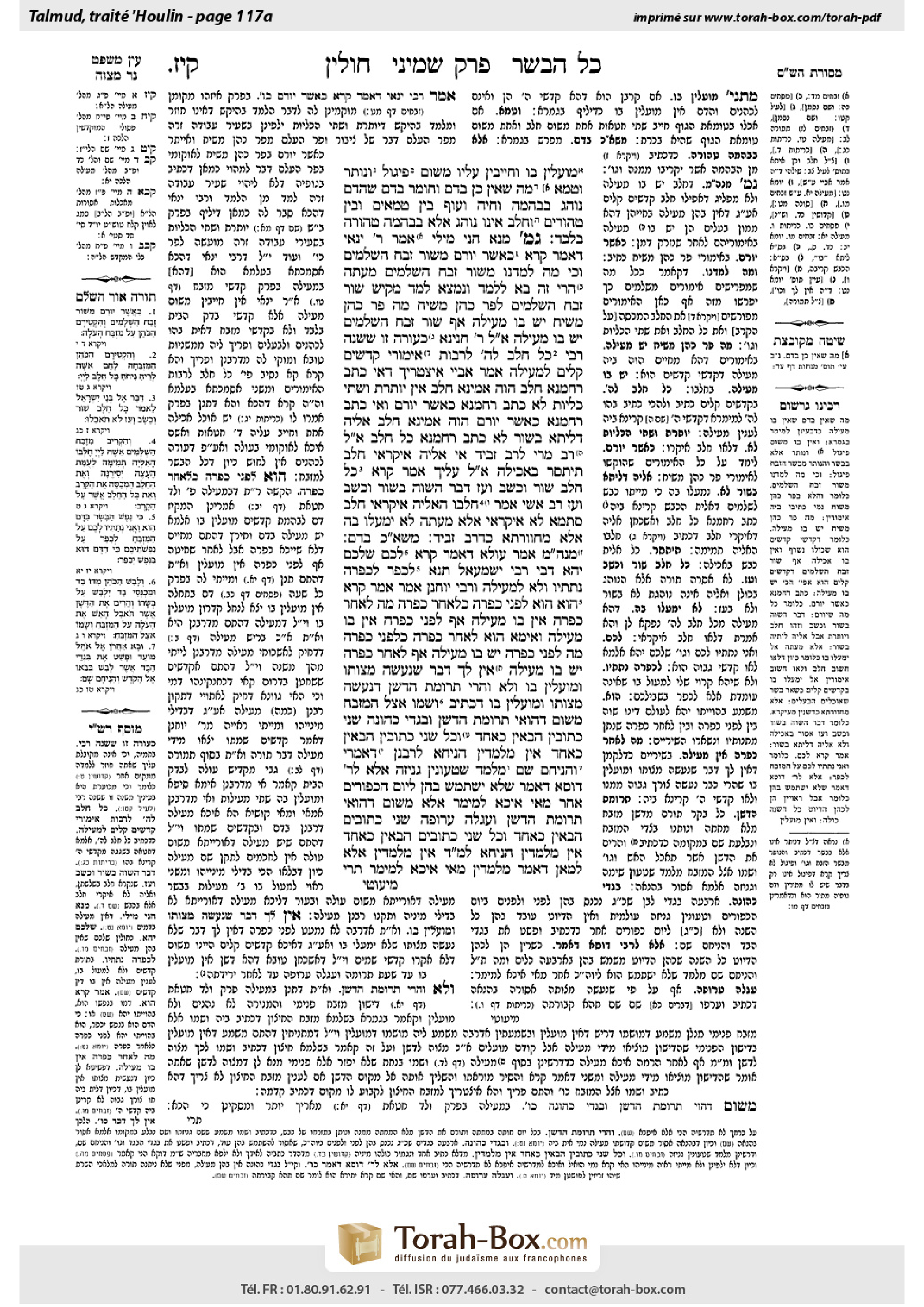
Chullin 117a: Talmud study for Daf Yomi
Study the Talmud for Daf Yomi with scanned pages, Hebrew text, English translations from Sefaria and AI-generated French translations.
Passage selection and English or AI-generated French translation are available where the scan has annotations. Daf Study is independent of Torah-Box and Sefaria.
Browse Chullin · חולין · All tractatesChullin 117a text and translations
This page of Chullin includes the Aramaic text, an English translation and an AI-generated French translation, alongside the scan above.
חולין קי״ז א · Aramaic and Hebrew text
מוֹעֲלִין בּוֹ, וְחַיָּיבִין עָלָיו מִשּׁוּם פִּיגּוּל וְנוֹתָר וְטָמֵא, מַה שֶּׁאֵין כֵּן בַּדָּם.
וְחוֹמֶר בַּדָּם, שֶׁהַדָּם נוֹהֵג בִּבְהֵמָה וְחַיָּה וָעוֹף, בֵּין טְמֵאִים וּבֵין טְהוֹרִים, וְחֵלֶב אֵינוֹ נוֹהֵג אֶלָּא בִּבְהֵמָה טְהוֹרָה בִּלְבַד.
גְּמָ׳ מְנָא הָנֵי מִילֵּי? אָמַר רַבִּי יַנַּאי: דְּאָמַר קְרָא ״כַּאֲשֶׁר יוּרַם מִשּׁוֹר זֶבַח הַשְּׁלָמִים״, וְכִי מָה לָמַדְנוּ מִשּׁוֹר זֶבַח הַשְּׁלָמִים מֵעַתָּה?
הֲרֵי זֶה בָּא לְלַמֵּד, וְנִמְצָא לָמֵד, מַקִּישׁ שׁוֹר זֶבַח הַשְּׁלָמִים לְפַר כֹּהֵן מָשִׁיחַ: מָה פַּר כֹּהֵן מָשִׁיחַ יֵשׁ בּוֹ מְעִילָה, אַף שׁוֹר זֶבַח הַשְּׁלָמִים יֵשׁ בּוֹ מְעִילָה.
אֲמַר לֵיהּ רַבִּי חֲנִינָא: כְּעוּרָה זוֹ שֶׁשָּׁנָה רַבִּי, ״כׇּל חֵלֶב לַה׳״ – לְרַבּוֹת אֵימוּרֵי קָדָשִׁים קַלִּים לִמְעִילָה?
אָמַר אַבָּיֵי: אִיצְטְרִיךְ, דְּאִי כְּתַב רַחֲמָנָא ״חֵלֶב״, הֲוָה אָמֵינָא: חֵלֶב – אִין, יוֹתֶרֶת וּשְׁתֵּי כְלָיוֹת – לָא. כְּתַב רַחֲמָנָא ״כַּאֲשֶׁר יוּרַם״.
וְאִי כְּתַב רַחֲמָנָא ״כַּאֲשֶׁר יוּרַם״, הֲוָה אָמֵינָא: חֵלֶב אַלְיָה דְּלֵיתַהּ בְּשׁוֹר – לָא, כְּתַב רַחֲמָנָא ״כׇּל חֵלֶב״.
אֲמַר לֵיהּ רַב מָרִי לְרַב זְבִיד: אִי אַלְיָה אִיקְּרַאי ״חֵלֶב״, תִּיתְּסַר בַּאֲכִילָה! אֲמַר לֵיהּ: עָלֶיךָ אָמַר קְרָא ״כׇּל חֵלֶב שׁוֹר וְכֶשֶׂב וָעֵז״ – דָּבָר הַשָּׁוֶה בְּשׁוֹר וְכֶשֶׂב וָעֵז.
רַב אָשֵׁי אָמַר: ״חֶלְבּוֹ הָאַלְיָה״ אִיקְּרַאי, ״חֵלֶב״ סְתָמָא לָא אִיקְּרַאי. אֶלָּא מֵעַתָּה, לֹא יִמְעֲלוּ בָּהּ! אֶלָּא מְחַוַּורְתָּא כִּדְרַב זְבִיד.
מַה שֶּׁאֵין כֵּן בַּדָּם, מְנָא הָנֵי מִילֵּי? אָמַר עוּלָּא: דְּאָמַר קְרָא ״לָכֶם״, שֶׁלָּכֶם יְהֵא. דְּבֵי רַבִּי יִשְׁמָעֵאל תָּנָא: ״לְכַפֵּר״ – לְכַפָּרָה נְתַתִּיו, וְלֹא לִמְעִילָה.
וְרַבִּי יוֹחָנָן אָמַר, אָמַר קְרָא: ״הוּא״, הוּא לִפְנֵי כַּפָּרָה כִּלְאַחַר כַּפָּרָה, מָה לְאַחַר כַּפָּרָה אֵין בּוֹ מְעִילָה, אַף לִפְנֵי כַּפָּרָה אֵין בּוֹ מְעִילָה.
וְאֵימָא הוּא לְאַחַר כַּפָּרָה כְּלִפְנֵי כַּפָּרָה: מָה לִפְנֵי כַּפָּרָה – יֵשׁ בּוֹ מְעִילָה, אַף לְאַחַר כַּפָּרָה – יֵשׁ בּוֹ מְעִילָה! אֵין לְךָ דָּבָר שֶׁנַּעֲשָׂה מִצְוָתוֹ וּמוֹעֲלִין בּוֹ.
וְלָא? וַהֲרֵי תְּרוּמַת הַדֶּשֶׁן, דְּנַעֲשָׂה מִצְוָתוֹ, וּמוֹעֲלִין בּוֹ, דִּכְתִיב: ״וְשָׂמוֹ אֵצֶל הַמִּזְבֵּחַ״!
מִשּׁוּם דְּהָוֵאי תְּרוּמַת הַדֶּשֶׁן וּבִגְדֵי כְהוּנָּה (שְׁנֵי כְּתוּבִין הַבָּאִין כְּאֶחָד), וְכׇל שְׁנֵי כְּתוּבִין הַבָּאִין כְּאֶחָד אֵין מְלַמְּדִין.
הָנִיחָא לְרַבָּנַן דְּאָמְרִי: ״וְהִנִּיחָם שָׁם״ – מְלַמֵּד שֶׁטְּעוּנִין גְּנִיזָה, אֶלָּא לְרַבִּי דּוֹסָא דְּאָמַר שֶׁלֹּא יִשְׁתַּמֵּשׁ בָּהֶן לְיוֹם הַכִּפּוּרִים אַחֵר, מַאי אִיכָּא לְמֵימַר?
אֶלָּא, מִשּׁוּם דְּהָוֵאי תְּרוּמַת הַדֶּשֶׁן וְעֶגְלָה עֲרוּפָה שְׁנֵי כְתוּבִים הַבָּאִין כְּאֶחָד, וְכׇל שְׁנֵי כְּתוּבִים הַבָּאִין כְּאֶחָד אֵין מְלַמְּדִין.
הָנִיחָא לְמַאן דְּאָמַר אֵין מְלַמְּדִין, אֶלָּא לְמַאן דְּאָמַר מְלַמְּדִין, מַאי אִיכָּא לְמֵימַר? תְּרֵי
Chullin 117a · English translation
one who derives benefit from it is liable for misuse of consecrated property. And second, one is liable for eating it due to violation of the prohibition of piggul, if it was from an offering that was slaughtered with the intent to sprinkle its blood or partake of it beyond its designated time, and due to the prohibition of notar, if it was from an offering whose period for consumption has expired. And third, if one is ritually impure, he is liable due to the prohibition of partaking of it while impure. This is not so with regard to blood, as one is not liable in these cases for violating the prohibitions of piggul, notar, and partaking of offerings while impure, but rather is liable only for violating the prohibition of consuming blood.
And the more stringent element in the prohibition of blood is that the prohibition of blood applies to domesticated animals, undomesticated animals, and birds, both kosher and non-kosher, but the prohibition of forbidden fat applies only to a kosher domesticated animal.
GEMARA: According to the mishna, one who consumes forbidden fat of an offering is liable for misuse of consecrated property. The Gemara asks: From where are these matters derived? Rabbi Yannai said: They are derived from a verse, as the verse states that the sacrificial portions of a bull brought for an unwitting sin of the anointed priest must be burned upon the altar: “As it is taken off from the bull of the peace offering” (Leviticus 4:10). But what, then, do we learn from the bull of the peace offering? Everything that is specified with regard to a peace offering is stated with regard to this bull as well (see Leviticus 4:8–9).
Rather, this phrase initially comes to teach a halakha about the bull brought as an offering for an unwitting sin of the anointed priest, but it turns out that it actually derives a halakha from that case, as the verse juxtaposes the bull of the peace offering to the bull of the anointed priest. It teaches that just as the bull of the anointed priest, as an offering of the most sacred order, is subject to the prohibition on misuse of consecrated property, as offerings of the most sacred order are called “the sacred items of the Lord” (see Leviticus 5:15), so too the sacrificial portions of the bull of the peace offering, including its forbidden fat, are subject to misuse of consecrated property, even though it is an offering of lesser sanctity and is considered the property of the owner before slaughter.
Rabbi Ḥanina said to Rabbi Yannai: Is that derivation that Rabbi Yehuda HaNasi taught unattractive, that you derive a new one? He taught that when the Torah states with regard to peace offerings, which are of lesser sanctity: “All the fat is the Lord’s” (Leviticus 3:16), it serves to include the sacrificial portions of offerings of lesser sanctity in the prohibition against misuse of consecrated property, even though the prohibition is stated explicitly only with regard to offerings of the most sacred order.
Abaye said: Rabbi Yannai’s derivation was necessary, as, if the Merciful One had written only the verse “All the fat is the Lord’s,” I would say that the fat of offerings of lesser sanctity, yes, they are included in the prohibition, but the diaphragm and the two kidneys of such offerings are not, even though they are also burned upon the altar. Therefore, the Merciful One writes: “As it is taken off from the bull of the peace offering,” to teach that even these portions are subject to the prohibition of misuse.
And conversely, if the Merciful One had written only the phrase: “As it is taken off from the bull,” I would say that the prohibition applies only to those portions that are found in a bull, and that the fat of a sheep tail, which is not found in a bull, is not included. Therefore, the Merciful One writes: “All the fat is the Lord’s,” to teach that the prohibition of misuse applies to all portions of offerings of lesser sanctity, including a sheep tail, which is referred to as fat in Leviticus 3:9.
Rav Mari said to Rav Zevid: If a sheep tail is called “fat,” it should be prohibited for consumption, like forbidden fat. Rav Zevid said to Rav Mari: With regard to your claim, the verse states: “You shall eat no fat, of ox, or sheep, or goat” (Leviticus 7:23). This teaches that the Torah designates as forbidden fat only an item that is found equally in an ox, and a sheep, and a goat. Since the ox and goat do not have a tail that consists of a large amount of fat, the sheep’s fatty tail is not prohibited.
Rav Ashi said a different explanation: It is called “the fat tail,” but it is not called simply: Fat, without specification. The Gemara objects: If that is so that the addition of a modifier indicates that the tail is not truly fat, then one who derives benefit from the tail should not be liable for misuse of consecrated property either. Rather, it is clear that the correct answer is as stated by Rav Zevid.
§ The mishna teaches: This is not so with regard to blood, as one who derives benefit from blood is not liable for misuse of consecrated property. The Gemara asks: From where are these matters derived? Ulla said: The verse states with regard to blood: “For the life of the flesh is in the blood, and I have given it to you upon the altar to make atonement for your souls” (Leviticus 17:11). The term “to you” indicates that it shall be yours, rather than consecrated property, and is therefore not subject to the prohibition of misuse of consecrated property. The school of Rabbi Yishmael taught a different derivation. By using the term “to make atonement,” the verse teaches that God is saying: I gave it to achieve atonement, but not to be subject to the prohibition against misuse of consecrated property.
And Rabbi Yoḥanan says that this halakha is derived from the latter part of the verse, which states: “For it is the blood that makes atonement for the soul” (Leviticus 17:11). The term “it is” teaches that the status of the blood remains as it is, i.e., it is before atonement as it is after atonement. As the Gemara will state, there is a principle that once the mitzva involving a consecrated item has been performed, the item is no longer subject to the prohibition of misuse of consecrated property. Accordingly, the term “it is” teaches that just as after atonement, i.e., after the blood has been sprinkled upon the altar, it is not subject to the prohibition against misuse of consecrated property, as the mitzva has already been performed, so too, before atonement, i.e., before the blood has been sprinkled upon the altar, it is not subject to the prohibition against misuse of consecrated property.
The Gemara objects: But if the term “it is” teaches that the status of the blood remains the same before and after atonement, one can say just the opposite: It is after atonement as it is before atonement. Just as before atonement the blood is subject to the prohibition of misuse of consecrated property, so too, after atonement it is subject to the prohibition of misuse of consecrated property. The Gemara responds: This cannot be the case, since as a rule, there is no item whose mitzva has been performed and is still subject to the prohibition of misusing of consecrated property.
The Gemara asks: And is there no such case? But there is the mitzva of the daily removal of the ashes of offerings burned on the altar, the mitzva of which has been performed, and yet one who derives benefit from it is liable for misuse of consecrated property, as it is written: “And he shall take up the ashes of what the fire has consumed of the burnt offering on the altar, and he shall put them beside the altar” (Leviticus 6:3). The ashes must be left there, where they are absorbed into the ground, and one who removes and derives benefit from them violates the prohibition against misuse of consecrated property, even though their mitzva has been performed. This contradicts the principle posited above.
The Gemara answers: The principle does not apply in that case, because the mitzva of the removal of the ashes and the matter of the four white priestly vestments worn by the High Priest on Yom Kippur, which may not be used again, are both specified as exceptions to the halakha that the prohibition of misuse of consecrated property does not apply after their mitzva has been performed. Consequently, they are two verses that come as one, i.e., they share a unique halakha not found elsewhere. And as a rule, any two verses that come as one do not teach their common element to apply to other cases. The principle therefore remains in place.
The Gemara raises a further difficulty: This works out well according to the opinion of the Rabbis, who say that the verse: “And he shall take off the linen garments, which he wore when he went into the Sanctuary, and shall leave them there” (Leviticus 16:23), teaches that these four white garments worn by the High Priest on Yom Kippur are not fit for further use, and they require interment. But according to the opinion of Rabbi Dosa, who said that the verse teaches only that the High Priest may not use the vestments on Yom Kippur in a different year, but they are fit for an ordinary priest and do not require interment, what is there to say? If the priestly vestments are not an exception to the halakha that there is no prohibition of misuse of consecrated property after the performance of a mitzva, the removal of the ashes remains as the only exception. Why, then, does it not serve as a paradigm for other instances in the Torah?
The Gemara responds: Rather, it is because the cases of the removal of the ashes and the heifer whose neck is broken to atone for an unsolved murder (Deuteronomy 21:1–9) are two verses that come as one, as it is also prohibited to derive benefit from the heifer after its mitzva is performed. And any two verses that come as one do not teach their common element to apply to other cases.
The Gemara asks: This works out well according to the one who says that two verses that come as one do not teach their common element to apply to other cases, but according to the one who says that two verses that come as one do teach their common element to apply to other cases, what is there to say? The Gemara answers: Two
Chullin 117a · Traduction française (IA)
Celui qui tire un bénéfice de cela est responsable de l'abus de propriété consacrée. Deuxièmement, on est responsable de manger cela en raison de la violation de l'interdiction de piggul, si cela provenait d'une offrande sacrifiée avec l'intention de verser son sang ou de le consommer au-delà de son temps déterminé, et en raison de l'interdiction de notar, si cela provenait d'une offrande dont la période de consommation avait expiré. Troisièmement, si l'on est impur, on est responsable en raison de l'interdiction de consommer cela en état d'impureté. Cela n'est pas le cas concernant le sang, car on n'est pas responsable dans ces cas de la violation des interdits de piggul, de notar et de consommation d'offrandes en état d'impureté, mais on est responsable uniquement de la violation de l'interdiction de consommer le sang.
L'élément le plus exigeant dans l'interdiction du sang est que l'interdiction du sang s'applique aux animaux domestiques, aux animaux sauvages et aux oiseaux, qu'ils soient permis ou non, mais l'interdiction de la graisse prohibée s'applique uniquement à un animal domestique permis.
GUEMARA : Selon la mitsva, celui qui consomme la graisse prohibée d'une offrande est responsable d'abus de propriété consacrée. La Guemara pose la question : D'où ces choses sont-elles dérivées ? Rabbi Yannai a dit : Elles sont dérivées d'un verset, car le verset stipule que les portions sacrificielles d'un taureau offert pour un péché involontaire du prêtre consacré doivent être brûlés sur l'autel : « Comme il est détaché du taureau de l'offrande de paix » (Lévitique 4:10). Mais alors, qu'apprenons-nous du taureau de l'offrande de paix ? Tout ce qui est spécifié concernant l'offrande de paix est également spécifié concernant ce taureau (voir Lévitique 4:8–9).
Plutôt, cette phrase vise initialement à enseigner une halakha concernant le taureau offert comme offrande pour un péché involontaire du prêtre consacré, mais elle révèle en réalité que cette phrase dérive une halakha à partir de ce cas, car le verset juxtapose le taureau de l'offrande de paix au taureau du prêtre consacré. Elle enseigne que tout comme le taureau du prêtre consacré, offrande d'ordre le plus sacré, est soumis à l'interdiction d'abus de propriété consacrée, car les offrandes d'ordre le plus sacré sont appelées « les choses sacrées du Seigneur » (voir Lévitique 5:15), ainsi les portions sacrificielles du taureau de l'offrande de paix, y compris sa graisse prohibée, sont soumises à l'interdiction d'abus de propriété consacrée, même si c'est une offrande de moindre sanctité et est considérée comme la propriété du propriétaire avant l'immolation.
Rabbi Ḥanina a dit à Rabbi Yannai : Est-ce que cette dérivation que Rabbi Yehuda HaNasi a enseignée est peu attrayante, que tu en dérives une autre ? Il a enseigné que lorsque la Torah stipule concernant les offrandes de paix, qui sont de moindre sanctité : « Toute la graisse est du Seigneur » (Lévitique 3:16), cela sert à inclure les portions sacrificielles des offrandes de moindre sanctité dans l'interdiction d'abus de propriété consacrée, même si l'interdiction est explicitement stipulée concernant les offrandes d'ordre le plus sacré.
Abaye a dit : La dérivation de Rabbi Yannai était nécessaire, car, si le Miséricordieux avait écrit seulement le verset « Toute la graisse est du Seigneur », je dirais que la graisse des offrandes de moindre sanctité, oui, elles sont incluses dans l'interdiction, mais le diaphragme et les deux reins de ces offrandes ne le sont pas, même s'ils sont également brûlés sur l'autel. Par conséquent, le Miséricordieux écrit : « Comme il est détaché du taureau de l'offrande de paix », pour enseigner que même ces portions sont soumises à l'interdiction d'abus.
Et inversement, si le Miséricordieux avait écrit seulement la phrase : « Comme il est détaché du taureau », je dirais que l'interdiction s'applique uniquement aux portions trouvées dans un taureau, et que la graisse de la queue d'un mouton, qui n'est pas trouvée dans un taureau, n'est pas incluse. Par conséquent, le Miséricordieux écrit : « Toute la graisse est du Seigneur », pour enseigner que l'interdiction d'abus s'applique à toutes les portions des offrandes de moindre sanctité, y compris la queue d'un mouton, qui est mentionnée comme de la graisse dans Lévitique 3:9.
Rav Mari a dit à Rav Zevid : Si la queue d'un mouton est appelée « graisse », elle devrait être interdite à la consommation, comme la graisse prohibée. Rav Zevid a dit à Rav Mari : Concernant votre affirmation, le verset stipule : « Vous ne mangerez point de graisse, d'ox, ou de mouton, ou de chèvre » (Lévitique 7:23). Cela enseigne que la Torah désigne comme graisse prohibée uniquement un élément trouvé de manière égale dans un boeuf, un mouton et une chèvre. Puisque les boeufs et les chèvres n'ont pas de queue composée d'une quantité importante de graisse, la queue grasse du mouton n'est pas interdite.
Rav Ashi a dit une autre explication : On l'appelle « la queue grasse », mais on ne l'appelle pas simplement « graisse », sans précision. La Guemara s'oppose : Si c'est ainsi que l'ajout d'un modificateur indique que la queue n'est pas véritablement grasse, alors celui qui tire un bénéfice de la queue ne devrait pas être responsable d'abus de propriété consacrée non plus. Plutôt, il est clair que la bonne réponse est celle que Rav Zevid a donnée.
§ La mitsva enseigne : Cela n'est pas le cas concernant le sang, car celui qui tire un bénéfice du sang n'est pas responsable d'abus de propriété consacrée. La Guemara pose la question : D'où ces choses sont-elles dérivées ? Ulla a dit : Le verset stipule concernant le sang : « Car la vie de la chair est dans le sang, et je l'ai donné à vous sur l'autel pour faire l'atonement de vos âmes » (Lévitique 17:11). Le terme « à vous » indique qu'il est à vous, plutôt que propriété consacrée, et est donc exempt de l'interdiction d'abus de propriété consacrée. La maison de Rabbi Yishmael a enseigné une autre dérivation. En utilisant le terme « pour faire l'atonement », le verset enseigne que Dieu dit : J'ai donné cela pour l'atonement, mais pas pour être soumis à l'interdiction d'abus de propriété consacrée.
Et le maître Rabbi Yoḥanan dit que cette halakha est tirée de la fin de la phrase, qui stipule : « Car c'est le sang qui fait l'expiation de l'âme » (Lévitique 17:11). Le terme « c'est » enseigne que le statut du sang demeure tel quel, c'est-à-dire qu'il est avant l'expiation comme après l'expiation. Comme le Guemara le dira plus tard, il y a un principe selon lequel une fois que la mitsva impliquant un objet consacré a été accomplie, l'objet n'est plus soumis à l'interdiction de l'usage abusif des choses consacrées. Ainsi, le terme « c'est » enseigne que tout comme après l'expiation, c'est-à-dire après que le sang ait été versé sur l'autel, il n'est plus soumis à l'interdiction d'usage abusif des choses consacrées, car la mitsva a déjà été accomplie, de même avant l'expiation, c'est-à-dire avant que le sang n'ait été versé sur l'autel, il n'est pas soumis à cette interdiction.
Le Guemara s'oppose à cela : mais si le terme « c'est » enseigne que le statut du sang demeure le même avant et après l'expiation, on pourrait dire tout le contraire : c'est après l'expiation comme avant l'expiation. Tout comme avant l'expiation le sang est soumis à l'interdiction d'usage abusif des choses consacrées, de même après l'expiation il est soumis à cette interdiction. Le Guemara répond : cela ne peut pas être le cas, car, en général, il n'y a pas d'objet dont la mitsva a été accomplie et qui reste soumis à l'interdiction d'usage abusif des choses consacrées.
Le Guemara pose une question : et n'y a-t-il pas un tel cas ? Mais il y a la mitsva de l'élimination quotidienne des cendres des offrandes brûlées sur l'autel, dont la mitsva a été accomplie, et pourtant celui qui en tire un bénéfice est puni pour l'usage abusif des choses consacrées, car il est écrit : « Et il prendra les cendres de ce qui a été consumé par le feu de l'holocauste sur l'autel, et il les mettra à côté de l'autel » (Lévitique 6:3). Les cendres doivent être laissées là, où elles s'absorbent dans le sol, et celui qui les retire et en tire un bénéfice viole l'interdiction d'usage abusif des choses consacrées, même si leur mitsva a été accomplie. Cela contredit le principe posé plus haut.
Le Guemara répond : ce principe ne s'applique pas dans ce cas-là, car la mitsva d'élimination des cendres et la question des quatre vêtements blancs portés par le grand prêtre le jour de la Journee d'atonement, qui ne peuvent plus être utilisés, sont tous deux spécifiés comme des exceptions à la halakha selon laquelle l'interdiction d'usage abusif des choses consacrées ne s'applique pas après l'accomplissement de leur mitsva. Ainsi, ils sont deux versets qui viennent ensemble, c'est-à-dire qu'ils partagent une halakha unique non trouvée ailleurs. Et en général, tout couple de versets qui viennent ensemble ne transmettent pas leur élément commun à d'autres cas. Le principe reste donc en place.
Le Guemara soulève une difficulté supplémentaire : cela s'arrange bien selon l'opinion des Rabbins, qui disent que le verset : « Et il enlèvera les vêtements de lin, qu'il portait lorsqu'il est entré dans le Saint des Saints, et il les laissera là » (Lévitique 16:23), enseigne que ces quatre vêtements blancs portés par le grand prêtre le jour de la Journee d'atonement ne sont pas adaptés à un usage ultérieur et nécessitent d'être enterrés. Mais selon l'opinion de Rabbi Dosa, qui dit que le verset enseigne seulement que le grand prêtre ne peut pas utiliser les vêtements le jour de la Journee d'atonement dans une autre année, mais qu'ils sont adaptés à un prêtre ordinaire et n'ont pas besoin d'être enterrés, que dire alors ? Si les vêtements sacrés ne sont pas une exception à la halakha selon laquelle il n'y a pas d'interdiction d'usage abusif des choses consacrées après l'accomplissement d'une mitsva, l'élimination des cendres reste l'unique exception. Pourquoi, alors, ne sert-elle pas de modèle pour d'autres cas dans la Torah ?
Le Guemara répond : plutôt, c'est parce que les cas de l'élimination des cendres et de la bête dont le cou est brisé pour expier un meurtre non résolu (Dt 21:1–9) sont deux versets qui viennent ensemble, car il est également interdit de tirer un bénéfice de la bête après l'accomplissement de sa mitsva. Et tout couple de versets qui viennent ensemble ne transmettent pas leur élément commun à d'autres cas.
Le Guemara pose une question : cela s'arrange bien selon celui qui dit que deux versets qui viennent ensemble ne transmettent pas leur élément commun à d'autres cas, mais selon celui qui dit que deux versets qui viennent ensemble transmettent leur élément commun à d'autres cas, que dire alors ? Le Guemara répond : deux
Traduction française générée par IA à partir de l’édition anglaise de Sefaria. Vérifie toujours un passage avec le texte source.
Text from Sefaria: William Davidson Edition - Vocalized Aramaic (unknown); William Davidson Edition - English (CC BY NC).