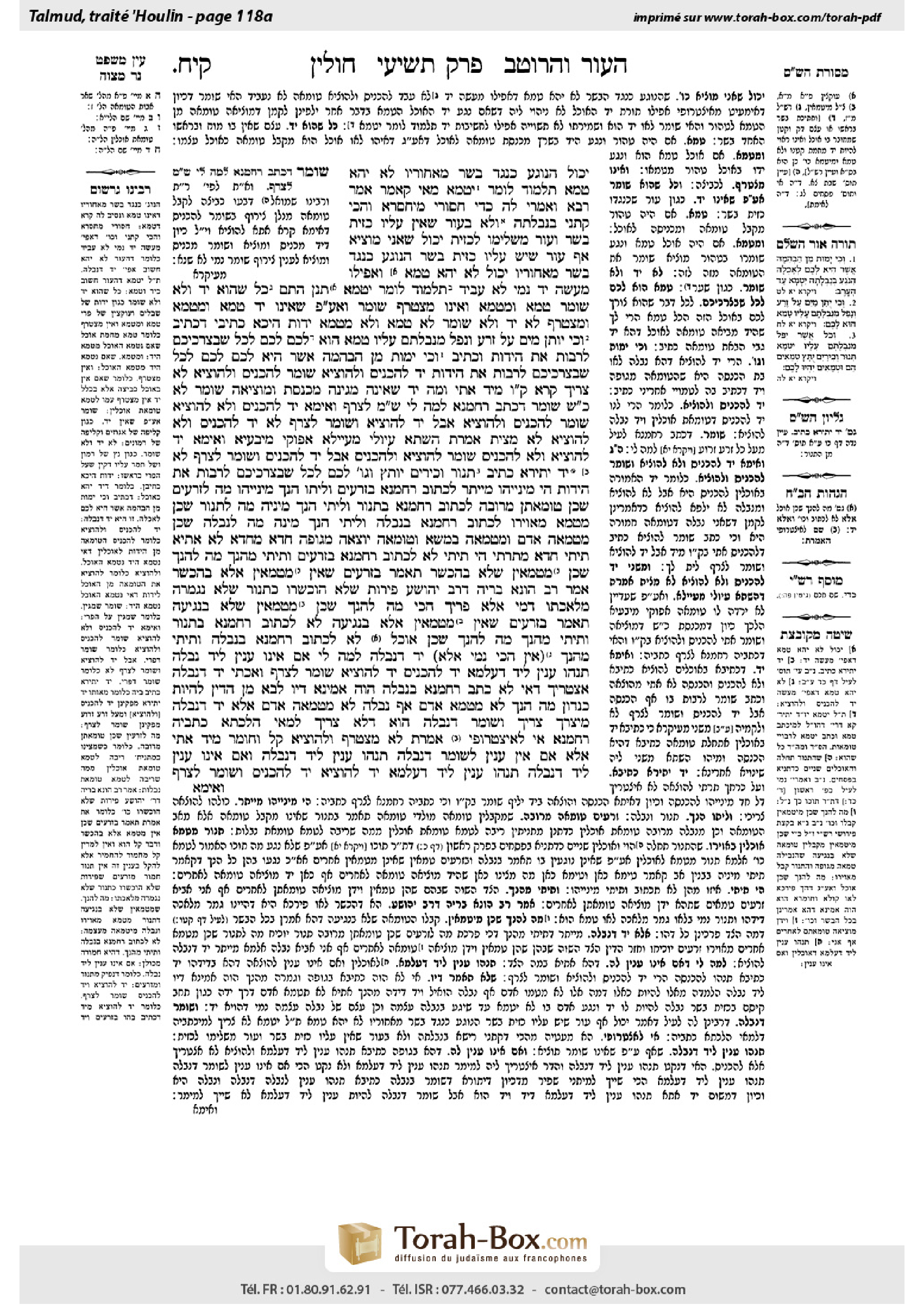
Chullin 118a: Talmud study for Daf Yomi
Study the Talmud for Daf Yomi with scanned pages, Hebrew text, English translations from Sefaria and AI-generated French translations.
Passage selection and English or AI-generated French translation are available where the scan has annotations. Daf Study is independent of Torah-Box and Sefaria.
Browse Chullin · חולין · All tractatesChullin 118a text and translations
This page of Chullin includes the Aramaic text, an English translation and an AI-generated French translation, alongside the scan above.
חולין קי״ח א · Aramaic and Hebrew text
יָכוֹל הַנּוֹגֵעַ כְּנֶגֶד בָּשָׂר מֵאֲחוֹרָיו לֹא יְהֵא טָמֵא? תַּלְמוּד לוֹמַר: ״יִטְמָא״.
מַאי קָאָמַר? אָמַר רָבָא, וְאָמְרִי לַהּ כְּדִי: חַסּוֹרֵי מִיחַסְּרָא וְהָכִי קָתָנֵי: ״בְּנִבְלָתָהּ״ – וְלֹא בְּעוֹר שֶׁאֵין עָלָיו כְּזַיִת בָּשָׂר, וְעוֹר מַשְׁלִימוֹ לִכְזַיִת.
יָכוֹל שֶׁאֲנִי מוֹצִיא אַף עוֹר שֶׁיֵּשׁ עָלָיו כְּזַיִת בָּשָׂר, הַנּוֹגֵעַ כְּנֶגֶד בָּשָׂר מֵאֲחוֹרָיו יָכוֹל לֹא יְהֵא טָמֵא, וַאֲפִילּוּ מַעֲשֵׂה יָד נָמֵי לָא עָבֵיד.
תַּלְמוּד לוֹמַר ״יִטְמָא״.
תְּנַן הָתָם: כֹּל שֶׁהוּא יָד וְלֹא שׁוֹמֵר – טָמֵא וּמְטַמֵּא, וְאֵינוֹ מִצְטָרֵף.
שׁוֹמֵר, וְאַף עַל פִּי שֶׁאֵינוֹ יָד – טָמֵא וּמְטַמֵּא וּמִצְטָרֵף; לֹא יָד וְלֹא שׁוֹמֵר – לֹא טָמֵא וְלֹא מְטַמֵּא.
יָדוֹת הֵיכָא כְּתִיבִי? דִּכְתִיב ״וְכִי יֻתַּן מַיִם עַל זֶרַע וְנָפַל מִנִּבְלָתָם עָלָיו טָמֵא הוּא לָכֶם״, ״לָכֶם״ – לְכֹל שֶׁבְּצׇרְכֵיכֶם, לְרַבּוֹת אֶת הַיָּדוֹת.
וּכְתִיב: ״וְכִי יָמוּת מִן הַבְּהֵמָה אֲשֶׁר הִיא לָכֶם״, ״לָכֶם״ – לְכֹל שֶׁבְּצׇרְכֵיכֶם, לְרַבּוֹת אֶת הַיָּדוֹת, יָד לְהַכְנִיס וּלְהוֹצִיא.
שׁוֹמֵר לְהַכְנִיס וּלְהוֹצִיא – לָא צְרִיךְ קְרָא, קַל וָחוֹמֶר מִיָּד אָתֵי: וּמָה יָד, שֶׁאֵינָהּ מְגִינָּה – מַכְנֶסֶת וּמוֹצִיאָה, שׁוֹמֵר – לֹא כׇּל שֶׁכֵּן?
שׁוֹמֵר דִּכְתַב רַחֲמָנָא, לְמָה לִי? שְׁמַע מִינַּהּ לְצָרֵף.
וְאֵימָא: יָד לְהַכְנִיס וְלֹא לְהוֹצִיא, שׁוֹמֵר לְהַכְנִיס וּלְהוֹצִיא, אֲבָל יָד לְהוֹצִיא וְשׁוֹמֵר לְצָרֵף – לָא.
יָד לְהַכְנִיס וְלֹא לְהוֹצִיא, לָא מָצֵית אָמְרַתְּ, הַשְׁתָּא עַיּוֹלֵי מְעַיְּילָא, אַפּוֹקֵי מִיבַּעְיָא?!
וְאֵימָא: יָד לְהוֹצִיא וְלֹא לְהַכְנִיס, שׁוֹמֵר לְהוֹצִיא וּלְהַכְנִיס, אֲבָל יָד לְהַכְנִיס וְשׁוֹמֵר לְצָרֵף – לָא.
יָד יַתִּירָא כְּתִיב, ״תַּנּוּר וְכִירַיִם יוּתַּץ וְגוֹ׳״.
לָכֶם״ – לְכֹל שֶׁבְּצׇרְכֵיכֶם, לְרַבּוֹת אֶת הַיָּדוֹת.
הֵי מִינַּיְיהוּ מְיַיתַּר?
לִכְתּוֹב רַחֲמָנָא בִּזְרָעִים, וְלֵיתוֹ הָנָךְ מִינַּיְיהוּ – מָה לִזְרָעִים, שֶׁכֵּן טוּמְאָתָן מְרוּבָּה.
לִכְתּוֹב רַחֲמָנָא בְּתַנּוּר, וְלֵיתֵי הָנָךְ מִינֵּיהּ – מָה לְתַנּוּר, שֶׁכֵּן מְטַמֵּא מֵאֲוִירוֹ.
לִכְתּוֹב רַחֲמָנָא בִּנְבֵלָה, וְלֵיתֵי הָנָךְ מִינַּהּ – מָה לִנְבֵלָה שֶׁכֵּן מְטַמְּאָה אָדָם, וּמְטַמְּאָה בְּמַשָּׂא, וְטוּמְאָה יוֹצְאָה מִגּוּפָהּ.
חֲדָא מֵחֲדָא לָא אָתְיָא, תֵּיתֵי חֲדָא מִתַּרְתֵּי.
הֵי תֵּיתֵי? לָא לִכְתּוֹב רַחֲמָנָא בִּזְרָעִים, וְתֵיתֵי מֵהָנָךְ! מָה לְהָנָךְ – שֶׁכֵּן מִטַּמְּאִין שֶׁלֹּא בְּהֶכְשֵׁר, תֹּאמַר בִּזְרָעִים – שֶׁאֵין מִטַּמְּאִין אֶלָּא בְּהֶכְשֵׁר!
אָמַר רַב הוּנָא בְּרֵיהּ דְּרַב יְהוֹשֻׁעַ: פֵּירוֹת שֶׁלֹּא הוּכְשְׁרוּ, כְּתַנּוּר שֶׁלֹּא נִגְמְרָה מְלַאכְתּוֹ דָּמֵי.
אֶלָּא פָּרֵיךְ הָכִי: מָה לְהָנָךְ, שֶׁכֵּן מִטַּמְּאִין שֶׁלֹּא בִּנְגִיעָה, תֹּאמַר בִּזְרָעִים, שֶׁאֵין מִטַּמְּאִין אֶלָּא בִּנְגִיעָה!
לָא לִכְתּוֹב רַחֲמָנָא בְּתַנּוּר, וְתֵיתֵי מֵהָנָךְ, מָה לְהָנָךְ שֶׁכֵּן אוֹכֶל.
לָא לִכְתּוֹב רַחֲמָנָא בִּנְבֵלָה, וְתֵיתֵי מֵהָנָךְ? אִין הָכִי נָמֵי. אֶלָּא יָד דִּנְבֵלָה לְמָה לִי? אִם אֵינוֹ עִנְיָן לְיַד נְבֵלָה, תְּנֵהוּ עִנְיָן לְיָד דְּעָלְמָא.
יָד לְהַכְנִיס, יָד לְהוֹצִיא, שׁוֹמֵר לְצָרֵף.
וְאַכַּתִּי, יָד דִּנְבֵלָה אִצְטְרִיךְ, דְּאִי לָא כְּתַב רַחֲמָנָא בִּנְבֵלָה, הֲוָה אָמֵינָא: דַּיּוֹ לַבָּא מִן הַדִּין לִהְיוֹת כַּנִּדּוֹן, מָה הָנָךְ לָא מְטַמּוּ אָדָם, אַף נְבֵלָה לָא מְטַמְּאָה אָדָם.
אֶלָּא, יָד דִּנְבֵלָה מִיצְרָךְ צְרִיךְ, וְשׁוֹמֵר דִּנְבֵלָה הוּא דְּלָא צְרִיךְ. לְמַאי הִלְכְתָא כַּתְבֵיהּ רַחֲמָנָא? אִי לְאִיצְטְרוֹפֵי – אָמְרַתְּ לָא מִצְטָרֵף, וּלְהוֹצִיא – קַל וָחוֹמֶר מִיָּד אָתֵי.
אֶלָּא, אִם אֵין עִנְיָן לְשׁוֹמֵר דִּנְבֵלָה, תְּנֵהוּ עִנְיָן לְיָד דִּנְבֵלָה, וְאִם אֵינוֹ עִנְיָן לְיָד דִּנְבֵלָה, תְּנֵהוּ עִנְיָן לְיָד דְּעָלְמָא: יָד לְהוֹצִיא, יָד לְהַכְנִיס, וְשׁוֹמֵר לְצָרֵף.
Chullin 118a · English translation
One might have thought that only one who touches the flesh of the carcass becomes impure, but one who touches the external side of the hide of the carcass that is aligned with the flesh, but does not touch the flesh itself, does not become impure. Therefore, the verse states: “One who touches its carcass shall be impure until the evening” (Leviticus 11:39). It is derived from the term “shall be impure” that even one who touches the hide in this manner becomes impure.
The Gemara asks: What is the baraita saying? The first clause of the baraita teaches that the hide does not impart impurity of a carcass while the latter clause teaches that one who touches the hide does become impure with the impurity of a carcass. Rava said, and some say it unattributed: The baraita is incomplete and this is what it is teaching: The term “its carcass” teaches that one who touches the flesh of a carcass becomes impure but one who touches the hide of a carcass upon which there is not an olive-bulk of flesh does not become impure. And even if the volume of the hide together with the flesh adds up to an olive-bulk, the hide does not join together with the flesh to constitute the measure of an olive-bulk required to impart impurity of an animal carcass.
One might have thought that I remove from the category of impurity of a carcass even a hide upon which there is an olive-bulk of flesh with regard to one who touches the external side of the hide of the carcass that is aligned with the flesh but does not touch the flesh itself. One might have thought that he does not become impure in such a case, and that the hide in this case does not even constitute a handle of the flesh, which would render one who touches it impure as though he touched the flesh itself.
Therefore, the verse states: “Shall be impure,” from which it is derived that even though an appendage that serves as protection for the flesh does not join together with the flesh to constitute the measure of an olive-bulk required to impart the impurity of animal carcasses, it is considered a handle of the flesh, which does impart impurity. Therefore, if there is an olive-bulk of flesh attached to the hide, one who touches the outside of the hide becomes impure, even if he did not touch the flesh.
§The Gemara discusses the transmission of impurity of food with regard to accessories that serve as a handle and that provide protection. We learned in a mishna there (Okatzin 1:1): With regard to any appendage that serves as a handle, i.e., a part that one holds while eating the food, but does not provide protection, the attached food becomes impure if the handle comes into contact with a source of impurity, and the handle transmits impurity from the attached food to other foods that come into contact with the handle. But the handle does not join together with the food to constitute the requisite measure to impart impurity.
With regard to any appendage that provides protection, even if it does not serve as a handle, the attached food becomes impure if the protection comes into contact with an impure item, and the protection imparts impurity, and it also joins together with the food to constitute the requisite measure to impart impurity. With regard to an appendage that does not serve as a handle nor as protection, the attached food does not become impure if the appendage comes into contact with a source of impurity, nor does the appendage impart impurity. In addition, it does not join together with the food to constitute the requisite measure to impart impurity.
The Gemara asks: Where is this halakha that handles are susceptible to and impart impurity written? The Gemara answers: As it is written with regard to the impurity of food: “But if water is put on the seed, and any of the carcass falls on it, it is impure for you” (Leviticus 11:38). It is derived from the term “for you” that any part needed for your use of the food is susceptible to impurity and imparts impurity, including the handles that facilitate the consumption of the food.
And furthermore it is written with regard to the impurity of a carcass: “And if any animal which is for you to consume dies, one who touches its carcass shall be impure until the evening” (Leviticus 11:39). The term “for you” indicates that any part needed for your use of the carcass imparts impurity, including the handles. One who touches the handle of an item that is impure with impurity of a carcass becomes impure as though he touched the carcass itself. These two verses teach that a handle transmits impurity both with regard to importing impurity into the attached food and with regard to exporting impurity from the attached food.
A verse is not needed to derive that protection both imports and exports impurity. This halakha is inferred a fortiori from the halakha of a handle: If a handle, which is treated more leniently than protection because it does not protect the food, nevertheless both imports and exports impurity, then with regard to protection, which is treated more stringently than a handle because it protects the food, should it not all the more so import and export impurity?
Since this is so, why do I need the verse that the Merciful One writes from which it is derived that protection is considered part of the food with regard to ritual impurity, i.e., the verses: “Upon any sowing seed that is sown…It is impure for you” (Leviticus 11:37–38)? Conclude from these verses that protection not only imparts impurity, but even joins together with the food to constitute the requisite measure to impart impurity.
The Gemara challenges: But say that these verses should be interpreted differently: A handle, which is treated more leniently than protection, is considered part of the food such that it imports but does not export impurity. Protection, which is treated more stringently than a handle, is considered like food to import and export impurity. But it is not derived that a handle exports impurity nor that protection joins together with the food to constitute the requisite measure to impart impurity.
The Gemara explains: You cannot say that a handle is considered part of the food such that it imports but does not export impurity for the following reason: Now that the handle is considered part of the food with regard to importing impurity into the food, is it necessary to state that it exports impurity? If a handle can cause ritually pure food attached to it to become impure, certainly it can transmit the impurity of impure food attached to it to other foods. Consequently, since a handle both imports and exports impurity, it is inferred a fortiori that protection also imports and exports impurity. It is therefore derived from the verse concerning appendages that serve as protection that protection joins together with the food to constitute the requisite measure to impart impurity.
The Gemara challenges: But say instead that a handle, which is treated more leniently than protection, is considered part of the food such that it exports but does not import impurity. Protection, which is treated more stringently than a handle, both exports and imports impurity. But it is not derived that a handle imports impurity nor that protection joins together with the food to constitute the requisite measure to impart impurity.
The Gemara explains: There is an additional derivation with regard to a handle, as it is written with regard to the impurity of vessels: “And everything upon which any part of their carcass falls shall be impure; whether an oven, or a range for pots, it shall be broken in pieces; they are impure, and shall be impure for you” (Leviticus 11:35).
It is derived from the term “for you” that any part needed for your use of a vessel has the impurity status of the vessel itself, including the handles. Therefore, if the vessel comes into contact with a source of impurity, the handle is considered part of the vessel and is also rendered impure. Consequently, there are two derivations with regard to a handle: One teaches that a handle imports impurity into the object to which it is attached, and the other teaches that a handle exports impurity from the object. It is derived through a fortiori inference from the halakha of a handle that protection both imports and exports impurity, and therefore the verse that states “Upon any sowing seed” teaches that protection joins together with the food to constitute the requisite measure to impart impurity.
The Gemara asks: With regard to these three verses that are interpreted as referring to handles, one of which discusses the impurity of food, one of which discusses the impurity of vessels, and one of which discusses the impurity of carcasses, which of them is superfluous such that one can derive from it that a handle does not merely export impurity from the food but imports impurity to the food as well? All of these verses are necessary to teach that a handle exports impurity.
The Gemara elaborates on the question: Let the Merciful One write that a handle exports impurity with regard to the impurity of seeds, i.e., food, and let those matters, i.e., that it exports the impurity of vessels and animal carcasses, be derived from it. But one cannot infer from the impurity of food that a handle exports the impurity of vessels, as what is notable about seeds? It is notable in that they have a greater susceptibility to impurity. Food is susceptible to even second-degree impurity, whereas vessels are susceptible to only first-degree impurity. Likewise, one cannot derive from the impurity of food that a handle exports the impurity of an animal carcass because the impurity of food applies to more items, as is taught in the mishna that some items are susceptible to the impurity of food but not to the impurity of animal carcasses.
Let the Merciful One write that a handle exports impurity with regard to the impurity of an oven, i.e., vessels, and let those matters, i.e., that it exports the impurity of food and the impurity of an animal carcass, be derived from it. But this inference is also not valid, as what is notable about the impurity of an oven? It is notable in that a vessel transmits impurity to foods not only through contact but also through its airspace, whereas those other types of impurity do not share this element of stringency.
Let the Merciful One write that a handle exports impurity with regard to the impurity of an animal carcass, and let those matters, i.e., that it exports the impurity of food and of vessels, be derived from it. But this inference is also not valid, as what is notable about the impurity of a carcass? It is notable in that a carcass transmits impurity to a person, and transmits impurity to one carrying the carcass even if he is not touching it, and its impurity emanates from its body and does not originate from an external source. Those other types of impurity do not share these elements of stringency.
The Gemara answers: The halakha of one of these three types of ritual impurity cannot be derived from the halakha of any one of the others. Yet, one of the verses is still superfluous because one can derive the halakha of one of these three types from the other two.
The Gemara asks: Which can one derive from the other two? Let the Merciful One not write that a handle exports impurity with regard to the impurity of seeds, i.e., food, and derive this halakha from those two other cases, the impurity of carcasses and of vessels. But this inference is not valid, as what is notable about those cases? They are notable in that they become ritually impure without first being rendered susceptible to impurity by coming into contact with liquid. Shall you say the same halakha with regard to seeds, which do not share this element of stringency, as food can become impure only after first being rendered susceptible to impurity by coming into contact with liquid?
Rav Huna, son of Rav Yehoshua, said: This element of leniency is not unique to the impurity of food. Produce that is not rendered susceptible to impurity by coming into contact with liquid is equivalent to an oven whose construction is not complete. An oven whose construction is incomplete is also not susceptible to impurity.
Rather, refute this derivation in the following manner: What is notable about those cases of impurity of carcasses and vessels? They are notable in that they become impure even without contact. An oven becomes impure if a creeping animal is within its airspace, and the impurity of an animal carcass originates from its own body without contact with an external source. Shall you state the same halakha with regard to seeds, which become impure only through contact?
Let the Merciful One not write that a handle exports impurity with regard to the impurity of an oven, i.e., vessels, and derive this halakha from those cases, the impurity of food and carcasses. But this derivation is not valid, as what is notable about those cases of the impurity of food and carcasses? They are notable in that they are food. Therefore, their halakhot cannot necessarily be applied to an oven and other vessels that are not food.
Let the Merciful One not write that a handle exports impurity with regard to a carcass and derive this halakha from those cases of the impurity of food and vessels. The Gemara responds: Yes, it is indeed so. Rather, since one can derive in such a manner that a handle attached to a carcass imparts impurity, why do I need the verse to state the halakha of a handle with regard to the impurity of a carcass? If it is not needed for the matter of a handle with regard to the impurity of a carcass, apply it to the matter of a handle in general with regard to food, and derive from it that a handle imports impurity to the food.
Therefore, in summary, one can derive that a handle imports impurity and that a handle exports impurity, and one can infer that protection imports and exports impurity a fortiori from the halakha of a handle. It is therefore derived from the verse concerning protection that protection joins together with the food to constitute the requisite measure to impart impurity.
The Gemara challenges: But it is still necessary for the verse to state the halakha that a handle exports impurity with regard to the impurity of a carcass; as, if the Merciful One had not written the halakha of a handle with regard to impurity of a carcass, I would say: It is sufficient for the conclusion that emerges from an a fortiori inference to be like its source. In this case, a halakha with regard to the impurity of carcasses which is inferred a fortiori from the cases of impurity of food and impurity of vessels is no more stringent than the source from which it is derived. Just as handles in these cases of impurity of food and vessels do not transmit impurity to a person, so too the handle of a carcass does not transmit impurity to a person. Therefore, the verse from which it is derived that a handle exports the impurity of a carcass is necessary, and cannot be applied to the matter of importing impurity.
The Gemara answers: Rather, it is necessary for the verse to state the halakha of a handle with regard to the impurity of a carcass, but it is not necessary for the verse to state the halakha of protection with regard to the impurity of a carcass. With regard to what halakha does the Merciful One write that verse? If it is teaching that protection joins together with the carcass to constitute the requisite measure to impart impurity, you said that protection does not join together with the carcass to constitute the requisite measure to impart impurity. And if it is teaching that protection exports the impurity of a carcass, it is not necessary to teach that, because that halakha is inferred a fortiori from the halakha of a handle.
Rather, if it is not needed for the matter of protection of a carcass, apply it to the matter of the handle of a carcass. And if it is not needed for the matter of a handle of a carcass, apply it to the matter of a handle in general, and derive from it that a handle imports impurity. Therefore, in summary, one can derive that a handle exports impurity and that a handle imports impurity, and one can derive from the verse concerning protection with regard to the impurity of food that protection joins together with the food to constitute the requisite measure to impart impurity.
Chullin 118a · Traduction française (IA)
On aurait pu penser que seul celui qui touche la chair du cadavre devient impur, mais celui qui touche le côté externe de la peau du cadavre qui est aligné avec la chair, sans toucher la chair elle-même, ne devient pas impur. Par conséquent, la Sainte Écriture dit : « Celui qui touche son cadavre devient impur jusqu'au soir » (Lévitique 11:39). On en déduit du terme « devient impur » que même celui qui touche la peau de cette manière devient impur.
Le Guemara pose la question : Quel est le baraïta qui dit cela ? La première partie du baraïta enseigne que la peau ne transmet pas l'impureté du cadavre, tandis que la seconde partie enseigne que celui qui touche la peau devient impur avec l'impureté du cadavre. Rava a dit, et certains disent sans attribution : le baraïta est incomplet et voici ce qu'il enseigne : le terme « son cadavre » enseigne que celui qui touche la chair du cadavre devient impur, mais celui qui touche la peau du cadavre sur laquelle il n'y a pas une quantité d'olive de chair ne devient pas impur. Et même si la quantité de la peau avec la chair atteint une quantité d'olive, la peau ne s'unira pas à la chair pour constituer la mesure d'olive requise pour transmettre l'impureté du cadavre.
On aurait pu penser que je retire de la catégorie de l'impureté du cadavre même une peau sur laquelle il y a une quantité d'olive de chair, concernant celui qui touche le côté externe de la peau du cadavre qui est aligné avec la chair mais ne touche pas la chair elle-même. On aurait pu penser qu'il ne devient pas impur dans ce cas-là, et que la peau ne constitue même pas un manche de la chair, ce qui rendrait impur celui qui la touche comme s'il avait touché la chair elle-même.
Par conséquent, la Sainte Écriture dit : « Devient impur », d'où on en déduit que même si un appendice qui sert de protection à la chair ne s'unira pas à la chair pour constituer la mesure d'olive requise pour transmettre l'impureté des cadavres d'animaux, il est considéré comme un manche de la chair, ce qui transmet l'impureté. Par conséquent, si une quantité d'olive de chair est attachée à la peau, celui qui touche l'extérieur de la peau devient impur, même s'il n'a pas touché la chair.
§ Le Guemara discute de la transmission de l'impureté des aliments concernant les accessoires qui servent de manche et qui offrent une protection. Nous avons appris dans une mitsva là (Okatzin 1:1) : Concernant tout appendice qui sert de manche, c'est-à-dire une partie que l'on tient lors de la consommation de l'aliment, mais qui ne fournit pas de protection, l'aliment attaché devient impur si le manche entre en contact avec une source d'impureté, et le manche transmet l'impureté de l'aliment attaché à d'autres aliments qui entrent en contact avec le manche. Mais le manche ne s'unira pas à l'aliment pour constituer la mesure requise pour transmettre l'impureté.
Concernant tout appendice qui fournit une protection, même s'il ne sert pas de manche, l'aliment attaché devient impur si la protection entre en contact avec un objet impur, et la protection transmet l'impureté, et elle s'unira également à l'aliment pour constituer la mesure requise pour transmettre l'impureté. Concernant un appendice qui ne sert ni de manche ni de protection, l'aliment attaché ne devient pas impur si l'appendice entre en contact avec une source d'impureté, ni l'appendice ne transmet l'impureté. En outre, il ne s'unira pas à l'aliment pour constituer la mesure requise pour transmettre l'impureté.
Le Guemara pose la question : Où est-il écrit cette halakha selon laquelle les manches sont sujets à l'impureté et transmettent l'impureté ? Le Guemara répond : Comme il est écrit concernant l'impureté des aliments : « Mais si de l'eau est versée sur la semence, et que quelque partie du cadavre tombe dessus, cela est impur pour vous » (Lévitique 11:38). On en déduit du terme « pour vous » que toute partie nécessaire à votre utilisation des aliments est sujette à l'impureté et transmet l'impureté, y compris les manches qui facilitent la consommation des aliments.
Et de plus, il est écrit concernant l'impureté du cadavre : « Et si un animal qui est pour vous à consommer meurt, celui qui touche son cadavre devient impur jusqu'au soir » (Lévitique 11:39). Le terme « pour vous » indique que toute partie nécessaire à votre utilisation du cadavre transmet l'impureté, y compris les manches. Celui qui touche le manche d'un objet impur avec l'impureté du cadavre devient impur comme s'il avait touché le cadavre lui-même. Ces deux versets enseignent que le manche transmet l'impureté à la fois concernant l'importation d'impureté dans l'aliment attaché et concernant l'exportation d'impureté de l'aliment attaché.
Un verset n'est pas nécessaire pour déduire que la protection importe et exporte l'impureté. Cette halakha est inférée a fortiori de la halakha du manche : Si un manche, qui est traité plus clémentement que la protection car il ne protège pas l'aliment, importe et exporte l'impureté, alors concernant la protection, qui est traitée plus sévèrement que le manche car elle protège l'aliment, ne devrait-elle pas encore plus importer et exporter l'impureté ?
Puisque c'est ainsi, pourquoi ai-je besoin du verset que l'Éternel a écrit d'où on déduit que la protection est considérée comme partie de l'aliment concernant l'impureté rituelle, c'est-à-dire les versets : « Sur toute semence que l'on sème… Cela est impur pour vous » (Lévitique 11:37–38) ? Concluez de ces versets que la protection ne transmet pas seulement l'impureté, mais même s'unie à l'aliment pour constituer la mesure requise pour transmettre l'impureté.
Le Guemara conteste : Mais disons que ces versets doivent être interprétés différemment : le manche, qui est traité plus clémentement que la protection, est considéré comme partie de l'aliment de sorte qu'il importe mais ne transmet pas l'impureté. La protection, qui est traitée plus sévèrement que le manche, est considérée comme de l'aliment pour importer et exporter l'impureté. Mais on ne déduit pas que le manche transmette l'impureté ni que la protection s'unisse à l'aliment pour constituer la mesure requise pour transmettre l'impureté.
La Guemara explique : On ne peut pas dire qu'une poignée est considérée comme faisant partie de la nourriture de telle sorte qu'elle importe mais ne transmet pas l'impureté, pour la raison suivante : Maintenant que la poignée est considérée comme faisant partie de la nourriture en ce qui concerne l'importation de l'impureté dans la nourriture, est-il nécessaire de dire qu'elle en exporte ? Si une poignée peut rendre une nourriture pure attachée à elle impure, certainement elle peut transmettre l'impureté d'une nourriture impure attachée à elle à d'autres aliments. Ainsi, puisque la poignée importe et exporte l'impureté, on peut en déduire a fortiori que la protection aussi importe et exporte l'impureté. On en déduit donc de la parole concernant les appendices qui servent de protection que la protection s'unifie avec la nourriture pour constituer la mesure nécessaire à la transmission de l'impureté.
La Guemara conteste : Mais disons plutôt que la poignée, qui est traitée avec plus de leni, est considérée comme faisant partie de la nourriture de telle sorte qu'elle exporte mais ne importe pas l'impureté. La protection, qui est traitée avec plus de rigueur que la poignée, importe et exporte l'impureté. Mais on ne peut pas en déduire que la poignée importe l'impureté ni que la protection s'unifie avec la nourriture pour constituer la mesure nécessaire à la transmission de l'impureté.
La Guemara explique : Il y a une autre dérivation concernant la poignée, car il est écrit concernant l'impureté des vases : « Et tout ce sur lequel tombera une partie de leur chair sera impur ; qu'il s'agisse d'un four, ou d'une table de cuisine, il sera brisé ; ils sont impurs, et ils seront impurs pour vous » (Lévitique 11:35).
On en déduit du terme « pour vous » que toute partie nécessaire à votre usage d'un vase a le statut d'impureté du vase lui-même, y compris les poignées. Ainsi, si le vase entre en contact avec une source d'impureté, la poignée est considérée comme faisant partie du vase et est également rendue impure. Ainsi, il y a deux dérivations concernant la poignée : l'une enseigne que la poignée importe l'impureté dans l'objet auquel elle est attachée, et l'autre enseigne que la poignée exporte l'impureté de l'objet. On en déduit par a fortiori de la halakha concernant la poignée que la protection importe et exporte l'impureté, et donc la parole qui dit « Sur toute semence » enseigne que la protection s'unifie avec la nourriture pour constituer la mesure nécessaire à la transmission de l'impureté.
La Guemara pose la question : Concernant ces trois versets interprétés comme faisant référence aux poignées, l'un concernant l'impureté des aliments, l'un concernant l'impureté des vases et l'un concernant l'impureté des cadavres, lequel est superflu de sorte qu'on puisse en déduire que la poignée ne transmet pas seulement l'impureté des aliments mais aussi qu'elle en importe ? Tous ces versets sont nécessaires pour enseigner que la poignée transmet l'impureté.
La Guemara développe la question : Que le Très Miséricordieux écrive que la poignée transmet l'impureté concernant l'impureté des semences, c'est-à-dire des aliments, et que ces matières, c'est-à-dire qu'elle transmet l'impureté des vases et des cadavres, soient déduites d'elle. Mais on ne peut pas en déduire de l'impureté des aliments que la poignée transmet l'impureté des vases, car qu'est-ce qui est notable dans les semences ? C'est qu'elles sont plus sensibles à l'impureté. La nourriture est sensible même à l'impureté de deuxième degré, tandis que les vases sont sensibles uniquement à l'impureté de premier degré. De même, on ne peut pas en déduire de l'impureté des aliments que la poignée transmet l'impureté d'un cadavre, car l'impureté des aliments s'applique à plus d'objets, comme il est enseigné dans la mitsva que certains objets sont sensibles à l'impureté des aliments mais pas à celle des cadavres.
Que le Très Miséricordieux écrive que la poignée transmet l'impureté concernant l'impureté d'un four, c'est-à-dire des vases, et que ces matières, c'est-à-dire qu'elle transmet l'impureté des aliments et de la chair des animaux, soient déduites d'elle. Mais cette déduction n'est pas valable, car qu'est-ce qui est notable dans l'impureté d'un four ? C'est qu'un vase transmet l'impureté aux aliments non seulement par contact mais aussi par son air, tandis que ces autres types d'impureté n'ont pas cet élément de rigueur.
Que le Très Miséricordieux écrive que la poignée transmet l'impureté concernant l'impureté d'une chair d'animal, et que ces matières, c'est-à-dire qu'elle transmet l'impureté des aliments et des vases, soient déduites d'elle. Mais cette déduction n'est pas valable non plus, car qu'est-ce qui est notable dans l'impureté d'une chair ? C'est qu'une chair transmet l'impureté à une personne, et transmet l'impureté à celui qui porte la chair même s'il ne la touche pas, et son impureté provient de son corps et ne provient pas d'une source externe. Ces autres types d'impureté n'ont pas ces éléments de rigueur.
La Guemara répond : La halakha d'un de ces trois types d'impureté rituelle ne peut pas être déduite de la halakha d'un autre. Cependant, l'un des versets est encore superflu car on peut déduire la halakha d'un de ces trois types des deux autres.
La Guemara pose la question : Quel peut-on déduire des deux autres ? Que le Très Miséricordieux ne écrive pas que la poignée transmet l'impureté concernant l'impureté des semences, c'est-à-dire des aliments, et déduise cette halakha de ces deux autres cas, l'impureté des cadavres et des vases. Mais cette déduction n'est pas valable, car qu'est-ce qui est notable dans ces cas ? Ils sont notables en ce qu'ils deviennent impurs sans avoir d'abord été rendus sensibles à l'impureté par contact avec un liquide. Diras-tu la même halakha concernant les semences, qui n'ont pas ce caractère de rigueur, comme la nourriture peut devenir impure seulement après avoir été rendue sensible à l'impureté par contact avec un liquide ?
Rav Huna, fils de Rav Yéhoshua, dit : Cette leniante n'est pas propre uniquement à l'impureté des aliments. Les produits qui ne deviennent pas impurs par contact avec un liquide sont équivalents à un four dont la construction n'est pas achevée. Un four dont la construction n'est pas achevée ne devient pas non plus impur.
Plutôt, réfutez cette dérivation de la manière suivante : Qu'est-ce qui est notable dans les cas d'impureté des cadavres et des vases ? Ce qu'ils ont de remarquable, c'est qu'ils deviennent impurs sans contact. Un four devient impur si un animal rampant est dans son espace aérien, et l'impureté d'un cadavre provient de son propre corps sans contact avec une source externe. Pourriez-vous affirmer la même halakha concernant les semences, qui deviennent impures uniquement par contact ?
Que le Miséricordieux ne mette pas par écrit que la poignée transmet l'impureté concernant l'impureté d'un four, c'est-à-dire des vases, et dérive cette halakha de ces cas, l'impureté des aliments et des cadavres. Mais cette dérivation n'est pas valable, car qu'est-ce qui est notable dans ces cas d'impureté des aliments et des cadavres ? Ce qu'ils ont de remarquable, c'est qu'ils sont des aliments. Par conséquent, leurs halakhot ne peuvent pas nécessairement s'appliquer à un four et à d'autres vases qui ne sont pas des aliments.
Que le Miséricordieux ne mette pas par écrit que la poignée transmet l'impureté concernant un cadavre, et dérive cette halakha de ces cas d'impureté des aliments et des vases. La Guemara répond : Oui, c'est effectivement ainsi. Plutôt, puisque l'on peut dériver de la sorte que la poignée attachée à un cadavre transmet l'impureté, pourquoi ai-je besoin de la parole pour établir la halakha de la poignée concernant l'impureté d'un cadavre ? Si cela n'est pas nécessaire pour la question de la poignée concernant l'impureté d'un cadavre, appliquez-le à la question de la poignée en général concernant les aliments, et dérivez-en que la poignée transmet l'impureté aux aliments.
Par conséquent, en résumé, l'on peut dériver que la poignée transmet l'impureté et que la poignée reçoit l'impureté, et l'on peut inférer que la protection transmet et reçoit l'impureté a fortiori à partir de la halakha de la poignée. Il est donc dérivé de la parole concernant la protection que la protection s'unifie avec l'aliment pour constituer la mesure nécessaire à la transmission de l'impureté.
La Guemara conteste : Mais il est encore nécessaire que la parole établisse la halakha que la poignée transmet l'impureté concernant l'impureté d'un cadavre ; car, si le Miséricordieux n'avait pas écrit la halakha de la poignée concernant l'impureté d'un cadavre, je dirais : Il est suffisant que la conclusion qui émerge d'une dérivation a fortiori soit semblable à sa source. Dans ce cas, une halakha concernant l'impureté des cadavres, dérivée a fortiori des cas d'impureté des aliments et des vases, n'est pas plus stricte que la source d'où elle est dérivée. Tout comme les poignées dans ces cas d'impureté des aliments et des vases ne transmettent pas l'impureté à une personne, de même la poignée d'un cadavre ne transmet pas l'impureté à une personne. Par conséquent, la parole d'où elle est dérivée que la poignée transmet l'impureté d'un cadavre est nécessaire, et ne peut être appliquée à la question de la transmission de l'impureté.
La Guemara répond : Plutôt, il est nécessaire que la parole établisse la halakha de la poignée concernant l'impureté d'un cadavre, mais il n'est pas nécessaire que la parole établisse la halakha de la protection concernant l'impureté d'un cadavre. À quel halakha la parole est-elle nécessaire ? Si elle enseigne que la protection s'unifie avec le cadavre pour constituer la mesure nécessaire à la transmission de l'impureté, vous dites que la protection ne s'unifie pas avec le cadavre pour constituer la mesure nécessaire à la transmission de l'impureté. Et si elle enseigne que la protection transmet l'impureté d'un cadavre, il n'est pas nécessaire d'enseigner cela, car cette halakha est dérivée a fortiori de la halakha de la poignée.
Plutôt, si elle n'est pas nécessaire pour la question de la protection d'un cadavre, appliquez-la à la question de la poignée d'un cadavre. Et si elle n'est pas nécessaire pour la question de la poignée d'un cadavre, appliquez-la à la question de la poignée en général, et dérivez-en que la poignée transmet l'impureté. Par conséquent, en résumé, l'on peut dériver que la poignée transmet l'impureté et que la poignée importe l'impureté, et l'on peut dériver à partir de la parole concernant la protection concernant l'impureté des aliments que la protection s'unifie avec l'aliment pour constituer la mesure nécessaire à la transmission de l'impureté.
Traduction française générée par IA à partir de l’édition anglaise de Sefaria. Vérifie toujours un passage avec le texte source.
Text from Sefaria: William Davidson Edition - Vocalized Aramaic (unknown); William Davidson Edition - English (CC BY NC).