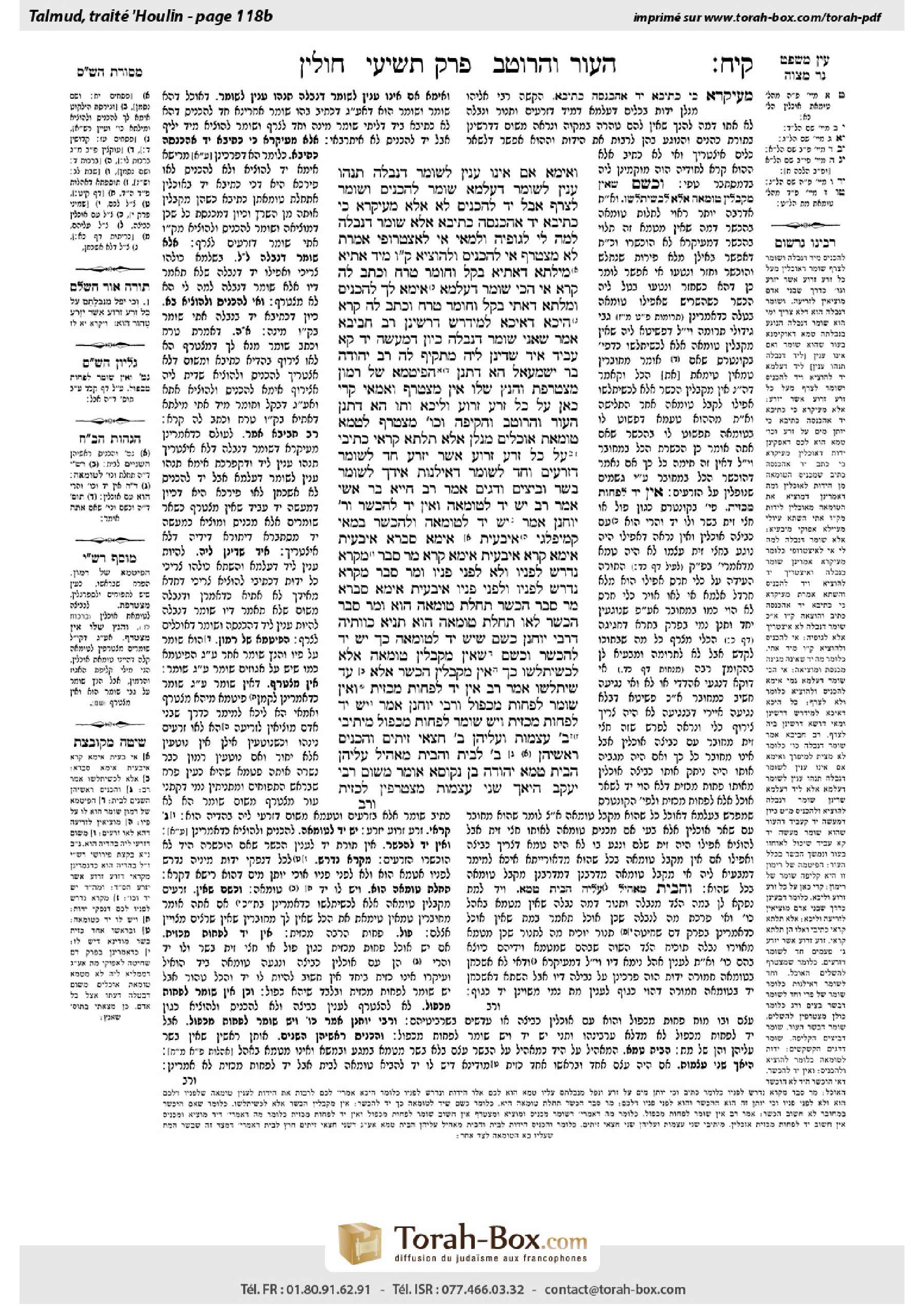
Chullin 118b: Talmud study for Daf Yomi
Study the Talmud for Daf Yomi with scanned pages, Hebrew text, English translations from Sefaria and AI-generated French translations.
Passage selection and English or AI-generated French translation are available where the scan has annotations. Daf Study is independent of Torah-Box and Sefaria.
Browse Chullin · חולין · All tractatesChullin 118b text and translations
This page of Chullin includes the Aramaic text, an English translation and an AI-generated French translation, alongside the scan above.
חולין קי״ח ב · Aramaic and Hebrew text
וְאֵימָא: אִם אֵינוֹ עִנְיָן לְשׁוֹמֵר דִּנְבֵלָה, תְּנֵהוּ עִנְיָן לְשׁוֹמֵר דְּעָלְמָא, שׁוֹמֵר לְהַכְנִיס וְשׁוֹמֵר לְצָרֵף, אֲבָל יָד לְהַכְנִיס לֹא!
אֶלָּא, מֵעִיקָּרָא כִּי כְּתִיבָא יָד, אַהַכְנָסָה כְּתִיבָא.
אֶלָּא שׁוֹמֵר דִּנְבֵלָה, לְמָה לִי? לְגוּפֵיהּ.
וּלְמַאי? אִי לְאִצְטְרוֹפֵי – אָמְרַתְּ לָא מִצְטָרֵף! אִי לְהַכְנִיס וּלְהוֹצִיא – קַל וָחוֹמֶר מִיָּד אָתְיָא! מִילְּתָא דְּאָתְיָא בְּקַל וְחוֹמֶר – טָרַח וְכָתַב לַהּ קְרָא.
אִי הָכִי, שׁוֹמֵר דְּעָלְמָא, אֵימָא לָךְ: לְהַכְנִיס, וּמִלְּתָא דְּאָתֵי בְּקַל וָחוֹמֶר – טָרַח וְכָתַב לַהּ קְרָא.
הֵיכָא דְּאִיכָּא לְמִידְרַשׁ, דָּרְשִׁינַן.
רַב חֲבִיבָא אָמַר: שָׁאנֵי שׁוֹמֵר דִּנְבֵלָה, כֵּיוָן דְּמַעֲשֵׂה יָד קָא עָבֵיד, אַיָּד שָׁדֵינַן לֵיהּ.
מַתְקֵיף לַהּ רַב יְהוּדָה בַּר יִשְׁמָעֵאל, הָא דִּתְנַן: הַפִּיטְמָא שֶׁל רִמּוֹן מִצְטָרֶפֶת, וְהַנֵּץ שֶׁלּוֹ אֵין מִצְטָרֵף.
וְאַמַּאי? קְרִי כָּאן ״עַל כׇּל זֶרַע זֵרוּעַ״, וְלֵיכָּא!
וְתוּ, הָא דִּתְנַן: הָעוֹר וְהָרוֹטֶב וְהַקֵּיפֶה וְכוּ׳. מִצְטָרֵף לְטַמֵּא טוּמְאַת אֳכָלִים – מְנָלַן?
אֶלָּא תְּלָתָא קְרָאֵי כְּתִיבִי: ״עַל כׇּל זֶרַע״, ״זֵרוּעַ״, ״אֲשֶׁר יִזָּרֵעַ״, חַד לְשׁוֹמֵר דִּזְרָעִים, וְחַד לְשׁוֹמֵר דְּאִילָנוֹת, אִידַּךְ לְשׁוֹמֵר בָּשָׂר וּבֵיצִים וְדָגִים.
אָמַר רַב חִיָּיא בַּר אָשֵׁי, אָמַר רַב: יֵשׁ יָד לְטוּמְאָה, וְאֵין יָד לְהֶכְשֵׁר.
וְרַבִּי יוֹחָנָן אָמַר: יֵשׁ יָד לְטוּמְאָה וּלְהֶכְשֵׁר.
בְּמַאי קָמִיפַּלְגִי? אִיבָּעֵית אֵימָא סְבָרָא, אִיבָּעֵית אֵימָא קְרָא.
אִיבָּעֵית אֵימָא קְרָא, מָר סָבַר: מִקְרָא נִדְרָשׁ לְפָנָיו, וְלֹא לִפְנֵי פָנָיו.
וּמָר סָבַר: מִקְרָא נִדְרָשׁ לְפָנָיו, וְלִפְנֵי פָנָיו.
אִיבָּעֵית אֵימָא סְבָרָא, מָר סָבַר: הֶכְשֵׁר תְּחִלַּת טוּמְאָה הוּא, וּמָר סָבַר: הֶכְשֵׁר לָאו תְּחִלַּת טוּמְאָה הוּא.
תַּנְיָא כְּוָותֵיהּ דְּרַבִּי יוֹחָנָן: כְּשֵׁם שֶׁיֵּשׁ יָד לְטוּמְאָה, כָּךְ יֵשׁ יָד לְהֶכְשֵׁר, וּכְשֵׁם שֶׁאֵין מְקַבְּלִין טוּמְאָה אֶלָּא לִכְשֶׁיִּתָּלְשׁוּ, כָּךְ אֵין מְקַבְּלִין הֶכְשֵׁר אֶלָּא עַד שֶׁיִּתָּלְשׁוּ.
אָמַר רַב: אֵין יָד לְפָחוֹת מִכְּזַיִת, וְאֵין שׁוֹמֵר לְפָחוֹת מִכְּפוֹל.
וְרַבִּי יוֹחָנָן אָמַר: יֵשׁ יָד לְפָחוֹת מִכְּזַיִת, וְיֵשׁ שׁוֹמֵר לְפָחוֹת מִכְּפוֹל.
מֵיתִיבִי: שְׁתֵּי עֲצָמוֹת, וַעֲלֵיהֶן שְׁנֵי חֲצָאֵי זֵיתִים, וְהִכְנִיס רָאשֵׁיהֶן (שנים) [הַשְּׁנַיִם] לְבַיִת, וְהַבַּיִת מַאֲהִיל עֲלֵיהֶן – הַבַּיִת טָמֵא.
יְהוּדָה בֶּן נָקוֹסָא אוֹמֵר מִשּׁוּם רַבִּי יַעֲקֹב: הֵיאַךְ שְׁנֵי עֲצָמוֹת מִצְטָרְפִין לִכְזַיִת?
Chullin 118b · English translation
The Gemara asks: Why is it assumed that if the verse is not needed for the matter of protection of a carcass, it should be applied to the matter of a handle in general? Say that if the verse is not needed for the matter of protection of a carcass, apply it to the matter of protection in general with regard to food. Although it is already written: “Upon any sowing seed” (Leviticus 11:37), two verses are necessary to teach the halakha of protection with regard to food: One verse to teach that protection imports impurity and one to teach that protection joins together with the food to constitute the requisite measure to impart impurity. But there is no source from which to derive that a handle imports impurity.
The Gemara answers: The halakha that a handle imports impurity is not derived from the superfluous verse written with regard to the impurity of a carcass. Rather, it is necessary to return to the explanation that was initially proposed, i.e., that it is written with regard to the impurity of food: “It is impure for you” (Leviticus 11:38), from which it is derived that any part needed for your use of the food imparts impurity, including handles. It was asked with regard to this derivation: Say that this verse teaches that a handle exports impurity but not that it imports impurity. The Gemara suggests: That question is not difficult. From the outset, when the halakha of a handle is written: “But if water is put upon the seed, and any of their carcass falls on it, it is impure for you” (Leviticus 11:38), it is written in the context of importing impurity. Therefore, it is inferred a fortiori that a handle exports impurity from the halakha that it imports impurity, and it is derived a fortiori from the halakhot of a handle that protection both imports and exports impurity. It is also derived that protection joins together with the food to constitute the requisite measure to impart impurity from that which is written: “On any sowing seed.”
The Gemara asks: But if that is so, why do I need the verse to teach the halakha of protection with regard to a carcass, as it is written: “Shall be impure” (Leviticus 11:39)? The Gemara answers: It is necessary for the matter itself, to teach that the halakha of protection is applicable to the impurity of a carcass.
The Gemara asks: And with regard to what halakha is this taught? If it teaches that protection joins together with the carcass to constitute the requisite measure to impart impurity, you said in the mishna that protection does not join together with the carcass to constitute the requisite measure to impart impurity. If it teaches that protection imports and exports the impurity of a carcass, it is not necessary for the verse to teach this halakha because it is inferred a fortiori from the halakhot of a handle. The Gemara answers: Sometimes there is a matter that could be inferred a fortiori, and the verse nevertheless takes the trouble and writes it explicitly.
The Gemara objects: If so, one may ask: With regard to protection in general, i.e., with regard to food, it was established that the verse is not necessary to teach that it imports and exports impurity, and therefore the verse teaches that protection joins together with the food to constitute the requisite measure to impart impurity. I will say to you instead that the verse teaches that protection imports impurity, and the reason that the verse teaches this halakha even though it could be inferred a fortiori is because sometimes there is a matter that could be inferred a fortiori and the verse nevertheless takes the trouble and writes it explicitly.
The Gemara answers: Where it is possible to interpret the verse in a manner that a novelty is derived, we interpret it in such a manner and do not maintain that the verse teaches that which could be inferred a fortiori.
The Gemara returns to the previous proposal to derive that a handle imports impurity from the verse concerning protection of a carcass based on the reasoning that if the verse is not needed for the matter of protection of a carcass, it should be applied to the matter of a handle in general. Previously, the Gemara challenged this derivation: If the verse is not needed for the matter of protection for the impurity of a carcass, it should be applied to the matter of protection in general. Rav Ḥaviva said in response: The halakha of protection of a carcass is different because it imports and exports impurity but does not join together with the carcass to constitute the requisite measure to impart impurity. Since the protection serves as a handle in that it only imports and exports impurity, we apply its novelty to the halakhot of a handle and not to the halakhot of protection.
§Previously it was derived that protection joins together with the food to constitute the requisite measure to impart impurity from that which is written: “On any sowing seed that is sown” (Leviticus 11:37), indicating that the entire seed is susceptible to ritual impurity when it is in a state where it is typical for people to take it out to the field for sowing, e.g., wheat and barley in their shells. Rav Yehuda bar Yishmael objects to this from that which we learned in a mishna (Okatzin 2:3): The protrusion of a pomegranate joins together with the pomegranate to constitute the measure of an egg-bulk that is required to impart impurity, because it provides protection for the fruit. But its flower does not join together with the pomegranate in that regard because it does not provide protection for the fruit; rather, it provides protection for the protection of the fruit.
Rav Yehuda bar Yishmael asks: And why does the protrusion join together with the pomegranate to constitute an egg-bulk? Read here that the verse states: “On any sowing seed,” indicating that the entire seed is susceptible to ritual impurity when it is in a state where it is typically taken out to the field for sowing. But pomegranates are not typically taken out to the field for sowing with their protrusions, since they are usually planted in the field as seedlings.
And furthermore, one can object to this derivation from that which we learned in the mishna: The hide and the congealed gravy attached to the meat, and the spices, and the meat residue, and the bones, and the tendons, and the lower section of the horns, and the section of the hooves, all join together with the meat to constitute the requisite egg-bulk to impart impurity of food. From where do we derive that these protections, although they are not sown together with the food, join together with the food to constitute the requisite measure to impart impurity?
Rather, three terms with the root zayin, reish, ayin are written in the verse with regard to protection: “On any sowing [zerua] seed [zera] that is sown [yizzare’a].” One term is written to teach the halakha of protection with regard to seeds, and one is written to teach the halakha of protection with regard to trees, and the other term is written to teach the halakha of protection with regard to meat, and eggs, and fish. Accordingly, this halakha is not limited to protection that is sown together with the food.
§It is written: “And if anything falls from their carcass upon any sowing seed that is sown, it is pure. But if water is put upon the seed, and any of the carcass falls on it, it is impure for you” (Leviticus 11:37–38). Previously, the Gemara derived from this verse that an appendage that serves as a handle both imports impurity to and exports impurity from the food. In addition, the simple understanding teaches that food can become impure only after first being rendered susceptible to impurity by coming into contact with liquid. With regard to these two halakhot, Rav Ḥiyya bar Ashi says that Rav says: There is significance to a handle with regard to importing and exporting impurity, i.e., a handle imports impurity to and exports impurity from the attached food, but there is no significance to a handle with regard to rendering the attached food susceptible to impurity. Rather, the food itself must come into contact with liquid directly.
And Rabbi Yoḥanan says: There is significance to a handle with regard to importing impurity to and exporting impurity from the attached food, and with regard to rendering the attached food susceptible to impurity even if only the handle came into contact with liquid.
The Gemara clarifies: With regard to what do Rav and Rabbi Yoḥanan disagree? If you wish, say that they disagree with regard to a logical argument. If you wish, say that they disagree with regard to the interpretation of a verse.
The Gemara explains: If you wish, say that they disagree with regard to the interpretation of a verse. One Sage, Rav, holds that a verse is interpreted homiletically based on juxtaposition to the term immediately preceding it and not based on juxtaposition to the term before the one preceding it. In this case, the verse states: “For you,” indicating inclusion of a handle with regard to the matter of imparting impurity, which is stated in the preceding phrase: “It is impure,” but not with regard to the matter of rendering the attached food susceptible to impurity through contact with liquid which is stated before the preceding phrase: “If water is put.”
And one Sage, Rabbi Yoḥanan, holds that a verse is interpreted homiletically based on juxtaposition to the term immediately preceding it, as well as to the term before the one preceding it. Therefore, he maintains that a handle can also render the attached food susceptible to impurity.
If you wish, say that they disagree with regard to a logical argument. One Sage, Rabbi Yoḥanan, holds that rendering food susceptible to impurity is the initial stage of the process of imparting impurity to it. Therefore, just as a handle imparts impurity, it can also render the food susceptible to impurity. And one Sage, Rav, holds that rendering food susceptible to impurity is not the initial stage of the process of imparting impurity.
It is taught in a baraita in accordance with the opinion of Rabbi Yoḥanan: Just as there is significance to a handle with regard to imparting impurity to food, so too there is significance to a handle with regard to rendering the attached food susceptible to impurity. And just as produce is susceptible to contracting impurity only when it is detached from the soil, so too produce cannot be rendered susceptible to impurity through contact with liquid until it is detached from the soil.
§The Gemara cites another disagreement between Rav and Rabbi Yoḥanan. Rav says: There is no halakha of a handle with regard to imparting impurity for a handle that is attached to less than an olive-bulk of food. And there is no halakha of protection with regard to imparting impurity for protection that is attached to less than a bean-bulk of food. In addition, the protection does not join together with the food to constitute the measure of an egg-bulk required to impart the impurity of food.
And Rabbi Yoḥanan says: There is a halakha of a handle with regard to imparting impurity for a handle that is attached to less than an olive-bulk of food. And there is a halakha of protection with regard to imparting impurity for protection that is attached to less than a bean-bulk of food. In addition, it joins together with the food to constitute the measure of an egg-bulk required to impart the impurity of food.
The Gemara raises an objection to the opinions of both Rav and Rabbi Yoḥanan from that which is taught in a Tosefta (Oholot 4:8): In a case of two bones that have two halves of an olive-bulk of flesh of a dead person upon them, i.e., half an olive-bulk of flesh is attached to one end of each bone, and one placed the ends of both bones that are not directly attached to the flesh inside a house in such a manner that the house overlies those ends of the bones but not the ends of the bones attached to the flesh, it is considered as though the house is overlying the flesh itself, and the house is impure.
Yehuda ben Nekosa says in the name of Rabbi Ya’akov: How can two bones join together to constitute an olive-bulk if the flesh attached to each bone is less than the measure of an olive-bulk?
Chullin 118b · Traduction française (IA)
La Guemara pose la question : Pourquoi suppose-t-on que si la parole n'est pas nécessaire pour la matière de la protection d'une carcasse, elle devrait être appliquée à la matière d'une manche en général ? Disons que si la parole n'est pas nécessaire pour la matière de la protection d'une carcasse, applique-la à la matière de la protection en général concernant les aliments. Bien que cela soit déjà écrit : « Sur toute semence que l'on sème » (Lévitique 11:37), deux versets sont nécessaires pour enseigner la halakha de la protection concernant les aliments : un verset pour enseigner que la protection transmet l'impureté et un autre pour enseigner que la protection s'unit à l'aliment pour constituer la mesure nécessaire à la transmission de l'impureté. Mais il n'y a pas de source à partir de laquelle on puisse déduire que la manche transmet l'impureté.
La Guemara répond : La halakha selon laquelle la manche transmet l'impureté n'est pas déduite du verset superflu écrit concernant l'impureté d'une carcasse. Plutôt, il faut revenir à l'explication initialement proposée, à savoir que cela est écrit concernant l'impureté des aliments : « Il est impur pour vous » (Lévitique 11:38), d'où on déduit que toute partie nécessaire à votre usage des aliments transmet l'impureté, y compris les manches. On a posé la question concernant cette déduction : Disons que ce verset enseigne que la manche transmet l'impureté, mais pas qu'elle l'importe. La Guemara suggère : Cette question n'est pas difficile. Dès le début, lorsque la halakha de la manche est écrite : « Mais si de l'eau est versée sur la semence, et que l'une de leurs carcasses tombe dessus, il est impur pour vous » (Lévitique 11:38), elle est écrite dans le contexte de l'importation d'impureté. Par conséquent, on en déduit a fortiori que la manche transmet l'impureté à partir de la halakha selon laquelle elle l'importe, et on en déduit a fortiori à partir des halakhot de la manche que la protection importe et exporte l'impureté. On en déduit également que la protection s'unit à l'aliment pour constituer la mesure nécessaire à la transmission de l'impureté à partir de ce qui est écrit : « Sur toute semence que l'on sème ».
La Guemara pose la question : Mais si c'est ainsi, pourquoi ai-je besoin du verset pour enseigner la halakha de la protection concernant la carcasse, puisque cela est écrit : « Doit être impur » (Lévitique 11:39) ? La Guemara répond : Il est nécessaire pour la matière elle-même, afin d'enseigner que la halakha de la protection s'applique à l'impureté de la carcasse.
La Guemara pose la question : Et concernant quelle halakha cette enseignement est-il fait ? Si elle enseigne que la protection s'unit à la carcasse pour constituer la mesure nécessaire à la transmission de l'impureté, vous avez dit dans la mitsva que la protection ne s'unit pas à la carcasse pour constituer la mesure nécessaire à la transmission de l'impureté. Si elle enseigne que la protection importe et exporte l'impureté de la carcasse, il n'est pas nécessaire que le verset enseigne cette halakha, car elle peut être déduite a fortiori à partir des halakhot de la manche. La Guemara répond : Parfois, il y a une matière qui pourrait être déduite a fortiori, et le verset n'en prend pas la peine, il l'écrit explicitement.
La Guemara s'oppose en disant : Si c'est ainsi, on peut poser la question : Concernant la protection en général, c'est-à-dire concernant les aliments, il a été établi que le verset n'est pas nécessaire pour enseigner qu'il importe et exporte l'impureté, et par conséquent, le verset enseigne que la protection s'unit à l'aliment pour constituer la mesure nécessaire à la transmission de l'impureté. Je dirai à vous plutôt que le verset enseigne que la protection importe l'impureté, et la raison pour laquelle le verset enseigne cette halakha même si elle pourrait être déduite a fortiori est que parfois il y a une matière qui pourrait être déduite a fortiori et le verset n'en prend pas la peine, il l'écrit explicitement.
La Guemara répond : Lorsqu'il est possible d'interpréter le verset de manière à en déduire une nouveauté, on l'interprète ainsi et on ne maintient pas que le verset enseigne ce qui pourrait être déduit a fortiori.
La Guemara revient à la proposition précédente de déduire que la manche importe l'impureté à partir du verset concernant la protection de la carcasse, en se basant sur la raison que si le verset n'est pas nécessaire pour la matière de la protection de la carcasse, il devrait être appliqué à la matière de la manche en général. Précédemment, la Guemara avait contesté cette déduction : Si le verset n'est pas nécessaire pour la matière de la protection de l'impureté de la carcasse, il devrait être appliqué à la matière de la protection en général. Rav Ḥaviva a répondu en disant : La halakha de la protection de la carcasse est différente, car elle importe et exporte l'impureté, mais ne s'unit pas à la carcasse pour constituer la mesure nécessaire à la transmission de l'impureté. Puisque la protection sert de manche, car elle importe et exporte l'impureté, on applique sa nouveauté aux halakhot de la manche et non aux halakhot de la protection.
§Précédemment, il a été déduit que la protection s'unit à l'aliment pour constituer la mesure nécessaire à la transmission de l'impureté à partir de ce qui est écrit : « Sur toute semence que l'on sème » (Lévitique 11:37), indiquant que toute la semence est susceptible d'impureté rituelle lorsqu'elle est dans un état où les gens la prennent normalement pour la semer, par exemple, le blé et la seigle dans leur coque. Rav Yehuda bar Yishmael s'oppose à cela à partir de ce que nous avons appris dans une mitsva (Okatzin 2:3) : La protubérance de la pomele s'unit à la pomele pour constituer la mesure d'un volume d'œuf nécessaire à la transmission de l'impureté, car elle fournit une protection au fruit. Mais sa fleur ne s'unit pas à la pomele à cet égard, car elle ne fournit pas de protection au fruit, mais plutôt une protection pour la protection du fruit.
Rav Yehuda bar Yishmael pose la question : Et pourquoi la protubérance s'unit-elle à la pomele pour constituer un volume d'œuf ? Lis ici que le verset dit : « Sur toute semence que l'on sème », indiquant que toute la semence est susceptible d'impureté rituelle lorsqu'elle est dans un état où elle est normalement prise pour la semer en champ. Mais les pomeles ne sont pas normalement prises pour la semer en champ avec leurs protubérances, car elles sont généralement plantées en champ sous forme de plants.
Et de plus, on peut s'opposer à cette dérivation à partir de ce que nous avons appris dans la mitsna : La peau et la sauce congelée attachée à la viande, les épices, la résidu de viande, les os, les tendons, la partie inférieure des cornes, et la partie des sabots, tout se joignent avec la viande pour constituer la quantité nécessaire d'œuf pour transmettre l'impureté alimentaire. D'où dérive-t-on que ces protections, bien qu'elles ne soient pas soudées avec l'aliment, se joignent avec l'aliment pour constituer la quantité nécessaire pour transmettre l'impureté ?
Plutôt, trois termes avec la racine zayin, reish, ayin sont écrits dans la parabole : « Sur toute semence [zerua] de grain [zera] qui est semée [yizzare’a]. » Un terme est écrit pour enseigner la halakha des protections concernant les graines, un autre pour enseigner la halakha des protections concernant les arbres, et le troisième pour enseigner la halakha des protections concernant la viande, les œufs et les poissons. Ainsi, cette halakha n'est pas limitée aux protections semées avec l'aliment.
§Il est écrit : « Et si quelque chose tombe de leur carcasse sur toute semence qui est semée, elle est pure. Mais si de l'eau est versée sur la semence, et que quelque chose de la carcasse tombe dessus, elle est impure pour vous » (Lévitique 11:37–38). Précédemment, le Guemara a dérivé de cette versette que l'attache qui sert de manche importe l'impureté à et exporte l'impureté de l'aliment. En outre, la compréhension simple enseigne que l'aliment ne peut devenir impur qu'après avoir été rendu susceptible d'impureté par contact avec un liquide. Concernant ces deux halakhot, Rav Ḥiyya bar Ashi dit que Rav dit : Il y a une importance au manche concernant l'importation et l'exportation d'impureté, c'est-à-dire que le manche importe l'impureté à et exporte l'impureté de l'aliment attaché, mais il n'y a pas d'importance au manche concernant la rendue de l'aliment attaché susceptible d'impureté. Plutôt, l'aliment lui-même doit entrer en contact direct avec le liquide.
Et Rabbi Yoḥanan dit : Il y a une importance au manche concernant l'importation d'impureté à et l'exportation d'impureté de l'aliment attaché, et concernant la rendue de l'aliment attaché susceptible d'impureté même si seulement le manche a entré en contact avec le liquide.
Le Guemara clarifie : À propos de quoi Rav et Rabbi Yoḥanan discutent-ils ? Si vous le souhaitez, dites qu'ils discutent à propos d'un argument logique. Si vous le souhaitez, dites qu'ils discutent à propos de l'interprétation d'une versette.
Le Guemara explique : Si vous le souhaitez, dites qu'ils discutent à propos de l'interprétation d'un verset. Un Sage, Rav, maintient qu'un verset est interprété homiletiquement en fonction de la juxtaposition au terme immédiatement précédent et non en fonction de la juxtaposition au terme avant le précédent. Dans ce cas, le verset dit : « Pour vous », indiquant l'inclusion du manche concernant la matière de transmission d'impureté, qui est mentionné dans la phrase précédente : « C'est impur », mais pas concernant la matière de rendre l'aliment attaché susceptible d'impureté par contact avec un liquide, qui est mentionné avant la phrase précédente : « Si de l'eau est versée ».
Et un Sage, Rabbi Yoḥanan, maintient qu'un verset est interprété homiletiquement en fonction de la juxtaposition au terme immédiatement précédent, ainsi qu'au terme avant le précédent. Ainsi, il maintient que le manche peut aussi rendre l'aliment attaché susceptible d'impureté.
Si vous le souhaitez, dites qu'ils discutent à propos d'un argument logique. Un Sage, Rabbi Yoḥanan, maintient que la rendre de l'aliment susceptible d'impureté est la première étape du processus de transmission d'impureté à l'aliment. Ainsi, tout comme le manche transmet l'impureté, il peut aussi rendre l'aliment susceptible d'impureté. Et un Sage, Rav, maintient que la rendre de l'aliment susceptible d'impureté n'est pas la première étape du processus de transmission d'impureté à l'aliment.
Il est enseigné dans une baraïta selon l'opinion de Rabbi Yoḥanan : Tout comme il y a une importance au manche concernant la transmission d'impureté à l'aliment, ainsi il y a une importance au manche concernant la rendre l'aliment attaché susceptible d'impureté. Et tout comme les produits sont susceptibles de contracter l'impureté seulement lorsqu'ils sont détachés du sol, ainsi les produits ne peuvent être rendus susceptibles d'impureté par contact avec un liquide qu'une fois détachés du sol.
§Le Guemara cite une autre divergence entre Rav et Rabbi Yoḥanan. Rav dit : Il n'y a pas de halakha du manche concernant la transmission d'impureté pour un manche attaché à moins d'une quantité d'olive d'aliment. Et il n'y a pas de halakha de protection concernant la transmission d'impureté pour une protection attachée à moins d'une quantité de haricot d'aliment. En outre, la protection ne se joindra pas à l'aliment pour constituer la mesure d'une quantité d'œuf nécessaire à la transmission de l'impureté alimentaire.
Et Rabbi Yoḥanan dit : Il y a une halakha du manche concernant la transmission d'impureté pour un manche attaché à moins d'une quantité d'olive d'aliment. Et il y a une halakha de protection concernant la transmission d'impureté pour une protection attachée à moins d'une quantité de haricot d'aliment. En outre, la protection se joindra à l'aliment pour constituer la mesure d'une quantité d'œuf nécessaire à la transmission de l'impureté alimentaire.
Le Guemara soulève une objection contre les opinions de Rav et de Rabbi Yoḥanan à partir de ce qui est enseigné dans une Tosefta (Oholot 4:8) : Dans un cas de deux os qui ont deux moitiés d'une quantité d'olive de viande morte sur eux, c'est-à-dire une moitié d'une quantité d'olive de viande attachée à chaque extrémité d'un os, et l'on a placé les extrémités des deux os qui ne sont pas directement attachées à la viande à l'intérieur d'une maison de telle sorte que la maison recouvre ces extrémités des os mais pas les extrémités des os attachées à la viande, on considère cela comme si la maison recouvrait la viande elle-même, et la maison est impure.
Yéhouda ben Nécosa dit au nom de Rabbi Ya’akov : Comment deux os peuvent-ils former un volume d’olive si la chair attachée à chaque os est inférieure à la mesure d’un volume d’olive ?
Traduction française générée par IA à partir de l’édition anglaise de Sefaria. Vérifie toujours un passage avec le texte source.
Text from Sefaria: William Davidson Edition - Vocalized Aramaic (unknown); William Davidson Edition - English (CC BY NC).