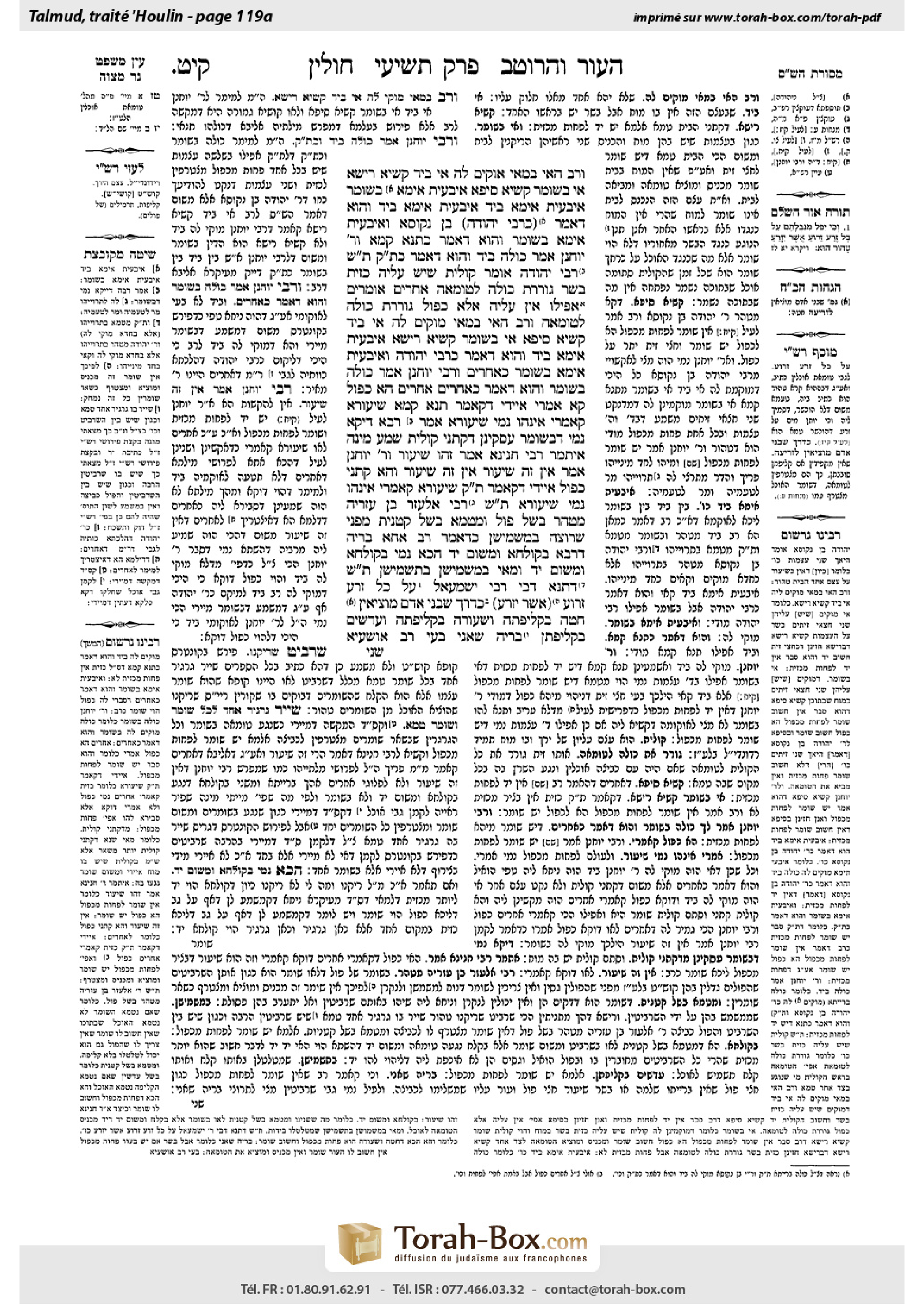
Chullin 119a: Talmud study for Daf Yomi
Study the Talmud for Daf Yomi with scanned pages, Hebrew text, English translations from Sefaria and AI-generated French translations.
Passage selection and English or AI-generated French translation are available where the scan has annotations. Daf Study is independent of Torah-Box and Sefaria.
Browse Chullin · חולין · All tractatesChullin 119a text and translations
This page of Chullin includes the Aramaic text, an English translation and an AI-generated French translation, alongside the scan above.
חולין קי״ט א · Aramaic and Hebrew text
וְרַב הַאי בְּמַאי מוֹקֵים לַהּ? אִי בְּיָד, קַשְׁיָא רֵישָׁא!
אִי בְּשׁוֹמֵר – קַשְׁיָא סֵיפָא.
אִיבָּעֵית אֵימָא בְּשׁוֹמֵר, אִיבָּעֵית אֵימָא בְּיָד.
אִיבָּעֵית אֵימָא בְּיָד, וְהוּא דְּאָמַר כְּרַבִּי יְהוּדָה בֶּן נָקוֹסָא, וְאִיבָּעֵית אֵימָא בְּשׁוֹמֵר, וְהוּא דְּאָמַר כְּתַנָּא קַמָּא.
וְרַבִּי יוֹחָנָן אָמַר: כּוּלַּהּ בְּיָד, וְהוּא דְּאָמַר כְּתַנָּא קַמָּא.
תָּא שְׁמַע: רַבִּי יְהוּדָה אוֹמֵר, קוּלִית שֶׁיֵּשׁ עָלֶיהָ כְּזַיִת בָּשָׂר – גּוֹרֶרֶת כּוּלָּהּ לְטוּמְאָה. אֲחֵרִים אוֹמְרִים: אֲפִילּוּ אֵין עָלֶיהָ אֶלָּא כְּפוֹל – גּוֹרֶרֶת כּוּלָּהּ לְטוּמְאָה.
וְרַב הַאי בְּמַאי מוֹקֵים לַהּ? אִי בְּיָד – קַשְׁיָא סֵיפָא, אִי בְּשׁוֹמֵר – קַשְׁיָא רֵישָׁא.
אִיבָּעֵית אֵימָא בְּיָד – וְהוּא דְּאָמַר כְּרַבִּי יְהוּדָה, וְאִיבָּעֵית אֵימָא בְּשׁוֹמֵר – כַּאֲחֵרִים.
וְרַבִּי יוֹחָנָן אָמַר: כּוּלַּהּ בְּשׁוֹמֵר, וְהוּא דְּאָמַר כַּאֲחֵרִים.
אֲחֵרִים, הָא ״כְּפוֹל״ קָא אָמְרִי!
אַיְּידֵי דְּקָאָמַר תַּנָּא קַמָּא שִׁיעוּרָא, קָאָמְרִי אִינְהוּ נָמֵי שִׁיעוּרָא.
אָמַר רָבָא: דַּיְקָא נָמֵי דִּבְשׁוֹמֵר עָסְקִינַן, דְּקָתָנֵי ״קוּלִית״, שְׁמַע מִינַּהּ.
אִיתְּמַר, רַבִּי חֲנִינָא אָמַר: זֶהוּ שִׁיעוּר, וְרַבִּי יוֹחָנָן אָמַר: אֵין זֶה שִׁיעוּר.
אֵין זֶה שִׁיעוּר, וְהָא קָתָנֵי ״כְּפוֹל״! אַיְּידֵי דְּקָאָמַר תַּנָּא קַמָּא שִׁיעוּרָא, קָאָמְרִי אִינְהוּ נָמֵי שִׁיעוּרָא.
תָּא שְׁמַע: רַבִּי אֶלְעָזָר בֶּן עֲזַרְיָה מְטַהֵר בְּשֶׁל פּוֹל, וּמְטַמֵּא בְּשֶׁל קִטְנִית, מִפְּנֵי שֶׁרוֹצֶה בְּמִשְׁמֻישָׁן!
כִּדְאָמַר רַב אַחָא בְּרֵיהּ דְּרָבָא, בְּקוּלְחָא, וּמִשּׁוּם יָד.
הָכָא נָמֵי בְּקוּלְחָא, וּמִשּׁוּם יָד, וּמַאי ״בְּמִשְׁמֻישָׁן״? בְּתַשְׁמִישָׁן.
תָּא שְׁמַע, דְּתָנָא דְּבֵי רַבִּי יִשְׁמָעֵאל: ״עַל כׇּל זֶרַע זֵרוּעַ אֲשֶׁר יִזָּרֵעַ״, כְּדֶרֶךְ שֶׁבְּנֵי אָדָם מוֹצִיאִין – חִטָּה בִּקְלִיפָּתָהּ, וּשְׂעוֹרָה בִּקְלִיפָּתָהּ, וַעֲדָשִׁים בִּקְלִיפָּתָן!
בְּרִיָּה – שָׁאנֵי.
בָּעֵי רַב אוֹשַׁעְיָא:
Chullin 119a · English translation
The Gemara explains the objection: And according to Rav, who holds that a handle that is attached to less than an olive-bulk of food or protection that is attached to less than a bean-bulk of food is not considered a handle or protection with regard to imparting impurity, in what manner does he interpret this baraita? If the baraita is discussing the case of a bone without marrow, and therefore the bone constitutes merely a handle for the flesh, which measures less than an olive-bulk, then the first clause of the baraita is difficult, because it indicates that a handle that is attached to less than an olive-bulk of food is considered a handle with regard to imparting impurity.
If the baraita is discussing the case of a bone containing marrow, and therefore the bone constitutes protection for food measuring less than an olive-bulk, then the last clause of the baraita is difficult because Yehuda ben Nekosa apparently holds that protection that is attached to less than an olive-bulk of food is not considered protection with regard to imparting impurity, contrary to the opinion of Rav, who holds that it is protection unless it is attached to less than a bean-bulk of food.
The Gemara answers: If you wish, say that Rav interprets the baraita as discussing the case of a bone that constitutes protection. If you wish, say instead that Rav interprets the baraita as discussing the case of a bone that constitutes a handle.
The Gemara explains its answers: If you wish, say that the baraita is discussing the case of a bone that constitutes a handle, and Rav stated his opinion in accordance with the opinion of Rabbi Yehuda ben Nekosa, who maintains that the house does not become impure because he holds that a handle that is attached to less than an olive-bulk of flesh does not impart impurity. And if you wish, say that the baraita is discussing the case of a bone that constitutes protection, and Rav stated his opinion in accordance with the opinion of the first tanna, who maintains that the house is impure because he holds that protection attached to less than an olive-bulk of flesh imparts impurity if the flesh measures at least a bean-bulk.
And Rabbi Yoḥanan could have said that the entire baraita is discussing the case of a bone that constitutes a handle, and Rabbi Yoḥanan stated his opinion in accordance with the opinion of the first tanna, who maintains that the house becomes impure because he holds that a handle that is attached to less than an olive-bulk of food imparts impurity. But he did not state his opinion in accordance with the opinion of Yehuda ben Nekosa, who maintains that the house does not become impure.
Come and hear another objection to the opinions of Rav and Rabbi Yoḥanan from the Tosefta (Okatzin 2:5): Rabbi Yehuda says: With regard to a femur that has an olive-bulk of flesh upon it, the flesh draws the entire femur into ritual impurity if any part of the femur comes into contact with a dead creeping animal. The Sage referred to as Aḥerim says: Even if there is only a bean-bulk of flesh upon the femur, it draws the entire femur into impurity.
The Gemara asks: In what manner does Rav interpret this baraita? If the baraita is discussing the case of a femur that constitutes merely a handle for the flesh, then the latter clause of the baraita is difficult, because Aḥerim apparently maintains that a handle that is attached to less than an olive-bulk of flesh imparts impurity, contrary to the opinion of Rav. If the baraita is discussing the case of a femur that constitutes protection, then the first clause of the baraita is difficult, because Rabbi Yehuda apparently holds that protection that is attached to less than an olive-bulk of flesh does not impart impurity, contrary to the opinion of Rav.
The Gemara answers: If you wish, say that the baraita is discussing the case of a femur that constitutes a handle, and Rav stated his opinion in accordance with the opinion of Rabbi Yehuda, who maintains that a handle attached to less than an olive-bulk of flesh does not impart impurity. And if you wish, say instead that the baraita is discussing the case of a femur that constitutes protection, and Rav stated his opinion in accordance with the opinion introduced with the words: Aḥerim says, according to which even protection attached to less than an olive-bulk of flesh imparts impurity.
And Rabbi Yoḥanan could have said that the entire baraita is referring to the case of a femur that constitutes protection, and Rabbi Yoḥanan stated his opinion in accordance with the opinion referred to as: Aḥerim says, according to which even protection that is attached to a bean-bulk of flesh imparts impurity.
The Gemara asks: How is Rabbi Yoḥanan’s opinion consistent with the opinion referred to as: Aḥerim says? Don’t they say that protection that is attached to a bean-bulk of flesh imparts impurity, and Rabbi Yoḥanan holds that even protection that is attached to less than a bean-bulk of food imparts impurity?
The Gemara answers: Aḥerim agrees that even protection that is attached to less than a bean-bulk imparts impurity. Nevertheless, since the first tanna states the specific measure of an olive-bulk, Aḥerim also states the specific measure of a bean-bulk even though he maintains his opinion with regard to a measure of less than a bean-bulk as well.
Rava said: The language of the baraita is also precise, indicating that we are dealing with protection and not a handle, as it teaches the case of a femur, which contains marrow, and therefore the bone provides protection for the food inside. If the baraita were discussing a handle, it would have taught this halakha with regard to any other bone that is attached to flesh and not specifically a femur. Conclude from it that the baraita is discussing the halakha of protection.
§The baraita cited above teaches that Aḥerim says: Even if there is only a bean-bulk of flesh attached to the femur it causes the entire femur to become impure. A dispute was stated with regard to this opinion. Rabbi Ḥanina says: When Aḥerim stated the measure of a bean-bulk, this is a specific measure, and Aḥerim holds that the halakha of protection applies to an appendage only if a bean-bulk of food is attached to it. And Rabbi Yoḥanan says: This is not a specific measure. Aḥerim holds that the halakha of protection applies even if it is attached to less than a bean-bulk of food.
The Gemara asks: How is it possible for Rabbi Yoḥanan to hold that this is not a specific measure? But doesn’t the baraita explicitly teach the measure of a bean-bulk? The Gemara answers: Indeed, Aḥerim holds that protection that is attached to even less than a bean-bulk of food imparts impurity. But since the first tanna states the specific measure of an olive-bulk, Aḥerim also states the specific measure of a bean-bulk even though he maintains his opinion with regard to a measure of less than a bean-bulk as well.
The Gemara suggests: Come and hear proof against the opinion of Rav from that which is taught in a mishna (Okatzin 1:5): Rabbi Elazar ben Azarya deems a pod containing beans that came in contact with a dead creeping animal ritually pure. Since beans are large and do not require the protection of the pod, the pod is not considered protection for the beans and therefore does not impart impurity. But he deems a pod containing smaller legumes that came in contact with a dead creeping animal ritually impure if even only one grain is attached to the pod, because one desires the use of the pod when handling the legumes so that he will not damage them, and it is therefore considered protection, which imparts impurity. Apparently, Rabbi Elazar ben Azarya holds that even protection that is attached to less than a bean-bulk of food imparts impurity, contrary to the opinion of Rabbi Ḥanina and Rav.
The Gemara rejects this proof: The explanation of that mishna is in accordance with that which Rav Aḥa, son of Rava, said in the context of a different discussion: That mishna is discussing a case where a dead creeping animal came into contact with the stalk to which the pod is attached, but not with the pod itself. And therefore the halakha in the mishna is not with regard to the matter of protection; rather, it is with regard to the matter of a handle, as the stalk serves as a handle for the pod and its attached grain.
Here, too, with regard to this proof one can respond that the mishna is discussing a case where a dead creeping animal came in contact with the stalk and therefore the halakha in the mishna is with regard to the matter of a handle. Since the mishna is referring to a stalk, and the stalk has many pods on it, it serves as a handle to more than an olive-bulk of food, and is consistent with the opinions of Rabbi Ḥanina and Rav. And what does Rabbi Elazar ben Azarya mean when he says that in the case of legumes, the stalk is impure because one desires the use of the stalk when handling [bemashmishan] the legumes? He is referring to using [betashmishan], i.e., carrying, the legumes with the stalk.
Come and hear proof from that which the school of Rabbi Yishmael taught: With regard to the impurity of food the verse states: “On any sowing seed that is sown” (Leviticus 11:37), indicating that the entire seed is susceptible to impurity when it is in a state where it is typical for people to take it out to the field for sowing: This applies to wheat in its shell, and barley in its shell, and lentils in their shells. It is derived from here that shells and other appendages that protect the food are considered part of the food. Since wheat, barley, and lentil grains are smaller than a bean-bulk, this statement indicates that even protection that is attached to less than a bean-bulk of food imparts impurity, contrary to the opinion of Rabbi Ḥanina and Rav.
The Gemara rejects this proof: A grain is a distinct entity, and therefore its status is different. The halakha of protection is applicable to a distinct entity even if it measures less than a bean-bulk.
§Rav Oshaya raises a dilemma:
Chullin 119a · Traduction française (IA)
La Guemara explique l'objection : Et selon Rav, qui considère qu'un manche attaché à moins d'une quantité d'olive de nourriture ou une protection attachée à moins d'une quantité de haricot de nourriture n'est pas considéré comme un manche ou une protection en ce qui concerne la transmission de l'impureté, dans quel sens interprète-t-il ce baraïta ? Si le baraïta discute le cas d'un os sans moelle, et donc l'os constitue simplement un manche pour la viande, qui mesure moins d'une quantité d'olive, alors la première partie du baraïta est difficile, car elle indique qu'un manche attaché à moins d'une quantité d'olive de nourriture est considéré comme un manche en ce qui concerne la transmission de l'impureté.
Si le baraïta discute le cas d'un os contenant de la moelle, et donc l'os constitue une protection pour une nourriture mesurant moins d'une quantité d'olive, alors la dernière partie du baraïta est difficile, car Yéhouda ben Nécosa semble considérer qu'une protection attachée à moins d'une quantité d'olive de nourriture n'est pas considérée comme une protection en ce qui concerne la transmission de l'impureté, contrairement à l'opinion de Rav, qui considère qu'il s'agit d'une protection à moins qu'elle ne soit attachée à moins d'une quantité de haricot de nourriture.
La Guemara répond : Si vous le souhaitez, dites que Rav interprète le baraïta comme discutant le cas d'un os qui constitue une protection. Si vous le souhaitez, dites plutôt que Rav interprète le baraïta comme discutant le cas d'un os qui constitue un manche.
La Guemara explique ses réponses : Si vous le souhaitez, dites que le baraïta discute le cas d'un os qui constitue un manche, et Rava a exprimé son opinion conformément à l'opinion de Rabbi Yéhouda ben Nécosa, qui maintient que la maison ne devient pas impure car il considère qu'un manche attaché à moins d'une quantité d'olive de viande ne transmet pas l'impureté. Et si vous le souhaitez, dites que le baraïta discute le cas d'un os qui constitue une protection, et Rava a exprimé son opinion conformément à l'opinion du premier tanna, qui maintient que la maison est impure car il considère que la protection attachée à moins d'une quantité d'olive de viande transmet l'impureté si la viande mesure au moins une quantité de haricot.
Et Rabbi Yoḥanan aurait pu dire que l'ensemble du baraïta discute le cas d'un os qui constitue un manche, et Rabbi Yoḥanan a exprimé son opinion conformément à l'opinion du premier tanna, qui maintient que la maison devient impure car il considère qu'un manche attaché à moins d'une quantité d'olive de nourriture transmet l'impureté. Mais il n'a pas exprimé son opinion conformément à l'opinion de Yéhouda ben Nécosa, qui maintient que la maison ne devient pas impure.
Venez écouter une autre objection contre les opinions de Rava et de Rabbi Yoḥanan, tirée de la Tosefta (Okatzin 2:5) : Rabbi Yéhouda dit : En ce qui concerne un fémur ayant une quantité d'olive de viande sur lui, la viande attire l'ensemble du fémur dans l'impureté rituelle si toute partie du fémur entre en contact avec un animal mort rampant. Le Sage désigné comme Aḥerim dit : Même si il n'y a que une quantité de haricot de viande sur le fémur, il attire l'ensemble du fémur dans l'impureté.
La Guemara demande : Dans quel sens Rav interprète-t-il ce baraïta ? Si le baraïta discute le cas d'un fémur qui constitue simplement un manche pour la viande, alors la dernière partie du baraïta est difficile, car Aḥerim semble maintenir qu'un manche attaché à moins d'une quantité d'olive de viande transmet l'impureté, contrairement à l'opinion de Rav. Si le baraïta discute le cas d'un fémur qui constitue une protection, alors la première partie du baraïta est difficile, car Rabbi Yéhouda semble maintenir qu'une protection attachée à moins d'une quantité d'olive de viande ne transmet pas l'impureté, contrairement à l'opinion de Rav.
La Guemara répond : Si vous le souhaitez, dites que le baraïta discute le cas d'un fémur qui constitue un manche, et Rav a exprimé son opinion conformément à l'opinion de Rabbi Yéhouda, qui maintient qu'un manche attaché à moins d'une quantité d'olive de viande ne transmet pas l'impureté. Et si vous le souhaitez, dites plutôt que le baraïta discute le cas d'un fémur qui constitue une protection, et Rav a exprimé son opinion conformément à l'opinion introduite par les mots : Aḥerim dit, selon laquelle même une protection attachée à moins d'une quantité d'olive de viande transmet l'impureté.
Et Rabbi Yoḥanan aurait pu dire que l'ensemble du baraïta fait référence au cas d'un fémur qui constitue une protection, et Rabbi Yoḥanan a exprimé son opinion conformément à l'opinion désignée comme : Aḥerim dit, selon laquelle même une protection attachée à une quantité de haricot de viande transmet l'impureté.
La Guemara demande : Comment l'opinion de Rabbi Yoḥanan est-elle cohérente avec l'opinion désignée comme : Aḥerim dit ? N'ont-ils pas dit que la protection attachée à une quantité d'olive de viande transmet l'impureté, et Rabbi Yoḥanan affirme que même la protection attachée à moins d'une quantité d'olive de nourriture transmet l'impureté ?
La Guemara répond : Aḥerim est d'accord que même la protection attachée à moins d'une quantité d'olive transmet l'impureté. Cependant, puisque le premier tanna indique la mesure spécifique d'une quantité d'olive, Aḥerim indique également la mesure spécifique d'une quantité de haricot, même s'il maintient son opinion concernant une mesure inférieure à une quantité d'olive.
Rava dit : La formulation du baraïta est également précise, indiquant que nous sommes en présence d'une protection et non d'un manche, car elle enseigne le cas d'un fémur, qui contient de la moelle, et donc l'os fournit une protection pour la nourriture à l'intérieur. Si le baraïta discutait d'un manche, il aurait enseigné cette halakha concernant n'importe quel autre os attaché à de la viande et pas spécifiquement un fémur. Concluez-en que le baraïta discute la halakha de la protection.
§La baraïta citée ci-dessus enseigne que Aḥerim dit : Même si une quantité égale à une lentille de viande est attachée au fémur, cela rend tout le fémur impur. Une dispute a été émise concernant cette opinion. Rabbi Ḥanina dit : Lorsque Aḥerim a mentionné la mesure d'une lentille, il s'agit d'une mesure spécifique, et Aḥerim considère que la halakha de protection s'applique à un appendice uniquement si une quantité égale à une lentille de nourriture y est attachée. Et Rabbi Yoḥanan dit : Ce n'est pas une mesure spécifique. Aḥerim considère que la halakha de protection s'applique même si la quantité est inférieure à une lentille de nourriture.
Le Guemara demande : Comment est-il possible que Rabbi Yoḥanan considère que ce n'est pas une mesure spécifique ? Mais ne dit pas la baraïta explicitement la mesure d'une lentille ? Le Guemara répond : En effet, Aḥerim considère que la protection attachée à une quantité inférieure à une lentille de nourriture transmet l'impureté. Cependant, puisque le premier tanna a mentionné la mesure spécifique d'une olive, Aḥerim mentionne également la mesure spécifique d'une lentille, même s'il maintient son opinion concernant une mesure inférieure à une lentille.
Le Guemara suggère : Viens écouter une preuve contre l'opinion de Rav à partir de ce qui est enseigné dans une mitsva (Okatzin 1:5) : Rabbi Elazar ben Azarya considère un pod contenant des haricots ayant été en contact avec un animal rampant mort comme rituellement pur. Puisque les haricots sont grands et n'ont pas besoin de la protection du pod, le pod n'est pas considéré comme une protection pour les haricots et donc ne transmet pas l'impureté. Mais il considère un pod contenant des légumineuses plus petites ayant été en contact avec un animal rampant mort comme impur si même une seule graine est attachée au pod, car on désire utiliser le pod lors de la manipulation des légumineuses afin de ne pas les abîmer, et il est donc considéré comme une protection, qui transmet l'impureté. Apparemment, Rabbi Elazar ben Azarya considère que même une protection attachée à une quantité inférieure à une lentille de nourriture transmet l'impureté, contrairement à l'opinion de Rabbi Ḥanina et de Rav.
Le Guemara rejette cette preuve : L'explication de cette mitsva est en conformité avec ce que Rav Aḥa, fils de Rava, a dit dans le contexte d'une discussion différente : cette mitsva est discutée dans un cas où un animal rampant mort a été en contact avec la tige à laquelle le pod est attaché, mais pas avec le pod lui-même. Et donc la halakha dans la mitsva n'est pas concernant la protection, mais concernant la matière d'une poignée, car la tige sert de poignée pour le pod et ses graines attachées.
Ici aussi, concernant cette preuve, on peut répondre que la mitsva est discutée dans un cas où un animal rampant mort a été en contact avec la tige et donc la halakha dans la mitsva est concernant la matière d'une poignée. Puisque la mitsva fait référence à une tige, et que la tige a plusieurs pods, elle sert de poignée à plus d'une olive de nourriture, et est conforme aux opinions de Rabbi Ḥanina et de Rav. Et que signifie Rabbi Elazar ben Azarya lorsqu'il dit que dans le cas des légumineuses, la tige est impure car on désire utiliser la tige lors de la manipulation [bemashmishan] des légumineuses ? Il fait référence à l'utilisation [betashmishan], c'est-à-dire le transport, des légumineuses avec la tige.
Viens écouter une preuve à partir de ce que l'école de Rabbi Yishmael a enseigné : concernant l'impureté des aliments, le verset dit : « Sur toute semence qui est semée » (Lévitique 11:37), indiquant que toute la semence est susceptible d'impureté lorsqu'elle est dans un état où elle est typique pour les gens de la prendre pour la semer : cela s'applique aux blés dans leur coque, aux orge dans leur coque et aux lentilles dans leurs coques. On en déduit que les coques et autres appendices qui protègent les aliments sont considérés comme faisant partie des aliments. Puisque les graines de blé, d'orge et de lentilles sont plus petites qu'une lentille, cette déclaration indique que même une protection attachée à une quantité inférieure à une lentille de nourriture transmet l'impureté, contrairement à l'opinion de Rabbi Ḥanina et de Rav.
Le Guemara rejette cette preuve : Une graine est une entité distincte, et donc son statut est différent. La halakha de protection s'applique à une entité distincte même si elle mesure moins qu'une lentille.
§Rav Oshaya pose un dilemme :
Traduction française générée par IA à partir de l’édition anglaise de Sefaria. Vérifie toujours un passage avec le texte source.
Text from Sefaria: William Davidson Edition - Vocalized Aramaic (unknown); William Davidson Edition - English (CC BY NC).