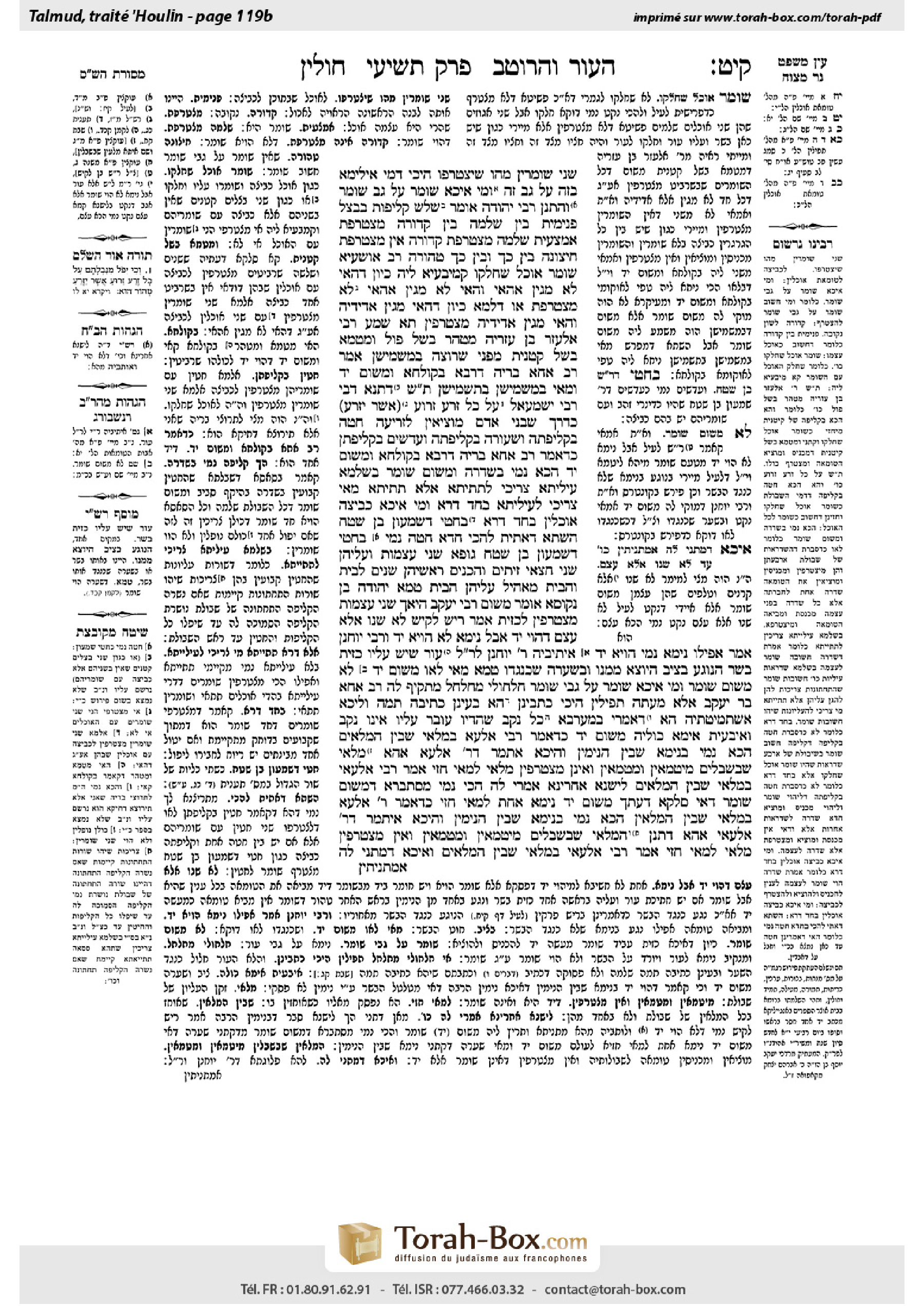
Chullin 119b: Talmud study for Daf Yomi
Study the Talmud for Daf Yomi with scanned pages, Hebrew text, English translations from Sefaria and AI-generated French translations.
Passage selection and English or AI-generated French translation are available where the scan has annotations. Daf Study is independent of Torah-Box and Sefaria.
Browse Chullin · חולין · All tractatesChullin 119b text and translations
This page of Chullin includes the Aramaic text, an English translation and an AI-generated French translation, alongside the scan above.
חולין קי״ט ב · Aramaic and Hebrew text
שְׁנֵי שׁוֹמְרִין מַהוּ שֶׁיִּצְטָרְפוּ?
הֵיכִי דָמֵי? אִילֵּימָא בְּזֶה עַל גַּב זֶה – וּמִי אִיכָּא שׁוֹמֵר עַל גַּב שׁוֹמֵר?
וְהָתְנַן: רַבִּי יְהוּדָה אוֹמֵר: שָׁלֹשׁ קְלִיפּוֹת בְּבָצָל – פְּנִימִית, בֵּין שְׁלֵמָה בֵּין קְדוּרָה – מִצְטָרֶפֶת; אֶמְצָעִית, שְׁלֵמָה – מִצְטָרֶפֶת, קְדוּרָה – אֵין מִצְטָרֶפֶת; חִיצוֹנָה, בֵּין כָּךְ וּבֵין כָּךְ – טְהוֹרָה.
רַב אוֹשַׁעְיָא, שׁוֹמֵר אוֹכֶל שֶׁחִלְּקוֹ קָמִיבַּעְיָא לֵיהּ.
כֵּיוָן דְּהַאי לָא מַגֵּין אַהַאי, וְהַאי לָא מַגֵּין אַהַאי, לָא מִצְטָרֵף.
אוֹ דִלְמָא, כֵּיוָן דְּהַאי מַגֵּין אַדִּידֵיהּ, וְהַאי מַגֵּין אַדִּידֵיהּ, מִצְטָרְפִין.
תָּא שְׁמַע: רַבִּי אֶלְעָזָר בֶּן עֲזַרְיָה מְטַהֵר בְּשֶׁל פּוֹל, וּמְטַמֵּא בְּשֶׁל קִטְנִית, מִפְּנֵי שֶׁרוֹצֶה בְּמִשְׁמֻישָׁן.
אָמַר רַב אַחָא בְּרֵיהּ דְּרָבָא: בְּקוּלְחָא, וּמִשּׁוּם יָד, וּמַאי ״בְּמִשְׁמֻישָׁן״ – בְּתַשְׁמִישָׁן.
תָּא שְׁמַע, דְּתָנָא דְּבֵי רַבִּי יִשְׁמָעֵאל: ״עַל כׇּל זֶרַע זֵרוּעַ (אֲשֶׁר יִזָּרֵעַ)״, כְּדֶרֶךְ שֶׁבְּנֵי אָדָם מוֹצִיאִין לִזְרִיעָה – חִטָּה בִּקְלִיפָּתָהּ, וּשְׂעוֹרָה בִּקְלִיפָּתָהּ, וַעֲדָשִׁים בִּקְלִיפָּתָן.
כִּדְאָמַר רַב אַחָא בְּרֵיהּ דְּרָבָא, בְּקוּלְחָא, וּמִשּׁוּם יָד.
הָכָא נָמֵי, בְּשִׁדְרָה, וּמִשּׁוּם שׁוֹמֵר.
בִּשְׁלָמָא עִילִּיָּתָא צְרִיכִי לְתַתָּיָתָא, אֶלָּא תְּתַּיָּתָא מַאי צְרִיכִי לְעִילִּיָּתָא? בְּחַד דָּרָא.
וּמִי אִיכָּא כְּבֵיצָה אֳכָלִין בְּחַד דָּרָא? בְּחִטֵּי דְּשִׁמְעוֹן בֶּן שָׁטַח.
הַשְׁתָּא דְּאָתֵית לְהָכִי, חֲדָא חִטָּה נָמֵי בְּחִטֵּי דְּשִׁמְעוֹן בֶּן שָׁטַח.
גּוּפָא: שְׁנֵי עֲצָמוֹת וַעֲלֵיהֶן שְׁנֵי חֲצָאֵי זֵיתִים, וְהִכְנִיס רָאשֵׁיהֶן שְׁנַיִם לְבַיִת, וְהַבַּיִת מַאֲהִיל עֲלֵיהֶן – הַבַּיִת טָמֵא.
יְהוּדָה בֶּן נָקוֹסָא אוֹמֵר מִשּׁוּם רַבִּי יַעֲקֹב: הֵיאַךְ שְׁנֵי עֲצָמוֹת מִצְטָרְפִין לִכְזַיִת?
אָמַר רֵישׁ לָקִישׁ: לֹא שָׁנוּ אֶלָּא עֶצֶם, דְּהָוֵי יָד, אֲבָל נִימָא לָא הָוְיָא יָד. וְרַבִּי יוֹחָנָן אָמַר: אֲפִילּוּ נִימָא נָמֵי הָוְיָא יָד.
אֵיתִיבֵיהּ רַבִּי יוֹחָנָן לְרֵישׁ לָקִישׁ: עוֹר שֶׁיֵּשׁ עָלָיו כְּזַיִת בָּשָׂר, הַנּוֹגֵעַ בְּצִיב הַיּוֹצֵא מִמֶּנּוּ, וּבִשְׂעָרָה שֶׁכְּנֶגְדּוֹ – טָמֵא. מַאי לָאו, מִשּׁוּם יָד?
לָא, מִשּׁוּם שׁוֹמֵר. וּמִי אִיכָּא שׁוֹמֵר עַל גַּבֵּי שׁוֹמֵר? חַלְחוּלֵי מְחַלְחֵל.
מַתְקֵיף לַהּ רַב אַחָא בַּר יַעֲקֹב: אֶלָּא מֵעַתָּה, תְּפִילִּין הֵיכִי כָּתְבִינַן? הָא בָּעֵינַן כְּתִיבָה תַּמָּה, וְלֵיכָּא!
אִשְׁתְּמִיטְתֵּיהּ הָא דְּאָמְרִי בְּמַעְרְבָא: כׇּל נֶקֶב שֶׁהַדְּיוֹ עוֹבֵר עָלָיו – אֵינוֹ נֶקֶב.
וְאִיבָּעֵית אֵימָא, כּוּלֵּיהּ מִשּׁוּם יָד, כִּדְאָמַר רַבִּי אִלְעָא: בִּמְלַאי שֶׁבֵּין הַמְּלָאִים.
הָכִי נָמֵי, בְּנִימָא שֶׁבֵּין הַנִּימִין.
וְהֵיכָא אִתְּמַר דְּרַבִּי אִלְעָא? אַהָא: מְלַאי שֶׁבַּשִּׁבֳּלִים מִיטַּמְּאִין וּמְטַמְּאִין, וְאֵינָן מִצְטָרְפִין. מְלַאי לְמַאי חֲזֵי? אָמַר רַבִּי אִלְעַאי: בִּמְלַאי שֶׁבֵּין הַמְּלָאִים.
לִישָּׁנָא אַחֲרִינָא אָמְרִי לַהּ.
הָכִי נָמֵי מִסְתַּבְּרָא, דְּמִשּׁוּם שׁוֹמֵר, דְּאִי סָלְקָא דַּעְתָּךְ מִשּׁוּם יָד – נִימָא אַחַת לְמַאי חֲזֵי?
כִּדְאָמַר רַבִּי אִלְעָא: בִּמְלַאי שֶׁבֵּין הַמְּלָאִין, הָכָא נָמֵי – בְּנִימָא שֶׁבֵּין הַנִּימִין.
וְהֵיכָא אִיתְּמַר דְּרַבִּי אִלְעַאי? אַהָא דִּתְנַן: הַמְּלַאי שֶׁבַּשִּׁבֳּלִים מִיטַּמְּאִין וּמְטַמְּאִין וְאֵין מִצְטָרְפִין. מְלַאי לְמַאי חֲזֵי? אָמַר רַבִּי אִלְעַאי: בִּמְלַאי שֶׁבֵּין הַמְּלָאִים.
וְאִיכָּא דְּמַתְנֵי לַהּ
Chullin 119b · English translation
As the Gemara stated, protection joins together with the food to constitute the requisite measure to impart impurity. What is the halakha with regard to two protections joining together with the food to constitute the measure of an egg-bulk required to impart impurity?
The Gemara asks: What are the circumstances of the dilemma? If we say that it is referring to a case where a food item has two layers of protection, and this outer protection is on top of that inner protection, is the halakha of protection applicable with regard to protection that is on top of another protection?
But didn’t we learn in a mishna (Okatzin 2:4) that Rabbi Yehuda says: There are three peels surrounding an onion. The inner peel is considered like the food itself, and therefore, whether whole or punctured, it joins together with the onion to constitute the requisite measure to impart the impurity of food. With regard to the middle peel, when it is whole it provides protection and therefore joins together with the onion, but when it is punctured it does not provide protection and therefore does not join together with the onion. The outer peel does not join together with the onion at all, and both in this case, when it is whole, and in that case, when it is punctured, it remains ritually pure. Evidently, the halakha of protection is not applied to a protection that surrounds another protection.
The Gemara explains the dilemma: Rav Oshaya does not raise the dilemma with regard to a food item that has two layers of protection. Rather, he raises the dilemma with regard to protection of food that one divided such that the food is whole but the protection is divided into separate sections.
The dilemma is as follows: Since this section of the protection is protecting this part of the food but does not provide protection for that other part of the food, and that other section of the protection is protecting another part of the food but does not provide protection for this part of the food, must one conclude that the two protections do not join together to constitute the requisite measure for the impurity of food?
Or perhaps, should one reason that since this section of the protection provides protection for its part of the food, and that section of the protection provides protection for its part of the food, and the two parts of the food are joined together, therefore the entire entity is considered unified and the two sections of the protection join together to constitute the requisite measure?
Come and hear a resolution to the dilemma from that which is taught in a mishna cited previously (Okatzin 1:5): Rabbi Elazar ben Azarya deems a pod containing beans that came in contact with a dead creeping animal ritually pure. But he deems a pod containing legumes that came in contact with a dead creeping animal impure because one desires the use of the pod when handling the legumes so that he will not damage them. Since the requisite volume for a food item to be susceptible to impurity is an egg-bulk, and the volume of one pod and its legumes is less than an egg-bulk, this statement must be discussing multiple pods joined together. Evidently, protection of food that is divided into separate sections joins together to constitute the requisite measure to impart impurity.
Rav Aḥa, son of Rava, said in rejection of this resolution: That mishna is discussing a case where a creeping animal touched the stalk to which the pods are attached but not the pods themselves. And the halakha in that mishna is not referring to the matter of protection; rather, it is with regard to the matter of a handle, as the stalk serves as a handle for the pod and its attached grain. And what does Rabbi Elazar ben Azarya mean when he says that in the case of legumes, the stalk is impure because one desires the use of the stalk when handling [bemashmishan] the legumes? He is referring to using [betashmishan], i.e., carrying, the legumes with the stalk.
Come and hear a resolution from that which the school of Rabbi Yishmael taught: With regard to the impurity of food the verse states: “On any sowing seed that is sown” (Leviticus 11:37), indicating that the entire seed is susceptible to ritual impurity when it is in a state where it is typical for people to take it out to the field for sowing: This applies to wheat in its shell, and barley in its shell, and lentils in their shells. It is derived from here that shells and other appendages that protect the food join together with the food to constitute the requisite measure to impart impurity. Since the measure of one grain and its shell is less than an egg-bulk, this statement must be discussing multiple grains and their shells joined together. Evidently, protection of food that is divided into separate sections joins together to impart impurity.
The Gemara rejects this resolution: One can explain this statement in accordance with that which Rav Aḥa, son of Rava, said with regard to the statement of Rabbi Elazar ben Azarya that was cited previously: The mishna is discussing a case where a creeping animal came in contact with the stalk to which the pods are attached but not the pods themselves. And therefore, the halakha in the mishna is not referring to the matter of protection; rather, it is with regard to the matter of a handle.
Here too, the statement of the school of Rabbi Yishmael is not referring to independent grains of wheat and barley, but rather to the stem to which the grains are attached, and it is with regard to the status of all the shells of the grains on one stem as protection. All of the grains surrounding the stem protect each other, since if one shell with its grain falls it causes all of the other shells and their grains to fall as well. Therefore, this case is not similar to Rav Oshaya’s dilemma, where each protection protects only part of the food.
The Gemara asks: Granted, the grains located higher on the stem need the grains located lower on the stem to remain in place in order to not fall. But for what purpose do the grains located lower on the stem need the grains located higher on the stem? The Gemara answers: The case is one where the grains are all positioned tightly around the stem in one row in such a manner that if even one located higher up on the stem were to fall, the remaining grains would fall too.
The Gemara asks: Is there a volume of an egg-bulk of food in one row of grain? The Gemara answers: Yes, this baraita is stated with regard to large grains of wheat, such as those grown in the time of Shimon ben Shataḥ.
The Gemara points out: Now that you have arrived at this conclusion, it is not necessary to interpret the baraita as referring to many grains tightly packed around the stem. It is even possible to explain that the baraita is discussing the case of one grain of wheat, such as the large grains of wheat grown in the time of Shimon ben Shataḥ.
§The Gemara proceeds to discuss the Tosefta itself that was cited earlier (118b): In a case of two bones upon which there are two halves of an olive-bulk of flesh of a corpse, i.e., half an olive-bulk of flesh is attached to one end of each bone, and one placed the ends of both bones that are not directly attached to the flesh inside the house in such a manner that the house overlies those ends of the bones but not the ends of the bones attached to the flesh, it is considered as though the house is overlying the flesh itself and the house is impure.
Yehuda ben Nekosa says in the name of Rabbi Ya’akov: How can two bones join together to constitute an olive-bulk if the flesh attached to each bone is less than the measure of an olive-bulk? It may be inferred from here that according to all, if the end of a bone that is attached to an olive-bulk of flesh is outside the house, and the other end that is not directly attached to any flesh is inside the house, the house becomes impure with the ritual impurity of a corpse.
With regard to this matter Reish Lakish said: The Sages taught this halakha only with regard to a bone, as it constitutes a handle vis-à-vis the flesh, but if one hair of a corpse is attached to an olive-bulk of flesh at one end, and the other end of the hair is inside a house, it does not render the house impure, because the hair does not constitute a handle vis-à-vis the flesh. And Rabbi Yoḥanan said: Even a hair constitutes a handle vis-à-vis the flesh, and therefore the house is rendered impure.
Rabbi Yoḥanan raised an objection to the opinion of Reish Lakish from the mishna taught later (124a): In the case of the hide of an unslaughtered animal carcass upon which there is an olive-bulk of flesh, one who touches a strand of flesh emerging from the flesh, or touches a hair that is on the side of the hide opposite the flesh, is ritually impure with the impurity of an unslaughtered carcass, even though he did not touch an olive-bulk of the flesh. What is the reason that one who touches the strand of flesh or the hair becomes impure? Is it not because they constitute a handle for the flesh, contrary to the opinion of Reish Lakish with regard to a hair?
The Gemara answers: No, the ruling of that mishna is not because the hair serves as a handle for the flesh. Rather, it is because the hair serves as protection for the flesh. The Gemara asks: But the hide protects the flesh, and the hair is on top of the hide; is the halakha of protection applicable with regard to protection that is on top of another protection? The Gemara answers: The hair penetrates through the hide and touches the flesh, thereby providing protection directly for the flesh.
Rav Aḥa bar Ya’akov objects to this answer: If that is so, that there are perforations in the hide through which the hairs penetrate, how can we write phylacteries? Don’t we require phylacteries to be written with a perfect writing, with no perforations in the letters? And that is not possible if there are perforations in the hide.
The Gemara answers: Rav Aḥa bar Ya’akov overlooked that halakha which they say in the West, Eretz Yisrael: Any perforation over which the ink passes and which it covers is not considered a perforation that invalidates the writing.
And if you wish, say instead a different answer to Rabbi Yoḥanan’s objection to Reish Lakish: The entire mishna teaches that one who touches either a strand of flesh or a hair becomes impure because these appendages serve the flesh as a handle and not as protection. Nevertheless, that statement does not contradict the opinion of Reish Lakish that a hair does not constitute a handle for the flesh, because one can explain this mishna as Rabbi Ela stated with regard to a different mishna: It is stated with regard to the case of an awn among many awns.
So too, the mishna taught later is stated with regard to the case of a hair among many hairs and not the case of a single hair. Therefore, the hair constitutes a handle for the flesh because one can hold the hair and lift the flesh without the hair becoming detached.
And where was the opinion of Rabbi Ela stated? It was stated with regard to that which is taught in a mishna (Okatzin 1:3): An awn [melai] that is on top of a stalk constitutes a handle for the stalk. Therefore, it can become impure and impart impurity, but it does not join together with the grains to constitute the requisite measure to impart impurity. It was asked: For what function is an awn fit such that it is considered to be a handle for the stalk? Rabbi Ilai, i.e., Rabbi Ela, said: That mishna is stated with regard to the case of an awn among many awns and not the case of a single awn. Therefore, the awns constitute a handle for the stalk because one can hold the awns and lift the stalk without the awns becoming detached from it.
Some say another version of this dispute between Rabbi Yoḥanan and Reish Lakish and the ensuing discussion with regard to the status of hairs vis-à-vis the flesh: Rabbi Yoḥanan and Reish Lakish agree that a single hair does not constitute a handle vis-à-vis the flesh connected to it, but they disagree with regard to several hairs. Rabbi Yoḥanan raises an objection to Reish Lakish’s opinion that hair is not considered a handle from the mishna taught later, which states that one who touches a hair emerging from the hide of an animal carcass opposite the flesh is impure, indicating that hair constitutes a handle.
Reish Lakish answers that one who touches the hair is impure not because it is considered a handle, but rather because it is considered protection for the flesh. The Gemara adds: So too it is reasonable to explain that the person is impure because hair is considered protection and not because it is considered a handle, as, if it enters your mind that it is because hair is considered a handle, for what function is one hair fit such that it is considered a handle?
The Gemara responds: One can explain that that mishna considers hair to constitute a handle, as Rabbi Ela stated in explanation of a different mishna: It is stated with regard to the case of an awn among many awns. Here too, that mishna is stated with regard to the case of a hair among many hairs and not the case of a single hair.
And where was the opinion of Rabbi Ela stated? It was stated with regard to that which we learned in a mishna: An awn that is on top of a stalk can become impure and impart impurity, but it does not join together with the grains to constitute the requisite measure to impart impurity. It was asked: For what function is an awn fit such that it is considered to be a handle for the stalk? Rabbi Ilai said: That mishna is stated with regard to the case of an awn among many awns.
And there are those who teach another version of this dispute between Rabbi Yoḥanan and Reish Lakish,
Chullin 119b · Traduction française (IA)
Comme la Guemara l’a dit, la protection s’unifie avec la nourriture pour constituer la mesure nécessaire à la transmission de l’impureté. Quelle est la halakha concernant deux protections s’unifiant avec la nourriture pour constituer la mesure d’un œuf, nécessaire à la transmission de l’impureté ?
La Guemara pose la question : Quelles sont les circonstances de ce dilemme ? Si l’on dit qu’il s’agit d’un cas où un aliment possède deux couches de protection, et que cette couche externe est au-dessus de la couche interne, la halakha de la protection s’applique-t-elle à la protection qui est au-dessus d’une autre protection ?
Mais n’avons-nous pas appris dans une mitsva (Okatzin 2:4) que Rabbi Yéhuda dit : Il y a trois peaux entourant un oignon. La peau interne est considérée comme la nourriture elle-même, et par conséquent, qu’elle soit entière ou percée, elle s’unifie avec l’oignon pour constituer la mesure nécessaire à la transmission de l’impureté de la nourriture. Concernant la peau moyenne, lorsqu’elle est entière elle fournit une protection et par conséquent s’unifie avec l’oignon, mais lorsqu’elle est percée elle ne fournit pas de protection et par conséquent ne s’unifie pas avec l’oignon. La peau externe ne s’unifie pas avec l’oignon du tout, et qu’elle soit entière ou percée, elle reste pure rituellement. Évidemment, la halakha de la protection ne s’applique pas à une protection entourant une autre protection.
La Guemara explique le dilemme : Rav Oshaya ne pose pas ce dilemme concernant un aliment possédant deux couches de protection. Plutôt, il pose ce dilemme concernant la protection d’un aliment qui a été divisé de sorte que l’aliment est entier mais la protection est divisée en sections séparées.
Le dilemme est le suivant : Puisque cette section de la protection protège cette partie de l’aliment mais ne protège pas cette autre partie de l’aliment, et que cette autre section de la protection protège une autre partie de l’aliment mais ne protège pas cette partie de l’aliment, doit-on conclure que les deux protections ne s’unifient pas pour constituer la mesure nécessaire à la transmission de l’impureté ?
Ou peut-être devrait-on raisonner que puisque cette section de la protection protège sa partie de l’aliment, et que cette autre section de la protection protège sa partie de l’aliment, et que les deux parties de l’aliment sont unifiées, donc l’ensemble est considéré comme unifié et les deux sections de la protection s’unifient pour constituer la mesure nécessaire à la transmission de l’impureté ?
Venez écouter une résolution à ce dilemme à partir de ce qui est enseigné dans une mitsva citée précédemment (Okatzin 1:5) : Rabbi Eléazar ben Azarya considère un pod contenant des haricots qui a été en contact avec un animal rampant comme pure rituellement. Mais il considère un pod contenant des légumineuses qui a été en contact avec un animal rampant comme impur, car on désire utiliser le pod lors de la manipulation des légumineuses afin de ne pas les abîmer. Puisque la mesure nécessaire pour qu’un aliment soit susceptible d’impureté est un œuf, et que le volume d’un pod et de ses légumineuses est inférieur à un œuf, cette déclaration doit être concernant plusieurs pods joints ensemble. Évidemment, la protection d’un aliment divisé en sections séparées s’unifie pour constituer la mesure nécessaire à la transmission de l’impureté.
Rav Acha, fils de Rava, a dit en rejet de cette résolution : Cette mitsva est concernant un cas où un animal rampant a touché la tige à laquelle les pods sont attachés mais pas les pods eux-mêmes. Et la halakha dans cette mitsva ne fait pas référence à la matière de la protection ; plutôt, elle est concernant la matière d’un manche, car la tige sert de manche pour le pod et ses grains attachés. Et que signifie Rabbi Eléazar ben Azarya lorsqu’il dit que dans le cas des légumineuses, la tige est impure car on désire utiliser la tige lors de la manipulation [bemashmishan] des légumineuses ? Il fait référence à utiliser [betashmishan], c’est-à-dire porter, les légumineuses avec la tige.
Venez écouter une résolution tirée de ce que l’école de Rabbi Yishmael a enseigné : Concernant l’impureté de la nourriture, le verset dit : « Sur toute semence qui est semée » (Lévitique 11:37), indiquant que toute la semence est susceptible d’impureté rituelle lorsqu’elle est dans un état où c’est typique pour les gens de la prendre pour semer : cela s’applique au blé dans sa coque, au froment dans sa coque, et aux lentilles dans leurs coques. On en déduit ici que les coques et autres appendices qui protègent la nourriture s’unifient avec la nourriture pour constituer la mesure nécessaire à la transmission de l’impureté. Puisque la mesure d’une graine et de sa coque est inférieure à un œuf, cette déclaration doit concerner plusieurs graines et leurs coques réunis ensemble. Évidemment, la protection d’un aliment divisé en sections séparées s’unifie pour transmettre l’impureté.
La Guemara rejette cette résolution : On peut expliquer cette déclaration en conformité avec ce que Rav Acha, fils de Rava, a dit concernant la déclaration de Rabbi Eléazar ben Azarya citée précédemment : la mitsva est concernant un cas où un animal rampant a touché la tige à laquelle les pods sont attachés mais pas les pods eux-mêmes. Et par conséquent, la halakha dans la mitsva ne fait pas référence à la question de la protection ; plutôt, elle est concernant la question d’un manche.
Ici aussi, la déclaration de l’école de Rabbi Yishmael ne fait pas référence à des graines indépendantes de blé et de froment, mais plutôt à la tige à laquelle les graines sont attachées, et elle est concernant le statut de toutes les coques des graines sur une tige comme protection. Toutes les graines entourant la tige protègent mutuellement, car si une coque avec sa graine tombe, cela fait tomber toutes les autres coques et leurs graines. Par conséquent, ce cas n’est pas semblable à celui de Rav Oshaya, où chaque protection protège seulement une partie de l’aliment.
La Guemara pose la question : Cela est vrai, les grains situés plus haut sur la tige ont besoin des grains situés plus bas sur la tige pour rester en place afin de ne pas tomber. Mais à quel usage les grains situés plus bas sur la tige ont-ils besoin des grains situés plus haut sur la tige ? La Guemara répond : Le cas est celui où les grains sont tous positionnés étroitement autour de la tige en une seule rangée de telle sorte que si même un grain situé plus haut sur la tige tombait, les autres grains tomberaient également.
La Guemara pose la question : Y a-t-il un volume équivalent à celui d’un œuf de nourriture dans une rangée de grains ? La Guemara répond : Oui, cette baraïta est énoncée concernant des grains de blé grands, tels que ceux cultivés à l’époque de Shim’on ben Shataḥ.
La Guemara souligne : Maintenant que vous avez atteint cette conclusion, il n’est plus nécessaire d’interpréter la baraïta comme faisant référence à de nombreux grains serrés autour de la tige. Il est même possible d’expliquer que la baraïta discute le cas d’un seul grain de blé, tel que les grains de blé grands cultivés à l’époque de Shim’on ben Shataḥ.
§La Guemara poursuit en discutant la Tosefta elle-même qui a été citée plus tôt (118b) : Dans le cas de deux os sur lesquels il y a deux moitiés d’un volume d’olive de viande d’un cadavre, c’est-à-dire une moitié d’un volume d’olive de viande attachée à chaque extrémité de l’os, et l’on a placé les extrémités des deux os qui ne sont pas directement attachées à la viande à l’intérieur de la maison de telle sorte que la maison recouvre ces extrémités des os mais pas les extrémités des os attachées à la viande, on considère cela comme si la maison recouvrait la viande elle-même et la maison est impure.
Yéhoudah ben Nécosa dit en nom de Rabbi Yaakov : Comment deux os peuvent-ils se joindre pour constituer un volume d’olive si la viande attachée à chaque os est inférieure à la mesure d’un volume d’olive ? On peut en déduire ici que selon tous, si l’extrémité d’un os qui est attachée à un volume d’olive de viande est en dehors de la maison, et l’autre extrémité qui n’est pas directement attachée à aucune viande est à l’intérieur de la maison, la maison devient impure avec la souillure rituelle du cadavre.
Concernant cette affaire, Reish Lakish a dit : Les Sages ont enseigné cette halakha uniquement concernant un os, car il constitue un manche par rapport à la viande, mais si une seule mèche du cadavre est attachée à un volume d’olive de viande à une extrémité, et l’autre extrémité de la mèche est à l’intérieur d’une maison, cela ne rend pas la maison impure, car la mèche ne constitue pas un manche par rapport à la viande. Et Rabbi Yoḥanan a dit : Même une mèche constitue un manche par rapport à la viande, et par conséquent la maison devient impure.
Rabbi Yoḥanan a soulevé une objection contre l’opinion de Reish Lakish à partir de la mitsna enseignée plus tard (124a) : Dans le cas de la peau d’un cadavre non sacrifié sur laquelle il y a un volume d’olive de viande, celui qui touche un fil de viande sortant de la viande, ou qui touche une mèche située sur le côté de la peau opposé à la viande, devient impur avec la souillure du cadavre non sacrifié, même s’il n’a pas touché un volume d’olive de viande. Quelle est la raison pour laquelle celui qui touche le fil de viande ou la mèche devient impur ? N’est-ce pas parce qu’ils constituent un manche pour la viande, contrairement à l’opinion de Reish Lakish concernant la mèche ?
La Guemara répond : Non, le jugement de cette mitsna n’est pas parce que la mèche sert de manche pour la viande. Plutôt, c’est parce que la mèche sert de protection pour la viande. La Guemara pose la question : Mais la peau protège la viande, et la mèche est au-dessus de la peau ; la halakha de protection s’applique-t-elle concernant une protection qui est au-dessus d’une autre protection ? La Guemara répond : La mèche pénètre à travers la peau et touche la viande, fournissant ainsi une protection directe pour la viande.
Rav Aḥa bar Ya’akov s’oppose à cette réponse : Si c’est ainsi, c’est-à-dire qu’il y a des perforations dans la peau à travers lesquelles les poils pénètrent, comment peut-on écrire des phylactères ? N’exige-t-on pas que les phylactères soient écrits avec une écriture parfaite, sans perforations dans les lettres ? Et cela n’est pas possible si les perforations sont présentes dans la peau.
La Guemara répond : Rav Aḥa bar Ya’akov a négligé la halakha qui est dite dans l’Ouest, Eretz Yisrael : Toute perforation sur laquelle l’encre passe et qu’elle recouvre n’est pas considérée comme une perforation qui invalide l’écriture.
Et si vous le souhaitez, dites plutôt une autre réponse à l’objection de Rabbi Yoḥanan contre Reish Lakish : L’intégralité de la mitsva enseigne que celui qui touche soit un fil de viande soit une mèche devient impur parce que ces appendices servent de manche pour la viande et non de protection. Cependant, cette déclaration ne contredit pas l’opinion de Reish Lakish selon laquelle une mèche ne constitue pas un manche pour la viande, car on peut expliquer cette mitsva selon ce que Rabbi Ela a dit concernant une autre mitsva : Il est dit concernant le cas d’un awn parmi de nombreux awns.
De même, la mitsva enseignée plus tard est énoncée concernant le cas d’une mèche parmi de nombreuses mèches et non le cas d’une seule mèche. Par conséquent, la mèche constitue un manche pour la viande car on peut saisir la mèche et lever la viande sans que la mèche ne se détache.
Et où a été énoncée l’opinion de Rabbi Ela ? Elle a été énoncée concernant ce qui est enseigné dans une mitsva (Okatzin 1:3) : Un awn [melai] qui est sur une tige constitue un manche pour la tige. Par conséquent, il peut devenir impur et transmettre la souillure, mais il ne se joint pas aux grains pour constituer la mesure nécessaire pour transmettre la souillure. On a demandé : Pour quelle fonction un awn est-il adapté afin qu’il soit considéré comme un manche pour la tige ? Rabbi Ilai, c’est-à-dire Rabbi Ela, a dit : Cette mitsva est énoncée concernant le cas d’un awn parmi de nombreux awns et non le cas d’un awn seul. Par conséquent, les awns constituent un manche pour la tige car on peut saisir les awns et lever la tige sans que les awns ne se détachent de celle-ci.
Certains disent une autre version de ce débat entre Rabbi Yoḥanan et Reish Lakish et la discussion qui en découle concernant le statut des cheveux par rapport à la viande : Rabbi Yoḥanan et Reish Lakish s'accordent sur le fait qu'un seul cheveu ne constitue pas un manche par rapport à la viande à laquelle il est attaché, mais ils divergent concernant plusieurs cheveux. Rabbi Yoḥanan émet une objection contre l'opinion de Reish Lakish selon laquelle le cheveu n'est pas considéré comme un manche, en se basant sur la mitsva apprise plus tard, qui stipule que celui qui touche un cheveu sortant de la peau d'un cadavre d'animaux en face de la viande devient impur, indiquant que le cheveu constitue un manche.
Reish Lakish répond que celui qui touche le cheveu devient impur non parce qu'il est considéré comme un manche, mais plutôt parce qu'il est considéré comme une protection pour la viande. La Guemara ajoute : De même, il est raisonnable d'expliquer que la personne devient impure parce que le cheveu est considéré comme une protection et non parce qu'il est considéré comme un manche, car, si l'on pense que c'est à cause du cheveu étant considéré comme un manche, à quelle fonction un seul cheveu est-il adapté pour être considéré comme un manche ?
La Guemara répond : On peut expliquer que cette mitsva considère le cheveu comme constituant un manche, comme Rabbi Ela l'a expliqué dans l'explication d'une autre mitsva : Il est dit concernant le cas d'un awn parmi plusieurs awns. Ici aussi, cette mitsva est dite concernant le cas d'un cheveu parmi plusieurs cheveux et non le cas d'un seul cheveu.
Et où a-t-on rapporté l'opinion de Rabbi Ela ? C'était concernant ce que nous avons appris dans une mitsna : Un awn qui est sur une tige peut devenir impur et transmettre l'impureté, mais il ne s'unifie pas avec les grains pour constituer la mesure nécessaire à la transmission de l'impureté. On a demandé : À quelle fonction l'awn est-il adapté pour être considéré comme un manche pour la tige ? Rabbi Ilai a dit : Cette mitsna est dite concernant le cas d'un awn parmi plusieurs awns.
Et il y a ceux qui enseignent une autre version de ce débat entre Rabbi Yoḥanan et Reish Lakish,
Traduction française générée par IA à partir de l’édition anglaise de Sefaria. Vérifie toujours un passage avec le texte source.
Text from Sefaria: William Davidson Edition - Vocalized Aramaic (unknown); William Davidson Edition - English (CC BY NC).