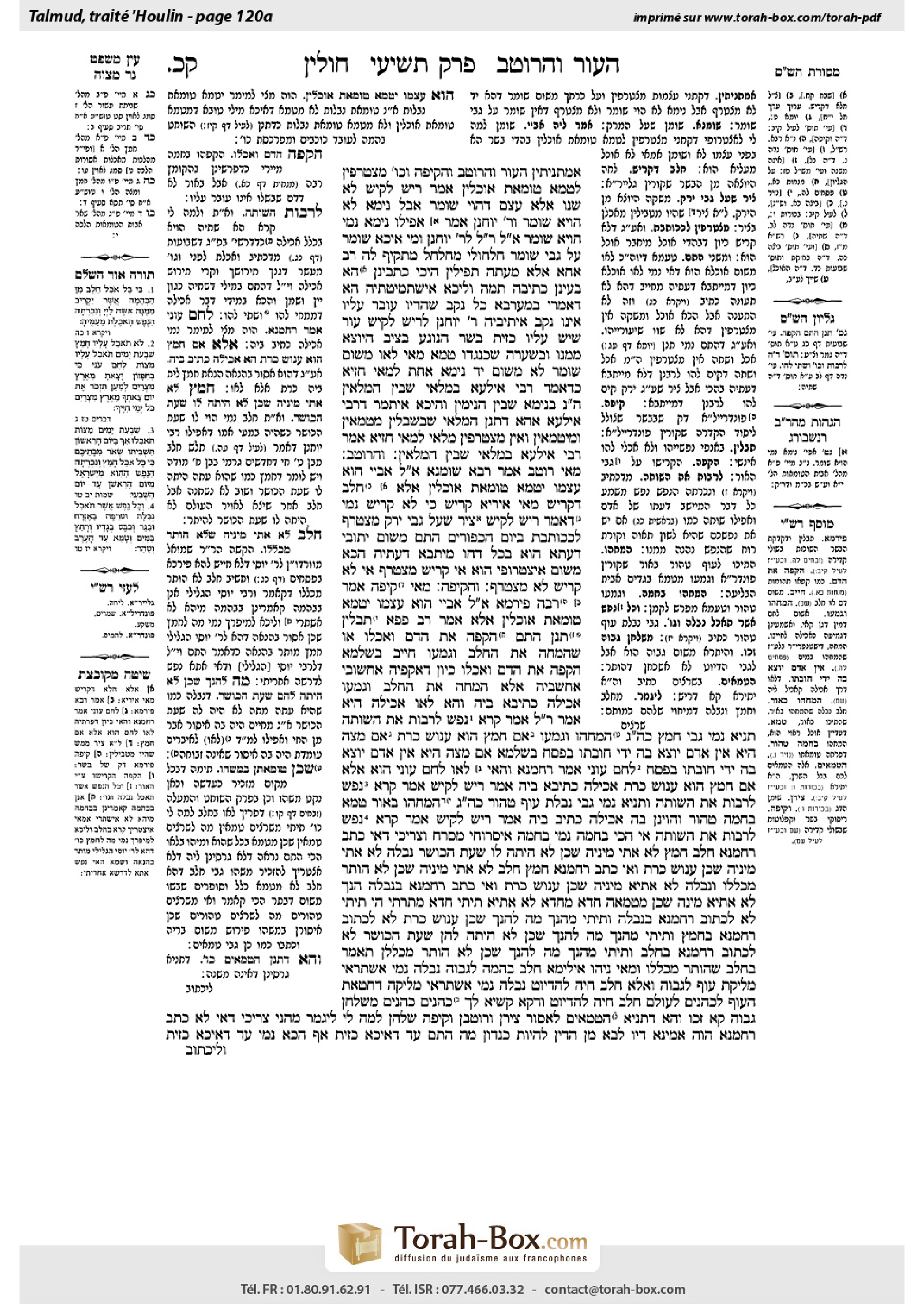
Chullin 120a: Talmud study for Daf Yomi
Study the Talmud for Daf Yomi with scanned pages, Hebrew text, English translations from Sefaria and AI-generated French translations.
Passage selection and English or AI-generated French translation are available where the scan has annotations. Daf Study is independent of Torah-Box and Sefaria.
Browse Chullin · חולין · All tractatesChullin 120a text and translations
This page of Chullin includes the Aramaic text, an English translation and an AI-generated French translation, alongside the scan above.
חולין ק״כ א · Aramaic and Hebrew text
אַמַּתְנִיתִין: ״הָעוֹר וְהָרוֹטֶב וְהַקֵּיפֶה וְכוּ׳״ מִצְטָרְפִין לְטַמֵּא טוּמְאַת אֳכָלִין.
אָמַר רֵישׁ לָקִישׁ: לֹא שָׁנוּ אֶלָּא עֶצֶם, דְּהָוֵי שׁוֹמֵר, אֲבָל נִימָא לָא הָוְיָא שׁוֹמֵר. וְרַבִּי יוֹחָנָן אָמַר: אֲפִילּוּ נִימָא נָמֵי הָוְיָא שׁוֹמֵר.
אֲמַר לֵיהּ רֵישׁ לָקִישׁ לְרַבִּי יוֹחָנָן: וּמִי אִיכָּא שׁוֹמֵר עַל גַּבֵּי שׁוֹמֵר? חַלְחוּלֵי מְחַלְחֵל.
מַתְקֵיף לַהּ רַב אַחָא: אֶלָּא מֵעַתָּה, תְּפִילִּין הֵיכִי כָּתְבִינַן? הָא בָּעֵינַן כְּתִיבָה תַּמָּה, וְלֵיכָּא!
אִישְׁתְּמִיטְתֵּיהּ הָא דְּאָמְרִי בְּמַעְרְבָא: כׇּל נֶקֶב שֶׁהַדְּיוֹ עוֹבֵר עָלָיו – אֵינוֹ נֶקֶב.
אֵיתִיבֵיהּ רַבִּי יוֹחָנָן לְרֵישׁ לָקִישׁ: עוֹר שֶׁיֵּשׁ עָלָיו כְּזַיִת בָּשָׂר, הַנּוֹגֵעַ בְּצִיב הַיּוֹצֵא מִמֶּנּוּ, וּבְשַׂעֲרָה שֶׁכְּנֶגְדּוֹ – טָמֵא. מַאי לָאו מִשּׁוּם שׁוֹמֵר? לָא, מִשּׁוּם יָד.
נִימָא אַחַת לְמַאי חַזְיָא? כִּדְאָמַר רַבִּי אִילְעָא: בִּמְלַאי שֶׁבֵּין הַמְּלָאִין, הָכִי נָמֵי בְּנִימָא שֶׁבֵּין הַנִּימִין.
וְהֵיכָא אִיתְּמַר דְּרַבִּי אִילְעָא? אַהָא דִּתְנַן: הַמְּלַאי שֶׁבַּשִּׁבֳּלִין מְטַמְּאִין וּמִיטַּמְּאִין וְאֵין מִצְטָרְפִין. מְלַאי לְמַאי חֲזֵי? אָמַר רַבִּי אִילְעָא: בִּמְלַאי שֶׁבֵּין הַמְּלָאִין.
וְהָרוֹטֶב. מַאי רוֹטֶב? אָמַר רָבָא: שׁוּמְנָא.
אֲמַר לֵיהּ אַבָּיֵי: הוּא עַצְמוֹ יְטַמֵּא טוּמְאַת אֳכָלִין! אֶלָּא חֵלֶב דִּקְרִישׁ.
מַאי אִירְיָא קְרִישׁ? כִּי לָא קְרִישׁ נָמֵי! דְּאָמַר רֵישׁ לָקִישׁ: צִיר שֶׁעַל גַּבֵּי יָרָק מִצְטָרֵף לִכְכוֹתֶבֶת בְּיוֹם הַכִּפּוּרִים.
הָתָם מִשּׁוּם יַתּוֹבֵי דַּעְתָּא הוּא, בְּכֹל דְּהוּ מְיַתְּבָא דַּעְתֵּיהּ.
הָכָא מִשּׁוּם אִיצְטְרוֹפֵי הוּא, אִי קְרִישׁ – מִצְטָרֵף, אִי לָא קְרִישׁ – לָא מִצְטָרֵף.
וְהַקֵּיפֶה, מַאי קֵיפֶה? אָמַר רַבָּה: פִּירְמָא.
אֲמַר לֵיהּ אַבָּיֵי: הוּא עַצְמוֹ יְטַמֵּא טוּמְאַת אֳכָלִין! אֶלָּא אָמַר רַב פָּפָּא: תַּבְלִין.
תְּנַן הָתָם: הִקְפָּה אֶת הַדָּם וַאֲכָלוֹ, אוֹ שֶׁהִמְחָה אֶת הַחֵלֶב וּגְמָעוֹ – חַיָּיב.
בִּשְׁלָמָא הִקְפָּה אֶת הַדָּם וַאֲכָלוֹ, כֵּיוָן דְּאַקְפְּיֵהּ אַחְשׁוֹבֵי אַחְשְׁבֵיהּ, אֶלָּא הִמְחָה אֶת הַחֵלֶב וּגְמָעוֹ – אֲכִילָה כְּתִיבָא בֵּיהּ, וְהָא לָאו אֲכִילָה הִיא!
אָמַר רֵישׁ לָקִישׁ: אָמַר קְרָא ״נֶפֶשׁ״ – לְרַבּוֹת אֶת הַשּׁוֹתֶה.
תַּנְיָא נָמֵי גַּבֵּי חָמֵץ כְּהַאי גַּוְנָא: הִמְחָהוּ וּגְמָעוֹ – אִם חָמֵץ הוּא, עָנוּשׁ כָּרֵת; אִם מַצָּה הִיא, אֵין אָדָם יוֹצֵא בָּהּ יְדֵי חוֹבָתוֹ בַּפֶּסַח.
בִּשְׁלָמָא אִם מַצָּה הִיא אֵין אָדָם יוֹצֵא בָּהּ יְדֵי חוֹבָתוֹ בַּפֶּסַח, ״לֶחֶם עֹנִי״ אָמַר רַחֲמָנָא, וְהַאי לָאו לֶחֶם עֹנִי הוּא. אֶלָּא אִם חָמֵץ הוּא עָנוּשׁ כָּרֵת, אֲכִילָה כְּתִיבָא בֵּיהּ!
אָמַר רֵישׁ לָקִישׁ: אָמַר קְרָא ״נֶפֶשׁ״ – לְרַבּוֹת אֶת הַשּׁוֹתֶה.
וְתַנְיָא נָמֵי גַּבֵּי נִבְלַת עוֹף טָהוֹר כְּהַאי גַּוְנָא: הִמְחָהוּ בָּאוּר – טָמֵא, בַּחַמָּה – טָהוֹר. וְהָוֵינַן בַּהּ: אֲכִילָה כְּתִיב בֵּיהּ!
אָמַר רֵישׁ לָקִישׁ: אָמַר קְרָא ״נֶפֶשׁ״ – לְרַבּוֹת אֶת הַשּׁוֹתֶה. אִי הָכִי, בַּחַמָּה נָמֵי? בַּחַמָּה אַיסְרוֹחֵי מַסְרַח.
וּצְרִיכִי, דְּאִי כְּתַב רַחֲמָנָא חֵלֶב – חָמֵץ לָא אָתֵי מִינֵּיהּ, שֶׁכֵּן לֹא הָיְתָה לוֹ שְׁעַת הַכּוֹשֶׁר; נְבֵלָה לָא אָתֵי מִינֵּיהּ, שֶׁכֵּן עָנוּשׁ כָּרֵת.
וְאִי כְּתַב רַחֲמָנָא חָמֵץ – חֵלֶב לָא אָתֵי מִינֵּיהּ, שֶׁכֵּן לֹא הוּתַּר מִכְּלָלוֹ, וּנְבֵלָה לָא אָתְיָא מִינֵּיהּ, שֶׁכֵּן עָנוּשׁ כָּרֵת.
וְאִי כְּתַב רַחֲמָנָא בִּנְבֵלָה – הָנָךְ לָא אָתְיָא מִינַּהּ, שֶׁכֵּן מְטַמְּאָה.
חֲדָא מֵחֲדָא לָא אָתְיָא, תֵּיתֵי חֲדָא מִתַּרְתֵּי! הֵי תֵּיתֵי? לָא לִכְתּוֹב רַחֲמָנָא בִּנְבֵלָה וְתֵיתֵי מֵהָנָךְ – מָה לְהָנָךְ שֶׁכֵּן עָנוּשׁ כָּרֵת!
לָא לִכְתּוֹב רַחֲמָנָא בְּחָמֵץ, וְתֵיתֵי מֵהָנָךְ – מָה לְהָנָךְ, שֶׁכֵּן לֹא הָיְתָה לָהֶן שְׁעַת הַכּוֹשֶׁר!
לָא לִכְתּוֹב רַחֲמָנָא בְּחֵלֶב, וְתֵיתֵי מֵהָנָךְ – מָה לְהָנָךְ שֶׁכֵּן לֹא הוּתַּר מִכְּלָלָן, תֹּאמַר בְּחֵלֶב שֶׁהוּתַּר מִכְּלָלוֹ!
וּמַאי נִיהוּ? אִילֵּימָא חֵלֶב בְּהֵמָה לַגָּבוֹהַּ – נְבֵלָה נָמֵי אִשְׁתְּרַאי מְלִיקַת עוֹף לַגָּבוֹהַּ.
וְאֶלָּא חֵלֶב חַיָּה לְהֶדְיוֹט – נְבֵלָה נָמֵי אִשְׁתְּרַאי מְלִיקָה דְּחַטַּאת הָעוֹף לַכֹּהֲנִים!
לְעוֹלָם חֵלֶב חַיָּה לְהֶדְיוֹט, וּדְקָא קַשְׁיָא לָךְ כֹּהֲנִים – כֹּהֲנִים מִשֻּׁלְחַן גָּבוֹהַּ קָא זָכוּ.
וְהָא דְּתַנְיָא: ״הַטְּמֵאִים״ – לֶאֱסוֹר צִירָן וְרוֹטְבָן וְקֵיפֶה שֶׁלָּהֶן, לְמָה לִי? לִיגְמַר מֵהָנֵי!
צְרִיכִי, דְּאִי לָא כְּתַב רַחֲמָנָא – הֲוָה אָמֵינָא: דַּיּוֹ לַבָּא מִן הַדִּין לִהְיוֹת כַּנִּדּוֹן, מָה הָתָם – עַד דְּאִיכָּא כְּזַיִת, אַף הָכָא נָמֵי – עַד דְּאִיכָּא כְּזַיִת.
Chullin 120a · English translation
maintaining that the dispute is with regard to that which is taught in the mishna: The attached hide, and the congealed gravy attached to the meat, and the spices, and the meat residue, and the bones, and the tendons, and the horns, and the hooves all join together with the meat to constitute the requisite egg-bulk to impart the impurity of food.
Reish Lakish said: The Sages taught that only a bone and the other items mentioned in the mishna join together with the meat to constitute the requisite measure to impart impurity because they constitute protection for the meat. But a hair does not join together with the meat to constitute the requisite measure to impart impurity because it is not protection for the meat. And Rabbi Yoḥanan said: Even a hair is protection for the meat and therefore joins together with the meat to constitute the requisite measure to impart impurity.
Reish Lakish said to Rabbi Yoḥanan: But the hide protects the flesh, and the hair is on top of the hide. Is the halakha of protection applicable with regard to protection that is on top of another protection? Rabbi Yoḥanan answered: The hair penetrates through the hide and touches the flesh, thereby providing protection directly for the flesh.
Rav Aḥa objects to this answer: If that is so, that there are perforations in the hide through which the hairs penetrate, how can we write phylacteries? Don’t we require phylacteries to be written with a perfect writing with no perforations in the letters? And that is not possible if there are perforations in the hide.
The Gemara answers: That halakha which they say in the West, Eretz Yisrael, escaped Rav Aḥa: Any perforation over which the ink passes and which it covers is not considered a perforation that invalidates the writing.
Rabbi Yoḥanan raised an objection to the opinion of Reish Lakish from the mishna taught later (124a): In the case of the hide of an animal carcass upon which there is an olive-bulk of flesh, one who touches a strand of flesh emerging from the flesh or touches a hair that is on the side of the hide opposite the flesh is ritually impure, even though he did not touch an olive-bulk of the flesh. What is the reason that one who touches the strand of flesh or the hair becomes impure? Is it not because they constitute protection for the flesh? The Gemara answers: No, it is because the hair constitutes a handle for the flesh.
The Gemara asks: For what function is one hair fit such that it constitutes a handle? The Gemara answers: One can explain that mishna as Rabbi Ela said in explanation of a different mishna: It is stated with regard to the case of an awn among many awns. Here too, the mishna is stated with regard to the case of a hair among many hairs and not the case of a single hair. The hair serves as a handle for the flesh because one can hold the hair and lift the flesh without the hair becoming detached.
And where was the opinion of Rabbi Ela stated? It was stated with regard to that which we learned in a mishna: An awn that is on top of a stalk can become impure and impart impurity, but it does not join together with the grains to constitute the requisite measure to impart impurity. It was asked: For what function is an awn fit such that it is considered to be a handle for the stalk? Rabbi Ela said: The mishna is stated with regard to the case of an awn among many awns.
§The mishna teaches: The gravy [rotev] joins together with the meat to constitute the requisite egg-bulk to impart the impurity of food, but an egg-bulk of gravy itself is not susceptible to impurity. The Gemara asks: To what is the term rotev referring? Rava said: The term rotev is referring to the fat that floats on top of a soup of cooked meat.
Abaye said to Rava: That fat itself is eaten and is therefore susceptible to impurity of food. Rather, the term rotev is referring to fat that oozed out of the meat and congealed. That fat is not eaten, but it does join together with the meat to constitute the requisite egg-bulk to impart the impurity of food.
The Gemara asks: Why is the mishna referring specifically to congealed fat? Even in a case where the fat did not congeal it joins together with the meat to constitute the requisite egg-bulk to impart the impurity of food, as Reish Lakish said: Brine on a vegetable, even though it is a liquid, combines with the vegetable to constitute a large date-bulk [kakotevet] with regard to rendering one liable for violating the prohibition against eating on Yom Kippur. Similarly, liquid fat should combine with the meat to constitute the requisite volume to impart the impurity of food.
The Gemara answers: Liquids and solids do not join together to constitute the requisite egg-bulk to impart the impurity of food. The reason for the halakha there, with regard to Yom Kippur, is because one is liable even for the consumption of a liquid that is not characterized as food if the mind of the one who consumes it is settled. This is because with regard to the fast of Yom Kippur the Torah is concerned with a person’s affliction, as the verse states: “You shall afflict your souls” (Leviticus 23:27). Therefore, one is liable on Yom Kippur for any eating that settles his mind.
But that is not the case here with regard to impurity. For two substances to join together to impart impurity, a combination between substances that have a common requisite measure for imparting impurity is necessary. Liquid and solid foods do not have the same requisite measure. Therefore, if the fat is congealed, it joins together with the meat. If it is not congealed, it does not join together with the meat.
§The mishna teaches: The spices [kifa] join together with the meat to constitute the requisite egg-bulk to impart the impurity of food, but an egg-bulk of kifa itself is not susceptible to impurity. The Gemara asks: To what is the term kifa referring? Rabba said: The term kifa is referring to a congealed hash of cooked meat that settled to the bottom of the pot.
Abaye said to Rabba: That hash itself is eaten and is therefore susceptible to the impurity of food. Rather, Rav Pappa said: The term kifa is referring to spices, which are not eaten themselves but do join together with the meat to constitute the requisite egg-bulk to impart the impurity of food.
§Since the mishna mentions kifa, which, according to Rabba, is referring to a congealed substance, the Gemara discusses the halakha of one who congealed a forbidden substance and consumed it. We learned in a baraita there: One who caused blood to coagulate and ate it or melted forbidden fat and swallowed it is liable.
The Gemara objects: Granted, one who caused blood to coagulate and ate it is liable. Although blood is not normally eaten in such a manner, since he caused the blood to coagulate, he ascribed the significance of food to it, and the Torah prohibits the eating of blood, as it is written: “You shall eat neither fat nor blood” (Leviticus 3:17). But why is one who melted forbidden fat and swallowed it liable? Eating, and not drinking, is stated in the Torah with regard to the prohibition against the consumption of forbidden fat, as it is written: “You shall eat no fat of ox or sheep or goat” (Leviticus 7:23), and this swallowing of a liquid is not eating.
Reish Lakish said: One is liable even for drinking the melted forbidden fat of an animal. The verse states: “For all who eat the fat of the animal that one could offer from it a fire offering to the Lord, the soul that eats it shall be cut off from his people” (Leviticus 7:25). The term “soul” is interpreted homiletically to include in the prohibition one who drinks the fat.
The Gemara comments: A novelty of this kind is also taught in a baraita with regard to the prohibition against eating leavened bread on Passover: If one took bread, dissolved it in water, and swallowed this mixture on Passover, the halakha is as follows: If it is leavened bread, he is punished with karet; if it is matza, then a person does not fulfill his obligation to eat matza on Passover with this food.
The Gemara objects: Granted, if it is matza, a person does not fulfill his obligation to eat matza on Passover with this food, as the Merciful One states with regard to the prohibition against eating leavened bread on Passover: “You shall eat no leavened bread with it; seven days you shall eat unleavened bread with it, even the bread of affliction” (Deuteronomy 16:3), indicating that one must eat the bread of affliction, but this bread dissolved in water is not considered the bread of affliction. But if the bread is leavened bread, why is he punished with karet? Eating is written with regard to the prohibition against leavened bread, and in this case he did not eat it but rather drank it.
Reish Lakish said: One is liable even for drinking leavened bread. The verse states: “For all who eat leavened bread from the first day until the seventh day, that soul shall be cut off from Israel” (Exodus 12:15). The term “soul” is interpreted homiletically to include in the prohibition one who drinks leavened bread.
The Gemara comments: A novelty of this kind is also taught in the Tosefta (Zavim 5:9) with regard to one who eats the unslaughtered carcass of a kosher bird: One who liquefied the carcass of an unslaughtered kosher bird in fire and drank the substance is impure. But one who liquefied it in the sun and drank it is pure. And we discussed it: Eating and not drinking is stated with regard to the impurity of a carcass, as it is written: “And every soul that eats an unslaughtered carcass or that which is mauled by an animal, whether he is native or stranger, he shall wash his garments, bathe in water, and shall be impure until the evening” (Leviticus 17:15). Why, then, does one who drinks a kosher bird carcass become impure?
Reish Lakish said: He becomes impure because the verse states: “And every soul.” The term “soul” is interpreted homiletically to include one who drinks. The Gemara objects: If so, one who drinks a carcass that is melted in the sun should also become impure. The Gemara explains: A carcass takes a long time to melt in the sun. Therefore, the liquid becomes rotten and unfit for consumption.
The Gemara cited three instances in which Reish Lakish interpreted the term “soul” as including one who drinks. The Gemara explains: All three mentions of the term “soul” are necessary. As, if the Merciful One had written the term “soul” only with regard to forbidden fat, liability for drinking liquefied leavened bread could not have been derived from it, since the prohibition against the consumption of forbidden fat has an element of stringency that does not apply to leavened bread in that the forbidden fat had no period of fitness for consumption. Leavened bread, on the other hand, may be consumed before Passover. Likewise, impurity contracted by drinking a liquefied carcass could not be derived from the halakha of forbidden fat because the consumption of forbidden fat is punishable by karet, which is not the case with regard to the consumption of a carcass.
And if the Merciful One had written the term “soul” only with regard to leavened bread, liability for drinking melted forbidden fat could not be derived from it, as there are no circumstances in which the general prohibition against eating leavened bread was permitted. The consumption of forbidden fat, on the other hand, is permitted with regard to the fat of an undomesticated animal. And similarly, impurity contracted by drinking a liquefied carcass could not be derived from the halakha of leavened bread, because the halakha of leavened bread has an element of stringency that does not apply to a carcass in that its consumption is punishable by karet.
And if the Merciful One had written the term “soul” only with regard to a carcass, those prohibitions against drinking melted fat and liquefied leavened bread could not be derived from it, because a carcass has an element of stringency that does not apply to those prohibitions in that it transmits impurity to one who eats it. Therefore, all three mentions of the term “soul” are necessary.
The Gemara objects: It is true that one halakha cannot be derived from either one of the others, as detailed above. Nevertheless, one can derive the halakha of one of them from the other two. The Gemara responds: This is not possible, as which halakha can one derive from the others? Let the Merciful One not write this halakha with regard to a liquefied carcass and derive it from these other prohibitions against eating forbidden fat and leavened bread. One can refute this derivation: What is notable about these other prohibitions? They are notable in that one who transgresses them is punished with karet, contrary to one who eats a carcass.
The Gemara suggests: Let the Merciful One not write this halakha with regard to dissolved leavened bread and derive it from these halakhot of forbidden fat and a carcass. The Gemara refutes the derivation: What is notable about these halakhot? They are notable in that they had no period of fitness for consumption, as opposed to leavened bread, which was fit for consumption before Passover.
The Gemara suggests: Let the Merciful One not write this halakha with regard to forbidden fat and derive it from these halakhot of consuming leavened bread and a carcass. The Gemara refutes the derivation: What is notable about these halakhot? They are notable in that there are no circumstances in which their general prohibition was permitted. Shall you say the same with regard to forbidden fat, whose general prohibition was permitted in certain circumstances? Therefore, all three mentions of the term “soul” are necessary.
The Gemara asks: And what is the case in which forbidden fat is permitted? If we say that it is the fat of a domesticated animal that is permitted to be sacrificed in the Temple to the Most High, a bird carcass is also permitted to be sacrificed in the Temple. Although pinching the nape of the neck of a bird renders it an unslaughtered carcass and forbidden for consumption, bird offerings are sacrificed to the Most High in such a manner.
And if the reference is rather to the forbidden fat of an undomesticated animal, which is permitted to an ordinary person, one may respond that a carcass is also permitted for a person’s consumption in a certain case, as the pinching of the nape of the neck of a bird sin offering renders it fit for consumption of the priests.
The Gemara answers: Actually, the reference is to the forbidden fat of an undomesticated animal, which is permitted to an ordinary person. And that which is difficult for you with regard to the fact that the priests eat the carcass of a bird which is brought as a sin offering is not difficult, as the priests receive their portion from the table of the Most High. Since this carcass is permitted as an offering to God, it is permitted to the priests as well. Therefore, this does not qualify as a case of an unslaughtered carcass permitted to ordinary people.
§The Gemara challenges: But that which is taught in the following baraita is difficult. The Torah states with regard to the prohibition against eating creeping animals: “These are they that are impure [hatteme’im] to you among all the creeping animals” (Leviticus 11:31). The Sages interpret the letter heh in the term “hatteme’im” to forbid their juice that oozes from their carcasses, and their gravy that is produced when they are cooked, and sediments of their flesh that congeal at the bottom of the dish when cooked. The Gemara explains the challenge: Why do I need a verse to teach this halakha? Let this halakha be learned from these halakhot of melted forbidden fat, a liquefied bird carcass, and dissolved leavened bread.
The Gemara answers: It is necessary for this halakha to be written, as if the Merciful One had not written this halakha with regard to creeping animals and instead the halakha was derived from the other halakhot, I would say: It is sufficient for the conclusion that emerges from an a fortiori inference to be like its source. Accordingly, just as there, one who consumes melted forbidden fat, a liquefied carcass, or dissolved leavened bread is not liable until he consumes an olive-bulk, so too here, with regard to consuming the juice, gravy, and sediments of creeping animals, one is not liable until he consumes an olive-bulk. Therefore, a separate verse is necessary to teach that one is liable even for consuming a lentil-bulk of the juice, gravy, or sediments of a creeping animal, just as one is liable for consuming this measure of the creeping animal itself.
Chullin 120a · Traduction française (IA)
affirmant que le débat porte sur ce qui est enseigné dans la Michna : la peau attachée, et la sauce congelée attachée à la viande, et les épices, et les résidus de viande, et les os, et les tendons, et les cornes, et les sabots, tout se joignent à la viande pour constituer la quantité d'œuf nécessaire pour transmettre l'impureté alimentaire.
Reish Lakish a dit : Les Sages ont enseigné que seul un os et les autres objets mentionnés dans la Michna se joignent à la viande pour constituer la mesure nécessaire à la transmission de l'impureté, car ils constituent une protection pour la viande. Mais une chevelure ne se joint pas à la viande pour constituer la mesure nécessaire à la transmission de l'impureté, car elle n'est pas une protection pour la viande. Et Rabbi Yoḥanan a dit : Même la chevelure est une protection pour la viande et donc se joint à la viande pour constituer la mesure nécessaire à la transmission de l'impureté.
Reish Lakish a dit à Rabbi Yoḥanan : Mais la peau protège la chair, et la chevelure est au-dessus de la peau. La halakha de la protection s'applique-t-elle à la protection qui est au-dessus d'une autre protection ? Rabbi Yoḥanan a répondu : La chevelure pénètre à travers la peau et touche la chair, ce qui lui donne une protection directe pour la chair.
Rav Aḥa s'oppose à cette réponse : Si c'est ainsi, c'est-à-dire s'il y a des perforations dans la peau par lesquelles les cheveux pénètrent, comment peut-on écrire des phylactères ? N'exige-t-on pas que les phylactères soient écrits avec une écriture parfaite, sans perforations dans les lettres ? Et cela n'est pas possible si les perforations existent dans la peau.
La Guemara répond : Ce halakha que l'on dit à l'Ouest, en Eretz Yisrael, a échappé à Rav Aḥa : Toute perforation sur laquelle l'encre passe et qu'elle recouvre n'est pas considérée comme une perforation invalidant l'écriture.
Rabbi Yoḥanan a soulevé une objection contre l'opinion de Reish Lakish à partir de la mishna enseignée plus tard (124a) : Dans le cas de la peau d'un cadavre d'animaux sur laquelle il y a une quantité d'olive de viande, celui qui touche un fil de viande sortant de la viande ou qui touche une chevelure qui est sur le côté de la peau opposé à la viande devient impur, même s'il n'a pas touché une quantité d'olive de viande. Pourquoi est-ce que celui qui touche le fil de viande ou la chevelure devient impur ? N'est-ce pas parce qu'ils constituent une protection pour la viande ? La Guemara répond : Non, c'est parce que la chevelure constitue un manche pour la viande.
La Guemara pose la question : Pour quelle fonction une chevelure est-elle adaptée pour constituer un manche ? La Guemara répond : On peut expliquer cette mishna comme Rabbi Ela l'a expliqué dans l'explication d'une autre mishna : Il est dit concernant le cas d'une épingle parmi beaucoup d'épingles. Ici aussi, la mishna est dite concernant le cas d'une chevelure parmi beaucoup de chevelures et non le cas d'une chevelure unique. La chevelure sert de manche pour la viande car on peut saisir la chevelure et lever la viande sans que la chevelure ne se détache.
Et où a-t-on dit l'opinion de Rabbi Ela ? Elle a été dite concernant ce que nous avons appris dans une mishna : Une épingle qui est sur un tige peut devenir impure et transmettre l'impureté, mais elle ne se joint pas aux grains pour constituer la mesure nécessaire à la transmission de l'impureté. On a demandé : Pour quelle fonction une épingle est-elle adaptée pour être considérée comme un manche pour la tige ? Rabbi Ela a dit : La mishna est dite concernant le cas d'une épingle parmi beaucoup d'épingles.
§La mishna enseigne : La sauce [rotev] se joint à la viande pour constituer la quantité d'œuf nécessaire à la transmission de l'impureté alimentaire, mais une quantité d'œuf de sauce elle-même n'est pas susceptible d'impureté. La Guemara pose la question : À quoi fait référence le terme rotev ? Rava a dit : Le terme rotev fait référence à la graisse qui flotte sur la soupe de viande cuite.
Abaye a dit à Rava : Cette graisse elle-même est mangée et est donc susceptible d'impureté alimentaire. Plutôt, le terme rotev désigne la graisse qui a suivi de la viande et s'est solidifiée. Cette graisse n'est pas mangée, mais elle se joint à la viande pour constituer la quantité d'œuf nécessaire à la transmission de l'impureté alimentaire.
La Guemara pose la question : Pourquoi la Michna fait-elle référence spécifiquement à la graisse solidifiée ? Même dans le cas où la graisse n'a pas solidifié, elle se joint à la viande pour constituer la quantité d'œuf nécessaire à la transmission de l'impureté alimentaire, comme Reish Lakish a dit : Le sel sur un légume, même s'il est liquide, se combine avec le légume pour constituer une quantité de datte [kakotevet] concernant la responsabilité de transgresser l'interdiction de manger le jour de Yom Kippur. De même, la graisse liquide devrait se combiner avec la viande pour constituer la quantité nécessaire à la transmission de l'impureté alimentaire.
La Guemara répond : Les liquides et les solides ne se joignent pas pour constituer la quantité d'œuf nécessaire à la transmission de l'impureté alimentaire. La raison de cette halakha concernant Yom Kippur est que l'on est tenu responsable même de la consommation d'un liquide non caractérisé comme aliment si l'esprit de celui qui le consomme est fixé. Cela est dû au fait que concernant le jeûne de Yom Kippur, la Torah s'occupe de l'affliction de la personne, comme le dit la parabole : « Vous affligerez vos âmes » (Lévitique 23:27). Par conséquent, l'on est tenu responsable de toute consommation qui fixe l'esprit de la personne.
Mais cela n'est pas le cas ici concernant l'impureté. Pour que deux substances se joignent afin de transmettre l'impureté, il faut une combinaison entre des substances ayant une mesure commune nécessaire à la transmission de l'impureté. Les aliments liquides et solides n'ont pas la même mesure nécessaire. Par conséquent, si la graisse est congelée, elle se joint à la viande. Si elle n'est pas congelée, elle ne se joint pas à la viande.
§La michna enseigne : Les épices [kifa] se joignent au viande pour former la quantité d'œuf nécessaire pour transmettre l'impureté alimentaire, mais une quantité d'œuf de kifa elle-même n'est pas sujette à l'impureté. La Guemara pose la question : À quoi fait référence le terme kifa ? Rabba dit : Le terme kifa fait référence à un bouillon de viande congelé qui s'est déposé au fond de la marmite.
Abaye dit à Rabba : Ce bouillon lui-même est mangé et est donc sujette à l'impureté alimentaire. En revanche, Rav Pappa dit : Le terme kifa fait référence aux épices, qui ne sont pas elles-mêmes mangées, mais qui se joignent au viande pour former la quantité d'œuf nécessaire pour transmettre l'impureté alimentaire.
§Puisque la michna mentionne kifa, qui, selon Rabba, fait référence à une substance congelée, la Guemara discute de la halakha d'une personne qui a congelé une substance interdite et l'a consommée. Nous avons appris dans une baraïta là-dessus : Celui qui a fait coaguler le sang et l'a mangé ou qui a fondé le gras interdit et l'a avalé est puni.
La Guemara s'oppose : C'est vrai, celui qui a fait coaguler le sang et l'a mangé est puni. Bien que le sang ne soit pas normalement mangé de cette manière, puisqu'il a fait coaguler le sang, il a attribué à ce dernier la signification d'aliment, et la Torah interdit la consommation du sang, comme il est écrit : « Vous ne mangerez ni de gras ni de sang » (Lévitique 3:17). Mais pourquoi celui qui a fondé le gras interdit et l'a avalé est-il puni ? La consommation, et non la boisson, est mentionnée dans la Torah concernant l'interdiction de la consommation du gras interdit, comme il est écrit : « Vous ne mangerez aucun gras de bœuf ou de mouton ou de chèvre » (Lévitique 7:23), et cette boisson de liquide n'est pas considérée comme une consommation.
Reish Lakish dit : On est puni même pour boire le gras interdit fondé d'un animal. Le verset dit : « Car celui qui mangera la graisse de l'animal dont on pouvait offrir un holocauste à l'Éternel, l'âme qui mangera cette graisse sera coupée de son peuple » (Lévitique 7:25). Le terme « âme » est interprété homiletiquement pour inclure dans l'interdiction celui qui boit la graisse.
La Guemara commente : Une nouveauté de ce genre est aussi enseignée dans une baraïta concernant l'interdiction de manger du pain levé pendant la Pâque : Si l'on a pris du pain, l'a dissous dans l'eau et l'a avalé pendant la Pâque, la halakha est la suivante : Si c'est du pain levé, il est puni avec karet ; si c'est du matza, alors une personne ne remplit pas son obligation de manger du matza pendant la Pâque avec ce aliment.
La Guemara s'oppose : C'est vrai, si c'est du matza, une personne ne remplit pas son obligation de manger du matza pendant la Pâque avec ce aliment, car l'Éternel dit concernant l'interdiction de manger du pain levé pendant la Pâque : « Vous ne mangerez pas de pain levé avec lui ; sept jours vous mangerez du pain sans levain avec lui, même le pain de l'affliction » (Dt 16:3), indiquant qu'on doit manger le pain de l'affliction, mais ce pain dissous dans l'eau n'est pas considéré comme le pain de l'affliction. Mais si c'est du pain levé, pourquoi est-il puni avec karet ? La consommation est écrite concernant l'interdiction du pain levé, et dans ce cas, il n'a pas mangé, mais a bu.
Reish Lakish dit : On est puni même pour boire du pain levé. Le verset dit : « Pour tous ceux qui mangeront du pain levé du premier jour jusqu'au septième jour, l'âme qui mangera ce pain sera coupée du peuple d'Israël » (Exode 12:15). Le terme « âme » est interprété homiletiquement pour inclure dans l'interdiction celui qui boit du pain levé.
La Guemara commente : Une nouveauté de ce genre est aussi enseignée dans la Tosefta (Zavim 5:9) concernant celui qui mange la carcasse non sacrifiée d'un oiseau kasher : Celui qui a liquéfié la carcasse d'un oiseau kasher non sacrifié dans le feu et a bu la substance est impur. Celui qui l'a liquéfié au soleil et a bu est pur. Et nous avons discuté : La consommation et non la boisson est mentionnée concernant l'impureté de la carcasse, comme il est écrit : « Et toute âme qui mangera une carcasse non sacrifiée ou qui est déchiquetée par un animal, qu'il soit indigène ou étranger, il laverait ses vêtements, se baignerait dans l'eau, et serait impur jusqu'au soir » (Lévitique 17:15). Pourquoi, alors, celui qui boit la carcasse d'un oiseau kasher devient-il impur ?
Reish Lakish dit : Il devient impur parce que le verset dit : « Et toute âme. » Le terme « âme » est interprété homiletiquement pour inclure celui qui boit. La Guemara s'oppose : Si c'est ainsi, celui qui boit une carcasse qui a été fondue au soleil devrait aussi devenir impur. La Guemara explique : Une carcasse prend longtemps pour fondre au soleil. Par conséquent, le liquide devient pourri et inutilisable.
La Guemara cite trois cas où Reish Lakish a interprété le terme « âme » pour inclure celui qui boit. La Guemara explique : Tous les trois mentions du terme « âme » sont nécessaires. Car, si l'Éternel avait écrit le terme « âme » seulement concernant la graisse interdite, la responsabilité pour boire la graisse fondue de pain levé ne pourrait pas avoir été dérivée de celle-ci, car l'interdiction de la consommation de la graisse interdite a un élément de stricteur qui ne s'applique pas au pain levé, car la graisse interdite n'avait pas de période de consommation autorisée. Le pain levé, en revanche, peut être consommé avant la Pâque. De même, l'impureté contractée par boire une carcasse fondue ne pourrait pas être dérivée de la halakha de la graisse interdite, car la consommation de la graisse interdite est punie par karet, ce qui n'est pas le cas concernant la consommation d'une carcasse.
Et si le Miséricordieux avait écrit le terme « âme » uniquement en référence au pain levé, la responsabilité de boire le gras prohibé fondue ne pourrait pas être déduite de cela, car il n'y a aucun cas où la prohibition générale de manger du pain levé était permise. La consommation du gras prohibé, en revanche, est permise en référence au gras d'un animal sauvage. De même, l'impureté contractée en buvant le corps liquide d'un cadavre ne pourrait pas être déduite de la halakha du pain levé, car la halakha du pain levé a un élément de stricte application qui ne s'applique pas au cadavre, car sa consommation est punie par le karet.
Et si le Miséricordieux avait écrit le terme « âme » uniquement en référence à un cadavre, ces prohibitions contre la consommation du gras prohibé fondue et du pain levé liquide ne pourraient pas être déduites de cela, car un cadavre a un élément de stricte application qui ne s'applique pas à ces prohibitions, car il transmet l'impureté à celui qui le mange. Par conséquent, les trois mentions du terme « âme » sont nécessaires.
La Guemara s'oppose : Il est vrai qu'une halakha ne peut pas être déduite d'une seule de ces autres, comme précisé ci-dessus. Cependant, on peut déduire la halakha d'une d'entre elles à partir des deux autres. La Guemara répond : Cela n'est pas possible, car quelle halakha peut-on déduire des autres ? Que le Miséricordieux ne mette pas cette halakha en référence à un cadavre liquide et la déduise de ces autres prohibitions contre la consommation du gras prohibé et du pain levé. On peut contester cette déduction : Qu'est-ce qui est notable à propos de ces prohibitions ? Ce qu'il y a de notable est que celui qui enfreint ces prohibitations est puni par le karet, contrairement à celui qui mange un cadavre.
La Guemara suggère : Que le Miséricordieux ne mette pas cette halakha en référence à un pain levé dissous et la déduise de ces halakhot du gras prohibé et du cadavre. La Guemara réfute cette déduction : Qu'est-ce qui est notable à propos de ces halakhot ? Ce qu'il y a de notable est qu'elles n'avaient pas de période de consommation permise, contrairement au pain levé, qui était permis à la consommation avant la Pâque.
La Guemara suggère : Que le Miséricordieux ne mette pas cette halakha en référence au gras prohibé et la déduise de ces halakhot de la consommation du pain levé et du cadavre. La Guemara réfute cette déduction : Qu'est-ce qui est notable à propos de ces halakhot ? Ce qu'il y a de notable est qu'il n'y a aucun cas où leur prohibition générale était permise. Direz-vous la même chose concernant le gras prohibé, dont la prohibition générale était permise dans certains cas ? Par conséquent, les trois mentions du terme « âme » sont nécessaires.
La Guemara pose la question : Et quel est le cas où le gras prohibé est permis ? Si nous disons que c'est le gras d'un animal domestique qui est permis à être sacrifié dans le Temple au Très Haut, un cadavre d'oiseau est également permis à être sacrifié dans le Temple. Bien que l'écrasement du cou d'un oiseau le rende un cadavre non sacrifié et interdit à la consommation, les offrandes d'oiseaux sont sacrifiées au Très Haut de cette manière.
Et si la référence est plutôt au gras prohibé d'un animal sauvage, qui est permis à un homme ordinaire, on peut répondre qu'un cadavre est également permis à la consommation d'un homme dans certains cas, car l'écrasement du cou d'un oiseau offrande de péché le rend adapté à la consommation des prêtres.
La Guemara répond : En réalité, la référence est au gras prohibé d'un animal sauvage, qui est permis à un homme ordinaire. Et ce qui vous semble difficile concernant le fait que les prêtres mangent le cadavre d'un oiseau offrande de péché n'est pas difficile, car les prêtres reçoivent leur part de la table du Très Haut. Puisque ce cadavre est permis comme offrande à Dieu, il est permis aux prêtres également. Par conséquent, cela ne constitue pas un cas de cadavre non sacrifié permis aux hommes ordinaires.
§ La Guemara conteste : Mais ce qui est enseigné dans la baraïta suivante est difficile. La Torah dit concernant la prohibition de manger les animaux rampants : « Ces sont ceux qui sont impurs [hatteme’im] pour vous parmi tous les animaux rampants » (Lévitique 11:31). Les Sages interprètent la lettre heh dans le terme « hatteme’im » pour interdire leur jus qui s'écoule de leurs cadavres, leur bouillon produit lorsqu'ils sont cuits, et les dépôts de leur chair qui se figent au fond du plat lorsqu'ils sont cuits. La Guemara explique la contestation : Pourquoi ai-je besoin d'un verset pour enseigner cette halakha ? Que cette halakha soit apprise à partir de ces halakhot du gras prohibé fondue, du cadavre d'oiseau liquide et du pain levé dissous.
La Guemara répond : Il est nécessaire que cette halakha soit écrite, car si le Miséricordieux n'avait pas écrit cette halakha concernant les animaux rampants et que cette halakha avait été déduite des autres halakhot, je dirais : Il suffit que la conclusion qui émerge d'une inférence a fortiori soit comme sa source. Ainsi, tout comme là, celui qui consomme du gras prohibé fondue, un cadavre liquide ou du pain levé dissous n'est pas responsable jusqu'à ce qu'il consume une quantité d'olive, de même ici, concernant la consommation du jus, du bouillon et des dépôts des animaux rampants, on n'est pas responsable jusqu'à ce qu'on consume une quantité d'olive. Par conséquent, un verset séparé est nécessaire pour enseigner que l'on est responsable même pour la consommation d'une quantité de lentille de ce jus, de ce bouillon ou de ces dépôts d'un animal rampant, tout comme l'on est responsable pour la consommation de cette mesure de l'animal rampant lui-même.
Traduction française générée par IA à partir de l’édition anglaise de Sefaria. Vérifie toujours un passage avec le texte source.
Text from Sefaria: William Davidson Edition - Vocalized Aramaic (unknown); William Davidson Edition - English (CC BY NC).