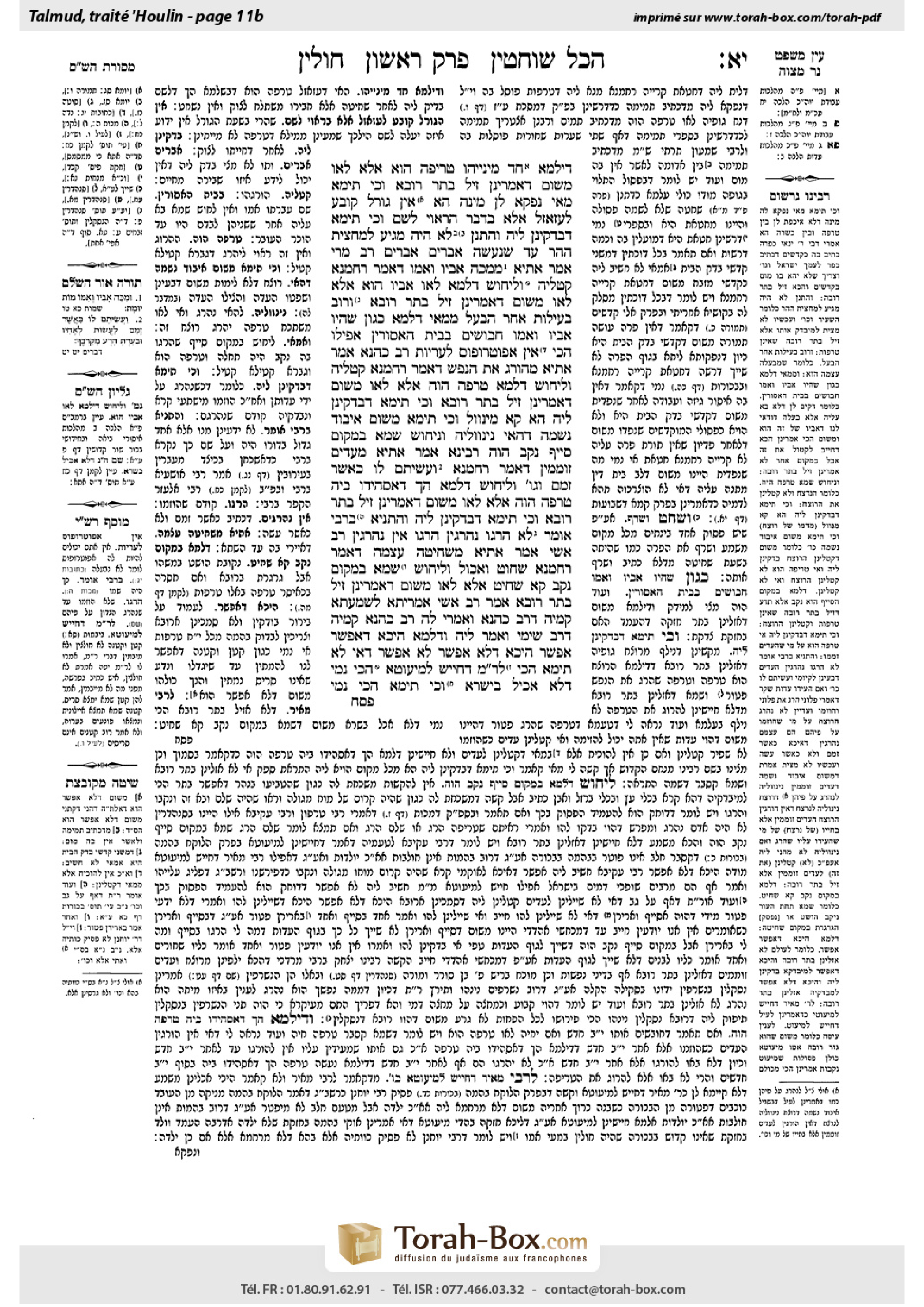
Chullin 11b: Talmud study for Daf Yomi
Study the Talmud for Daf Yomi with scanned pages, Hebrew text, English translations from Sefaria and AI-generated French translations.
Passage selection and English or AI-generated French translation are available where the scan has annotations. Daf Study is independent of Torah-Box and Sefaria.
Browse Chullin · חולין · All tractatesChullin 11b text and translations
This page of Chullin includes the Aramaic text, an English translation and an AI-generated French translation, alongside the scan above.
חולין י״א ב · Aramaic and Hebrew text
דִּילְמָא חַד מִינַּיְיהוּ טְרֵיפָה הוּא? אֶלָּא לָאו מִשּׁוּם דְּאָמְרִינַן: זִיל בָּתַר רוּבָּא.
וְכִי תֵּימָא, מַאי נָפְקָא לַן מִינַּהּ? הָא אֵין גּוֹרָל קוֹבֵעַ לַעֲזָאזֵל אֶלָּא בְּדָבָר הָרָאוּי לַשֵּׁם. וְכִי תֵּימָא דְּבָדְקִינַן לֵיהּ, וְהָתְנַן: לֹא הָיָה מַגִּיעַ לְמַחֲצִית הֶהָר עַד שֶׁנַּעֲשֶׂה אֵבָרִים אֵבָרִים.
רַב מָרִי אָמַר: אָתְיָא מִמַּכֵּה אָבִיו וְאִמּוֹ, דְּאָמַר רַחֲמָנָא קַטְלֵיהּ, וְלֵיחוּשׁ דִּלְמָא לָאו אָבִיו הוּא? אֶלָּא לָאו מִשּׁוּם דְּאָמְרִינַן: זִיל בָּתַר רוּבָּא, וְרוֹב בְּעִילוֹת אַחַר הַבַּעַל.
מִמַּאי? דִּלְמָא כְּגוֹן שֶׁהָיוּ אָבִיו וְאִמּוֹ חֲבוּשִׁים בְּבֵית הָאֲסוּרִין! אֲפִילּוּ הָכִי, אֵין אַפּוֹטְרוֹפּוֹס לַעֲרָיוֹת.
רַב כָּהֲנָא אָמַר: אָתְיָא מֵהוֹרֵג אֶת הַנֶּפֶשׁ, דְּאָמַר רַחֲמָנָא: קַטְלֵיהּ, וְלֵיחוּשׁ דִּלְמָא טְרֵפָה הֲוָה? אֶלָּא לָאו מִשּׁוּם דְּאָמְרִינַן: זִיל בָּתַר רוּבָּא.
וְכִי תֵּימָא דְּבָדְקִינַן לֵיהּ, הָא קָא מִינַּוַּול, וְכִי תֵּימָא מִשּׁוּם אִיבּוּד נְשָׁמָה דְּהַאי – נִינַוְּולֵיהּ, וְנֵיחוּשׁ שֶׁמָּא בִּמְקוֹם סַיִיף נֶקֶב הֲוָה.
רָבִינָא אָמַר: אָתְיָא מֵעֵדִים זוֹמְמִין, דְּאָמַר רַחֲמָנָא: ״וַעֲשִׂיתֶם לוֹ כַּאֲשֶׁר זָמַם וְגוֹ׳״, וְלֵיחוּשׁ דִּלְמָא הָךְ דְּאַסְהִידוּ בֵּיהּ טְרֵפָה הֲוָה? אֶלָּא לָאו מִשּׁוּם דְּאָמְרִינַן: זִיל בָּתַר רוּבָּא.
וְכִי תֵּימָא דְּבָדְקִינַן לֵיהּ, וְהָתַנְיָא: בְּרַבִּי אוֹמֵר: לֹא הָרְגוּ – נֶהֱרָגִין, הָרְגוּ – אֵין נֶהֱרָגִין.
רַב אָשֵׁי אָמַר: אָתְיָא מִשְּׁחִיטָה עַצְמָהּ, דְּאָמַר רַחֲמָנָא: שְׁחוֹט וֶאֱכוֹל, וְלֵיחוּשׁ שֶׁמָּא בִּמְקוֹם נֶקֶב קָא שָׁחֵיט? אֶלָּא לָאו מִשּׁוּם דְּאָמְרִינַן: זִיל בָּתַר רוּבָּא.
אָמַר רַב אָשֵׁי: אַמְרִיתָא לִשְׁמַעְתָּא קַמֵּיהּ דְּרַב כָּהֲנָא, וְאָמְרִי לָהּ רַב כָּהֲנָא קַמֵּיהּ דְּרַב שִׁימִי, וַאֲמַר לֵיהּ: וְדִלְמָא הֵיכָא דְּאֶפְשָׁר – אֶפְשָׁר, הֵיכָא דְּלָא אֶפְשָׁר – לָא אֶפְשָׁר.
דְּאִי לָא תֵּימָא הָכִי, לְרַבִּי מֵאִיר דְּחָיֵישׁ לְמִיעוּטָא, הָכִי נָמֵי דְּלָא אָכֵיל בִּישְׂרָא? וְכִי תֵּימָא הָכִי נָמֵי,
Chullin 11b · English translation
that perhaps one of the animals, the scapegoat, is a tereifa. Since it is not slaughtered, but is rather cast from a cliff while alive, there is no way to ascertain that it is not a tereifa. Rather, is the reason we are not concerned for this not due to the fact that we say: Follow the majority of animals, which are not tereifot?
And if you would seek to reject that proof and say that there is no need for an examination, as what practical difference is there to us whether it is a tereifa, since it is neither eaten nor sacrificed, and the two goats are fit after the fact even if they are not equal (see Yoma 62a); doesn’t the lot determine the goat for Azazel only with regard to an item, a goat, that is fit for sacrifice to the Lord? And if you would say that we examine the goat after it is cast from the cliff and do not rely on a majority, but didn’t we learn in a mishna (Yoma 67a): The goat did not reach halfway down the mountain until it was torn limb from limb.
Rav Mari said: The fact that one follows a non-quantifiable majority is derived from the halakha of one who strikes his father or his mother, with regard to whom the Merciful One states: Kill him (see Exodus 21:15). Rav Mari clarifies: But let us be concerned that perhaps the man that he struck is not actually his father. Rather, is the reason we are not concerned for this not due to the fact that we say: Follow the majority, and the majority of acts of intercourse performed by a married woman are attributable to the husband.
The Gemara asks: From where is that conclusion drawn? Perhaps the reference is to a case where at the time he was conceived his mother and father were incarcerated together in prison. Therefore, the fact that it was his father that he struck is based on certainty, not a majority. The Gemara answers: Even so, there is no steward [apotropos] for restraining sexual immorality, and the identity of his father is not based on certainty.
Rav Kahana said: It is derived from the halakha of one who kills another person, with regard to whom the Merciful One states: Kill him (see Exodus 21:12). Rav Kahana clarifies: And let us be concerned that perhaps the person that he killed was a tereifa, one who has a wound or condition that will lead to his death within twelve months. One who kills a tereifa is exempt from capital punishment because in that sense, the halakhic status of a tereifa is that of a dead person. Rather, is the reason we are not concerned for this not due to the fact that we say: Follow the majority of people, who are not tereifot?
And if you would seek to reject that proof and say that we examine the corpse to determine whether he was a tereifa, wouldn’t the corpse be mutilated through that examination? And if you would say that due to concern for the possibility of an unjustified loss of life of that murderer, we will mutilate the corpse to determine whether the victim was a tereifa, it would remain necessary to rely on the majority, as let us be concerned that perhaps there was a perforation in the place that he stabbed the victim with the sword.
Ravina said: It is derived from the halakha of conspiring witnesses, with regard to whom the Merciful One states: “And you shall do unto him as he had conspired to do unto his brother” (Deuteronomy 19:19). If the witnesses testified falsely that a person is guilty of a capital offense, they are liable to receive the death penalty. And let us be concerned that perhaps that person against whom they testified was a tereifa, and they should not be executed for conspiring to have a tereifa executed. Rather, is the reason we are not concerned for this not due to the fact that we say: Follow the majority of people, who are not tereifot?
And if you would say in rejection of that proof that we examine the corpse of the executed defendant to determine whether he was a tereifa, but isn’t it taught in a baraita that a distinguished Sage [beribbi] says with regard to witnesses who conspired to have a person killed based on their testimony: If the conspiring witnesses have not yet killed the accused with their testimony, they are executed; but if they killed the accused with their testimony, they are not executed.
Rav Ashi said: The principle of following a non-quantifiable majority is derived from the halakha of slaughter itself, with regard to which the Merciful One states: Slaughter the animal and eat it. And let us be concerned that perhaps he is slaughtering the animal in the place of a preexisting perforation. Rather, is the reason we are not concerned for this not due to the fact that we say: Follow the majority of animals that are not tereifot?
Rav Ashi said: I stated this halakha before Rav Kahana, and some say that Rav Kahana stated this halakha before Rav Shimi, and the Sage before whom the halakha was stated said to the one who stated it: And perhaps where it is possible to examine the situation it is possible, and the majority is not followed; but where it is not possible to examine the situation it is not possible, and the majority is followed.
As if you do not say so, then according to Rabbi Meir, who despite the existence of a majority takes the minority into consideration and does not follow the majority, is it indeed true that one does not eat meat due to the concern that there was a perforation in the place that he slaughtered the animal? And if you would say, indeed, according to Rabbi Meir it is prohibited to eat meat,
Chullin 11b · Traduction française (IA)
que peut-être l'un des animaux, le bouc émissaire, est un téréif. Comme il n'est pas sacrifié, mais plutôt jeté du haut d'un rocher tout vivant, il n'y a aucun moyen de vérifier qu'il ne s'agit pas d'un téréif. Plutôt, la raison pour laquelle nous ne nous en préoccupons pas ne vient-elle pas du fait que nous disons : Suivez la majorité des animaux, qui ne sont pas téréifs ?
Et si vous vouliez rejeter cette preuve et dire qu'il n'y a pas besoin d'examen, car quelle différence pratique avons-nous si c'est un téréif, puisqu'il n'est ni mangé ni sacrifié, et les deux boucs sont considérés comme propres même s'ils ne sont pas égaux (voir Yoma 62a) ; ne détermine-t-il pas le lot du bouc pour Azazel uniquement en ce qui concerne un animal, un bouc, propre à l'adoration du Seigneur ? Et si vous disiez que nous examinons le bouc après qu'il ait été jeté du rocher et que nous ne nous appuyons pas sur la majorité, n'avons-nous pas appris dans une mitsva (Yoma 67a) : Le bouc n'a pas atteint la moitié du montagnes avant d'être déchiré membre par membre ?
Rav Mari a dit : Le fait de suivre une majorité non quantifiable est tiré de la halakha de celui qui frappe son père ou sa mère, concernant lequel le Tout-Puissant dit : Tue-le (voir Exode 21:15). Rav Mari précise : Mais laissons-nous inquiéter que peut-être la personne qu'il a frappé n'est pas effectivement son père. Plutôt, la raison pour laquelle nous ne nous en préoccupons pas ne vient-elle pas du fait que nous disons : Suivez la majorité, et la majorité des actes sexuels accomplis par une femme mariée sont attribués à son mari ?
La Guemara demande : D'où cette conclusion est-elle tirée ? Peut-être la référence est-elle à un cas où, à l'époque de sa conception, sa mère et son père étaient incarcérés ensemble dans une prison. Ainsi, le fait qu'il s'agisse de son père qu'il a frappé est basé sur la certitude, pas sur la majorité. La Guemara répond : Même ainsi, il n'y a pas de gardien [apotropos] pour empêcher la luxure, et l'identité de son père n'est pas basée sur la certitude.
Rav Kahana a dit : Il est tiré de la halakha de celui qui tue une autre personne, concernant lequel le Tout-Puissant dit : Tue-le (voir Lévitique 21:12). Rav Kahana précise : Et laissons-nous inquiéter que peut-être la personne qu'il a tuée était un téréif, c'est-à-dire une personne qui a une blessure ou une maladie qui mènera à sa mort dans les douze mois. Celui qui tue un téréif est exempt de la peine de mort, car, dans ce sens, le statut halakhique d'un téréif est celui d'une personne morte. Plutôt, la raison pour laquelle nous ne nous en préoccupons pas ne vient-elle pas du fait que nous disons : Suivez la majorité des gens, qui ne sont pas téréif ?
Et si vous vouliez rejeter cette preuve et dire que nous examinons le corps pour déterminer s'il s'agissait d'un téréif, ne serait-il pas mutilé par cet examen ? Et si vous disiez que, par crainte de la perte injustifiée de vie du meurtrier, nous mutilerions le corps pour déterminer si la victime était un téréif, il resterait nécessaire de se fier à la majorité, car laissons-nous inquiéter que peut-être il y avait une perforation au lieu où il a frappé la victime avec son épée.
Ravina a dit : Il est tiré de la halakha des témoins qui conspirent, concernant lequel le Tout-Puissant dit : « Et tu feras à lui ce qu'il avait combiné de faire à son frère » (Deutéronome 19:19). Si les témoins ont témoigné faussement que quelqu'un est coupable d'une offense capitale, ils sont tenus de recevoir la peine de mort. Et laissons-nous inquiéter que peut-être la personne contre laquelle ils ont témoigné était un téréif, et qu'ils ne devraient pas être exécutés pour avoir conspiré à exécuter un téréif. Plutôt, la raison pour laquelle nous ne nous en préoccupons pas ne vient-elle pas du fait que nous disons : Suivez la majorité des gens, qui ne sont pas téréif ?
Et si vous disiez, en rejetant cette preuve, que nous examinons le corps du défunt accusé pour déterminer s'il était un téréif, n'est-il pas enseigné dans une baraïta que le Sage [beribbi] dit concernant les témoins qui ont conspiré à faire mourir une personne sur la base de leur témoignage : Si les témoins conspirants n'ont pas encore tué l'accusé avec leur témoignage, ils sont exécutés ; mais si ils ont tué l'accusé avec leur témoignage, ils ne sont pas exécutés.
Rav Ashi a dit : Le principe de suivre une majorité non quantifiable est tiré de la halakha de la bataille, concernant laquelle le Tout-Puissant dit : Tue l'animal et mange-le. Et laissons-nous inquiéter que peut-être il tue l'animal à l'endroit d'une perforation préexistante. Plutôt, la raison pour laquelle nous ne nous en préoccupons pas ne vient-elle pas du fait que nous disons : Suivez la majorité des animaux qui ne sont pas téréif ?
Rav Ashi a dit : J'ai dit cette halakha à Rav Kahana, et certains disent que Rav Kahana a dit cette halakha à Rav Shimi, et le Sage devant qui la halakha a été dite a dit à celui qui l'avait dite : Et peut-être que là où il est possible d'examiner la situation, il est possible, et la majorité n'est pas suivie ; mais là où il n'est pas possible d'examiner la situation, il n'est pas possible, et la majorité est suivie.
Comme si vous ne disiez pas cela, alors selon Rabbi Meir, qui malgré l'existence d'une majorité prend en compte la minorité et ne suit pas la majorité, est-ce vraiment vrai que l'on ne mange pas de viande par crainte qu'il y ait une perforation à l'endroit où il a tué l'animal ? Et si vous disiez, en effet, selon Rabbi Meir, il est interdit de manger de la viande,
Traduction française générée par IA à partir de l’édition anglaise de Sefaria. Vérifie toujours un passage avec le texte source.
Text from Sefaria: William Davidson Edition - Vocalized Aramaic (unknown); William Davidson Edition - English (CC BY NC).