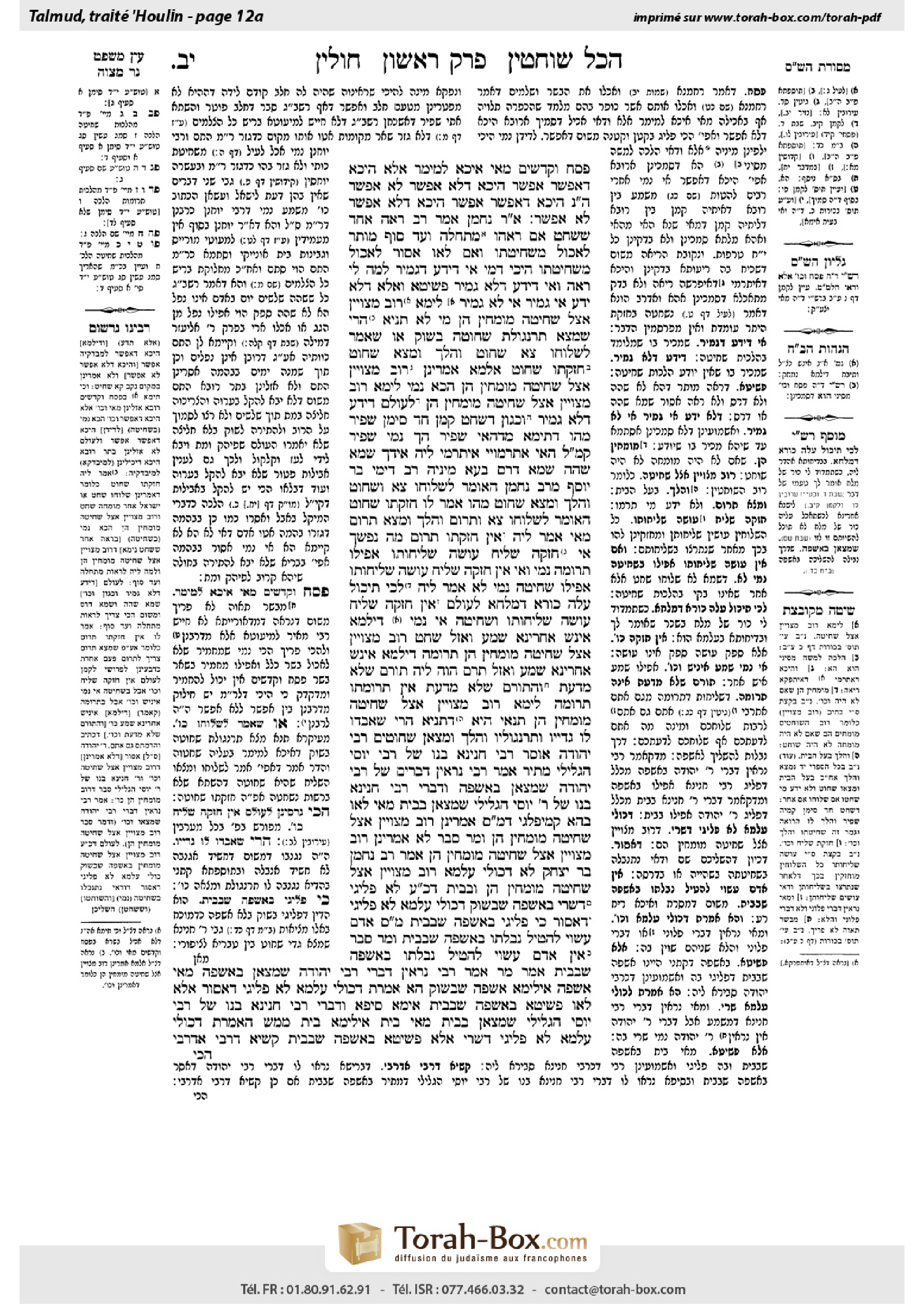
Chullin 12a: Talmud study for Daf Yomi
Study the Talmud for Daf Yomi with scanned pages, Hebrew text, English translations from Sefaria and AI-generated French translations.
Passage selection and English or AI-generated French translation are available where the scan has annotations. Daf Study is independent of Torah-Box and Sefaria.
Browse Chullin · חולין · All tractatesChullin 12a text and translations
This page of Chullin includes the Aramaic text, an English translation and an AI-generated French translation, alongside the scan above.
חולין י״ב א · Aramaic and Hebrew text
פֶּסַח וְקָדָשִׁים מַאי אִיכָּא לְמֵימַר? אֶלָּא הֵיכָא דְּאֶפְשָׁר – אֶפְשָׁר, הֵיכָא דְּלָא אֶפְשָׁר – לָא אֶפְשָׁר. הָכָא נָמֵי, הֵיכָא דְּאֶפְשָׁר – אֶפְשָׁר, הֵיכָא דְּלָא אֶפְשָׁר – לָא אֶפְשָׁר.
אָמַר רַב נַחְמָן אָמַר רַב: רָאָה אֶחָד שֶׁשָּׁחַט, אִם רָאָהוּ מִתְּחִלָּה וְעַד סוֹף – מוּתָּר לֶאֱכוֹל מִשְּׁחִיטָתוֹ, וְאִם לָאו – אָסוּר לֶאֱכוֹל מִשְּׁחִיטָתוֹ.
הֵיכִי דָמֵי? אִי דְּיָדַע דִּגְמִיר, לְמָה לִי רָאָה? וְאִי דְּיָדַע דְּלָא גְּמִיר, פְּשִׁיטָא!
וְאֶלָּא, דְּלָא יְדַע אִי גְּמִיר אִי לָא גְּמִיר, לֵימָא: רוֹב מְצוּיִין אֵצֶל שְׁחִיטָה מוּמְחִין הֵן.
מִי לָא תַּנְיָא: הֲרֵי שֶׁמָּצָא תַּרְנְגוֹלֶת שְׁחוּטָה בַּשּׁוּק, אוֹ שֶׁאָמַר לִשְׁלוּחוֹ ״צֵא שְׁחוֹט״, וְהָלַךְ וּמָצָא שָׁחוּט – חֶזְקָתוֹ שָׁחוּט.
אַלְמָא אָמְרִינַן: רוֹב מְצוּיִין אֵצֶל שְׁחִיטָה מוּמְחִין הֵן. הָכָא נָמֵי לֵימָא: רוֹב מְצוּיִין אֵצֶל שְׁחִיטָה מוּמְחִין הֵן!
לְעוֹלָם דְּיָדַע דְּלָא גְּמִיר, וּכְגוֹן דִּשְׁחַט קַמַּן חַד סִימָן שַׁפִּיר. מַהוּ דְּתֵימָא: מִדְּהַאי שַׁפִּיר הָךְ נָמֵי שַׁפִּיר, קָא מַשְׁמַע לַן: הַאי אִתְרְמוֹיֵי אִיתְרְמִי לֵיהּ, אִידַּךְ – שֶׁמָּא שָׁהָה שֶׁמָּא דָּרַס.
בְּעָא מִינֵּיהּ רַב דִּימִי בַּר יוֹסֵף מֵרַב נַחְמָן: הָאוֹמֵר לִשְׁלוּחוֹ ״צֵא וּשְׁחוֹט״, וְהָלַךְ וּמָצָא שָׁחוּט, מַהוּ? אָמַר לוֹ: חֶזְקָתוֹ שָׁחוּט. הָאוֹמֵר לִשְׁלוּחוֹ ״צֵא וּתְרוֹם״, וְהָלַךְ וּמָצָא תָּרוּם, מַאי? אֲמַר לֵיהּ: אֵין חֶזְקָתוֹ תָּרוּם.
מָה נַפְשָׁךְ, אִי חֲזָקָה שָׁלִיחַ עוֹשֶׂה שְׁלִיחוּתוֹ – אֲפִילּוּ תְּרוּמָה נָמֵי, וְאִי אֵין חֲזָקָה שָׁלִיחַ עוֹשֶׂה שְׁלִיחוּתוֹ – אֲפִילּוּ שְׁחִיטָה נָמֵי לָא.
אֲמַר לֵיהּ: לְכִי תֵּיכוּל עֲלַהּ כּוֹרָא דְמִלְחָא, לְעוֹלָם אֵין חֲזָקָה שָׁלִיחַ עוֹשֶׂה שְׁלִיחוּתוֹ, וּשְׁחִיטָה – אִי נָמֵי דִּילְמָא אִינָשׁ אַחֲרִינָא שְׁמַע וַאֲזַל שְׁחַט – רוֹב מְצוּיִין אֵצֶל שְׁחִיטָה מוּמְחִין הֵן. תְּרוּמָה – דִּילְמָא אִינָשׁ אַחֲרִינָא שְׁמַע וַאֲזַל תְּרַם, הָוֵה לֵיהּ תּוֹרֵם שֶׁלֹּא מִדַּעַת, וְהַתּוֹרֵם שֶׁלֹּא מִדַּעַת – אֵין תְּרוּמָתוֹ תְּרוּמָה.
לֵימָא: רוֹב מְצוּיִין אֵצֶל שְׁחִיטָה מוּמְחִין הֵן תַּנָּאֵי הִיא? דְּתַנְיָא: הֲרֵי שֶׁאָבְדוּ לוֹ גְּדָיָיו וְתַרְנְגוֹלָיו וְהָלַךְ וּמְצָאָן שְׁחוּטִים – רַבִּי יְהוּדָה אוֹסֵר, רַבִּי חֲנִינָא בְּנוֹ שֶׁל רַבִּי יוֹסֵי הַגְּלִילִי מַתִּיר. אָמַר רַבִּי: נִרְאִין דְּבָרִים שֶׁל רַבִּי יְהוּדָה שֶׁמְּצָאָן בְּאַשְׁפָּה, וְדִבְרֵי רַבִּי חֲנִינָא בְּנוֹ שֶׁל רַבִּי יוֹסֵי הַגְּלִילִי שֶׁמְּצָאָן בְּבַיִת.
מַאי לָאו בְּהָא קָמִיפַּלְגִי, דְּמָר סָבַר: אָמְרִינַן רוֹב מְצוּיִין אֵצֶל שְׁחִיטָה מוּמְחִין הֵן, וּמָר סָבַר: לָא אָמְרִינַן רוֹב מְצוּיִין אֵצֶל שְׁחִיטָה מוּמְחִין הֵן?
אָמַר רַב נַחְמָן בַּר יִצְחָק: לָא, דְּכוּלֵּי עָלְמָא רוֹב מְצוּיִין אֵצֶל שְׁחִיטָה מוּמְחִין הֵן, וּבְבַיִת – דְּכוּלֵּי עָלְמָא לָא פְּלִיגִי דִּשְׁרֵי, בְּאַשְׁפָּה שֶׁבַּשּׁוּק – דְּכוּלֵּי עָלְמָא לָא פְּלִיגִי דְּאָסוּר, כִּי פְּלִיגִי בְּאַשְׁפָּה שֶׁבַּבַּיִת: מָר סָבַר אָדָם עָשׂוּי לְהַטִּיל נִבְלָתוֹ בְּאַשְׁפָּה שֶׁבַּבַּיִת, וּמַר סָבַר אֵין אָדָם עָשׂוּי לְהַטִּיל נִבְלָתוֹ בְּאַשְׁפָּה שֶׁבַּבַּיִת.
אָמַר מָר, אָמַר רַבִּי: נִרְאִין דִּבְרֵי רַבִּי יְהוּדָה שֶׁמְּצָאָן בְּאַשְׁפָּה. מַאי אַשְׁפָּה? אִילֵּימָא אַשְׁפָּה שֶׁבְּשׁוּק – הָא אָמְרַתְּ דְּכוּלֵּי עָלְמָא לָא פְּלִיגִי דְּאָסוּר! אֶלָּא לָאו פְּשִׁיטָא בְּאַשְׁפָּה שֶׁבַּבַּיִת.
אֵימָא סֵיפָא, וְדִבְרֵי רַבִּי חֲנִינָא בְּנוֹ שֶׁל רַבִּי יוֹסֵי הַגְּלִילִי שֶׁמְּצָאָן בְּבַיִת. מַאי בַּיִת? אִילֵּימָא בַּיִת מַמָּשׁ – הָאָמְרַתְּ דְּכוּלֵּי עָלְמָא לָא פְּלִיגִי דִּשְׁרֵי! אֶלָּא פְּשִׁיטָא בְּאַשְׁפָּה שֶׁבַּבַּיִת. קַשְׁיָא דְּרַבִּי אַדְּרַבִּי!
Chullin 12a · English translation
then with regard to the Paschal offering and sacrificial meat that one is obligated to eat, what is there to say? Rather, according to Rabbi Meir, there is no alternative to saying: Where it is possible to examine the situation it is possible, and the majority is not followed; where it is not possible to examine the situation it is not possible, and the majority is followed. If so, here too, according to the Rabbis, it cannot be proven from the above sources that one follows a non-quantifiable majority ab initio, as perhaps where it is possible to examine the situation it is possible, and where it is not possible to examine the situation it is not possible, and the majority is followed.
§ Rav Naḥman says that Rav says: In the case of a person who saw one who slaughtered an animal, if the person saw him slaughtering continuously from beginning to end of the act, he is permitted to eat from his slaughter, and if not, he is prohibited from eating from his slaughter.
The Gemara asks: What are the circumstances? If it is a case where the onlooker knows that he is knowledgeable in the halakhot of slaughter, why do I require that the onlooker saw the slaughter? Even if he did not see him slaughter, the onlooker may rely on his slaughter. And if the onlooker knows that he is not knowledgeable in the halakhot of slaughter, it is obvious that only if the person saw him slaughtering from beginning to end he is permitted to eat from his slaughter.
Rather, perhaps it is a case where the onlooker does not know whether he is knowledgeable or whether he is not knowledgeable. But if that is the case, let us say: The majority of those associated with slaughter are experts in the halakhot of slaughter, and one may rely on his slaughter.
Isn’t it taught in a baraita: In a case where one found a slaughtered chicken in the marketplace, or where one said to his agent: Go out and slaughter a chicken, and he went and found the chicken slaughtered and he does not know who slaughtered it, its presumptive status is that it was slaughtered properly.
Apparently, we say: The majority of those associated with slaughter are experts. Here too, in a case where it is unknown whether he is knowledgeable, let us say: The majority of those associated with slaughter are experts.
The Gemara answers: Actually, the reference is to a case where the onlooker knows that the one slaughtering is not knowledgeable in the halakhot of slaughter, and where he slaughtered one siman before us properly. Lest you say: From the fact that this siman was slaughtered properly, that siman was also slaughtered properly; therefore, Rav teaches us that this is not so. As, perhaps this siman happened to be slaughtered properly for him, but with regard to the other siman, perhaps he interrupted the slaughter or perhaps he pressed the knife, invalidating the slaughter.
Rav Dimi bar Yosef raised a dilemma before Rav Naḥman: With regard to one who says to his agent: Go out and slaughter a chicken, and he went and found the chicken slaughtered, what is the halakha? Rav Naḥman said to him: Its presumptive status is that it was slaughtered properly. And he raised another dilemma: With regard to one who says to his agent: Go out and separate teruma for me, and he went and found that teruma was separated from his produce, what is the halakha? Rav Naḥman said to him: Its presumptive status is not that teruma was separated.
Rav Dimi bar Yosef challenged: Whichever way you look at it, your ruling is problematic. If there is a presumption that an agent performs his assigned agency, that should be the case even with regard to teruma; and if there is no presumption that an agent performs his assigned agency, there should be no such presumption even with regard to slaughter.
Rav Naḥman said to Rav Dimi in jest: After you eat a kor of salt over it, and analyze the matter at length, you will be able to understand the difference. Actually, there is no presumption that an agent performs his assigned agency, and in the case of slaughter, even if perhaps another person heard him instruct the agent and that person went and slaughtered the chicken, the slaughter would be valid, because the majority of those associated with slaughter are experts. By contrast, in the case of teruma, if perhaps another person heard him instruct the agent and then went and separated his teruma, he becomes one who designates teruma without the knowledge of the owner of the produce; and with regard to one who designates teruma without the knowledge of the owner of the produce, his teruma is not teruma.
The Gemara suggests: Let us say that the statement: The majority of those associated with slaughter are experts, is a dispute between tanna’im, as it is taught in a baraita: In a case where one’s young goats and roosters were lost, and the owner went and found them slaughtered, Rabbi Yehuda deems the meat forbidden, and Rabbi Ḥanina, son of Rabbi Yosei HaGelili, deems it permitted. Rabbi Yehuda HaNasi said: The statement of Rabbi Yehuda appears correct in a case where the owner found the slaughtered animals in a scrap heap, as the concern is that they were thrown away because the slaughter was not valid. And the statement of Rabbi Ḥanina, son of Rabbi Yosei HaGelili, appears correct in a case where he found them in the house.
What, is it not with regard to this matter that they disagree, that one Sage, Rabbi Ḥanina, holds: We say that the majority of those associated with slaughter are experts, and one Sage, Rabbi Yehuda, holds: We do not say that the majority of those associated with slaughter are experts?
Rav Naḥman bar Yitzḥak said: No, the fact is that everyone agrees that the majority of those associated with slaughter are experts, and if he found the slaughtered goats or roosters in the house, everyone agrees that it is permitted to eat the meat. If he found them in a scrap heap that is in the marketplace, everyone agrees that it is prohibited to eat the meat. When they disagree is in a case where he found them in a scrap heap that is in the house. One Sage, Rabbi Yehuda, holds: A person is prone to cast his unslaughtered animal carcass onto a scrap heap that is in the house. And one Sage, Rabbi Ḥanina, holds: A person is not prone to cast his unslaughtered animal carcass onto a scrap heap that is in the house.
The Master said in the baraita that Rabbi Yehuda HaNasi said: The statement of Rabbi Yehuda appears correct in a case where he found them in the scrap heap. The Gemara asks: What is the term scrap heap referring to in this context? If we say the reference is to a scrap heap in the marketplace, didn’t you say that everyone agrees that it is prohibited, and it is not merely the opinion of Rabbi Yehuda? Rather, it is obvious that he found it on a scrap heap that is in the house, and it is in that case that Rabbi Yehuda HaNasi rules in accordance with the opinion of Rabbi Yehuda.
Say the latter clause of the statement of Rabbi Yehuda HaNasi: And the statement of Rabbi Ḥanina, son of Rabbi Yosei HaGelili, appears correct in a case where he found them in the house. What is the word house referring to in this context? If we say the reference is to an actual house, didn’t you say that everyone agrees that it is permitted? Rather, it is obvious that he found it on a scrap heap that is in the house. If so, it is difficult, as there is a contradiction between one statement of Rabbi Yehuda HaNasi, where he rules in accordance with the opinion of Rabbi Yehuda to prohibit the meat in a case where it is found in a scrap heap in the house, and another statement of Rabbi Yehuda HaNasi, where he rules in accordance with the opinion of Rabbi Ḥanina, son of Rabbi Yosei HaGelili, to permit the meat in that case.
Chullin 12a · Traduction française (IA)
En ce qui concerne l'offrande pascal et la viande sacrée que l'on est tenu de manger, que peut-on dire ? Plutôt, selon Rabbi Meir, il n'y a pas d'autre solution que de dire : Lorsqu'il est possible d'examiner la situation, on l'examine, et la majorité n'est pas suivie ; lorsqu'il n'est pas possible d'examiner la situation, on ne l'examine pas, et la majorité est suivie. Si c'est ainsi, ici aussi, selon les Sages, il ne peut pas être prouvé à partir des sources ci-dessus que l'on suit une majorité non quantifiable dès le début, car peut-être, lorsqu'il est possible d'examiner la situation, on l'examine, et lorsqu'il n'est pas possible d'examiner la situation, on ne l'examine pas, et la majorité est suivie.
§ Rav Naḥman dit que Rav dit : Dans le cas d'une personne qui a vu un autre qui a tué un animal, si la personne a vu qu'il tuait continuellement du début à la fin de l'acte, elle est autorisée à manger de son meurtre, et si ce n'est pas le cas, elle est interdite de manger de son meurtre.
La Guemara pose la question : Quelles sont les circonstances ? Si c'est un cas où l'observateur sait qu'il est compétent en matière de halakha du meurtre, pourquoi exige-t-on que l'observateur ait vu le meurtre ? Même s'il n'a pas vu le meurtre, l'observateur peut se fier à son meurtre. Et si l'observateur sait qu'il n'est pas compétent en matière de halakha du meurtre, il est évident que seul si la personne a vu qu'il tuait du début à la fin est-elle autorisée à manger de son meurtre.
Plutôt, peut-être il s'agit d'un cas où l'observateur ne sait pas s'il est compétent ou non. Mais si c'est le cas, disons : La majorité de ceux qui sont associés à la boucherie sont des experts en matière de halakhot de la boucherie, et l'on peut se fier à son boucherie.
Ne dit-on pas dans une baraïta : Dans un cas où l'on trouve un poulet sacrifié sur le marché, ou où l'on dit à son agent : Va dehors et sacrifie un poulet, et il va et trouve le poulet sacrifié et ne sait pas qui l'a sacrifié, son statut présomptif est qu'il a été sacrifié correctement.
Apparemment, nous disons : La majorité de ceux qui sont associés au sacrifice sont des experts. Ici aussi, dans un cas où l'on ne sait pas si l'autre est compétent, disons : La majorité de ceux qui sont associés au sacrifice sont des experts.
La Guemara répond : En réalité, la référence est à un cas où l'observateur sait que celui qui effectue la bête n'est pas compétent en matière de halakha de la bête, et où il a effectué un siman devant nous correctement. De peur que l'on dise : Parce que ce siman a été effectué correctement, ce siman a aussi été effectué correctement ; donc Rav nous enseigne que ce n'est pas le cas. En effet, peut-être ce siman a eu la chance d'être effectué correctement pour lui, mais concernant l'autre siman, peut-être il a interrompu l'effet ou peut-être il a pressé le couteau, invalidant l'effet.
Rav Dimi bar Yosef a posé un dilemme devant Rav Naḥman : Concernant celui qui dit à son agent : Va dehors et effectue un poulet, et il va et trouve le poulet effectué, quelle est la halakha ? Rav Naḥman a dit à lui : Son statut présomptif est qu'il a été effectué correctement. Et il a posé un autre dilemme : Concernant celui qui dit à son agent : Va dehors et sépare la terouma pour moi, et il va et trouve que la terouma a été séparée de ses produits, quelle est la halakha ? Rav Naḥman a dit à lui : Son statut présomptif n'est pas que la terouma a été séparée.
Rav Dimi bar Yosef a contesté : Quel que soit le point de vue, votre décision est problématique. Si il y a une présomption que l'agent exécute son mandat, cela devrait être le cas même concernant la terouma ; et si il n'y a pas de présomption que l'agent exécute son mandat, il ne devrait pas y avoir de telle présomption même concernant l'effet.
Rav Naḥman a dit à Rav Dimi avec humour : Après que vous ayez mangé un kor de sel sur cela, et que vous aurez analysé la question en détail, vous comprendrez la différence. En réalité, il n'y a pas de présomption que l'agent exécute son mandat, et dans le cas de la boucherie, même si peut-être une autre personne a entendu l'homme instruire l'agent et que cette personne est allée sacrifier le poulet, le sacrifice serait valide, car la majorité de ceux qui sont associés à la boucherie sont des experts. En revanche, dans le cas de la terouma, si peut-être une autre personne a entendu l'homme instruire l'agent et que cette personne a ensuite séparé sa terouma, il devient celui qui désigne la terouma sans la connaissance du propriétaire des produits ; et concernant celui qui désigne la terouma sans la connaissance du propriétaire des produits, sa terouma n'est pas terouma.
La Guemara suggère : Disons que l'affirmation : La majorité de ceux qui sont associés à la boucherie sont des experts, est un débat entre les tannaïm, comme il est enseigné dans une baraïta : Dans un cas où les jeunes boucs et les poulets de quelqu'un ont été perdus, et que l'propriétaire a trouvé qu'ils avaient été sacrifiés, Rabbi Yehuda considère la viande comme interdite, et Rabbi Ḥanina, fils de Rabbi Yosei HaGelili, considère qu'elle est permise. Rabbi Yehuda HaNasi a dit : L'affirmation de Rabbi Yehuda semble correcte dans un cas où l'propriétaire a trouvé les animaux sacrifiés dans un tas de déchets, car la préoccupation est qu'ils ont été jetés parce que le sacrifice n'était pas valide. Et l'affirmation de Rabbi Ḥanina, fils de Rabbi Yosei HaGelili, semble correcte dans un cas où il les a trouvés à la maison.
Qu'est-ce que ce n'est pas concernant cette question qu'ils débattent, que l'un des Sages, Rabbi Ḥanina, affirme : Nous disons que la majorité de ceux qui sont associés à la boucherie sont des experts, et l'autre Sage, Rabbi Yehuda, affirme : Nous ne disons pas que la majorité de ceux qui sont associés à la boucherie sont des experts ?
Rav Naḥman bar Yitzḥak a dit : Non, la réalité est que tout le monde convient que la majorité de ceux qui sont associés à la boucherie sont des experts, et s'il trouvait des agneaux ou des poulets sacrifiés à la maison, tout le monde convient qu'il est permis de manger la viande. S'il les trouvait dans un tas de détritus qui est dans le marché, tout le monde convient qu'il est interdit de manger la viande. Le désaccord est dans le cas où il les trouvait dans un tas de détritus qui est à la maison. Un sage, Rabbi Yéhuda, dit : Une personne a tendance à jeter le cadavre d'un animal non sacrifié dans un tas de détritus qui est à la maison. Et un autre sage, Rabbi Ḥanina, dit : Une personne n'a pas tendance à jeter le cadavre d'un animal non sacrifié dans un tas de détritus qui est à la maison.
Le Maître a dit dans la baraïta que Rabbi Yéhuda HaNasi a dit : L'opinion de Rabbi Yéhuda est correcte dans le cas où il les trouvait dans le tas de détritus. La Guemara pose la question : De quel tas de détritus s'agit-il dans ce contexte ? Si nous disons que c'est un tas de détritus dans le marché, n'avez-vous pas dit que tout le monde convient qu'il est interdit, et ce n'est pas seulement l'opinion de Rabbi Yéhuda ? Plutôt, il est évident qu'il les trouvait dans un tas de détritus qui est à la maison, et c'est dans ce cas que Rabbi Yéhuda HaNasi rend son jugement conformément à l'opinion de Rabbi Yéhuda.
Dites la seconde partie de l'opinion de Rabbi Yéhuda HaNasi : Et l'opinion de Rabbi Ḥanina, fils de Rabbi Yosei HaGelili, est correcte dans le cas où il les trouvait à la maison. De quel mot « maison » s'agit-il dans ce contexte ? Si nous disons que c'est une maison réelle, n'avez-vous pas dit que tout le monde convient qu'il est permis ? Plutôt, il est évident qu'il les trouvait dans un tas de détritus qui est à la maison. Si c'est ainsi, c'est difficile, car il y a une contradiction entre une déclaration de Rabbi Yéhuda HaNasi, où il rend son jugement conformément à l'opinion de Rabbi Yéhuda pour interdire la viande dans le cas où elle est trouvée dans un tas de détritus à la maison, et une autre déclaration de Rabbi Yéhuda HaNasi, où il rend son jugement conformément à l'opinion de Rabbi Ḥanina, fils de Rabbi Yosei HaGelili, pour permettre la viande dans ce cas.
Traduction française générée par IA à partir de l’édition anglaise de Sefaria. Vérifie toujours un passage avec le texte source.
Text from Sefaria: William Davidson Edition - Vocalized Aramaic (unknown); William Davidson Edition - English (CC BY NC).