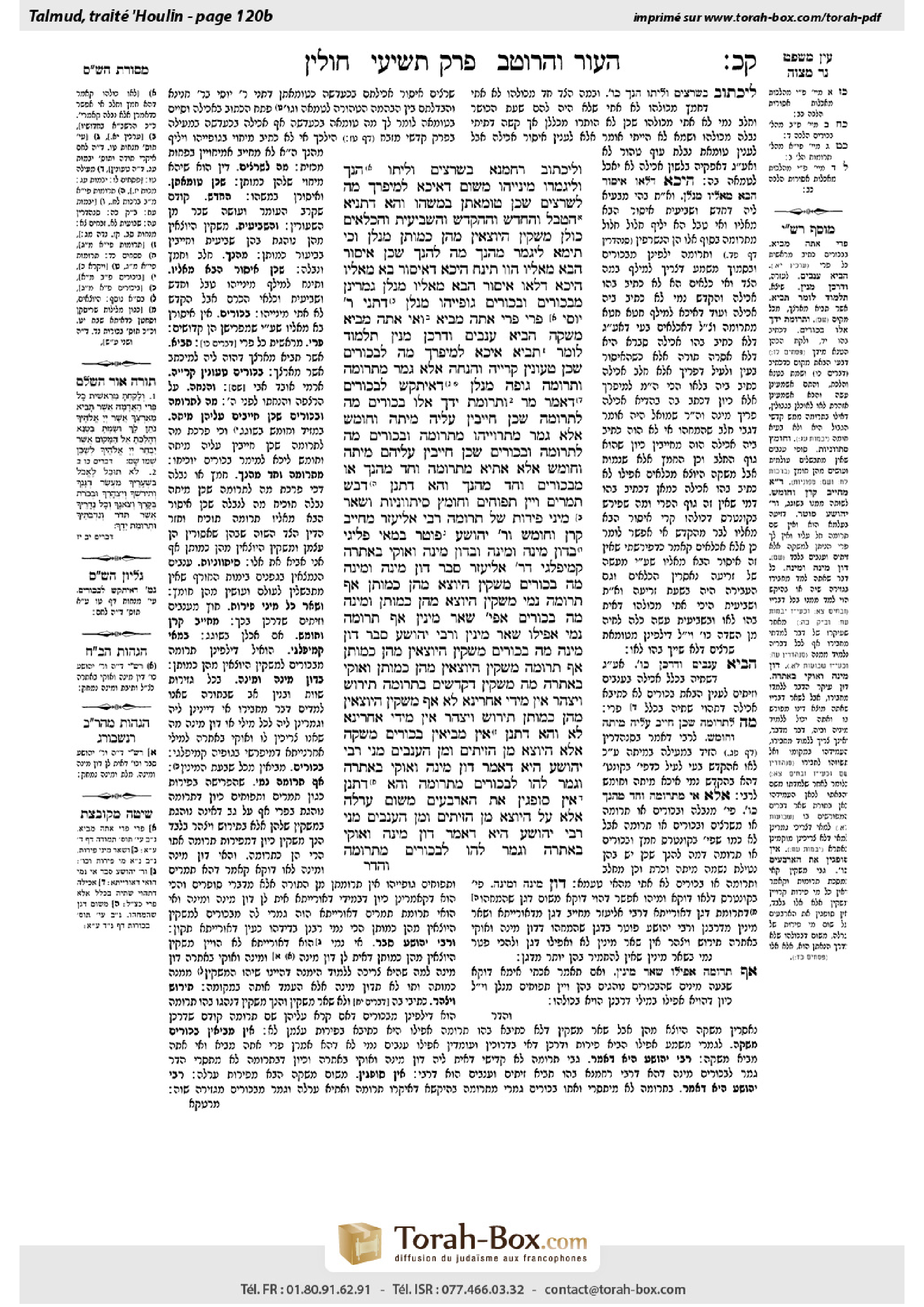
Chullin 120b: Talmud study for Daf Yomi
Study the Talmud for Daf Yomi with scanned pages, Hebrew text, English translations from Sefaria and AI-generated French translations.
Passage selection and English or AI-generated French translation are available where the scan has annotations. Daf Study is independent of Torah-Box and Sefaria.
Browse Chullin · חולין · All tractatesChullin 120b text and translations
This page of Chullin includes the Aramaic text, an English translation and an AI-generated French translation, alongside the scan above.
חולין ק״כ ב · Aramaic and Hebrew text
וְלִיכְתּוֹב רַחֲמָנָא בִּשְׁרָצִים, וְלֵיתוֹ הָנָךְ וְלִיגְמְרוּ מִינַּיְיהוּ!
מִשּׁוּם דְּאִיכָּא לְמִיפְרַךְ: מָה לִשְׁרָצִים, שֶׁכֵּן טוּמְאָתָן בְּמַשֶּׁהוּ.
וְהָא דְּתַנְיָא: הַטֶּבֶל, וְהֶחָדָשׁ, וְהַהֶקְדֵּשׁ, וְהַשְּׁבִיעִית, וְהַכִּלְאַיִם – כּוּלָּן מַשְׁקִין הַיּוֹצְאִין מֵהֶן כְּמוֹתָן. מְנָלַן?
וְכִי תֵּימָא: לִיגְמַר מֵהָנָךְ? מָה לְהָנָךְ – שֶׁכֵּן אִיסּוּר הַבָּא מֵאֵלָיו הָווּ.
תִּינַח הֵיכָא דְּאִיסּוּר בָּא מֵאֵלָיו, הֵיכָא דְּלָאו אִיסּוּר הַבָּא מֵאֵלָיו – מְנָלַן?
גָּמְרִינַן מִבִּכּוּרִים, וּבִכּוּרִים גּוּפַיְיהוּ מְנָלַן?
דְּתָנֵי רַבִּי יוֹסֵי: ״פְּרִי״ – פְּרִי אַתָּה מֵבִיא, וְאִי אַתָּה מֵבִיא מַשְׁקֶה. הֵבִיא עֲנָבִים וּדְרָכָן – מִנַּיִן? תַּלְמוּד לוֹמַר: ״תָּבִיא״.
אִיכָּא לְמִיפְרַךְ: מָה לְבִכּוּרִים שֶׁכֵּן טְעוּנִין קְרִיָּיה וְהַנָּחָה!
אֶלָּא גָּמַר מִתְּרוּמָה.
וּתְרוּמָה גּוּפַהּ מְנָלַן? דְּאִיתַּקַּשׁ לְבִכּוּרִים, דְּאָמַר מָר: ״וּתְרוּמַת יָדֶךָ״ – אֵלּוּ בִּכּוּרִים.
מָה לִתְרוּמָה, שֶׁכֵּן חַיָּיבִין עָלֶיהָ מִיתָה וָחוֹמֶשׁ?
אֶלָּא, גָּמַר מִתַּרְוַיְיהוּ, מִתְּרוּמָה וּבִכּוּרִים – מָה לִתְרוּמָה וּבִכּוּרִים, שֶׁכֵּן חַיָּיבִין עֲלֵיהֶם מִיתָה וָחוֹמֶשׁ!
אֶלָּא, אָתְיָא מִתְּרוּמָה וְחַד מֵהָנָךְ, אוֹ מִבִּכּוּרִים וְחַד מֵהָנָךְ.
וְהָא דִּתְנַן: דְּבַשׁ תְּמָרִים, וְיֵין תַּפּוּחִים, וְחוֹמֶץ סִיתְוָונִיּוֹת, וּשְׁאָר מִינֵי פֵירוֹת שֶׁל תְּרוּמָה – רַבִּי אֱלִיעֶזֶר מְחַיֵּיב קֶרֶן וָחוֹמֶשׁ, וְרַבִּי יְהוֹשֻׁעַ פּוֹטֵר.
בְּמַאי פְּלִיגִי? בְּדוּן מִינַּהּ וּמִינַּהּ, וּבְדוּן מִינַּהּ וְאוֹקֵי בְּאַתְרַהּ קָמִיפַּלְגִי.
דְּרַבִּי אֱלִיעֶזֶר סָבַר: דּוּן מִינַּהּ וּמִינַּהּ, מָה בִּכּוּרִים – מַשְׁקִין הַיּוֹצֵא מֵהֶן כְּמוֹתָן, אַף תְּרוּמָה נָמֵי – מַשְׁקִין הַיּוֹצֵא מֵהֶן כְּמוֹתָן, וּמִינַּהּ – מָה בִּכּוּרִים אֲפִילּוּ שְׁאָר מִינִין, אַף תְּרוּמָה נָמֵי אֲפִילּוּ שְׁאָר מִינִין.
וְרַבִּי יְהוֹשֻׁעַ סָבַר, דּוּן מִינַּהּ: מָה בִּכּוּרִים – מַשְׁקִין הַיּוֹצְאִין מֵהֶן כְּמוֹתָן, אַף תְּרוּמָה – מַשְׁקִין הַיּוֹצְאִין מֵהֶן כְּמוֹתָן. וְאוֹקֵי בְּאַתְרַהּ: מָה מַשְׁקִין דְּקָדָשִׁים בִּתְרוּמָה, תִּירוֹשׁ וְיִצְהָר – אִין, מִידֵּי אַחֲרִינָא – לָא, אַף מַשְׁקִין הַיּוֹצְאִין מֵהֶן כְּמוֹתָן, תִּירוֹשׁ וְיִצְהָר – אִין, מִידֵּי אַחֲרִינָא – לָא.
וְהָא דִּתְנַן: אֵין מְבִיאִין בִּכּוּרִים מַשְׁקֶה אֶלָּא הַיּוֹצֵא מִן הַזֵּיתִים וּמִן הָעֲנָבִים – מַנִּי?
רַבִּי יְהוֹשֻׁעַ הִיא, דְּאָמַר: דּוּן מִינַּהּ וְאוֹקֵי בְאַתְרַהּ, וְגָמַר לְהוּ לְבִכּוּרִים מִתְּרוּמָה.
וְהָא דִּתְנַן: אֵין סוֹפְגִין אֶת הָאַרְבָּעִים מִשּׁוּם עׇרְלָה, אֶלָּא עַל הַיּוֹצֵא מִן הַזֵּיתִים וּמִן הָעֲנָבִים – מַנִּי?
רַבִּי יְהוֹשֻׁעַ הִיא, דְּאָמַר: דּוּן מִינַּהּ וְאוֹקֵי בְּאַתְרַהּ, וְגָמַר לְהוּ לְבִכּוּרִים מִתְּרוּמָה,
Chullin 120b · English translation
The Gemara objects: Let the Merciful One write the prohibition against consuming the juice, gravy, and sediments of creeping animals and let these halakhot of consuming liquefied forbidden fat, dissolved leavened bread, and a melted carcass of a bird come and be learned from it. The Torah does not need to state those halakhot explicitly.
The Gemara explains: It is not possible to derive those halakhot in such a manner because that derivation can be refuted: What is notable about creeping animals? They are notable in that their impurity is imparted in any amount. Those other halakhot, on the other hand, do not apply to less than an olive-bulk.
§The Gemara continues to examine the source for the status of liquids with regard to various halakhot based on that which is taught in a baraita: With regard to untithed produce; and the new crop of grain of the year, which is forbidden until after the omer offering is brought on the sixteenth of Nisan (see Leviticus 23:14); and consecrated produce; and the produce of the Sabbatical Year after the designated time when it must be removed from one’s house; and diverse kinds, i.e., the produce of a vineyard in which grains were sown; with regard to all of them, it is prohibited to consume liquid that emerges from them just as it is prohibited to consume them themselves. The Gemara asks: From where do we derive this halakha?
And if you would say: Let those prohibitions be learned from these prohibitions of consuming the liquid that seeps from creeping animals, liquefied fat, dissolved leavened bread, and liquefied bird carcasses, one can respond that this derivation can be refuted. What is notable about these prohibitions? They are notable in that each of them is a prohibition that develops on its own without any human intervention, as opposed to the prohibitions in the baraita, which do not necessarily share this element of stringency.
Therefore, it works out well to derive the prohibition against consuming liquids that emerged from a solid where the prohibition is one that develops on its own, such as untithed produce, the new crop, Sabbatical Year produce and diverse kinds. But with regard to consecrated produce, where the prohibition does not develop on its own but rather only after a person consecrates the produce, from where do we derive that it is prohibited to consume the liquid that emerges from the produce just as it is prohibited to consume the produce itself?
The Gemara answers: We learn this halakha from the case of first fruits. Consumption of first fruits is a prohibition that does not develop on its own, because the owner must set aside the first fruits. And consumption of the liquid that emerges from first fruits is prohibited like consumption of the fruit itself. The Gemara asks: And from where do we derive this halakha with regard to first fruits themselves?
The Gemara answers that first fruits can be brought as wine, as Rabbi Yosei teaches: The verse states with regard to first fruits: “You shall take of the first of all the fruit of the ground, which you shall bring in from your land” (Deuteronomy 26:2). Since the verse mentions fruit, this indicates that you must bring actual fruit, and you may not bring the first fruits in the form of beverages. But if one brought grapes and he had already pressed them into wine, from where is it derived that he has fulfilled his obligation? The verse states: “You shall bring in from your land.” This superfluous term serves to teach that if one brings wine for the mitzva of first fruits, he has fulfilled his obligation.
But this derivation from the case of first fruits can be refuted: What is notable about first fruits? They are notable in that they require reciting the passage which begins: “My father was a wandering Aramean” (Deuteronomy 26:5), and placing the fruits in the Temple, whereas no such requirements exists with regard to consecrated produce.
Rather, one can derive the prohibition against consuming the liquid that emerges from consecrated produce from the prohibition against consuming liquid that emerges from teruma, i.e., the portion of produce designated for the priest.
The Gemara asks: And from where do we derive this halakha with regard to teruma itself? the Gemara answers: It is derived from the fact that teruma is compared to first fruits, as it is written: “You may not eat within your gates the tithe of your grain, or of your wine, or of your oil, or the firstborn of your cattle and of your flocks, or any of your vows that you will vow, or your pledges, nor the offering of your hand” (Deuteronomy 12:17), and the Master said with regard to the phrase “nor the offering [teruma] of your hand” that these are the first fruits. Since the verse uses the term “teruma” with regard to first fruits, the halakha of teruma is compared to the halakha of first fruits: Just as liquid that emerges from first fruits is forbidden like the fruit itself, so too liquid that emerges from teruma is forbidden like the produce itself. Consequently, the prohibition against consuming the liquid that emerges from consecrated produce can be derived from teruma.
The Gemara refutes this derivation from teruma: What is notable about teruma? It is notable in that a non-priest is liable to receive the punishment of death at the hand of Heaven for consuming teruma, and he must restore the value of the produce he ate, adding one-fifth of its value as a fine. This element of stringency does not exist with regard to one who consumes consecrated produce.
Rather, one can learn the prohibition against consuming the liquid that emerges from consecrated produce from both teruma and first fruits. The Gemara refutes this derivation: What is notable about teruma and first fruits? They are notable in that a non-priest is liable to receive the punishment of death at the hand of Heaven for consuming teruma or first fruits, and he must restore the value of the produce he ate, adding one-fifth of its value as a fine. This is not true with regard to one who consumes consecrated produce.
Rather, the prohibition against consuming the liquid that emerges from consecrated produce is derived from teruma and one of these prohibitions, i.e., a liquefied carcass of a bird or dissolved leavened bread; or it can be derived from first fruits and one of these prohibitions.
§The Gemara elaborates on the comparison between teruma and first fruits with regard to the halakha that the status of liquid that emerges from produce is like that of the produce itself, and it explains that which we learned in a mishna (Terumot 11:2): If a non-priest ate date honey, or apple wine, or vinegar made from grapes of autumn that grow stunted at the end of the season and are unfit for wine production, or any of the other types of juice made from fruits of teruma, Rabbi Eliezer deems him obligated to repay the principal and an additional fifth, like the penalty for one who ate the teruma produce itself. And Rabbi Yehoshua deems him exempt from payment.
The Gemara explains: With regard to what principle do Rabbi Eliezer and Rabbi Yehoshua disagree? They disagree with regard to the principles governing the process of deriving one halakha from another halakha. One maintains the exegetical principle: Infer from it, and again from it, i.e., when one case is derived from another all the details of the source case are applied to the other case; and one maintains the principle: Infer from it but interpret the halakha according to its own place, i.e., one derives only the basic principle of the source case, whereas all other aspects of the source case are not applied to the case at hand.
As Rabbi Eliezer holds: Infer from it, and again from it. Just as with regard to first fruits, the status of the liquid that emerges from them is like that of the produce itself, so too with regard to teruma, the status of the liquid that emerges from it is like that of the produce itself. And again infer from it: Just as the halakha of first fruits includes not only olives and grapes but even other types of produce from the seven species for which Eretz Yisrael is praised, and the status of liquid that emerges from that produce is like that of the produce itself, so too with regard to teruma, although oil and wine are the only liquids from which one is obligated to separate teruma, even liquid that emerges from other types of produce designated as teruma besides olives and grapes has the same status as the produce itself.
And Rabbi Yehoshua holds: Infer from it that just as with regard to first fruits the status of the liquid that emerges from them is like that of the produce itself, so too with regard to teruma, the status of the liquid that emerges from it is like that of the produce itself. But interpret the halakha according to its own place: Just as in the case of liquids that are consecrated as teruma, with regard to wine and oil, yes, they are included, but other types are not included, so too in the case of liquid that emerges from teruma, as with regard to wine and oil, yes, they are like the produce itself, but any other type of liquid that emerges from teruma is not like the produce itself. Therefore, Rabbi Yehoshua deems exempt a non-priest who consumed any of the beverages mentioned in the mishna.
The Gemara cites that which we learned in a mishna (Terumot 11:3): One may bring beverages made from first fruits to the Temple only in the case of that which emerges from the olives, i.e., oil, or from the grapes, i.e., wine. The Gemara asks: In accordance with whose opinion is that mishna?
The Gemara answers: It is in accordance with the opinion of Rabbi Yehoshua, who says: Infer from it but interpret the halakha according to its own place. He derives the halakha of liquid that emerges from teruma from first fruits only with regard to wine and oil, and in the opposite direction, he derives the halakha of liquid that emerges from first fruits from teruma. Therefore, even with regard to first fruits the status of liquid that emerges from the produce is like that of the produce itself only with regard to wine and oil. But according to the opinion of Rabbi Eliezer, who holds that the halakha of liquid that emerges from teruma is derived from first fruits even with regard to other types of produce besides grapes and olives, contrary to the statement of that mishna, one may bring beverages extracted from other first fruits besides wine and oil to the Temple.
The Gemara cites that which we learned in the same mishna (Terumot 11:3): One incurs the forty lashes due to drinking the juice squeezed from orla, i.e., the fruit of a tree during the first three years after its planting, only for that which emerges from the olives or from the grapes. The Gemara asks: In accordance with whose opinion is that mishna?
The Gemara answers: It is in accordance with the opinion of Rabbi Yehoshua, who says: Infer from it but interpret the halakha according to its own place, and he derives the halakha of liquid that emerges from first fruits from teruma. Therefore, even with regard to first fruits, the status of liquid that emerges from the produce is like that of the produce itself only with regard to wine and oil.
Chullin 120b · Traduction française (IA)
La Guemara s'oppose : Que le Miséricordieux écrive la prohibition de consommer le jus, la sauce et les dépôts des animaux rampants, et que ces halakhot de consommer la graisse prohibée en état liquide, le pain aisé dissous et le cadavre de volaille fondue viennent s'apprendre d'elle. La Torah n'a pas besoin de les énoncer explicitement.
La Guemara explique : Il n'est pas possible d'extraire ces halakhot de cette manière, car cette extraction peut être réfutée : Qu'est-ce qui est notable aux animaux rampants ? Ils sont notables dans le fait que leur impureté est transmise même en quantité minime. Ces autres halakhot, en revanche, ne s'appliquent pas à moins d'une quantité d'olive.
§ La Guemara continue d'examiner la source du statut des liquides en ce qui concerne divers halakhot, en se basant sur ce qui est enseigné dans une baraïta : En ce qui concerne les produits non titrés ; et la nouvelle moisson de blé de l'année, interdite jusqu'après l'offrande de l'omer sur le seizième de Nisan (cf. Lévitique 23 : 14) ; et les produits consacrés ; et les produits de l'année sabbatique après le moment désigné pour les enlever de chez soi ; et les divers genres, c'est-à-dire les produits d'un vignoble où des céréales ont été semées ; concernant tous ceux-ci, il est interdit de consommer le liquide qui en émerge, tout comme il est interdit de consommer les produits eux-mêmes. La Guemara demande : D'où tirons-nous cette halakha ?
Et si l'on disait que ces prohibitions soient tirées de ces prohibitions de consommer le liquide qui s'écoule des animaux rampants, la graisse en état liquide, le pain aisé dissous et le cadavre de volaille fondue, on pourrait répondre que cette dérivation peut être réfutée. Qu'est-ce qui est notable à ces prohibitions ? Elles sont notables dans le fait que chacune d'entre elles est une prohibition qui se développe d'elle-même sans intervention humaine, contrairement aux prohibitions de la baraïta, qui ne partagent pas nécessairement cet élément de stricteur.
Par conséquent, il est bien fait de tirer la prohibition de consommer les liquides qui émergent d'un solide, où la prohibition se développe d'elle-même, tels que les produits non titrés, la nouvelle moisson, les produits de l'année sabbatique et les divers genres. Mais concernant les produits consacrés, où la prohibition ne se développe pas d'elle-même mais seulement après que la personne ait consacré les produits, d'où tirons-nous que la consommation du liquide qui en émerge est interdite, tout comme la consommation des produits eux-mêmes ?
La Guemara répond : Nous apprenons cette halakha du cas des premiers fruits. La consommation des premiers fruits est une prohibition qui ne se développe pas d'elle-même, car l'propriétaire doit séparer les premiers fruits. Et la consommation du liquide qui en émerge est interdite comme la consommation des fruits eux-mêmes. La Guemara demande : Et d'où tirons-nous cette halakha concernant les premiers fruits eux-mêmes ?
La Guemara répond que les premiers fruits peuvent être apportés sous forme de vin, comme Rabbi Yosei enseigne : Le verset dit concernant les premiers fruits : « Tu prendras le premier de tous les fruits de la terre, que tu apporteras de ta terre » (Deutéronome 26 : 2). Puisque le verset mentionne les fruits, cela indique que tu dois apporter des fruits réels, et tu ne peux pas apporter les premiers fruits sous forme de boissons. Mais si l'on apporte des raisins et qu'ils ont déjà été pressés en vin, d'où tire-t-on que l'obligation est accomplie ? Le verset dit : « Tu apporteras de ta terre ». Ce terme superflu sert à enseigner que si l'on apporte du vin pour l'obligation de premiers fruits, l'obligation est accomplie.
Mais cette dérivation du cas des premiers fruits peut être réfutée : Qu'est-ce qui est notable aux premiers fruits ? Ils sont notables dans le fait qu'ils exigent de réciter le passage qui commence par : « Mon père était un Araméen errant » (Deutéronome 26 : 5), et de placer les fruits dans le Temple, alors que cela n'existe pas concernant les produits consacrés.
Plutôt, on peut dériver la prohibition de consommer le liquide qui émerge des produits consacrés du cas des terouma, c'est-à-dire la part de produits désignée pour le prêtre.
La Guemara demande : Et d'où tirons-nous cette halakha concernant le terouma lui-même ? La Guemara répond : Elle est dérivée du fait que le terouma est comparé aux premiers fruits, comme il est écrit : « Tu ne mangeras pas dans tes villes la tithe de tes grains, de ton vin, de ton huile, ou le premier-né de tes bêtes et de tes troupeaux, ni aucun de tes vœux que tu voudras faire, ni tes offrandes, ni l'offrande de ta main » (Deutéronome 12 : 17), et le Maître dit concernant la phrase « ni l'offrande [terouma] de ta main » que ces sont les premiers fruits. Puisque le verset utilise le terme « terouma » concernant les premiers fruits, la halakha du terouma est comparée à la halakha des premiers fruits : Tout comme le liquide qui émerge des premiers fruits est interdit comme les fruits eux-mêmes, de même le liquide qui émerge du terouma est interdit comme les produits eux-mêmes. Ainsi, la prohibition de consommer le liquide qui émerge des produits consacrés peut être dérivée du terouma.
La Guemara réfute cette dérivation du terouma : Qu'est-ce qui est notable au terouma ? Il est notable dans le fait qu'un non-prêtre est puni de mort par la main du Ciel pour avoir consommé du terouma, et il doit restituer la valeur des produits qu'il a mangés, en ajoutant un cinquième de sa valeur comme amendement. Cet élément de stricteur n'existe pas concernant celui qui consomme des produits consacrés.
Plutôt, on peut apprendre la prohibition de consommer le liquide qui émerge des produits consacrés à la fois du terouma et des premiers fruits. La Guemara réfute cette dérivation : Qu'est-ce qui est notable au terouma et aux premiers fruits ? Ils sont notables dans le fait qu'un non-prêtre est puni de mort par la main du Ciel pour avoir consommé du terouma ou des premiers fruits, et il doit restituer la valeur des produits qu'il a mangés, en ajoutant un cinquième de sa valeur comme amendement. Cela n'est pas vrai concernant celui qui consomme des produits consacrés.
En réalité, l'interdiction de consommer le liquide qui émerge des produits consacrés est tirée de la terouma et d'une de ces interdictions, c'est-à-dire un cadavre de volaille liquéfié ou du pain aisé dissous ; ou bien elle peut être tirée des premiers fruits et d'une de ces interdictions.
§La Guemara développe la comparaison entre la terouma et les premiers fruits concernant la halakha selon laquelle le statut du liquide qui émerge des produits est comme celui des produits eux-mêmes, et elle explique ce que nous avons appris dans une mitsva (Terumot 11:2) : Si un non-prêtre a mangé du miel de date, ou du vin de pomme, ou du vinaigre fait à partir de des raisins d'automne qui pèsent mal à la fin de la saison et ne sont pas adaptés à la production de vin, ou n'importe quel autre type de jus fait à partir de fruits de terouma, le Rabbi Eliezer considère qu'il est tenu de réparer le principal et un cinquième supplémentaire, comme la sanction pour celui qui a mangé les produits de terouma lui-même. Et le Rabbi Yéhoshua considère qu'il est exempt de paiement.
La Guemara explique : Sur quel principe les Rabbi Eliezer et Rabbi Yéhoshua s'opposent-ils ? Ils s'opposent sur les principes régissant le processus de dérivation d'une halakha d'une autre halakha. L'un maintient le principe exégétique : Infère-en, et encore d'après cela, c'est-à-dire lorsque l'un des cas est dérivé de l'autre, tous les détails du cas source sont appliqués au cas cible ; et l'autre maintient le principe : Infère-en mais interprète la halakha selon son propre lieu, c'est-à-dire qu'on dérive seulement le principe fondamental du cas source, tandis que tous les autres aspects du cas source ne sont pas appliqués au cas cible.
Comme le Rabbi Eliezer le soutient : Infère-en, et encore d'après cela. Tout comme concernant les premiers fruits, le statut du liquide qui en émerge est comme celui des produits eux-mêmes, de même concernant la terouma, le statut du liquide qui en émerge est comme celui des produits eux-mêmes. Et encore infère-en : Tout comme la halakha des premiers fruits inclut non seulement les olives et les raisins mais aussi d'autres types de produits des sept espèces pour lesquels Eretz Yisrael est loué, et le statut du liquide qui en émerge est comme celui des produits eux-mêmes, de même concernant la terouma, bien que l'huile et le vin soient les seuls liquides d'où l'on est tenu de séparer la terouma, même le liquide qui émerge d'autres types de produits désignés comme terouma, à l'exception des olives et des raisins, a le même statut que les produits eux-mêmes.
Et le Rabbi Yéhoshua le soutient : Infère-en, tout comme concernant les premiers fruits le statut du liquide qui en émerge est comme celui des produits eux-mêmes, de même concernant la terouma, le statut du liquide qui en émerge est comme celui des produits eux-mêmes. Mais interprète la halakha selon son propre lieu : Tout comme dans le cas des liquides consacrés comme terouma, concernant le vin et l'huile, oui, ils sont inclus, mais d'autres types ne sont pas inclus, de même dans le cas du liquide qui émerge de la terouma, comme concernant le vin et l'huile, oui, ils sont comme les produits eux-mêmes, mais tout autre type de liquide qui émerge de la terouma n'est pas comme les produits eux-mêmes. Par conséquent, le Rabbi Yéhoshua considère qu'un non-prêtre qui a consommé n'importe quel des boissons mentionnées dans la mitsva est exempt.
La Guemara cite ce que nous avons appris dans une mitsva (Terumot 11:3) : On peut apporter des boissons faites à partir des premiers fruits au Temple uniquement dans le cas de ce qui émerge des olives, c'est-à-dire l'huile, ou des raisins, c'est-à-dire le vin. La Guemara demande : Selon l'opinion de qui est cette mitsva ?
La Guemara répond : C'est selon l'opinion du Rabbi Yéhoshua, qui dit : Infère-en mais interprète la halakha selon son propre lieu. Il dérive la halakha du liquide qui émerge de la terouma à partir des premiers fruits uniquement concernant le vin et l'huile, et dans l'autre sens, il dérive la halakha du liquide qui émerge des premiers fruits à partir de la terouma. Par conséquent, même concernant les premiers fruits, le statut du liquide qui en émerge est comme celui des produits eux-mêmes uniquement concernant le vin et l'huile. Mais selon l'opinion du Rabbi Eliezer, qui maintient que la halakha du liquide qui émerge de la terouma est dérivée des premiers fruits même concernant d'autres types de produits que les raisins et les olives, contrairement à l'affirmation de cette mitsva, on peut apporter des boissons extraites d'autres premiers fruits que le vin et l'huile au Temple.
La Guemara cite ce que nous avons appris dans la même mitsva (Terumot 11:3) : On subit quarante coups de fouet en raison de boire le jus pressé des orla, c'est-à-dire des fruits d'un arbre durant les trois premières années après sa plantation, uniquement pour ce qui émerge des olives ou des raisins. La Guemara demande : Selon l'opinion de qui est cette mitsva ?
La Guemara répond : C'est selon l'opinion du Rabbi Yéhoshua, qui dit : Infère-en mais interprète la halakha selon son propre lieu, et il dérive la halakha du liquide qui émerge des premiers fruits à partir de la terouma. Par conséquent, même concernant les premiers fruits, le statut du liquide qui en émerge est comme celui des produits eux-mêmes uniquement concernant le vin et l'huile.
Traduction française générée par IA à partir de l’édition anglaise de Sefaria. Vérifie toujours un passage avec le texte source.
Text from Sefaria: William Davidson Edition - Vocalized Aramaic (unknown); William Davidson Edition - English (CC BY NC).