Chullin 121a: Talmud study for Daf Yomi
Study the Talmud for Daf Yomi with scanned pages, Hebrew text, English translations from Sefaria and AI-generated French translations.
Passage selection and English or AI-generated French translation are available where the scan has annotations. Daf Study is independent of Torah-Box and Sefaria.
Browse Chullin · חולין · All tractatesChullin 121a text and translations
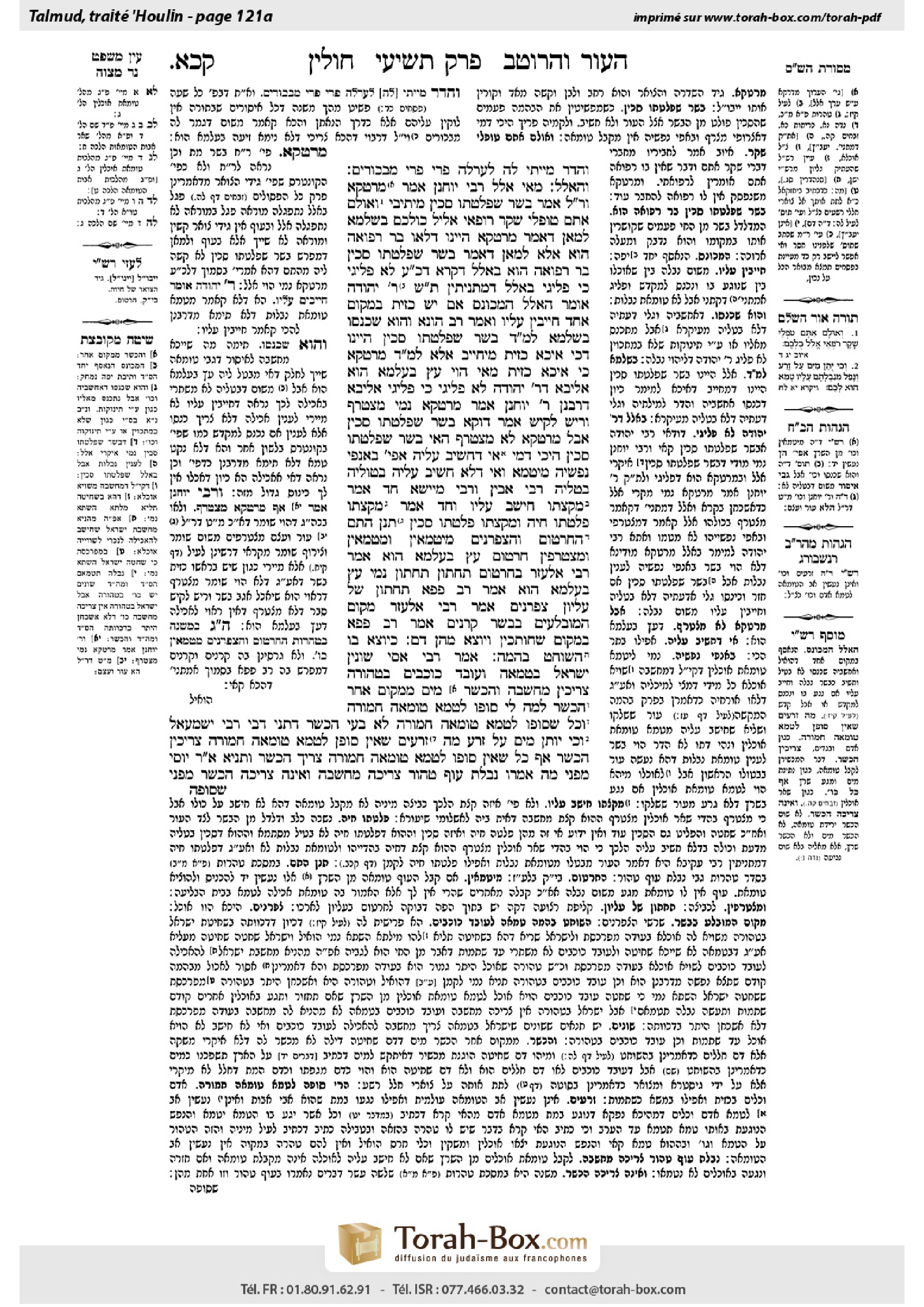
This page of Chullin includes the Aramaic text, an English translation and an AI-generated French translation, alongside the scan above.
חולין קכ״א א · Aramaic and Hebrew text
וַהֲדַר מַיְיתֵי לַהּ לְעׇרְלָה ״פְּרִי״ ״פְּרִי״ מִבִּכּוּרִים.
וְהָאָלָל. מַאי אָלָל? רַבִּי יוֹחָנָן אָמַר: מַרְטְקָא, וְרֵישׁ לָקִישׁ אָמַר: בָּשָׂר שֶׁפְּלָטַתּוּ סַכִּין.
מֵיתִיבִי: ״וְאוּלָם אַתֶּם טֹפְלֵי שָׁקֶר רֹפְאֵי אֱלִל כֻּלְּכֶם״. בִּשְׁלָמָא לְמַאן דְּאָמַר מַרְטְקָא – הַיְינוּ דְּלָאו בַּר רְפוּאָה הוּא, אֶלָּא לְמַאן דְּאָמַר בָּשָׂר שֶׁפְּלָטַתּוּ סַכִּין – בַּר רְפוּאָה הוּא!
בָּאָלָל דִּקְרָא, דְּכוּלֵּי עָלְמָא לָא פְלִיגִי; כִּי פְּלִיגִי – בָּאָלָל דְּמַתְנִיתִין.
תָּא שְׁמַע, רַבִּי יְהוּדָה אוֹמֵר: הָאָלָל הַמְכוּנָּס, אִם יֵשׁ כְּזַיִת בְּמָקוֹם אֶחָד – חַיָּיבִין עָלָיו, וְאָמַר רַב הוּנָא: וְהוּא שֶׁכִּנְּסוֹ.
בִּשְׁלָמָא לְמַאן דְּאָמַר בָּשָׂר שֶׁפְּלָטַתּוּ סַכִּין, הַיְינוּ דְּכִי אִיכָּא כְּזַיִת מִיחַיַּיב, אֶלָּא לְמַאן דְּאָמַר מַרְטְקָא, כִּי אִיכָּא כְּזַיִת מַאי הָוֵי? עֵץ בְּעָלְמָא הוּא!
אַלִּיבָּא דְּרַבִּי יְהוּדָה לָא פְּלִיגִי, כִּי פְּלִיגִי אַלִּיבָּא דְּרַבָּנַן: רַבִּי יוֹחָנָן אָמַר: מַרְטְקָא נָמֵי מִצְטָרֵף, וְרֵישׁ לָקִישׁ אָמַר: דַּוְקָא בָּשָׂר שֶׁפְּלָטַתּוּ סַכִּין, אֲבָל מַרְטְקָא לָא מִצְטָרֵף.
הַאי בָּשָׂר שֶׁפְּלָטַתּוּ סַכִּין, הֵיכִי דָמֵי? אִי דְּחַשֵּׁיב עֲלֵיהּ – אֲפִילּוּ בְּאַנְפֵּי נַפְשֵׁיהּ מִיטַּמֵּא, וְאִי דְּלָא חַשֵּׁיב עֲלֵיהּ – בַּטּוֹלֵיה בַּטְּלֵיהּ!
רַבִּי אָבִין וְרַבִּי מְיָישָׁא, חַד אָמַר: מִקְצָתוֹ חִישֵּׁב עָלָיו.
וְחַד אָמַר: מִקְצָתוֹ פְּלָטַתּוּ חַיָּה, וּמִקְצָתוֹ פְּלָטַתּוּ סַכִּין.
תְּנַן הָתָם: הַחַרְטוֹם וְהַצִּפׇּרְנַיִם מִיטַּמְּאִין וּמְטַמְּאִין וּמִצְטָרְפִין. חַרְטוֹם – עֵץ בְּעָלְמָא הוּא!
אָמַר רַבִּי אֶלְעָזָר: בְּחַרְטוֹם תַּחְתּוֹן. תַּחְתּוֹן נָמֵי עֵץ בְּעָלְמָא הוּא! אָמַר רַב פָּפָּא: תַּחְתּוֹן שֶׁל עֶלְיוֹן.
צִפׇּרְנַיִם, אָמַר רַבִּי אֶלְעָזָר: מָקוֹם (המובלעים) [הַמּוּבְלָע] בַּבָּשָׂר.
קַרְנַיִם, אָמַר רַב פָּפָּא: בִּמְקוֹם שֶׁחוֹתְכִין וְיוֹצֵא מֵהֶן דָּם.
כְּיוֹצֵא בּוֹ, הַשּׁוֹחֵט בְּהֵמָה.
אָמַר רַבִּי אַסִּי: שׁוֹנִין יִשְׂרָאֵל בִּטְמֵאָה, וְגוֹי בִּטְהוֹרָה – צְרִיכִין מַחְשָׁבָה וְהֶכְשֵׁר מַיִם מִמָּקוֹם אַחֵר.
הֶכְשֵׁר לְמָה לִי? סוֹפוֹ לְטַמֵּא טוּמְאָה חֲמוּרָה, וְכֹל שֶׁסּוֹפוֹ לְטַמֵּא טוּמְאָה חֲמוּרָה – לָא בָּעֵי הֶכְשֵׁר.
דְּתָנֵי דְּבֵי רַבִּי יִשְׁמָעֵאל: ״וְכִי יֻתַּן מַיִם עַל זֶרַע״, מָה זְרָעִים שֶׁאֵין סוֹפָן לְטַמֵּא טוּמְאָה חֲמוּרָה צְרִיכִין הֶכְשֵׁר, אַף כֹּל שֶׁאֵין סוֹפוֹ לְטַמֵּא טוּמְאָה חֲמוּרָה צָרִיךְ הֶכְשֵׁר.
וְתַנְיָא, אָמַר רַבִּי יוֹסֵי: מִפְּנֵי מָה אָמְרוּ נִבְלַת עוֹף טָהוֹר צְרִיכָה מַחְשָׁבָה וְאֵינָהּ צְרִיכָה הֶכְשֵׁר? מִפְּנֵי
Chullin 121a · English translation
And then he derives the halakha of liquid that emerges from orla from first fruits via a verbal analogy between one instance of the word fruit and another instance of the word fruit. With regard to orla the verse states: “And you shall count the fruit thereof as forbidden” (Leviticus 19:23), and with regard to first fruits the verse states: “And you shall take of the first of all the fruit of the ground” (Deuteronomy 26:2). Therefore, just as with regard to first fruits the status of liquid that emerges from the produce is like that of the produce only with regard to grapes and olives, so too with regard to orla one receives lashes only for drinking the liquid of grapes and olives, but not for drinking the liquid of other types of produce.
§The mishna teaches that the alal joins together with the flesh to constitute the requisite egg-bulk to impart the impurity of food, despite not being considered food itself. The Gemara asks: To what is the term alal referring? Rabbi Yoḥanan says: It is referring to the nuchal ligament [marteka]. And Reish Lakish says: It is referring to the meat residue that is attached to the hide after the knife has flayed the flesh.
The Gemara raises an objection to the explanation of Reish Lakish from that which is written: “But you are plasterers of lies, you are all physicians of no value [elil]” (Job 13:4). The term “no value [elil]” stems from the same linguistic root as the word alal. Granted, according to the one who says that the word alal is referring to the nuchal ligament, i.e., Rabbi Yoḥanan, that is why Job accused his companions of giving advice without merit by making an analogy to a physician who attempts to heal the nuchal ligament, which cannot be healed. But according to the one who says that the word alal is referring to the meat residue that is attached to the hide after the knife has flayed the flesh, i.e., Reish Lakish, flesh that is hanging from the hide is able to be healed.
The Gemara answers: With regard to the term elil in the verse, everyone agrees that it is referring to the nuchal ligament. When Rabbi Yoḥanan and Reish Lakish disagree, it is with regard to the definition of the term alal employed by the Sages in the mishna.
Come and hear a resolution from that which is taught in the mishna: Rabbi Yehuda says: With regard to the alal that was collected, if there is an olive-bulk of it in one place it imparts the impurity of animal carcasses. Therefore, one who eats it or touches it and then eats consecrated food or enters the Temple is liable to receive karet for it. And Rav Huna said: This halakha is applicable only when a halakhically competent person collected the alal in one place, but not if the alal was collected by a child or without human intervention. By collecting it in one place, the person indicates that he considers it to be food.
Granted, according to the one who says that the word alal is referring to the meat residue that is attached to the hide after the knife has flayed the flesh, i.e., Reish Lakish, that is why Rabbi Yehuda says that one is rendered liable when there is an olive-bulk of alal collected in one place, because the person who collected it considers it to be food. But according to the one who says that the word alal is referring to the nuchal ligament, i.e., Rabbi Yoḥanan, even in a case when there is an olive-bulk of alal collected in one place, what of it? It is merely wood, i.e., it is unfit for consumption.
The Gemara answers: According to the opinion of Rabbi Yehuda, Rabbi Yoḥanan and Reish Lakish do not disagree; they agree that the term alal is referring to the meat residue attached to the hide after the knife has flayed the flesh. When they disagree, it is with regard to the definition of the word alal according to the opinion of the Rabbis. Rabbi Yoḥanan says: The Rabbis maintain that the nuchal ligament also joins together with the meat to constitute the requisite measure of an egg-bulk to impart the impurity of food. And Reish Lakish says: The Rabbis maintain that specifically the meat residue that is attached to the hide after the knife has flayed the meat joins together with the flesh, but the nuchal ligament does not join together.
What are the circumstances of that which is taught in the mishna, that the meat residue that is attached to the hide after the knife flayed the flesh joins together with the meat to constitute the measure of an egg-bulk required to impart the impurity of food? If it is a case where one intends to eat this meat residue, then it can become impure not only by joining together with the meat, but even by itself, like any other food. And if it is a case where one does not intend to eat this meat residue, why should it be susceptible to impurity at all? One has completely nullified its status as food.
Rabbi Avin and Rabbi Meyasha answered this dilemma. One said: It is a case where one intends to eat part of the meat residue, but it is uncertain which part. Therefore, the meat residue is not susceptible to impurity by itself because it is not entirely considered to be food, but the part that he intends to eat joins together with the meat to constitute the measure of an egg-bulk.
And one said: It is a case where one does not intend to eat any part of the meat residue. Rather, an animal severed part of the meat residue attached to the hide, and therefore that part of the meat residue retains its status as food. And the knife severed part of the meat residue, and one therefore nullified its status as food with regard to that part. Since it is uncertain which part was severed by a knife and which part by an animal, the meat residue itself is not susceptible to impurity, but the part that was severed by an animal joins together with the meat to constitute the measure of an egg-bulk.
§The mishna stated that the horns join together with the flesh to constitute the requisite egg-bulk to impart the impurity of food. The Gemara comments that we learned in a mishna elsewhere (Teharot 1:2): The beak and the talons of a bird that come into contact with a creeping animal can become impure, and transmit impurity to food, and join together with the attached flesh to constitute the requisite measure to impart impurity. The Gemara asks: Why does a beak join together with the flesh to impart impurity? It is merely wood, i.e., it is unfit for consumption.
Rabbi Elazar says: The mishna is stated with regard to the lower half of the beak, i.e., the lower mandible. The Gemara objects: The lower mandible is also merely wood. Rav Pappa says: The mishna is discussing the lower section of the upper mandible and is referring to the membrane inside the mouth that is attached to the beak.
Similarly, with regard to the talons mentioned in that mishna, Rabbi Elazar says: That mishna is not discussing the talons themselves, but rather the place at the base of the talon that is subsumed within the flesh.
Similarly, with regard to the horns mentioned in the mishna, Rav Pappa says: The mishna is not discussing the hard substance of the horn, but rather is referring to the place at the base of the horns where one severs the horns and blood flows from them.
§The mishna teaches: Similarly, in the case of one who slaughters a non-kosher animal for a gentile and the animal is still twitching and comes into contact with a source of impurity, it imparts impurity of food, but does not impart impurity of an animal carcass.
Rabbi Asi says: Some Sages teach that when a Jew slaughters a non-kosher animal or a gentile slaughters a kosher animal, in order for it to be susceptible to impurity of food, it is necessary that the intention of the one performing the slaughter be that the flesh be designated as food while it is still twitching. And furthermore, in order for the animal to be rendered susceptible to impurity, it requires contact with water or another liquid that renders food susceptible to impurity that comes from another place. The blood of this slaughter is not considered a liquid that renders food susceptible to impurity because it flowed from a valid slaughter.
The Gemara asks: Why do I need the animal to come in contact with liquid in order for it to be rendered susceptible to impurity of food? The flesh of the animal will eventually become impure with a more severe level of impurity when it dies, i.e., impurity of an animal carcass. And any food that will eventually become impure with a more severe level of impurity does not require contact with liquid to be rendered susceptible to impurity of food.
The Gemara now explains the source of this principle. As the school of Rabbi Yishmael teaches: With regard to rendering food susceptible to impurity through contact with liquid, the verse states: “But if water is put upon the seed, and any of the carcass falls on it, it is impure for you” (Leviticus 11:38). Just as seeds, which will never contract a more severe level of impurity, because no form of severe impurity applies to foods other than meat, require contact with liquid to render them susceptible to their less severe level of impurity, so too any food that will never contract a more severe level of impurity requires contact with liquid to be rendered susceptible to impurity of food. By contrast, any food that will become impure with a more severe level of impurity does not require contact with liquid to be rendered susceptible to impurity of food.
And similarly, it is taught in a baraita that Rabbi Yosei says: For what reason did the Sages say that in order for the carcass of a kosher bird to become susceptible to impurity it requires that the intention of the one performing the slaughter be to designate the animal as food, but it is not required for the bird to be rendered susceptible to impurity through contact with liquid? The reason is because
Chullin 121a · Traduction française (IA)
Et ensuite, il déduit la halakha concernant le liquide issu de l'orla à partir des premiers fruits par une analogie verbale entre une occurrence du mot « fruit » et une autre occurrence du même mot. En ce qui concerne l'orla, la Bible dit : « Et tu compteras le fruit de cela comme interdit » (Lévitique 19:23), et en ce qui concerne les premiers fruits, la Bible dit : « Et tu prendras le premier de tous les fruits de la terre » (Dt 26:2). Ainsi, tout comme, concernant les premiers fruits, le statut du liquide issu des produits est semblable à celui des produits, mais seulement en ce qui concerne le raisin et l'olive, de même, concernant l'orla, on est puni de flagellation uniquement pour boire le liquide du raisin et de l'olive, mais pas pour boire le liquide d'autres types de produits.
§La Guemara pose la question : à quoi fait référence le terme « alal » ? Rabbi Yoḥanan dit : il fait référence au ligament nuchal [marteka]. Et Reish Lakish dit : il fait référence à la résidu de viande attaché à la peau après que le couteau a écorché la chair.
La Guemara soulève un objet contre l'explication de Reish Lakish à partir de ce qui est écrit : « Mais vous êtes des plâtriers de mensonges, vous êtes tous des médecins sans valeur [elil] » (Job 13:4). Le terme « sans valeur [elil] » provient du même racine linguistique que le mot « alal ». En effet, selon celui qui dit que le mot « alal » fait référence au ligament nuchal, c'est-à-dire Rabbi Yoḥanan, c'est pourquoi Job accuse ses compagnons de donner des conseils sans valeur en faisant une analogie avec un médecin qui tente de guérir le ligament nuchal, qui ne peut être guéri. Mais selon celui qui dit que le mot « alal » fait référence au résidu de viande attaché à la peau après que le couteau a écorché la chair, c'est-à-dire Reish Lakish, la viande qui pend de la peau peut être guérie.
La Guemara répond : concernant le terme « elil » dans la Bible, tout le monde convient qu'il fait référence au ligament nuchal. Lorsque Rabbi Yoḥanan et Reish Lakish divergent, c'est concernant la définition du terme « alal » employé par les Sages dans la Michna.
Viens écouter une résolution à partir de ce qui est enseigné dans la Michna : Rabbi Yehuda dit : concernant l'alal qui a été recueilli, si une quantité d'olive de celui-ci est présente dans un endroit, il transmet l'impureté des cadavres d'animaux. Ainsi, celui qui le mange ou le touche et ensuite mange des aliments consacrés ou entre dans le Temple est punissable de karet pour cela. Et Rav Huna dit : cette halakha s'applique uniquement lorsque la personne compétente halakhiquement a recueilli l'alal dans un endroit, mais pas si l'alal a été recueilli par un enfant ou sans intervention humaine. En recueillant l'alal dans un endroit, la personne indique qu'elle le considère comme de la nourriture.
En effet, selon celui qui dit que le mot « alal » fait référence au résidu de viande attaché à la peau après que le couteau a écorché la chair, c'est-à-dire Reish Lakish, c'est pourquoi Rabbi Yehuda dit que l'on est punissable lorsqu'il y a une quantité d'olive d'alal recueillie dans un endroit, car la personne qui l'a recueilli le considère comme de la nourriture. Mais selon celui qui dit que le mot « alal » fait référence au ligament nuchal, c'est-à-dire Rabbi Yoḥanan, même dans le cas où il y a une quantité d'olive d'alal recueillie dans un endroit, qu'y a-t-il ? C'est simplement du bois, c'est-à-dire qu'il n'est pas comestible.
La Guemara répond : selon l'opinion de Rabbi Yehuda, Rabbi Yoḥanan et Reish Lakish ne divergent pas ; ils conviennent que le terme « alal » fait référence au résidu de viande attaché à la peau après que le couteau a écorché la chair. Lorsqu'ils divergent, c'est concernant la définition du mot « alal » selon l'opinion des Rabbins. Rabbi Yoḥanan dit : les Rabbins maintiennent que le ligament nuchal s'unit à la viande pour constituer la mesure nécessaire d'un œuf pour transmettre l'impureté alimentaire. Et Reish Lakish dit : les Rabbins maintiennent que spécifiquement le résidu de viande attaché à la peau après que le couteau a écorché la viande s'unit à la chair, mais le ligament nuchal ne s'unit pas.
Quelles sont les circonstances de ce qui est enseigné dans la mitsna, que le résidu de viande attaché à la peau après que le couteau a écorché la chair s'unit à la viande pour constituer la mesure d'un œuf nécessaire pour transmettre l'impureté alimentaire ? Si c'est un cas où l'on veut manger ce résidu de viande, alors il peut devenir impur non seulement en s'unissant à la viande, mais même par lui-même, comme tout autre aliment. Et si c'est un cas où l'on ne veut pas manger ce résidu de viande, pourquoi devrait-il être susceptible d'impureté du tout ? On a totalement annulé son statut d'aliment.
Rabbi Avin et Rabbi Meyasha ont répondu à ce dilemme. L'un dit : c'est un cas où l'on veut manger une partie du résidu de viande, mais il est incertain de quelle partie. Ainsi, le résidu de viande n'est pas susceptible d'impureté par lui-même car il n'est pas entièrement considéré comme de la nourriture, mais la partie que l'on veut manger s'unit à la viande pour constituer la mesure d'un œuf.
Et l'un dit : c'est un cas où l'on ne veut pas manger aucune partie du résidu de viande. Plutôt, un animal a séparé une partie du résidu de viande attaché à la peau, et donc cette partie du résidu de viande conserve son statut d'aliment. Et le couteau a séparé une partie du résidu de viande, et l'on a donc annulé son statut d'aliment concernant cette partie. Puisque c'est incertain de quelle partie a été séparée par le couteau et de quelle partie par l'animal, le résidu de viande lui-même n'est pas susceptible d'impureté, mais la partie séparée par l'animal s'unis à la viande pour constituer la mesure d'un œuf.
§La Michna a déclaré que les cornes s'unissent avec la chair pour constituer la quantité nécessaire pour transmettre l'impureté des aliments. La Guemara commente que nous avons appris dans une autre Michna (Téharot 1:2) : Le bec et les griffes d'un oiseau qui entrent en contact avec un animal rampant peuvent devenir impurs et transmettre l'impureté aux aliments, et s'unissent avec la chair attachée pour constituer la quantité nécessaire pour transmettre l'impureté. La Guemara pose la question : Pourquoi le bec s'unit-il avec la chair pour transmettre l'impureté ? Il s'agit simplement de bois, c'est-à-dire qu'il n'est pas comestible.
Rabbi Eléazar dit : La Michna est formulée concernant la partie inférieure du bec, c'est-à-dire la mâchoire inférieure. La Guemara s'oppose : La mâchoire inférieure est également simplement du bois. Rav Pappa dit : La Michna parle de la partie inférieure de la mâchoire supérieure et fait référence à la membrane à l'intérieur de la bouche qui est attachée au bec.
De même, concernant les griffes mentionnées dans cette Michna, Rabbi Eléazar dit : Cette Michna ne parle pas des griffes elles-mêmes, mais plutôt de la partie située à la base des griffes qui est intégrée dans la chair.
De même, concernant les cornes mentionnées dans la Michna, Rav Pappa dit : La Michna ne parle pas de la substance dure des cornes, mais plutôt de la partie située à la base des cornes où l'on coupe les cornes et où le sang en sort.
§La Michna enseigne : De même, dans le cas d'une personne qui sacrifie un animal non-kosher pour un non-Juif et que l'animal continue de trembler et entre en contact avec une source d'impureté, il transmet l'impureté du nourrisson, mais ne transmet pas l'impureté du cadavre d'animal.
Rabbi Asi dit : Certains Sages enseignent que lorsque un Juif sacrifie un animal non-kosher ou qu'un non-Juif sacrifie un animal kosher, afin que l'animal soit susceptible d'impureté du nourrisson, il est nécessaire que l'intention de celui qui sacrifie soit de désigner la chair comme nourriture alors qu'elle continue de trembler. De plus, afin que l'animal soit rendu susceptible d'impureté, il faut qu'il entre en contact avec de l'eau ou un autre liquide qui rend la nourriture susceptible d'impureté provenant d'un autre lieu. Le sang de ce sacrifice n'est pas considéré comme un liquide qui rend la nourriture susceptible d'impureté, car il est sorti d'un sacrifice valide.
La Guemara pose la question : Pourquoi ai-je besoin que l'animal entre en contact avec un liquide afin qu'il soit rendu susceptible d'impureté de nourriture ? La chair de l'animal deviendra ultérieurement impure avec un niveau plus grave d'impureté lorsqu'il meurt, c'est-à-dire l'impureté du cadavre d'animal. Et toute nourriture qui deviendra ultérieurement impure avec un niveau plus grave d'impureté n'a pas besoin de contact avec un liquide pour être rendue susceptible d'impureté de nourriture.
La Guemara explique maintenant la source de ce principe. Comme l'école de Rabbi Yishmael enseigne : Concernant la rendre susceptible d'impureté par contact avec un liquide, la Paracha dit : « Mais si l'on verse de l'eau sur la semence, et que quelque partie du cadavre tombe dessus, cela est impur pour vous » (Lévitique 11:38). Tout comme les semences, qui ne peuvent jamais contracter un niveau plus grave d'impureté, car aucun type d'impureté grave ne s'applique aux aliments sauf la viande, nécessitent un contact avec un liquide pour être rendues susceptibles de leur niveau moins grave d'impureté, de même toute nourriture qui ne peut jamais contracter un niveau plus grave d'impureté nécessite un contact avec un liquide pour être rendue susceptible d'impureté de la nourriture. À l'inverse, toute nourriture qui devient impure avec un niveau plus grave d'impureté n'a pas besoin de contact avec un liquide pour être rendue susceptible d'impureté de la nourriture.
Et de même, il est enseigné dans une baraïta que Rabbi Yosei dit : Pourquoi les Sages ont-ils dit que afin que le cadavre d'un oiseau kasher devienne susceptible d'impureté, il est nécessaire que l'intention de celui qui sacrifie soit de désigner l'animal comme nourriture, mais il n'est pas nécessaire que l'oiseau soit rendu susceptible d'impureté par contact avec un liquide ? La raison est que
Traduction française générée par IA à partir de l’édition anglaise de Sefaria. Vérifie toujours un passage avec le texte source.
Text from Sefaria: William Davidson Edition - Vocalized Aramaic (unknown); William Davidson Edition - English (CC BY NC).