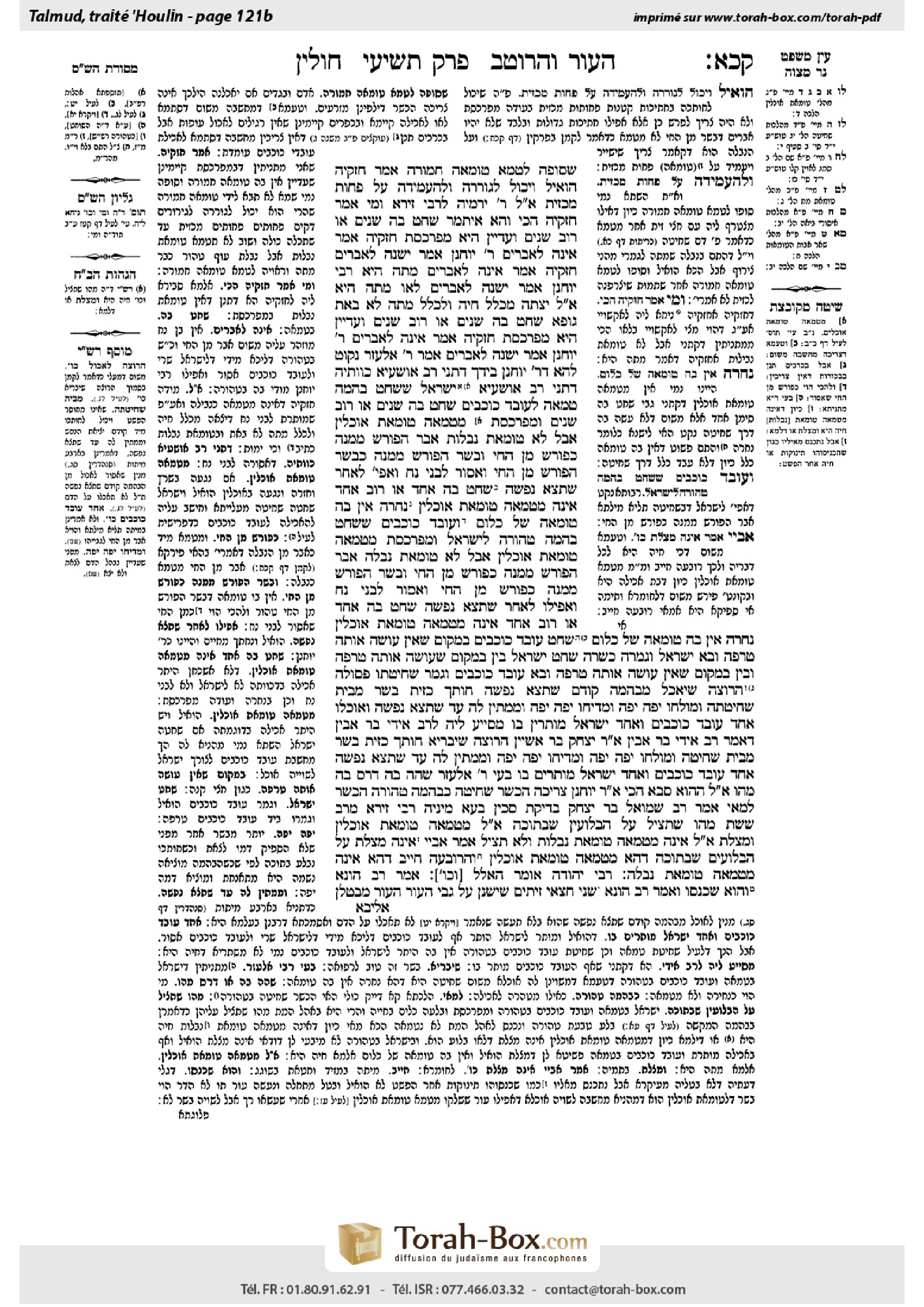
Chullin 121b: Talmud study for Daf Yomi
Study the Talmud for Daf Yomi with scanned pages, Hebrew text, English translations from Sefaria and AI-generated French translations.
Passage selection and English or AI-generated French translation are available where the scan has annotations. Daf Study is independent of Torah-Box and Sefaria.
Browse Chullin · חולין · All tractatesChullin 121b text and translations
This page of Chullin includes the Aramaic text, an English translation and an AI-generated French translation, alongside the scan above.
חולין קכ״א ב · Aramaic and Hebrew text
שֶׁסּוֹפָהּ לְטַמֵּא טוּמְאָה חֲמוּרָה!
אָמַר חִזְקִיָּה: הוֹאִיל וְיָכוֹל לְגוֹרְרָהּ, וּלְהַעֲמִידָהּ עַל פָּחוֹת מִכְּזַיִת.
אֲמַר לֵיהּ רַבִּי יִרְמְיָה לְרַבִּי זֵירָא: וּמִי אָמַר חִזְקִיָּה הָכִי? וְהָא אִיתְּמַר: שָׁחַט בָּהּ שְׁנַיִם אוֹ רוֹב שְׁנַיִם, וַעֲדַיִין הִיא מְפַרְכֶּסֶת – חִזְקִיָּה אָמַר: אֵינָהּ לְאֵבָרִים, רַבִּי יוֹחָנָן אָמַר: יֶשְׁנָהּ לְאֵבָרִים.
חִזְקִיָּה אָמַר אֵינָהּ לְאֵבָרִים: מֵתָה הִיא. רַבִּי יוֹחָנָן אָמַר יֶשְׁנָהּ לְאֵבָרִים: לָאו מֵתָה הִיא.
אֲמַר לֵיהּ: יָצְתָה מִכְּלַל חַיָּה, וְלִכְלַל מֵתָה לֹא בָּאת.
גּוּפָא: שָׁחַט בָּהּ שְׁנַיִם, אוֹ רוֹב שְׁנַיִם, וַעֲדַיִין הִיא מְפַרְכֶּסֶת – חִזְקִיָּה אָמַר: אֵינָהּ לְאֵבָרִים, רַבִּי יוֹחָנָן אָמַר: יֶשְׁנָהּ לְאֵבָרִים. אָמַר רַבִּי אֶלְעָזָר: נְקוֹט לְהָא דְּרַבִּי יוֹחָנָן בְּיָדְךָ, דְּתָנֵי רַב אוֹשַׁעְיָא כְּוָותֵיהּ.
דְּתָנֵי רַב אוֹשַׁעְיָא: יִשְׂרָאֵל שֶׁשָּׁחַט בְּהֵמָה טְמֵאָה לְגוֹי, שָׁחַט בָּהּ שְׁנַיִם אוֹ רוֹב שְׁנַיִם, וּמְפַרְכֶּסֶת – מְטַמְּאָה טוּמְאַת אֳכָלִין, אֲבָל לֹא טוּמְאַת נְבֵלוֹת.
אֵבֶר הַפּוֹרֵשׁ מִמֶּנָּה, כְּפוֹרֵשׁ מִן הַחַי, וּבָשָׂר הַפּוֹרֵשׁ מִמֶּנָּה, כְּבָשָׂר הַפּוֹרֵשׁ מִן הַחַי, וְאָסוּר לִבְנֵי נֹחַ, וַאֲפִילּוּ לְאַחַר שֶׁתֵּצֵא נַפְשָׁהּ.
שָׁחַט בָּהּ אֶחָד, אוֹ רוֹב אֶחָד – אֵינָהּ מְטַמְּאָה טוּמְאַת אֳכָלִין; נְחָרָהּ – אֵין בָּהּ טוּמְאָה שֶׁל כְּלוּם.
וְגוֹי שֶׁשָּׁחַט בְּהֵמָה טְהוֹרָה לְיִשְׂרָאֵל, וּמְפַרְכֶּסֶת – מְטַמְּאָה טוּמְאַת אֳכָלִין, אֲבָל לֹא טוּמְאַת נְבֵלָה.
אֵבֶר הַפּוֹרֵשׁ מִמֶּנָּה, כְּפוֹרֵשׁ מִן הַחַי, וּבָשָׂר הַפּוֹרֵשׁ מִמֶּנָּה, כְּפוֹרֵשׁ מִן הַחַי, וְאָסוּר לִבְנֵי נֹחַ, וַאֲפִילּוּ לְאַחַר שֶׁתֵּצֵא נַפְשָׁהּ.
שָׁחַט בָּהּ אֶחָד אוֹ רוֹב אֶחָד – אֵינָהּ מְטַמְּאָה טוּמְאַת אֳכָלִין, נְחָרָהּ – אֵין בָּהּ טוּמְאָה שֶׁל כְּלוּם.
שָׁחַט גּוֹי בִּמְקוֹם שֶׁאֵין עוֹשֶׂה אוֹתָהּ טְרֵפָה, וּבָא יִשְׂרָאֵל וּגְמָרָהּ – כְּשֵׁרָה.
שָׁחַט יִשְׂרָאֵל, בֵּין בִּמְקוֹם שֶׁעוֹשֶׂה אוֹתָהּ טְרֵפָה, וּבֵין בִּמְקוֹם שֶׁאֵין עוֹשֶׂה אוֹתָהּ טְרֵפָה, וּבָא גּוֹי וְגָמַר שְׁחִיטָתוֹ – פְּסוּלָה.
הָרוֹצֶה שֶׁיֹּאכַל מִבְּהֵמָה קוֹדֶם שֶׁתֵּצֵא נַפְשָׁהּ, חוֹתֵךְ כְּזַיִת בָּשָׂר מִבֵּית שְׁחִיטָתָהּ, וּמוֹלְחוֹ יָפֶה יָפֶה, וּמְדִיחוֹ יָפֶה יָפֶה, וּמַמְתִּין לַהּ עַד שֶׁתֵּצֵא נַפְשָׁהּ, וְאוֹכְלוֹ. אֶחָד גּוֹי וְאֶחָד יִשְׂרָאֵל מוּתָּרִין בּוֹ.
מְסַיַּיע לֵיהּ לְרַב אִידִי בַּר אָבִין, דְּאָמַר רַב אִידִי בַּר אָבִין אָמַר רַב יִצְחָק בַּר אַשְׁיָין: הָרוֹצֶה שֶׁיַּבְרִיא, חוֹתֵךְ כְּזַיִת בָּשָׂר מִבֵּית שְׁחִיטָה, וּמוֹלְחוֹ יָפֶה יָפֶה, וּמְדִיחוֹ יָפֶה יָפֶה, וּמַמְתִּין לָהּ עַד שֶׁתֵּצֵא נַפְשָׁהּ, אֶחָד גּוֹי וְאֶחָד יִשְׂרָאֵל מוּתָּרִים בּוֹ.
בָּעֵי רַבִּי אֶלְעָזָר: שָׁהָה בָּהּ, דָּרַס בָּהּ – מַהוּ?
אֲמַר לֵיהּ הָהוּא סָבָא: הָכִי אָמַר רַבִּי יוֹחָנָן: צְרִיכָה הֶכְשֵׁר שְׁחִיטָה כִּבְהֵמָה טְהוֹרָה. הֶכְשֵׁר לְמַאי? אָמַר רַב שְׁמוּאֵל בַּר יִצְחָק: בְּדִיקַת סַכִּין.
בְּעָא מִינֵּיהּ רַבִּי זֵירָא מֵרַב שֵׁשֶׁת: מַהוּ שֶׁתַּצִּיל עַל הַבְּלוּעִין שֶׁבְּתוֹכָהּ?
אֲמַר לֵיהּ מְטַמְּאָה טוּמְאַת אֳכָלִין, וּמַצֶּלֶת? אֲמַר לֵיהּ: אֵינָהּ מְטַמְּאָה טוּמְאַת נְבֵלוֹת, וְלֹא תַּצִּיל?
אָמַר אַבָּיֵי: אֵינָהּ מַצֶּלֶת עַל הַבְּלוּעִים שֶׁבְּתוֹכָהּ, דְּהָא מְטַמְּאָה טוּמְאַת אֳכָלִין, וְהָרוֹבְעָהּ חַיָּיב, דְּהָא אֵינָהּ מְטַמְּאָה טוּמְאַת נְבֵלָה.
רַבִּי יְהוּדָה אוֹמֵר: הָאָלָל [וְכוּ׳]. אָמַר רַב הוּנָא: וְהוּא שֶׁכִּנְּסוֹ.
וְאָמַר רַב הוּנָא: שְׁנֵי חֲצָאֵי זֵיתִים שֶׁיֶּשְׁנָן עַל גַּבֵּי הָעוֹר – הָעוֹר מְבַטְּלָן,
Chullin 121b · English translation
eventually the carcass of the bird will impart a more severe impurity when it is in the throat of the person who consumes it. Therefore, it is not necessary for the carcass of a kosher bird to come in contact with liquid in order for it to be susceptible to impurity.
Ḥizkiyya says in response: The reason for the opinion of the Sages stated by Rabbi Asi is since the slaughterer is able to chop the animal into small pieces and thereby establish the volume of every piece of the animal as less than an olive-bulk. In such a scenario, the animal would not be susceptible to impurity. Therefore, it is not certain that the animal will eventually become impure with a more severe impurity.
Rabbi Yirmeya said to Rabbi Zeira: And did Ḥizkiyya actually say such a statement? But wasn’t it stated: If one slaughtered a non-kosher animal in a valid manner by cutting the two simanim, i.e., the windpipe and the gullet, or the majority of the two simanim, and the animal is still twitching, Ḥizkiyya says: There is no prohibition against eating the limbs from such a twitching animal. Therefore, a gentile, who is prohibited from consuming a limb from a living animal, may consume this animal. Rabbi Yoḥanan says: There is a prohibition against eating the limbs of such an animal.
The Gemara explains the opinions: Ḥizkiyya says that there is no prohibition against eating the limbs of such an animal, as since it was slaughtered in a valid manner it is considered dead. Rabbi Yoḥanan says that there is a prohibition against eating the limbs of such an animal, as since it is twitching it is not yet dead. Therefore, since Ḥizkiyya maintains that a twitching animal is considered dead, it should have the impurity of a carcass, contrary to the opinion of the Sages cited by Rabbi Asi, as well as the mishna.
Rabbi Zeira said to Rabbi Yirmeya in response: Ḥizkiyya maintains that such an animal has left the category of a living animal, but has not entered the category of a dead animal. Therefore, it is not prohibited for a gentile to consume such an animal, but the animal does not have the impurity of a carcass.
§The Gemara discusses the matter itself of the dispute between Ḥizkiyya and Rabbi Yoḥanan: If one slaughtered a non-kosher animal by cutting the two simanim, or the majority of the two simanim, and the animal is still twitching, Ḥizkiyya says: There is no prohibition against eating its limbs. Rabbi Yoḥanan says: There is a prohibition against eating its limbs. Rabbi Elazar said: Take that opinion of Rabbi Yoḥanan in your hand and accept it, as Rav Oshaya teaches a baraita in accordance with his opinion.
As Rav Oshaya teaches (Tosefta, Oholot 2:1): In the case of a Jew who slaughtered a non-kosher animal for the consumption of a gentile, if he slaughtered it by cutting two simanim or the majority of two simanim, and the animal is still twitching, the animal imparts impurity of food; but so long as it is twitching it does not impart the impurity of animal carcasses.
A limb that separates from this twitching animal is considered like a limb that separates from a living animal, and as such it imparts the impurity of a carcass. And flesh that separates from this twitching animal is considered like flesh that separates from a living animal, and as such it does not impart impurity. And it is prohibited for the descendants of Noah to consume the flesh that separates from this twitching animal, and this prohibition applies even after its soul departs. This ruling of Rav Oshaya is in accordance with the opinion of Rabbi Yoḥanan.
The Gemara cites the continuation of the Tosefta: In the case where a Jew slaughtered a non-kosher animal for a gentile’s consumption, if he slaughtered it by cutting only one siman or the majority of one siman, and the animal is still twitching, the animal does not impart the impurity of food because the slaughter was invalid. Similarly, if he did not perform a valid slaughter but rather stabbed the animal, the animal has no impurity whatsoever while it is still twitching.
And similarly, in the case of a gentile who slaughtered a kosher animal for the consumption of a Jew, and the animal is still twitching, the animal imparts the impurity of food because it is considered to be food, but so long as it is twitching it does not impart the impurity of an animal carcass.
A limb that separates from this twitching animal is considered like a limb that separates from a living animal, and as such it imparts the impurity of a carcass. And flesh that separates from this twitching animal is considered like flesh that separates from a living animal, and as such it does not impart the impurity of food. And it is prohibited for the descendants of Noah to consume the flesh that separates from this twitching animal, and this prohibition applies even after its soul departs.
If the gentile slaughtered the kosher animal by cutting only one siman or the majority of one siman, and the animal is still twitching, the animal does not impart impurity of food because the slaughter was not valid. Similarly, if he stabbed the animal rather than slaughtering it properly, it has no impurity whatsoever.
If a gentile partially slaughtered a kosher animal in a place that does not render the animal a tereifa, i.e., unfit for consumption due to a mortal wound, e.g., he cut half of the windpipe, and then a Jew came and completed the slaughter, the animal is fit for consumption.
But if a Jew slaughtered the animal, either in a place that renders the animal a tereifa, e.g., he cut the majority of the windpipe, or in a place that does not render the animal a tereifa, e.g., he only partially cut the windpipe, and then a gentile came and completed the slaughter, his slaughter is not valid.
The baraita continues: One who wishes to eat from the meat of a slaughtered animal before its soul departs may cut an olive-bulk of meat from the area of its slaughter, the neck, and salt it very well, i.e., more than is normally required, and rinse it very well in water to remove the salt and blood, and then wait until the animal’s soul departs, and then eat it. Both a gentile and a Jew are permitted to eat it because the prohibition against eating a limb from a living animal is not applicable in such a case.
The Gemara notes: This baraita supports the opinion of Rav Idi bar Avin, as Rav Idi bar Avin said that Rav Yitzḥak bar Ashyan said: One who wants to be healthy should cut an olive-bulk of meat from the area of the slaughter, and salt it very well and rinse it very well, and then wait until the animal’s soul departs, and then both a gentile and a Jew are permitted to eat it.
§It was previously taught in the baraita that if a Jew slaughtered a non-kosher animal for a gentile’s consumption, or a gentile slaughtered a kosher animal for a Jew’s consumption, that animal imparts impurity of food when it is twitching after the slaughter. With regard to that halakha, Rabbi Elazar raises a dilemma: What is the halakha in such a case if one interrupted the slaughter or pressed on the knife during the slaughter? Do these acts, which normally invalidate slaughter, also invalidate this slaughter, or does the slaughter in this case not have to fulfill all of the halakhic requirements of valid slaughter in order to render the slaughtered animal as food with regard to imparting the impurity of food?
A certain elder resolved this dilemma and said to him: Rabbi Yoḥanan said as follows: This case requires a valid slaughter in every detail, just like a Jew slaughtering a kosher animal. The Gemara clarifies: To what requirement does valid slaughter just like a kosher animal refer? Rav Shmuel bar Yitzḥak said: It is referring to the requirement of examining the knife before the slaughter.
Rabbi Zeira asked Rav Sheshet: If a non-kosher animal slaughtered by a Jew is twitching under the same roof as a corpse, and the animal swallowed items before being slaughtered, what is the halakha with regard to those swallowed items that are inside the animal? Is the animal considered to be living and therefore it should save these items that are swallowed inside it from the impurity transmitted by the corpse to all items under the same roof? Or is the animal considered to be dead and therefore the items become impure?
Rav Sheshet said to Rabbi Zeira: Since it is established that such an animal is considered to be dead and imparts impurity of food, is it possible that it saves those items inside it from impurity? Certainly it does not. Rabbi Zeira said to him in response: It is also established that such an animal does not impart impurity of carcasses and is considered to be a living animal in that regard. How is it possible that the animal does not save those items inside it from impurity?
Abaye resolved the dilemma and said: It is proper to treat this case stringently. Therefore, such an animal does not save the items that are swallowed inside it because it imparts impurity of food. But one who engages in bestiality with such an animal is liable because the animal does not impart impurity of a carcass and is considered to be living in that regard.
§The mishna teaches that Rabbi Yehuda says: With regard to the meat residue attached to the hide after flaying that was collected, if there is an olive-bulk of it in one place it imparts impurity of an animal carcass, and one who contracts impurity from it and eats consecrated foods or enters the Temple is liable to receive karet for it. Rav Huna says in explanation: This halakha is applicable only when a halakhically competent person collected the meat residue in one place, but not if the meat residue was collected by a child or without human intervention. By collecting it in one place, the person indicates that he considers it to be food.
And Rav Huna says: In a case of two pieces of flesh of an animal carcass, each measuring half an olive-bulk, that are attached to the hide, the hide nullifies them, as the hide does not impart the impurity of a carcass. Consequently, these pieces do not impart impurity either.
Chullin 121b · Traduction française (IA)
Finalement, le cadavre de l'oiseau transmettra une impureté plus grave lorsqu'il sera dans la gorge de la personne qui le consomme. Par conséquent, il n'est pas nécessaire que le cadavre d'un oiseau kasher entre en contact avec un liquide pour être susceptible d'impureté.
Ḥizkiyya répond : La raison de l'opinion des Sages évoquée par Rabbi Asi est que le boucher peut découper l'animal en petits morceaux et ainsi établir le volume de chaque morceau comme inférieur à celui d'une olive. Dans ce cas, l'animal ne serait pas susceptible d'impureté. Par conséquent, il n'est pas certain que l'animal devienne impur avec une impureté plus grave.
Rabbi Yirmeya dit à Rabbi Zeira : Et Ḥizkiyya a-t-il vraiment dit cela ? Mais n'était-il pas dit : Si l'on a sacrifié un animal non-kasher de manière valide en coupant les deux simanim, c'est-à-dire la trachée et l'œsophage, ou la majorité des deux simanim, et que l'animal continue de trembler, Ḥizkiyya dit : Il n'y a pas de prohibition à manger les membres de cet animal tremblant. Par conséquent, un non-Jeu, qui est interdit de consommer un membre d'un animal vivant, peut consommer cet animal. Rabbi Yoḥanan dit : Il y a une prohibition à manger les membres de cet animal.
La Guemara explique les opinions : Ḥizkiyya dit qu'il n'y a pas de prohibition à manger les membres de cet animal, car il a été tué de manière valide et est donc considéré comme mort. Rabbi Yoḥanan dit qu'il y a une prohibition à manger les membres de cet animal, car il continue de trembler et n'est pas encore mort. Par conséquent, puisque Ḥizkiyya maintient que l'animal tremblant est considéré comme mort, il devrait avoir l'impureté d'un cadavre, contrairement à l'opinion des Sages cités par Rabbi Asi, ainsi que la mitsna.
Rabbi Zeira répond à Rabbi Yirmeya : Ḥizkiyya maintient que cet animal a quitté la catégorie des animaux vivants mais n'a pas encore entré dans celle des animaux morts. Par conséquent, il n'est pas interdit à un non-Jeu de consommer cet animal, mais cet animal n'a pas l'impureté d'un cadavre.
§La Guemara discute la question elle-même du débat entre Ḥizkiyya et Rabbi Yoḥanan : Si l'on a tué un animal non-kasher en coupant les deux simanim, ou la majorité des deux simanim, et que l'animal continue de trembler, Ḥizkiyya dit : Il n'y a pas de prohibition à manger ses membres. Rabbi Yoḥanan dit : Il y a une prohibition à manger ses membres. Rabbi Elazar dit : Prends l'opinion de Rabbi Yoḥanan et accept-la, car Rav Oshaya enseigne une baraïta conformément à son opinion.
Comme Rav Oshaya enseigne (Tosefta, Oholot 2:1) : Dans le cas d'un Juif qui a tué un animal non-kasher pour la consommation d'un non-Jeu, si l'on a tué l'animal en coupant les deux simanim ou la majorité des deux simanim, et que l'animal continue de trembler, l'animal transmet l'impureté alimentaire ; mais tant qu'il continue de trembler, il ne transmet pas l'impureté des cadavres.
Un membre qui s'éloigne de cet animal tremblant est considéré comme un membre qui s'éloigne d'un animal vivant, et par conséquent il transmet l'impureté d'un cadavre. Et la chair qui s'éloigne de cet animal tremblant est considérée comme la chair qui s'éloigne d'un animal vivant, et par conséquent elle ne transmet pas l'impureté. Et il est interdit aux descendants de Noé de consommer la chair qui s'éloigne de cet animal tremblant, et cette interdiction s'applique même après que son âme ait quitté son corps. Cette décision de Rav Oshaya s'inscrit dans l'opinion de Rabbi Yoḥanan.
La Guemara cite la continuation de la Tosefta : Dans le cas où un Juif a tué un animal non-kasher pour la consommation d'un non-Jeu, si l'on a tué l'animal en coupant un seul siman ou la majorité d'un seul siman, et que l'animal continue de trembler, l'animal ne transmet pas l'impureté alimentaire car le sacrifice était invalide. De même, si l'on n'a pas effectué un sacrifice valide mais plutôt que l'on a transpercé l'animal, l'animal n'a aucune impureté tant qu'il continue de trembler.
De même, dans le cas d'un non-Jeu qui a tué un animal kasher pour la consommation d'un Juif, et que l'animal continue de trembler, l'animal transmet l'impureté alimentaire car il est considéré comme de la nourriture, mais tant qu'il continue de trembler, il ne transmet pas l'impureté d'un cadavre.
Un membre qui s'éloigne de cet animal tremblant est considéré comme un membre qui s'éloigne d'un animal vivant, et par conséquent il transmet l'impureté d'un cadavre. Et la chair qui s'éloigne de cet animal tremblant est considérée comme la chair qui s'éloigne d'un animal vivant, et par conséquent elle ne transmet pas l'impureté alimentaire. Et il est interdit aux descendants de Noé de consommer la chair qui s'éloigne de cet animal tremblant, et cette interdiction s'applique même après que son âme ait quitté son corps.
Si le non-Jeu a tué l'animal kasher en coupant un seul siman ou la majorité d'un seul siman, et que l'animal continue de trembler, l'animal ne transmet pas l'impureté alimentaire car le sacrifice n'était pas valide. De même, si l'on a transpercé l'animal plutôt que de le sacrifier correctement, il n'a aucune impureté du tout.
Si un non-Jeu a partiellement sacrifié un animal kasher dans un lieu qui ne rend pas l'animal tereifa, c'est-à-dire inadapté à la consommation en raison d'une blessure mortelle, par exemple il a coupé la moitié de la trachée, et ensuite un Juif est venu et a achevé le sacrifice, l'animal est adapté à la consommation.
Mais si un Juif a sacrifié l'animal, soit dans un lieu qui rend l'animal tereifa, par exemple il a coupé la majorité de la trachée, soit dans un lieu qui ne rend pas l'animal tereifa, par exemple il a partiellement coupé la trachée, et ensuite un non-Jeu est venu et a achevé le sacrifice, son sacrifice n'est pas valide.
La baraïta continue : Celui qui veut manger de la viande d'un animal sacrifié avant que son âme ne s'en aille peut couper une quantité d'olive de viande dans la zone de la mise à mort, le cou, et la saler très bien, c'est-à-dire plus que ce qui est normalement requis, et la rincer très bien à l'eau pour enlever la saumure et le sang, puis attendre que l'âme de l'animal s'en aille, et ensuite la manger. À la fois un non-Juif et un Juif sont autorisés à la manger, car l'interdiction de manger une partie d'un animal vivant ne s'applique pas dans ce cas-ci.
La Guemara note : Cette baraïta soutient l'opinion de Rav Idi bar Avin, car Rav Idi bar Avin a dit que Rav Yitzḥak bar Ashyan a dit : Celui qui veut être en bonne santé doit couper une quantité d'olive de viande dans la zone de la mise à mort, la saler très bien et la rincer très bien, puis attendre que l'âme de l'animal s'en aille, et ensuite à la fois un non-Juif et un Juif sont autorisés à la manger.
§Il avait été précédemment enseigné dans la baraïta que si un Juif sacrifiait un animal non-kosher pour la consommation d'un non-Juif, ou si un non-Juif sacrifiait un animal kosher pour la consommation d'un Juif, cet animal transmet l'impureté alimentaire lorsqu'il tremble après la mise à mort. En ce qui concerne cette halakha, Rabbi Elazar soulève un dilemme : Quelle est la halakha dans ce cas si l'on interrompait la mise à mort ou qu'on appuyait sur le couteau pendant la mise à mort ? Ces actes, qui annulent normalement la mise à mort, annulent-ils aussi cette mise à mort, ou la mise à mort dans ce cas-ci n'a-t-elle pas besoin de satisfaire toutes les exigences halakhiques de mise à mort valide afin de rendre l'animal sacrifié comme aliment concernant la transmission de l'impureté alimentaire ?
Un certain vieillard a résolu ce dilemme et a dit à lui : Rabbi Yoḥanan a dit comme suit : Ce cas exige une mise à mort valide en tous détails, tout comme un Juif sacrifiant un animal kasher. La Guemara précise : À quel exigence la mise à mort valide comme un animal kasher fait référence ? Rav Shmuel bar Yitzḥak a dit : Il fait référence à l'exigence d'examiner le couteau avant la mise à mort.
Rabbi Zeira a demandé à Rav Sheshet : Si un animal non-kasher sacrifié par un Juif tremble sous le même toit qu'un cadavre, et que l'animal a avalé des objets avant d'être sacrifié, quelle est la halakha concernant ces objets avalés qui sont à l'intérieur de l'animal ? L'animal est-il considéré comme vivant et donc il devrait sauver ces objets avalés à l'intérieur de lui de l'impureté transmise par le cadavre à tous les objets sous le même toit ? Ou l'animal est-il considéré comme mort et donc les objets deviennent impurs ?
Rav Sheshet a dit à Rabbi Zeira : Puisque cela est établi que cet animal est considéré comme mort et transmet l'impureté alimentaire, est-il possible qu'il sauve ces objets à l'intérieur de lui de l'impureté ? Certainement non. Rabbi Zeira a dit à lui en réponse : Il est aussi établi que cet animal ne transmet pas l'impureté de cadavre et est considéré comme vivant en ce sens. Comment est-il possible que l'animal ne sauve pas ces objets à l'intérieur de lui de l'impureté ?
Abaye a résolu le dilemme et a dit : Il est convenable de traiter ce cas avec rigueur. Par conséquent, cet animal ne sauve pas les objets avalés à l'intérieur de lui car il transmet l'impureté alimentaire. Mais celui qui a des relations avec un tel animal est puni car l'animal ne transmet pas l'impureté de cadavre et est considéré comme vivant en ce sens.
§La mishna enseigne que Rabbi Yehuda dit : Concernant le résidu de viande attaché à la peau après la dépeau, si une quantité d'olive est présente dans un endroit, elle transmet l'impureté d'un cadavre, et celui qui contracte l'impureté de ce résidu et mange des aliments consacrés ou entre dans le Temple est puni de karet pour cela. Rav Huna dit en explication : Cette halakha s'applique uniquement lorsque une personne compétente halakhiquement a collecté le résidu de viande dans un endroit, mais pas si le résidu de viande a été collecté par un enfant ou sans intervention humaine. En collectant le résidu dans un endroit, la personne indique qu'elle le considère comme de la nourriture.
Et Rav Huna dit : Dans le cas de deux morceaux de viande d'un cadavre, chacun mesurant la moitié d'une olive, qui sont attachés à la peau, la peau annule ces morceaux, car la peau ne transmet pas l'impureté d'un cadavre. Par conséquent, ces morceaux ne transmettent pas non plus l'impureté.
Traduction française générée par IA à partir de l’édition anglaise de Sefaria. Vérifie toujours un passage avec le texte source.
Text from Sefaria: William Davidson Edition - Vocalized Aramaic (unknown); William Davidson Edition - English (CC BY NC).