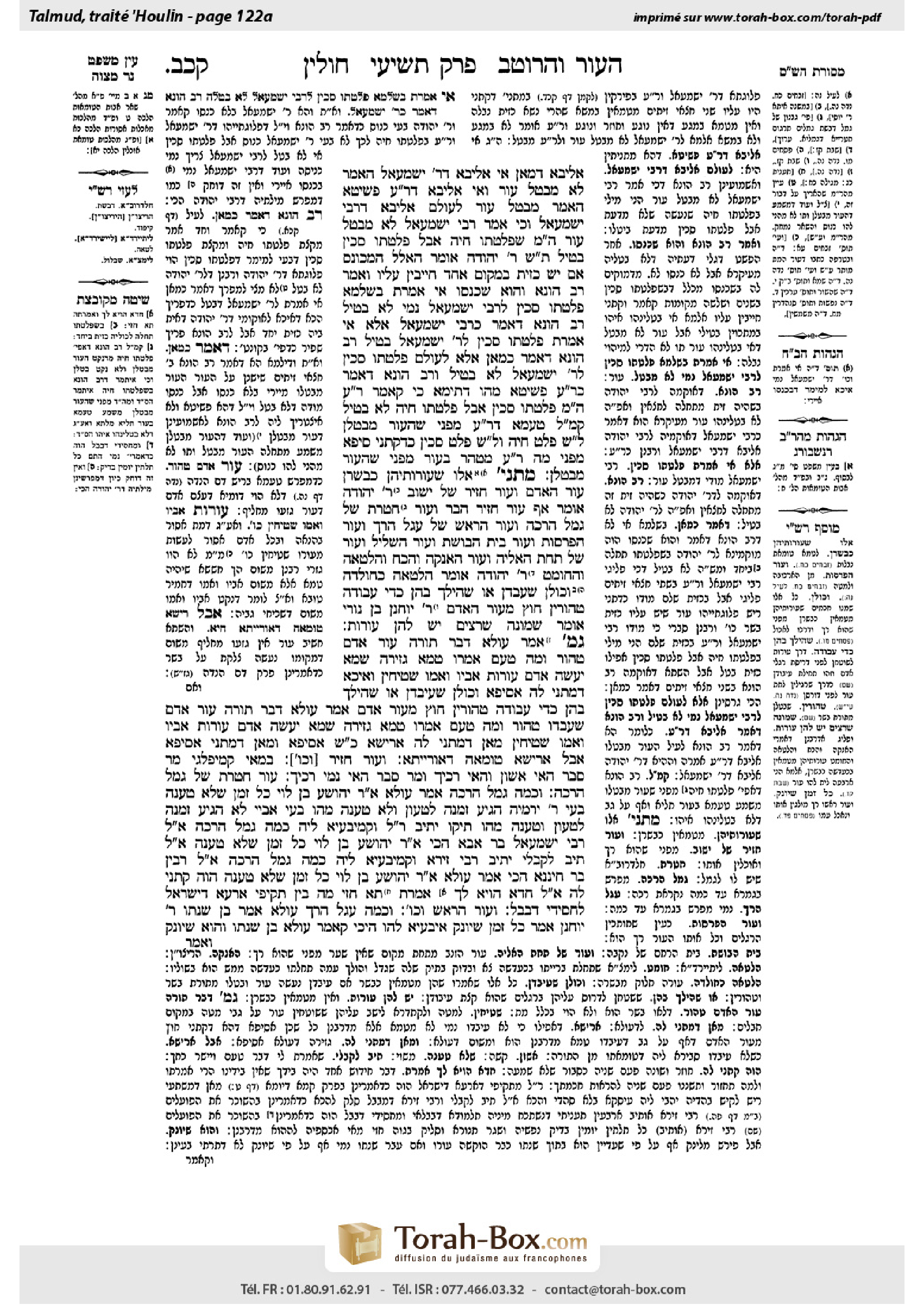
Chullin 122a: Talmud study for Daf Yomi
Study the Talmud for Daf Yomi with scanned pages, Hebrew text, English translations from Sefaria and AI-generated French translations.
Passage selection and English or AI-generated French translation are available where the scan has annotations. Daf Study is independent of Torah-Box and Sefaria.
Browse Chullin · חולין · All tractatesChullin 122a text and translations
This page of Chullin includes the Aramaic text, an English translation and an AI-generated French translation, alongside the scan above.
חולין קכ״ב א · Aramaic and Hebrew text
אַלִּיבָּא דְּמַאן?
אִי אַלִּיבָּא דְּרַבִּי יִשְׁמָעֵאל – הָאָמַר לֹא מְבַטֵּל עוֹר. וְאִי אַלִּיבָּא דְרַבִּי עֲקִיבָא – פְּשִׁיטָא, הָאָמַר מְבַטֵּל עוֹר.
לְעוֹלָם אַלִּיבָּא דְּרַבִּי יִשְׁמָעֵאל, וְכִי אָמַר רַבִּי יִשְׁמָעֵאל לֹא מְבַטֵּל עוֹר – הָנֵי מִילֵּי שֶׁפְּלָטַתּוּ חָיָה, אֲבָל פְּלָטַתּוּ סַכִּין – בָּטֵיל.
תָּא שְׁמַע, רַבִּי יְהוּדָה אוֹמֵר: הָאָלָל הַמְכוּנָּס, אִם יֵשׁ כְּזַיִת בְּמָקוֹם אֶחָד – חַיָּיבִין עָלָיו, וְאָמַר רַב הוּנָא: וְהוּא שֶׁכִּנְּסוֹ.
אִי אָמְרַתְּ בִּשְׁלָמָא פְּלָטַתּוּ סַכִּין, לְרַבִּי יִשְׁמָעֵאל נָמֵי לָא בָּטֵיל, רַב הוּנָא דְּאָמַר כְּרַבִּי יִשְׁמָעֵאל.
אֶלָּא אִי אָמְרַתְּ פְּלָטַתּוּ סַכִּין, לְרַבִּי יִשְׁמָעֵאל בָּטֵיל, רַב הוּנָא דְּאָמַר כְּמַאן?
אֶלָּא לְעוֹלָם פְּלָטַתּוּ סַכִּין, לְרַבִּי יִשְׁמָעֵאל לֹא בָּטֵיל, וְרַב הוּנָא דְּאָמַר כְּרַבִּי עֲקִיבָא!
פְּשִׁיטָא! מַהוּ דְּתֵימָא, כִּי קָאָמַר רַבִּי עֲקִיבָא – הָנֵי מִילֵּי פְּלָטַתּוּ סַכִּין, אֲבָל פְּלָטַתּוּ חַיָּה – לָא בָּטֵיל.
קָא מַשְׁמַע לַן טַעְמָא דְּרַבִּי עֲקִיבָא מִפְּנֵי שֶׁהָעוֹר מְבַטְּלָן, לָא שְׁנָא (פלט) [פְּלָטַתּוּ] חַיָּה, וְלָא שְׁנָא (פלט) [פְּלָטַתּוּ] סַכִּין, כִּדְקָתָנֵי סֵיפָא: מִפְּנֵי מָה רַבִּי עֲקִיבָא מְטַהֵר בְּעוֹר? מִפְּנֵי שֶׁהָעוֹר מְבַטְּלָן.
מַתְנִי׳ אֵלּוּ שֶׁעוֹרוֹתֵיהֶן כִּבְשָׂרָן: עוֹר הָאָדָם, וָעוֹר חֲזִיר שֶׁל יִשּׁוּב. רַבִּי יְהוּדָה אוֹמֵר: אַף עוֹר חֲזִיר הַבָּר.
וָעוֹר חֲטֶרֶת שֶׁל גָּמָל הָרַכָּה, וְעוֹר הָרֹאשׁ שֶׁל עֵגֶל הָרַךְ, וָעוֹר הַפְּרָסוֹת, וְעוֹר בֵּית הַבּוֹשֶׁת, וָעוֹר הַשְּׁלִיל, וְעוֹר שֶׁל תַּחַת הָאַלְיָה, וָעוֹר הָאֲנָקָה וְהַכֹּחַ וְהַלְּטָאָה וְהַחוֹמֶט. רַבִּי יְהוּדָה אוֹמֵר: הַלְּטָאָה כְּחוּלְדָּה.
וְכוּלָּן שֶׁעִבְּדָן, אוֹ שֶׁהִילֵּךְ בָּהֶן כְּדֵי עֲבוֹדָה – טְהוֹרִין, חוּץ מֵעוֹר הָאָדָם. רַבִּי יוֹחָנָן בֶּן נוּרִי אוֹמֵר: שְׁמוֹנָה שְׁרָצִים יֵשׁ לָהֶן עוֹרוֹת.
גְּמָ׳ אָמַר עוּלָּא: דְּבַר תּוֹרָה עוֹר אָדָם טָהוֹר, וּמָה טַעַם אָמְרוּ טָמֵא? גְּזֵירָה שֶׁמָּא יַעֲשֶׂה אָדָם עוֹרוֹת אָבִיו וְאִמּוֹ שְׁטִיחִין.
וְאִיכָּא דְּמַתְנֵי לַהּ אַסֵּיפָא, וְכוּלָּן שֶׁעִיבְּדָן אוֹ שֶׁהִילֵּךְ בָּהֶן כְּדֵי עֲבוֹדָה טְהוֹרִין, חוּץ מֵעוֹר אָדָם. אָמַר עוּלָּא: דְּבַר תּוֹרָה עוֹר אָדָם שֶׁעִבְּדוֹ טָהוֹר, וּמָה טַעַם אָמְרוּ טָמֵא? גְּזֵירָה שֶׁמָּא יַעֲשֶׂה אָדָם עוֹרוֹת אָבִיו וְאִמּוֹ שְׁטִיחִין.
מַאן דְּמַתְנֵי לַהּ אַרֵישָׁא, כׇּל שֶׁכֵּן אַסֵּיפָא, וּמַאן דְּמַתְנֵי אַסֵּיפָא, אֲבָל אַרֵישָׁא – טוּמְאָה דְּאוֹרָיְיתָא.
וְעוֹר חֲזִיר [וְכוּ׳]. בְּמַאי קָמִיפַּלְגִי? מָר סָבַר: הַאי אַשּׁוּן וְהַאי רַכִּיךְ, וּמָר סָבַר: הַאי נָמֵי רַכִּיךְ.
עוֹר חֲטֶרֶת שֶׁל גָּמָל הָרַכָּה, וְכַמָּה גָּמָל הָרַכָּה? אָמַר עוּלָּא, אָמַר רַבִּי יְהוֹשֻׁעַ בֶּן לֵוִי: כׇּל זְמַן שֶׁלֹּא טָעֲנָה.
בָּעֵי רַבִּי יִרְמְיָה: הִגִּיעַ זְמַנָּהּ לִטְעוֹן וְלֹא טָעֲנָה, מַהוּ? בָּעֵי אַבָּיֵי: לֹא הִגִּיעַ זְמַנָּהּ לִטְעוֹן וְטָעֲנָה, מַהוּ? תֵּיקוּ.
יָתֵיב רֵישׁ לָקִישׁ וְקָמִיבַּעְיָא לֵיהּ: כַּמָּה גָּמָל הָרַכָּה? אֲמַר לֵיהּ רַבִּי יִשְׁמָעֵאל בַּר אַבָּא: הָכִי אָמַר רַבִּי יְהוֹשֻׁעַ בֶּן לֵוִי: כׇּל זְמַן שֶׁלֹּא טָעֲנָה. אֲמַר לֵיהּ: תִּיב לְקִבְלִי.
יָתֵיב רַבִּי זֵירָא וְקָמִיבַּעְיָא לֵיהּ: כַּמָּה גָּמָל הָרַכָּה? אֲמַר לֵיהּ רָבִין בַּר חִינָּנָא: הָכִי אָמַר עוּלָּא, אָמַר רַבִּי יְהוֹשֻׁעַ בֶּן לֵוִי: כׇּל זְמַן שֶׁלֹּא טָעֲנָה. הֲוָה קָתָנֵי לַהּ. אֲמַר לֵיהּ: חֲדָא הָוְיָא לָךְ אֲמַרְתְּ.
תָּא חֲזִי, מָה בֵּין תַּקִּיפֵי אַרְעָא דְיִשְׂרָאֵל, לַחֲסִידֵי דְבָבֶל.
וְעוֹר הָרֹאשׁ וְכוּ׳. וְכַמָּה עֵגֶל הָרַךְ? עוּלָּא אָמַר: בֶּן שְׁנָתוֹ, רַבִּי יוֹחָנָן אָמַר: כׇּל זְמַן שֶׁיּוֹנֵק. אִיבַּעְיָא לְהוּ: הֵיכִי קָאָמַר עוּלָּא? בֶּן שְׁנָתוֹ וְהוּא שֶׁיּוֹנֵק,
Chullin 122a · English translation
The Gemara asks: In accordance with whose opinion is the statement of Rav Huna? It is taught in the mishna (124a) that in a case where the hide of an unslaughtered carcass was attached to two half olive-bulks of flesh, Rabbi Yishmael says that the hide imparts the impurity of an unslaughtered carcass by means of carrying but not by means of contact with the flesh, because one touches them separately whereas one carries them together. Rabbi Akiva says: One contracts impurity neither by means of contact with the hide nor by means of carrying it.
If one maintains that Rav Huna’s statement is in accordance with the opinion of Rabbi Yishmael, didn’t Rabbi Yishmael say that the hide does not nullify the attached flesh and therefore the one who carries it becomes impure with the impurity of a carcass? And if one maintains that Rav Huna’s statement is in accordance with the opinion of Rabbi Akiva, then it is obvious, as didn’t Rabbi Akiva say that the hide nullifies the flesh and therefore one who carries it does not become impure?
The Gemara answers: Actually, the statement of Rav Huna is in accordance with the opinion of Rabbi Yishmael. And when Rabbi Yishmael said that the hide does not nullify the flesh, that statement applies to a case where an animal severed the hide. But in a case where a person used a knife to flay the hide, the hide nullifies the attached flesh.
The Gemara suggests: Come and hear a refutation to this explanation of the statement of Rav Huna from that which is taught in the mishna: Rabbi Yehuda says: With regard to the meat residue attached to the hide after flaying that was collected, if there is an olive-bulk of it in one place it imparts impurity of an animal carcass, and one who contracts impurity from it and eats consecrated foods or enters the Temple is liable to receive karet for it. And Rav Huna says in explanation of this statement of Rabbi Yehuda: This halakha is applicable only when a halakhically competent person collected the meat residue in one place, but not if the meat residue was collected by a child or without human intervention.
Since Rav Huna interprets the statement of Rabbi Yehuda as referring to a case where a halakhically competent person collected the pieces of flesh, the mishna must be discussing a case where such a person flayed the hide with a knife in multiple places and then collected the pieces of flesh attached to the hide. Evidently, the hide does not nullify the flesh because if the hide did nullify the flesh, that flesh would not impart the impurity of a carcass even if it were later collected. Therefore, the Gemara challenges: Granted, if you say that according to Rabbi Yishmael, even in a case where a person used a knife to flay the hide, the hide does not nullify the flesh, accordingly, Rav Huna said his statement in accordance with the opinion of Rabbi Yishmael that a hide flayed by a knife does not nullify the flesh, and therefore the flesh imparts the impurity of a carcass if a person collected the pieces.
But if you say that according to Rabbi Yishmael, in a case where a person used a knife to flay the hide, the hide nullifies the flesh and therefore the flesh does not impart the impurity of a carcass even if a halakhically competent person collected the pieces, then in accordance with whose opinion did Rav Huna say that the hide does not nullify the flesh and that the pieces of flesh that one collected impart the impurity of a carcass?
The Gemara responds: Rather, it is necessary to explain the opinion of Rabbi Yishmael differently. Actually, according to Rabbi Yishmael even a hide flayed by a knife does not nullify the attached flesh. And Rav Huna said his statement that the hide nullifies attached pieces of flesh in accordance with the opinion of Rabbi Akiva.
The Gemara asks: Isn’t it obvious that the hide nullifies the flesh according to Rabbi Akiva? Rav Huna’s statement is unnecessary. The Gemara answers: Rav Huna’s statement is necessary lest you say: When Rabbi Akiva said that the hide nullifies the attached pieces of flesh, that statement applies only to a case where a person used a knife to flay the animal. But if an animal severed the hide, the hide does not nullify the flesh.
Therefore, Rav Huna teaches us that the reason for the opinion of Rabbi Akiva is because the hide nullifies the flesh, and there is no difference whether an animal severed the hide, and there is no difference whether a person used a knife to flay the hide. This statement of Rav Huna is therefore in accordance with that which the latter clause of that mishna teaches: For what reason does Rabbi Akiva deem one ritually pure in a case where he moved both half olive-bulks with the hide? It is because the hide separates between them and nullifies them.
MISHNA: These are the entities whose skin has the same halakhic status as their flesh: The skin of a dead person, which imparts impurity like his flesh; and the skin of a domesticated pig, which is soft and eaten by gentiles, and imparts the impurity of an animal carcass like its flesh. Rabbi Yehuda says: Even the skin of a wild boar has the same status.
And the halakhic status of the skin of all of the following animals is also like that of their flesh: The skin of the hump of a young camel that did not yet toughen; and the skin of the head of a young calf; and the hide of the hooves; and the skin of the womb; and the skin of an animal fetus in the womb of a slaughtered animal; and the skin beneath the tail of a ewe; and the skin of the gecko [anaka], and the desert monitor [ko’aḥ], and the lizard [leta’a], and the skink [ḥomet], four of the eight creeping animals that impart ritual impurity after death. Rabbi Yehuda says: The halakhic status of the skin of the lizard is like that of the skin of the weasel and is not like that of its flesh.
And with regard to all of these skins, in a case where one tanned them or spread them on the ground and trod upon them for the period of time required for tanning, they are no longer classified as flesh and are ritually pure, except for the skin of a person, which maintains the status of flesh. Rabbi Yoḥanan ben Nuri says: All eight creeping animals enumerated in the Torah have skins whose halakhic status is not that of flesh.
GEMARA: The first clause of the mishna teaches that the skin of a dead person imparts impurity like his flesh. With regard to this, Ulla says: The skin of a dead person is pure by Torah law; and what is the reason that the Sages said that it is impure? It is a rabbinic decree lest a person fashion mats from the skins of his deceased father and mother.
And there are those who teach this statement of Ulla with regard to the latter clause of the mishna: And with regard to all of these skins, in a case where one tanned them or spread them on the ground and trod upon them for the period of time required for tanning, they are no longer classified as flesh and are ritually pure, except for the skin of a person, which maintains the status of flesh. With regard to that clause, Ulla says: The skin of a dead person that one tanned is pure by Torah law; and what is the reason that the Sages said that it is impure? It is a rabbinic decree lest a person fashion mats from the skins of his deceased father and mother.
The Gemara comments: The one who teaches the statement of Ulla that the skin of a corpse is pure by Torah law with regard to the first clause of the mishna, which discusses a softer hide that is not tanned, all the more so would teach it with regard to the latter clause of the mishna. But the one who teaches this statement with regard to the latter clause of the mishna holds that only the tanned skin of a corpse is pure by Torah law, but does not teach it with regard to the first clause of the mishna because he holds that the impurity of the skin of a corpse that is not tanned is by Torah law.
§The mishna teaches that according to the first tanna, the skin of a domesticated pig imparts impurity of an animal carcass like its flesh, indicates that the skin of a wild boar does not impart impurity of a carcass. Rabbi Yehuda disagrees and holds that even the skin of a wild boar has the same status as its flesh. The Gemara asks: With regard to what do the first tanna and Rabbi Yehuda disagree? The Gemara answers: One Sage, the first tanna, holds that this skin of a wild boar is tough and therefore its status is not that of flesh, but that skin of a domesticated pig is soft and therefore its status is that of flesh. And one Sage, Rabbi Yehuda, holds that this skin of a wild boar is also soft and therefore its status is that of flesh.
§The mishna teaches that the skin of the hump of a young camel that did not yet toughen imparts impurity of a carcass like its flesh. The Gemara asks: And for how long is a camel considered young and the status of the skin considered like that of the flesh? Ulla says that Rabbi Yehoshua ben Levi says: As long as the camel has not carried a burden.
Rabbi Yirmeya raises a dilemma: What is the halakha with regard to the skin of a camel whose time, i.e., age, to carry a burden has arrived, but it has not yet carried one? Abaye raises a dilemma: What is the halakha with regard to the skin of a camel whose time to carry a burden has not arrived, but it has nevertheless carried one? The Gemara answers: These dilemmas shall stand unresolved.
Reish Lakish sat and raised a dilemma: For how long is a camel considered young? Rabbi Yishmael bar Abba said to him: This is what Rabbi Yehoshua ben Levi said: As long as the camel has not carried a burden. In response to his answer, Reish Lakish honored him and said to him: Sit opposite me.
Rabbi Zeira sat and raised a dilemma: For how long is a camel considered young? Ravin bar Ḥinnana said to him: This is what Ulla said that Rabbi Yehoshua ben Levi said: As long as the camel has not carried a burden. Ravin bar Ḥinnana then repeated his answer to Rabbi Zeira. Rabbi Zeira said to him: Do you have only one halakha to say, and that is why you are repeating it?
The Gemara points out: Come and see what the difference is between the harsh scholars of Eretz Yisrael, such as Reish Lakish, and the saintly ones of Babylonia, such as Rabbi Zeira. Although Reish Lakish was known for his harsh nature, he was the one who honored the Sage who resolved his dilemma, whereas Rabbi Zeira responded sharply to the one who taught him this halakha.
§The mishna teaches: And the skin of the head of a young calf has the same halakhic status as the flesh with regard to impurity. The Gemara asks: And for how long is a calf considered young? Ulla says: It is considered young in its first year of age. Rabbi Yoḥanan says: For as long as the calf is suckling. A dilemma was raised before the Sages: With regard to what case is Ulla speaking? Is he referring to a calf that is in its first year of age and is still suckling,
Chullin 122a · Traduction française (IA)
La Guemara pose la question : Selon l'opinion de qui est l'affirmation de Rav Huna ? Il est enseigné dans la mitsva (124a) que dans un cas où la peau d'un cadavre non sacrifié était attachée à deux moitiés de bûche d'olive de viande, Rabbi Yishmael dit que la peau transmet l'impureté du cadavre non sacrifié par le portement mais pas par le contact avec la viande, car l'on touche séparément ces deux éléments tandis qu'on les porte ensemble. Rabbi Akiva dit : On ne contracte pas d'impureté ni par le contact avec la peau ni par le portement de celle-ci.
Si l'on maintient que l'affirmation de Rav Huna est selon l'opinion de Rabbi Yishmael, n'a-t-on pas dit que la peau ne nullifie pas la viande attachée et donc celui qui la porte devient impur avec l'impureté du cadavre ? Et si l'on maintient que l'affirmation de Rav Huna est selon l'opinion de Rabbi Akiva, alors c'est évident, car n'a-t-on pas dit que la peau nullifie la viande et donc celui qui la porte ne devient pas impur ?
La Guemara répond : En réalité, l'affirmation de Rav Huna est selon l'opinion de Rabbi Yishmael. Et lorsque Rabbi Yishmael a dit que la peau ne nullifie pas la viande, cette affirmation s'applique à un cas où un animal a séparé la peau. Mais dans un cas où une personne a utilisé un couteau pour dépecer la peau, la peau nullifie la viande attachée.
La Guemara suggère : Venez écouter une réfutation à cette explication de l'affirmation de Rav Huna à partir de ce qui est enseigné dans la mitsva : Rabbi Yéhuda dit : En ce qui concerne le résidu de viande attaché à la peau après dépecage qui a été collecté, si un olivier de ce résidu est présent dans un endroit, il transmet l'impureté d'un cadavre, et celui qui contracte cette impureté et mange des aliments consacrés ou entre dans le Temple est puni de karet pour cela. Et Rav Huna dit, en expliquant cette affirmation de Rabbi Yéhuda : Cette halakha s'applique uniquement lorsque une personne halakhiquement compétente a collecté le résidu de viande dans un seul endroit, mais pas si le résidu de viande a été collecté par un enfant ou sans intervention humaine.
Puisque Rav Huna interprète l'affirmation de Rabbi Yéhuda comme se référant à un cas où une personne halakhiquement compétente a collecté les morceaux de viande, la mitsva doit parler d'un cas où cette personne a dépecé la peau avec un couteau à plusieurs endroits et a ensuite collecté les morceaux de viande attachés à la peau. Évidemment, la peau ne nullifie pas la viande, car si la peau nullifiait la viande, celle-ci ne transmettrait pas l'impureté d'un cadavre même après avoir été collectée. Par conséquent, la Guemara remet en question : Admettons, si vous dites que selon Rabbi Yishmael, même dans un cas où une personne a utilisé un couteau pour dépecer la peau, la peau ne nullifie pas la viande, donc Rav Huna a dit son affirmation selon l'opinion de Rabbi Yishmael que la peau dépecée avec un couteau ne nullifie pas la viande, et donc la viande transmet l'impureté d'un cadavre si une personne a collecté les morceaux.
Mais si vous dites que selon Rabbi Yishmael, dans un cas où une personne a utilisé un couteau pour dépecer la peau, la peau annule la viande et donc la viande ne transmet pas l'impureté d'un cadavre même si une personne halakhiquement compétente a collecté les morceaux, alors selon l'opinion de qui Rav Huna a-t-il dit que la peau ne nullifie pas la viande et que les morceaux de viande que l'on a collectés transmettent l'impureté d'un cadavre ?
La Guemara répond : Plutôt, il faut expliquer l'opinion de Rabbi Yishmael différemment. En réalité, selon Rabbi Yishmael, même une peau dépecée avec un couteau ne nullifie pas la viande attachée. Et Rav Huna a dit son affirmation que la peau nullifie les morceaux de viande attachés selon l'opinion de Rabbi Akiva.
La Guemara pose la question : N'est-ce pas évident que la peau annule la viande selon Rabbi Akiva ? L'affirmation de Rav Huna n'est pas nécessaire. La Guemara répond : L'affirmation de Rav Huna est nécessaire afin que l'on ne dise pas : Lorsque Rabbi Akiva a dit que la peau annule les morceaux de viande attachés, cette affirmation s'applique uniquement à un cas où une personne a utilisé un couteau pour dépecer l'animal. Mais si un animal a séparé la peau, la peau ne nullifie pas la viande.
Par conséquent, Rav Huna nous enseigne que la raison de l'opinion de Rabbi Akiva est que la peau annule la viande, et il n'y a pas de différence entre le cas où un animal a séparé la peau et celui où une personne a utilisé un couteau pour dépecer l'animal. Cette affirmation de Rav Huna est donc en conformité avec ce que la dernière partie de cette mitsna enseigne : Pour quelle raison Rabbi Akiva considère qu'une personne est pure dans le cas où elle a transporté les deux moitiés de bûche d'olive avec la peau ? C'est parce que la peau les sépare et les annule.
MITSNA : Ces sont les entités dont la peau a le même statut halakhique que leur viande : La peau d'une personne morte, qui transmet l'impureté comme sa viande ; et la peau d'un porc domestique, qui est douce et mangée par les non-Juifs, et qui transmet l'impureté d'un cadavre comme sa viande. Rabbi Yéhuda dit : Même la peau d'un sanglier a le même statut.
Et le statut halakhique de la peau de tous les animaux suivants est aussi comme celui de leur viande : La peau du cou d'un jeune chameau qui n'avait pas encore durci ; et la peau de la tête d'un jeune veau ; et la peau des sabots ; et la peau du ventre ; et la peau d'un fœtus d'animal dans le ventre d'un animal sacrifié ; et la peau sous la queue d'une brebis ; et la peau du gecko [anaka], et du lézard [ko’aḥ], et du lézard [leta’a], et du lézard [ḥomet], quatre des huit animaux rampants qui transmettent l'impureté après leur mort. Rabbi Yéhuda dit : Le statut halakhique de la peau du lézard est comme celui de la peau du blaireau et n'est pas comme celui de sa viande.
Et concernant toutes ces peaux, dans le cas où l'on les tannait ou les étalait sur le sol et qu'on marchait dessus pendant la durée nécessaire à la tannage, elles ne sont plus considérées comme de la chair et sont rituellement pures, sauf la peau d'un être humain, qui conserve le statut de chair. Rabbi Yoḥanan ben Nuri dit : Tous les huit animaux rampants énumérés dans la Torah ont des peaux dont le statut halakhique n'est pas celui de chair.
GUEMARA : La première clause de la mitsna enseigne que la peau d'un mort transmet l'impureté comme sa chair. À ce sujet, Ulla dit : La peau d'un mort est pure selon la loi juive ; et quelle est la raison pour laquelle les Sages ont dit qu'elle est impure ? C'est un décret rabbinique afin que personne ne fabrique des tapis à partir des peaux de ses parents décédés.
Et ceux qui enseignent cette déclaration d'Ulla concernant la seconde clause de la mitsna : Et concernant toutes ces peaux, dans le cas où l'on les tannait ou les étalait sur le sol et qu'on marchait dessus pendant la durée nécessaire à la tannage, elles ne sont plus considérées comme de la chair et sont rituellement pures, sauf la peau d'un être humain, qui conserve le statut de chair. À ce sujet, Ulla dit : La peau d'un mort que l'on a tannée est pure selon la loi juive ; et quelle est la raison pour laquelle les Sages ont dit qu'elle est impure ? C'est un décret rabbinique afin que personne ne fabrique des tapis à partir des peaux de ses parents décédés.
Le Guemara commente : Celui qui enseigne la déclaration d'Ulla selon laquelle la peau d'un cadavre est pure selon la halakha concernant la première clause de la mitsva, qui discute d'une peau douce non tannée, encore davantage devrait-il enseigner cela concernant la seconde clause de la mitsva. Mais celui qui enseigne cette déclaration concernant la seconde clause de la mitsva considère que seule la peau tannée d'un cadavre est pure selon la halakha, mais ne l'enseigne pas concernant la première clause de la mitsva, car il considère que l'impureté de la peau d'un cadavre non tannée est selon la halakha.
§La mitsva enseigne que selon le premier tanna, la peau d'un porc domestique transmet l'impureté d'un cadavre comme sa chair, indiquant que la peau d'un sanglier sauvage ne transmet pas l'impureté d'un cadavre. Rabbi Yehuda désaccorde et considère que même la peau d'un sanglier sauvage a le même statut que sa chair. Le Guemara pose une question : À propos de quoi les deux tannaïm et Rabbi Yehuda s'opposent-ils ? Le Guemara répond : Un Sage, le premier tanna, considère que cette peau de sanglier sauvage est dure et donc son statut n'est pas celui de chair, mais que la peau d'un porc domestique est douce et donc son statut est celui de chair. Et un autre Sage, Rabbi Yehuda, considère que cette peau de sanglier sauvage est également douce et donc son statut est celui de chair.
§La mitsva enseigne que la peau du cou d'un jeune chameau qui n'avait pas encore durci transmet l'impureté d'un cadavre comme sa chair. Le Guemara pose une question : Et pendant combien de temps un chameau est-il considéré comme jeune et la peau comme ayant le statut de chair ? Ulla dit que Rabbi Yehoshua ben Levi dit : Aussi longtemps que le chameau n'a pas porté une charge.
Rabbi Yirmeya soulève un dilemme : Quel est le halakha concernant la peau d'un chameau dont l'âge à porter une charge est arrivé, mais qui n'a pas encore porté une charge ? Abaye soulève un dilemme : Quel est le halakha concernant la peau d'un chameau dont l'âge à porter une charge n'est pas arrivé, mais qui a tout de même porté une charge ? Le Guemara répond : Ces dilemmes resteront sans réponse.
Reish Lakish s'est assis et a soulevé un dilemme : Pendant combien de temps un chameau est-il considéré comme jeune ? Rabbi Yishmael bar Abba a dit à lui : C'est ce que Rabbi Yehoshua ben Levi a dit : Aussi longtemps que le chameau n'a pas porté une charge. En réponse à cette réponse, Reish Lakish l'a honoré et a dit à lui : Assieds-toi à côté de moi.
Rabbi Zeira s'est assis et a soulevé un dilemme : Pendant combien de temps un chameau est-il considéré comme jeune ? Ravin bar Ḥinnana a dit à lui : C'est ce que Ulla a dit que Rabbi Yehoshua ben Levi a dit : Aussi longtemps que le chameau n'a pas porté une charge. Ravin bar Ḥinnana a ensuite répété sa réponse à Rabbi Zeira. Rabbi Zeira a dit à lui : As-tu seulement une seule halakha à dire, et c'est pourquoi tu la répètes ainsi ?
Le Guemara souligne : Approche et vois la différence entre les savants durs d'Israël, tels que Reish Lakish, et les saints de Babylone, tels que Rabbi Zeira. Bien que Reish Lakish fût connu pour son tempérament dur, c'est lui qui a honoré le sage qui a résolu son dilemme, tandis que Rabbi Zeira a répondu durement à celui qui lui a enseigné cette halakha.
§La mitsna enseigne : Et la peau de la tête d'un veau jeune a le même statut halakhique que la chair concernant l'impureté. Le Guemara pose une question : Et pendant combien de temps un veau est-il considéré comme jeune ? Ulla dit : Il est considéré comme jeune pendant sa première année. Rabbi Yoḥanan dit : Aussi longtemps que le veau est allaitant. Un dilemme a été soulevé devant les Sages : À propos de quel cas Ulla parle-t-il ? Est-ce un veau qui est dans sa première année et qui est encore allaitant,
Traduction française générée par IA à partir de l’édition anglaise de Sefaria. Vérifie toujours un passage avec le texte source.
Text from Sefaria: William Davidson Edition - Vocalized Aramaic (unknown); William Davidson Edition - English (CC BY NC).