Chullin 122b: Talmud study for Daf Yomi
Study the Talmud for Daf Yomi with scanned pages, Hebrew text, English translations from Sefaria and AI-generated French translations.
Passage selection and English or AI-generated French translation are available where the scan has annotations. Daf Study is independent of Torah-Box and Sefaria.
Browse Chullin · חולין · All tractatesChullin 122b text and translations
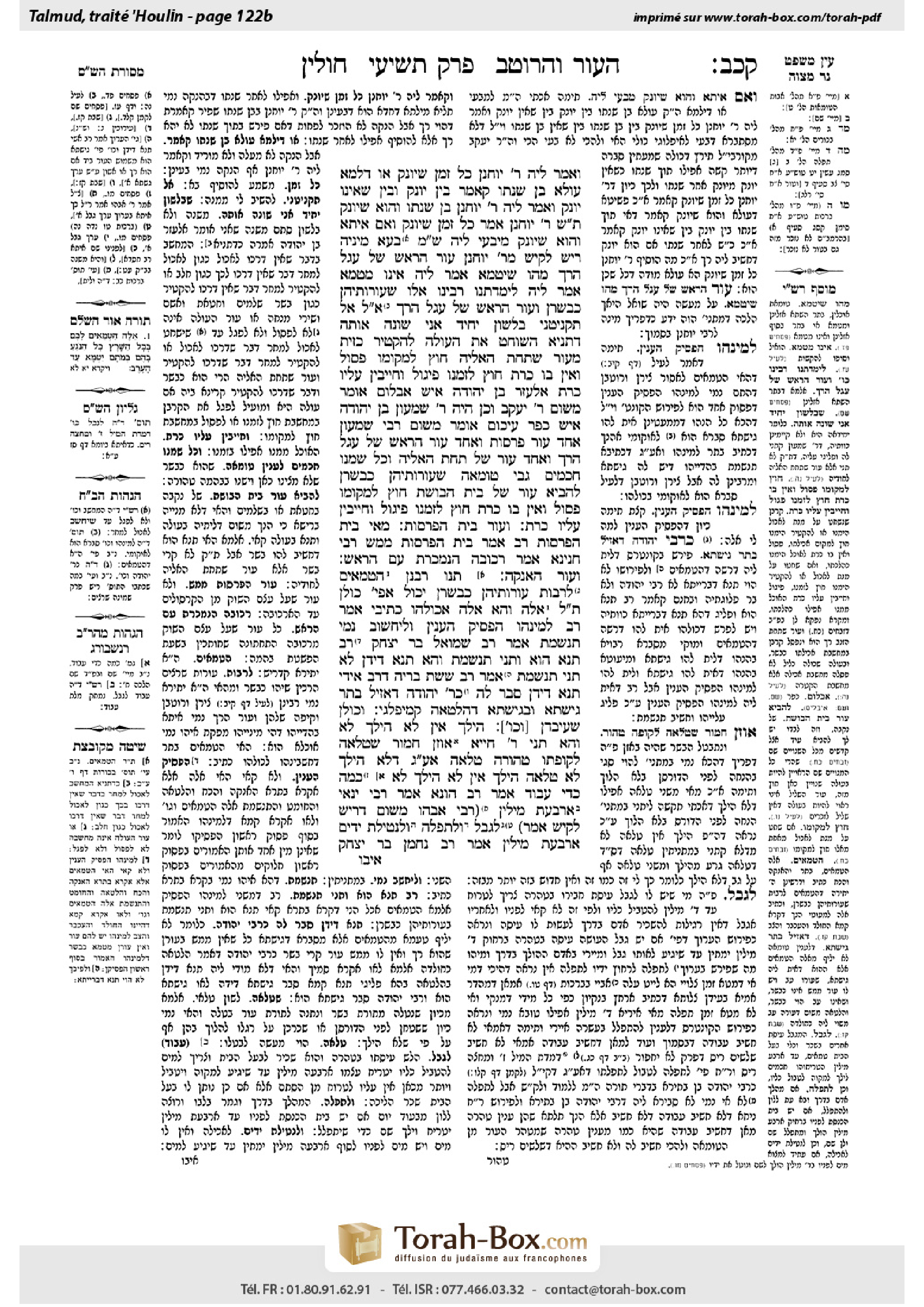
This page of Chullin includes the Aramaic text, an English translation and an AI-generated French translation, alongside the scan above.
חולין קכ״ב ב · Aramaic and Hebrew text
וַאֲמַר לֵיהּ רַבִּי יוֹחָנָן: כׇּל זְמַן שֶׁיּוֹנֵק.
אוֹ דִלְמָא, עוּלָּא בֶּן שְׁנָתוֹ קָאָמַר, בֵּין יוֹנֵק וּבֵין שֶׁאֵינוֹ יוֹנֵק, וַאֲמַר לֵיהּ רַבִּי יוֹחָנָן: בֶּן שְׁנָתוֹ וְהוּא שֶׁיּוֹנֵק?
תָּא שְׁמַע, רַבִּי יוֹחָנָן אָמַר: כׇּל זְמַן שֶׁיּוֹנֵק, וְאִם אִיתַהּ – ״וְהוּא שֶׁיּוֹנֵק״ מִיבְּעֵי לֵיהּ! שְׁמַע מִינַּהּ.
בְּעָא מִינֵּיהּ רֵישׁ לָקִישׁ מֵרַבִּי יוֹחָנָן: עוֹר הָרֹאשׁ שֶׁל עֵגֶל הָרַךְ, מַהוּ שֶׁיְּטַמֵּא? אֲמַר לֵיהּ: אֵינוֹ מְטַמֵּא.
אֲמַר לֵיהּ, לִימַּדְתָּנוּ רַבֵּינוּ: אֵלּוּ שֶׁעוֹרוֹתֵיהֶן כִּבְשָׂרָן, וְעוֹר הָרֹאשׁ שֶׁל עֵגֶל הָרַךְ! אֲמַר לֵיהּ: אַל תַּקְנִיטֵנִי, בִּלְשׁוֹן יָחִיד אֲנִי שׁוֹנֶה אוֹתָהּ.
דְּתַנְיָא: הַשּׁוֹחֵט אֶת הָעוֹלָה לְהַקְטִיר כְּזַיִת מֵעוֹר שֶׁתַּחַת הָאַלְיָה, חוּץ לִמְקוֹמוֹ – פָּסוּל, וְאֵין בּוֹ כָּרֵת; חוּץ לִזְמַנּוֹ – פִּיגּוּל, וְחַיָּיבִין עָלָיו כָּרֵת.
אֶלְעָזָר בֶּן יְהוּדָה אִישׁ אֶבְלַיִם אוֹמֵר מִשּׁוּם רַבִּי יַעֲקֹב, וְכֵן הָיָה רַבִּי שִׁמְעוֹן בֶּן יְהוּדָה אִישׁ כְּפַר עִיכּוּם אוֹמֵר מִשּׁוּם רַבִּי שִׁמְעוֹן: אֶחָד עוֹר פְּרָסוֹת, וְאֶחָד עוֹר הָרֹאשׁ שֶׁל עֵגֶל הָרַךְ, וְאֶחָד עוֹר שֶׁל תַּחַת הָאַלְיָה, וְכׇל שֶׁמָּנוּ חֲכָמִים גַּבֵּי טוּמְאָה שֶׁעוֹרוֹתֵיהֶן כִּבְשָׂרָן, לְהָבִיא עוֹר שֶׁל בֵּית הַבּוֹשֶׁת.
חוּץ לִמְקוֹמוֹ – פָּסוּל, וְאֵין בּוֹ כָּרֵת. חוּץ לִזְמַנּוֹ – פִּיגּוּל, וְחַיָּיבִין עָלָיו כָּרֵת.
וְעוֹר בֵּית הַפְּרָסוֹת. מַאי בֵּית הַפְּרָסוֹת? רַב אָמַר: בֵּית הַפְּרָסוֹת מַמָּשׁ, רַבִּי חֲנִינָא אָמַר: רְכוּבָּה הַנִּמְכֶּרֶת עִם הָרֹאשׁ.
וָעוֹר הָאֲנָקָה, תָּנוּ רַבָּנַן: ״הַטְּמֵאִים״ – לְרַבּוֹת עוֹרוֹתֵיהֶן כִּבְשָׂרָן.
יָכוֹל אֲפִילּוּ כּוּלָּן, תַּלְמוּד לוֹמַר ״אֵלֶּה״.
וְהָא ״אֵלֶּה״ אַכּוּלְּהוּ כְּתִיבִי! אָמַר רַב: ״לְמִינֵהוּ״ הִפְסִיק הָעִנְיָן.
וְלִיחְשׁוֹב נָמֵי תִּנְשֶׁמֶת? אָמַר רַב שְׁמוּאֵל בַּר יִצְחָק: רַב תְּנָא הוּא, וְתָנֵי תִּנְשֶׁמֶת.
וְהָא תַּנָּא דִּידַן לָא תָּנֵי תִּנְשֶׁמֶת?
אָמַר רַב שֵׁשֶׁת בְּרֵיהּ דְּרַב אִידִי: תַּנָּא דִּידַן סָבַר לַהּ כְּרַבִּי יְהוּדָה, דְּאָזֵיל בָּתַר גִּישְׁתָּא.
וּבְגִישְׁתָּא דְּהַלְּטָאָה קָמִיפַּלְגִי.
וְכוּלָּן שֶׁעִיבְּדָן [וְכוּ׳]. הִילֵּךְ אִין, לֹא הִילֵּךְ לָא? וְהָא תָּנֵי רַבִּי חִיָּיא: אוֹזֶן חֲמוֹר שֶׁטְּלָאָהּ לְקוּפָּתוֹ טְהוֹרָה, טְלָאָהּ – אַף עַל גַּב דְּלָא הִילֵּךְ!
לֹא: טְלָאָהּ, הִילֵּךְ – אִין, לֹא הִילֵּךְ – לָא.
כַּמָּה כְּדֵי עִבּוּד? אָמַר רַב הוּנָא אָמַר רַבִּי יַנַּאי: אַרְבַּעַת מִילִין.
רַבִּי אֲבָהוּ מִשּׁוּם דְּרֵישׁ לָקִישׁ אָמַר: לְגַבָּל,
וְלִתְפִלָּה וְלִנְטִילַת יָדַיִם – אַרְבַּעַת מִילִין.
אָמַר רַב נַחְמָן בַּר יִצְחָק:
Chullin 122b · English translation
and Rabbi Yoḥanan disagreed with Ulla and said to him: A calf is considered young as long as it is suckling, even after its first year of age? According to this explanation, Ulla considers a calf to be young only when it is both in its first year and suckling, and Rabbi Yoḥanan considers a calf that is suckling to be young even if it is beyond its first year.
Or perhaps, does Ulla say that a calf is considered young if it is in its first year of age, whether it is suckling or whether it is no longer suckling, and Rabbi Yoḥanan said to him: The calf must be in its first year of age and it must also be suckling in order to be considered young?
Come and hear a resolution to this dilemma: Rabbi Yoḥanan says: The calf is considered young the entire time that it is suckling. And if it is so that Rabbi Yoḥanan requires a calf to be both in its first year and suckling to be considered young, Rabbi Yoḥanan should have said: And provided the calf is suckling, indicating an additional condition. Conclude from it that Rabbi Yoḥanan considers a calf that is suckling to be young even if it is beyond its first year, and that Ulla considers only a calf that is both in its first year and suckling to be young.
§The Gemara continues to discuss the skin of the head of a young calf. Reish Lakish asked Rabbi Yoḥanan: What is the halakha with regard to whether the skin of the head of a young calf that is still fit to be eaten imparts impurity? Is the status of the skin like that of flesh or not? Rabbi Yoḥanan said to him: It does not impart impurity.
Reish Lakish said to him: But didn’t you teach us, our teacher, that it says in the mishna: These are the entities whose skin has the same halakhic status as their flesh, and the skin of the head of a young calf is included among them? Rabbi Yoḥanan said to Reish Lakish: Do not provoke me by asking such a question. I teach that mishna in the singular, i.e., that mishna is in accordance with an individual opinion and is contrary to the majority opinion. Therefore, the halakha is not in accordance with it.
As it is taught in a baraita: One who slaughters a burnt offering with the intention to burn an olive-bulk of the skin beneath the tail outside its designated area, i.e., outside the Temple courtyard, renders the offering unfit, but there is no liability for karet for one who partakes of the offering. If he intended to burn it beyond its designated time, i.e., not on that day, then it is rendered piggul, and one is liable to receive karet for partaking of it. Since this particular area of the skin is soft, its status is therefore like that of flesh. This is the opinion of the Rabbis.
Elazar ben Yehuda of Aveilum says in the name of Rabbi Ya’akov, and so Rabbi Shimon ben Yehuda of Kefar Ikom says in the name of Rabbi Shimon: This halakha applies both to the hide of the hooves, and the skin of the head of a young calf, and the skin beneath the tail, and all of the entities that the Sages listed with regard to ritual impurity that the halakhic status of their skin is like that of their flesh, including the skin of the womb.
Therefore, one who sacrifices a burnt offering with the intention to burn an olive-bulk of any of these skins outside its designated area renders the offering unfit, but there is no liability for karet for one who partakes of the offering. If he intended to burn it beyond its designated time, then it is rendered piggul, and one is liable to receive karet for eating it. Therefore, the mishna is in accordance with the individual opinion of Elazar ben Yehuda, who holds that all of the skins listed in the mishna have the status of flesh, and not in accordance with the Rabbis’ opinion that only the skin beneath the tail has the status of flesh.
§The mishna teaches: And the hide of the hooves has the status of flesh with regard to imparting impurity. The Gemara asks: To what is the term hooves referring? Rav says: It is literally referring to the hooves. Rabbi Ḥanina says: It is referring to the skin of the section of the knee at the top of the lower bone, which is sold with the head. This skin of the knee, and of the lower bone attached to it, has the status of flesh.
§The mishna teaches: And the halakhic status of the skin of the gecko, and the desert monitor, and the lizard, and the skink, four of the eight creeping animals that impart ritual impurity after death, is like that of their flesh with regard to imparting impurity. The Sages taught in a baraita: It is written: “And these are they which are impure for you among the creeping animals that creep upon the earth: The weasel, and the mouse, and the great lizard after its kinds. And the gecko, and the desert monitor, and the lizard, and the skink, and the chameleon. These are they which are impure for you among all that swarm; whosoever touches them, when they are dead, shall be impure until the evening” (Leviticus 11:29–32). The term “they which are” in the expression “they which are impure” seems superfluous, and serves to include the skins of these animals as having the same halakhic status as their flesh.
One might have thought that this halakha applies even to all of the creeping animals listed in the verses. Therefore, the verse states: “These,” indicating that this halakha applies only to these animals mentioned in the mishna, i.e., the gecko, the desert monitor, the lizard, and the skink.
The Gemara asks: But isn’t the term “these” written with regard to all eight of the creeping animals listed in the verse? Rav says: After mentioning the weasel, the mouse, and the great lizard the verse states: “After its kinds.” Therefore, the verse interrupted the previous matter and taught that the status of the skin is like that of the flesh only with regard to the creeping animals mentioned in the latter part of the verse.
The Gemara objects: But since the chameleon is listed in the latter part of the verse, let the chameleon also be counted among the animals whose skin has the status of flesh. Rav Shmuel bar Yitzḥak said: Rav, who interprets the verse in this manner, has the status of a tanna, and unlike the mishna, he teaches that the skin of the chameleon has the status of flesh.
The Gemara asks: But the tanna of our mishna does not teach this halakha with regard to the chameleon. According to his opinion, why doesn’t the skin of the chameleon have the status of flesh?
Rav Sheshet, son of Rav Idi, said: The tanna of our mishna holds in accordance with the opinion of Rabbi Yehuda that the halakhic status of the skin of the lizard, even though it is mentioned in the latter part of the verse, is like that of the skin of the weasel and is not like that of its flesh. Rabbi Yehuda does not derive that the status of the skin is like that of flesh from the verse that states: “They which are impure.” Rather, he follows the texture of the skin of each creeping animal when deciding whether the status of its skin is like that of its flesh.
The first tanna of the mishna and Rabbi Yehuda agree that the texture of the skin of the gecko, the desert monitor, and the skink is soft and therefore the status of their skin is like that of their flesh; and they disagree with regard to the texture of the skin of the lizard. Rabbi Yehuda classifies its skin as tough, and the first tanna of the mishna classifies its skin as soft.
§The mishna teaches: And all of these skins, in a case where one tanned them or spread them on the ground and trod upon them, are no longer classified as flesh and are ritually pure. The Gemara objects: The mishna indicates that if one trod upon them they are no longer classified as flesh, but if one did not tread upon them they do not cease being classified as flesh. But doesn’t Rabbi Ḥiyya teach: The ear of a donkey that one sewed into his basket is pure and is no longer classified as flesh. Just as the ear is no longer classified as flesh once it is sewed into a basket, so too skin that is spread on the ground, even if one did not tread upon it, should no longer be classified as flesh.
The Gemara explains: No, this is not difficult. Sewing the ear is an action that nullifies the ear’s classification as flesh. But spreading skin on the ground is not an action that nullifies the skin’s classification as flesh unless one trod upon the skin. Therefore, if one trod upon the skin it is no longer classified as flesh, but if one did not tread upon it, it does not cease being classified as flesh.
The mishna states that the skin must be trodden upon for the period required for tanning. The Gemara clarifies: How long is the period required for tanning? Rav Huna says that Rabbi Yannai says: The time which it takes one to walk four mil.
§Since the period of time it takes to walk four mil was mentioned, the Gemara lists halakhot that employ this period of time. Rabbi Abbahu says in the name of Reish Lakish: With regard to a professional kneader who is careful to maintain the ritual purity of the dough that he kneads for others, he must walk up to four mil in order to purify the vessel he is using by immersing it in a ritual bath. He is not required to walk farther than this unless the person hiring him pays for him to do so.
And similarly, with regard to prayer, one who is traveling may not pray where he is if there is a synagogue within four mil ahead of him, but rather must continue traveling in order to pray in the synagogue. And similarly, with regard to washing one’s hands before eating, one who is traveling may not eat without washing his hands if there is water within four mil ahead of him.
With regard to this statement of Reish Lakish, Rav Naḥman bar Yitzḥak said:
Chullin 122b · Traduction française (IA)
et le maître Rabbi Yoḥanan a contesté l'opinion d'Ulla et lui a dit : Un veau est considéré comme jeune tant qu'il tète, même après son premier an. Selon cette explication, Ulla considère un veau comme jeune uniquement s'il est à la fois dans son premier an et en train de téter, tandis que Rabbi Yoḥanan considère un veau qui tète comme jeune même s'il est au-delà de son premier an.
Ou peut-être, Ulla dit-il que le veau est considéré comme jeune s'il est dans son premier an, qu'il tète ou non, et Rabbi Yoḥanan a répondu à Ulla : Le veau doit être dans son premier an et teter pour être considéré comme jeune.
Venez écouter une résolution à ce dilemme : Rabbi Yoḥanan dit : Le veau est considéré comme jeune pendant toute la durée où il tète. Et si Rabbi Yoḥanan exige que le veau soit à la fois dans son premier an et en train de téter pour être considéré comme jeune, il aurait dû dire : Et à condition qu'il tète, indiquant une condition supplémentaire. Concluez-en que Rabbi Yoḥanan considère un veau qui tète comme jeune même s'il est au-delà de son premier an, et que Ulla considère uniquement un veau qui est à la fois dans son premier an et en train de téter comme jeune.
§ La Guemara continue à discuter de la peau de la tête d'un veau jeune. Reish Lakish demande à Rabbi Yoḥanan : Quelle est la halakha concernant la peau de la tête d'un veau jeune qui est encore comestible ? Transmet-elle l'impureté ? Est-elle considérée comme la chair ou non ? Rabbi Yoḥanan répond à Reish Lakish : Elle ne transmet pas l'impureté.
Reish Lakish répond à Rabbi Yoḥanan : Mais n'avez-vous pas enseigné, notre maître, que vous dites dans la Michna : Ces sont les entités dont la peau a le même statut halakhique que leur chair, et la peau de la tête d'un veau jeune est parmi elles ? Rabbi Yoḥanan répond à Reish Lakish : Ne m'interrogez pas ainsi, cela m'irrite. Je fais référence à cette Michna au singulier, c'est-à-dire que cette Michna est selon un avis individuel et s'oppose à l'opinion majoritaire. Ainsi, la halakha n'est pas selon celle-ci.
Comme il est enseigné dans une baraïta : Celui qui immole un holocauste avec l'intention de brûler une quantité d'olive de peau sous la queue en dehors de son lieu désigné, c'est-à-dire en dehors du cour de l'Autel, rend l'offrande inutilisable, mais il n'y a pas de responsabilité de karet pour celui qui consomme l'offrande. Si l'intention était de brûler au-delà du temps désigné, c'est-à-dire pas ce jour, alors l'offrande est rendue piggul, et l'on est responsable de karet pour en consommer. Puisque cette partie de la peau est molle, son statut est donc comme celui de la chair. C'est l'opinion des Rabbins.
Elazar ben Yehuda d'Aveilum dit en nom de Rabbi Ya’akov, et ainsi Rabbi Shimon ben Yehuda de Kefar Ikom dit en nom de Rabbi Shimon : Cette halakha s'applique aussi à la peau des sabots, et à la peau de la tête d'un veau jeune, et à la peau sous la queue, et à toutes les entités que les Sages ont listées concernant l'impureté rituelle, dont le statut halakhique de leur peau est comme celui de leur chair, y compris la peau du ventre.
Ainsi, celui qui immole un holocauste avec l'intention de brûler une quantité d'olive de n'importe quelle de ces peaux en dehors de son lieu désigné rend l'offrande inutilisable, mais il n'y a pas de responsabilité de karet pour celui qui en consomme. Si l'intention était de brûler au-delà du temps désigné, alors l'offrande est rendue piggul, et l'on est responsable de karet pour en consommer. Ainsi, la mishna est selon l'opinion individuelle d'Elazar ben Yehuda, qui considère que toutes les peaux listées dans la mishna ont le statut de la chair, et non selon l'opinion des Rabbins que seule la peau sous la queue a le statut de la chair.
§ La mishna enseigne : Et la peau des sabots a le statut de la chair concernant la transmission de l'impureté. La Guemara pose la question : À quoi fait référence le terme « sabots » ? Rav dit : Cela fait référence littéralement aux sabots. Rabbi Ḥanina dit : Cela fait référence à la peau de la partie du genou supérieur de l'os inférieur, qui est vendue avec la tête. Cette peau du genou, ainsi que celle de l'os inférieur attaché à elle, a le statut de la chair.
§ La mishna enseigne : Et le statut halakhique de la peau du gecko, du lézard du désert, du lézard, et du skink, quatre des huit animaux rampants qui transmettent l'impureté après leur mort, est comme celui de leur chair concernant la transmission de l'impureté. Les Sages ont enseigné dans une baraïta : Il est écrit : « Et ces sont ceux qui sont impurs pour vous parmi les animaux rampants qui rampent sur la terre : Le rat, et la souris, et le grand lézard selon ses espèces. Et le gecko, et le lézard du désert, et le lézard, et le skink, et le caméléon. Ces sont ceux qui sont impurs pour vous parmi tous ceux qui rampent ; celui qui touche ces animaux, lorsqu'ils sont morts, est impur jusqu'au soir » (Lévitique 11:29–32). Le terme « ceux qui sont » dans l'expression « ceux qui sont impurs » semble superflu, et sert à inclure les peaux de ces animaux comme ayant le même statut halakhique que leur chair.
On aurait pu penser que cette halakha s'applique même à tous les animaux rampants listés dans les versets. Ainsi, le verset dit : « Ces », indiquant que cette halakha s'applique uniquement à ces animaux mentionnés dans la mishna, c'est-à-dire le gecko, le lézard du désert, le lézard et le skink.
La Guemara pose la question : Mais n'est-ce pas le terme « ces » écrit concernant tous les huit animaux rampants listés dans le verset ? Rav dit : Après avoir mentionné le rat, la souris et le grand lézard, le verset dit : « selon ses espèces ». Ainsi, le verset a interrompu la matière précédente et enseigné que le statut de la peau est comme celui de la chair uniquement concernant les animaux rampants mentionnés dans la partie finale du verset.
La Guemara s'oppose : Mais puisque le lézard est mentionné dans la seconde partie de la phrase, pourquoi ne pas considérer également le lézard comme un animal dont la peau a le statut de viande. Rav Shmuel bar Yitzḥak dit : Rav, qui interprète ainsi la parole, a le statut de tanna, et contrairement à la mitsna, il enseigne que la peau du lézard a le statut de viande.
La Guemara pose la question : Mais le tanna de notre mitsna ne transmet pas cette halakha concernant le lézard. Selon son avis, pourquoi la peau du lézard n'a-t-elle pas le statut de viande ?
Rav Sheshet, fils de Rav Idi, dit : Le tanna de notre mitsna suit l'opinion de Rabbi Yehuda, selon lequel le statut halakhique de la peau du lézard, même s'il est mentionné dans la seconde partie de la phrase, est comme celui de la peau du rat et non comme celui de sa viande. Rabbi Yehuda ne dérive pas que le statut de la peau soit comme celui de la viande à partir de la parole qui dit : « Ceux qui sont impurs. » Il suit plutôt la texture de la peau de chaque animal rampant pour décider si le statut de sa peau est comme celui de sa viande.
Le premier tanna de la mitsna et Rabbi Yehuda s'accordent sur le fait que la texture de la peau du lézard du désert, du lézard commun et du gecko est douce et donc le statut de leur peau est comme celui de leur viande ; ils s'opposent concernant la texture de la peau du lézard. Rabbi Yehuda classe sa peau comme dure, et le premier tanna de la mitsna la classe comme douce.
§La mitsna enseigne : Et toutes ces peaux, dans le cas où l'on les a tannées ou étalées sur le sol et foulées, ne sont plus classées comme de la viande et sont rituellement pures. La Guemara s'oppose : La mitsna indique que si l'on a foulé ces peaux, elles ne sont plus classées comme de la viande, mais si l'on n'a pas foulé ces peaux, elles ne cessent pas d'être classées comme de la viande. Mais ne dit pas Rabbi Ḥiyya : L'oreille d'un âne que l'on a cousue dans son panier est pure et n'est plus classée comme de la viande. Tout comme l'oreille n'est plus classée comme de la viande une fois qu'elle est cousue dans un panier, de même la peau étalée sur le sol, même si l'on n'a pas foulé cette peau, devrait ne plus être classée comme de la viande.
La Guemara explique : Non, cela n'est pas difficile. Coudre l'oreille est une action qui annule le statut de viande de l'oreille. Mais étaler la peau sur le sol n'est pas une action qui annule le statut de viande de la peau, sauf si l'on a foulé la peau. Ainsi, si l'on a foulé la peau, elle n'est plus classée comme de la viande, mais si l'on n'a pas foulé la peau, elle ne cesse pas d'être classée comme de la viande.
La mitsva stipule que la peau doit être foulée pendant la période nécessaire à la tannage. La Guemara précise : Combien de temps dure cette période ? Rav Huna dit que Rabbi Yannai dit : Le temps qu'il faut pour marcher quatre mil.
§Puisque le temps nécessaire pour marcher quatre mil a été mentionné, la Guemara liste des halakhot qui utilisent cette période. Rabbi Abbahu dit en nom de Reish Lakish : Concernant un kneader professionnel qui prend soin de maintenir la pureté rituelle de la pâte qu'il pétrit pour autrui, il doit marcher jusqu'à quatre mil afin de purifier le récipient qu'il utilise en le plongeant dans un mikvé. Il n'est pas tenu de marcher plus loin à moins que la personne qui l'engage ne lui paie pour cela.
De même, concernant la prière, celui qui voyage ne peut pas prier là où il est si il y a une synagogue à quatre mil devant lui, mais doit continuer à voyager afin de prier dans la synagogue. De même, concernant le lavage des mains avant de manger, celui qui voyage ne peut pas manger sans laver ses mains s'il y a de l'eau à quatre mil devant lui.
Concernant cette déclaration de Reish Lakish, Rav Naḥman bar Yitzḥak dit :
Traduction française générée par IA à partir de l’édition anglaise de Sefaria. Vérifie toujours un passage avec le texte source.
Text from Sefaria: William Davidson Edition - Vocalized Aramaic (unknown); William Davidson Edition - English (CC BY NC).