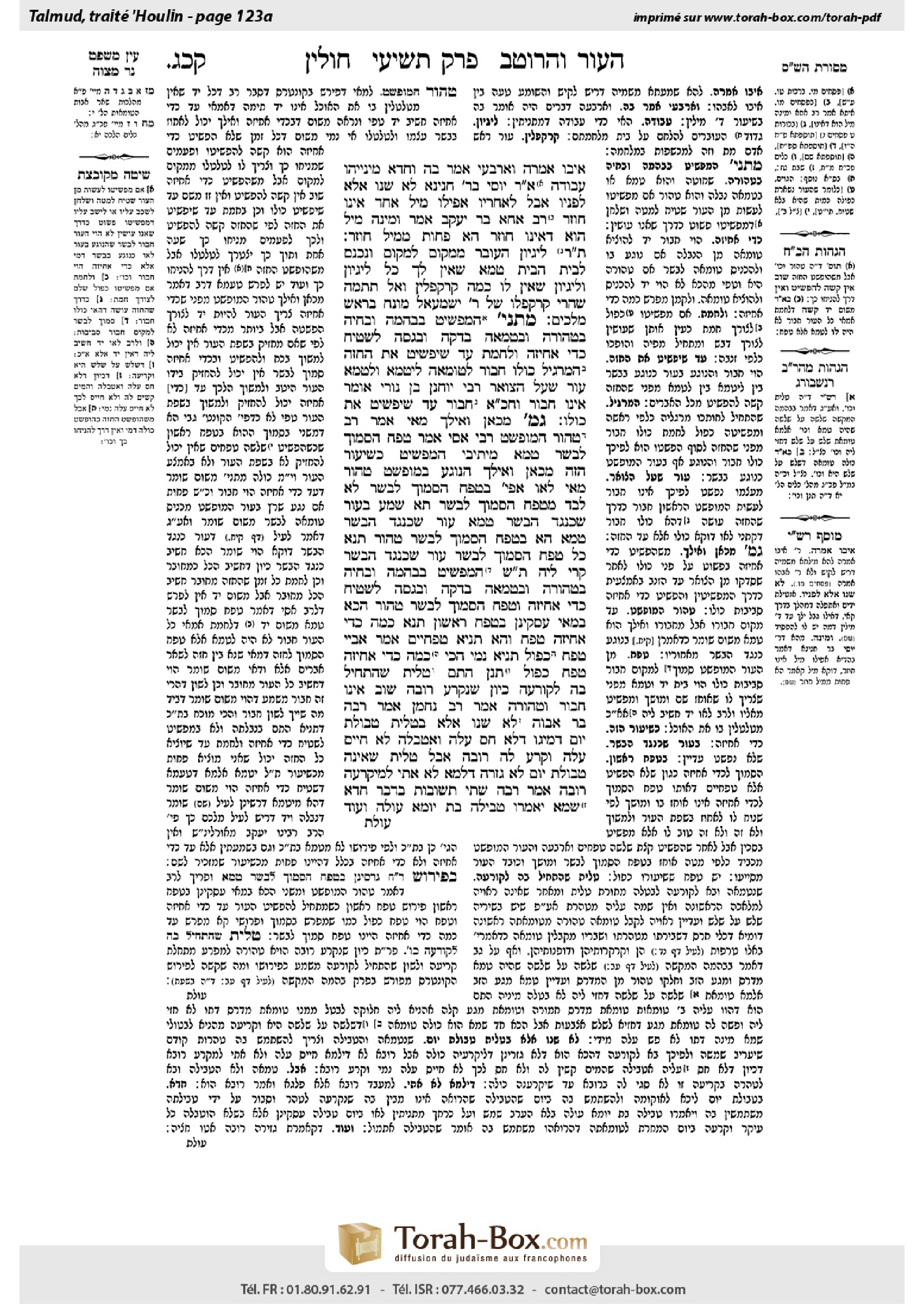
Chullin 123a: Talmud study for Daf Yomi
Study the Talmud for Daf Yomi with scanned pages, Hebrew text, English translations from Sefaria and AI-generated French translations.
Passage selection and English or AI-generated French translation are available where the scan has annotations. Daf Study is independent of Torah-Box and Sefaria.
Browse Chullin · חולין · All tractatesChullin 123a text and translations
This page of Chullin includes the Aramaic text, an English translation and an AI-generated French translation, alongside the scan above.
חולין קכ״ג א · Aramaic and Hebrew text
אַיְבוּ אַמְרַהּ, וְאַרְבְּעֵי אֲמַר בַּהּ, וַחֲדָא מִינַּיְיהוּ עֲבוֹדָה.
אָמַר רַבִּי יוֹסֵי בְּרַבִּי חֲנִינָא: לֹא שָׁנוּ אֶלָּא לְפָנָיו, אֲבָל לְאַחֲרָיו – אֲפִילּוּ מִיל אֶחָד אֵינוֹ חוֹזֵר. רַב אַחָא בַּר יַעֲקֹב אָמַר, וּמִינַּהּ: מִיל הוּא דְּאֵינוֹ חוֹזֵר, הָא פָּחוֹת מִמִּיל – חוֹזֵר.
תָּנוּ רַבָּנַן: לִיגְיוֹן הָעוֹבֵר מִמָּקוֹם לְמָקוֹם, וְנִכְנַס לְבַיִת – הַבַּיִת טָמֵא, שֶׁאֵין לָךְ כׇּל לִיגְיוֹן וְלִיגְיוֹן שֶׁאֵין לוֹ כַּמָּה קַרְקִפְלִין. וְאַל תִּתְמַהּ, שֶׁהֲרֵי קַרְקִפְלוֹ שֶׁל רַבִּי יִשְׁמָעֵאל מוּנָּח בְּרֹאשׁ מְלָכִים.
מַתְנִי׳ הַמַּפְשִׁיט בַּבְּהֵמָה וּבַחַיָּה, בַּטְּהוֹרָה וּבַטְּמֵאָה, בַּדַּקָּה וּבַגַּסָּה –
לְשָׁטִיחַ, כְּדֵי אֲחִיזָה.
וּלְחֵמֶת – עַד שֶׁיַּפְשִׁיט אֶת הֶחָזֶה.
הַמַּרְגִּיל – כּוּלּוֹ חִבּוּר לַטּוּמְאָה, לִיטַּמֵּא וּלְטַמֵּא. עוֹר שֶׁעַל הַצַּוָּאר – רַבִּי יוֹחָנָן בֶּן נוּרִי אוֹמֵר: אֵינוֹ חִבּוּר, וַחֲכָמִים אוֹמְרִים: חִבּוּר עַד שֶׁיַּפְשִׁיט אֶת כּוּלּוֹ.
גְּמָ׳ מִכָּאן וְאֵילָךְ מַאי?
אָמַר רַב: טָהוֹר הַמּוּפְשָׁט, רַבִּי אַסִּי אָמַר: טֶפַח הַסָּמוּךְ לַבָּשָׂר טָמֵא.
מֵיתִיבִי: הַמַּפְשִׁיט כְּשִׁיעוּר הַזֶּה, מִכָּאן וְאֵילָךְ, הַנּוֹגֵעַ בַּמּוּפְשָׁט טָהוֹר. מַאי לָאו אֲפִילּוּ בְּטֶפַח הַסָּמוּךְ לַבָּשָׂר? לָא, לְבַר מִטֶּפַח הַסָּמוּךְ לַבָּשָׂר.
תָּא שְׁמַע: בְּעוֹר שֶׁכְּנֶגֶד הַבָּשָׂר – טָמֵא. עוֹר שֶׁכְּנֶגֶד הַבָּשָׂר – טָמֵא, הָא בְּטֶפַח הַסָּמוּךְ לַבָּשָׂר – טָהוֹר. תָּנָא: כׇּל טֶפַח הַסָּמוּךְ לַבָּשָׂר, עוֹר שֶׁכְּנֶגֶד הַבָּשָׂר קָרֵי לֵיהּ.
תָּא שְׁמַע: הַמַּפְשִׁיט בַּבְּהֵמָה וּבַחַיָּה, בַּטְּהוֹרָה וּבַטְּמֵאָה, בַּדַּקָּה וּבַגַּסָּה, לְשָׁטִיחַ – כְּדֵי אֲחִיזָה, וְטֶפַח הַסָּמוּךְ לַבָּשָׂר – טָהוֹר.
הָכָא בְּמַאי עָסְקִינַן? בְּטֶפַח רִאשׁוֹן.
תָּנָא: כַּמָּה כְּדֵי אֲחִיזָה? טֶפַח. וְהָא תַּנְיָא: טִפְחַיִים!
אָמַר אַבָּיֵי: טֶפַח כָּפוּל. תַּנְיָא נָמֵי הָכִי: כַּמָּה כְּדֵי אֲחִיזָה? טֶפַח כָּפוּל.
תְּנַן הָתָם: טַלִּית שֶׁהִתְחִיל בָּהּ לְקוֹרְעָהּ, כֵּיוָן שֶׁנִּקְרַע רוּבָּהּ – שׁוּב אֵינוֹ חִבּוּר, וּטְהוֹרָה.
אָמַר רַב נַחְמָן אָמַר רַבָּה בַּר אֲבוּהּ: לֹא שָׁנוּ אֶלָּא בְּטַלִּית טְבוּלַת יוֹם.
דְּמִיגּוֹ דְּלָא חַס עֲלַהּ וְאַטְבְּלַהּ, לָא חָיֵיס עֲלַהּ וְקָרַע לַהּ רוּבַּהּ. אֲבָל טַלִּית שֶׁאֵינָהּ טְבוּלַת יוֹם – לָא, גְּזֵרָה דִּלְמָא לָא אָתֵי לְמִיקְרְעַהּ רוּבַּהּ.
אָמַר רַבָּה: שְׁתֵּי תְּשׁוּבוֹת בַּדָּבָר: חֲדָא – שֶׁמָּא יֹאמְרוּ טְבִילָה בַּת יוֹמָא עוֹלָה, וְעוֹד –
Chullin 123a · English translation
It was Aivu who said this statement in the name of Reish Lakish and not Rabbi Abbahu, and he said four halakhot, not three, with regard to the measure of four mil, and the fourth one of them is the halakha mentioned in the mishna: Skins that one spread on the ground and trod upon for the period required for tanning, i.e., the amount of time it takes to walk four mil, are no longer classified as flesh and are ritually pure.
Rabbi Yosei, son of Rabbi Ḥanina, says: With regard to prayer and washing one’s hands, the Sages taught that one must travel four mil to find a synagogue or water only if the synagogue or the water is ahead of him, in the direction that he is traveling. But if it is behind him, he need not return even one mil. Rav Aḥa bar Yaakov said: From this statement one may infer that it is specifically a mil that one need not return; but one must return for a synagogue or water that is at a distance of less than one mil.
§The mishna states that the skin of a human corpse is impure like its flesh. The Sages taught in the Tosefta (8:16): In the case of a legion traveling for warfare from place to place, and one member of the legion enters a house, the house is impure, as there is no legion that does not have several scalps that its soldiers carry around for witchcraft. And you should not be surprised that they do so, as the scalp [karkefal] of Rabbi Yishmael was placed on the heads of kings.
MISHNA: The halakhic status of the hide of an animal after it was flayed is no longer like its flesh in terms of becoming impure and imparting impurity. Nevertheless, in the case of one who flays either a domesticated animal or an undomesticated animal; a ritually pure animal that was slaughtered properly and afterward came in contact with impurity, e.g., the one flaying it is impure, or a ritually impure unslaughtered carcass; a small animal, e.g., sheep, or a large animal, e.g., cattle; and even after flaying the animal’s hide is still partially attached to the flesh, the hide’s halakhic status remains that of flesh in some circumstances.
These circumstances are: If he is flaying the animal for the purpose of using the hide as a carpet, a tablecloth, or to drape over a couch, in which case he would cut the hide along the length of the animal from head to tail and then remove the hide from both sides, its halakhic status remains that of flesh until he has flayed the measure of grasping the hide, i.e., two handbreadths.
And if he is flaying the animal for the purpose of crafting a leather jug, in which case he cuts a circle near the animal’s neck and removes the hide in a downward movement, its halakhic status remains that of flesh until he flays the animal’s entire breast.
In the case of one who seeks to fashion a jug and begins flaying from the legs, until he removes the animal’s hide in its entirety, the entire hide is considered as having a connection with the flesh and its halakhic status remains that of flesh with regard to impurity, i.e., with regard to becoming impure and with regard to imparting impurity. If one removed the entire hide except for the hide over the neck, Rabbi Yoḥanan ben Nuri says: It is not considered to have a connection to the flesh, and the Rabbis say: It is considered to have a connection to the flesh until he removes the animal’s hide in its entirety, including the neck.
GEMARA: The mishna teaches: If one flays an animal for the purpose of making a carpet out of it, the halakhic status of the hide remains that of flesh until he has flayed the measure of grasping the hide. The Gemara asks: From that point forward, i.e., when one has flayed more than the measure of grasping of the hide, what is the status of the hide?
Rav says: The entire section of the hide that has been flayed is pure because it no longer serves the flesh as a handle. But the hide that is still attached to the flesh serves the flesh as protection, and therefore it transmits impurity to the flesh and from the flesh, and joins together with the flesh to constitute the requisite measure to impart the impurity of food. Rabbi Asi says: One handbreadth of the flayed hide that is next to the flesh is susceptible to impurity. Since the one who flays the hide holds this handbreadth of the hide while flaying, this section of the hide serves the flesh as a handle.
The Gemara raises an objection to the statement of Rabbi Asi from a baraita: In the case of one who flays an unslaughtered animal carcass, once he has cut the hide along the length of the animal from head to tail and then removed this measure of the hide from both sides, then from that point forward, a person who touches the flayed hide is pure, because the flayed hide does not impart impurity of a carcass. What, is it not discussing even the handbreadth of hide next to the flesh, contrary to the opinion of Rabbi Asi? The Gemara answers: No, there is no proof from this baraita, as it may be discussing the flayed hide except for the handbreadth next to the flesh.
Come and hear a refutation of the opinion of Rabbi Asi from a baraita: Once an animal carcass has been flayed more than the measure of grasping the hide, if one touches the hide opposite the flesh before that hide was flayed he is impure. This statement indicates that the attached hide opposite the flesh is impure, but one handbreadth of the flayed hide that is next to the flesh is pure, contrary to the opinion of Rabbi Asi. The Gemara answers: There is no proof from this baraita. The tanna who taught this baraita was referring to the entire handbreadth of flayed hide next to the flesh by calling it the hide opposite the flesh.
Come and hear a refutation of the opinion of Rabbi Asi from a baraita (Tosefta 8:18): In the case of one who flays a domesticated animal or an undomesticated animal, a ritually pure animal or a ritually impure unslaughtered carcass, a small animal or a large animal, if he is flaying the animal for the purpose of using the hide as a carpet, the halakhic status of the hide remains that of flesh until he has flayed the measure of grasping it, and one who touches one handbreadth of the flayed hide next to the flesh remains pure, contrary to the opinion of Rabbi Asi.
The Gemara answers: Here we are dealing with the first handbreadth of hide that is flayed in addition to the measure of grasping. In a case where only one handbreadth of hide has been flayed in addition to the measure of grasping, it is more comfortable for the one flaying the hide to grasp the edge of the hide rather than the handbreadth of hide that is nearest to the flesh. Furthermore, the most comfortable way to continue flaying is to do so with a knife without grasping the flayed hide at all. Therefore, Rabbi Asi concedes that the hide in this case does not serve the flesh as a handle and consequently does not impart impurity. But afterward, when one has already flayed more than three handbreadths of hide, one holds the handbreadth of hide next to the flesh while continuing to flay the animal, and since it serves the flesh as a handle it imparts impurity.
§The mishna teaches that the hide’s halakhic status remains that of flesh until he has flayed the measure of grasping the hide. It was taught in a baraita: How much is the measure of grasping? It is one handbreadth. The Gemara asks: But isn’t it taught in another baraita: The measure of grasping is two handbreadths?
Abaye says: The first baraita is referring to one who grasps a double handbreadth by folding the first two handbreadths together and grasping them. This explanation of Abaye is also taught in the Tosefta (8:18): How much is the measure of grasping? It is a double handbreadth.
§The Gemara discusses a matter similar to the previous discussion of a partially flayed hide. We learned in a mishna elsewhere (Kelim 28:8): A ritually impure garment that tears is rendered pure because it is no longer considered a useable garment. In the case of a ritually impure garment that one began to tear, once the majority of the garment is torn, the two sections are no longer considered as having a connection, and since it is no longer considered a useable garment, it is pure.
Rav Naḥman says that Rabba bar Avuh says: The Sages taught this halakha only with regard to an impure garment that was already immersed in a ritual bath that day, but one must wait until nightfall for the purification process to be completed in order to wear the garment while eating ritually pure food. In such a case, tearing the majority of the garment renders it pure, and the Sages did not apply the requirement that the entire garment be torn.
This is because the reason for this rabbinic decree is lest one tear only half of it out of concern for the damage to the garment. And since in this case, the owner of the garment showed that he was not concerned about damage to the garment by immersing it in a ritual bath, an act which damages the garment, so too he is presumably not concerned about the garment with regard to tearing it, and he will certainly tear the majority of it. But a garment that was not immersed that day is not rendered pure by tearing the majority of the garment due to a rabbinic decree lest one come to not tear the majority of the garment but only half of it.
Rabba said: There are two refutations of this statement. One is that the decree should apply even to a garment that was immersed that day, lest people who see one eating ritually pure food while wearing such a garment say that immersion of a garment on the same day is sufficient for the garment to be worn while eating ritually pure food, and there is no need to wait until nightfall. And furthermore, if a garment that was not immersed that day is rendered pure only by tearing the entire garment and not by tearing merely a majority of the garment, due to a decree lest one tear less than a majority of the garment,
Chullin 123a · Traduction française (IA)
C'est Aivu qui a dit cette déclaration au nom de Reish Lakish et non Rabbi Abbahu, et il a dit quatre halakhot, et non trois, concernant la mesure de quatre mil, et la quatrième d'entre elles est la halakha mentionnée dans la mitsna : Les peaux que l'on étend sur le sol et qu'on marche dessus pendant la période nécessaire à la tannure, c'est-à-dire pendant le temps qu'il faut pour marcher quatre mil, ne sont plus considérées comme de la chair et sont rituellement pures.
Rabbi Yosei, fils de Rabbi Ḥanina, dit : Concernant la prière et le lavage des mains, les Sages ont enseigné que l'on doit voyager quatre mil pour trouver une synagogue ou de l'eau seulement si la synagogue ou l'eau est devant soi, dans la direction où l'on voyage. Mais si elle est derrière soi, il n'est pas nécessaire de revenir même un mil. Rav Aḥa bar Yaakov a dit : On peut en déduire de cette déclaration que c'est spécifiquement un mil que l'on n'a pas besoin de revenir ; mais l'on doit revenir pour une synagogue ou de l'eau qui est à une distance inférieure à un mil.
§La mitsna stipule que la peau d'un cadavre humain est impure comme sa chair. Les Sages ont enseigné dans la Tosefta (8:16) : Dans le cas d'une légion marchant pour la guerre d'un lieu à un autre, et un membre de la légion entre dans une maison, la maison est impure, car il n'y a pas de légion qui n'ait plusieurs crânes que ses soldats portent pour la sorcellerie. Et vous ne devriez pas être étonné qu'ils fassent cela, car le crâne de Rabbi Yishmael a été placé sur les têtes des rois.
MICHNA : Le statut halakhique de la peau d'un animal après qu'elle ait été dépecée n'est plus comme sa chair en ce qui concerne l'impureté et la transmission d'impureté. Cependant, dans le cas d'une personne qui dépece soit un animal domestique soit un animal sauvage ; un animal rituellement pur qui a été tué correctement et ensuite s'est trouvé en contact avec l'impureté, par exemple, celui qui dépece l'animal est impur, ou un cadavre non tué rituellement impur ; un petit animal, par exemple un mouton, ou un grand animal, par exemple un bovin ; et même après la dépecage, la peau de l'animal est encore partiellement attachée à la chair, le statut halakhique de la peau reste celui de la chair dans certains cas.
Ces cas sont : S'il dépece l'animal à des fins d'utilisation de la peau comme tapis, nappe ou pour couvrir un canapé, dans ce cas il coupera la peau le long du corps de l'animal de la tête à la queue et retirera la peau des deux côtés, son statut halakhique reste celui de la chair jusqu'à ce qu'il ait dépecé la mesure de saisie de la peau, c'est-à-dire deux tefachim.
Et si l'on dépece l'animal à des fins de fabrication d'un récipient en cuir, dans ce cas on coupe un cercle près du cou de l'animal et on retire la peau en mouvement vers le bas, son statut halakhique reste celui de la chair jusqu'à ce qu'on dépece toute la poitrine de l'animal.
Dans le cas d'une personne qui cherche à fabriquer un récipient et commence à dépecer à partir des pattes, jusqu'à ce qu'il retire toute la peau de l'animal, toute la peau est considérée comme ayant un lien avec la chair et son statut halakhique reste celui de la chair en ce qui concerne l'impureté, c'est-à-dire en ce qui concerne l'acquisition d'impureté et la transmission d'impureté. Si l'on a retiré toute la peau sauf la peau sur le cou, Rabbi Yoḥanan ben Nuri dit : Ce n'est pas considéré comme ayant un lien avec la chair, et les Sages disent : Il est considéré comme ayant un lien avec la chair jusqu'à ce qu'on retire toute la peau de l'animal, y compris le cou.
GUEMARA : La mitsva enseigne : Si l'on dépece un animal à des fins de fabrication d'un tapis, le statut halakhique de la peau reste celui de la chair jusqu'à ce qu'on ait dépecé la mesure de saisie de la peau. La Guemara pose une question : À partir de ce point, c'est-à-dire lorsque l'on a dépecé plus que la mesure de saisie de la peau, quel est le statut de la peau ?
Rav dit : La section entière de la peau dépecée est pure car elle ne sert plus de manche à la chair. La peau qui est encore attachée à la chair sert de protection à la chair, et donc elle transmet l'impureté à la chair et de la chair, et se joint à la chair pour constituer la mesure nécessaire à la transmission de l'impureté des aliments. Rabbi Asi dit : Un tefach de la peau dépecée qui est adjacent à la chair est susceptible d'impureté. Puisque celui qui dépece la peau tient ce tefach de la peau pendant le dépecage, cette section de la peau sert de manche à la chair.
La Guemara soulève une objection contre l'opinion de Rabbi Asi à partir d'une baraïta : Dans le cas d'une carcasse d'animal non sacrifié, une fois qu'on a coupé la peau le long du corps de l'animal de la tête à la queue et qu'on a retiré cette mesure de la peau des deux côtés, à partir de ce point, une personne qui touche la peau dépecée est pure, car la peau dépecée ne transmet pas l'impureté de la carcasse. Qu'est-ce que cela ne parle pas même du tefach de peau adjacent à la chair, contrairement à l'opinion de Rabbi Asi ? La Guemara répond : Non, il n'y a pas de preuve à partir de cette baraïta, car cela peut parler de la peau dépecée à l'exception du tefach adjacent à la chair.
Venez écouter une réfutation de l'opinion de Rabbi Asi à partir d'une baraïta : Une fois que la carcasse d'un animal a été dépecée plus que la mesure de saisie de la peau, si l'on touche la peau opposée à la chair avant que cette peau ne soit dépecée, l'on est impur. Cette déclaration indique que la peau attachée opposée à la chair est impure, mais un tefach de la peau dépecée adjacent à la chair est pur, contrairement à l'opinion de Rabbi Asi. La Guemara répond : Il n'y a pas de preuve à partir de cette baraïta. Le tanna qui a enseigné cette baraïta faisait référence à l'ensemble du tefach de peau dépecée adjacent à la chair en disant qu'il s'agissait de la peau opposée à la chair.
Venez écouter une réfutation de l'opinion du Rabbi Asi, tirée d'une baraïta (Tosefta 8:18) : Dans le cas d'une personne qui dépele un animal domestique ou non domestique, un animal rituellement pur ou un cadavre non sacrifié rituellement impur, un petit ou un grand animal, si l'on dépele l'animal à l'intention d'utiliser la peau comme tapis, le statut halakhique de la peau reste celui de viande jusqu'à ce qu'il ait dépelé la mesure de saisie, et celui qui touche un doigt de la peau dépelée à côté de la viande reste pur, contrairement à l'opinion du Rabbi Asi.
La Guemara répond : Ici, nous parlons de la première paume de peau dépelée en plus de la mesure de saisie. Dans le cas où seule une paume de peau a été dépelée en plus de la mesure de saisie, il est plus confortable pour celui qui dépele la peau de saisir le bord de la peau plutôt que la paume de peau la plus proche de la viande. De plus, la manière la plus confortable de continuer à dépele est de le faire avec un couteau sans saisir du tout la peau dépelée. Ainsi, le Rabbi Asi reconnaît que la peau dans ce cas ne sert pas la viande comme une poignée et ne transmet donc pas l'impureté. Mais ensuite, lorsque l'on a déjà dépelé plus de trois paumes de peau, l'on tient la paume de peau à côté de la viande tout en continuant à dépele l'animal, et puisque cette peau sert la viande comme une poignée, elle transmet l'impureté.
§ La mitsva enseigne que le statut halakhique de la peau reste celui de viande jusqu'à ce qu'il ait dépelé la mesure de saisie. Il a été enseigné dans une baraïta : Combien est la mesure de saisie ? C'est une paume. La Guemara pose la question : Mais n'est-il pas enseigné dans une autre baraïta : La mesure de saisie est deux paumes ?
Abaye dit : La première baraïta fait référence à celui qui saisit une double paume en réunissant les deux premières paumes et en les saisissant ensemble. Cette explication d'Abaye est également enseignée dans la Tosefta (8:18) : Combien mesure-t-on la saisie ? C'est une double paume.
§ La Guemara discute d'une question similaire à la précédente concernant une peau partiellement dépelée. Nous avons appris dans une mitsva ailleurs (Kelim 28:8) : Un vêtement rituellement impur qui se déchire devient pur car il n'est plus considéré comme un vêtement utilisable. Dans le cas d'un vêtement rituellement impur que l'on commence à déchirer, une fois que la majorité du vêtement est déchirée, les deux parties ne sont plus considérées comme ayant une connexion, et puisque le vêtement n'est plus considéré comme utilisable, il est pur.
Rav Naḥman dit que Rabba bar Avuh dit : Les Sages ont enseigné cette halakha uniquement concernant un vêtement impur déjà immergé dans un bain rituel de la même journée, mais l'on doit attendre jusqu'au coucher du soleil pour que le processus de purification soit achevé afin de porter le vêtement lors de la consommation de nourriture rituellement pure. Dans ce cas, la déchirure de la majorité du vêtement rend le vêtement pur, et les Sages n'ont pas appliqué la condition que l'ensemble du vêtement soit déchiré.
C'est parce que la raison de ce décret rabbinique est de craindre que l'on déchire seulement la moitié par crainte de l'endommagement du vêtement. Et puisque dans ce cas, l'propriétaire du vêtement a montré qu'il ne s'occupait pas de l'endommagement du vêtement en l'immergeant dans un bain rituel, une action qui endommage le vêtement, il est donc probablement également indifférent à l'endommagement du vêtement en ce qui concerne sa déchirure, et il déchirera certainement la majorité du vêtement. Mais un vêtement qui n'a pas été immergé cette journée n'est pas rendu pur par la déchirure de la majorité du vêtement en raison d'un décret rabbinique de crainte que l'on ne déchire pas la majorité du vêtement mais seulement la moitié du vêtement.
Rabba dit : Il y a deux réfutations à cette déclaration. La première est que le décret devrait s'appliquer même à un vêtement immergé cette même journée, de peur que les gens qui voient quelqu'un manger de la nourriture rituellement pure en portant un tel vêtement disent que l'immersion du vêtement la même journée est suffisante pour porter le vêtement pendant la consommation de nourriture rituellement pure, et qu'il n'est pas nécessaire d'attendre jusqu'au coucher du soleil. Et de plus, si un vêtement qui n'a pas été immergé cette journée est rendu pur uniquement par la déchirure de l'ensemble du vêtement et non par la déchirure de la majorité du vêtement, en raison d'un décret de crainte que l'on ne déchire pas la majorité du vêtement mais seulement la moitié du vêtement,
Traduction française générée par IA à partir de l’édition anglaise de Sefaria. Vérifie toujours un passage avec le texte source.
Text from Sefaria: William Davidson Edition - Vocalized Aramaic (unknown); William Davidson Edition - English (CC BY NC).