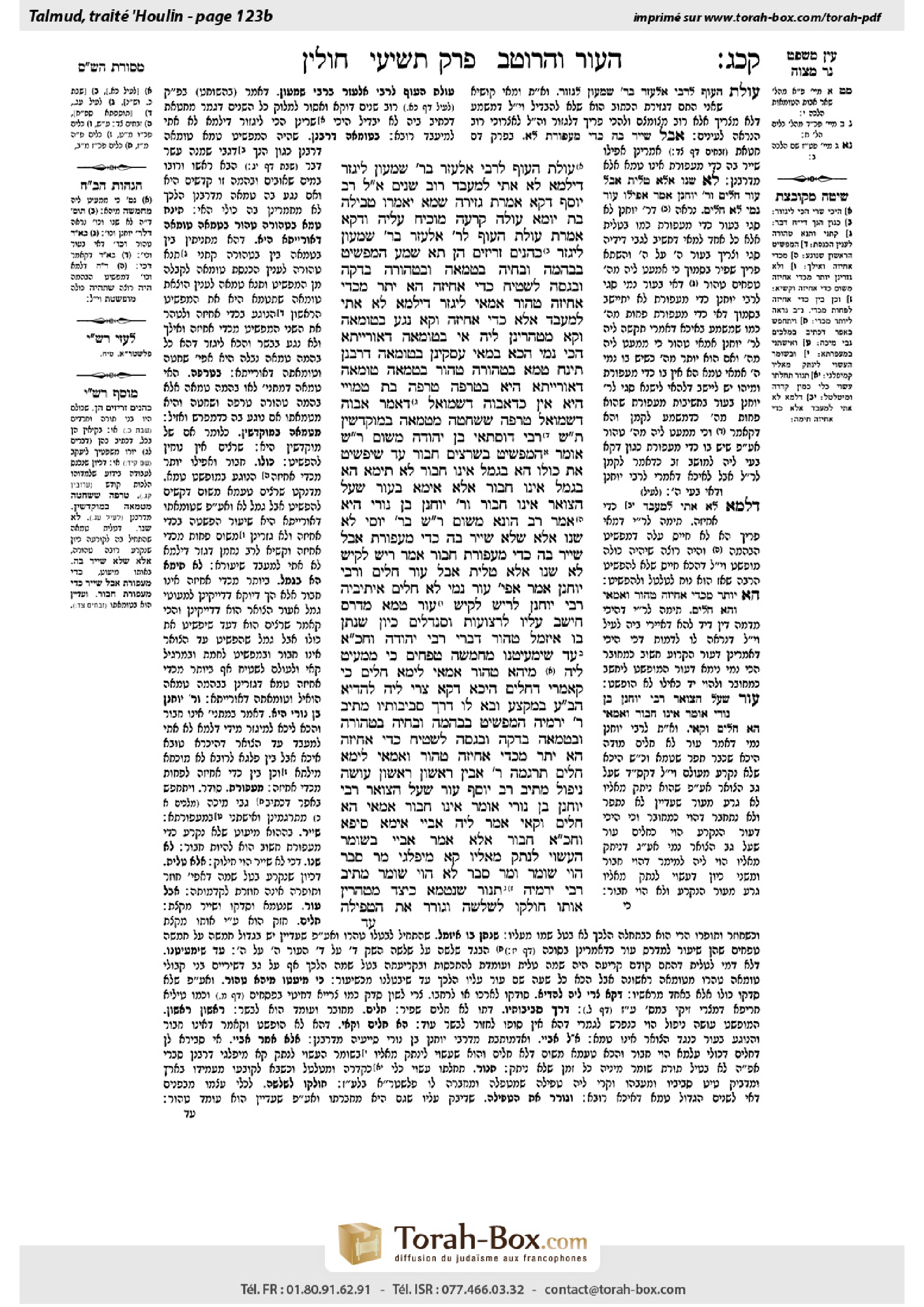
Chullin 123b: Talmud study for Daf Yomi
Study the Talmud for Daf Yomi with scanned pages, Hebrew text, English translations from Sefaria and AI-generated French translations.
Passage selection and English or AI-generated French translation are available where the scan has annotations. Daf Study is independent of Torah-Box and Sefaria.
Browse Chullin · חולין · All tractatesChullin 123b text and translations
This page of Chullin includes the Aramaic text, an English translation and an AI-generated French translation, alongside the scan above.
חולין קכ״ג ב · Aramaic and Hebrew text
עוֹלַת הָעוֹף לְרַבִּי אֶלְעָזָר בְּרַבִּי שִׁמְעוֹן לִיגְזַר, דִּילְמָא לָא אָתֵי לְמֶעְבַּד רוֹב שְׁנַיִם.
אֲמַר לֵיהּ רַב יוֹסֵף: דְּקָא אָמְרַתְּ גְּזֵירָה שֶׁמָּא יֹאמְרוּ טְבִילָה בַּת יוֹמָא עוֹלָה – קִרְעָהּ מוֹכִיחַ עָלֶיהָ.
וּדְקָא אָמְרַתְּ, עוֹלַת הָעוֹף לְרַבִּי אֶלְעָזָר בְּרַבִּי שִׁמְעוֹן לִיגְזַר – כֹּהֲנִים זְרִיזִים הֵן.
תָּא שְׁמַע: הַמַּפְשִׁיט בַּבְּהֵמָה וּבַחַיָּה, בַּטְּמֵאָה וּבִטְהוֹרָה, בַּדַּקָּה וּבַגַּסָּה, לְשָׁטִיחַ – כְּדֵי אֲחִיזָה.
הָא יָתֵר מִכְּדֵי אֲחִיזָה – טָהוֹר, אַמַּאי? לִיגְזַר, דִּילְמָא לָא אָתֵי לְמֶעְבַּד אֶלָּא כְּדֵי אֲחִיזָה, וְקָא נְגַע בְּטוּמְאָה, וְקָא מְטַהֲרִינַן לֵיהּ!
אִי בְּטוּמְאָה דְּאוֹרָיְיתָא – הָכִי נָמֵי, הָכָא בְּמַאי עָסְקִינַן? בְּטוּמְאָה דְּרַבָּנַן.
תִּינַח טָמֵא בַּטְּהוֹרָה, טָהוֹר בִּטְמֵאָה – טוּמְאָה דְּאוֹרָיְיתָא הִיא! בִּטְרֵפָה.
טְרֵפָה בַּת טַמּוֹיֵי הִיא? אִין, כְּדַאֲבוּהּ דִּשְׁמוּאֵל, דְּאָמַר אֲבוּהּ דִּשְׁמוּאֵל: טְרֵפָה שֶׁשְּׁחָטָהּ מְטַמְּאָה בְּמוּקְדָּשִׁין.
תָּא שְׁמַע: רַבִּי דּוֹסְתַּאי בֶּן יְהוּדָה מִשּׁוּם רַבִּי שִׁמְעוֹן אוֹמֵר: הַמַּפְשִׁיט בִּשְׁרָצִים – חִבּוּר, עַד שֶׁיַּפְשִׁיט אֶת כּוּלּוֹ.
הָא בְּגָמָל – אֵינוֹ חִבּוּר.
לָא תֵּימָא הָא בְּגָמָל אֵינוֹ חִבּוּר, אֶלָּא אֵימָא: בְּעוֹר שֶׁעַל הַצַּוָּאר אֵינוֹ חִבּוּר, וְרַבִּי יוֹחָנָן בֶּן נוּרִי הִיא.
אָמַר רַב הוּנָא מִשּׁוּם רַבִּי שִׁמְעוֹן בְּרַבִּי יוֹסֵי: לֹא שָׁנוּ אֶלָּא שֶׁלֹּא שִׁיֵּיר בָּהּ כְּדֵי מַעְפּוֹרֶת, אֲבָל שִׁיֵּיר בָּהּ כְּדֵי מַעְפּוֹרֶת – חִבּוּר.
אָמַר רֵישׁ לָקִישׁ: לֹא שָׁנוּ אֶלָּא טַלִּית, אֲבָל עוֹר – חֲלִים. וְרַבִּי יוֹחָנָן אָמַר: אֲפִילּוּ עוֹר נָמֵי לָא חֲלִים.
אֵיתִיבֵיהּ רַבִּי יוֹחָנָן לְרֵישׁ לָקִישׁ: עוֹר טָמֵא מִדְרָס, חִישֵּׁב עָלָיו לִרְצוּעוֹת וְסַנְדָּלִים – כֵּיוָן שֶׁנָּתַן בּוֹ אִיזְמֵל טָהוֹר, דִּבְרֵי רַבִּי יְהוּדָה. וַחֲכָמִים אוֹמְרִים: עַד שֶׁיַּמְעִיטֶנּוּ מֵחֲמִשָּׁה טְפָחִים. כִּי מְמַעֵיט לֵיהּ מִיהָא טָהוֹר, אַמַּאי? לֵימָא חֲלִים!
כִּי קָאָמְרִי דַּחֲלִים, הֵיכָא דְּקָא צָרֵי לֵיהּ לְהֶדְיָא, הָכָא בְּמַאי עָסְקִינַן – בִּמְקַצֵּעַ וּבָא לוֹ דֶּרֶךְ סְבִיבוֹתָיו.
מֵתִיב רַבִּי יִרְמְיָה: הַמַּפְשִׁיט בַּבְּהֵמָה וּבַחַיָּה, בַּטְּהוֹרָה וּבַטְּמֵאָה, בַּדַּקָּה וּבַגַּסָּה, לְשָׁטִיחַ כְּדֵי אֲחִיזָה – הָא יָתֵר מִכְּדֵי אֲחִיזָה טָהוֹר, וְאַמַּאי? לֵימָא חֲלִים! תַּרְגְּמַהּ רַבִּי אָבִין: רִאשׁוֹן רִאשׁוֹן עוֹשֶׂה נִיפּוּל.
מֵתִיב רַב יוֹסֵף: עוֹר שֶׁעַל הַצַּוָּאר, רַבִּי יוֹחָנָן בֶּן נוּרִי אוֹמֵר אֵינוֹ חִבּוּר. אַמַּאי? הָא חֲלִים וְקָאֵי!
אֲמַר לֵיהּ אַבָּיֵי: אֵימָא סֵיפָא, וַחֲכָמִים אוֹמְרִים: חִבּוּר.
אֶלָּא אָמַר אַבָּיֵי: בְּשׁוֹמֵר הֶעָשׂוּי לִנָּתֵק מֵאֵלָיו קָא מִיפַּלְגִי, מָר סָבַר: הָוֵי שׁוֹמֵר, וּמָר סָבַר: לָא הָוֵי שׁוֹמֵר.
מֵתִיב רַבִּי יִרְמְיָה: תַּנּוּר שֶׁנִּטְמָא כֵּיצַד מְטַהֲרִין אוֹתוֹ? חוֹלְקוֹ לִשְׁלֹשָׁה, וְגוֹרֵר אֶת הַטְּפֵילָה
Chullin 123b · English translation
so too, with regard to a bird burnt offering according to the opinion of Rabbi Elazar, son of Rabbi Shimon, who holds that one is required to pinch merely a majority of two simanim in the nape of the neck in order to prepare it for sacrifice, let him decree against pinching the majority of two simanim lest one come to not perform the pinching on the majority of two simanim, but rather on merely half of them.
Rav Yosef responded to Rabba’s two refutations and said to him: With regard to that which you said, that a rabbinic decree is necessary even with regard to a garment that was immersed that day lest onlookers say that immersion of a garment on that same day is sufficient, there is no reason for such a concern. This is because its tear proves that the garment is pure due to the tear, and not because one is allowed to wear an immersed garment while eating pure food before sunset.
And with regard to that which you said, that with regard to a bird burnt offering according to the opinion of Rabbi Elazar, son of Rabbi Shimon, let him decree against pinching the majority of the simanim lest one fail to pinch the majority, in fact there is no reason for such a concern. Rav Yosef explains: The reason there is no concern is that pinching is performed by the priests, who are vigilant with regard to mitzvot.
The Gemara suggests: Come and hear a refutation to Rabba bar Avuh’s explanation of the mishna in tractate Kelim from the mishna here: In the case of one who flays a domesticated animal or an undomesticated animal, a ritually impure animal or a ritually pure animal, a small animal or a large animal, if he is flaying the animal for the purpose of using the hide as a carpet, the halakhic status of the hide remains that of flesh until he has flayed the measure of grasping the hide.
The Gemara infers: But after one has flayed more than a measure of grasping the hide, the hide is pure. Why is this so? Let the Sages decree that even a hide that was flayed more than the measure of grasping is susceptible to impurity lest one who intends to flay more than a measure of grasping come to complete only a measure of grasping, and he is thereby touching a source of impurity, and we might mistakenly deem him pure.
The Gemara answers: If the mishna were discussing impurity by Torah law, indeed the Sages would issue such a decree. But here we are dealing with impurity by rabbinic law, and therefore the Sages did not issue such a decree.
The Gemara objects: According to this answer, the case in the mishna of an impure person who flays a pure animal works out well. That could be referring to a case of impurity by rabbinic law. But in every case of a pure person who flays an impure animal, i.e., an unslaughtered animal carcass, the impurity of the animal is by Torah law. Therefore, in such a case the Sages should have issued a decree. The Gemara explains: The case taught in the mishna of a person who flays an impure animal is referring to a pure animal that was properly slaughtered, but after the slaughter the animal was found to have a wound that would have caused it to die within twelve months, thereby rendering it a tereifa. Such an animal imparts impurity by rabbinic law.
The Gemara asks: Is a pure animal that is found to be a tereifa capable of imparting impurity? The Gemara answers: Yes, in accordance with the opinion of Shmuel’s father, as Shmuel’s father said: A tereifa that one slaughtered imparts impurity by rabbinic law if it is a sacrificial animal. Accordingly, the mishna is referring to the case of a sacrificial animal that was found to be a tereifa.
The Gemara suggests: Come and hear a refutation of Rabba bar Avuh’s explanation of the mishna in tractate Kelim from a baraita (Tosefta 8:19): Rabbi Dostai ben Yehuda says in the name of Rabbi Shimon: With regard to one who flays creeping animals, its hide is considered to have a connection with the flesh, and it imparts impurity of a creeping animal until he flays the animal in its entirety.
The Gemara infers: This halakha applies only with regard to creeping animals, but with regard to a camel or other non-kosher animals, when the hide is flayed more than a measure of grasping it is not considered to have a connection with the flesh and is pure, even though when the measure of grasping is flayed it is impure. Apparently, there is no rabbinic decree that even a hide that was flayed more than the measure of grasping imparts impurity lest one who intends to flay more than a measure of grasping come to flay only a measure of grasping, contrary to the opinion of Rabba bar Avuh.
The Gemara rejects this proof: Do not say that this statement indicates that with regard to a camel, when the hide is flayed more than a measure of grasping it is not considered to have a connection with the flesh. Rather, say that this statement indicates that only with regard to a creeping animal is the hide considered to have a connection with the flesh until one flays the animal in its entirety. But with regard to a camel carcass and other non-kosher animals, in a case where one seeks to fashion a jug and begins flaying from the legs, if he removed the entire hide except for the hide over the neck, it is not considered to have a connection to the flesh, and this statement is in accordance with the opinion of Rabbi Yoḥanan ben Nuri stated in the mishna.
§The Gemara returns to discuss, and limit the scope of, the previously cited mishna (Kelim 28:8): In the case of a ritually impure garment that one began to tear, once the majority of the garment is torn, the two sections are no longer considered to have a connection, and the garment is pure. Rav Huna says in the name of Rabbi Shimon, son of Rabbi Yosei: The mishna taught that an impure garment, most of which has been torn, is no longer impure only when one did not leave untorn a part of the garment that is the measure of a scarf. But if he left an untorn piece that is the measure of a scarf, it is considered to have a connection, and the garment remains ritually impure.
Reish Lakish said: The mishna taught only with regard to an impure garment, most of which has been torn, that it is no longer impure, but an impure hide that was torn in such a manner remains impure because it is repairable. And Rabbi Yoḥanan said: Even a hide that was torn in such a manner is no longer impure because it is not repairable.
Rabbi Yoḥanan raised an objection to the opinion of Reish Lakish from a mishna (Kelim 26:9): In the case of a hide that is impure with impurity imparted by treading, if the owner intended with regard to the hide to make it into straps and sandals, when he applies a scalpel [izmel] to the hide, the hide becomes pure; this is the statement of Rabbi Yehuda. And the Rabbis say: The hide does not become pure until he reduces the size of the hide to a measure of less than five handbreadths. In any event, when he reduces the hide to a measure of less than five handbreadths, everyone agrees that it becomes pure. Why is this so? Let us say according the opinion of Reish Lakish that the hide should not become pure, as it is repairable.
Reish Lakish responded to Rabbi Yoḥanan: When I said that a torn hide is repairable, I was referring to a case where one cut the hide in a straight line. By contrast, here we are dealing with a case where one cut the hide in a circular manner. In such a case, the hide is not repairable.
Rabbi Yirmeya raises an objection to the opinion of Reish Lakish from the mishna: In the case of one who flays either a domesticated animal or an undomesticated animal, a ritually pure animal or a ritually impure animal, a small animal or a large animal, if he is flaying the animal for the purpose of using the hide as a carpet, the halakhic status of the hide remains that of flesh until he has flayed the measure of grasping. Rabbi Yirmeya infers: But once one has flayed more than the measure of grasping, the hide is pure. But according to Reish Lakish, why is this so? Let us say that the hide is repairable, i.e., it can be sewn back on. Rabbi Avin interpreted the mishna and explained that one piece after one piece, i.e., each piece that is flayed is rendered fallen and disconnected from the flesh, as it will never be reattached to the flesh, unlike the case of a torn hide, which may be sewn back together.
Rav Yosef raises an objection to the opinion of Reish Lakish from another ruling in the mishna: With regard to the hide over the neck, Rabbi Yoḥanan ben Nuri says: It is not considered to have a connection to the flesh, as the hide is merely loosely connected to the neck itself, and it is pure. According to Reish Lakish, why is this so? Doesn’t the hide exist in its repaired state, i.e., isn’t it still connected to the neck itself? If an impure hide that was torn and can be repaired remains impure, this should certainly be the halakha with regard to hide that was never moved from its initial state.
Abaye said to Rav Yosef: Instead of objecting to the opinion of Reish Lakish due to the statement of Rabbi Yoḥanan ben Nuri, say the latter clause of the mishna: And the Rabbis say: The hide covering the neck is considered to have a connection to the flesh, a statement that supports the opinion of Reish Lakish according to your reasoning.
Rather, Abaye said: The dispute between Reish Lakish and Rabbi Yoḥanan is irrelevant to the dispute in the mishna between Rabbi Yoḥanan ben Nuri and the Rabbis. In the mishna, they disagree with regard to whether an appendage, such as the hide of the neck, that protects the flesh but is prone to become detached by itself is considered to be protection. One Sage, i.e., the Rabbis, holds that it is considered to be protection, and one Sage, Rabbi Yoḥanan ben Nuri, holds that it is not considered to be protection.
Rabbi Yirmeya raises an objection to the opinion of Reish Lakish from a mishna (Kelim 5:7): With regard to an oven that has become impure, how does one purify it? One divides the oven into three parts and scrapes off the layer of plaster that surrounds the oven
Chullin 123b · Traduction française (IA)
De même, concernant un sacrifice holocauste d'oiseau selon l'opinion du Rabbi Elazar, fils du Rabbi Shimon, qui considère que l'on doit simplement écraser la majorité de deux simanim à la base du cou pour préparer le sacrifice, qu'il ordonne de ne pas écraser la majorité de deux simanim, de peur que l'on ne vienne à ne pas écraser la majorité de deux simanim, mais plutôt seulement la moitié de ceux-ci.
Rav Yosef répondit aux deux objections de Rabba et dit à celui-ci : Concernant ce que vous avez dit, à savoir qu'un décret rabbinique est nécessaire même concernant un vêtement immergé le même jour de peur que les spectateurs pensent que l'immersion d'un vêtement le même jour suffit, il n'y a pas de raison de s'inquiéter. Cela est dû au fait que la déchirure prouve que le vêtement est pur en raison de la déchirure, et non parce qu'on est autorisé à porter un vêtement immergé pendant le repas de nourriture pure avant le coucher du soleil.
Et concernant ce que vous avez dit, à savoir que concernant un sacrifice holocauste d'oiseau selon l'opinion du Rabbi Elazar, fils du Rabbi Shimon, qu'il ordonne de ne pas écraser la majorité des simanim, de peur que l'on ne vienne à ne pas écraser la majorité, en réalité il n'y a pas de raison de s'inquiéter. Rav Yosef explique : La raison pour laquelle il n'y a pas de raison de s'inquiéter est que l'écrasement est effectué par les prêtres, qui sont vigilants concernant les mitsvot.
La Guemara suggère : Venez écouter une réfutation de l'explication de Rabba bar Avuh sur la mitsna dans le traité Kelim à partir de la mitsna ici : Dans le cas d'une personne qui dépele un animal domestique ou non domestique, un animal impur ou pur, un petit ou un grand animal, si l'on dépele l'animal à l'intention d'utiliser la peau comme tapis, le statut halakhique de la peau reste celui de la chair jusqu'à ce qu'il ait dépelé la mesure de saisie de la peau.
La Guemara déduit : Mais après qu'une personne ait dépelé plus qu'une mesure de saisie de la peau, la peau est pure. Pourquoi est-ce ainsi ? Que les Sages ordonnent que même une peau dépelée plus qu'une mesure de saisie soit sujette à l'impureté, de peur qu'une personne qui a l'intention de dépele plus qu'une mesure de saisie vienne à achever seulement une mesure de saisie, et qu'elle touche ainsi une source d'impureté, et qu'on puisse défaire à tort qu'elle soit pure.
La Guemara répond : Si la mitsna avait parlé d'impureté selon la Torah, en effet les Sages auraient émis un tel décret. Mais ici nous sommes en présence d'impureté selon la loi rabbinique, et par conséquent les Sages n'ont pas émis un tel décret.
La Guemara s'oppose : Selon cette réponse, le cas de la mitsna d'une personne impure qui dépele un animal pur s'arrange bien. Cela pourrait faire référence à un cas d'impureté selon la loi rabbinique. Mais dans chaque cas d'une personne pure qui dépele un animal impur, c'est-à-dire un cadavre non sacrifié, l'impureté de l'animal est selon la Torah. Par conséquent, dans ce cas les Sages devraient avoir émis un décret. La Guemara explique : Le cas enseigné dans la mitsna d'une personne qui dépele un animal impur fait référence à un animal pur qui a été sacrifié, mais après la sacrifice l'animal a été trouvé avoir une blessure qui l'aurait tué en douze mois, ce qui le rend tereifa. Un tel animal transmet l'impureté selon la loi rabbinique.
La Guemara pose la question : Un animal pur trouvé être tereifa est-il capable de transmettre l'impureté ? La Guemara répond : Oui, selon l'opinion du père de Shmuel, car le père de Shmuel a dit : Un tereifa que l'on a sacrifié transmet l'impureté selon la loi rabbinique s'il s'agit d'un animal sacré. Ainsi, la mitsna fait référence au cas d'un animal sacré trouvé être tereifa.
La Guemara suggère : Venez écouter une réfutation de l'explication de Rabba bar Avuh sur la mitsna dans le traité Kelim à partir d'une baraïta (Tosefta 8:19) : Rabbi Dostai ben Yehuda dit en nom de Rabbi Shimon : Concernant une personne qui dépele des animaux rampants, leur peau est considérée comme ayant un lien avec la chair, et elle transmet l'impureté d'un animal rampant jusqu'à ce qu'on dépele l'animal entièrement.
La Guemara conclut : Cette halakha s'applique uniquement aux animaux rampants, mais concernant un chameau ou d'autres animaux non-kosher, lorsque la peau est dépelée en excès par rapport à la mesure de saisie, elle n'est pas considérée comme ayant un lien avec la chair et est pure, même si lorsqu'on dépele la mesure de saisie elle est impure. Apparemment, il n'y a pas de décret rabbinique selon lequel même une peau dépelée en excès par rapport à la mesure de saisie transmet l'impureté, de peur qu'une personne qui a l'intention de dépele en excès par rapport à la mesure de saisie vienne à dépele seulement la mesure de saisie, contrairement à l'opinion de Rabba bar Avuh.
La Guemara rejette cette preuve : Ne dites pas que cette déclaration indique que concernant un chameau, lorsque la peau est dépelée en excès par rapport à la mesure de saisie, elle n'est pas considérée comme ayant un lien avec la chair. Plutôt, dites que cette déclaration indique que seulement concernant un animal rampant la peau est considérée comme ayant un lien avec la chair jusqu'à ce qu'on dépele l'animal entièrement. Mais concernant un cadavre de chameau et d'autres animaux non-kosher, dans un cas où l'on cherche à fabriquer un récipient et commence à dépele à partir des pattes, si l'on a retiré toute la peau sauf la peau sur le cou, elle n'est pas considérée comme ayant un lien avec la chair, et cette déclaration est selon l'opinion du Rabbi Yoḥanan ben Nuri énoncé dans la mitsna.
§ La Guemara reprend la discussion et limite le champ d'application de la mitsna précédemment citée (Kelim 28:8) : Dans le cas d'un vêtement impur que l'on a commencé à déchirer, une fois que la majorité du vêtement est déchirée, les deux parties ne sont plus considérées comme ayant un lien, et le vêtement est pur. Rav Huna cite Rabbi Shimon, fils de Rabbi Yosei : La mitsna enseigne que lorsqu'une majorité d'un vêtement impur est déchirée, il n'est plus impur que lorsque l'on n'a pas laissé une partie non déchirée du vêtement égale à la mesure d'un châle. Mais si l'on a laissé une partie non déchirée égale à la mesure d'un châle, elle est considérée comme ayant un lien, et le vêtement reste impur.
Reish Lakish a dit : La michna a enseigné uniquement concernant un vêtement impur, la plupart du temps déchiré, que celui-ci n'est plus impur, mais un cuir impur qui a été déchiré de manière telle reste impur car il peut être réparé. Et Rabbi Yoḥanan a dit : Même un cuir qui a été déchiré de manière telle n'est plus impur car il ne peut être réparé.
Rabbi Yoḥanan a soulevé une objection contre l'opinion de Reish Lakish à partir d'une michna (Kelim 26:9) : Dans le cas d'un cuir impur par impureté acquise par la foulée, si l'propriétaire avait l'intention de faire de ce cuir des brides et des sandales, lorsqu'il applique un scalpel [izmel] sur le cuir, le cuir devient pur ; c'est l'opinion de Rabbi Yehuda. Et les Sages disent : Le cuir ne devient pur qu'une fois que l'on réduit la taille du cuir à une mesure inférieure à cinq paumes. En tout cas, lorsque l'on réduit le cuir à une mesure inférieure à cinq paumes, tout le monde convient qu'il devient pur. Pourquoi est-ce ainsi ? Disons selon l'opinion de Reish Lakish que le cuir ne devrait pas devenir pur, car il peut être réparé.
Reish Lakish a répondu à Rabbi Yoḥanan : Lorsque j'ai dit qu'un cuir déchiré est réparable, je faisais référence à un cas où l'on a coupé le cuir en ligne droite. En revanche, ici nous sommes en présence d'un cas où l'on a coupé le cuir en cercle. Dans ce cas, le cuir n'est pas réparable.
Rabbi Yirmeya soulève une objection contre l'opinion de Reish Lakish à partir de la michna : Dans le cas d'une personne qui dépele un animal domestique ou non domestique, un animal rituellement pur ou impur, un petit ou un grand animal, si l'on dépele l'animal à l'intention d'utiliser le cuir comme tapis, le statut halakhique du cuir reste celui de la chair jusqu'à ce qu'il ait dépelé la mesure de saisie. Rabbi Yirmeya en déduit : Mais une fois que l'on a dépelé plus que la mesure de saisie, le cuir est pur. Mais selon Reish Lakish, pourquoi est-ce ainsi ? Disons que le cuir est réparable, c'est-à-dire qu'il peut être cousu à nouveau. Rabbi Avin a interprété la michna et a expliqué que pièce après pièce, c'est-à-dire chaque pièce dépelée est rendue tombante et détachée de la chair, car elle ne sera jamais rebranchée à la chair, contrairement au cas d'un cuir déchiré, qui peut être cousu ensemble.
Rav Yosef soulève une objection contre l'opinion de Reish Lakish à partir d'une autre décision de la michna : Concernant le cuir sur le cou, Rabbi Yoḥanan ben Nuri dit : Il n'est pas considéré comme ayant un lien avec la chair, car le cuir est simplement faiblement connecté au cou lui-même, et il est pur. Selon Reish Lakish, pourquoi est-ce ainsi ? N'est-ce pas que le cuir existe dans son état réparé, c'est-à-dire n'est-il pas encore connecté au cou lui-même ? Si un cuir impur qui a été déchiré et peut être réparé reste impur, cela devrait certainement être la halakha concernant un cuir qui n'a jamais été déplacé de son état initial.
Abaye a dit à Rav Yosef : Au lieu de soulever une objection contre l'opinion de Reish Lakish en raison de la déclaration de Rabbi Yoḥanan ben Nuri, dites la dernière partie de la michna : Et les Sages disent : Le cuir qui couvre le cou est considéré comme ayant un lien avec la chair, une déclaration qui soutient l'opinion de Reish Lakish selon votre raisonnement.
En réalité, Abaye a dit : Le débat entre Reish Lakish et Rabbi Yoḥanan est sans rapport avec le débat dans la michna entre Rabbi Yoḥanan ben Nuri et les Sages. Dans la michna, ils s'opposent sur le fait qu'une appendice, tel que le cuir du cou, qui protège la chair mais qui a tendance à se détacher tout seul, soit considéré comme une protection. Un Sage, c'est-à-dire les Sages, considère qu'il est considéré comme une protection, et un Sage, Rabbi Yoḥanan ben Nuri, considère qu'il n'est pas considéré comme une protection.
Rabbi Yirmeya soulève une objection contre l'opinion de Reish Lakish à partir d'une michna (Kelim 5:7) : Concernant un four qui est devenu impur, comment l'on purifie-t-il ? On divise le four en trois parties et on gratte la couche de plâtre qui entoure le four
Traduction française générée par IA à partir de l’édition anglaise de Sefaria. Vérifie toujours un passage avec le texte source.
Text from Sefaria: William Davidson Edition - Vocalized Aramaic (unknown); William Davidson Edition - English (CC BY NC).