Chullin 124a: Talmud study for Daf Yomi
Study the Talmud for Daf Yomi with scanned pages, Hebrew text, English translations from Sefaria and AI-generated French translations.
Passage selection and English or AI-generated French translation are available where the scan has annotations. Daf Study is independent of Torah-Box and Sefaria.
Browse Chullin · חולין · All tractatesChullin 124a text and translations
This page of Chullin includes the Aramaic text, an English translation and an AI-generated French translation, alongside the scan above.
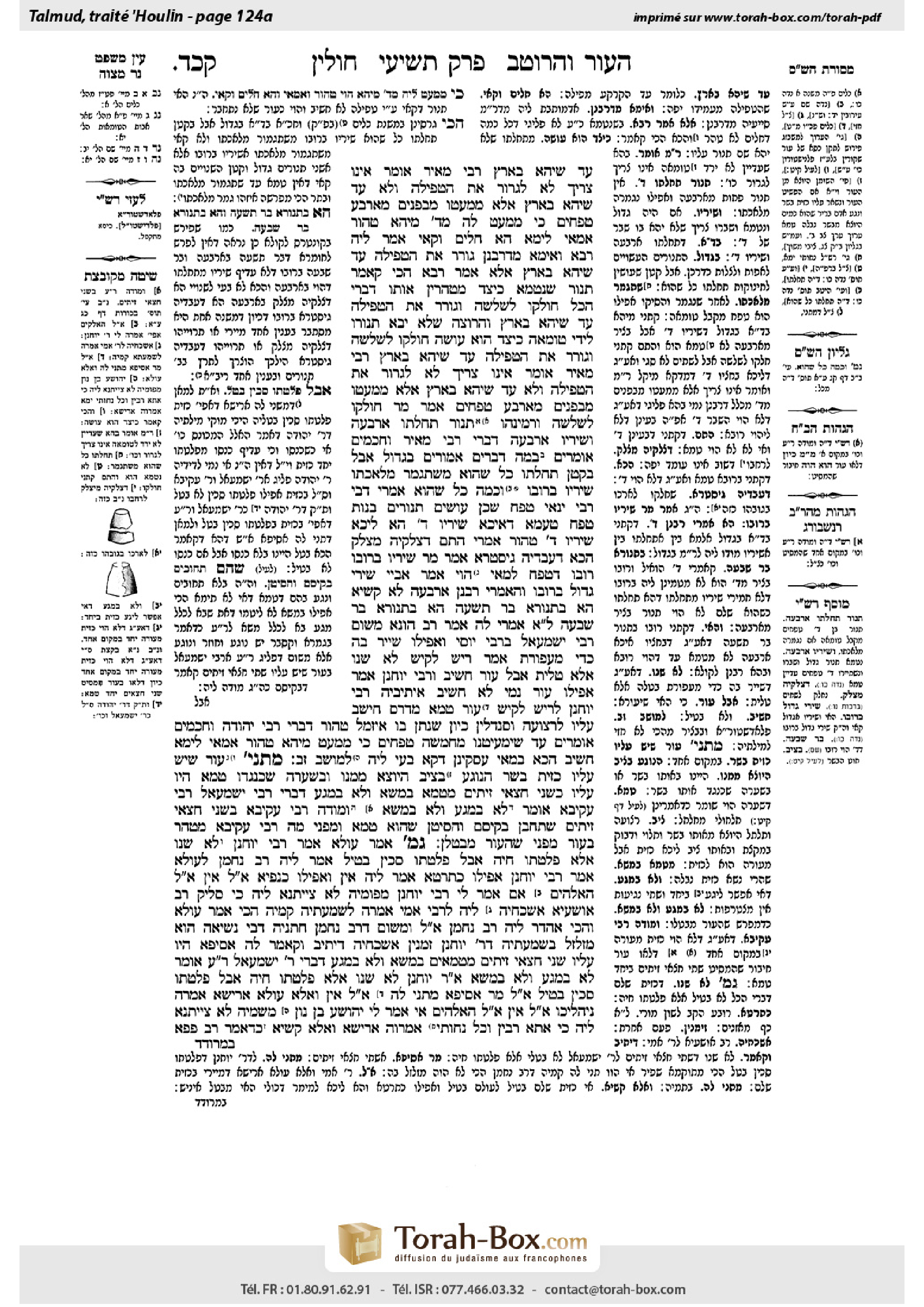
חולין קכ״ד א · Aramaic and Hebrew text
עַד שֶׁיְּהֵא בָּאָרֶץ. רַבִּי מֵאִיר אוֹמֵר: אֵינוֹ צָרִיךְ לֹא לִגְרוֹר אֶת הַטְּפֵילָה וְלֹא עַד שֶׁיְּהֵא בָּאָרֶץ, אֶלָּא מְמַעֲטוֹ מִבִּפְנִים (מארבע) [מֵאַרְבָּעָה] טְפָחִים.
כִּי מְמַעֵט לַהּ (מארבע) [מֵאַרְבָּעָה] מִיהָא טָהוֹר, אַמַּאי? לֵימָא: הָא חֲלִים וְקָאֵי!
אֲמַר לֵיהּ רָבָא: וְאֵימָא מִדְּרַבָּנַן – גּוֹרֵר אֶת הַטְּפֵילָה עַד שֶׁיְּהֵא בָּאָרֶץ.
אֶלָּא אָמַר רָבָא: הָכִי קָאָמַר, תַּנּוּר שֶׁנִּטְמָא כֵּיצַד מְטַהֲרִין אוֹתוֹ? דִּבְרֵי הַכֹּל חוֹלְקוֹ לִשְׁלֹשָׁה, וְגוֹרֵר אֶת הַטְּפֵילָה עַד שֶׁיְּהֵא בָּאָרֶץ.
וְהָרוֹצֶה שֶׁלֹּא יָבֹא תַּנּוּרוֹ לִידֵי טוּמְאָה, כֵּיצַד הוּא עוֹשֶׂה? חוֹלְקוֹ לִשְׁלֹשָׁה, וְגוֹרֵר אֶת הַטְּפֵילָה עַד שֶׁיְּהֵא בָּאָרֶץ. רַבִּי מֵאִיר אוֹמֵר: אֵינוֹ צָרִיךְ לֹא לִגְרוֹר אֶת הַטְּפֵילָה וְלֹא עַד שֶׁיְּהֵא בָּאָרֶץ, אֶלָּא מְמַעֲטוֹ מִבִּפְנִים מֵאַרְבָּעָה טְפָחִים.
אָמַר מָר: חוֹלְקוֹ לִשְׁלֹשָׁה.
וּרְמִינְהוּ: תַּנּוּר, תְּחִלָּתוֹ אַרְבָּעָה, וּשְׁיָרָיו אַרְבָּעָה, דִּבְרֵי רַבִּי מֵאִיר.
וַחֲכָמִים אוֹמְרִים: בַּמֶּה דְּבָרִים אֲמוּרִים בְּגָדוֹל, אֲבָל בְּקָטָן – תְּחִלָּתוֹ כׇּל שֶׁהוּא, מִשֶּׁתִּגָּמֵר מְלַאכְתּוֹ – שְׁיָרָיו בְּרוּבּוֹ.
וְכַמָּה ״כׇּל שֶׁהוּא״? אָמְרִי דְּבֵי רַבִּי יַנַּאי: טֶפַח, שֶׁכֵּן עוֹשִׂים (תנורים) [תַּנּוּרֵי] בָּנוֹת טֶפַח.
טַעְמָא דְּאִיכָּא שְׁיָרָיו אַרְבַּע, הָא לֵיכָּא שְׁיָרָיו אַרְבַּע – טָהוֹר.
אָמְרִי: הָתָם, דְּצַלְקֵיהּ מִצְלָק; הָכָא, דְּעַבְדֵיהּ גִּיסְטְרָא.
אָמַר מָר: שְׁיָרָיו בְּרוּבּוֹ, רוּבּוֹ דְּטֶפַח לְמַאי הָוֵי?
אָמַר אַבָּיֵי: שְׁיָרֵי גָּדוֹל בְּרוּבּוֹ, וְהָאָמְרִי רַבָּנַן אַרְבָּעָה? לָא קַשְׁיָא: הָא בְּתַנּוּרָא בַּר תִּשְׁעָה, הָא בְּתַנּוּרָא בַּר שִׁבְעָה.
לִישָּׁנָא אַחֲרִינָא אָמְרִי לַהּ: אָמַר רַב הוּנָא מִשּׁוּם רַבִּי יִשְׁמָעֵאל בְּרַבִּי יוֹסֵי: וַאֲפִילּוּ שִׁיֵּיר בָּהּ כְּדֵי מַעְפּוֹרֶת.
אָמַר רֵישׁ לָקִישׁ: לֹא שָׁנוּ אֶלָּא טַלִּית, אֲבָל עוֹר – חֲשִׁיב, וְרַבִּי יוֹחָנָן אָמַר: אֲפִילּוּ עוֹר נָמֵי לָא חֲשִׁיב.
אֵיתִיבֵיהּ רַבִּי יוֹחָנָן לְרֵישׁ לָקִישׁ: עוֹר טָמֵא מִדְרָס, חִישֵּׁב עָלָיו לִרְצוּעָה וְסַנְדָּלִין – כֵּיוָן שֶׁנָּתַן בּוֹ אִיזְמֵל טָהוֹר, דִּבְרֵי רַבִּי יְהוּדָה. וַחֲכָמִים אוֹמְרִים: עַד שֶׁיַּמְעִיטֶנּוּ מֵחֲמִשָּׁה טְפָחִים.
כִּי מְמַעֵט מִיהָא טָהוֹר, אַמַּאי? לֵימָא חֲשִׁיב! הָכָא בְּמַאי עָסְקִינַן – דְּקָא בָעֵי לֵיהּ לְמוֹשַׁב זָב.
מַתְנִי׳ עוֹר שֶׁיֵּשׁ עָלָיו כְּזַיִת בָּשָׂר, הַנּוֹגֵעַ בְּצִיב הַיּוֹצֵא מִמֶּנּוּ, וּבְשַׂעֲרָה שֶׁכְּנֶגְדּוֹ – טָמֵא.
הָיוּ עָלָיו כִּשְׁנֵי חֲצָאֵי זֵיתִים, מְטַמֵּא בְּמַשָּׂא וְלֹא בְּמַגָּע, דִּבְרֵי רַבִּי יִשְׁמָעֵאל. רַבִּי עֲקִיבָא אוֹמֵר: לֹא בְּמַגָּע וְלֹא בְּמַשָּׂא. וּמוֹדֶה רַבִּי עֲקִיבָא בִּשְׁנֵי חֲצָאֵי זֵיתִים שֶׁתְּחָבָן בְּקֵיסָם וֶהֱסִיטָן, שֶׁהוּא טָמֵא. וּמִפְּנֵי מָה רַבִּי עֲקִיבָא מְטַהֵר בָּעוֹר? מִפְּנֵי שֶׁהָעוֹר מְבַטְּלָן.
גְּמָ׳ אָמַר עוּלָּא אָמַר רַבִּי יוֹחָנָן: לֹא שָׁנוּ אֶלָּא פְּלָטַתּוּ חַיָּה, אֲבָל פְּלָטַתּוּ סַכִּין – בָּטֵיל.
אֲמַר לֵיהּ רַב נַחְמָן לְעוּלָּא: אָמַר רַבִּי יוֹחָנָן אֲפִילּוּ כְּתַרְטָא? אֲמַר לֵיהּ: אִין. וַאֲפִילּוּ כְּנַפְיָא? אֲמַר לֵיהּ: אִין. אֲמַר לֵיהּ: הָאֱלֹהִים! אִם אָמַר לִי רַבִּי יוֹחָנָן מִפּוּמֵּיהּ – לָא צָיֵיתְנָא לֵיהּ.
כִּי סְלֵיק רַב אוֹשַׁעְיָא, אַשְׁכְּחֵיהּ לֵיהּ לְרַבִּי אַמֵּי, אַמְרַהּ לִשְׁמַעְתָּיה קַמֵּיהּ: הָכִי אֲמַר עוּלָּא, וְהָכִי אַהְדַּר לֵיהּ רַב נַחְמָן. אֲמַר לֵיהּ: וּמִשּׁוּם דְּרַב נַחְמָן חַתְנֵיהּ דְּבֵי נְשִׂיאָה הוּא, מְזַלְזֵל בִּשְׁמַעְתֵּיהּ דְּרַבִּי יוֹחָנָן?!
זִמְנִין אַשְׁכְּחֵיהּ דְּיָתֵיב וְקָאָמַר לַהּ אַסֵּיפָא: הָיוּ עָלָיו שְׁנֵי חֲצָאֵי זֵיתִים – מְטַמְּאִים בְּמַשָּׂא וְלֹא בְּמַגָּע, דִּבְרֵי רַבִּי יִשְׁמָעֵאל. רַבִּי עֲקִיבָא אוֹמֵר: לֹא בְּמַגָּע וְלֹא בְּמַשָּׂא.
אָמַר רַבִּי יוֹחָנָן: לֹא שָׁנוּ אֶלָּא פְּלָטַתּוּ חַיָּה, אֲבָל פְּלָטַתּוּ סַכִּין – בָּטֵיל.
אֲמַר לֵיהּ מָר אַסֵּיפָא מַתְנֵי לַהּ? אֲמַר לֵיהּ: אִין. וְאֶלָּא עוּלָּא אַרֵישָׁא אַמְרַהּ נִיהֲלַיְכוּ? אֲמַר לֵיהּ: אִין. אֲמַר לֵיהּ: הָאֱלֹהִים, אִי אָמַר לִי יְהוֹשֻׁעַ בִּן נוּן מִשְּׁמֵיהּ – לָא צָיֵיתְנָא לֵיהּ!
כִּי אֲתָא רָבִין וְכׇל נָחוֹתֵי, אַמְרוּהָ אַרֵישָׁא. וְאֶלָּא קַשְׁיָא? כִּדְאָמַר רַב פָּפָּא:
Chullin 124a · English translation
until the oven itself merely rests on the ground and is not held in place by plaster. Breaking the oven in such a manner renders the oven pure because it is no longer considered a vessel. Rabbi Meir says: It is unnecessary to scrape off the layer of plaster, and it is certainly not necessary to remove it until the oven rests on the ground. Rather, one makes cuts in the oven itself, reducing its size from within the layer of plaster, i.e., without removing the layer of plaster, until the unbroken part is less than four handbreadths.
Rabbi Meir holds that although breaking off a minority of the structure of the oven is insufficient, in any event when one reduces the size of the oven to less than four handbreadths in height the oven is rendered pure. Why is this so, according to the opinion of Reish Lakish? Let us say that this oven exists in a repairable state, as the plaster holds it together, and according to Reish Lakish it should therefore be considered connected and remain impure.
Rava said to Rabbi Yirmeya: Instead of objecting to the opinion of Reish Lakish from the statement of Rabbi Meir, state a proof for his opinion from the statement of the Rabbis who disagree with Rabbi Meir and hold that the oven becomes pure only if one scrapes off the layer of plaster until the oven rests on the ground. Apparently, the Rabbis hold that the oven is rendered pure only if it is completely and irreparably broken, which supports the opinion of Reish Lakish according to your reasoning.
Rather, Rava said: Not only is there no proof against the opinion of Reish Lakish from this mishna, as the statement of the Rabbis supports his opinion, but Rabbi Meir may even accept the opinion of Reish Lakish; as this is what the mishna is saying: How does one purify an oven that became impure? Everyone, even Rabbi Meir, agrees that one divides it into three parts and scrapes off the layer of plaster until the oven rests on the ground.
And anyone who wishes that his oven not become susceptible to impurity, how does he act? The Rabbis hold that he goes through the same process as is necessary in order to purify an impure oven: From the outset, he divides the oven into three parts and scrapes off the layer of plaster until the oven rests on the ground. Rabbi Meir says: With regard to an oven that has not yet become impure, it is unnecessary to scrape off the layer of plaster, and it is certainly not necessary to remove it until the oven rests on the ground. Rather, one reduces the size of the oven from within the layer of plaster until the unbroken part is less than four handbreadths in height.
§The Gemara discusses the mishna in tractate Kelim cited above. The Master said: An impure oven is rendered pure when one divides it into three parts, such that no one part contains the majority of the oven. But one cannot purify the oven by dividing it into two parts because one of the parts would contain the majority of the oven.
The Gemara raises a contradiction to this mishna from another mishna (Kelim 5:1): A clay oven in its original state, once it is finished being built, is susceptible to ritual impurity if it is four handbreadths tall. And with regard to an oven that became impure and was subsequently broken, if its remains include a piece four handbreadths tall, that piece remains impure. This is the statement of Rabbi Meir.
And the Rabbis say: In what case is this statement said? It is said in the case of a large oven, but in the case of a small oven, in its original state, any size is sufficient for it to be susceptible to impurity. Once its construction is completed, if the oven became impure and was subsequently broken, its remains are still impure in a case where they contain the majority of the oven.
The Gemara explains: And how small is the size defined by the mishna as any size? The school of Rabbi Yannai says: One handbreadth, as people make toy ovens one handbreadth tall.
The Gemara infers: The Rabbis in that mishna hold that with regard to a large impure oven that breaks, any remaining piece that measures four handbreadths remains impure. Evidently, the reason that the oven remains impure is because there are pieces of its remains that measure four handbreadths, but if there are no remains of the oven measuring four handbreadths, even if a piece contains the majority of the oven, the oven is rendered pure. This opinion is not consistent with the opinion of the Rabbis in the previously cited mishna.
The Sages said in response: There, with regard to the opinion of the Rabbis that if there are no remains measuring four handbreadths then the oven is pure, that mishna is discussing a case where one cut the oven horizontally such that the pieces do not stand one on top of the other in a stable manner. Here, with regard to the opinion of the Rabbis that an impure oven is rendered pure only when no one piece constitutes the majority of the oven, the mishna is discussing a case where one rendered the oven a shard [gistera] by cutting it in half vertically, in which case a piece that contains the majority of the oven can stand on its own.
§The Gemara discusses the previously cited mishna in tractate Kelim. The Master said: In the case of a small oven, in its original state, any size is sufficient for it to be susceptible to impurity. And once its construction is completed, if the oven became impure and was subsequently broken, its remains are still impure if they contain the majority of the oven. The Gemara asks: Rabbi Yannai explained that the phrase: Any size, is referring to a measure of one handbreadth. For what purpose is a piece of an oven the size of the majority of one handbreadth usable? Since such a small piece is not functional; why should it remain impure?
Abaye said: The statement of the mishna: Its remains are still impure if they contain the majority of the oven, is not discussing a small oven, but rather is teaching that the remains of a large oven remain impure if they contain the majority of the oven. The Gemara asks: But didn’t the Rabbis say in the mishna that any remaining piece of a large oven measuring four handbreadths remains impure? The Gemara answers: That is not difficult. That statement of the Rabbis that the remains of a large oven remain impure if they contain the majority of the oven is referring to an oven measuring nine handbreadths. That statement of the Rabbis that any remaining piece of a large oven measuring four handbreadths remains impure is referring to an oven measuring seven handbreadths.
§The Gemara returns to discuss the mishna in tractate Kelim (28:8) previously mentioned in the Gemara (123a–b): In the case of a ritually impure garment that one begins to tear, once the majority of the garment is torn, the two sections are no longer considered to have a connection, and the garment is pure. Rav Huna said in the name of Rabbi Shimon, son of Rabbi Yosei, that even if the majority of the garment is torn, if a part of the garment the measure of a scarf is left intact, the garment remains impure. Some say another version of Rav Huna’s statement: Rav Huna said in the name of Rabbi Yishmael, son of Rabbi Yosei: If the majority of the garment is torn, the garment is rendered pure even if one left an untorn piece the measure of a scarf.
With regard to that statement of Rav Huna, Reish Lakish said: The Sages taught that the garment is pure even if one left an untorn piece the measure of a scarf only with regard to a torn garment. But with regard to a hide, if the majority was torn and a piece the measure of a scarf remains, the piece is considered significant and the hide remains impure. And Rabbi Yoḥanan said: Even with regard to a torn hide, if a piece the size of a scarf remains it is not considered significant and the hide is therefore rendered pure.
Rabbi Yoḥanan raised an objection to the opinion of Reish Lakish from that which is taught in the mishna (Kelim 26:9): With regard to a hide that is impure with impurity imparted by treading, if the owner intended with regard to the hide to fashion it into straps and sandals, then when he applies a scalpel to the hide, the hide becomes pure; this is the statement of Rabbi Yehuda. And the Rabbis say: The hide does not become pure until he reduces the hide to a measure of less than five handbreadths.
In any event, when one reduces the hide to a measure of less than five handbreadths, everyone agrees that it becomes pure. Why is this so? Let us say that the hide is considered significant and therefore remains impure. Reish Lakish answered: Here, we are dealing with a case where one needs the cut hide for a seat that he wishes to designate for a man who experiences a gonorrhea-like discharge [zav]. Since a piece of hide measuring less than five handbreadths cannot be used for a seat, it is not considered significant in such a case.
MISHNA: In the case of a hide of an unslaughtered carcass upon which there is an olive-bulk of flesh, one who touches a strand of flesh emerging from the flesh or a hair that is on the side of the hide opposite the flesh is ritually impure. Although he did not touch an olive-bulk of the flesh, he is rendered impure with the impurity of an unslaughtered carcass. The reason is that the strand of flesh has the same status as the flesh itself, and the hair is considered protection to the flesh, which also has the same status as the flesh with regard to one who touches it.
If upon the hide there were two half olive-bulks, the hide imparts the impurity of an unslaughtered carcass by means of carrying, because one moves them together, but not by means of contact with the flesh, because one touches them separately; this is the statement of Rabbi Yishmael. Rabbi Akiva says: The hide does not impart impurity, neither by means of contact nor by means of carrying. And Rabbi Akiva concedes in the case of two half olive-bulks where one skewered them with a wood chip and moved them that he is impure. And for what reason does Rabbi Akiva deem one ritually pure in a case where he moved both half olive-bulks with the hide, as in that case, too, he moved them together? It is because the hide separates between them and nullifies them.
GEMARA: The mishna teaches that in the case of a hide of an unslaughtered carcass upon which there is an olive-bulk of flesh, the flesh is not nullified by the hide, and therefore one who touches a strand of flesh emerging from the flesh is ritually impure. With regard to this section of the mishna, Ulla said that Rabbi Yoḥanan said: The Sages taught this halakha only in a case where an animal severed the piece of flesh, e.g., a dog bite. But if a person used a knife to sever the flesh, the flesh is nullified by the hide because the person nullified the flesh via his action.
Rav Naḥman said to Ulla: Did Rabbi Yoḥanan say this halakha even with regard to a large piece of flesh the size of a tarta, i.e., a quarter of a kav? Ulla said to him: Yes. Rav Naḥman was surprised and asked: And did he say it even with regard to a piece of flesh the size of a sifter? Ulla said to him: Yes. Rav Naḥman swore and said to him: By God! Even if Rabbi Yoḥanan had said this statement to me directly from his mouth, I would not have listened to him.
When Rav Oshaya ascended from Babylonia to Eretz Yisrael he found Rabbi Ami, and he said this halakha before him: This is what Ulla said and this is what Rav Naḥman responded to him. Rav Oshaya said to Rabbi Ami: And just because Rav Naḥman is the son-in-law of the family of the Nasi, can he demean the halakhic statement of Rabbi Yoḥanan?
Another time Rav Oshaya found Rabbi Ami sitting and saying this halakha with regard to the latter clause of the mishna: If upon the hide there were two half olive-bulks, the hide imparts the impurity of an unslaughtered carcass by means of carrying but not by means of contact with the flesh, because he touches them separately and moves them together; this is the statement of Rabbi Yishmael. Rabbi Akiva says: It imparts impurity neither by means of contact nor by means of carrying.
With regard to this section of the mishna, Rabbi Yoḥanan said: The Sages taught Rabbi Yishmael’s opinion that the hide imparts the impurity of an unslaughtered carcass by means of carrying only in a case where an animal severed the half olive-bulks of flesh from the animal. But if a person used a knife to sever the half olive-bulks of flesh, the flesh is nullified. If Rav Naḥman had heard that the statement of Rabbi Yoḥanan was stated with regard to a case of half olive-bulks of flesh, he would not have been surprised that this halakha also applies to pieces of flesh that amount together to the size of a tarta or a sifter.
Rav Oshaya said to Rabbi Ami: Does the Master teach this halakha with regard to the latter clause of the mishna but not with regard to the first section of the mishna that discusses the case of a complete olive-bulk of flesh? Rabbi Ami said to him: Yes. But did Ulla say to you this halakhic statement of Rabbi Yoḥanan in Babylonia with regard to the first clause of the mishna? Rav Oshaya said to him: Yes. Rabbi Ami said to him: If so, Rav Naḥman was justified in his surprise at the halakha of Rabbi Yoḥanan. By God, even if Joshua, son of Nun, had said this halakha to me in his name, i.e., from his own mouth, I would not have listened to him.
When Ravin and all those descending from Eretz Yisrael came to Babylonia, they stated this halakha of Rabbi Yoḥanan with regard to the first clause of the mishna. The Gemara objects: But the matter is difficult. If an olive-bulk of flesh is nullified by being severed with a knife, the same should be true for larger measurements, such as a tarta, which is unreasonable, as people would not usually disregard such a large amount. The Gemara resolves this difficulty in accordance with that which Rav Pappa said with regard to a different matter:
Chullin 124a · Traduction française (IA)
jusqu'à ce que l'four lui-même repose simplement sur le sol et n'est pas maintenu en place par du plâtre. Casser l'four de cette manière le rend pur, car il n'est plus considéré comme un récipient. Rabbi Meïr dit : Il n'est pas nécessaire de retirer la couche de plâtre, et il n'est certainement pas nécessaire de la retirer jusqu'à ce que l'four repose sur le sol. Plutôt, on fait des entailles dans l'four lui-même, réduisant sa taille à l'intérieur de la couche de plâtre, c'est-à-dire sans retirer la couche de plâtre, jusqu'à ce que la partie intacte soit inférieure à quatre paumes.
Rabbi Meïr affirme que bien que casser une partie mineure de la structure de l'four soit insuffisant, en tout cas, lorsque l'on réduit la taille de l'four à moins de quatre paumes de hauteur, l'four est rendu pur. Pourquoi est-ce ainsi, selon l'opinion de Rachi Lakish ? Disons que cet four existe dans un état réparable, car le plâtre le maintient ensemble, et selon Rachi Lakish, il devrait donc être considéré comme connecté et rester impur.
Rava dit à Rabbi Yirméya : Au lieu de contester l'opinion de Rachi Lakish à partir de l'affirmation de Rabbi Meïr, présentez une preuve en faveur de son opinion à partir de l'affirmation des Sages qui s'opposent à Rabbi Meïr et qui affirment que l'four devient pur uniquement si l'on retire la couche de plâtre jusqu'à ce que l'four repose sur le sol. Apparemment, les Sages affirment que l'four est rendu pur uniquement s'il est complètement et irrémédiablement brisé, ce qui soutient l'opinion de Rachi Lakish selon votre raisonnement.
Plutôt, Rava dit : Il n'y a pas de preuve contre l'opinion de Reish Lakish à partir de cette mitsna, car l'affirmation des Sages la soutient, mais Rabbi Meïr peut même accepter l'opinion de Reish Lakish ; car c'est ce que la mitsna dit : Comment purifier un four devenu impur ? Tout le monde, même Rabbi Meïr, convient que l'on le divise en trois parties et qu'on retire la couche de plâtre jusqu'à ce que le four repose sur le sol.
Et celui qui veut que son four ne devienne pas susceptible d'impureté, comment agit-il ? Les Sages affirment qu'il suit le même processus nécessaire pour purifier un four impur : Dès le début, il divise le four en trois parties et retire la couche de plâtre jusqu'à ce que le four repose sur le sol. Rabbi Meïr dit : En ce qui concerne un four qui n'a pas encore devenu impur, il n'est pas nécessaire de retirer la couche de plâtre, et il n'est certainement pas nécessaire de la retirer jusqu'à ce que le four repose sur le sol. Plutôt, on réduit la taille du four à l'intérieur de la couche de plâtre jusqu'à ce que la partie intacte soit inférieure à quatre paumes de hauteur.
§La Guemara discute de la mitsna citée ci-dessus dans le tractat Kelim. Le Maître dit : Un four impur devient pur lorsqu'on le divise en trois parties, de sorte qu'aucune partie ne contient la majorité du four. Mais on ne peut pas purifier le four en le divisant en deux parties, car l'une des parties contiendrait la majorité du four.
La Guemara soulève une contradiction avec cette mitsna à partir d'une autre mitsna (Kelim 5:1) : Un four en argile dans son état initial, une fois qu'il est terminé dans sa construction, est susceptible d'impureté s'il mesure quatre paumes de hauteur. Et concernant un four devenu impur et ensuite brisé, si ses restes incluent une pièce mesurant quatre paumes, cette pièce reste impure. C'est l'affirmation de Rabbi Meïr.
Et les Sages disent : Dans quel cas cette affirmation est-elle dite ? Elle est dite dans le cas d'un four grand, mais dans le cas d'un four petit, dans son état initial, toute taille est suffisante pour qu'il soit susceptible d'impureté. Une fois sa construction terminée, si le four est devenu impur et a ensuite été brisé, ses restes restent impurs dans le cas où ils contiennent la majorité du four.
La Guemara explique : Et comment est définie la petite taille mentionnée dans la mitsna comme toute taille ? La scolie de Rabbi Yannai dit : Une paume, car les gens font des fours en jouet mesurant une paume de hauteur.
La Guemara déduit : Les Sages dans cette mitsva affirment que concernant un four impur grand qui se brise, toute pièce restante mesurant quatre paumes reste impure. Évidemment, la raison pour laquelle le four reste impur est que ses restes contiennent des pièces mesurant quatre paumes, mais si aucun reste du four ne mesure quatre paumes, même si une pièce contient la majorité du four, le four est rendu pur. Cette opinion ne correspond pas à l'opinion des Sages dans la mitsva précédemment citée.
Les Sages répondent : Là, concernant l'opinion des Sages que si aucun reste ne mesure quatre paumes alors le four est pur, cette mitsva parle d'un cas où l'on a coupé le four horizontalement de sorte que les pièces ne se tiennent pas l'une sur l'autre de manière stable. Ici, concernant l'opinion des Sages que le four impur est rendu pur uniquement lorsque aucune pièce ne contient la majorité du four, la mitsva parle d'un cas où l'on a rendu le four en fragments [gistera] en le coupant en deux verticalement, dans lequel cas une pièce contenant la majorité du four peut se tenir debout.
§La Guemara discute de la mitsva précédemment citée dans le tractat Kelim. Le Maître dit : Dans le cas d'un four petit, dans son état initial, toute taille est suffisante pour qu'il soit susceptible d'impureté. Et une fois sa construction terminée, si le four est devenu impur et a ensuite été brisé, ses restes restent impurs s'ils contiennent la majorité du four. La Guemara demande : Rabbi Yannai explique que la phrase : toute taille, fait référence à une mesure d'une paume. À quel usage un morceau de four de la taille de la majorité d'une paume est-il utile ? Puisque ce petit morceau n'est pas fonctionnel ; pourquoi devrait-il rester impur ?
Abaye dit : La déclaration de la mitsna : Ses restes restent impurs si ils contiennent la majorité de la cheminée, ne parle pas d'une petite cheminée, mais enseigne que les restes d'une grande cheminée restent impurs si ils contiennent la majorité de la cheminée. La Guemara pose la question : Mais n'ont pas les Sages dit dans la mitsna que toute pièce restante d'une grande cheminée mesurant quatre paumes reste impure ? La Guemara répond : Ce n'est pas difficile. Cette déclaration des Sages selon laquelle les restes d'une grande cheminée restent impurs si ils contiennent la majorité de la cheminée fait référence à une cheminée mesurant neuf paumes. Cette déclaration des Sages selon laquelle toute pièce restante d'une grande cheminée mesurant quatre paumes reste impure fait référence à une cheminée mesurant sept paumes.
§La Guemara reprend la discussion de la mitsna dans le traité Kelim (28:8) mentionné précédemment dans la Guemara (123a–b) : Dans le cas d'un vêtement impur qui l'on commence à déchirer, une fois que la majorité du vêtement est déchirée, les deux parties ne sont plus considérées comme étant connectées, et le vêtement est pur. Rav Huna dit au nom de Rabbi Shimon, fils de Rabbi Yosei, que même si la majorité du vêtement est déchirée, si une partie du vêtement mesurant la taille d'un mouchoir reste intacte, le vêtement reste impur. Certains disent une autre version de la déclaration de Rav Huna : Rav Huna dit au nom de Rabbi Yishmael, fils de Rabbi Yosei : Si la majorité du vêtement est déchirée, le vêtement est rendu pur même si l'on a laissé une pièce intacte mesurant la taille d'un mouchoir.
Concernant cette déclaration de Rav Huna, Reish Lakish dit : Les Sages ont enseigné que le vêtement est pur même si l'on a laissé une pièce intacte mesurant la taille d'un mouchoir uniquement concernant un vêtement déchiré. Mais concernant un cuir, si la majorité a été déchirée et une pièce mesurant la taille d'un mouchoir reste, la pièce est considérée comme significative et le cuir reste impur. Et Rabbi Yoḥanan dit : Même concernant un cuir déchiré, si une pièce de la taille d'un mouchoir reste, elle n'est pas considérée comme significative et le cuir est donc rendu pur.
Rabbi Yoḥanan a soulevé une objection contre l'opinion de Reish Lakish à partir de ce qui est enseigné dans la mitsva (Kelim 26:9) : Concernant un cuir impur avec une impureté transmise par la piétinement, si l'propriétaire avait l'intention du cuir de le faire devenir des brides et des sandales, alors quand il applique un scalpel au cuir, le cuir devient pur ; c'est la déclaration de Rabbi Yehuda. Et les Sages disent : Le cuir ne devient pur que lorsqu'il est réduit à une mesure inférieure à cinq paumes.
En tout cas, lorsqu'on réduit le cuir à une mesure inférieure à cinq paumes, tout le monde convient qu'il devient pur. Pourquoi est-ce ainsi ? Disons que le cuir est considéré comme significatif et donc reste impur. Reish Lakish répondit : Ici, nous sommes dans un cas où l'on a besoin du cuir tranché pour un siège que l'on désigne pour un homme qui souffre d'une émission similaire à celle d'un zav. Puisque un morceau de cuir mesurant moins de cinq paumes ne peut être utilisé pour un siège, il n'est pas considérée comme significative dans ce cas.
MICHNA : Dans le cas d'un cuir d'un cadavre non sacrifié sur lequel il y a une quantité d'olive de viande, celui qui touche un fil de viande sortant de la viande ou un poil qui est sur le côté du cuir opposé à la viande est impur. Bien qu'il n'ait pas touché une quantité d'olive de la viande, il est rendu impur avec l'impureté d'un cadavre non sacrifié. La raison est que le fil de viande a le même statut que la viande elle-même, et le poil est considéré comme une protection pour la viande, qui a aussi le même statut que la viande concernant celui qui le touche.
Si sur le cuir il y avait deux demi-quantités d'olive, le cuir transmet l'impureté d'un cadavre non sacrifié par le transport, car l'on déplace ensemble, mais pas par le contact avec la viande, car l'on touche séparément ; c'est la déclaration de Rabbi Yishmael. Rabbi Akiva dit : Le cuir ne transmet pas l'impureté, ni par contact ni par transport. Et Rabbi Akiva reconnaît le cas où deux demi-quantités d'olive sont percées avec un morceau de bois et déplacées, il est impur. Et pour quelle raison Rabbi Akiva considère l'un pur dans le cas où l'on déplace les deux demi-quantités avec le cuir, comme dans ce cas-là aussi, l'on déplace ensemble ? C'est parce que le cuir sépare entre eux et annule.
GUEMARA : La mitsva enseigne que dans le cas d'un cuir d'un cadavre non sacrifié sur lequel il y a une quantité d'olive de viande, la viande n'est pas annulée par le cuir, et donc celui qui touche un fil de viande sortant de la viande est impur. Concernant cette section de la mitsva, Ulla dit que Rabbi Yoḥanan dit : Les Sages ont enseigné cette halakha uniquement dans un cas où un animal a sectionné la pièce de viande, c'est-à-dire une morsure de chien. Mais si une personne a utilisé un couteau pour sectionner la viande, la viande est annulée par le cuir car la personne a annulé la viande via son action.
Rav Naḥman dit à Ulla : Rabbi Yoḥanan a-t-il dit cette halakha même concernant une grande pièce de viande mesurant la taille d'un tarta, c'est-à-dire un quart de kav ? Ulla dit à lui : Oui. Rav Naḥman fut surpris et demanda : Et a-t-il dit cela même concernant une pièce de viande mesurant la taille d'un tamis ? Ulla dit à lui : Oui. Rav Naḥman jura et dit à lui : Par Dieu ! Même si Rabbi Yoḥanan avait dit cette déclaration directement à ma bouche, je ne l'aurais pas écouté.
Quand Rav Oshaya est monté de Babylone en Eretz Yisrael, il a trouvé Rabbi Ami, et il a dit cette halakha devant lui : C'est ce que Ulla a dit et c'est ce que Rav Naḥman a répondu à lui. Rav Oshaya dit à Rabbi Ami : Et justement parce que Rav Naḥman est le fils de la famille du Nasi, peut-il dénigrer la déclaration halakhique de Rabbi Yoḥanan ?
Une autre fois, Rav Oshaya trouva Rabbi Ami assis et disant cette halakha concernant la dernière clause de la michna : Si sur la peau il y avait deux demi-olives, la peau transmet l'impureté d'un cadavre non sacrifié par le transport mais pas par le contact avec la chair, car il touche chacune séparément et les déplace ensemble ; c'est la déclaration de Rabbi Yishmael. Rabbi Akiva dit : Elle ne transmet l'impureté ni par le contact ni par le transport.
Concernant cette section de la michna, Rabbi Yoḥanan dit : Les Sages enseignèrent l'opinion de Rabbi Yishmael selon laquelle la peau transmet l'impureté d'un cadavre non sacrifié par le transport uniquement dans le cas où un animal avait séparé les demi-olives de chair de l'animal. Mais si une personne utilisait un couteau pour séparer les demi-olives de chair, la chair est annulée. Si Rav Naḥman avait entendu que la déclaration de Rabbi Yoḥanan était faite concernant un cas de demi-olives de chair, il n'aurait pas été surpris que cette halakha s'applique également aux morceaux de chair dont la somme atteint la taille d'une tarta ou d'un tamiseur.
Rav Oshaya dit à Rabbi Ami : Le Maître enseigne-t-il cette halakha concernant la dernière clause de la michna mais pas concernant la première section de la michna qui discute du cas d'une olive complète de chair ? Rabbi Ami dit à lui : Oui. Mais Ulla t'a-t-il dit cette déclaration halakhique de Rabbi Yoḥanan en Babylonie concernant la première clause de la michna ? Rav Oshaya dit à lui : Oui. Rabbi Ami dit à lui : Si c'est ainsi, Rav Naḥman avait raison de s'étonner de la halakha de Rabbi Yoḥanan. Par Dieu, même si Josué, fils de Nun, avait dit cette halakha à moi en son nom, c'est-à-dire de sa propre bouche, je ne l'aurais pas écouté.
Quand Rabin et tous ceux venant d'Eretz Yisrael sont arrivés en Babylonie, ils ont déclaré cette halakha de Rabbi Yoḥanan concernant la première clause de la michna. La Guemara s'oppose : Mais cela est difficile. Si une quantité d'olive de chair est annulée par la séparation avec un couteau, cela devrait être vrai aussi pour des mesures plus grandes, comme une tarta, ce qui est irraisonné, car les gens ne négligent généralement pas une telle quantité. La Guemara résout cette difficulté conformément à ce que Rav Pappa a dit concernant une autre question :
Traduction française générée par IA à partir de l’édition anglaise de Sefaria. Vérifie toujours un passage avec le texte source.
Text from Sefaria: William Davidson Edition - Vocalized Aramaic (unknown); William Davidson Edition - English (CC BY NC).