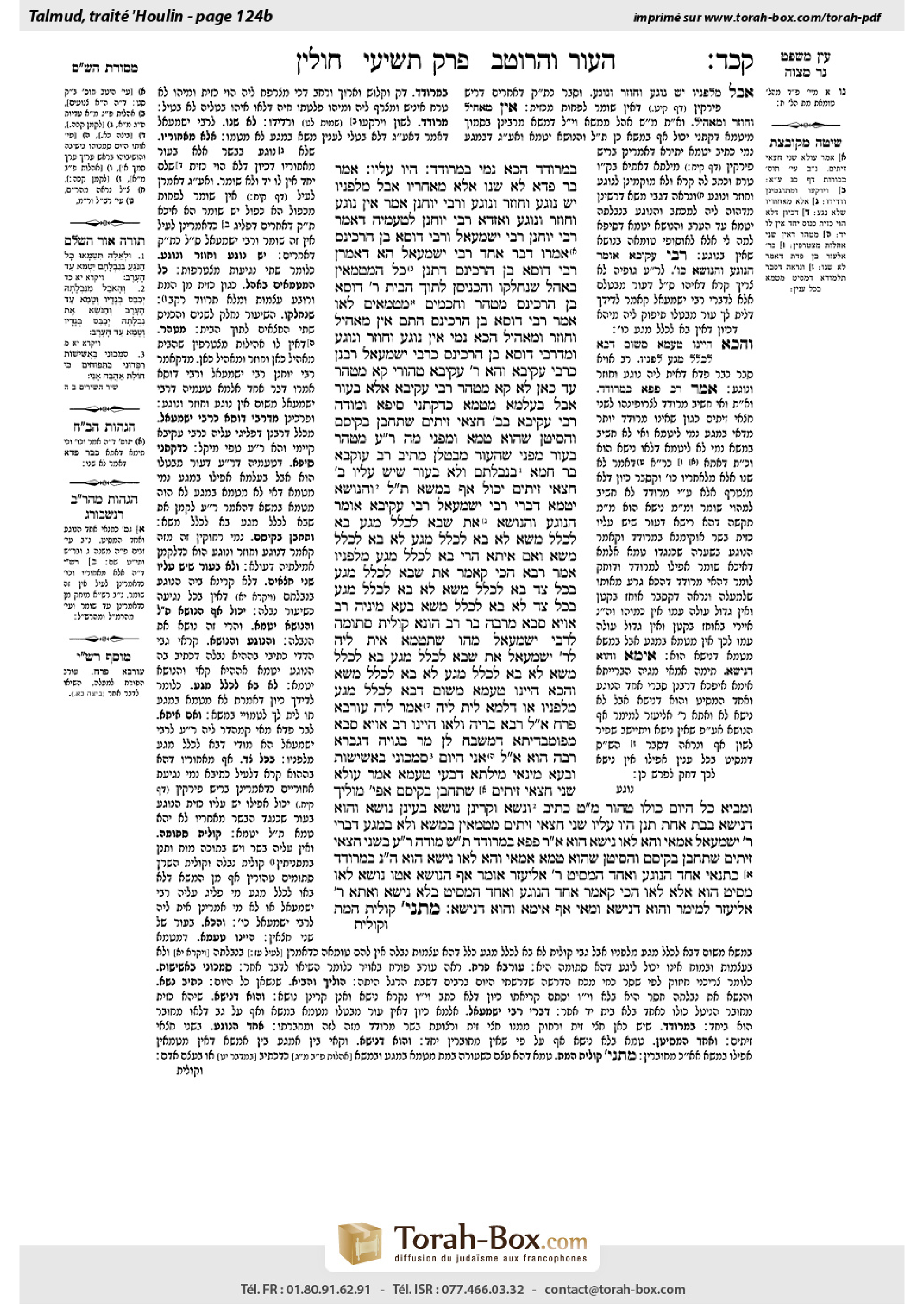
Chullin 124b: Talmud study for Daf Yomi
Study the Talmud for Daf Yomi with scanned pages, Hebrew text, English translations from Sefaria and AI-generated French translations.
Passage selection and English or AI-generated French translation are available where the scan has annotations. Daf Study is independent of Torah-Box and Sefaria.
Browse Chullin · חולין · All tractatesChullin 124b text and translations
This page of Chullin includes the Aramaic text, an English translation and an AI-generated French translation, alongside the scan above.
חולין קכ״ד ב · Aramaic and Hebrew text
בִּמְרוּדָּד, הָכָא נָמֵי בִּמְרוּדָּד.
הָיוּ עָלָיו.
אָמַר בַּר פְּדָא: לֹא שָׁנוּ אֶלָּא מֵאַחֲרָיו, אֲבָל מִלְּפָנָיו – יֵשׁ נוֹגֵעַ וְחוֹזֵר וְנוֹגֵעַ.
וְרַבִּי יוֹחָנָן אָמַר: אֵין נוֹגֵעַ וְחוֹזֵר וְנוֹגֵעַ, וְאַזְדָּא רַבִּי יוֹחָנָן לְטַעְמֵיהּ, דְּאָמַר רַבִּי יוֹחָנָן: רַבִּי יִשְׁמָעֵאל וְרַבִּי דּוֹסָא בֶּן הַרְכִּינָס אָמְרוּ דָּבָר אֶחָד.
רַבִּי יִשְׁמָעֵאל – הָא דַּאֲמַרַן; רַבִּי דּוֹסָא בֶּן הַרְכִּינָס – דִּתְנַן: כָּל הַמְטַמְּאִין בְּאֹהֶל, שֶׁנֶּחְלְקוּ וְהִכְנִיסָן לְתוֹךְ הַבַּיִת – רַבִּי דּוֹסָא בֶּן הַרְכִּינָס מְטַהֵר, וַחֲכָמִים מְטַמְּאִים.
לָאו אָמַר רַבִּי דּוֹסָא בֶּן הַרְכִּינָס הָתָם, אֵין מַאֲהִיל וְחוֹזֵר וּמַאֲהִיל, הָכָא נָמֵי אֵין נוֹגֵעַ וְחוֹזֵר וְנוֹגֵעַ.
וּמִדְּרַבִּי דּוֹסָא בֶּן הַרְכִּינָס כְּרַבִּי יִשְׁמָעֵאל, רַבָּנַן כְּרַבִּי עֲקִיבָא? וְהָא רַבִּי עֲקִיבָא טַהוֹרֵי קָא מְטַהַר!
עַד כָּאן לָא קָא מְטַהַר רַבִּי עֲקִיבָא אֶלָּא בְּעוֹר, אֲבָל בְּעָלְמָא מְטַמֵּא, כִּדְקָתָנֵי סֵיפָא: וּמוֹדֶה רַבִּי עֲקִיבָא בִּשְׁנֵי חֲצָאֵי זֵיתִים שֶׁתְּחָבָן בְּקֵיסָם וֶהֱסִיטָן שֶׁהוּא טָמֵא. וּמִפְּנֵי מָה רַבִּי עֲקִיבָא מְטַהֵר בָּעוֹר? מִפְּנֵי שֶׁהָעוֹר מְבַטְּלָן.
מֵתִיב רַב עוּקְבָא בַּר חָמָא: ״בְּנִבְלָתָם״ – וְלֹא בְּעוֹר שֶׁיֵּשׁ עָלָיו שְׁנֵי חֲצָאֵי זֵיתִים.
יָכוֹל אַף בְּמַשָּׂא? תַּלְמוּד לוֹמַר ״וְהַנּוֹשֵׂא יִטְמָא״ – דִּבְרֵי רַבִּי יִשְׁמָעֵאל. רַבִּי עֲקִיבָא אוֹמֵר: ״הַנּוֹגֵעַ״ ״וְהַנּוֹשֵׂא״ – אֶת שֶׁבָּא לִכְלַל מַגָּע, בָּא לִכְלַל מַשָּׂא; לֹא בָּא לִכְלַל מַגָּע, לֹא בָּא לִכְלַל מַשָּׂא.
וְאִם אִיתָא, הֲרֵי בָּא לִכְלַל מַגָּע מִלְּפָנָיו?
אָמַר רָבָא: הָכִי קָאָמַר, אֶת שֶׁבָּא לִכְלַל מַגָּע בְּכׇל צַד – בָּא לִכְלַל מַשָּׂא, לֹא בָּא לִכְלַל מַגָּע בְּכׇל צַד – לֹא בָּא לִכְלַל מַשָּׂא.
בְּעָא מִינֵּיהּ רַב אַוְיָא סָבָא מֵרַבָּה בַּר רַב הוּנָא: קוּלִית סְתוּמָה, לְרַבִּי יִשְׁמָעֵאל, מַהוּ שֶׁתְּטַמֵּא?
אִית לֵיהּ לְרַבִּי יִשְׁמָעֵאל: אֶת שֶׁבָּא לִכְלַל מַגָּע – בָּא לִכְלַל מַשָּׂא, לֹא בָּא לִכְלַל מַגָּע – לֹא בָּא לִכְלַל מַשָּׂא, וְהָכָא הַיְינוּ טַעְמָא מִשּׁוּם דְּבָא לִכְלַל מַגָּע מִלְּפָנָיו.
אוֹ דִלְמָא לֵית לֵיהּ?
אֲמַר לֵיהּ: עוֹרְבָא פָּרַח.
אֲמַר לֵיהּ רָבָא בְּרֵיהּ: וְלָאו הַיְינוּ רַב אַוְיָא סָבָא מִפּוּמְבְּדִיתָא, דִּמְשַׁבַּח לַן מָר בְּגַוֵּיהּ דְּגַבְרָא רַבָּה הוּא? אֲמַר לֵיהּ: אֲנִי הַיּוֹם ״סַמְּכוּנִי בָּאֲשִׁישׁוֹת״, וּבְעָא מִינַּאי מִילְּתָא דְּבָעֵי טַעְמָא.
אָמַר עוּלָּא: שְׁנֵי חֲצָאֵי זֵיתִים שֶׁתְּחָבָן בְּקֵיסָם, אֲפִילּוּ מוֹלִיךְ וּמֵבִיא כׇּל הַיּוֹם כּוּלּוֹ – טָהוֹר.
מַאי טַעְמָא? כְּתִיב ״וְנִשָּׂא״ וְקָרֵינַן ״נוֹשֵׂא״, בָּעֵינַן ״נוֹשֵׂא״ וְהוּא דְּנִישָּׂא בְּבַת אַחַת.
תְּנַן: הָיוּ עָלָיו שְׁנֵי חֲצָאֵי זֵיתִים – מְטַמְּאִין בְּמַשָּׂא וְלֹא בְּמַגָּע, דִּבְרֵי רַבִּי יִשְׁמָעֵאל. אַמַּאי? וְהָא לָאו נִישָּׂא הוּא!
אָמַר רַב פָּפָּא: בִּמְרוּדָּד.
תָּא שְׁמַע: מוֹדֶה רַבִּי עֲקִיבָא בִּשְׁנֵי חֲצָאֵי זֵיתִים שֶׁתְּחָבָן בְּקֵיסָם וֶהֱסִיטָן שֶׁהוּא טָמֵא. אַמַּאי? וְהָא לָאו נִישָּׂא הוּא! הָכִי נָמֵי בִּמְרוּדָּד.
כְּתַנָּאֵי: אֶחָד הַנּוֹגֵעַ וְאֶחָד הַמֵּסִיט, רַבִּי אֱלִיעֶזֶר אוֹמֵר: אַף הַנּוֹשֵׂא. אַטּוּ נוֹשֵׂא לָאו מֵסִיט הוּא?
אֶלָּא לָאו הָכִי קָאָמַר: אֶחָד הַנּוֹגֵעַ וְאֶחָד הַמֵּסִיט בְּלֹא נִישָּׂא, וַאֲתָא רַבִּי אֱלִיעֶזֶר לְמֵימַר: וְהוּא דְּנִישָּׂא, וּמַאי ״אַף״? אֵימָא: וְהוּא דְּנִישָּׂא.
מַתְנִי׳ קוּלִית הַמֵּת
Chullin 124b · English translation
The reference is to a thin layer of flesh attached to the hide. Here, too, the Gemara concludes that Rabbi Yoḥanan’s statement is referring to a thin layer of flesh attached to the hide. When a person severs such a piece of flesh along with the hide, even if the total volume of the flesh is an olive-bulk, or even a much larger measure, it is insignificant and is nullified by the hide.
§The mishna teaches: If upon the hide there were two half olive-bulks, the hide imparts the impurity of an unslaughtered carcass by means of carrying but not by means of contact with the flesh; this is the statement of Rabbi Yishmael.
Bar Padda says: The Sages taught that Rabbi Yishmael holds that that hide does not impart impurity by means of contact only with regard to one who touched the hide on the outside. But if one directly touched the pieces of flesh inside the hide, even though he did not touch any one piece measuring an olive-bulk, he is impure. This is because there is a principle that if one touches an impure item measuring less than an olive-bulk and again touches another impure item measuring less than an olive-bulk, he becomes impure, as the two instances of contact join together to constitute contact with the requisite measure of an olive-bulk.
And Rabbi Yoḥanan says: There is no such principle that if one touches an impure item and again touches another impure item that the two instances of contact join together to constitute contact with the requisite measure of an olive-bulk. And Rabbi Yoḥanan follows his line of reasoning, as Rabbi Yoḥanan said: Rabbi Yishmael and Rabbi Dosa ben Harkinas said the same thing, i.e., maintained the same principle.
The statement of Rabbi Yishmael is that which we said: Two instances of contact do not join together to constitute contact with the requisite measure of impurity. The statement of Rabbi Dosa ben Harkinas is that which we learned in a mishna (Oholot 3:1): With regard to any part of a corpse that imparts impurity in a tent, i.e., that imparts impurity to any other item that is under the same roof, if that body part was divided into two pieces, each measuring less than an olive-bulk, but together they constitute an olive-bulk, and one placed both pieces inside the house, Rabbi Dosa ben Harkinas rules that the two pieces do not join together to constitute the requisite measure of an olive-bulk. Therefore, he deems everything inside the house pure. And the Rabbis rule that the two pieces of the corpse join together to constitute an olive-bulk, and therefore they deem everything inside the house impure.
Didn’t Rabbi Dosa ben Harkinas say in that mishna there that there is no such principle that a tent overlies an impure item and again overlies another impure item such that the two instances join together to constitute the requisite measure for impurity imparted in a tent? Here, too, Rabbi Dosa ben Harkinas would agree with Rabbi Yishmael that there is no such principle that if one touches an impure item and again touches another impure item that the two instances join together to constitute contact with the requisite measure of an olive-bulk.
The Gemara objects to the statement of Rabbi Yoḥanan: Since the opinion of Rabbi Dosa ben Harkinas is in accordance with the opinion of Rabbi Yishmael, so too, the opinion of the Rabbis who disagree with Rabbi Dosa ben Harkinas must be in accordance with the opinion of Rabbi Akiva, who disagrees with Rabbi Yishmael. But doesn’t Rabbi Akiva rule more leniently than Rabbi Yishmael, as he deems one pure in both cases of contact and carrying, whereas the Rabbis rule more stringently than Rabbi Dosa ben Harkinas and deem everything in the house impure?
The Gemara answers: Rabbi Akiva deems one who touches or carries the pieces of flesh pure only because they are nullified by the hide. But in general he holds that items join together to impart impurity, as the latter clause of the mishna teaches: And Rabbi Akiva concedes in the case of two half olive-bulks where one skewered them with a wood chip and moved them that he is impure. And for what reason does Rabbi Akiva deem one ritually pure in a case where he moved both half olive-bulks with the hide? It is because the hide separates between them and nullifies them.
Rav Ukva bar Ḥama raises an objection to the statement of bar Padda that Rabbi Yishmael maintains that two instances of contact with two pieces measuring less than an olive-bulk join together to constitute contact with the requisite measure of an olive-bulk. His objection is based on that which is taught in a baraita: It is written: “And by these you shall become impure; whoever touches their carcass shall be impure until evening. And whoever carries the carcass of them shall wash his clothes and be impure until evening” (Leviticus 11:24–25). It is derived from the term “their carcass” that one who touches the carcass itself becomes impure, but one who touches a hide that has upon it two half olive-bulks of flesh does not become impure.
One might have thought that a hide that has upon it two half olive-bulks of flesh does not impart impurity even by means of carrying. Therefore, the continuation of the verse states: “And whoever carries the carcass of them shall wash his clothes and be impure until evening,” from which it is derived that one who carries a carcass, even by means of the hide, becomes impure; this is the statement of Rabbi Yishmael. Rabbi Akiva says: The verse juxtaposes “whoever touches” with “and whoever carries,” indicating that that which enters the category of impurity via contact, enters the category of impurity via carrying; that which does not enter the category of impurity via contact, does not enter the category of impurity via carrying.
Based on this baraita, one can object to the statement of bar Padda: And if it is so that Rabbi Yishmael maintains that two instances of contact with two pieces of flesh measuring less than an olive-bulk join together to constitute contact with the requisite measure of an olive-bulk, then the case of a hide that has upon it two half olive-bulks of flesh also enters the category of impurity transmitted by means of contact when one directly touches the flesh inside the hide. Therefore, why does Rabbi Akiva disagree with Rabbi Yishmael by stating that in this case there is no transmission of impurity by means of carrying because there is no transmission of impurity by means of contact?
Rava said that this is what Rabbi Akiva is saying: That which enters the category of impurity via contact in every manner, even by touching the hide on the outside, enters the category of impurity via carrying; that which does not enter the category of impurity via contact in every manner, does not enter the category of impurity via carrying.
§The Gemara continues to discuss the opinion of Rabbi Yishmael. Rav Avya the Elder asked Rabba bar Rav Huna: The mishna below teaches that with regard to a sealed thigh bone of an unslaughtered carcass and of a creeping animal, where the bone is intact to the extent that there is no access to the marrow, which contains marrow inside but no flesh outside, one who touches it remains ritually pure because it does not enter the category of impurity via contact. According to the opinion of Rabbi Yishmael, what is the halakha as to whether it imparts impurity via carrying?
Perhaps Rabbi Yishmael maintains the principle: That which enters the category of impurity via contact, enters the category of impurity via carrying; that which does not enter the category of impurity via contact, does not enter the category of impurity via carrying. And therefore, here, in the baraita cited above, this is the reason that Rabbi Yishmael taught that one who carries a hide that has upon it two half olive-bulks of flesh becomes impure even though it does not enter the category of impurity via contact if one touched the outside of the hide: It is because it enters the category of impurity via contact if one directly touched the flesh inside the hide. Therefore, a sealed thigh bone, which does not enter the category of impurity via contact in any manner, does not enter the category of impurity via carrying either.
Or perhaps Rabbi Yishmael does not maintain this principle, and he would maintain that one who carries a hide that has upon it two half olive-bulks of flesh becomes impure even if it were not the case that it enters the category of impurity via contact if one directly touched the flesh inside the hide. And therefore, Rabbi Yishmael holds that a sealed thigh bone imparts impurity via carrying even though it does not enter the category of impurity via contact in any manner.
In an effort to evade the question, Rabba bar Rav Huna distracted Rav Avya the Elder and said to him: Look, a raven flies in the sky.
Rava, son of Rabba bar Rav Huna, said to his father: But isn’t this Rav Avya the Elder of Pumbedita, whom the Master would praise to us, saying that he is a great man? If so, why did you treat him in that manner and evade his question? Rabba bar Rav Huna said to him: Today I am in a state best described by the verse: “Let me lean against the stout trunks; let me couch among the apple trees” (Song of Songs 2:5), meaning: I am tired, and he asked me about a matter that requires reasoning and careful examination, and therefore I could not provide an immediate answer.
§Ulla says: With regard to two half olive-bulks that one skewered with a wood chip, even if one moves them back and forth the entire day, he does not contract impurity via carrying, and he is pure.
The Gemara explains: What is the reason? With regard to impurity transmitted by carrying it is written: “And one who carries [vahannosei] its carcass shall wash his clothes and be impure until evening” (Leviticus 11:40). The words “and who carries” in the term “and one who carries” is written vav, nun, sin, alef, which can be read venisa, meaning: Is carried; but according to the traditional vocalization we read the word as nosei, meaning: Carries. From here it is derived that with regard to impurity transmitted by carrying we require that one carry [nosei] the requisite measure of impurity of a carcass, i.e., an olive-bulk, and that that olive-bulk be capable of being carried [nissa] all at once, without the assistance of a utensil. This requirement is not met with regard to two half olive-bulks that one skewered with a wood chip, which are carried only with the assistance of a utensil.
The Gemara objects to Ulla’s statement: We learned in the mishna that if upon the hide there were two half olive-bulks, the hide imparts the impurity of an unslaughtered carcass by means of carrying but not by means of contact with the flesh; this is the statement of Rabbi Yishmael. Why does it impart impurity by means of carrying? This case does not fulfill the requirement that an olive-bulk of impure flesh be capable of being carried all at once without the assistance of a utensil, as the hide is needed to carry them.
Rav Pappa says: The mishna is discussing a case where a thin layer of flesh was attached to the hide. Despite the fact that there is not one piece of flesh the size of an olive-bulk, the two half olive-bulks are connected by a strip of thin flesh which enables the two pieces to be carried at once without the assistance of the hide. Therefore, the pieces impart impurity by means of carrying but not by means of contact.
The Gemara suggests: Come and hear a refutation to the opinion of Ulla from that which is stated in the mishna: Rabbi Akiva concedes in the case of two half olive-bulks where one skewered them with a wood chip and moved them that he is impure. Why? This case does not fulfill the requirement that an olive-bulk of impure flesh be capable of being carried all at once without the assistance of a utensil. The Gemara rejects this refutation: Here too, with regard to the statement of Rabbi Akiva, the mishna is discussing a case of a thin layer of flesh connecting the two pieces.
The Gemara suggests: The opinion of Ulla is like one side of a dispute between tanna’im, as it is taught in a baraita: With regard to two pieces of flesh, neither of which measures an olive-bulk, both one who touches and one who moves the pieces is impure. Rabbi Eliezer says: Even one who carries the pieces is impure. The Gemara asks: What is added by the statement of Rabbi Eliezer? Is that to say that carrying is not the same as moving?
Rather, isn’t this what the baraita is saying: Both one who touches and one who moves pieces of flesh is impure even if an olive-bulk of flesh is not capable of being carried without the assistance of a utensil? And Rabbi Eliezer comes to say: One becomes impure only if an olive-bulk of flesh is capable of being carried without the assistance of a utensil. The Gemara asks: But if the intention of Rabbi Eliezer’s statement is to qualify the statement of the Rabbis, what is the meaning of the word even? Rather, say the statement of Rabbi Eliezer differently: One is impure only if an olive-bulk of flesh is capable of being carried without the assistance of a utensil.
MISHNA: With regard to the thigh bone of a human corpse,
Chullin 124b · Traduction française (IA)
La référence est à une fine couche de chair attachée à la peau. Ici aussi, la Guemara conclut que la déclaration de Rabbi Yoḥanan fait référence à une fine couche de chair attachée à la peau. Lorsqu'une personne coupe un tel morceau de chair avec la peau, même si la quantité totale de chair est égale à l'olive, ou même une mesure bien plus grande, cela est insignifiant et est annulé par la peau.
§La mitsva enseigne : Si sur la peau il y avait deux demi-olives, la peau transmet l'impureté du cadavre non sacrifié par le transport mais pas par le contact avec la chair ; c'est l'opinion de Rabbi Yishmael.
Bar Padda dit : Les Sages enseignèrent que Rabbi Yishmael considère que la peau ne transmet l'impureté par le contact que concernant celui qui a touché la peau de l'extérieur. Mais si l'on a touché directement les morceaux de chair à l'intérieur de la peau, même s'il n'a pas touché un seul morceau mesurant une olive, il est impur. Cela est dû à un principe selon lequel si l'on touche un objet impur mesurant moins qu'une olive et à nouveau un autre objet impur mesurant moins qu'une olive, l'on devient impur, car les deux contacts s'unissent pour constituer un contact avec la mesure requise d'une olive.
Et Rabbi Yoḥanan dit : Il n'y a pas de tel principe que si l'on touche un objet impur et à nouveau un autre objet impur, les deux contacts s'unissent pour constituer un contact avec la mesure requise d'une olive. Et Rabbi Yoḥanan suit sa ligne de raisonnement, car Rabbi Yoḥanan dit : Rabbi Yishmael et Rabbi Dosa ben Harkinas ont dit la même chose, c'est-à-dire maintenu le même principe.
L'opinion de Rabbi Yishmael est celle que nous avons dite : deux contacts ne s'unissent pas pour constituer un contact avec la mesure requise d'impureté. L'opinion de Rabbi Dosa ben Harkinas est celle que nous avons appris dans une mitsna (Oholot 3:1) : Concernant toute partie du cadavre qui transmet l'impureté dans une tente, c'est-à-dire qui transmet l'impureté à tout autre objet sous le même toit, si cette partie du corps était divisée en deux morceaux, chacun mesurant moins qu'une olive, mais ensemble ils constituaient une olive, et si l'on avait mis les deux morceaux à l'intérieur de la maison, Rabbi Dosa ben Harkinas décide que les deux morceaux ne s'unissent pas pour constituer la mesure requise d'une olive. Il considère donc tout ce qui est à l'intérieur de la maison comme pur. Et les Rabbins décident que les deux morceaux du cadavre s'unissent pour constituer une olive, et donc ils considèrent tout ce qui est à l'intérieur de la maison comme impur.
N'a-t-il pas dit Rabbi Dosa ben Harkinas dans cette mitsna là que il n'y a pas de tel principe que la tente recouvre un objet impur et à nouveau recouvre un autre objet impur de sorte que les deux s'unissent pour constituer la mesure requise pour l'impureté transmise dans une tente ? Ici aussi, Rabbi Dosa ben Harkinas serait d'accord avec Rabbi Yishmael que il n'y a pas de tel principe que si l'on touche un objet impur et à nouveau un autre objet impur, les deux contacts s'unissent pour constituer un contact avec la mesure requise d'une olive.
La Guemara s'oppose à la déclaration de Rabbi Yoḥanan : Puisque l'opinion de Rabbi Dosa ben Harkinas est en accord avec l'opinion de Rabbi Yishmael, de même l'opinion des Rabbins qui s'opposent à Rabbi Dosa ben Harkinas doit être en accord avec l'opinion de Rabbi Akiva, qui s'oppose à Rabbi Yishmael. Mais n'est-ce pas que Rabbi Akiva décide plus clémentement que Rabbi Yishmael, car il considère un homme pur dans les deux cas de contact et de transport, tandis que les Rabbins décident plus strictement que Rabbi Dosa ben Harkinas et considèrent tout ce qui est à l'intérieur de la maison comme impur ?
La Guemara répond : Rabbi Akiva considère qu'une personne qui touche ou transporte les morceaux de chair est pure uniquement parce qu'ils sont annulés par la peau. Mais en général, il considère que les objets s'unissent pour transmettre l'impureté, comme le dernier verset de la mitsva enseigne : Et Rabbi Akiva reconnaît dans le cas de deux demi-olives où l'on a piqueté avec un morceau de bois et transporté qu'il est impur. Et pour quelle raison Rabbi Akiva considère-t-il une personne pure dans le cas où l'on a transporté les deux demi-olives avec la peau ? C'est parce que la peau les sépare et les annule.
Rav Ukva bar Ḥama soulève un objet contre la déclaration de bar Padda que Rabbi Yishmael maintient que deux contacts avec deux morceaux mesurant moins qu'une olive s'unissent pour constituer un contact avec la mesure requise d'une olive. Son objet est basé sur ce qui est enseigné dans une baraïta : Il est écrit : « Et par ces choses vous devenez impurs ; celui qui touche leur carcasse devient impur jusqu'au soir. Et celui qui transporte la carcasse d'eux lave ses vêtements et devient impur jusqu'au soir » (Lévitique 11:24–25). Il est dérivé du terme « leur carcasse » que celui qui touche la carcasse elle-même devient impur, mais celui qui touche une peau ayant sur elle deux demi-olives de chair ne devient pas impur.
On pouvait penser qu'une peau sur laquelle sont deux demi-olives de chair ne transmet pas l'impureté même par le transport. Ainsi, la continuation du verset dit : « Et celui qui transporte la carcasse d'eux lave ses vêtements et devient impur jusqu'au soir », d'où il est dérivé que celui qui transporte une carcasse, même par la peau, devient impur ; c'est l'opinion de Rabbi Yishmael. Rabbi Akiva dit : Le verset juxtapose « celui qui touche » avec « et celui qui transporte », indiquant que ce qui entre dans la catégorie de l'impureté par le contact entre dans la catégorie de l'impureté par le transport ; ce qui n'entre pas dans la catégorie de l'impureté par le contact, n'entre pas dans la catégorie de l'impureté par le transport.
D'après cette baraïta, on peut s'opposer à l'assertion de bar Padda : Et si c'est ainsi que Rabbi Yishmael affirme que deux contacts avec deux morceaux de chair mesurant moins qu'une olive se joignent pour former un contact avec la mesure requise d'une olive, alors le cas d'une peau ayant deux demi-olives de chair sur elle entre dans la catégorie de l'impureté transmise par contact lorsqu'on touche directement la chair à l'intérieur de la peau. Ainsi, pourquoi Rabbi Akiva s'oppose-t-il à Rabbi Yishmael en affirmant que dans ce cas, il n'y a pas transmission d'impureté par le portage, car il n'y a pas transmission d'impureté par contact ?
Rava dit que c'est ce que Rabbi Akiva affirme : Ce qui entre dans la catégorie de l'impureté par contact en toute circonstance, même en touchant la peau de l'extérieur, entre dans la catégorie de l'impureté par portage ; ce qui ne rentre pas dans la catégorie de l'impureté par contact en toute circonstance, ne rentre pas dans la catégorie de l'impureté par portage.
§La Guemara continue à discuter l'opinion de Rabbi Yishmael. Rav Avya le Vieux demande à Rabba bar Rav Huna : La Michna ci-dessous enseigne que concernant un os de cuisse scellé d'un cadavre non sacrifié et d'un animal rampant, où l'os est intact au point qu'il n'y a pas d'accès à la moelle, qui contient de la moelle à l'intérieur mais pas de chair à l'extérieur, celui qui le touche reste rituellement pur car il ne rentre pas dans la catégorie de l'impureté par contact. Selon l'opinion de Rabbi Yishmael, quelle est la halakha concernant la transmission d'impureté par portage ?
Peut-être Rabbi Yishmael maintient-il le principe : Ce qui entre dans la catégorie de l'impureté par contact entre dans la catégorie de l'impureté par portage ; ce qui ne rentre pas dans la catégorie de l'impureté par contact ne rentre pas dans la catégorie de l'impureté par portage. Et donc, ici, dans la baraïta citée ci-dessus, c'est la raison pour laquelle Rabbi Yishmael enseignait que celui qui porte une peau ayant deux demi-olives de chair sur elle devient impur même s'il ne rentre pas dans la catégorie de l'impureté par contact si on touche l'extérieur de la peau : C'est parce qu'il entre dans la catégorie de l'impureté par contact si on touche directement la chair à l'intérieur de la peau. Ainsi, un os de cuisse scellé, qui ne rentre pas dans la catégorie de l'impureté par contact en toute circonstance, ne rentre pas non plus dans la catégorie de l'impureté par portage.
Ou peut-être Rabbi Yishmael ne maintient-il pas ce principe, et il maintiendrait que celui qui porte une peau ayant deux demi-olives de chair sur elle devient impur même si ce n'était pas le cas qu'il entre dans la catégorie de l'impureté par contact si on touche directement la chair à l'intérieur de la peau. Et donc, Rabbi Yishmael considère que l'os de cuisse scellé transmet l'impureté par portage même s'il ne rentre pas dans la catégorie de l'impureté par contact en toute circonstance.
Dans un effort pour éviter la question, Rabba bar Rav Huna a distrait Rav Avya le Vieux et lui a dit : Regarde, un corbeau vole dans le ciel.
Rava, fils de Rabba bar Rav Huna, a dit à son père : Mais n'est-ce pas Rav Avya le Vieux de Pumbedita, que le Maître louait à nous en disant qu'il est un grand homme ? Si c'est ainsi, pourquoi as-tu traité ainsi cet homme et as-tu évité sa question ? Rabba bar Rav Huna a répondu à lui : Aujourd'hui, je suis dans un état décrit par la verset : « Laisse-moi me reposer contre les troncs épais ; laisse-moi me reposer parmi les arbres de pomme » (Song of Songs 2:5), c'est-à-dire : Je suis fatigué, et il m'a posé une question qui exige une réflexion et une examen soigneux, et donc je n'ai pas pu fournir une réponse immédiate.
§Ulla dit : Concernant deux demi-olives que l'on a piquées avec un morceau de bois, même si l'on les déplace toute la journée, l'on ne contracte pas l'impureté par portage, et l'on est pur.
La Guemara explique : Quelle est la raison ? Concernant l'impureté transmise par portage, il est écrit : « Et celui qui porte [vahannosei] son cadavre lavera ses vêtements et sera impur jusqu'au soir » (Lévitique 11:40). Les mots « et qui porte » dans le terme « et celui qui porte » sont écrits vav, nun, sin, alef, ce qui peut être lu venisa, signifiant : est porté ; mais selon la vocalisation traditionnelle, on lit la parole comme nosei, signifiant : porte. D'où l'on déduit que concernant l'impureté transmise par portage, on exige que l'on porte [nosei] la mesure requise d'impureté de cadavre, c'est-à-dire une olive, et que cette olive soit capable d'être portée [nissa] d'un seul coup, sans l'aide d'un ustensile. Cette exigence n'est pas remplie concernant deux demi-olives que l'on a piquées avec un morceau de bois, qui sont portées seulement avec l'aide d'un ustensile.
La Guemara s'oppose à l'affirmation d'Ulla : Nous avons appris dans la Michna que si sur la peau il y avait deux demi-olives, la peau transmet l'impureté d'un cadavre non sacrifié par portage mais pas par contact avec la chair ; c'est l'assertion de Rabbi Yishmael. Pourquoi transmet-elle l'impureté par portage ? Ce cas ne remplit pas la condition que la mesure d'impureté de chair soit capable d'être portée d'un seul coup sans l'aide d'un ustensile, car la peau est nécessaire pour les porter.
Rav Pappa dit : La Michna discute d'un cas où une fine couche de chair était attachée à la peau. Malgré le fait qu'il n'y ait pas un seul morceau de chair de la taille d'une olive, les deux demi-olives sont reliées par une bande de chair fine qui permet aux deux morceaux d'être portés d'un seul coup sans l'aide de la peau. Ainsi, les morceaux transmettent l'impureté par portage mais pas par contact.
La Guemara suggère : Viens écouter une réfutation de l'opinion d'Ulla, à partir de ce qui est dit dans la mitsna : Rabbi Akiva admet dans le cas de deux demi-olives de viande, où l'un d'eux a été piqueté avec un morceau de bois et déplacé, qu'il est impur. Pourquoi ? Ce cas ne remplit pas la condition que la viande impure d'une olive soit capable d'être transportée d'un seul coup sans l'aide d'un ustensile. La Guemara rejette cette réfutation : ici aussi, concernant l'affirmation de Rabbi Akiva, la mitsna parle d'un cas où une fine couche de viande relie les deux morceaux.
La Guemara suggère : L'opinion d'Ulla est comme l'une des deux parties d'un débat entre les tannaïm, car il est enseigné dans une baraïta : Concernant deux morceaux de viande, aucun desquels ne mesure une olive, à la fois celui qui touche et celui qui déplace les morceaux est impur. Rabbi Éliézer dit : même celui qui transporte les morceaux est impur. La Guemara demande : Quel est l'ajout de l'affirmation de Rabbi Éliézer ? Est-ce dire que transporter n'est pas la même chose que déplacer ?
Plutôt, n'est-ce pas ce que dit la baraïta : à la fois celui qui touche et celui qui déplace des morceaux de viande est impur, même si une olive de viande n'est pas capable d'être transportée sans l'aide d'un ustensile ? Et Rabbi Éliézer vient dire : l'impureté est acquise uniquement si une olive de viande est capable d'être transportée sans l'aide d'un ustensile. La Guemara demande : mais si l'intention de l'affirmation de Rabbi Éliézer est de qualifier l'affirmation des Sages, quelle est la signification du mot même ? Plutôt, disent les Sages, reformule l'affirmation de Rabbi Éliézer ainsi : l'impureté est acquise uniquement si une olive de viande est capable d'être transportée sans l'aide d'un ustensile.
MICHNA : Concernant le fémur d'un cadavre humain,
Traduction française générée par IA à partir de l’édition anglaise de Sefaria. Vérifie toujours un passage avec le texte source.
Text from Sefaria: William Davidson Edition - Vocalized Aramaic (unknown); William Davidson Edition - English (CC BY NC).