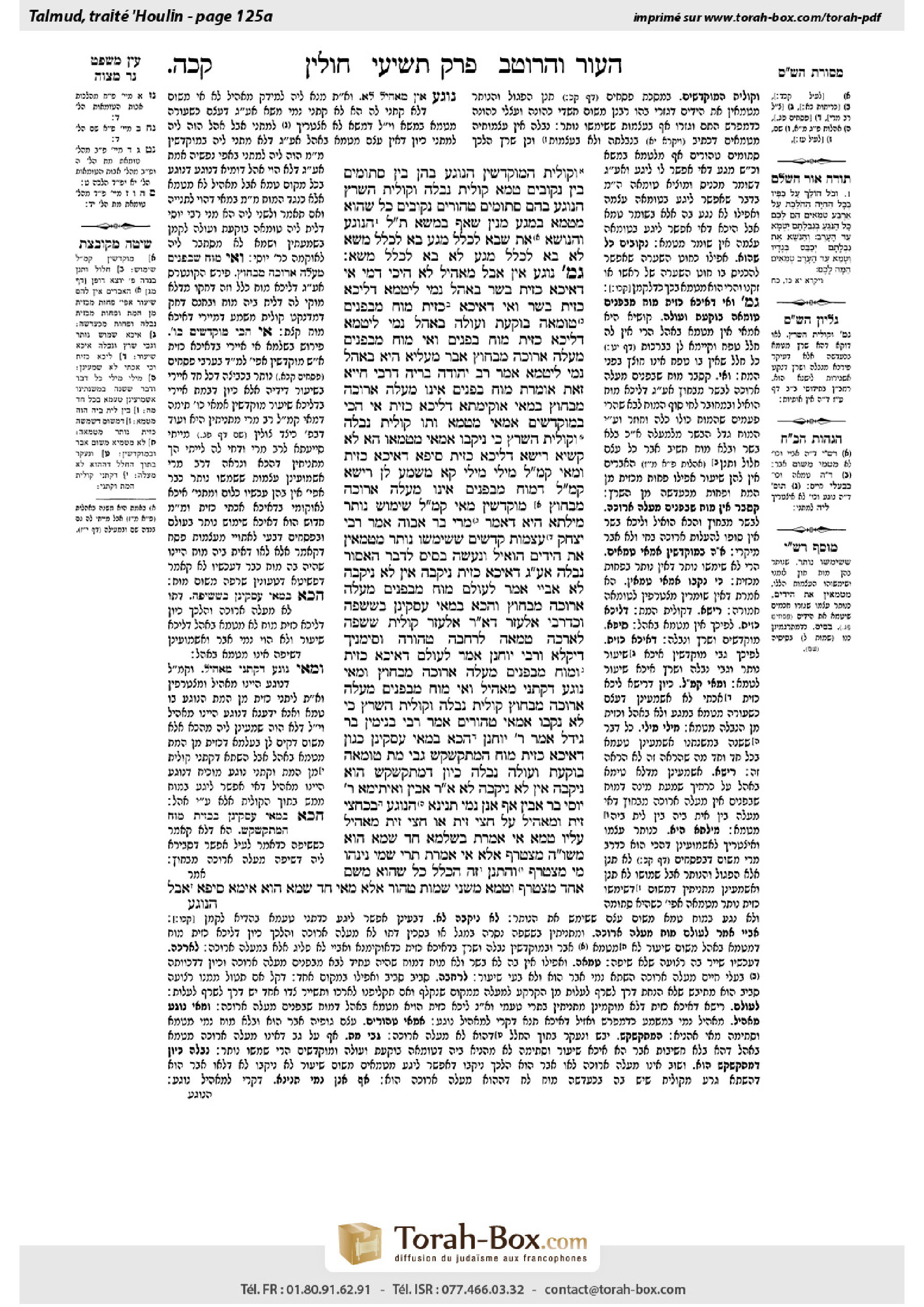
Chullin 125a: Talmud study for Daf Yomi
Study the Talmud for Daf Yomi with scanned pages, Hebrew text, English translations from Sefaria and AI-generated French translations.
Passage selection and English or AI-generated French translation are available where the scan has annotations. Daf Study is independent of Torah-Box and Sefaria.
Browse Chullin · חולין · All tractatesChullin 125a text and translations
This page of Chullin includes the Aramaic text, an English translation and an AI-generated French translation, alongside the scan above.
חולין קכ״ה א · Aramaic and Hebrew text
וְקוּלִית הַמּוּקְדָּשִׁין, הַנּוֹגֵעַ בָּהֶן, בֵּין סְתוּמִים בֵּין נְקוּבִים – טָמֵא.
קוּלִית נְבֵלָה וְקוּלִית הַשֶּׁרֶץ, הַנּוֹגֵעַ בָּהֶם סְתוּמִים – טְהוֹרִים, נְקוּבִים כׇּל שֶׁהוּא – מְטַמֵּא בְּמַגָּע. מִנַּיִן שֶׁאַף בְּמַשָּׂא? תַּלְמוּד לוֹמַר ״הַנּוֹגֵעַ … וְהַנּוֹשֵׂא״, אֶת שֶׁבָּא לִכְלַל מַגָּע – בָּא לִכְלַל מַשָּׂא, לֹא בָּא לִכְלַל מַגָּע – לֹא בָּא לִכְלַל מַשָּׂא.
גְּמָ׳ נוֹגֵעַ – אִין, אֲבָל מַאֲהִיל – לָא.
הֵיכִי דָמֵי? אִי דְּאִיכָּא כְּזַיִת בָּשָׂר – בְּאֹהֶל נָמֵי לִיטַמֵּא! דְּלֵיכָּא כְּזַיִת בָּשָׂר.
וְאִי דְּאִיכָּא כְּזַיִת מוֹחַ מִבִּפְנִים – טוּמְאָה בּוֹקַעַת וְעוֹלָה, בְּאֹהֶל נָמֵי לִיטַמֵּא! דְּלֵיכָּא כְּזַיִת מוֹחַ בִּפְנִים.
וְאִי מוֹחַ מִבִּפְנִים מַעֲלֶה אֲרוּכָה מִבַּחוּץ, אֵבֶר מְעַלְּיָא הִיא, בְּאֹהֶל נָמֵי לִיטַמֵּא! אָמַר רַב יְהוּדָה בְּרֵיהּ דְּרַבִּי חִיָּיא: זֹאת אוֹמֶרֶת, מוֹחַ בִּפְנִים אֵינוֹ מַעֲלֶה אֲרוּכָה מִבַּחוּץ.
בְּמַאי אוֹקֵימְתַּהּ? דְּלֵיכָּא כְּזַיִת. אִי הָכִי, בְּמוּקְדָּשִׁים אַמַּאי מְטַמֵּא?
וְתוּ, קוּלִית נְבֵלָה וְקוּלִית הַשֶּׁרֶץ כִּי נִיקְּבוּ, אַמַּאי מְטַמְּאוּ?
הָא לָא קַשְׁיָא, רֵישָׁא דְּלֵיכָּא כְּזַיִת, סֵיפָא דְּאִיכָּא כְּזַיִת. וּמַאי קָא מַשְׁמַע לַן? מִילֵּי מִילֵּי קָא מַשְׁמַע לַן.
רֵישָׁא קָא מַשְׁמַע לַן דְּמוֹחַ מִבִּפְנִים אֵינוֹ מַעֲלֶה אֲרוּכָה מִבַּחוּץ. מוּקְדָּשִׁין מַאי קָא מַשְׁמַע לַן? שִׁימּוּשׁ נוֹתָר מִילְּתָא הִיא, דְּאָמַר מָרִי בַּר אֲבוּהּ אָמַר רַבִּי יִצְחָק: עַצְמוֹת קָדָשִׁים שֶׁשִּׁימְּשׁוּ נוֹתָר, מְטַמְּאִין אֶת הַיָּדַיִם, הוֹאִיל וְנַעֲשָׂה בָּסִיס לְדָבָר הָאָסוּר.
נְבֵלָה, אַף עַל גַּב דְּאִיכָּא כְּזַיִת, נִיקְּבָה – אִין, לֹא נִיקְּבָה – לָא.
אַבָּיֵי אָמַר: לְעוֹלָם מוֹחַ מִבִּפְנִים מַעֲלֶה אֲרוּכָה מִבַּחוּץ, וְהָכָא בְּמַאי עָסְקִינַן – בְּשֶׁשִּׁפָּהּ.
וְכִדְרַבִּי אֶלְעָזָר, דְּאָמַר רַבִּי אֶלְעָזָר: קוּלִית שֶׁשִּׁפָּהּ לְאׇרְכָּהּ – טְמֵאָה, לְרׇחְבָּהּ – טְהוֹרָה, וְסִימָנָיךְ – דִּיקְלָא.
וְרַבִּי יוֹחָנָן אָמַר: לְעוֹלָם דְּאִיכָּא כְּזַיִת, וּמוֹחַ מִבִּפְנִים מַעֲלֶה אֲרוּכָה מִבַּחוּץ, וּמַאי נוֹגֵעַ דְּקָתָנֵי – מַאֲהִיל.
וְאִי מוֹחַ מִבִּפְנִים מַעֲלֶה אֲרוּכָה מִבַּחוּץ, קוּלִית נְבֵלָה וְקוּלִית הַשֶּׁרֶץ כִּי לֹא נִקְּבוּ, אַמַּאי טְהוֹרִים?
אָמַר רַבִּי בִּנְיָמִין בַּר גִּידֵּל, אָמַר רַבִּי יוֹחָנָן: הָכָא בְּמַאי עָסְקִינַן, כְּגוֹן דְּאִיכָּא כְּזַיִת מוֹחַ הַמִּתְקַשְׁקֵשׁ, גַּבֵּי מֵת – טוּמְאָה בּוֹקַעַת וְעוֹלָה, נְבֵלָה – כֵּיוָן דְּמִתְקַשְׁקֵשׁ הוּא, נִיקְּבָה – אִין, לֹא נִיקְּבָה – לָא.
אָמַר רַבִּי אָבִין, וְאִיתֵּימָא רַבִּי יוֹסֵי בַּר אָבִין: אַף אֲנַן נָמֵי תְּנֵינָא – הַנּוֹגֵעַ בְּכַחֲצִי זַיִת, וּמַאֲהִיל עַל חֲצִי זַיִת, אוֹ חֲצִי זַיִת מַאֲהִיל עָלָיו – טָמֵא.
אִי אָמְרַתְּ בִּשְׁלָמָא חַד שְׁמָא הוּא – מִשּׁוּם הָכִי מִצְטָרֵף.
אֶלָּא אִי אָמְרַתְּ תְּרֵי שְׁמֵי נִינְהוּ – מִי מִצְטָרֵף? וְהָתְנַן: זֶה הַכְּלָל, כֹּל שֶׁהוּא מִשֵּׁם אֶחָד – מִצְטָרֵף וְטָמֵא, מִשְּׁנֵי שֵׁמוֹת – טָהוֹר!
אֶלָּא מַאי חַד שְׁמָא הוּא? אֵימָא סֵיפָא: אֲבָל
Chullin 125a · English translation
and the thigh bone of a sacrificial animal that was rendered unfit as piggul, i.e., an offering that was sacrificed with the intent to consume it after its designated time, or notar, i.e., part of an offering left over after the time allotted for its consumption, whether these thigh bones were sealed and there was no access to the marrow, or whether they were perforated and there was access to the marrow, one who touches them is ritually impure. The reason is that a piece of bone of a corpse the size of a barley grain imparts impurity, and the bone of a sacrificial animal that was disqualified in this manner imparts impurity by rabbinic decree via contact.
With regard to the thigh bone of an unslaughtered carcass and the thigh bone of a creeping animal, one who touches them when they are sealed remains ritually pure. If one of these thigh bones was perforated at all, it imparts impurity via contact, as in that case contact with the bone is tantamount to contact with the marrow. From where is it derived that even with regard to impurity transmitted via carrying there is a distinction between sealed and perforated thigh bones? It is derived from a verse, as the verse states: “One who touches the carcass thereof shall be impure until the evening; and one who carries the carcass thereof shall be impure until the evening” (Leviticus 11:39–40), indicating: That which enters the category of impurity via contact, enters the category of impurity via carrying; that which does not enter the category of impurity via contact, does not enter the category of impurity via carrying.
GEMARA: The mishna teaches that one who touches the thigh bone of a human corpse is ritually impure, whether or not it was sealed. The Gemara infers that with regard to one who touches the bone, yes, he is impure, but one who overlies the thigh bone is not impure, as it does not transmit impurity to that which is above it or under the same roof.
The Gemara asks: What are the circumstances? If there is an olive-bulk of flesh attached to the bone then it should transmit impurity in a tent, i.e., to that which is under the same roof, as well. The Gemara answers: The mishna is discussing a case where there is not an olive-bulk of flesh attached to the bone.
The Gemara objects: But if there is an olive-bulk of marrow inside the bone, the impurity breaks through the bone, so to speak, and ascends beyond it. Therefore, it should transmit impurity in a tent as well. The Gemara explains: The mishna is discussing a case where there is not an olive-bulk of marrow inside the bone.
The Gemara objects: But if the mishna maintains that marrow inside the bone of a living person heals the flesh outside the bone, then since the marrow could replenish itself and catalyze the growth of flesh on the bone it is a proper limb. Therefore, as is the case with any piece of a proper limb, even one less than the size of an olive-bulk, it should transmit impurity in a tent as well. Rav Yehuda, son of Rabbi Ḥiyya, says: That is to say that the mishna maintains that marrow inside the bone does not heal the flesh outside the bone.
The Gemara asks: To what case did you interpret the mishna to be referring? It is a case where there is not an olive-bulk of marrow. If so, in the case of a sacrificial animal, why does the thigh bone impart impurity? The Sages issued a decree that the bones of a sacrificial animal that are attached to flesh or contain marrow that became piggul or notar render those who touch them impure, as they serve as handles or protection for the flesh or marrow. By contrast, in this case there can be no piggul or notar because there is less than an olive-bulk of flesh or marrow.
And furthermore, if the mishna is discussing a case where there is not an olive-bulk of marrow, why do the thigh bone of an unslaughtered carcass and the thigh bone of a creeping animal impart impurity in a case when they were perforated?
The Gemara answers: That is not difficult. The first clause of the mishna, which discusses the thigh bone of a corpse, is referring to a case where there is not an olive-bulk of marrow. The latter clause of the mishna, which discusses the thigh bones of a sacrificial animal, an unslaughtered carcass, and a creeping animal, is referring to a case where there is an olive-bulk of marrow. And accordingly, what is the tanna of the mishna teaching us? He is teaching us several distinct matters separately, as follows.
In the first clause he is teaching us that the marrow inside the bone does not heal the flesh outside the bone. With regard to the thigh bone of sacrificial animals, what is he teaching us? He is teaching us that a bone that serves as a handle or protection for flesh or marrow that became notar is significant and imparts impurity, as Mari bar Avuh said that Rabbi Yitzḥak said: Bones of sacrificial animals that served as a handle for notar, meaning that they have leftover meat on them or inside them after the allotted time for its consumption, transmit impurity to the hands of those who handle them, just as the leftover sacrificial meat itself transmits impurity to the hands. Since the bones have become a base for an intrinsically forbidden object, they are treated in the same manner as the forbidden object itself.
Next, the tanna of the mishna teaches that with regard to the thigh bone of an unslaughtered carcass, even if there is an olive-bulk of marrow inside, if it was perforated it does impart impurity, but if it was not perforated, it does not impart impurity.
Abaye said: Actually, the tanna of the mishna maintains that marrow inside the bone heals the flesh outside the bone. And with regard to the consequent assertion: If so, the thigh bone should impart impurity in a tent as well, the explanation is that here we are dealing with a case where one scraped the bone. Therefore, the flesh and the marrow can no longer heal, and the bone is not considered a proper limb that imparts impurity in a tent.
And this mishna is in accordance with the opinion of Rabbi Elazar, as Rabbi Elazar said: A thigh bone that one scraped lengthwise is impure like a limb. Even if it is not attached to flesh or marrow, a bone scraped in such a manner still has the ability to heal. But if one scraped it widthwise it will not heal and is therefore pure. And your mnemonic to remember which can heal and which cannot is a palm tree, because if one sawed a strip off of a palm tree lengthwise it can heal, but if one did so widthwise, i.e., one sawed a strip off of the circumference of the tree, the flow of sap is disrupted and the tree cannot heal.
And Rabbi Yoḥanan said: Actually, the mishna is discussing a case where there is an olive-bulk of marrow in the bone. And the tanna of the mishna also holds that marrow inside the bone heals the flesh outside the bone. And as for the consequent assertion: If so, the bone should transmit impurity in a tent, in fact the bone does impart impurity in a tent. And to what is the mishna referring when it teaches that one who touches the bone is ritually impure? It is also referring to one who overlies the bone.
The Gemara asks: But if the marrow inside the bone heals the flesh outside the bone, why does the mishna teach that the thigh bone of a carcass and the thigh bone of a creeping animal are pure when they were not perforated?
Rabbi Binyamin bar Giddel said that Rabbi Yoḥanan said: Here we are dealing with a case where there is an olive-bulk of marrow that has become detached and is rattling inside the bone. With regard to impurity imparted by a corpse, the impurity breaks through the bone and ascends, and it therefore transmits impurity in a tent. But with regard to the impurity of a carcass, since the marrow is loose and rattling, it will not heal. Therefore, if the bone was perforated and it is possible to touch the marrow, the bone does impart impurity. But if the bone was not perforated it does not impart impurity.
According to Rabbi Yoḥanan, overlying is referred to as touching in the mishna. Rabbi Avin said, and some say it was Rabbi Yosei bar Avin who said: We learn in a mishna as well (Oholot 3:1): In the case of one who touches with one hand half an olive-bulk of a corpse and simultaneously his other hand overlies half an olive-bulk or half an olive-bulk of flesh from a corpse overlies him, he is impure.
Granted, if you say that impurity via contact and impurity transmitted in a tent or to one overlying a part of the corpse are one concept, it is due to that reason that the half olive-bulk of impurity that he touched and the half olive-bulk of impurity that he overlaid join together to constitute the requisite measure of an olive-bulk.
But if you say that they are two concepts, how can they join together? But didn’t we learn in that mishna (Oholot 3:1): This is the principle: Any impure items lacking the requisite volume to have impure status on their own that are of one concept join together and are impure; if they are of two concepts, they do not join together and remain pure? Apparently, touching and overlying a corpse create the same type of impurity, and therefore overlying is referred to as touching in the mishna here.
The Gemara challenges: Rather, what is the alternative? Is it one concept that comprises both touching and overlying? Say the latter clause of the mishna in tractate Oholot: But
Chullin 125a · Traduction française (IA)
et la cuisse d'un animal sacrifié qui a été rendu inutilisable en raison de piggul, c'est-à-dire une offrande sacrifiée avec l'intention de la consommer après le temps désigné, ou notar, c'est-à-dire une partie d'une offrande laissée après le temps alloué à sa consommation, que ces côtes soient scellées et qu'il n'y ait pas d'accès à la moelle, ou qu'elles soient perçées et qu'il y ait accès à la moelle, celui qui les touche est impur rituellement. La raison est que la moelle d'un cadavre de la taille d'une graine de blé transmet l'impureté, et la moelle d'un animal sacrifié qui a été disqualifié ainsi transmet l'impureté par décret rabbinique par contact.
En ce qui concerne la cuisse d'un cadavre non sacrifié et la cuisse d'un animal rampant, celui qui les touche lorsqu'elles sont scellées reste rituellement pur. Si l'une de ces côtes a été percée du tout, elle transmet l'impureté par contact, car dans ce cas, le contact avec la côte équivaut au contact avec la moelle. D'où cette dérivation ? Elle est tirée d'un verset, car le verset dit : « Celui qui touche le cadavre en sera impur jusqu'au soir ; celui qui transporte le cadavre en sera impur jusqu'au soir » (Lévitique 11:39-40), indiquant : Ce qui entre dans la catégorie de l'impureté par contact entre dans la catégorie de l'impureté par transport ; ce qui n'entre pas dans la catégorie de l'impureté par contact n'entre pas dans la catégorie de l'impureté par transport.
GUEMARA : La mitsva enseigne que celui qui touche la côte d'un cadavre humain est impur rituellement, qu'elle soit scellée ou non. La Guemara infère que concernant celui qui touche la côte, oui, il est impur, mais celui qui recouvre la côte n'est pas impur, car elle ne transmet pas l'impureté à ce qui est au-dessus ou sous le même toit.
La Guemara pose la question : Quelles sont les circonstances ? Si une quantité d'olive de chair est attachée à l'os, elle devrait transmettre l'impureté dans une tente, c'est-à-dire à ce qui est sous le même toit, également. La Guemara répond : La mitsna parle d'un cas où il n'y a pas une quantité d'olive de chair attachée à l'os.
La Guemara s'oppose : Mais si une quantité d'olive de moelle est à l'intérieur de l'os, l'impureté pénètre l'os, en quelque sorte, et monte au-delà, donc elle devrait transmittre l'impureté dans une tente également. La Guemara explique : La mitsna parle d'un cas où il n'y a pas une quantité d'olive de moelle à l'intérieur de l'os.
La Guemara s'oppose : Mais si la mitsna maintient que la moelle à l'intérieur de l'os d'une personne vivante guérit la chair à l'extérieur de l'os, alors puisque la moelle pourrait se régénérer et catalyser la croissance de chair sur l'os, elle est une partie propre. Donc, comme c'est le cas avec toute pièce d'une partie propre, même inférieure à la taille d'une quantité d'olive, elle devrait transmettre l'impureté dans une tente également. Rav Yehuda, fils de Rabbi Ḥiyya, dit : Cela signifie que la mitsna maintient que la moelle à l'intérieur de l'os ne guérit pas la chair à l'extérieur de l'os.
La Guemara pose la question : À quel cas avez-vous interprété la Michna à propos ? C'est un cas où il n'y a pas une quantité d'olive de moelle. Si tel est le cas, pourquoi la côte transmet-elle l'impureté dans le cas d'un animal sacré ? Les Sages ont émis un décret selon lequel les os d'un animal sacré qui sont attachés à la chair ou contiennent de la moelle devenue piggul ou notar rendent impurs ceux qui les touchent, car ils servent de manche ou de protection pour la chair ou la moelle. À l'inverse, dans ce cas, il ne peut pas y avoir de piggul ou de notar, car il y a moins d'une quantité d'olive de chair ou de moelle.
Et de plus, si la mitsna parle d'un cas où il n'y a pas une quantité d'olive de moelle, pourquoi les côtes d'un cadavre non sacrifié et d'un animal rampant transmettent-elles l'impureté dans le cas où elles ont été perçées ?
La Guemara répond : Ce n'est pas difficile. La première partie de la mitsna, qui parle de la côte d'un cadavre, fait référence à un cas où il n'y a pas une quantité d'olive de moelle. La seconde partie de la mitsna, qui parle des côtes d'un animal sacrifié, d'un cadavre non sacrifié et d'un animal rampant, fait référence à un cas où il y a une quantité d'olive de moelle. Et ainsi, à quoi la tanna de la mitsna nous enseigne-t-il ? Il nous enseigne plusieurs choses distinctes séparément, comme suit.
Dans la première partie, il nous enseigne que la moelle à l'intérieur de l'os ne guérit pas la chair à l'extérieur de l'os. En ce qui concerne l'os du cuisse d'animaux sacrés, à quoi cela nous enseigne-t-il ? Il nous enseigne que l'os qui sert de manche ou de protection pour la chair ou la moelle devenue notar est important et transmet l'impureté, car Mari bar Avuh a dit que Rabbi Yitzḥak a dit : Les os d'animaux sacrés qui servaient de manche pour le notar, c'est-à-dire qui ont de la viande restante sur eux ou à l'intérieur après le temps alloué à leur consommation, transmettent l'impureté aux mains de ceux qui les manipulent, tout comme la viande sacrée restante transmet l'impureté aux mains. Puisque les os sont devenus une base pour un objet interdit, ils sont traités de la même manière que l'objet interdit lui-même.
Ensuite, la tanna de la mitsva nous enseigne que concernant l'os du cuisse d'un cadavre non sacrifié, même s'il y a une quantité d'olive de moelle à l'intérieur, si elle a été percée, elle transmet l'impureté, mais si elle n'a pas été percée, elle ne transmet pas l'impureté.
Abaye a dit : En réalité, la tanna de la mitsva maintient que la moelle à l'intérieur de l'os guérit la chair à l'extérieur de l'os. Et concernant l'affirmation conséquente : Si tel est le cas, l'os du cuisse devrait transmettre l'impureté dans une tente également, l'explication est que nous sommes ici dans un cas où l'on a graté l'os. Ainsi, la chair et la moelle ne peuvent plus guérir, et l'os n'est pas considéré comme une partie propre qui transmet l'impureté dans une tente.
Et cette mitsva est conforme à l'opinion du Rabbi Elazar, car le Rabbi Elazar a dit : Un os de cuisse que l'on gratte longitudinalement est impur comme un membre. Même s'il n'est pas attaché à de la chair ou à de la moelle, un os gratté ainsi possède la capacité de guérir. Mais si l'on gratte l'os transversalement, il ne guérira pas et sera donc pur. Et votre mnémonique pour retenir ce qui guérit et ce qui ne guérit pas est un palmier, car si l'on coupe un lambeau du palmier longitudinalement, il peut guérir, mais si l'on le fait transversalement, c'est-à-dire si l'on coupe un lambeau de la circonférence de l'arbre, le flux du sirop est perturbé et l'arbre ne peut guérir.
Et le Rabbi Yoḥanan a dit : En réalité, la mitsva parle d'un cas où il y a une quantité d'olive de moelle dans l'os. Et le tanna de la mitsva maintient également que la moelle à l'intérieur de l'os guérit la chair à l'extérieur de l'os. Et concernant l'affirmation conséquente : Si c'est ainsi, l'os devrait transmettre l'impureté dans une tente, en réalité l'os transmet l'impureté dans une tente. Et à quoi la mitsva fait-elle référence lorsqu'elle enseigne que celui qui touche l'os est impur rituellement ? Elle fait également référence à celui qui recouvre l'os.
La Guemara pose la question : Mais si la moelle à l'intérieur de l'os guérit la chair à l'extérieur de l'os, pourquoi la mitsva enseigne-t-elle que l'os de la cuisse d'un cadavre et l'os de la cuisse d'un animal rampant sont purs lorsqu'ils n'ont pas été perçés ?
Le Rabbi Binyamin bar Giddel a dit que le Rabbi Yoḥanan a dit : Ici, nous sommes en présence d'un cas où il y a une quantité d'olive de moelle qui a perdu son ancrage et qui tremble à l'intérieur de l'os. En ce qui concerne l'impureté transmise par un cadavre, l'impureté traverse l'os et monte, et elle transmet donc l'impureté dans une tente. Mais en ce qui concerne l'impureté d'un cadavre, puisque la moelle est détachée et tremblante, elle ne guérira pas. Ainsi, si l'os a été percé et qu'il est possible de toucher la moelle, l'os transmet l'impureté. Mais si l'os n'a pas été percé, il ne transmet pas l'impureté.
Selon le Rabbi Yoḥanan, le recouvrement est mentionné comme le toucher dans la mitsna. Le Rabbi Avin a dit, et certains disent que c'était le Rabbi Yosei bar Avin qui a dit : Nous apprenons également dans une mitsna (Oholot 3:1) : Dans le cas d'une personne qui touche avec une main une quantité d'olive de cadavre et simultanément sa main autre touche une quantité d'olive ou une quantité d'olive de chair d'un cadavre recouvre lui, il est impur.
Admettons, si vous dites que l'impureté par contact et l'impureté transmise dans une tente ou à celui qui recouvre une partie du cadavre sont une seule et même notion, c'est pour cette raison que la quantité d'olive d'impureté qu'il a touchée et la quantité d'olive d'impureté qu'il a recouvert s'unissent pour constituer la mesure requise d'une olive.
Mais si vous dites qu'il s'agit de deux notions différentes, comment peuvent-elles s'unir ? Mais n'avons-nous pas appris dans cette mitsna (Oholot 3:1) : Ce principe est le suivant : Tout objet impur manquant de la mesure requise pour avoir un statut d'impureté par lui-même, qui sont de la même nature, s'unissent et deviennent impurs ; si ils sont de deux natures différentes, ils ne s'unissent pas et restent purs ? Apparemment, le toucher et le recouvrement d'un cadavre créent le même type d'impureté, et par conséquent le recouvrement est mentionné comme le toucher dans cette mitsna-ci.
La Guemara conteste : Plutôt, quelle est l'alternative ? S'agit-il d'une seule notion qui englobe à la fois le toucher et le recouvrement ? Dites la dernière partie de la mitsna dans le traité Oholot : Mais
Traduction française générée par IA à partir de l’édition anglaise de Sefaria. Vérifie toujours un passage avec le texte source.
Text from Sefaria: William Davidson Edition - Vocalized Aramaic (unknown); William Davidson Edition - English (CC BY NC).