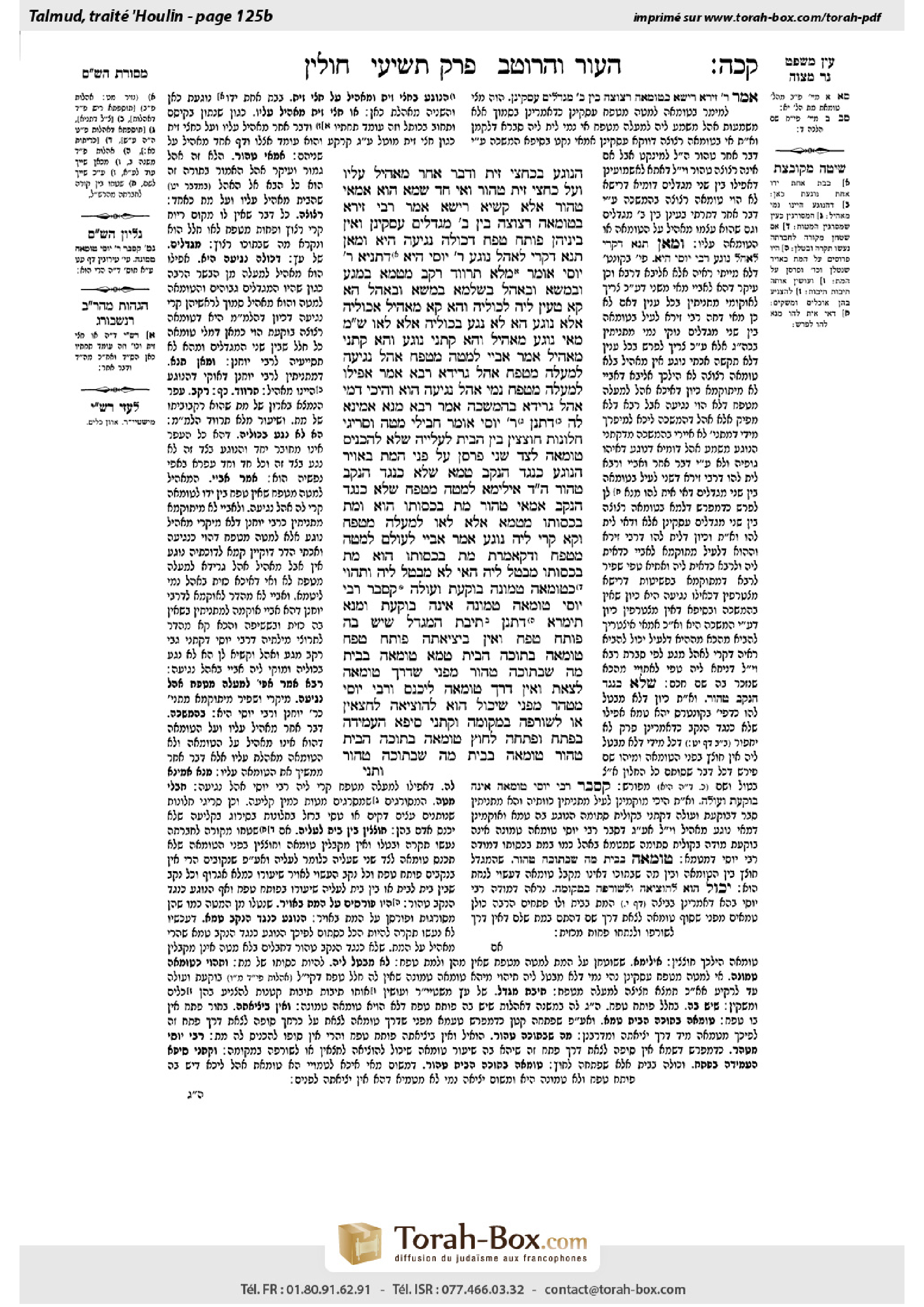
Chullin 125b: Talmud study for Daf Yomi
Study the Talmud for Daf Yomi with scanned pages, Hebrew text, English translations from Sefaria and AI-generated French translations.
Passage selection and English or AI-generated French translation are available where the scan has annotations. Daf Study is independent of Torah-Box and Sefaria.
Browse Chullin · חולין · All tractatesChullin 125b text and translations
This page of Chullin includes the Aramaic text, an English translation and an AI-generated French translation, alongside the scan above.
חולין קכ״ה ב · Aramaic and Hebrew text
הַנּוֹגֵעַ בְּכַחֲצִי זַיִת, וְדָבָר אַחֵר מַאֲהִיל עָלָיו וְעַל כַּחֲצִי זַיִת – טָהוֹר.
וְאִי חַד שְׁמָא הוּא, אַמַּאי טָהוֹר? אֶלָּא, קַשְׁיָא רֵישָׁא.
אָמַר רַבִּי זֵירָא: בְּטוּמְאָה רְצוּצָה בֵּין שְׁנֵי מִגְדָּלִים עָסְקִינַן, וְאֵין בֵּינֵיהֶן פּוֹתֵחַ טֶפַח, דְּכוּלַּהּ נְגִיעָה הִיא.
וּמַאן תַּנָּא דְּקָרֵי לְאֹהֶל ״נוֹגֵעַ״? רַבִּי יוֹסֵי הִיא, דְּתַנְיָא: רַבִּי יוֹסֵי אוֹמֵר: מְלֹא תַרְוָוד רָקָב מְטַמֵּא בְּמַגָּע, וּבְמַשָּׂא, וּבְאֹהֶל.
בִּשְׁלָמָא בְּמַשָּׂא וּבְאֹהֶל, הָא קָא טָעֵין לֵיהּ לְכוּלֵּיהּ, וְהָא קָא מַאֲהֵיל אַכּוּלֵּיהּ. אֶלָּא נוֹגֵעַ – הָא לָא נָגַע בְּכוּלֵּיהּ! אֶלָּא לָאו שְׁמַע מִינַּהּ: מַאי ״נוֹגֵעַ״ – מַאֲהִיל.
וְהָא קָתָנֵי ״נוֹגֵעַ״, וְהָא קָתָנֵי ״מַאֲהִיל״! אָמַר אַבָּיֵי: לְמַטָּה מִטֶּפַח – אֹהֶל נְגִיעָה, לְמַעְלָה מִטֶּפַח – אֹהֶל גְּרֵידָא.
רָבָא אָמַר: אֲפִילּוּ לְמַעְלָה מִטֶּפַח נָמֵי אֹהֶל נְגִיעָה הוּא, וְהֵיכִי דָּמֵי אֹהֶל גְּרֵידָא? בְּהַמְשָׁכָה.
אָמַר רָבָא: מְנָא אָמֵינָא לַהּ? דִּתְנַן, רַבִּי יוֹסֵי אוֹמֵר: חֲבִילֵי מִטָּה וּסְרִיגֵי חַלּוֹנוֹת חוֹצְצִין בֵּין הַבַּיִת לַעֲלִיָּיה, שֶׁלֹּא לְהַכְנִיס טוּמְאָה לְצַד שֵׁנִי.
פְּרָסָן עַל פְּנֵי הַמֵּת בַּאֲוִיר, הַנּוֹגֵעַ כְּנֶגֶד הַנֶּקֶב – טָמֵא, שֶׁלֹּא כְּנֶגֶד הַנֶּקֶב – טָהוֹר.
הֵיכִי דָמֵי? אִילֵּימָא לְמַטָּה מִטֶּפַח, שֶׁלֹּא כְּנֶגֶד הַנֶּקֶב – אַמַּאי טָהוֹר? מֵת בִּכְסוּתוֹ הִיא, וּמֵת בִּכְסוּתוֹ מְטַמֵּא!
אֶלָּא לָאו לְמַעְלָה מִטֶּפַח, וְקָא קָרֵי לֵיהּ ״נוֹגֵעַ״.
אָמַר אַבָּיֵי: לְעוֹלָם לְמַטָּה מִטֶּפַח, וּדְקָאָמְרַתְּ: מֵת בִּכְסוּתוֹ הוּא – מֵת בִּכְסוּתוֹ מְבַטֵּל לֵיהּ, הַאי לָא מְבַטֵּל לֵיהּ.
וְתֶהֱוֵי כְּטוּמְאָה טְמוּנָה בּוֹקַעַת וְעוֹלָה? קָסָבַר רַבִּי יוֹסֵי: טוּמְאָה טְמוּנָה אֵינָהּ בּוֹקַעַת.
וּמְנָא תֵּימְרָא? דִּתְנַן: תֵּיבַת הַמִּגְדָּל שֶׁיֵּשׁ בָּהּ פּוֹתֵחַ טֶפַח וְאֵין בִּיצִיאָתָהּ פּוֹתֵחַ טֶפַח, טוּמְאָה בְּתוֹכָהּ – הַבַּיִת טָמֵא; טוּמְאָה בַּבַּיִת – מַה שֶּׁבְּתוֹכָהּ טָהוֹר.
מִפְּנֵי שֶׁדֶּרֶךְ טוּמְאָה לָצֵאת, וְאֵין דֶּרֶךְ טוּמְאָה לִיכָּנֵס.
וְרַבִּי יוֹסֵי מְטַהֵר, מִפְּנֵי שֶׁיָּכוֹל הוּא לְהוֹצִיאָהּ לַחֲצָאִין, אוֹ לְשׂוֹרְפָהּ בִּמְקוֹמָהּ.
וְקָתָנֵי סֵיפָא: הֶעֱמִידָהּ בַּפֶּתַח, וּפִתְחָהּ לַחוּץ – טוּמְאָה בְּתוֹכָהּ, הַבַּיִת טָהוֹר; טוּמְאָה בַּבַּיִת, מַה שֶּׁבְּתוֹכָהּ טָהוֹר.
Chullin 125b · English translation
in the case of one who touches half an olive-bulk of flesh from a corpse and simultaneously another item overlies both him and half an olive-bulk of flesh from a corpse, he remains pure.
But if impurity via contact and via a tent are considered one concept, why does he remain pure? Rather, based on the latter clause of the mishna, the first clause of the mishna is difficult, because it indicates that these two categories of impurity are considered one concept and join together to constitute the requisite measure for impurity.
Rabbi Zeira said: In the first clause of the mishna we are dealing with a case where the source of impurity is pressed between two wooden chests and there is no opening of one handbreadth in between the chests. When the hand of a person overlies the chests, the impurity of the pressed item rises beyond the chests and it transmits impurity to the person. Therefore, his interaction with all the sources of impurity is considered as though he is touching them simultaneously. Consequently, there is no proof in the mishna for the opinion of Rabbi Yoḥanan that imparting impurity via contact and via a tent are considered the same concept.
Therefore, the Gemara asks: Who is the tanna who refers to impurity imparted in a tent as one who touches [noge’a]? The Gemara answers: It is Rabbi Yosei, as it is taught in a baraita (Tosefta, Oholot 4:1): Rabbi Yosei says: A full ladle [tarvad] of dust from a corpse imparts impurity like the corpse itself in three ways: By contact [bemagga], and by carrying, and in a tent.
Granted, the dust of a corpse imparts impurity via carrying and in a tent; this one who carries it carries the entire amount of dust and that one who overlies the dust overlies all of it. But with regard to one who touches it, one does not touch all of the dust, and it should therefore be impossible for one to become impure via contact. Rather, isn’t it correct to conclude from this baraita: To what is the term noge’a referring? It is referring to one who overlies the dust.
The Gemara asks: How is it possible to explain the baraita in such a manner? But doesn’t Rabbi Yosei teach the case of one who touches separately, and doesn’t he teach the case of one who overlies separately? Therefore, the term noge’a cannot be referring to overlying. Abaye said: That is not difficult because there are two types of overlying. With regard to a tent that overlies impurity at a height of below one handbreadth, that tent is referred to as touching. But a tent that overlies impurity at a height of above one handbreadth is referred to as merely a tent.
Rava said: According to Rabbi Yosei, even a tent that overlies impurity at a height above one handbreadth is referred to as touching. And what are the circumstances of a tent that is referred to as merely a tent and not as touching? The term tent is referring to the case of a structure that overlies both a person and a source of impurity, thereby spreading the impurity from its source to the person.
Rava said: From where do I say my opinion? It is as we learned in a baraita (Tosefta, Oholot 9:4) that Rabbi Yosei says: With regard to bundles that serve as a bed and grilles taken from windows, if one placed them between the ground floor and the upper floor of the house such that they serve as a ceiling, since they have become part of the building they are not susceptible to impurity. Therefore, even if there are holes in the bundles and the grilles, they serve as a barrier between the house and the upper floor such that the impurity of a corpse present in the area of the house cannot enter the other side, i.e., the upper floor.
And if one spread out the bundles and grilles outside the house in an impermanent manner by hanging them over a corpse in the air like a net, one who touches, i.e., overlies the corpse, opposite a hole in the netting becomes impure. By contrast, one who overlies it not opposite a hole remains pure.
Rava explains his proof: What are the circumstances? If we say that he spread out the netting below the height of one handbreadth above the corpse, why does one who overlies the corpse not opposite a hole in the netting remain pure? In such a case, the netting is close enough to the corpse to be considered part of the clothing of the corpse. Therefore, the case is tantamount to one where the corpse is dressed in its clothing, and a corpse dressed in its clothing imparts impurity to one who overlies it because the clothing does not act as a barrier.
Rather, is it not the case that he spread out the netting more than one handbreadth above the corpse? And Rabbi Yosei refers to overlying the corpse as touching. Apparently, contrary to the opinion of Abaye, Rabbi Yosei refers to overlying as touching even when the overlying item is more than one handbreadth above the source of impurity.
Abaye rejected Rava’s proof and said: Actually, the case is one where one spread the netting out below the height of one handbreadth above the corpse. And with regard to that which you say: If so, one who overlies the corpse not opposite a hole in the netting should also become impure as it is tantamount to a case of a corpse dressed in its clothing, this case is not similar to the case of a corpse dressed in its clothing. In the case of a corpse dressed in its clothing the clothing does not act as a barrier to the impurity because the one who dressed the corpse nullified the clothing by rendering its status as though it is a part of the corpse. But in this case in the baraita, the one who spread out the netting over the corpse intended to remove the bundles and grilles afterward and he did not nullify them.
The Gemara objects with regard to Abaye’s explanation: But if the case is one where he spread out the netting less than one handbreadth above the corpse, even if it is not considered the clothing of the corpse, let it be considered like a source of impurity hidden underneath an overlying structure at a distance of less than one handbreadth. In such a case, the impurity breaks through and ascends, and therefore it should transmit impurity even to one who overlies it not opposite a hole in the netting. The Gemara explains: Rabbi Yosei holds that hidden impurity does not break through and ascend.
And from where do you say that this is the opinion of Rabbi Yosei? It is as we learned in a mishna (Oholot 4:2): In the case of a compartment in a chest that is inside a house, in which the open space of the compartment itself has at least one cubic handbreadth in volume, but the opening of the compartment to the house does not have the area of one square handbreadth, and the volume of the entire chest is forty se’a, in that case, if there is a source of impurity inside the compartment, the compartment does not act as a barrier and the house is impure. If the source of impurity is inside the house but outside the chest, whatever is inside the compartment remains pure, because the opening of the compartment is less than one handbreadth.
This differentiation exists because it is typical for a source of impurity to exit from its location, and therefore impurity can be transmitted out of the compartment and into the house. But it is not typical for a source of impurity to enter a location, and therefore an impure item that lies in the house does not transmit impurity into the compartment. Since the volume of the chest is forty se’a it constitutes a separate tent, and the compartment that is part of the chest is also considered part of this tent.
And Rabbi Yosei deems the house pure when the impure item is in the compartment. The item will not necessarily impart impurity outside of the compartment because one can remove the source of impurity from the compartment in halves, i.e., in pieces that each measure less than the requisite amount to impart impurity. Or, alternatively, one can burn the source of impurity while it still remains in its place inside the compartment.
And the latter clause of that mishna teaches: If one placed the chest in the entrance to the house and the opening of the compartment is facing out of the house, if there is a source of impurity inside the chest, the house remains pure because the impure item will typically exit the house. If there is a source of impurity in the house, whatever is inside the chest remains pure, because the source of impurity will not enter the chest.
Chullin 125b · Traduction française (IA)
dans le cas d'une personne qui touche la moitié d'une olivée de chair provenant d'un cadavre et qu'un autre objet recouvre à la fois cette personne et la moitié d'une olivée de chair provenant d'un cadavre, il demeure pur.
Mais si l'impureté par contact et par une tente sont considérées comme un seul concept, pourquoi demeure-t-il pur ? Plutôt, d'après la seconde partie de la mitsva, la première partie de la mitsva est difficile à comprendre, car elle indique que ces deux catégories d'impureté sont considérées comme un seul concept et s'unissent pour constituer la mesure nécessaire à l'impureté.
Rabbi Zéira a dit : Dans la première partie de la mitsva, nous sommes en présence d'un cas où la source d'impureté est pressée entre deux coffres en bois et où il n'y a pas d'ouverture d'un tefach entre les coffres. Lorsque la main d'une personne recouvre les coffres, l'impureté de l'objet pressé monte au-delà des coffres et transmet l'impureté à la personne. Ainsi, son interaction avec toutes les sources d'impureté est considérée comme s'il touchait simultanément ces sources. Par conséquent, il n'y a pas de preuve dans la mitsva pour l'opinion de Rabbi Yochanan selon laquelle l'impureté par contact et par une tente sont considérées comme un seul concept.
Ainsi, le Guemara pose la question : Qui est le tanna qui fait référence à l'impureté transmise dans une tente comme celui qui touche [noge’a] ? Le Guemara répond : C'est Rabbi Yosei, comme il est enseigné dans une baraïta (Tosefta, Oholot 4:1) : Rabbi Yosei dit : Une olivée de poussière provenant d'un cadavre transmet l'impureté comme le cadavre lui-même de trois manières : par contact [bemagga], par transport et dans une tente.
D'accord, la poussière d'un cadavre transmet l'impureté par transport et dans une tente ; celui qui transporte la poussière transporte toute la quantité de poussière et celui qui recouvre la poussière recouvre toute la quantité. Mais concernant celui qui touche la poussière, on ne touche pas toute la poussière, et il devrait donc être impossible de devenir impur par contact. Plutôt, n'est-ce pas correct de conclure à partir de cette baraïta : à quoi fait référence le terme noge’a ? Il fait référence à celui qui recouvre la poussière.
Le Guemara pose la question : Comment peut-on expliquer cette baraïta ainsi ? Mais ne dit-il pas Rabbi Yosei enseigner le cas de celui qui touche séparément et ne l'enseigne-t-il pas aussi le cas de celui qui recouvre séparément ? Par conséquent, le terme noge’a ne peut pas faire référence au recouvrement. Abaye a dit : Ce n'est pas difficile, car il existe deux types de recouvrement. Concernant une tente qui recouvre l'impureté à une hauteur inférieure à un tefach, cette tente est appelée contact. Mais une tente qui recouvre l'impureté à une hauteur supérieure à un tefach est appelée simplement une tente.
Rava a dit : Selon Rabbi Yosei, même une tente qui recouvre l'impureté à une hauteur supérieure à un tefach est appelée contact. Et quels sont les cas d'une tente qui est appelée simplement une tente et non pas contact ? Le terme tente fait référence au cas d'une structure qui recouvre à la fois une personne et une source d'impureté, et qui répand ainsi l'impureté de sa source vers la personne.
Rava a dit : D'où dis-je mon opinion ? C'est comme nous avons appris dans une baraïta (Tosefta, Oholot 9:4) que Rabbi Yosei dit : Concernant les ballots qui servent de lit et les grilles provenant des fenêtres, si l'on les place entre le rez-de-chaussée et l'étage supérieur de la maison de sorte qu'ils servent de toit, puisqu'ils sont devenus partie de la construction, ils ne sont pas sujets à l'impureté. Par conséquent, même s'il y a des trous dans les ballots et les grilles, ils servent de barrière entre la maison et l'étage supérieur de sorte que l'impureté d'un cadavre présent dans la zone de la maison ne puisse pas entrer de l'autre côté, c'est-à-dire l'étage supérieur.
Et si l'on étend les ballots et les grilles en dehors de la maison de manière temporaire en les suspendant au-dessus du cadavre dans l'air comme un filet, celui qui touche, c'est-à-dire qui recouvre le cadavre, opposé à un trou du filet devient impur. À l'inverse, celui qui recouvre le cadavre sans être opposé à un trou demeure pur.
Rava explique sa preuve : Quelles sont les circonstances ? Si l'on dit qu'il a étendu le filet en dessous de la hauteur d'un tefach au-dessus du cadavre, pourquoi celui qui recouvre le cadavre sans être opposé à un trou du filet demeure-t-il pur ? Dans ce cas, le filet est suffisamment proche du cadavre pour être considéré comme faisant partie de ses vêtements. Par conséquent, le cas est équivalent à celui où le cadavre est vêtu de ses vêtements, et un cadavre vêtu de ses vêtements transmet l'impureté à celui qui le recouvre, car les vêtements ne servent pas de barrière.
Plutôt, n'est-ce pas le cas qu'il a étendu le filet à une hauteur supérieure à un tefach au-dessus du cadavre ? Et Rabbi Yosei fait référence au recouvrement du cadavre comme au contact. Apparemment, contrairement à l'opinion d'Abaye, Rabbi Yosei fait référence au recouvrement comme au contact même lorsque l'objet de recouvrement est à une hauteur supérieure à un tefach de la source d'impureté.
Abaye a rejeté la preuve de Rava et a dit : En réalité, le cas est celui où l'on a étendu le filet en dessous de la hauteur d'un tefach au-dessus du cadavre. Et concernant ce que vous dites : Si tel est le cas, celui qui recouvre le cadavre sans être opposé à un trou du filet devrait aussi devenir impur, car c'est équivalent au cas d'un cadavre vêtu de ses vêtements, ce cas n'est pas comparable au cas d'un cadavre vêtu de ses vêtements. Dans le cas d'un cadavre vêtu de ses vêtements, les vêtements ne servent pas de barrière à l'impureté, car celui qui a vêtu le cadavre a annulé les vêtements en les rendant comme s'ils faisaient partie du cadavre. Mais dans ce cas de la baraïta, celui qui a étendu le filet sur le cadavre avait l'intention de retirer les ballots et les grilles plus tard et n'a pas annulé ces vêtements.
La Guemara s'oppose à l'explication d'Abaye : Mais si le cas est celui où l'on a étalé le tissu à moins d'une paume au-dessus du corps, même s'il n'est pas considéré comme les vêtements du corps, qu'on le considère comme une source de souillure cachée sous une structure supérieure à moins d'une paume. Dans ce cas, la souillure pénètre et monte, et donc elle transmet la souillure même à celui qui le recouvre sans être opposé à un trou dans le tissu. La Guemara explique : Rabbi Yosei considère que la souillure cachée ne pénètre pas et ne monte pas.
Et d'où dis-tu que c'est l'opinion de Rabbi Yosei ? C'est comme nous avons appris dans une mitsva (Oholot 4:2) : Dans le cas d'une cloison dans une armoire qui est à l'intérieur d'une maison, dans laquelle l'espace ouvert de la cloison elle-même a au moins un cube de paume de volume, mais l'ouverture de la cloison vers la maison n'a pas la surface d'une paume carrée, et le volume de l'armoire entière est de quarante se'ot, dans ce cas, si une source de souillure est à l'intérieur de la cloison, la cloison ne sert pas de barrière et la maison est souillée. Si la source de souillure est à l'intérieur de la maison mais en dehors de l'armoire, tout ce qui est à l'intérieur de la cloison reste pur, car l'ouverture de la cloison est inférieure à une paume.
Cette différenciation existe car il est typique qu'une source de souillure sorte de son lieu, et donc la souillure peut être transmise hors de la cloison et dans la maison. Mais il n'est pas typique qu'une source de souillure entre dans un lieu, et donc un objet souillé qui est dans la maison ne transmet pas la souillure dans la cloison. Puisque le volume de l'armoire est de quarante se'ot, cela constitue une tente distincte, et la cloison qui est partie de l'armoire est également considérée comme partie de cette tente.
Et Rabbi Yosei considère la maison comme pure lorsque l'objet souillé est dans la cloison. L'objet ne transmettra pas nécessairement la souillure hors de la cloison car on peut retirer la source de souillure de la cloison par morceaux, c'est-à-dire en morceaux qui mesurent chacun moins que la quantité nécessaire pour transmettre la souillure. Ou, de manière alternative, on peut brûler la source de souillure tout en la laissant dans son lieu à l'intérieur de la cloison.
Et la dernière partie de cette mitsva enseigne : Si l'on a placé l'armoire à l'entrée de la maison et que l'ouverture de la cloison fait face à l'extérieur de la maison, si une source de souillure est à l'intérieur de l'armoire, la maison reste pure car l'objet souillé sortira généralement de la maison. Si une source de souillure est dans la maison, tout ce qui est à l'intérieur de l'armoire reste pur, car la source de souillure ne pénètrera pas dans l'armoire.
Traduction française générée par IA à partir de l’édition anglaise de Sefaria. Vérifie toujours un passage avec le texte source.
Text from Sefaria: William Davidson Edition - Vocalized Aramaic (unknown); William Davidson Edition - English (CC BY NC).