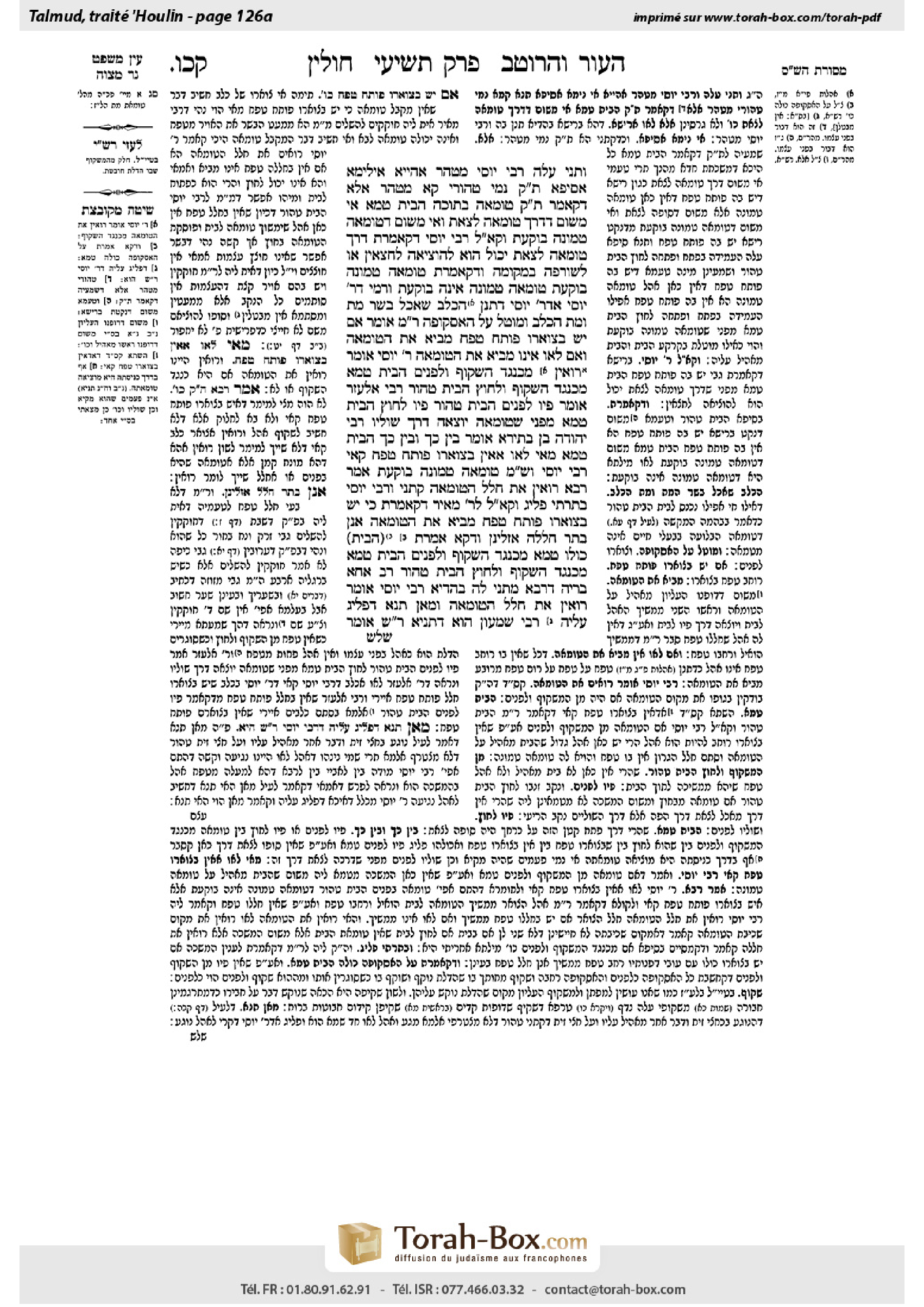
Chullin 126a: Talmud study for Daf Yomi
Study the Talmud for Daf Yomi with scanned pages, Hebrew text, English translations from Sefaria and AI-generated French translations.
Passage selection and English or AI-generated French translation are available where the scan has annotations. Daf Study is independent of Torah-Box and Sefaria.
Browse Chullin · חולין · All tractatesChullin 126a text and translations
This page of Chullin includes the Aramaic text, an English translation and an AI-generated French translation, alongside the scan above.
חולין קכ״ו א · Aramaic and Hebrew text
וְתָנֵי עֲלַהּ: רַבִּי יוֹסֵי מְטַהֵר. אַהֵיָיא? אִילֵּימָא אַסֵּיפָא – תַּנָּא קַמָּא נָמֵי טַהוֹרֵי קָא מְטַהַר!
אֶלָּא, דְּקָאָמַר תַּנָּא קַמָּא: טוּמְאָה בְּתוֹכָהּ – הַבַּיִת טָמֵא, אִי מִשּׁוּם דְּדֶרֶךְ טוּמְאָה לָצֵאת, וְאִי מִשּׁוּם דְּטוּמְאָה טְמוּנָה בּוֹקַעַת. וְקָאָמַר לֵיהּ רַבִּי יוֹסֵי: וּדְקָאָמְרַתְּ דֶּרֶךְ טוּמְאָה לָצֵאת – יָכוֹל הוּא לְהוֹצִיאָהּ לַחֲצָאִין אוֹ לְשׂוֹרְפָהּ בִּמְקוֹמָהּ, וּדְקָאָמְרַתְּ טוּמְאָה טְמוּנָה בּוֹקַעַת – טוּמְאָה טְמוּנָה אֵינָהּ בּוֹקַעַת.
וְרָמֵי דְּרַבִּי יוֹסֵי אַדְּרַבִּי יוֹסֵי.
דִּתְנַן: הַכֶּלֶב שֶׁאָכַל בָּשָׂר מֵת, וּמֵת הַכֶּלֶב, וּמוּטָּל עַל הָאִסְקוּפָּה – רַבִּי מֵאִיר אוֹמֵר: אִם יֵשׁ בְּצַוָּארוֹ פּוֹתֵחַ טֶפַח – מֵבִיא אֶת הַטּוּמְאָה, וְאִם לָאו – אֵינוֹ מֵבִיא אֶת הַטּוּמְאָה.
רַבִּי יוֹסֵי אוֹמֵר: רוֹאִין מִכְּנֶגֶד הַשָּׁקוֹף וְלִפְנִים – הַבַּיִת טָמֵא, מִכְּנֶגֶד הַשְּׁקוֹף וְלַחוּץ – הַבַּיִת טָהוֹר.
רַבִּי אֶלְעָזָר אוֹמֵר: פִּיו לִפְנִים הַבַּיִת – טָהוֹר, פִּיו לַחוּץ הַבַּיִת – טָמֵא, מִפְּנֵי שֶׁטּוּמְאָה יוֹצְאָה דֶּרֶךְ שׁוּלָיו.
רַבִּי יְהוּדָה בֶּן בְּתִירָא אוֹמֵר: בֵּין כָּךְ וּבֵין כָּךְ, הַבַּיִת טָמֵא.
מַאי לָאו, אַאֵין בְּצַוָּארוֹ פּוֹתֵחַ טֶפַח קָאֵי רַבִּי יוֹסֵי?
וּשְׁמַע מִינַּהּ: טוּמְאָה טְמוּנָה בּוֹקַעַת!
אָמַר רָבָא: רוֹאִין אֶת חֲלַל הַטּוּמְאָה קָתָנֵי, וְרַבִּי יוֹסֵי בְּתַרְתֵּי פְּלִיג, וְקָאָמַר לֵיהּ לְרַבִּי מֵאִיר: דְּקָאָמְרַתְּ כִּי יֵשׁ בְּצַוָּארוֹ פּוֹתֵחַ טֶפַח מֵבִיא אֶת הַטּוּמְאָה – אֲנַן בָּתַר חֲלָלַהּ אָזְלִינַן.
וּדְקָא אָמְרַתְּ הַבַּיִת כּוּלּוֹ טָמֵא – מִכְּנֶגֶד הַשְּׁקוֹף וְלִפְנִים הַבַּיִת טָמֵא, מִכְּנֶגֶד הַשְּׁקוֹף וְלַחוּץ הַבַּיִת טָהוֹר.
רַב אַחָא בְּרֵיהּ דְּרָבָא מַתְנֵי לַהּ בְּהֶדְיָא: רַבִּי יוֹסֵי אוֹמֵר: רוֹאִין אֶת חֲלַל הַטּוּמְאָה.
וּמַאן תַּנָּא דִּפְלִיג עֲלֵיהּ? רַבִּי שִׁמְעוֹן הוּא, דְּתַנְיָא: רַבִּי שִׁמְעוֹן אוֹמֵר:
Chullin 126a · English translation
And it is taught with regard to that halakha in the mishna that Rabbi Yosei deems it pure. To which halakha in the mishna is this referring? If we say that it is referring to the latter clause of the mishna, which discusses a chest placed in the entrance of the house, the first tanna also deems it pure in that case.
Rather, it is clear that the first tanna says that if a source of impurity is inside the compartment of a chest that is inside the house, the house is impure, either because it is typical for a source of impurity to exit its location, or because he holds that a hidden source of impurity breaks through and ascends. And Rabbi Yosei disagrees and says to him: With regard to that which you say that it is typical for a source of impurity to exit its location, it is not necessarily so. One can remove the impure item in halves or burn it in its place inside the compartment. And with regard to that which you say that a hidden source of impurity breaks through and ascends, a hidden source of impurity does not break through. Consequently, Rabbi Yosei must hold that a hidden source of impurity does not break through and ascend.
§Based on the previous statement of Rabbi Yosei, the Gemara established that Rabbi Yosei holds that a hidden source of impurity does not break through and ascend. And the Gemara raises a contradiction between that previous statement of Rabbi Yosei and another statement of Rabbi Yosei.
As we learned in a mishna (Oholot 11:7): In the case of a dog that ate the flesh of a corpse, and the dog then died and is lying on the threshold in such a manner that its neck and mouth are facing toward the inside of the house, Rabbi Meir says: If there is an opening the size of one cubic handbreadth inside the neck of the dog, i.e., the neck itself constitutes this measure, the dog imports impurity into the house because the upper portion of the dog’s body overlies the impure item inside the dog and the impurity is transmitted through the neck and mouth of the dog into the house. But if there is not such a large cavity in the neck of the dog, then there is no halakha of a tent, and the dog does not import the impurity into the house.
Rabbi Yosei says: One looks to determine exactly where on the threshold the dog is located. If the impure item inside the dog is located anywhere from opposite, i.e., under, the lintel and toward the inside of the house, the house is impure. If the dog is located anywhere from opposite the lintel and toward the outside of the house, the house remains pure.
Rabbi Elazar says: One must determine the exact manner in which the dog is lying on the threshold. If its mouth is located inside the house, but its rear is located outside the house, the house remains pure. If its mouth is located outside the house but its rear is located inside the house, the house is impure. This is because the source of impurity exits the dog’s body through its edge, i.e., its rear.
Rabbi Yehuda ben Beteira says: In both this case and that case, i.e., whether the dog is lying such that its mouth is inside the house or outside the house, the house is impure. The reason is that the impure item can exit through either the mouth or the rear.
The Gemara analyzes the statement of Rabbi Yosei that if the dog is located anywhere from under the lintel and toward the inside of the house, the house is impure. What, is the statement of Rabbi Yosei not referring to a case where there is not an opening the size of one cubic handbreadth inside the dog’s neck, with regard to which Rabbi Meir says that the house remains pure? Accordingly, Rabbi Yosei is responding to Rabbi Meir and saying: Even if the neck of the dog is not the size of one cubic handbreadth, as long as the impure item inside the dog is located from under the lintel and toward the house, the house is impure because it overlies the impure item.
And therefore learn from it that Rabbi Yosei holds that a hidden source of impurity breaks through and ascends, contrary to Rabbi Yosei’s opinion as understood from his previous statement.
Rava said: Rabbi Yosei holds that a hidden source of impurity does not break through and ascend. As for that which Rabbi Yosei teaches: One looks whether the impure item inside the dog is located opposite the lintel and toward the inside of the house, Rabbi Yosei actually teaches: One looks at the empty space adjacent to the source of impurity. And Rabbi Yosei disagrees with Rabbi Meir with regard to two matters, and says to Rabbi Meir: As for that which you say that if there is the width of one cubic handbreadth in the neck of the dog, it imports the impurity into the house, that is not so. Rather, we follow the measure of the empty space, i.e., the neck of the dog imports impurity into the house only if it contains a cubic handbreadth of space in addition to the thickness of the flesh of the neck itself.
And with regard to that which you say that even if the dog is located on the outer portion of the threshold of the house, the entire house is impure, that is not so. Rather, if the impurity inside the dog is located anywhere from opposite the lintel and toward the inside of the house, the house is impure. If the impurity inside the dog is located anywhere from opposite the lintel and toward the outside of the house, the house remains pure.
Rav Aḥa, son of Rava, teaches that Rava’s explanation is explicit in the mishna itself, as follows: Rabbi Yosei says: One looks at the empty space adjacent to the source of impurity.
§Previously the Gemara established that Rabbi Yosei holds that with regard to the halakhot of impurity, overlying is referred to as touching, as the transmission of impurity via contact and via overlying are considered one category. But the mishna (Oholot 3:1) cited earlier (125b) states that in the case of one who touches half an olive-bulk of flesh of a corpse, if a tent simultaneously overlies him and another half an olive-bulk of flesh he remains pure. Evidently, there is a tanna who disagrees with Rabbi Yosei and holds that these two methods of transmitting impurity are not the same category. The Gemara asks: Who is the tanna who disagrees with Rabbi Yosei? The Gemara answers: It is Rabbi Shimon, as it is taught in a baraita: Rabbi Shimon says:
Chullin 126a · Traduction française (IA)
Et il est enseigné concernant cette halakha de la Michna que Rabbi Yosei considère comme pure. À quelle halakha de la Michna cette affirmation se réfère-t-elle ? Si nous disons qu'il s'agit de la seconde partie de la Michna, qui discute d'un coffre placé à l'entrée de la maison, le premier tanna considère également cette situation comme pure.
Au contraire, il est clair que le premier tanna affirme que si une source d'impureté est à l'intérieur du compartiment d'un coffre placé à l'intérieur de la maison, la maison est impure, soit parce que c'est typique pour une source d'impureté de sortir de son emplacement, soit parce qu'il considère qu'une source d'impureté cachée pénètre et monte. Rabbi Yosei désaccorde avec lui et dit : Concernant ce que vous dites que c'est typique pour une source d'impureté de sortir de son emplacement, ce n'est pas nécessairement le cas. On peut retirer l'objet impur par morceaux ou le brûler à l'endroit où il se trouve à l'intérieur du compartiment. Et concernant ce que vous dites qu'une source d'impureté cachée pénètre et monte, une source d'impureté cachée ne pénètre pas. Ainsi, Rabbi Yosei doit considérer qu'une source d'impureté cachée ne pénètre pas et ne monte pas.
§En se basant sur l'affirmation précédente de Rabbi Yosei, la Guemara établit que Rabbi Yosei considère qu'une source d'impureté cachée ne pénètre pas et ne monte pas. Et la Guemara soulève une contradiction entre cette affirmation précédente de Rabbi Yosei et une autre affirmation de Rabbi Yosei.
Comme nous l'avons appris dans une mishna (Oholot 11:7) : Dans le cas d'un chien qui a mangé la chair d'un cadavre, et que ce chien est ensuite mort et gît sur le seuil de telle sorte que sa tête et sa bouche sont orientées vers l'intérieur de la maison, Rabbi Meir dit : Si une ouverture de la taille d'un cube de mainbreadth existe à l'intérieur du cou du chien, c'est-à-dire que le cou lui-même constitue cette mesure, le chien transmet l'impureté à la maison car la partie supérieure du corps du chien recouvre l'objet impur à l'intérieur du chien et l'impureté est transmise par le cou et la bouche du chien vers la maison. Mais si une telle cavité n'existe pas dans le cou du chien, alors il n'y a pas de halakha de tente, et le chien ne transmet pas l'impureté à la maison.
Rabbi Yosei dit : On examine exactement l'emplacement du chien sur le seuil. Si l'objet impur à l'intérieur du chien est situé n'importe où de l'autre côté du linteau et vers l'intérieur de la maison, la maison est impure. Si le chien est situé n'importe où de l'autre côté du linteau et vers l'extérieur de la maison, la maison reste pure.
Rabbi Elazar dit : On doit déterminer la manière exacte dont le chien gît sur le seuil. Si sa bouche est située à l'intérieur de la maison, mais son arrière est situé à l'extérieur de la maison, la maison reste pure. Si sa bouche est située à l'extérieur de la maison mais son arrière est situé à l'intérieur de la maison, la maison est impure. Cela est dû au fait que la source d'impureté sort du corps du chien par son bord, c'est-à-dire son arrière.
Rabbi Yehuda ben Beteira dit : Dans les deux cas, c'est-à-dire que le chien est allongé de telle sorte que sa bouche est à l'intérieur ou à l'extérieur de la maison, la maison est impure. La raison est que l'objet impur peut sortir par la bouche ou par l'arrière.
La Guemara analyse l'affirmation de Rabbi Yosei selon laquelle si le chien est situé n'importe où sous le linteau et vers l'intérieur de la maison, la maison est impure. Qu'est-ce que l'affirmation de Rabbi Yosei ne se réfère pas à un cas où il n'y a pas une ouverture de la taille d'un cube de mainbreadth à l'intérieur du cou du chien, concernant lequel Rabbi Meir dit que la maison reste pure ? Ainsi, Rabbi Yosei répond à Rabbi Meir et dit : Même si le cou du chien n'est pas de la taille d'un cube de mainbreadth, tant que l'objet impur à l'intérieur du chien est situé sous le linteau et vers la maison, la maison est impure car il recouvre l'objet impur.
Et donc, on en déduit que Rabbi Yosei considère qu'une source d'impureté cachée pénètre et monte, contrairement à l'opinion de Rabbi Yosei telle que comprendue à partir de son affirmation précédente.
Rava dit : Rabbi Yosei considère qu'une source d'impureté cachée ne pénètre pas et ne monte pas. En ce qui concerne ce que Rabbi Yosei enseigne : On examine si l'objet impur à l'intérieur du chien est situé opposé au linteau et vers l'intérieur de la maison, Rabbi Yosei enseigne en réalité : On examine l'espace vide adjacent à la source d'impureté. Et Rabbi Yosei désaccorde avec Rabbi Meir concernant deux points, et dit à Rabbi Meir : En ce qui concerne ce que vous dites que si la largeur d'un cube de mainbreadth est dans le cou du chien, cela transmet l'impureté à la maison, ce n'est pas ainsi. Plutôt, on suit la mesure de l'espace vide, c'est-à-dire que le cou du chien transmet l'impureté à la maison seulement s'il contient un cube de mainbreadth d'espace en plus de l'épaisseur de la chair du cou lui-même.
Et concernant ce que vous dites que même si le chien est situé sur la partie externe du seuil de la maison, toute la maison est impure, ce n'est pas ainsi. Plutôt, si l'impureté à l'intérieur du chien est située n'importe où opposé au linteau et vers l'intérieur de la maison, la maison est impure. Si l'impureté à l'intérieur du chien est située n'importe où opposé au linteau et vers l'extérieur de la maison, la maison reste pure.
Rav Aḥa, fils de Rava, enseigne que l'explication de Rava est explicite dans la Michna elle-même, comme suit : Rabbi Yosei dit : On examine l'espace vide adjacent à la source d'impureté.
§Le Guemara a établi précédemment que Rabbi Yosei considère que, concernant les halakhot de l'impureté, l'overlaying est considéré comme le toucher, car la transmission de l'impureté par le contact et par l'overlaying sont considérés comme une même catégorie. Cependant, la mitsna (Oholot 3:1) citée plus tôt (125b) stipule que dans le cas d'une personne qui touche une quantité d'ongle égale à demi-olive de viande d'un cadavre, si un tente l'overlaye en même temps et qu'une autre quantité d'ongle égale à demi-olive de viande l'atteint, il demeure pur. Il est évident qu'il existe un tanna qui s'oppose à Rabbi Yosei et qui considère que ces deux méthodes de transmission de l'impureté ne sont pas de la même catégorie. Le Guemara pose la question : Qui est ce tanna qui s'oppose à Rabbi Yosei ? Le Guemara répond : C'est Rabbi Shimon, car il est enseigné dans une baraïta : Rabbi Shimon dit :
Traduction française générée par IA à partir de l’édition anglaise de Sefaria. Vérifie toujours un passage avec le texte source.
Text from Sefaria: William Davidson Edition - Vocalized Aramaic (unknown); William Davidson Edition - English (CC BY NC).