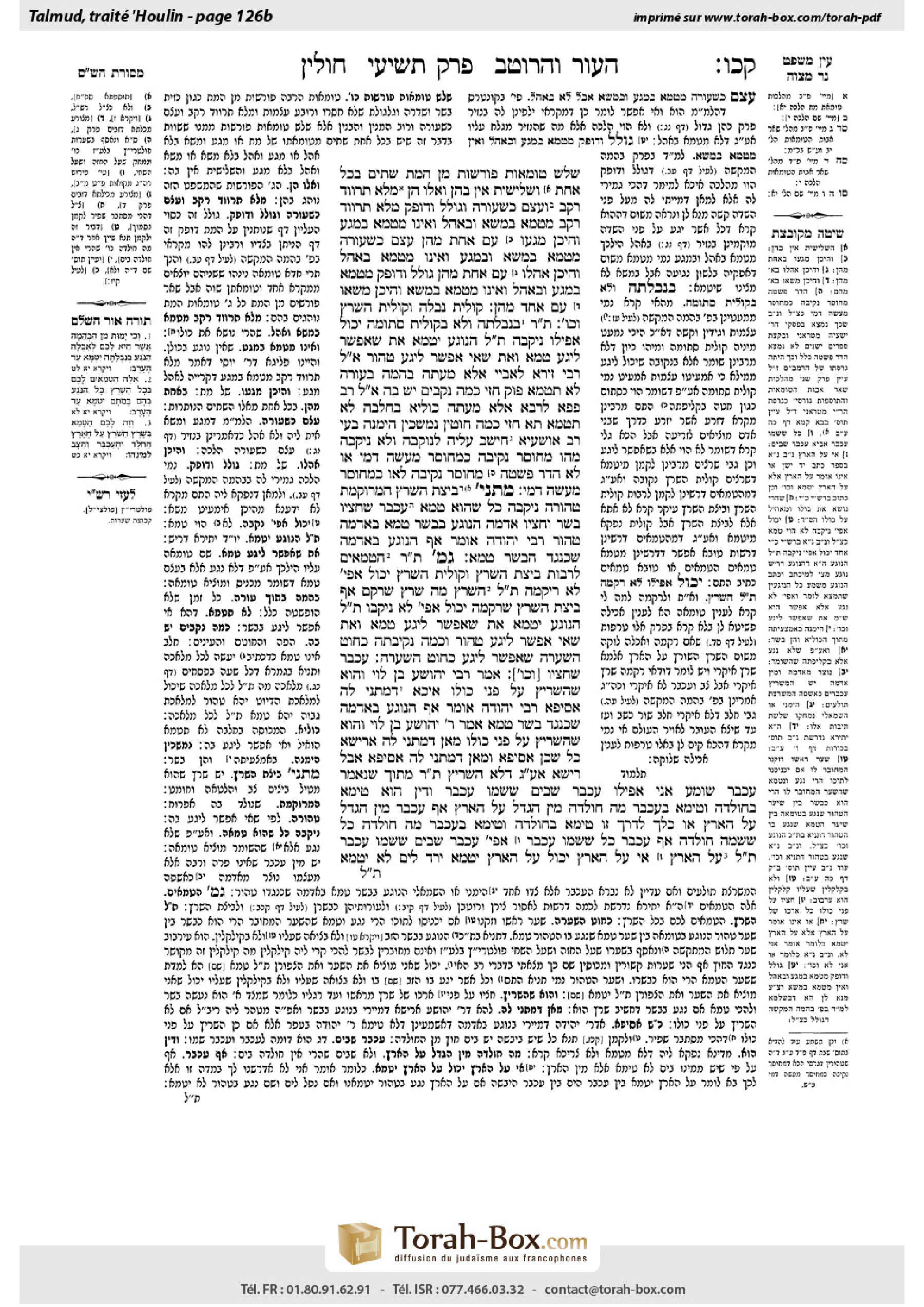
Chullin 126b: Talmud study for Daf Yomi
Study the Talmud for Daf Yomi with scanned pages, Hebrew text, English translations from Sefaria and AI-generated French translations.
Passage selection and English or AI-generated French translation are available where the scan has annotations. Daf Study is independent of Torah-Box and Sefaria.
Browse Chullin · חולין · All tractatesChullin 126b text and translations
This page of Chullin includes the Aramaic text, an English translation and an AI-generated French translation, alongside the scan above.
חולין קכ״ו ב · Aramaic and Hebrew text
שָׁלֹשׁ טוּמְאוֹת פּוֹרְשׁוֹת מִן הַמֵּת, שְׁתַּיִם בְּכׇל אַחַת וּשְׁלִישִׁית אֵין בָּהֶן, וְאֵלּוּ הֵן: מְלֹא תַרְוָוד רָקָב, וְעֶצֶם כִּשְׂעוֹרָה, וְגוֹלֵל וְדוֹפֵק.
מְלֹא תַרְוָוד רָקָב – מְטַמֵּא בְּמַשָּׂא וּבְאֹהֶל, וְאֵינוֹ מְטַמֵּא בְּמַגָּע, וְהֵיכָן מַגָּעוֹ? עִם אַחַת מֵהֶן.
עֶצֶם כִּשְׂעוֹרָה – מְטַמֵּא בְּמַשָּׂא וּבְמַגָּע, וְאֵינוֹ מְטַמֵּא בְּאֹהֶל, וְהֵיכָן אׇהֳלוֹ? עִם אַחַת מֵהֶן.
הַגּוֹלֵל וְדוֹפֵק – מְטַמֵּא בְּמַגָּע וּבְאֹהֶל, וְאֵינוֹ מְטַמֵּא בְּמַשָּׂא, וְהֵיכָן מַשָּׂאוֹ? עִם אֶחָד מֵהֶן.
קוּלִית נְבֵלָה וְקוּלִית הַשֶּׁרֶץ וְכוּ׳. תָּנוּ רַבָּנַן: ״בְּנִבְלָתָהּ״ – וְלֹא בְּקוּלִית סְתוּמָה.
יָכוֹל אֲפִילּוּ נִיקְּבָה? תַּלְמוּד לוֹמַר ״הַנּוֹגֵעַ … יִטְמָא״, אֶת שֶׁאֶפְשָׁר לִיגַּע – טָמֵא, וְאֶת שֶׁאִי אֶפְשָׁר לִיגַּע – טָהוֹר.
אֲמַר לֵיהּ רַבִּי זֵירָא לְאַבָּיֵי: אֶלָּא מֵעַתָּה, בְּהֵמָה בְּעוֹרָהּ לֹא תְּטַמֵּא? פּוֹק חֲזִי כַּמָּה נְקָבִים יֵשׁ בָּהּ!
אֲמַר לֵיהּ רַב פָּפָּא לְרָבָא: אֶלָּא מֵעַתָּה, כּוּלְיָא בְּחֶלְבָּהּ לֹא תְּטַמֵּא? תָּא חֲזִי כַּמָּה חוּטִין נִמְשָׁכִין הֵימֶנָּה.
בָּעֵי רַב אוֹשַׁעְיָא: חִישֵּׁב עָלֶיהָ לְנוֹקְבָהּ וְלֹא נִיקְּבָה, מַהוּ? מְחוּסַּר נְקִיבָה כִּמְחוּסַּר מַעֲשֶׂה דָּמֵי, אוֹ לָא?
הֲדַר פַּשְׁטַהּ: מְחוּסַּר נְקִיבָה לָאו כִּמְחוּסַּר מַעֲשֶׂה דָּמֵי.
מַתְנִי׳ בֵּיצַת הַשֶּׁרֶץ הַמְרוּקֶּמֶת טְהוֹרָה, נִיקְּבָה כׇּל שֶׁהוּא – טָמֵא. עַכְבָּר שֶׁחֶצְיוֹ בָּשָׂר וְחֶצְיוֹ אֲדָמָה – הַנּוֹגֵעַ בַּבָּשָׂר טָמֵא, בָּאֲדָמָה טָהוֹר. רַבִּי יְהוּדָה אוֹמֵר: אַף הַנּוֹגֵעַ בָּאֲדָמָה שֶׁכְּנֶגֶד הַבָּשָׂר טָמֵא.
גְּמָ׳ תָּנוּ רַבָּנַן: ״הַטְּמֵאִים״ – לְרַבּוֹת בֵּיצַת הַשֶּׁרֶץ וְקוּלִית הַשֶּׁרֶץ.
יָכוֹל אֲפִילּוּ לֹא רִיקְּמָה? תַּלְמוּד לוֹמַר ״הַשֶּׁרֶץ״ – מָה שֶׁרֶץ שֶׁרִקֵּם, אַף בֵּיצַת הַשֶּׁרֶץ שֶׁרִקְּמָה.
יָכוֹל אֲפִילּוּ לֹא נִיקְּבוּ? תַּלְמוּד לוֹמַר ״הַנּוֹגֵעַ … יִטְמָא״, אֶת שֶׁאֶפְשָׁר לִיגַּע – טָמֵא, וְאֶת שֶׁאִי אֶפְשָׁר לִיגַּע – טָהוֹר.
וְכַמָּה נְקִיבָתָהּ? כְּחוּט הַשַּׂעֲרָה, שֶׁאֶפְשָׁר לִיגַּע כְּחוּט הַשַּׂעֲרָה.
עַכְבָּר שֶׁחֶצְיוֹ [וְכוּ׳]. אָמַר רַבִּי יְהוֹשֻׁעַ בֶּן לֵוִי: וְהוּא שֶׁהִשְׁרִיץ עַל פְּנֵי כּוּלּוֹ. אִיכָּא דְּמַתְנֵי לַהּ אַסֵּיפָא – רַבִּי יְהוּדָה אוֹמֵר: אַף הַנּוֹגֵעַ בָּאֲדָמָה שֶׁכְּנֶגֶד בָּשָׂר טָמֵא, אָמַר רַבִּי יְהוֹשֻׁעַ בֶּן לֵוִי: וְהוּא שֶׁהִשְׁרִיץ עַל פְּנֵי כּוּלּוֹ.
מַאן דְּמַתְנֵי לַהּ אַרֵישָׁא, כׇּל שֶׁכֵּן אַסֵּיפָא, וּמַאן דְּמַתְנֵי לַהּ אַסֵּיפָא – אֲבָל רֵישָׁא, אַף עַל גַּב דְּלָא הִשְׁרִיץ.
תָּנוּ רַבָּנַן: מִתּוֹךְ שֶׁנֶּאֱמַר ״עַכְבָּר״, שׁוֹמֵעַ אֲנִי אֲפִילּוּ עַכְבָּר שֶׁבַּיָּם, שֶׁשְּׁמוֹ עַכְבָּר. וְדִין הוּא: טִימֵּא בְּחוּלְדָּה וְטִימֵּא בְּעַכְבָּר, מָה חוּלְדָּה מִין הַגָּדֵל עַל הָאָרֶץ, אַף עַכְבָּר מִין הַגָּדֵל עַל הָאָרֶץ.
אוֹ כְּלָךְ לְדֶרֶךְ זוֹ: טִימֵּא בְּחוּלְדָּה וְטִימֵּא בְּעַכְבָּר, מָה חוּלְדָּה כֹּל שֶׁשְּׁמָהּ ״חוּלְדָּה״, אַף עַכְבָּר כֹּל שֶׁשְּׁמוֹ ״עַכְבָּר״, אֲפִילּוּ עַכְבָּר שֶׁבַּיָּם שֶׁשְּׁמוֹ ״עַכְבָּר״. תַּלְמוּד לוֹמַר ״עַל הָאָרֶץ״.
אִי ״עַל הָאָרֶץ״, יָכוֹל עַל הָאָרֶץ – יְטַמֵּא, יָרַד לְיָם – לֹא יְטַמֵּא,
Chullin 126b · English translation
Parts of a corpse that impart impurity include an olive-bulk of flesh, a complete limb, the majority of a corpse’s bones, and the majority of the essential bones of its skeleton, namely, its legs, spine, and ribs. All of these impart impurity via contact, carrying, and in a tent. There are also three sources of impurity that derive from a corpse, each one of which imparts impurity in two ways but does not impart impurity in a third way. And they are the following: A full ladle of dust from a corpse, and a bone the size of a barley grain, and a grave cover [golel] and a grave wall [dofek] upon which the cover rests.
A full ladle of dust imparts impurity via carrying and in a tent, but it does not impart impurity via contact, as it is impossible for one to touch all of the particles of dust simultaneously. And where among these sources of impurity is the imparting of impurity via contact applicable? It is applicable with one of those other two sources of impurity, i.e., a bone the size of a barley grain and the cover or wall of a grave.
A bone the size of a barley grain imparts impurity via carrying and contact, but it does not impart impurity in a tent. This halakha was transmitted to Moses from Sinai. And where among these sources of impurity is impurity imparted in a tent? It is with one of those other two sources of impurity.
A grave cover and a grave wall impart impurity via contact and in a tent, but they do not impart impurity via carrying. This halakha too was transmitted to Moses from Sinai. And where among these sources of impurity is impurity transmitted via carrying? It is with one of those other two sources of impurity. It may be inferred from Rabbi Shimon’s statement that a full ladle of dust imparts impurity in a tent but not via contact that he disagrees with Rabbi Yosei and holds that overlying is not the same category as touching.
§The mishna teaches: With regard to the thigh bone of an unslaughtered carcass and the thigh bone of a creeping animal, one who touches them when they are sealed remains ritually pure, because the bone itself does not impart impurity. With regard to this topic, the Sages taught in a baraita: The verse states: “One who touches the carcass thereof shall be impure until the evening” (Leviticus 11:39). The word “carcass” indicates that one who touches the carcass is impure, but one who touches a sealed thigh bone is not.
One might have thought that even one who touches a perforated thigh bone remains pure. Therefore, the verse states: “One who touches the carcass thereof [benivlatah] shall be impure,” indicating that one who touches a part of the animal through which it is possible to touch the flesh, which has the halakhic status of an unslaughtered carcass [neveila], is impure, but one who touches a part of the animal through which it is impossible to touch the flesh remains pure. Therefore, one who touches a protective layer such as the outside of a sealed thigh bone does not become impure, as it is impossible to touch the marrow.
Rabbi Zeira said to Abaye: If that is so, that one who touches the protective layer of a carcass via which it is impossible to touch the flesh of the carcass itself does not become impure, an animal still in its hide should not impart impurity, as one can touch the hide, which constitutes a protective layer, but not the flesh. Abaye answered: Go out and see how many orifices there are in the body of an animal via which one can touch the flesh, e.g., the eyes, the nostrils, and the mouth.
Similarly, Rav Pappa said to Rava: If that is so, that one who touches the protective layer of a carcass via which it is impossible to touch the flesh of the carcass itself does not become impure, the kidney of a carcass that is completely covered in its fat should not impart impurity via contact. Rava answered: Come and see how many sinews emerge from the kidney that one is able to touch.
§The mishna taught that the halakha distinguishes between a sealed and a perforated thigh bone of a carcass or a creeping animal. With regard to this topic, Rav Oshaya raises a dilemma: What is the halakha if one intended to perforate the thigh bone but did not yet perforate it? This is the dilemma: Is a thigh bone lacking perforation considered to be lacking the necessary action for it to impart impurity, and it therefore retains its status as a sealed thigh bone, or not?
Rabbi Oshaya then resolves the dilemma: A thigh bone lacking perforation is not considered to be lacking the necessary action for it to impart impurity. If one intends to perforate it, it imparts impurity immediately.
MISHNA: The egg of a creeping animal in which tissue of an embryo developed and one who comes into contact with the egg are ritually pure, as the impure creeping animal is hermetically sealed. But if one perforated the egg with a hole of any size, one who comes in contact with the egg is ritually impure. In the case of a mouse that grows from the ground and is half-flesh half-earth, one who touches the half that is flesh is impure; one who touches the half that is earth is pure. Rabbi Yehuda says: Even one who touches the half that is earth where it is adjacent to the flesh is ritually impure.
GEMARA: The mishna states that in the case of an egg of a creeping animal in which tissue of an embryo developed, if it is perforated then one who touches it is ritually impure. With regard to this matter the Sages taught in a baraita: The verse states: “These are the impure ones to you among all that creep; whoever touches them when they are dead shall be impure until the evening” (Leviticus 11:31). The term “the impure ones” is interpreted as including the egg of a creeping animal and the thigh bone of a creeping animal in the category of sources of impurity.
One might have thought that even an egg in which tissue of an embryo has not developed imparts impurity. Therefore, the verse states: “That creep,” indicating that just as a creeping animal has developed tissue, so too only the egg of a creeping animal in which tissue of an embryo has developed imparts impurity.
One might have thought that in the case of an egg in which tissue of an embryo has developed, it imparts impurity even if it was not perforated. Therefore, the verse states: “Whoever touches them when they are dead shall be impure,” indicating that when it is possible to touch the flesh, contact renders one impure; but when it is impossible to touch the flesh, one remains pure.
And how large must its perforation be to render one touching the egg or thigh bone impure? Its width must be the size of a strand of hair, as it is possible for one to touch the inside of an egg or thigh bone with a strand of his hair.
§The mishna teaches: In the case of a mouse that grows from the ground and is half-flesh half-earth, one who touches the half that is flesh is impure. Rabbi Yehoshua ben Levi says in this regard: One becomes impure in such a case only if the flesh of the mouse has developed along the entire length of the mouse, from head to foot. Some teach the statement of Rabbi Yehoshua ben Levi with regard to the latter clause of the mishna: Rabbi Yehuda says: Even one who touches the half that is earth where it is adjacent to the flesh is ritually impure. Rabbi Yehoshua ben Levi says: One becomes impure in such a case only if the flesh of the mouse has developed along the entire length of the mouse.
The one who teaches the statement of Rabbi Yehoshua ben Levi with regard to the first clause of the mishna, all the more so he teaches this same halakha with regard to the latter clause of the mishna. But the one who teaches the statement of Rabbi Yehoshua ben Levi with regard to the latter clause of the mishna holds that it applies only to that clause, with regard to one who touches the half that is earth where it is adjacent to the flesh according to Rabbi Yehuda. But according to the opinion of the first tanna, stated in the first clause of the mishna, even if the flesh of the mouse has not developed along the entire length of the mouse, one who touches the half of the mouse that is flesh is impure.
§The Sages taught in a baraita concerning the following verse: “And these are they which are impure to you among the creeping animals that creep upon the earth: The weasel, and the mouse, and the great lizard after its kinds” (Leviticus 11:29). Since “mouse” is stated among the creeping animals that impart impurity, I would derive that even a sea mouse, i.e., a sea creature that has an appearance similar to a mouse, imparts impurity because its name is also mouse. But ostensibly, the opposite conclusion could be derived through logical inference: The verse deems a weasel impure and deems a mouse impure. Therefore, just as a weasel is a species that grows on land, so too the mouse to which the verse is referring is a species that grows on land; a sea mouse does not impart impurity.
Or, perhaps go this way: The verse deems a weasel impure and deems a mouse impure; accordingly, just as “weasel” is referring to any animal whose name is weasel, so too, “mouse” is referring to any animal whose name is mouse, even a sea mouse, as its name is also mouse. Therefore, the verse states: “Upon the earth,” indicating that a land mouse imparts impurity, but a sea mouse does not.
If this halakha is derived only from the phrase “upon the earth,” one might have thought that the verse means that any mouse, whether a land mouse or a sea mouse, imparts impurity when it is upon the earth, but if it descended to the sea it does not impart impurity.
Chullin 126b · Traduction française (IA)
Les parties du corps qui transmettent l'impureté incluent une quantité d'chair égale à une olive, un membre complet, la majorité des os du corps, et la majorité des os essentiels de son squelette, à savoir ses jambes, sa colonne vertébrale et ses côtes. Toutes ces parties transmettent l'impureté par contact, par transport et dans une tente. Il existe également trois sources d'impureté provenant du corps, chacune transmettant l'impureté de deux manières mais pas la troisième. Elles sont les suivantes : une quantité d'argile égale à une cuillère pleine provenant d'un corps, un os de la taille d'une graine de blé, et une couverture de sépulture [golel] et un mur de sépulture [dofek] sur lequel repose la couverture.
Une quantité d'argile égale à une cuillère pleine transmet l'impureté par transport et dans une tente, mais pas par contact, car il est impossible de toucher simultanément toutes les particules d'argile. Et parmi ces sources d'impureté, dans quel cas la transmission d'impureté par contact s'applique ? C'est avec l'une des deux autres sources d'impureté, à savoir un os de la taille d'une graine de blé et la couverture ou le mur d'une sépulture.
Un os de la taille d'une graine de blé transmet l'impureté par transport et par contact, mais pas dans une tente. Cette halakha a été transmise à Moïse depuis le Sinaï. Et parmi ces sources d'impureté, dans quel cas l'impureté est-elle transmise dans une tente ? C'est avec l'une des deux autres sources d'impureté.
Une couverture de sépulture et un mur de sépulture transmettent l'impureté par contact et dans une tente, mais pas par transport. Cette halakha a également été transmise à Moïse depuis le Sinaï. Et parmi ces sources d'impureté, dans quel cas l'impureté est-elle transmise par transport ? C'est avec l'une des deux autres sources d'impureté. On peut en déduire, à partir de la déclaration du Rabbi Shimon selon laquelle une quantité d'argile égale à une cuillère pleine transmet l'impureté dans une tente mais pas par contact, qu'il conteste l'opinion du Rabbi Yosei et considère que l'overlay n'appartient pas à la même catégorie que le toucher.
§La mitsva enseigne : En ce qui concerne l'os du cuisse d'un cadavre non sacrifié et l'os du cuisse d'un animal rampant, celui qui les touche lorsqu'ils sont scellés reste rituellement pur, car l'os lui-même ne transmet pas l'impureté. En ce qui concerne ce sujet, les Sages ont enseigné dans une baraïta : L'Écriture dit : « Celui qui touche le cadavre sera impur jusqu'au soir » (Lévitique 11:39). Le mot « cadavre » indique que celui qui touche le cadavre est impur, mais celui qui touche un os du cuisse scellé n'est pas impur.
On aurait pu penser que même celui qui touche un os du cuisse percé reste pur. C'est pourquoi l'Écriture dit : « Celui qui touche le cadavre [benivlatah] sera impur », indiquant que celui qui touche une partie de l'animal par laquelle il est possible de toucher la chair, qui a le statut halakhique de cadavre non sacrifié [neveila], est impur, mais celui qui touche une partie de l'animal par laquelle il est impossible de toucher la chair reste pur. C'est pourquoi celui qui touche une couche protectrice, comme l'extérieur d'un os du cuisse scellé, ne devient pas impur, car il est impossible de toucher la moelle.
Rabbi Zeira dit à Abaye : Si c'est ainsi, celui qui touche la couche protectrice d'un cadavre par laquelle il est impossible de toucher la chair du cadavre lui-même ne devient pas impur, un animal encore dans sa peau ne devrait pas transmettre l'impureté, car l'on peut toucher la peau, qui constitue une couche protectrice, mais pas la chair. Abaye répondit : Sortez et voyez combien d'orifices il y a dans le corps d'un animal par lesquels l'on peut toucher la chair, par exemple les yeux, les narines et la bouche.
De même, Rav Pappa dit à Rava : Si c'est ainsi, celui qui touche la couche protectrice d'un cadavre par laquelle il est impossible de toucher la chair du cadavre lui-même ne devient pas impur, le rein d'un cadavre complètement recouvert de sa graisse ne devrait pas transmettre l'impureté par contact. Rava répondit : Venez et voyez combien de nerfs émergent du rein que l'on peut toucher.
§La mitsva enseigne que la halakha distingue entre un os du cuisse scellé et un os du cuisse percé d'un cadavre ou d'un animal rampant. En ce qui concerne ce sujet, Rav Oshaya soulève un dilemme : Quelle est la halakha si l'on a l'intention de percer l'os du cuisse mais qu'on n'a pas encore perçé l'os ? C'est le dilemme : L'os du cuisse manquant de perçage est-il considéré comme manquant de l'action nécessaire pour transmettre l'impureté, et il conserve donc son statut d'os du cuisse scellé, ou non ?
Rabbi Oshaya résout alors ce dilemme : L'os du cuisse manquant de perçage n'est pas considéré comme manquant de l'action nécessaire pour transmettre l'impureté. Si l'on a l'intention de le percer, il transmet l'impureté immédiatement.
MICHNA : L'œuf d'un animal rampant dans lequel un tissu d'un embryon s'est développé, et celui qui entre en contact avec l'œuf est rituellement pur, car l'animal rampant impur est hermétiquement scellé. Mais si l'œuf est percé d'un trou de toute taille, celui qui entre en contact avec l'œuf est rituellement impur. En ce qui concerne un rat qui pousse du sol et est à moitié chair à moitié terre, celui qui touche la moitié qui est chair est impur ; celui qui touche la moitié qui est terre est pur. Rabbi Yehuda dit : Même celui qui touche la moitié qui est terre à l'endroit où elle est adjacente à la chair est rituellement impur.
GUEMARA : La mitsva dit que dans le cas d'un œuf d'un animal rampant dans lequel un tissu d'un embryon s'est développé, si l'œuf est percé, celui qui le touche est rituellement impur. En ce qui concerne cette matière, les Sages ont enseigné dans une baraïta : L'Écriture dit : « Ces sont les impurs pour vous parmi tous ceux qui rampent ; celui qui touche eux lorsqu'ils sont morts sera impur jusqu'au soir » (Lévitique 11:31). Le terme « les impurs » est interprété comme incluant l'œuf d'un animal rampant et l'os du cuisse d'un animal rampant dans la catégorie des sources d'impureté.
On aurait pu penser que même un œuf dans lequel le tissu d'un embryon n'a pas encore développé impureté. Par conséquent, la Sainte Écriture dit : « Ce qui rampe », indiquant que tout comme un animal qui rampe a développé du tissus, ainsi seulement l'œuf d'un animal qui rampe dans lequel le tissu d'un embryon a développé impureté.
On aurait pu penser que dans le cas d'un œuf dans lequel le tissu d'un embryon a développé, il impureté même s'il n'était pas percé. Par conséquent, la Sainte Écriture dit : « Celui qui touche ces choses lorsqu'elles sont mortes devient impur », indiquant que lorsque l'on peut toucher la chair, le contact rend impur ; mais lorsque l'on ne peut pas toucher la chair, l'on reste pur.
Et de quelle taille doit être la perforation pour que celui qui touche l'œuf ou le fémur devienne impur ? Sa largeur doit être la taille d'un fil de coton, car il est possible de toucher l'intérieur d'un œuf ou d'un fémur avec un fil de coton.
§La mitsva enseigne : Dans le cas d'une souris qui grandit du sol et qui est à moitié chair et à moitié terre, celui qui touche la moitié qui est chair devient impur. Rabbi Yéhoshua ben Levi dit à ce sujet : On devient impur dans ce cas uniquement si la chair de la souris a développé le long de toute la longueur de la souris, du crâne au pied. Certains enseignent la déclaration de Rabbi Yéhoshua ben Levi concernant la dernière clause de la mitsva : Rabbi Yéhuda dit : Même celui qui touche la moitié qui est terre où elle est adjacente à la chair devient impur. Rabbi Yéhoshua ben Levi dit : On devient impur dans ce cas uniquement si la chair de la souris a développé le long de toute la longueur de la souris.
Celui qui enseigne la déclaration de Rabbi Yéhoshua ben Levi concernant la première clause de la mitsna, encore davantage il enseigne cette même halakha concernant la deuxième clause de la mitsna. Mais celui qui enseigne la déclaration de Rabbi Yéhoshua ben Levi concernant la deuxième clause de la mitsna considère qu'elle s'applique uniquement à cette clause, concernant celui qui touche la moitié qui est terre où elle est adjacente à la chair selon Rabbi Yéhuda. Mais selon l'opinion du premier tanna, énoncée dans la première clause de la mitsna, même si la chair de la souris n'a pas développé le long de toute la longueur de la souris, celui qui touche la moitié de la souris qui est chair devient impur.
§Les Sages ont enseigné dans une baraïta concernant le verset suivant : « Et ces sont ceux qui sont impurs pour vous parmi les animaux qui rampent sur la terre : le rat, la souris, et le grand lézard selon leur espèce » (Lévitique 11:29). Puisque « souris » est mentionné parmi les animaux qui transmettent l'impureté, on pourrait déduire que même une souris de mer, c'est-à-dire un animal marin ayant une apparence semblable à une souris, transmet l'impureté car son nom est aussi souris. Mais apparemment, la conclusion opposée pourrait être déduite par l'inférence logique : le verset considère le rat comme impur et la souris comme impure. Par conséquent, tout comme le rat est une espèce qui vit sur la terre, ainsi la souris à laquelle le verset fait référence est une espèce qui vit sur la terre ; la souris de mer ne transmet pas l'impureté.
Ou, peut-être aller ainsi : le verset considère le rat comme impur et la souris comme impure ; donc, tout comme « rat » fait référence à tout animal dont le nom est rat, ainsi « souris » fait référence à tout animal dont le nom est souris, même une souris de mer, car son nom est aussi souris. Par conséquent, le verset dit : « Sur la terre », indiquant que la souris terrestre transmet l'impureté, mais la souris de mer ne la transmet pas.
Si cette halakha est déduite uniquement de la phrase « sur la terre », on aurait pu penser que le verset signifie que toute souris, qu'il s'agisse d'une souris terrestre ou d'une souris de mer, transmet l'impureté lorsqu'elle est sur la terre, mais si elle descend dans la mer, elle ne transmet pas l'impureté.
Traduction française générée par IA à partir de l’édition anglaise de Sefaria. Vérifie toujours un passage avec le texte source.
Text from Sefaria: William Davidson Edition - Vocalized Aramaic (unknown); William Davidson Edition - English (CC BY NC).