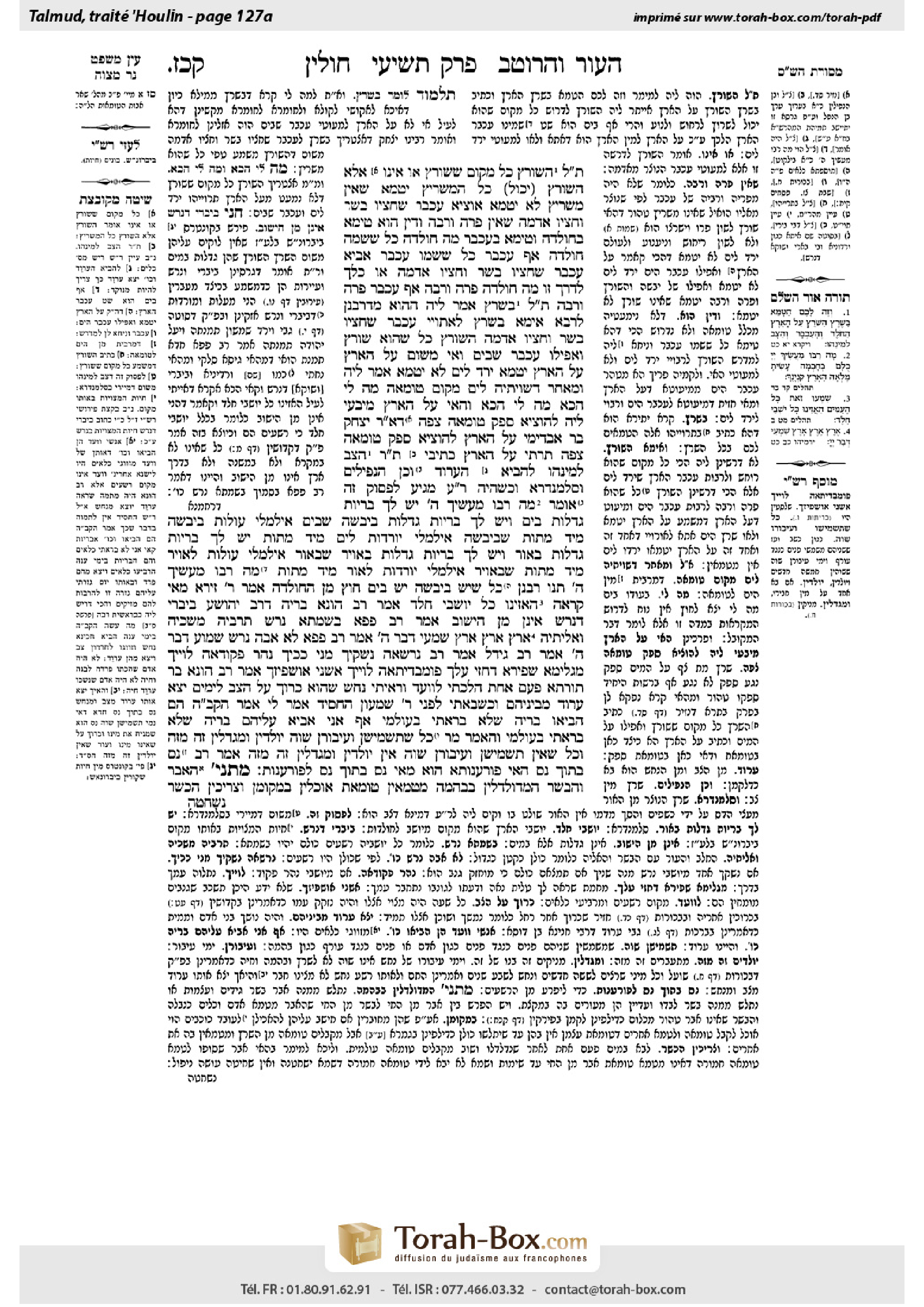
Chullin 127a: Talmud study for Daf Yomi
Study the Talmud for Daf Yomi with scanned pages, Hebrew text, English translations from Sefaria and AI-generated French translations.
Passage selection and English or AI-generated French translation are available where the scan has annotations. Daf Study is independent of Torah-Box and Sefaria.
Browse Chullin · חולין · All tractatesChullin 127a text and translations
This page of Chullin includes the Aramaic text, an English translation and an AI-generated French translation, alongside the scan above.
חולין קכ״ז א · Aramaic and Hebrew text
תַּלְמוּד לוֹמַר ״הַשּׁוֹרֵץ״ – כׇּל מָקוֹם שֶׁשּׁוֹרֵץ.
אוֹ אֵינוֹ אֶלָּא ״הַשּׁוֹרֵץ״ – יָכוֹל כׇּל הַמַּשְׁרִיץ יְטַמֵּא, שֶׁאֵין מַשְׁרִיץ לֹא יְטַמֵּא? אוֹצִיא עַכְבָּר שֶׁחֶצְיוֹ בָּשָׂר וְחֶצְיוֹ אֲדָמָה, שֶׁאֵין פָּרֶה וְרָבֶה.
וְדִין הוּא: טִימֵּא בְּחוּלְדָּה וְטִימֵּא בְּעַכְבָּר, מָה חוּלְדָּה – כֹּל שֶׁשְּׁמָהּ חוּלְדָּה, אַף עַכְבָּר – כֹּל שֶׁשְּׁמוֹ עַכְבָּר, אָבִיא עַכְבָּר שֶׁחֶצְיוֹ בָּשָׂר וְחֶצְיוֹ אֲדָמָה.
אוֹ כְּלָךְ לְדֶרֶךְ זוֹ: מָה חוּלְדָּה פָּרָה וְרָבָה, אַף עַכְבָּר פָּרֶה וְרָבֶה? תַּלְמוּד לוֹמַר ״בַּשֶּׁרֶץ״.
אֲמַר לֵיהּ הָהוּא מִדְּרַבָּנַן לְרָבָא: אֵימָא ״בַּשֶּׁרֶץ״, לְאֵתוֹיֵי עַכְבָּר שֶׁחֶצְיוֹ בָּשָׂר וְחֶצְיוֹ אֲדָמָה, ״הַשּׁוֹרֵץ״ – כֹּל שֶׁהוּא שׁוֹרֵץ, וַאֲפִילּוּ עַכְבָּר שֶׁבַּיָּם, וְאִי מִשּׁוּם ״עַל הָאָרֶץ״ – עַל הָאָרֶץ יְטַמֵּא, יָרַד לַיָּם – לֹא יְטַמֵּא.
אֲמַר לֵיהּ: וּמֵאַחַר דְּשַׁוִּיתֵיהּ לְיָם מְקוֹם טוּמְאָה, מָה לִי הָכָא, מָה לִי הָכָא.
וְהַאי ״עַל הָאָרֶץ״ מִיבְּעֵי לֵיהּ לְהוֹצִיא סְפֵק טוּמְאָה צָפָה, דְּאָמַר רַב יִצְחָק בַּר אַבְדִּימִי: ״עַל הָאָרֶץ״ – לְהוֹצִיא סְפֵק טוּמְאָה צָפָה!
תַּרְתֵּי ״עַל הָאָרֶץ״ כְּתִיבִי.
תָּנוּ רַבָּנַן: ״הַצָּב לְמִינֵהוּ״ – לְהָבִיא הֶעָרוֹד, וְכֵן הַנְּפִילִים וְסָלָמַנְדְּרָא.
וּכְשֶׁהָיָה רַבִּי עֲקִיבָא מַגִּיעַ לְפָסוּק זֶה, אוֹמֵר: ״מָה רַבּוּ מַעֲשֶׂיךָ ה׳״! יֵשׁ לְךָ בְּרִיּוֹת גְּדֵלוֹת בַּיָּם, וְיֵשׁ לְךָ בְּרִיּוֹת גְּדֵלוֹת בַּיַּבָּשָׁה. שֶׁבַּיָּם – אִילְמָלֵי עוֹלוֹת (בַּיַּבָּשָׁה) [לַיַּבָּשָׁה] מִיָּד מֵתוֹת, שֶׁבַּיַּבָּשָׁה – אִילְמָלֵי יוֹרְדוֹת לַיָּם מִיָּד מֵתוֹת.
יֵשׁ לְךָ בְּרִיּוֹת גְּדֵלוֹת בָּאוּר, וְיֵשׁ לְךָ בְּרִיּוֹת גְּדֵלוֹת בָּאֲוִיר. שֶׁבָּאוּר – אִילְמָלֵי עוֹלוֹת לָאֲוִיר מִיָּד מֵתוֹת, שֶׁבָּאֲוִיר – אִילְמָלֵי יוֹרְדוֹת לָאוּר מִיָּד מֵתוֹת. ״מָה רַבּוּ מַעֲשֶׂיךָ ה׳״.
תָּנוּ רַבָּנַן: כֹּל שֶׁיֵּשׁ בַּיַּבָּשָׁה יֵשׁ בַּיָּם, חוּץ מִן הַחוּלְדָּה. אָמַר רַבִּי זֵירָא: מַאי קְרָאָה? ״הַאֲזִינוּ כׇּל יֹשְׁבֵי חָלֶד״.
אָמַר רַב הוּנָא בְּרֵיהּ דְּרַב יְהוֹשֻׁעַ: בִּיבְרֵי דְּנָרֶשׁ אֵינָן מִן הַיִּשּׁוּב.
אָמַר רַב פָּפָּא: בְּשַׁמְתָּא נָרֶשׁ, תַּרְבֵּיהּ מַשְׁכֵּיהּ וְאַלְיְתֵיהּ. ״אֶרֶץ אֶרֶץ אָרֶץ שִׁמְעִי דְּבַר ה׳״ – אָמַר רַב פָּפָּא: לֹא אָבָה נָרֶשׁ שְׁמוֹעַ דְּבַר ה׳.
אָמַר רַב גִּידֵּל, אָמַר רַב: נַרְשָׁאָה נַשְּׁקָיךְ – מָנֵי כַּכָּיךְ; נְהַר פְּקוֹדָאָה לַוְיָיךְ – מִגְּלִימָא שַׁפִּירָא דְּחָזֵי עֲלָךְ; פּוּמְבְּדִיתָאָה לַוְיָיךְ – אַשְׁנִי אוּשְׁפִּיזָךְ.
אָמַר רַב הוּנָא בַּר תּוֹרְתָּא: פַּעַם אַחַת הָלַכְתִּי לַוַּועַד, וְרָאִיתִי נָחָשׁ שֶׁהוּא כָּרוּךְ עַל הַצָּב, לְיָמִים יָצָא עַרְוָד מִבֵּינֵיהֶם.
וּכְשֶׁבָּאתִי לִפְנֵי רַבִּי שִׁמְעוֹן הֶחָסִיד, אָמַר לִי: אָמַר הַקָּדוֹשׁ בָּרוּךְ הוּא: הֵם הֵבִיאוּ בְּרִיָּה שֶׁלֹּא בָּרָאתִי בְּעוֹלָמִי, אַף אֲנִי אָבִיא עֲלֵיהֶם בְּרִיָּה שֶׁלֹּא בָּרָאתִי בְּעוֹלָמִי.
וְהָאָמַר מָר: כֹּל שֶׁתַּשְׁמִישָׁן וְעִיבּוּרָן שָׁוֶה – יוֹלְדִין וּמְגַדְּלִין זֶה מִזֶּה, וְכֹל שֶׁאֵין תַּשְׁמִישָׁן וְעִיבּוּרָן שָׁוֶה – אֵין יוֹלְדִין וּמְגַדְּלִין זֶה מִזֶּה.
אָמַר רַב: נֵס בְּתוֹךְ נֵס! הַאי פּוּרְעֲנוּתָא הוּא? מַאי נֵס בְּתוֹךְ נֵס – לְפוּרְעָנוּת.
מַתְנִי׳ הָאֵבֶר וְהַבָּשָׂר הַמְדוּלְדָּלִין בַּבְּהֵמָה, מְטַמְּאִין טוּמְאַת אֳכָלִין בִּמְקוֹמָן, וּצְרִיכִין הֶכְשֵׁר.
Chullin 127a · English translation
Therefore, the verse states: “That creep,” indicating that creeping animals impart impurity anywhere that they creep, including the sea, as these animals can float in the sea. Consequently, the phrase “upon the earth” is understood as indicating that a sea mouse does not impart impurity.
The baraita raises an alternative interpretation: Or perhaps the term “that creep [hashoretz]” should not be interpreted in this manner, as it could rather be interpreted to mean that any creeping animal that breeds [hammashritz] imparts impurity, but a creeping animal that does not breed does not impart impurity. I shall therefore exclude a mouse that is half-flesh half-earth, i.e., that generates spontaneously from the earth, as it does not breed and therefore does not impart impurity.
But ostensibly, the halakha of a mouse that is half-flesh half-earth is subject to logical inference: Since the verse deems a weasel impure and deems a mouse impure, then just as “weasel” is referring to any animal whose name is weasel, so too, “mouse” is referring to any animal whose name is mouse, even a mouse that is half-flesh half-earth.
Or perhaps go this way: One might think that just as a weasel breeds, so too, “mouse” is referring to a mouse that breeds, excluding one that generates from the earth, which does not impart impurity. Therefore, the verse states: “And these are they which are impure to you among the creeping animals that creep upon the earth.” The term “among the creeping animals” is interpreted as including a spontaneously generated mouse. Therefore, the term “that creep” is interpreted as indicating that creeping animals impart impurity on land and in the sea, and the phrase “upon the earth” teaches that a sea mouse is not included in the category of mouse and does not impart impurity.
One of the Sages said to Rava: Say the interpretation of the verse differently. The term “among the creeping animals” serves to include a mouse that is half-flesh half-earth among those that impart impurity. The term “that creep” teaches that any animal that creeps imparts impurity, and even a sea mouse. And if one should reject this interpretation due to the phrase “upon the earth,” which seems to indicate that a sea mouse does not impart impurity, that phrase teaches that a creeping animal imparts impurity only when it is on land, but if it descended to the sea it does not impart impurity.
Rava said to him: Your suggestion is not logical. According to your opinion, a sea mouse, which is in the sea, imparts impurity. And since you consider the sea a location of impurity, it is impossible to suggest that a mouse does not impart impurity when it is located in the sea. Since both land and sea are places of impurity, what difference does it make for me if the mouse is located here on land, and what difference does it make for me if it is located there in the sea?
The Gemara asks: How can the baraita interpret the phrase “upon the earth” as teaching that a sea mouse does not impart impurity? Isn’t this phrase: “Upon the earth,” necessary to exclude a case of uncertainty involving a floating source of impurity? If a person is uncertain whether he touched a source of impurity that is floating in the water, he remains pure even if the incident took place in a private domain, where a case of uncertain impurity is generally deemed impure. As Rav Yitzḥak bar Avdimi said: The phrase “upon the earth” is written to exclude a case of uncertainty involving a floating source of impurity.
The Gemara answers: The phrase “upon the earth” is written two times in the passage. One instance is written to exclude a case of uncertainty involving a source of impurity that is floating, and the other instance teaches that a sea mouse does not impart impurity.
§With regard to the topic of the eight creeping animals mentioned in the Torah, the Sages taught in a baraita: The verse: “The great lizard after its kinds” (Leviticus 11:29) includes in the category of creeping animals the arvad, a type of snake, and also the creeping animals called nefilim and salamander [salamandera].
Apropos the salamander, which was thought to generate from fire, the baraita continues: When Rabbi Akiva would reach this verse in Leviticus, he would say in exclamation: “How great are Your works, O Lord” (Psalms 104:24). You have creatures that grow in the sea and you have creatures that grow on land. If those in the sea would ascend to the land they would immediately die. If those that are on land would descend to the sea they would immediately die.
Similarly, you have creatures that grow in the fire and you have creatures that grow in the air. If those in the fire would ascend to the air they would immediately die. If those in the air would descend to the fire they would immediately die. Therefore, “how great are Your works, O Lord.”
§The Gemara continues to discuss creatures living in a particular environment. The Sages taught in a baraita (Tosefta, Kilayim 5:10): For every animal that exists on land there is an equivalent animal in the sea, except for the weasel, which exists only on land. Rabbi Zeira said: What is the verse from which it is derived? It is written: “Listen all you inhabitants of the world [ḥeled]” (Psalms 49:2). Dry land is called ḥeled because it is the sole habitat for the weasel [ḥulda].
In continuation of the discussion of creatures living in a particular environment, Rav Huna the son of Rav Yehoshua said: The beavers of the region of Neresh are not from the settled area, because they live only in the water and not on dry land. Consequently, one who eats their meat is not liable to receive lashes for violating the prohibition: “And every creeping animal that creeps upon the earth is a detestable thing; it shall not be eaten” (Leviticus 11:41).
§Apropos the region surrounding Neresh, Rav Pappa said: The people of the city of Neresh shall be placed under excommunication, as they are all wicked, including its fat, its hide, and its tail, i.e., all types of people, both old and young. The Gemara continues to discuss Neresh. The verse states: “Oh land, land, land hear the word of the Lord” (Jeremiah 22:29). Rav Pappa said: This verse is appropriate with regard to the inhabitants of Neresh, as Neresh does not want to listen to the word of the Lord.
Furthermore, Rav Giddel said that Rav said: If a resident of Neresh kisses you, count your teeth to make sure he did not steal one. And if a resident of the city of Nehar Pekod accompanies you on a journey, it is because of the beautiful jacket that he sees on you and wants to steal from you. If a resident of Pumbedita accompanies you on a journey, change your lodging place because there is a concern that he will rob you.
§The Gemara returns to discussing different types of creatures. Rav Huna bar Torta said: Once I went to the city of Va’ad and I saw that the locals were in the practice of placing a snake wrapped around a great lizard in order to breed the two. After a period of time, an arvad, a snake that bites and kills people, emerged from between them.
And when I came before Rabbi Shimon the Righteous, he explained why this crossbreeding created an arvad and said to me: The Holy One, Blessed be He, said: These residents of Va’ad caused the emergence of a creature that I did not create in My world by crossbreeding a snake and a great lizard; so too, I will bring upon them a punishment, the hazard of this uniquely dangerous creature that I did not create in My world, i.e., an arvad.
The Gemara objects: But didn’t the Master say: All different animals whose method of procreation and period of gestation are the same are able to reproduce and raise offspring together. But all animals whose method of procreation and period of gestation are not the same cannot reproduce and raise offspring together. And the gestation period for a great lizard and a snake are not equal.
Rav says: It was a miracle within a miracle that they were able to reproduce and a new creature was born. The Gemara asks: Why is this considered a miracle? It was a calamity because an arvad was born. The Gemara answers: What is meant by a miracle within a miracle? It was a miraculous calamity for the wicked people, to punish them for their actions.
MISHNA: The limb of an animal, with flesh, sinews, and bones, and the flesh of an animal, that were partially severed and remain hanging from the animal do not have the halakhic status of a limb severed from a living animal, which imparts impurity like an unslaughtered carcass, or of flesh severed from a living animal, which is ritually pure, respectively. If one had intent to eat the limb or the flesh, the limb or flesh becomes impure if it comes in contact with a source of impurity, and they impart impurity as food to other foods and liquids, although they remain in their place attached to the animal. But in order for them to become impure, they need to be rendered susceptible to impurity through contact with one of the seven liquids that facilitate susceptibility.
Chullin 127a · Traduction française (IA)
Par conséquent, la versette dit : « Cet animal rampant », indiquant que les animaux rampants transmettent l'impureté partout où ils rampent, y compris la mer, car ces animaux peuvent flotter dans la mer. Ainsi, la phrase « sur la terre » est interprétée comme signifiant que le rat de mer ne transmet pas l'impureté.
La baraïta propose une autre interprétation : Peut-être que le terme « rampant [hashoretz] » ne doit pas être interprété ainsi, car il pourrait plutôt signifier que tout animal rampant qui se reproduit [hammashritz] transmet l'impureté, mais un animal rampant qui ne se reproduit pas ne transmet pas l'impureté. Je vais donc exclure un rat qui est à la fois chair et terre, c'est-à-dire qui se génère spontanément de la terre, car il ne se reproduit pas et donc ne transmet pas l'impureté.
Mais apparemment, la halakha concernant un rat qui est à la fois chair et terre est soumise à une déduction logique : Puisque la versette considère le blaireau comme impur et le rat comme impur, alors tout comme « blaireau » désigne tout animal dont le nom est blaireau, ainsi « rat » désigne tout animal dont le nom est rat, même un rat qui est à la fois chair et terre.
Ou peut-être ainsi : On pourrait penser que tout comme le blaireau se reproduit, ainsi « rat » désigne un rat qui se reproduit, excluant celui qui se génère de la terre, qui ne transmet pas l'impureté. Ainsi, la versette dit : « Et ces sont ceux qui sont impurs pour vous parmi les animaux rampants qui rampent sur la terre. » Le terme « parmi les animaux rampants » est interprété comme incluant un rat spontanément généré. Ainsi, le terme « qui rampent » est interprété comme indiquant que les animaux rampants transmettent l'impureté sur la terre et en mer, et la phrase « sur la terre » enseigne que le rat de mer n'est pas inclus dans la catégorie de rat et ne transmet pas l'impureté.
Un des Sages dit à Rava : Interprète la versette différemment. Le terme « parmi les animaux rampants » sert à inclure un rat qui est à la fois chair et terre parmi ceux qui transmettent l'impureté. Le terme « qui rampent » enseigne que tout animal qui rampe transmet l'impureté, et même un rat de mer. Et si l'on rejette cette interprétation en raison de la phrase « sur la terre », qui semble indiquer que le rat de mer ne transmet pas l'impureté, cette phrase enseigne que tout animal rampant transmet l'impureté uniquement lorsqu'il est sur la terre, mais s'il descend en mer, il ne transmet pas l'impureté.
Rava répondit à lui : Votre suggestion n'est pas logique. Selon votre opinion, un rat de mer, qui est en mer, transmet l'impureté. Et puisque vous considérez la mer comme un lieu d'impureté, il est impossible de suggérer qu'un rat ne transmette pas l'impureté lorsqu'il est situé en mer. Puisque la terre et la mer sont des lieux d'impureté, quelle différence cela fait-il pour moi si le rat est ici sur la terre, et quelle différence cela fait-il pour moi si il est là en mer ?
La Guemara pose la question : Comment la baraïta peut-elle interpréter la phrase « sur la terre » comme enseignant que le rat de mer ne transmet pas l'impureté ? N'est-ce pas cette phrase : « sur la terre », nécessaire pour exclure un cas d'incertitude concernant une source d'impureté flottante ? Si une personne est incertaine de savoir si elle a touché une source d'impureté flottante dans l'eau, elle reste pure même si l'incident s'est produit dans un domaine privé, où un cas d'incertitude concernant l'impureté est généralement considéré comme impur. Comme Rav Yitzḥak bar Avdimi a dit : La phrase « sur la terre » est écrite pour exclure un cas d'incertitude concernant une source d'impureté flottante.
La Guemara répond : La phrase « sur la terre » est écrite deux fois dans le passage. L'une est écrite pour exclure un cas d'incertitude concernant une source d'impureté flottante, et l'autre enseigne que le rat de mer ne transmet pas l'impureté.
§ Concernant le sujet des huit animaux rampants mentionnés dans la Torah, les Sages enseignèrent dans une baraïta : La versette : « Le grand lézard selon son espèce » (Lévitique 11:29) inclut dans la catégorie des animaux rampants l'arvad, un type de serpent, ainsi que les animaux rampants appelés nefilim et salamandre [salamandera].
A propos de la salamandre, qui était censée se générer du feu, la baraïta continue : Lorsque Rabbi Akiva arrivait à cette versette dans Lévitique, il disait en exclamation : « Combien sont grands vos œuvres, ô Seigneur » (Psaumes 104:24). Vous avez des créatures qui grandissent en mer et vous avez des créatures qui grandissent sur terre. Si celles en mer montaient sur la terre, elles mourraient aussitôt. Si celles sur terre descendaient en mer, elles mourraient aussitôt.
De même, vous avez des créatures qui grandissent dans le feu et des créatures qui grandissent dans l'air. Si celles dans le feu montaient dans l'air, elles mourraient aussitôt. Si celles dans l'air descendaient dans le feu, elles mourraient aussitôt. Ainsi, « combien sont grands vos œuvres, ô Seigneur. »
§ La Guemara continue à discuter des créatures vivant dans un environnement particulier. Les Sages enseignèrent dans une baraïta (Tosefta, Kilayim 5:10) : Pour chaque animal existant sur terre, il existe un animal équivalent en mer, sauf le blaireau, qui existe uniquement sur terre. Rabbi Zeira dit : De quelle versette cela est-il dérivé ? Il est écrit : « Écoutez, tous les habitants du monde [ḥeled] » (Psaumes 49:2). La terre sèche est appelée ḥeled car c'est le seul habitat du blaireau [ḥulda].
En continuation de la discussion des créatures vivant dans un environnement particulier, Rav Huna fils de Rav Yehoshua dit : Les castors de la région de Neresh ne proviennent pas de la zone habitée, car ils vivent uniquement dans l'eau et non sur la terre sèche. Ainsi, celui qui mange leur viande n'est pas tenu responsable de recevoir des coups de fouet pour avoir violé l'interdiction : « Et tout animal rampant qui rampe sur la terre est un objet abominable ; il ne doit pas être mangé » (Lévitique 11:41).
§ Concernant la région entourant Neresh, Rav Pappa a dit : Les habitants de la ville de Neresh doivent être mis sous excommunication, car ils sont tous mauvais, y compris leur gras, leur peau et leur queue, c'est-à-dire tous les types de personnes, jeunes et vieux. La Guemara continue de discuter de Neresh. La versette dit : « Oh terre, terre, terre, écoutez la parole du Seigneur » (Jérémie 22:29). Rav Pappa a dit : Cette versette s'applique aux habitants de Neresh, car Neresh ne veut pas écouter la parole du Seigneur.
De plus, Rav Giddel a dit que Rav a dit : Si un habitant de Neresh vous embrasse, comptez vos dents pour vérifier qu'il n'en a pas volé une. Et si un habitant de la ville de Nehar Pekod vous accompagne sur un voyage, c'est parce qu'il voit un manteau joli sur vous et veut vous voler. Si un habitant de Pumbedita vous accompagne sur un voyage, changez votre lieu d'hébergement, car il y a un risque qu'il vous vole.
§ La Guemara reprend la discussion sur différents types d'animaux. Rav Huna bar Torta a dit : Une fois, je suis allé à la ville de Va’ad et j'ai vu que les locaux pratiquaient de placer un serpent entourant un grand lézard afin de les faire se reproduire. Après un certain temps, un arvad, un serpent qui mord et tue les gens, est sorti d'entre eux.
Et quand je suis venu devant Rabbi Shimon le Juste, il m'a expliqué pourquoi cette hybridation a créé un arvad et m'a dit : Le Saint, le Très Haut, a dit : Ces habitants de Va’ad ont causé l'apparition d'un créature que je n'ai pas créé dans Mon monde en hybridant un serpent et un grand lézard ; de même, je vais leur faire subir une punition, le danger de cette créature particulièrement dangereuse que je n'ai pas créée dans Mon monde, c'est-à-dire un arvad.
La Guemara s'oppose : Mais n'a-t-il pas dit le Maître : Tous les animaux dont la méthode de procréation et la période de gestation sont les mêmes peuvent se reproduire et élever des petits ensemble. Mais tous les animaux dont la méthode de procréation et la période de gestation ne sont pas les mêmes ne peuvent pas se reproduire et élever des petits ensemble. Et la période de gestation d'un grand lézard et d'un serpent n'est pas égale.
Rav dit : C'était un miracle au sein d'un miracle qu'ils ont pu se reproduire et qu'un nouveau créature est né. La Guemara demande : Pourquoi cela est-il considéré comme un miracle ? C'était une calamité car un arvad est né. La Guemara répond : Qu'entend-on par un miracle au sein d'un miracle ? C'était un miracle calamiteux pour les mauvais gens, pour les punir de leurs actions.
MICHNA : Le membre d'un animal, avec la chair, les nerfs et les os, et la chair d'un animal, qui a été partiellement séparé et reste accroché à l'animal, ne possède pas le statut halakhique d'un membre séparé d'un animal vivant, qui transmet l'impureté comme un cadavre non sacrifié, ou de la chair séparée d'un animal vivant, qui est pure rituellement, respectivement. Si l'on avait l'intention de manger le membre ou la chair, le membre ou la chair devient impur s'il entre en contact avec une source d'impureté, et ils transmettent l'impureté aux aliments et aux liquides, bien qu'ils restent attachés à l'animal. Mais pour qu'ils deviennent impurs, ils doivent être rendus susceptibles d'impureté par le contact avec l'un des sept liquides qui facilitent cette susceptibilité.
Traduction française générée par IA à partir de l’édition anglaise de Sefaria. Vérifie toujours un passage avec le texte source.
Text from Sefaria: William Davidson Edition - Vocalized Aramaic (unknown); William Davidson Edition - English (CC BY NC).