Chullin 127b: Talmud study for Daf Yomi
Study the Talmud for Daf Yomi with scanned pages, Hebrew text, English translations from Sefaria and AI-generated French translations.
Passage selection and English or AI-generated French translation are available where the scan has annotations. Daf Study is independent of Torah-Box and Sefaria.
Browse Chullin · חולין · All tractatesChullin 127b text and translations
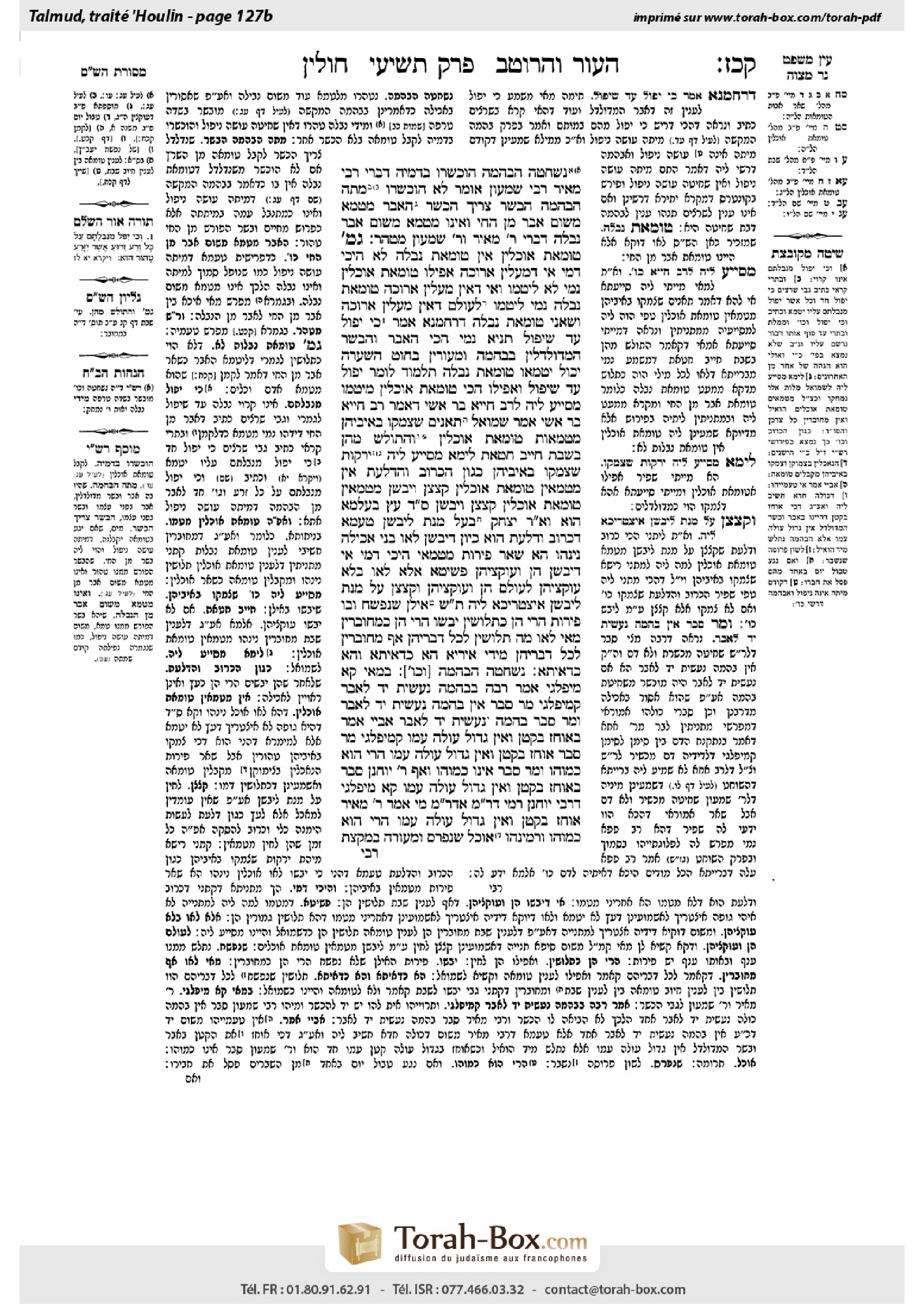
This page of Chullin includes the Aramaic text, an English translation and an AI-generated French translation, alongside the scan above.
חולין קכ״ז ב · Aramaic and Hebrew text
נִשְׁחֲטָה הַבְּהֵמָה – הוּכְשְׁרוּ בְּדָמֶיהָ, דִּבְרֵי רַבִּי מֵאִיר. רַבִּי שִׁמְעוֹן אוֹמֵר: לֹא הוּכְשְׁרוּ.
מֵתָה הַבְּהֵמָה – הַבָּשָׂר צָרִיךְ הֶכְשֵׁר, הָאֵבֶר מְטַמֵּא מִשּׁוּם אֵבֶר מִן הַחַי, וְאֵינוֹ מְטַמֵּא מִשּׁוּם אֵבֶר נְבֵלָה – דִּבְרֵי רַבִּי מֵאִיר, וְרַבִּי שִׁמְעוֹן מְטַהֵר.
גְּמָ׳ טוּמְאַת אֳכָלִין – אִין, טוּמְאַת נְבֵלָה – לָא.
הֵיכִי דָמֵי? אִי דְּמַעֲלִין אֲרוּכָה – אֲפִילּוּ טוּמְאַת אֳכָלִין נָמֵי לָא לִיטַּמּוּ, וְאִי דְּאֵין מַעֲלִין אֲרוּכָה – טוּמְאַת נְבֵלָה נָמֵי לִיטַּמּוּ!
לְעוֹלָם, דְּאֵין מַעֲלִין אֲרוּכָה, וְשָׁאנֵי טוּמְאַת נְבֵלָה, דְּרַחֲמָנָא אָמַר ״כִּי יִפּוֹל״, עַד שֶׁיִּפּוֹל.
תַּנְיָא נָמֵי הָכִי: הָאֵבֶר וְהַבָּשָׂר הַמְדוּלְדָּלִין בִּבְהֵמָה וּמְעוֹרִין בְּחוּט הַשַּׂעֲרָה, יָכוֹל יְטַמְּאוּ טוּמְאַת נְבֵלָה? תַּלְמוּד לוֹמַר ״יִפּוֹל״ – עַד שֶׁיִּפּוֹל, וַאֲפִילּוּ הָכִי טוּמְאַת אֳכָלִין מְטַמּוּ.
מְסַיַּיע לֵיהּ לְרַב חִיָּיא בַּר אָשֵׁי, דְּאָמַר רַב חִיָּיא בַּר אָשֵׁי אָמַר שְׁמוּאֵל: תְּאֵנִים שֶׁצָּמְקוּ בְּאִיבֵּיהֶן – מְטַמְּאוֹת טוּמְאַת אֳכָלִין, וְהַתּוֹלֵשׁ מֵהֶן בְּשַׁבָּת חַיָּיב חַטָּאת.
לֵימָא מְסַיַּיע לֵיהּ: יְרָקוֹת שֶׁצָּמְקוּ בְּאִיבֵּיהֶן, כְּגוֹן הַכְּרוּב וְהַדַּלַּעַת – אֵין מְטַמְּאִין טוּמְאַת אֳכָלִין; קְצָצָן וְיִבְּשָׁן – מְטַמְּאִין טוּמְאַת אֳכָלִין.
קְצָצָן וְיִבְּשָׁן, סָלְקָא דַּעְתָּךְ?! עֵץ בְּעָלְמָא הוּא! וְאָמַר רַבִּי יִצְחָק: בְּעַל מְנָת לְיַבְּשָׁן.
טַעְמָא דִּכְרוּב וְדַלַּעַת הוּא, כֵּיוָן דְּיִבְּשָׁן לָאו בְּנֵי אֲכִילָה נִינְהוּ, הָא שְׁאָר פֵּירוֹת מְטַמְּאִי.
הֵיכִי דָמֵי? אִי דְּיִבְּשָׁן הֵן וְעוּקְצֵיהֶן – פְּשִׁיטָא! אֶלָּא לָאו – בְּלֹא עוּקְצֵיהֶן.
לְעוֹלָם הֵן וְעוּקְצֵיהֶן, וּקְצָצָן עַל מְנָת לְיַבְּשָׁן אִיצְטְרִיכָא לֵיהּ.
תָּא שְׁמַע: אִילָן שֶׁנִּפְשַׁח וּבוֹ פֵּירוֹת – הֲרֵי הֵן כִּתְלוּשִׁין, יָבְשׁוּ – הֲרֵי הֵן כִּמְחוּבָּרִין. מַאי לָאו: מָה תְּלוּשִׁין לְכׇל דִּבְרֵיהֶן, אַף מְחוּבָּרִין לְכׇל דִּבְרֵיהֶן?
מִידֵּי אִירְיָא? הָא כִּדְאִיתָא, וְהָא כִּדְאִיתָא.
נִשְׁחֲטָה הַבְּהֵמָה [וְכוּ׳]. בְּמַאי קָא מִיפַּלְגִי?
אָמַר רַבָּה: בִּבְהֵמָה נַעֲשֵׂית יָד לְאֵבֶר קָמִיפַּלְגִי: מָר סָבַר אֵין בְּהֵמָה נַעֲשֵׂית יָד לְאֵבֶר, וּמָר סָבַר בְּהֵמָה נַעֲשֵׂית יָד לְאֵבֶר.
אַבָּיֵי אָמַר: בְּאוֹחֵז בְּקָטָן וְאֵין גָּדוֹל עוֹלֶה עִמּוֹ קָמִיפַּלְגִי.
מָר סָבַר: אוֹחֵז בְּקָטָן וְאֵין גָּדוֹל עוֹלֶה עִמּוֹ – הֲרֵי הוּא כָּמוֹהוּ, וּמָר סָבַר: אֵינוֹ כָּמוֹהוּ.
וְאַף רַבִּי יוֹחָנָן סָבַר, בְּאוֹחֵז בְּקָטָן וְאֵין גָּדוֹל עוֹלֶה עִמּוֹ קָא מִיפַּלְגִי.
דְּרַבִּי יוֹחָנָן רָמֵי דְּרַבִּי מֵאִיר אַדְּרַבִּי מֵאִיר: מִי אָמַר רַבִּי מֵאִיר, אוֹחֵז בְּקָטָן וְאֵין גָּדוֹל עוֹלֶה עִמּוֹ הֲרֵי הוּא כָּמוֹהוּ?
וּרְמִינְהוּ: אוֹכֶל שֶׁנִּפְרַס וּמְעוֹרֶה בְּמִקְצָת,
Chullin 127b · English translation
If the animal was slaughtered, although this act of slaughter does not render it permitted for consumption by a Jew (see 73b), the limb and the flesh were thereby rendered susceptible to impurity by coming in contact with the blood of the slaughtered animal, as blood is one of the seven liquids; this is the statement of Rabbi Meir. Rabbi Shimon says: They were not rendered susceptible to impurity through the animal’s own blood; they are rendered susceptible only once they have been wet with another liquid.
If the animal died without slaughter, the hanging flesh needs to be rendered susceptible to impurity in order to become impure, as its halakhic status is that of flesh severed from a living animal, which is ritually pure and does not have the status of an unslaughtered carcass. The hanging limb imparts impurity as a limb severed from a living animal but does not impart impurity as the limb of an unslaughtered carcass; this is the statement of Rabbi Meir. And Rabbi Shimon deems the limb ritually pure.
GEMARA: The mishna states that the limb of an animal that was partially severed and remains hanging from the animal imparts impurity as food if one had intent to eat it. The Gemara infers: It imparts impurity as food, yes, but it does not impart the impurity of a carcass, which can be transmitted to people and utensils in addition to food.
The Gemara asks: What are the circumstances? If the limb can heal and reattach to the animal’s body then it should not be susceptible even to impurity as food. And if it cannot heal, it should impart the impurity of a carcass as well.
The Gemara answers: Actually, the mishna is discussing a case where the limb will not heal, and the reason that the limb does not impart impurity of a carcass is that the impurity of a carcass is different and unique, as the Merciful One states with regard to the impurity of a carcass: “And if any of their carcass fall upon any sowing seed” (Leviticus 11:37), indicating that the severed limb of an animal is not considered a carcass until it completely falls from the animal.
This explanation is also taught in a baraita: With regard to the limb and the flesh of an animal that were partially severed and remain hanging from the animal and are connected to the animal by a connector the size of a strand of hair, one might have thought that they impart the impurity of a carcass. Therefore, the verse states: “And if any of the carcass fall,” indicating that a severed limb does not impart the impurity of a carcass until it completely falls from the animal. And nevertheless, despite the fact that it is not considered severed with regard to the impurity of a carcass, such a limb is considered severed with regard to being susceptible to impurity as food.
This explanation supports the opinion of Rav Ḥiyya bar Ashi, as Rav Ḥiyya bar Ashi said that Shmuel said: With regard to figs that dried while still attached to their tree, despite the fact that they are still attached, they are considered as if they have been picked and are susceptible to impurity as food. But with regard to one who picks them on Shabbat they are considered attached, and he is liable to bring a sin offering. Just as a partially severed limb of an animal is considered both attached and severed with regard to different halakhot, so too this dried fruit is considered both attached and detached with regard to different halakhot.
Let us say that a baraita (Tosefta, Okatzin 2:11) supports the opinion of Shmuel, who holds that dried figs still attached to the tree are considered as if they are detached with regard to susceptibility to impurity as food: Vegetables that dried while they are attached to their plant, such as cabbage and gourd, which become hard as wood and inedible when dried, are not susceptible to impurity as food. But if one cut them when they were still moist and then dried them in order to use them for fuel, or, in the case of gourds, to make utensils out of them, they are susceptible to impurity as food.
The Gemara asks: Does it enter your mind that if one cut them and dried them they are susceptible to impurity as food? Such a vegetable is merely wood, and it is inedible. And Rabbi Yitzḥak says: The baraita is discussing a case where one cut the vegetables when they were still moist in order to dry them. The novelty of the baraita is that even though one intends to dry the vegetables and render them inedible, as long as they are still moist they are susceptible to impurity as food.
The Gemara infers: The reason for this halakha in the baraita is that it is discussing cabbage and gourd: Since one dried them, they are inedible and consequently are not susceptible to impurity as food. But other types of produce, which are edible when dried, are susceptible to impurity.
The Gemara explains the suggested support to Shmuel: What are the circumstances? If one dried both the produce itself and its stems, isn’t it obvious that the produce is no longer considered attached to the plant and is susceptible to impurity? If so, it would be unnecessary for the baraita to teach this. Rather, isn’t the baraita discussing a case where one dried the produce without drying its stems? Accordingly, in such a case the produce is considered detached with regard to impurity even though it is considered attached with regard to Shabbat, in accordance with the statement of Shmuel.
The Gemara rejects this interpretation: The baraita is not necessarily discussing that case. Actually, the baraita is discussing a case where both the produce itself and its stems were dried. And although it appears that the halakha is obvious in such a case, it was necessary for the baraita to mention it in order to teach the latter clause of the baraita: In a case where one cut the cabbage and gourd when they were still moist in order to dry them, they are susceptible to impurity as long as they are still moist.
The Gemara suggests: Come and hear a challenge to the opinion of Shmuel from a baraita: In the case of a tree from which a branch broke off, and the branch has fruit attached to it, even if the fruit is still moist it is considered detached from the tree. But if the branch did not break off, and the fruit dried on the tree, it is considered attached. What, isn’t the ruling of the baraita that just as in the first clause the fruit on the detached branch is considered detached with regard to all matters, the halakhot of both Shabbat and impurity, so too in the latter clause the fruit that dried on the tree is considered attached to the tree with regard to all matters, even the transmission of impurity, contrary to the opinion of Shmuel?
The Gemara rejects this challenge: Are the cases comparable? This case is as it is, and that case is as it is. In the first clause of the baraita, the fruit on the detached branch is considered detached with regard to all matters. In the latter clause of the baraita, the dried fruit on the tree is considered attached with regard to Shabbat but detached with regard to impurity.
§The mishna teaches: If the animal was slaughtered, Rabbi Meir holds that with the blood of the slaughtered animal the limb and the flesh were rendered susceptible to impurity. Rabbi Shimon says that they were not rendered susceptible with the animal’s own blood. The Gemara asks: With regard to what principle do Rabbi Meir and Rabbi Shimon disagree?
Rabba said: The mishna is discussing a case where the blood of the slaughtered animal came into contact with the body of the animal but not with the partially severed limb. The tanna’im agree that if an appendage that constitutes a handle is rendered susceptible to impurity, the food to which it is attached is also rendered susceptible. But they disagree with regard to whether an animal constitutes a handle for its limb. One Sage, Rabbi Shimon, holds that an animal does not constitute a handle for its limb, and therefore the limb is not rendered susceptible to contract impurity along with the body of the animal. And one Sage, Rabbi Meir, holds that an animal constitutes a handle for its limb, and therefore the limb is rendered susceptible along with the body of the animal.
Abaye said a different explanation of the dispute between Rabbi Meir and Rabbi Shimon: The mishna is discussing a case where the blood of the slaughtered animal came into contact with the body of the animal but not with the partially severed limb, and both tanna’im agree that an animal does not constitute a handle for its limb. But they also agree that if the liquid comes into contact with only part of the food it renders the entire item susceptible to impurity. Therefore, if the partially severed limb is considered part of the animal it is rendered susceptible to impurity along with the animal. Rabbi Meir and Rabbi Shimon disagree with regard to whether the limb is considered part of the animal, and generally speaking, with regard to any case where a small part of an item is hanging off the larger part such that if one grasps and lifts the small part the large part does not ascend with it.
One Sage, Rabbi Meir, holds that although if one grasps and lifts the small part the large part does not ascend with it, the small part is still considered one and the same with the large part. Therefore, a partially severed limb is rendered susceptible to impurity along with the body of the animal. And one Sage, Rabbi Shimon, holds that the small part is not considered one and the same with the large part in such a case, and therefore the partially severed limb is not rendered susceptible to impurity along with the body of the animal.
And Rabbi Yoḥanan also holds in accordance with the explanation of Abaye that the tanna’im disagree with regard to the status of a small part of an item that is hanging off the larger part such that one grasps the small part and the large part does not ascend with it.
As Rabbi Yoḥanan raises a contradiction between one statement of Rabbi Meir and another statement of Rabbi Meir: Did Rabbi Meir actually say that even in a case where one grasps the small part of an item and the large part does not ascend with it, the small part is still considered one and the same with the large part?
One can raise a contradiction to this statement from a mishna (Tevul Yom 3:1): With regard to a piece of food that was sliced from a larger piece of food and remains partially connected to the larger piece, the entire item is considered one and the same with regard to impurity. If one who was previously ritually impure and immersed that day and is waiting for nightfall for the purification process to be completed touched either piece of the item, the entire item becomes impure.
Chullin 127b · Traduction française (IA)
Si l'animal a été sacrifié, bien que cet acte de sacrifice ne rende pas l'animal permis à la consommation par un Juif (voir 73b), le membre et la chair ont été rendus sujets à la souillure par contact avec le sang de l'animal sacrifié, car le sang est l'un des sept liquides ; c'est la déclaration du Rabbi Meir. Le Rabbi Shimon dit : Ils n'ont pas été rendus sujets à la souillure par le sang de l'animal lui-même ; ils sont rendus sujets à la souillure uniquement lorsqu'ils sont imbibés d'un autre liquide.
Si l'animal est mort sans être sacrifié, la chair suspendue a besoin d'être rendue sujette à la souillure pour devenir souillante, car son statut halakhique est celui de chair séparée d'un animal vivant, qui est rituellement pure et ne possède pas le statut d'un cadavre non sacrifié. Le membre suspendu transmet la souillure comme un membre séparé d'un animal vivant, mais ne transmet pas la souillure comme le membre d'un cadavre non sacrifié ; c'est la déclaration du Rabbi Meir. Et le Rabbi Shimon considère le membre comme rituellement pur.
GUEMARA : La mitsva dit que le membre d'un animal partiellement séparé et restant suspendu à l'animal transmet la souillure comme aliment si l'on avait l'intention de le manger. La Guemara infère : Elle transmet la souillure comme aliment, oui, mais elle ne transmet pas la souillure de cadavre, qui peut être transmise aux personnes et aux ustensiles en plus de l'aliment.
La Guemara pose la question : Quelles sont les circonstances ? Si le membre peut guérir et se relier à nouveau au corps de l'animal, il ne devrait pas être sujet à la souillure même comme aliment. Et si celui-ci ne peut pas guérir, il devrait transmettre la souillure de cadavre également.
La Guemara répond : En réalité, la Michna discute d'un cas où le membre ne guérira pas, et la raison pour laquelle le membre ne transmet pas la souillure de cadavre est que la souillure de cadavre est différente et unique, car l'Éternel dit concernant la souillure de cadavre : « Et si l'une de leurs carcasses tombe sur une semence de culture » (Lévitique 11:37), indiquant que le membre séparé d'un animal n'est pas considéré comme un cadavre jusqu'à ce qu'il tombe entièrement de l'animal.
Cette explication est également enseignée dans une baraïta : Concernant le membre et la chair d'un animal partiellement séparés et restant suspendus à l'animal et connectés à l'animal par un connecteur de la taille d'un fil de coton, on aurait pu penser qu'ils transmettent la souillure de cadavre. Par conséquent, la Sainte Écriture dit : « Et si l'une de leurs carcasses tombe », indiquant qu'un membre séparé ne transmet pas la souillure de cadavre jusqu'à ce qu'il tombe entièrement de l'animal. Et pourtant, malgré le fait qu'il n'est pas considéré comme séparé concernant la souillure de cadavre, ce membre est considéré comme séparé concernant la souillure comme aliment.
Cette explication soutient l'opinion de Rav Ḥiyya bar Ashi, car Rav Ḥiyya bar Ashi a dit que Shmuel a dit : Concernant les figues qui sèchent tout en restant attachées à leur arbre, malgré le fait qu'elles sont encore attachées, elles sont considérées comme si elles avaient été récoltées et sont sujettes à la souillure comme aliment. Mais concernant celui qui les récolte le sabbat, elles sont considérées comme attachées, et il est tenu responsable de présenter un sacrifice expiatoire. Tout comme un membre partiellement séparé d'un animal est considéré à la fois comme attaché et séparé concernant différents halakhot, de même ce fruit sec est considéré à la fois comme attaché et détaché concernant différents halakhot.
Disons que la baraïta (Tosefta, Okatzin 2:11) soutient l'opinion de Shmuel, qui considère que les figues sèches encore attachées à l'arbre sont considérées comme si elles étaient détachées en ce qui concerne la souillure comme aliment : Les légumes qui sèchent tout en restant attachés à leur plant, comme le chou et le citrouille, qui deviennent durs comme du bois et inedibles lorsqu'ils sont sèches, ne sont pas sujets à la souillure comme aliment. Mais si l'on a coupé ces légumes alors qu'ils étaient encore humides et qu'on les a ensuite séchés pour les utiliser comme combustible, ou, dans le cas des citrouilles, pour en faire des ustensiles, ils sont sujets à la souillure comme aliment.
La Guemara pose la question : Entrez-vous dans l'idée que si l'on a coupé et séché ces légumes, ils sont sujets à la souillure comme aliment ? Ce légume est simplement du bois, et il est inedible. Et Rabbi Yitzḥak dit : La baraïta discute d'un cas où l'on a coupé les légumes alors qu'ils étaient encore humides pour les sécher. La nouveauté de la baraïta est que même si l'on a l'intention de sécher les légumes et de les rendre inedibles, tant qu'ils sont encore humides, ils sont sujets à la souillure comme aliment.
La Guemara infère que la raison de cette halakha dans la baraïta est qu'elle parle du chou et de la citrouille : puisqu'ils ont été séchés, ils sont inedibles et par conséquent ne sont pas sujets à la souillure comme aliment. Mais d'autres types de produits, qui restent comestibles lorsqu'ils sont séchés, sont sujets à la souillure.
La Guemara explique la suggestion de soutien à Shmuel : quels sont les circonstances ? Si l'on a séché à la fois le produit lui-même et ses tiges, n'est-ce pas évident que le produit n'est plus considéré comme attaché à la plante et est sujet à la souillure ? Si c'est le cas, il n'aurait pas été nécessaire pour la baraïta d'enseigner cela. Plutôt, n'est-ce pas la baraïta qui parle d'un cas où l'on a séché le produit sans sécher ses tiges ? Ainsi, dans ce cas, le produit est considéré comme détaché concernant la souillure, même s'il est considéré comme attaché concernant le sabbat, conformément à l'affirmation de Shmuel.
La Guemara rejette cette interprétation : la baraïta ne parle pas nécessairement de ce cas. En réalité, la baraïta parle d'un cas où à la fois le produit lui-même et ses tiges ont été séchés. Et bien qu'il semble que la halakha soit évidente dans ce cas, il était nécessaire pour la baraïta de mentionner cela afin d'enseigner la seconde partie de la baraïta : dans un cas où l'on a coupé le chou et la citrouille alors qu'ils étaient encore humides pour les sécher, ils sont sujets à la souillure tant qu'ils sont encore humides.
La Guemara suggère : Viens écouter un défi à l'opinion de Shmuel, tiré d'une baraïta : Dans le cas d'un arbre dont une branche s'est détachée, et la branche a des fruits attachés, même si les fruits sont encore humides, ils sont considérés comme détachés de l'arbre. Mais si la branche n'a pas été détachée, et que les fruits sont secs sur l'arbre, ils sont considérés comme attachés. Qu'est-ce que cela ne montre pas que la décision de la baraïta est que justement comme dans la première clause les fruits sur la branche détachée sont considérés comme détachés en ce qui concerne toutes les choses, les halakhot de la Shabbat et de l'impureté, ainsi aussi dans la seconde clause les fruits secs sur l'arbre sont considérés comme attachés à l'arbre en ce qui concerne toutes les choses, même la transmission de l'impureté, contrairement à l'opinion de Shmuel ?
La Guemara rejette ce défi : Ces cas sont-ils comparables ? Ce cas est ainsi, et celui-ci est ainsi. Dans la première clause de la baraïta, les fruits sur la branche détachée sont considérés comme détachés en ce qui concerne toutes les choses. Dans la seconde clause de la baraïta, les fruits secs sur l'arbre sont considérés comme attachés en ce qui concerne la Shabbat mais détachés en ce qui concerne l'impureté.
§La mitsva enseigne : Si l'animal a été sacrifié, Rabbi Meir considère que le sang de l'animal sacrifié rend le membre et la chair sujets à l'impureté. Rabbi Shimon dit qu'ils ne sont pas rendus sujets à l'impureté par le sang de l'animal lui-même. La Guemara demande : Sur quel principe Rabbi Meir et Rabbi Shimon s'opposent-ils ?
Rabba dit : La mitsna discute d'un cas où le sang de l'animal sacrifié a été en contact avec le corps de l'animal mais pas avec le membre partiellement détaché. Les tannaïm s'accordent sur le fait que si une partie qui constitue un manche est rendue sujette à l'impureté, la nourriture à laquelle elle est attachée est également rendue sujette à l'impureté. Mais ils s'opposent sur le fait de savoir si l'animal constitue un manche pour son membre. Un Sage, Rabbi Shimon, considère que l'animal ne constitue pas un manche pour son membre, et par conséquent le membre n'est pas rendu sujette à contracter l'impureté avec le corps de l'animal. Et un autre Sage, Rabbi Meir, considère que l'animal constitue un manche pour son membre, et par conséquent le membre est rendu sujette à l'impureté avec le corps de l'animal.
Abaye a une autre explication du débat entre Rabbi Meir et Rabbi Shimon : La mitsna discute d'un cas où le sang de l'animal sacrifié a été en contact avec le corps de l'animal mais pas avec le membre partiellement détaché, et les tannaïm s'accordent sur le fait que l'animal ne constitue pas un manche pour son membre. Mais ils s'accordent aussi sur le fait que si le liquide entre en contact avec seulement une partie de la nourriture, il rend l'ensemble de l'objet sujette à l'impureté. Par conséquent, si le membre partiellement détaché est considéré comme faisant partie de l'animal, il est rendu sujette à l'impureté avec l'animal. Rabbi Meir et Rabbi Shimon s'opposent sur le fait de savoir si le membre est considéré comme faisant partie de l'animal, et généralement parlant, sur le fait de tout cas où une petite partie d'un objet est suspendue à la grande partie de sorte que si l'on saisit et lève la petite partie, la grande partie ne monte pas avec elle.
Un Sage, Rabbi Meir, affirme que même si l'on saisit et lève la petite partie et que la grande partie ne monte pas avec elle, la petite partie est considérée comme une seule et même chose avec la grande partie. Par conséquent, un membre partiellement détaché est rendu susceptible d'impureté avec le corps de l'animal. Et un autre Sage, Rabbi Shimon, affirme que la petite partie n'est pas considérée comme une seule et même chose avec la grande partie dans ce cas, et par conséquent, le membre partiellement détaché n'est pas rendu susceptible d'impureté avec le corps de l'animal.
Et Rabbi Yoḥanan adopte également l'explication d'Abaye, affirmant que les tannaïm s'opposent sur le statut d'une petite partie d'un objet qui pend à la grande partie de sorte que l'on saisit la petite partie et que la grande partie ne monte pas avec elle.
Rabbi Yoḥanan soulève une contradiction entre une déclaration de Rabbi Meir et une autre déclaration de Rabbi Meir : Rabbi Meir a-t-il vraiment affirmé que même dans le cas où l'on saisit la petite partie d'un objet et que la grande partie ne monte pas avec elle, la petite partie est considérée comme une seule et même chose avec la grande partie ?
On peut soulever une contradiction à cette déclaration à partir d'une mitsva (Tevul Yom 3:1) : En ce qui concerne un morceau de nourriture qui a été coupé d'un morceau plus grand et reste partiellement connecté au morceau plus grand, l'ensemble est considéré comme une seule et même chose en ce qui concerne l'impureté. Si une personne qui était précédemment impure rituellement et s'est immergée ce jour-là et attend la nuit pour que le processus de purification soit terminé touche l'un ou l'autre des morceaux de l'objet, l'ensemble devient impur.
Traduction française générée par IA à partir de l’édition anglaise de Sefaria. Vérifie toujours un passage avec le texte source.
Text from Sefaria: William Davidson Edition - Vocalized Aramaic (unknown); William Davidson Edition - English (CC BY NC).