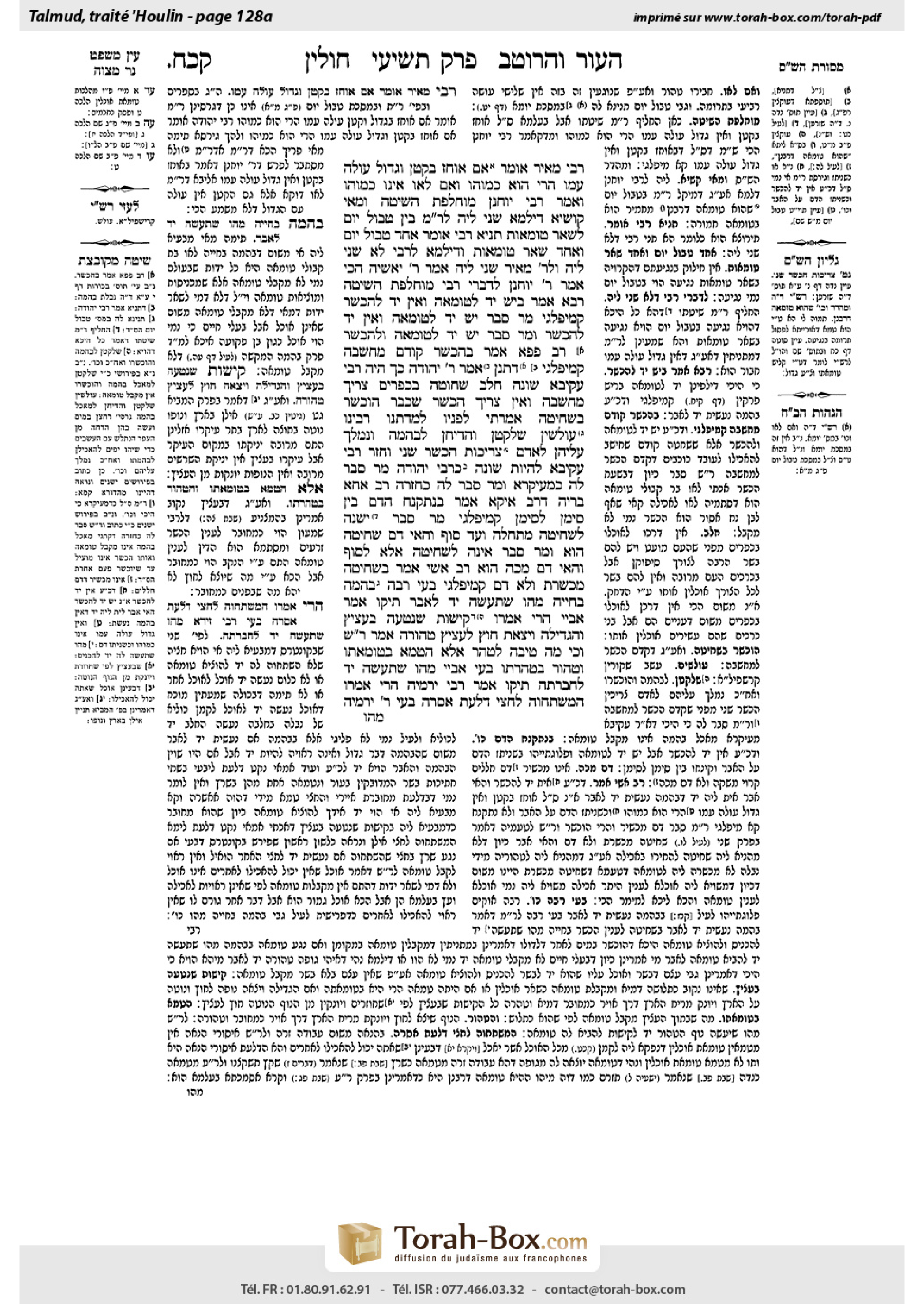
Chullin 128a: Talmud study for Daf Yomi
Study the Talmud for Daf Yomi with scanned pages, Hebrew text, English translations from Sefaria and AI-generated French translations.
Passage selection and English or AI-generated French translation are available where the scan has annotations. Daf Study is independent of Torah-Box and Sefaria.
Browse Chullin · חולין · All tractatesChullin 128a text and translations
This page of Chullin includes the Aramaic text, an English translation and an AI-generated French translation, alongside the scan above.
חולין קכ״ח א · Aramaic and Hebrew text
רַבִּי מֵאִיר אוֹמֵר: אִם אוֹחֵז בַּקָּטָן וְגָדוֹל עוֹלֶה עִמּוֹ – הֲרֵי הוּא כָּמוֹהוּ, וְאִם לָאו – אֵינוֹ כָּמוֹהוּ.
וְאָמַר רַבִּי יוֹחָנָן: מוּחְלֶפֶת הַשִּׁיטָה.
וּמַאי קוּשְׁיָא? דִּילְמָא שָׁנֵי לֵיהּ לְרַבִּי מֵאִיר בֵּין טְבוּל יוֹם לִשְׁאָר טוּמְאוֹת.
תַּנְיָא, רַבִּי אוֹמֵר: אֶחָד טְבוּל יוֹם וְאֶחָד שְׁאָר טוּמְאוֹת.
וְדִילְמָא, לְרַבִּי לָא שָׁנֵי לֵיהּ, וּלְרַבִּי מֵאִיר שָׁנֵי לֵיהּ?
אָמַר רַבִּי יֹאשִׁיָּה, הָכִי אָמַר רַבִּי יוֹחָנָן: לְדִבְרֵי רַבִּי מוּחְלֶפֶת הַשִּׁיטָה.
רָבָא אָמַר: בְּיֵשׁ יָד לְטוּמְאָה, וְאֵין יָד לְהֶכְשֵׁר, קָמִיפַּלְגִי.
מָר סָבַר יֵשׁ יָד לְטוּמְאָה וְאֵין יָד לְהֶכְשֵׁר, וּמָר סָבַר יֵשׁ יָד לְטוּמְאָה וּלְהֶכְשֵׁר.
רַב פָּפָּא אָמַר: בְּהֶכְשֵׁר קוֹדֶם מַחְשָׁבָה קָמִיפַּלְגִי.
דִּתְנַן, אָמַר רַבִּי יְהוּדָה: כָּךְ הָיָה רַבִּי עֲקִיבָא שׁוֹנֶה – חֵלֶב שְׁחוּטָה בַּכְּפָרִים צָרִיךְ מַחְשָׁבָה, וְאֵין צָרִיךְ הֶכְשֵׁר, שֶׁכְּבָר הוּכְשַׁר בַּשְּׁחִיטָה.
אָמַרְתִּי לְפָנָיו: לִמַּדְתָּנוּ רַבֵּינוּ, עוּלְשִׁין שֶׁלִּקְּטָן וְהִדִּיחָן לַבְּהֵמָה, וְנִמְלַךְ עֲלֵיהֶן לָאָדָם – צְרִיכוֹת הֶכְשֵׁר שֵׁנִי. וְחָזַר רַבִּי עֲקִיבָא לִהְיוֹת שׁוֹנֶה כְּרַבִּי יְהוּדָה.
מָר סָבַר לַהּ כְּמֵעִיקָּרָא, וּמָר סָבַר לַהּ כַּחֲזָרָה.
רַב אַחָא בְּרֵיהּ דְּרַב אִיקָא אָמַר: בְּנִתְקַנֵּחַ הַדָּם בֵּין סִימָן לְסִימָן קָמִיפַּלְגִי.
מָר סָבַר יֶשְׁנָהּ לִשְׁחִיטָה מִתְּחִלָּה וְעַד סוֹף, וְהַאי דַּם שְׁחִיטָה הוּא, וּמָר סָבַר אֵינָהּ לִשְׁחִיטָה אֶלָּא לְסוֹף, וְהַאי דַּם מַכָּה הוּא.
רַב אָשֵׁי אָמַר: בִּשְׁחִיטָה מַכְשֶׁרֶת וְלֹא דָּם קָמִיפַּלְגִי.
בָּעֵי רַבָּה: בְּהֵמָה בְּחַיֶּיהָ, מַהוּ שֶׁתֵּעָשֶׂה יָד לְאֵבֶר? תֵּיקוּ.
אָמַר אַבָּיֵי: הֲרֵי אָמְרוּ, קִישּׁוּת שֶׁנְּטָעָהּ בְּעָצִיץ וְהִגְדִּילָה וְיָצָאת חוּץ לֶעָצִיץ – טְהוֹרָה.
אָמַר רַבִּי שִׁמְעוֹן: וְכִי מָה טִיבָהּ לְטַהֵר? אֶלָּא הַטָּמֵא בְּטוּמְאָתוֹ, וְטָהוֹר בְּטׇהֳרָתוֹ.
בָּעֵי אַבָּיֵי: מַהוּ שֶׁתֵּעָשֶׂה יָד לַחֲבֶרְתָּהּ? תֵּיקוּ.
אָמַר רַבִּי יִרְמְיָה: הֲרֵי אָמְרוּ הַמִּשְׁתַּחֲוֶה לַחֲצִי דַלַּעַת אֲסָרָהּ, בָּעֵי רַבִּי יִרְמְיָה:
Chullin 128a · English translation
Rabbi Meir says: If when one grasps the small piece, the large piece ascends with it, it is considered one and the same; but if it does not ascend with it, it is not considered one and the same. This statement of Rabbi Meir is not in accordance with his statement in the mishna that a partially severed limb is part of the body of the animal and is rendered susceptible to impurity along with the body even if one lifts the partially severed limb and the body of the animal does not ascend with it.
And Rabbi Yoḥanan resolves the contradiction and says: The attribution of the opinions in tractate Tevul Yom is reversed. Indeed, Rabbi Meir holds that even if when one lifts the smaller piece, the larger piece does not ascend with it, it is still the same item. Therefore, it is apparent that Rabbi Yoḥanan explains the dispute between Rabbi Meir and Rabbi Shimon in the mishna in accordance with the explanation of Abaye.
With regard to the contradiction between the two statements of Rabbi Meir, the Gemara asks: What is the difficulty? Perhaps Rabbi Meir distinguishes between the impurity of one who immersed that day and other types of impurity. The impurity of one who immersed that day is a more lenient type of impurity, because he has already immersed and need only wait until the end of the day in order to consume sacrificial offerings. Therefore, there is reason to be more lenient when he touches a partially severed piece of food and to rule that the entire food item does not become impure.
The Gemara answers: One cannot make such a distinction between different types of impurity because it is taught in a baraita that Rabbi Yehuda HaNasi says: With regard to both the impurity of one who immersed that day and other types of impurity, the halakhot of contact are the same; whatever is considered contact that transmits impurity with regard to one type of impurity transmits impurity for all types of impurity.
The Gemara asks: But perhaps Rabbi Yehuda HaNasi does not distinguish between the impurity of one who immersed that day and other types of impurity and Rabbi Meir does distinguish in such a manner. Therefore, there is no contradiction between the statements of Rabbi Meir.
Rabbi Yoshiya said: This is what Rabbi Yoḥanan meant to say: According to the statement of Rabbi Yehuda HaNasi, who does not distinguish between the impurity of one who immersed that day and other types of impurity, there is a contradiction between the two statements of Rabbi Meir, and the attribution of the opinions in the mishna in tractate Tevul Yom is reversed.
Rava said a different explanation of the dispute between Rabbi Meir and Rabbi Shimon: The mishna is discussing a case where the blood from the slaughter came into contact with the body of the animal but not with the partially severed limb, and both tanna’im agree that an animal constitutes a handle for its limb. They disagree with regard to the principle that there is a status of a handle, i.e., a handle is considered part of the item itself, with regard to transmitting impurity to the attached food, but there is no status of a handle with regard to rendering the attached food susceptible to impurity, as in that regard the handle is considered a separate item.
One Sage, Rabbi Shimon, holds that there is a status of a handle with regard to transmitting impurity, but there is no status of a handle with regard to rendering the attached food susceptible to impurity. Therefore, although the body of the animal constitutes a handle vis-à-vis the limb, it does not render the limb susceptible to impurity. And one Sage, Rabbi Meir, holds that there is a status of a handle both with regard to transmitting impurity and with regard to rendering the attached food susceptible to impurity. Therefore, the body of the animal renders the limb susceptible to impurity.
Rav Pappa said a different explanation of the dispute: Both tanna’im hold that a handle renders the attached food susceptible to impurity. Yet, the mishna is discussing a case where the slaughter took place before the owner of the animal designated its meat for the consumption of a gentile. Rabbi Meir and Rabbi Shimon disagree with regard to whether an item can be rendered susceptible to impurity before intention, i.e., before one intends to use it as food. Rabbi Shimon holds that since the animal came in contact with the blood of the slaughter before the owner intended to use it as food, it is not rendered susceptible to impurity. Rabbi Meir holds that the susceptibility to impurity takes effect such that when the owner considers it as food it will be susceptible to impurity.
This dispute is also found in that which we learned in a baraita (Tosefta, Okatzin 3:2): Rabbi Yehuda says that Rabbi Akiva would teach this halakha: Fat forbidden in consumption for a Jew from an animal slaughtered in the villages requires intention, i.e., designation, for consumption, for it to become susceptible to impurity. This is because the population in such places is small and there is an abundance of meat, so people do not generally consume the fat. Consequently, unless the Jewish owner intends for a gentile to consume it, it is not considered food. But the fat does not require contact with a liquid in order to be rendered susceptible to impurity, as it was already rendered susceptible by the blood of slaughter even though it came into contact with the blood before the Jew designated it for consumption.
Rabbi Yehuda continues: I said before him: You taught us, our teacher, that in a case of endives that one picked and rinsed in water for the consumption of an animal, and one later reconsidered and decided to designate them for human consumption, the endives need to come into contact with liquid a second time in order to be rendered susceptible to impurity, as food designated for animal consumption does not contract impurity. Evidently, for a food item to become susceptible to impurity, its contact with liquid must occur after one designated it as food. And Rabbi Akiva then retracted his previous statement and taught the halakha in accordance with the statement of Rabbi Yehuda.
Rav Pappa concludes: Rabbi Meir and Rabbi Shimon disagree in the same manner. One Sage, Rabbi Meir, holds in accordance with that which Rabbi Akiva taught originally, and one Sage, Rabbi Shimon, holds in accordance with that which Rabbi Akiva taught after his retraction of his original statement.
Rav Aḥa, son of Rav Ika, said another explanation of the dispute: The mishna is discussing a case where the blood of slaughter came into contact with a partially severed limb, and the blood of slaughter is one of the liquids that render food susceptible to impurity. But slaughter is valid only if one cuts the two simanim, the windpipe and the gullet, or the majority of the two simanim, and the tanna’im disagree with regard to a case where the blood in question was wiped off between the cutting of the first siman and the second siman.
One Sage, Rabbi Meir, holds that slaughter is defined from the beginning to the end of its performance, and this blood that splashed on the limb is considered blood of slaughter. And one Sage, Rabbi Shimon, holds that slaughter is defined only as the conclusion of its performance, and this blood from the first siman is considered the blood of a wound and does not render the limb susceptible to impurity.
Rav Ashi said another explanation of the dispute: The case is where the blood of slaughter came in contact with the partially severed limb, but Rabbi Meir and Rabbi Shimon disagree with regard to the principle that the slaughter itself renders the limb susceptible to impurity, and not the blood of slaughter. Rabbi Shimon holds that the blood of slaughter is not one of the liquids that render food susceptible to impurity. But the slaughter itself renders the meat of the animal susceptible to impurity, because it prepares the meat for consumption. Therefore, since a partially severed limb is not prepared for consumption by the slaughter, as it remains forbidden, the slaughter does not render it susceptible to impurity. Rabbi Meir maintains that the blood of slaughter is one of the liquids that render food susceptible to impurity, and therefore, the limb is rendered susceptible.
§Earlier (127b), Rabba explained that Rabbi Meir and Rabbi Shimon disagree with regard to whether the body of an animal constitutes a handle for its limb. With regard to the opinion of Rabbi Meir, who holds that it does constitute a handle, Rabba raises a dilemma: What is the halakha if an animal with a partially severed limb came into contact with a source of impurity during its lifetime? In such a case, where the animal is not susceptible to contract impurity because it is alive but the partially severed limb is susceptible to contract impurity as food, does the animal constitute a handle for its limb and transmit the impurity to the limb? The Gemara concludes: The dilemma shall stand unresolved.
The Gemara introduces a similar dilemma. Abaye says: The Sages said in the mishna (Okatzin 2:9): In the case of an impure cucumber that one planted in an unperforated flowerpot, such that the cucumber is considered detached from the ground and susceptible to impurity as food, and the cucumber grew and went out beyond the edge of the flowerpot such that part of the cucumber is overlying the ground, the entire cucumber is considered attached to the ground and therefore becomes pure.
Rabbi Shimon says: What is the nature of the impurity of the cucumber that it is rendered pure in such a case? Rather, the part of the cucumber that is inside the flowerpot and impure remains in its state of impurity, and the part of the cucumber that is outside the flowerpot and pure remains in its state of purity.
Based on this mishna, Abaye raises a dilemma according to the opinion of Rabbi Shimon: What is the halakha if the part of the cucumber outside of the flowerpot comes into contact with a source of impurity? Does the part of the cucumber outside the flowerpot constitute a handle for its counterpart inside the flowerpot and transmit impurity to it to it? The Gemara concludes: The dilemma shall stand unresolved.
The Gemara relates another dilemma based on the opinion of Rabbi Shimon. Rabbi Yirmeya says: The Sages said that one who bows down to a half of a gourd, worshipping it as a divinity, renders that half of the gourd forbidden, i.e., it is prohibited to derive benefit from it, because it was worshipped as an idol. The other half, though, is not forbidden. Based on this ruling, Rabbi Yirmeya raises a dilemma:
Chullin 128a · Traduction française (IA)
Rabbi Meir dit : Si, lorsqu'on saisit la petite pièce, la grande pièce monte avec elle, on considère qu'il s'agit d'un seul et même objet ; mais si elle ne monte pas avec elle, on ne considère pas qu'il s'agit d'un seul et même objet. Cette déclaration de Rabbi Meir n'est pas en accord avec sa déclaration dans la mitsna que la partie séparée d'un membre est partie du corps de l'animal et est rendue susceptible d'impureté avec le corps même si l'on soulève la partie séparée du membre et que le corps de l'animal ne monte pas avec elle.
Et Rabbi Yoḥanan résout la contradiction et dit : L'attribution des opinions dans le traité Tevul Yom est inversée. En effet, Rabbi Meir considère que même si, lorsqu'on soulève la petite pièce, la grande pièce ne monte pas avec elle, il s'agit toujours du même objet. Ainsi, il est évident que Rabbi Yoḥanan explique le désaccord entre Rabbi Meir et Rabbi Shimon dans la mitsna selon l'explication d'Abaye.
Concernant la contradiction entre les deux déclarations de Rabbi Meir, le Guemara demande : Quel est le problème ? Peut-être que Rabbi Meir distingue entre l'impureté d'une personne qui s'est immergée ce jour-là et d'autres types d'impureté. L'impureté d'une personne qui s'est immergée ce jour-là est un type plus clément d'impureté, car il a déjà été immergé et doit seulement attendre la fin de la journée pour consommer les offrandes sacrées. Ainsi, il y a une raison d'être plus clément lorsqu'il touche une partie séparée d'un aliment et de décider que l'ensemble de l'aliment ne devient pas impur.
Le Guemara répond : On ne peut pas faire cette distinction entre différents types d'impureté, car cela est enseigné dans une baraïta que Rabbi Yehuda HaNasi dit : Concernant à la fois l'impureté d'une personne qui s'est immergée ce jour-là et d'autres types d'impureté, les halakhot de contact sont les mêmes ; tout ce qui est considéré comme contact transmettant l'impureté concernant un type d'impureté transmet l'impureté pour tous les types d'impureté.
Le Guemara demande : Mais peut-être que Rabbi Yehuda HaNasi ne distingue pas entre l'impureté d'une personne qui s'est immergée ce jour-là et d'autres types d'impureté et que Rabbi Meir distingue ainsi. Ainsi, il n'y a pas de contradiction entre les déclarations de Rabbi Meir.
Rabbi Yoshiya dit : C'est ce que Rabbi Yoḥanan voulait dire : Selon la déclaration de Rabbi Yehuda HaNasi, qui ne distingue pas entre l'impureté d'une personne qui s'est immergée ce jour-là et d'autres types d'impureté, il y a une contradiction entre les deux déclarations de Rabbi Meir, et l'attribution des opinions dans la mitsva du traité Tevul Yom est inversée.
Rava a donné une autre explication du désaccord entre Rabbi Meir et Rabbi Shimon : La mitsna discute d'un cas où le sang de la bête est entré en contact avec le corps de l'animal mais pas avec la partie séparée du membre, et les deux tannaïm s'accordent sur le fait qu'un animal constitue un manche pour son membre. Ils divergent concernant le principe d'un manche, c'est-à-dire qu'un manche est considéré comme faisant partie de l'objet lui-même, en ce qui concerne la transmission de l'impureté à l'aliment attaché, mais il n'y a pas de statut de manche concernant la rendue de l'aliment attaché susceptible d'impureté, comme dans ce cas le manche est considéré comme un objet séparé.
Un sage, Rabbi Shimon, considère qu'il y a un statut de manche concernant la transmission de l'impureté, mais pas concernant la rendue de l'aliment attaché susceptible d'impureté. Ainsi, bien que le corps de l'animal constitue un manche vis-à-vis du membre, il ne rend pas le membre susceptible d'impureté. Un autre sage, Rabbi Meir, considère qu'il y a un statut de manche à la fois concernant la transmission de l'impureté et concernant la rendue de l'aliment attaché susceptible d'impureté. Ainsi, le corps de l'animal rend le membre susceptible d'impureté.
Rav Pappa a donné une autre explication du désaccord : Les deux tannaïm considèrent que le manche rend l'aliment attaché susceptible d'impureté. Cependant, la mitsna discute d'un cas où la bête a été sacrifiée avant que l'propriétaire de la bête ne désigne sa viande pour la consommation d'un non-Jeu. Rabbi Meir et Rabbi Shimon divergent concernant la question de savoir si un objet peut être rendu susceptible d'impureté avant l'intention, c'est-à-dire avant qu'on ne l'ait décidé comme aliment. Rabbi Shimon considère que, puisque la bête a été en contact avec le sang du sacrifice avant que l'propriétaire ne l'ait décidé comme aliment, elle n'est pas rendue susceptible d'impureté. Rabbi Meir considère que la susceptibilité à l'impureté prend effet de sorte que lorsque l'propriétaire considère l'objet comme aliment, il devient susceptible d'impureté.
Ce désaccord est également trouvé dans ce que nous avons appris dans une baraïta (Tosefta, Okatzin 3:2) : Rabbi Yehuda dit que Rabbi Akiva enseignait cette halakha : La graisse interdite à la consommation d'un Juif d'un animal sacrifié dans les villages exige l'intention, c'est-à-dire la désignation, pour la consommation, afin de devenir susceptible d'impureté. Cela est dû au fait que la population dans ces lieux est petite et qu'il y a une abondance de viande, donc les gens ne consomment généralement pas la graisse. Ainsi, sauf si l'propriétaire juif désigne la graisse pour la consommation d'un non-Jeu, elle n'est pas considérée comme aliment. Cependant, la graisse ne nécessite pas le contact avec un liquide pour devenir susceptible d'impureté, car elle a déjà été rendue susceptible par le sang du sacrifice même si elle a été en contact avec le sang avant que le Juif ne la désigne pour la consommation.
Rabbi Yehuda continue : J'ai dit devant lui : Vous avez enseigné, notre maître, que dans le cas d'endives que l'on a récoltées et rincées dans l'eau pour la consommation d'un animal, et que l'on a ensuite changé d'avis et décidé de les désigner pour la consommation humaine, les endives doivent entrer en contact avec un liquide une deuxième fois afin de devenir susceptibles d'impureté, car les aliments désignés pour la consommation animale ne contractent pas l'impureté. Évidemment, pour qu'un aliment devienne susceptible d'impureté, son contact avec un liquide doit avoir lieu après que l'on ait désigné cet aliment comme aliment. Et Rabbi Akiva a ensuite rétracté sa déclaration précédente et a enseigné la halakha selon la déclaration de Rabbi Yehuda.
Rav Pappa conclut : Rabbi Meïr et Rabbi Shimon divergent de la même manière. Un Sage, Rabbi Meïr, suit ce que Rabbi Akiva avait enseigné initialement, et un autre Sage, Rabbi Shimon, suit ce que Rabbi Akiva avait enseigné après son retrait de son enseignement initial.
Rav Acha, fils de Rav Ika, dit une autre explication de ce désaccord : La mitsva discute d'un cas où le sang de sacrifice a été en contact avec un membre partiellement sectionné, et le sang de sacrifice est l'un des liquides qui rendent les aliments sujets à la souillure. Mais le sacrifice est valide uniquement si l'on coupe les deux simanim, le larynx et l'œsophage, ou la majorité des deux simanim, et les tannaïm divergent concernant un cas où le sang en question a été essuyé entre la coupe du premier siman et celle du second siman.
Un Sage, Rabbi Meïr, considère que le sacrifice est défini du début à la fin de son accomplissement, et ce sang qui a saigné sur le membre est considéré comme le sang de sacrifice. Un autre Sage, Rabbi Shimon, considère que le sacrifice est défini uniquement à la fin de son accomplissement, et ce sang provenant du premier siman est considéré comme le sang d'une plaie et ne rend pas le membre sujet à la souillure.
Rav Ashi dit une autre explication du désaccord : Le cas est celui où le sang de sacrifice a été en contact avec le membre partiellement sectionné, mais Rabbi Meïr et Rabbi Shimon divergent concernant le principe que c'est le sacrifice lui-même qui rend le membre sujet à la souillure, et non le sang de sacrifice. Rabbi Shimon considère que le sang de sacrifice n'est pas l'un des liquides qui rendent les aliments sujets à la souillure. Cependant, le sacrifice lui-même rend la viande de l'animal sujet à la souillure, car il prépare la viande à la consommation. Ainsi, puisque le membre partiellement sectionné n'est pas préparé à la consommation par le sacrifice, car il reste interdit, le sacrifice ne rend pas le membre sujet à la souillure. Rabbi Meïr maintient que le sang de sacrifice est l'un des liquides qui rendent les aliments sujets à la souillure, et par conséquent, le membre est rendu sujet à la souillure.
§ Plus tôt (127b), Rabba explique que Rabbi Meïr et Rabbi Shimon divergent concernant la question de savoir si le corps d'un animal constitue un manche pour son membre. Concernant l'opinion de Rabbi Meïr, qui considère que oui, Rabba soulève un dilemme : Quelle est la halakha si un animal avec un membre partiellement sectionné a été en contact avec une source de souillure pendant sa vie ? Dans ce cas, où l'animal n'est pas sujet à contracter la souillure car il est vivant, mais le membre partiellement sectionné est sujet à la souillure comme aliment, le corps de l'animal constitue-t-il un manche pour son membre et transmet-il la souillure à ce membre ? La Guemara conclut : Ce dilemme restera sans solution.
La Guemara introduit un dilemme similaire. Abaye dit : Les Sages ont dit dans la mitsva (Okatzin 2:9) : Dans le cas d'un concombre impur que l'on a planté dans un pot de fleur non percé, de sorte que le concombre est considéré comme détaché du sol et sujet à la souillure comme aliment, et le concombre a grandi et est sorti au-delà de l'orifice du pot de fleur de sorte que partie du concombre est sur le sol, l'ensemble du concombre est considéré comme attaché au sol et donc devenu pur.
Rabbi Shimon dit : Quelle est la nature de la souillure du concombre qui le rend pur dans ce cas ? Plutôt, la partie du concombre qui est à l'intérieur du pot de fleur et impure reste dans son état de souillure, et la partie du concombre qui est à l'extérieur du pot de fleur et pure reste dans son état de pureté.
En se basant sur cette mitsva, Abaye soulève un dilemme selon l'opinion de Rabbi Shimon : Quelle est la halakha si la partie du concombre à l'extérieur du pot de fleur entre en contact avec une source de souillure ? La partie du concombre à l'extérieur du pot de fleur constitue-t-elle un manche pour sa contrepartie à l'intérieur du pot de fleur et transmet-elle la souillure à celle-ci ? La Guemara conclut : Ce dilemme restera sans solution.
La Guemara rapporte un autre dilemme basé sur l'opinion de Rabbi Shimon. Rabbi Yirmeya dit : Les Sages ont dit que celui qui s'agenouille devant la moitié d'un citron, en la vénérant comme un dieu, rend cette moitié du citron interdite, c'est-à-dire qu'il est interdit d'en tirer un bénéfice, car elle a été vénérée comme un idole. L'autre moitié, en revanche, n'est pas interdite. En se basant sur cette décision, Rabbi Yirmeya soulève un dilemme :
Traduction française générée par IA à partir de l’édition anglaise de Sefaria. Vérifie toujours un passage avec le texte source.
Text from Sefaria: William Davidson Edition - Vocalized Aramaic (unknown); William Davidson Edition - English (CC BY NC).